How to Write a Grant That Actually Gets Funded
Sep 30, 2026 · 14 min read
In 2023, 91% of surveyed nonprofits submitted at least one grant application, yet the results depended heavily on how many well-matched opportunities they pursued. Among respondents in the same report, 62% of organizations that submitted one application received an award, compared with 96% of those submitting six to ten applications (GrantBoost grant statistics). The lesson isn't that volume can rescue a weak proposal. It's that learning how to write a grant starts before the first sentence, with a pipeline designed to find suitable funders, qualify opportunities, and support consistent execution.
Strong prose still matters. It clarifies the problem, makes the program credible, and helps a reviewer trace activities to outcomes. But polished writing can't compensate for poor fit, unrealistic deadlines, missing attachments, or a budget that contradicts the narrative. The most competitive organizations treat each application as one part of a managed process, from prospect research and fit scoring to compliance review, submission, and learning after a decision.
Table of Contents
- Why Most Grant Proposals Lose Before They Are Read
- Building a Shortlist That Matches Your Organization
- Writing the Letter of Inquiry That Earns a Full Read
- Drafting the Narrative That Reviewers Can Follow
- Building a Budget That Mirrors Your Story
- Attachments, Formatting, and the First-Read Checklist
- Turning Grant Writing Into a Repeatable Pipeline
Why Most Grant Proposals Lose Before They Are Read
35% of foundations funded at least half of the requests they received, while another 35% funded less than 10%, according to a GrantBoost summary of foundation giving data (Candid foundation grantmaker statistics). The same dataset found that foundations receiving fewer than 50 proposals were more likely to fund at least half of them than foundations receiving more than 1,000 proposals. In that higher-volume group, only 11% funded at least half. The figures point to a selection problem before they point to a writing problem.
A thoughtful, evidence-based proposal can still fail when the applicant chooses a funder with little connection to its work. Fit, competition, funder capacity, and applicant volume shape the odds before a reviewer studies the narrative. An organization that applies to every open opportunity may spend scarce staff time adapting generic language for funders that do not support its geography, population, program type, or organizational scale.
A disciplined team may submit fewer applications during a given period. Each one enters the pipeline after a deliberate fit review, with a clear reason to pursue it and enough time to complete the requirements accurately.
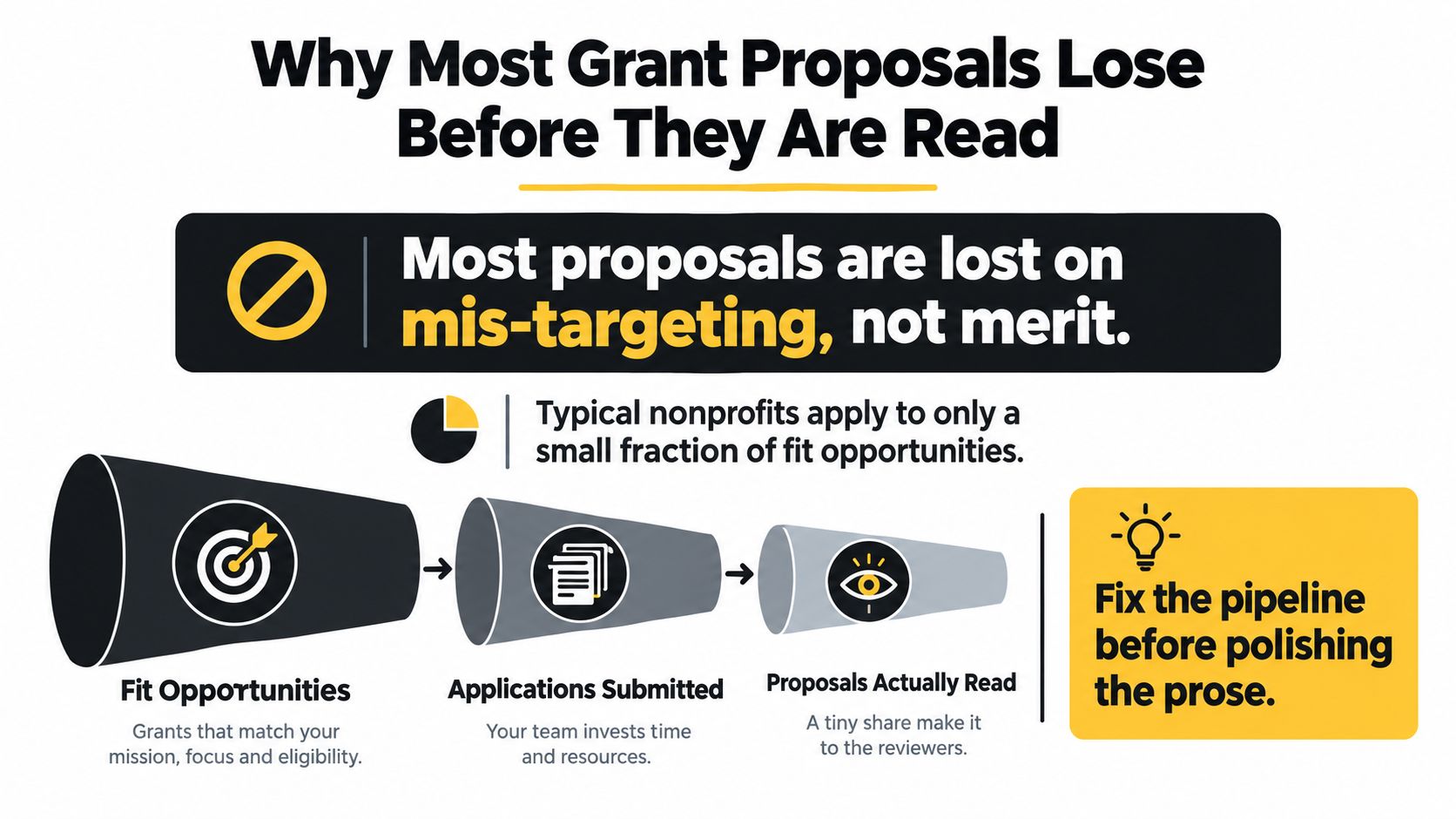
The pipeline starts before the narrative
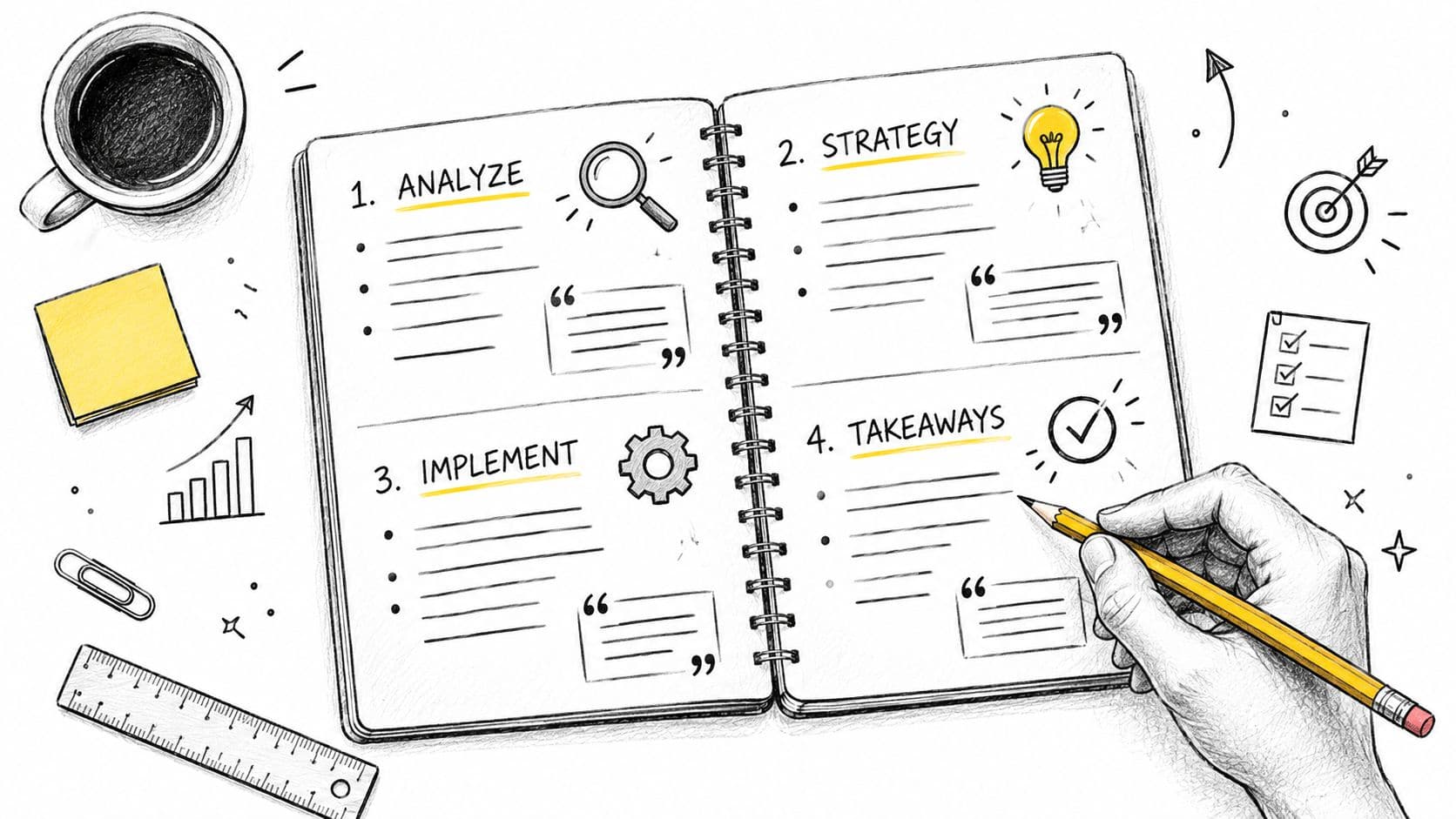
Grant work has connected stages:
- Prospect research: Find funders whose priorities, giving history, geography, and applicant requirements match the organization.
- Fit scoring: Compare opportunities against consistent criteria rather than selecting them for an attractive title or large award.
- LOI qualification: Use the letter of inquiry to test whether the funder sees a credible match before committing to a full proposal.
- Narrative threading: Connect need, objectives, activities, outputs, outcomes, timeline, and evaluation in a sequence a reviewer can follow.
- Compliance hygiene: Confirm eligibility, attachments, formatting, signatures, word limits, budget calculations, and portal fields.
- Post-decision learning: Record why applications advanced or were declined, then apply that information to the next shortlist.
Reviewers assess more than persuasive language. They look for an applicant that understands the funder's purpose, has designed a feasible response, and can manage the obligations that follow an award. Operational discipline protects the proposal from avoidable rejection.
Practical rule: Fix the pipeline before polishing the prose. A well-written application aimed at a poor-fit funder remains a poor application.
Building a Shortlist That Matches Your Organization
Don't open a blank proposal document until you've defined what a good opportunity looks like for your organization. Start with an internal profile that covers mission, population served, geography, program model, organizational capacity, prior results, budget scale, and eligibility status. This profile becomes the reference point for every prospect, so the development team doesn't make a fresh judgment from scratch each time.
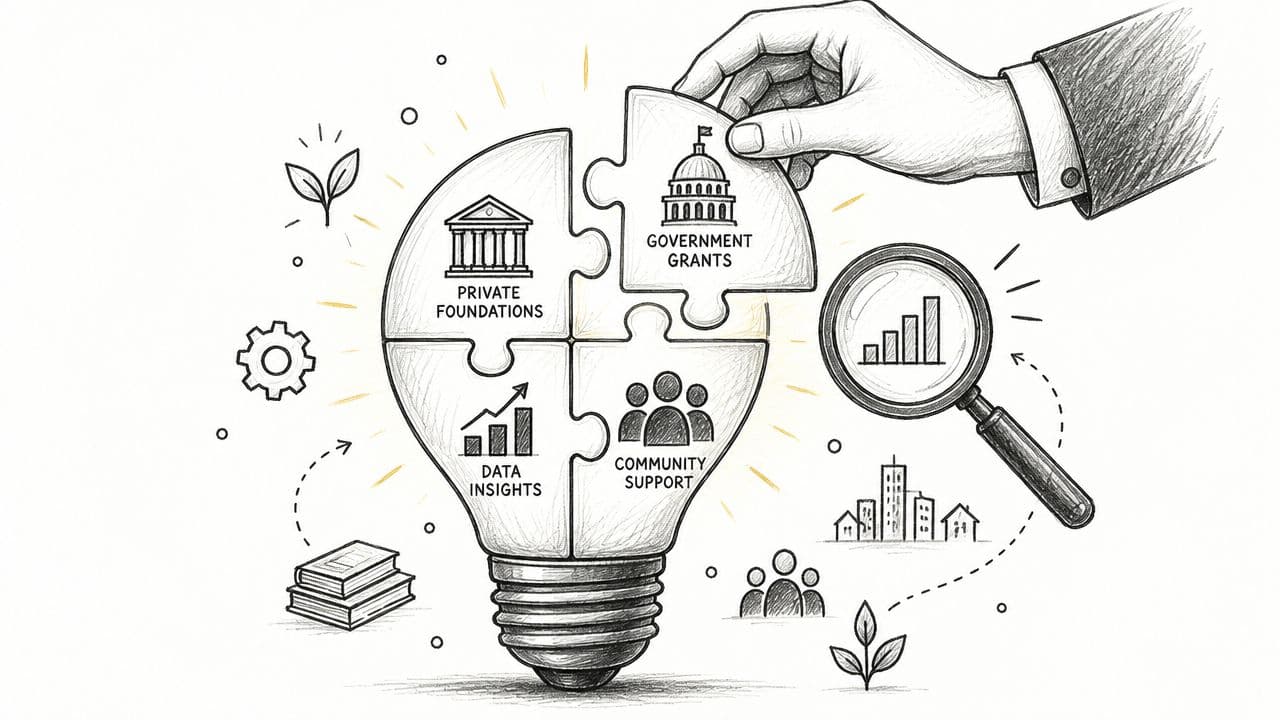
Prospecting can combine subscription databases such as Instrumentl and Foundation Directory with Candid, federal listings, and state grant portals. State resources can be especially useful when an organization serves a defined local population or works in a field supported by a state agency. The source matters less than the discipline of recording the opportunity, its requirements, the funder's giving history, and the reason it fits.
Score before you draft
A simple weighted sheet prevents enthusiasm from overpowering judgment. Give each criterion a weight, rate the opportunity on a consistent scale, and set a minimum threshold before it enters the active writing queue. A low score on eligibility should usually disqualify a prospect, even if the mission alignment looks excellent.
| Criterion | Weight | Score (1-5) | Weighted Score |
|---|---|---|---|
| Mission and program fit | High | 1 to 5 | Weight multiplied by score |
| Eligibility and applicant type | High | 1 to 5 | Weight multiplied by score |
| Geography and population match | High | 1 to 5 | Weight multiplied by score |
| Funding range and budget fit | Medium | 1 to 5 | Weight multiplied by score |
| Deadline realism | Medium | 1 to 5 | Weight multiplied by score |
| Existing relationship | Medium | 1 to 5 | Weight multiplied by score |
| Evidence of support for similar work | High | 1 to 5 | Weight multiplied by score |
The sheet should also include a disqualification field. Mark invitation-only programs, geographic exclusions, unsupported applicant types, and requests that demand resources the organization can't provide. A fit-scoring tool such as Grantlas can serve as one research option here, alongside manual review of funder websites, filings, and application guidelines.
A prospect record should survive the decision. If a funder declines, record the stated reason, any feedback, the stage at which the application stopped, and whether the problem was fit, timing, program design, budget, or compliance. Teams that review these patterns improve their shortlist; teams that merely archive the rejection repeat the same selection errors.
For file preparation, teams may also want to browse nonprofit PDF tools to organize, combine, or prepare application documents without treating document management as an afterthought.
Stop writing proposals for funders you wouldn't choose as a partner. If the opportunity doesn't make sense for your mission, community, or operating model, the right action is to remove it from the pipeline.
Writing the Letter of Inquiry That Earns a Full Read
The letter of inquiry is not a miniature version of a full proposal. It's a fit test. The funder is deciding whether the organization, problem, approach, and request belong in a longer conversation. A strong LOI makes that decision easy by answering the funder's priorities directly and showing enough evidence of capacity to justify a full application.
A practical structure looks like this:
- Open with alignment. Tie the first sentence to a priority the funder has already published. Avoid a broad introduction about the organization.
- Define the problem. Name the affected population, location, service gap, and relevant local evidence. Use a specific source your organization can stand behind.
- Describe the response. Explain the activities, delivery model, partners, and intended outcomes without turning the LOI into an operational manual.
- Establish credibility. Include the organizational capability, relevant experience, and relationships that make delivery plausible.
- State the request. Identify what you want the funder to support and what change the funding will help produce.
The strongest LOIs make the community visible before they make the organization prominent. They don't rely on phrases such as “helping underserved communities” without explaining who is underserved, what barrier they face, and how the proposed intervention addresses it. They also avoid vague asks. A funder should understand whether the request supports a defined program, a specific expansion, planning, evaluation, or general operating work.
Run a sentence-level fit check
Before submission, underline every sentence and label the reason it exists. It should establish need, demonstrate fit, explain the approach, prove capacity, define the request, or clarify the intended result. If a sentence does none of those jobs, remove it.
Look for these failure points:
- Organization-first openings: A long history of the nonprofit appears before the community need.
- Boilerplate language: The same paragraph appears across applications despite different funder priorities.
- Unclear purpose: The letter describes activities without explaining the change they should produce.
- Unsupported confidence: The organization promises impact without evidence, measurement, or delivery capacity.
- Unfocused requests: The reader can't tell what support is being sought or why the funder is a logical partner.
Use the Grantlas guide to writing a letter of inquiry as a structural reference, then adapt the document to the specific funder's instructions. An LOI that doesn't earn an invitation has still done useful work if it exposes a weak fit before the team spends substantial time on a full narrative.
Treat the LOI as a hypothesis test, not a formality. Your hypothesis is that this funder cares about this problem, sees your organization as a credible implementer, and could reasonably support this approach. The response tells you whether the full proposal deserves a place in the production schedule.
Drafting the Narrative That Reviewers Can Follow
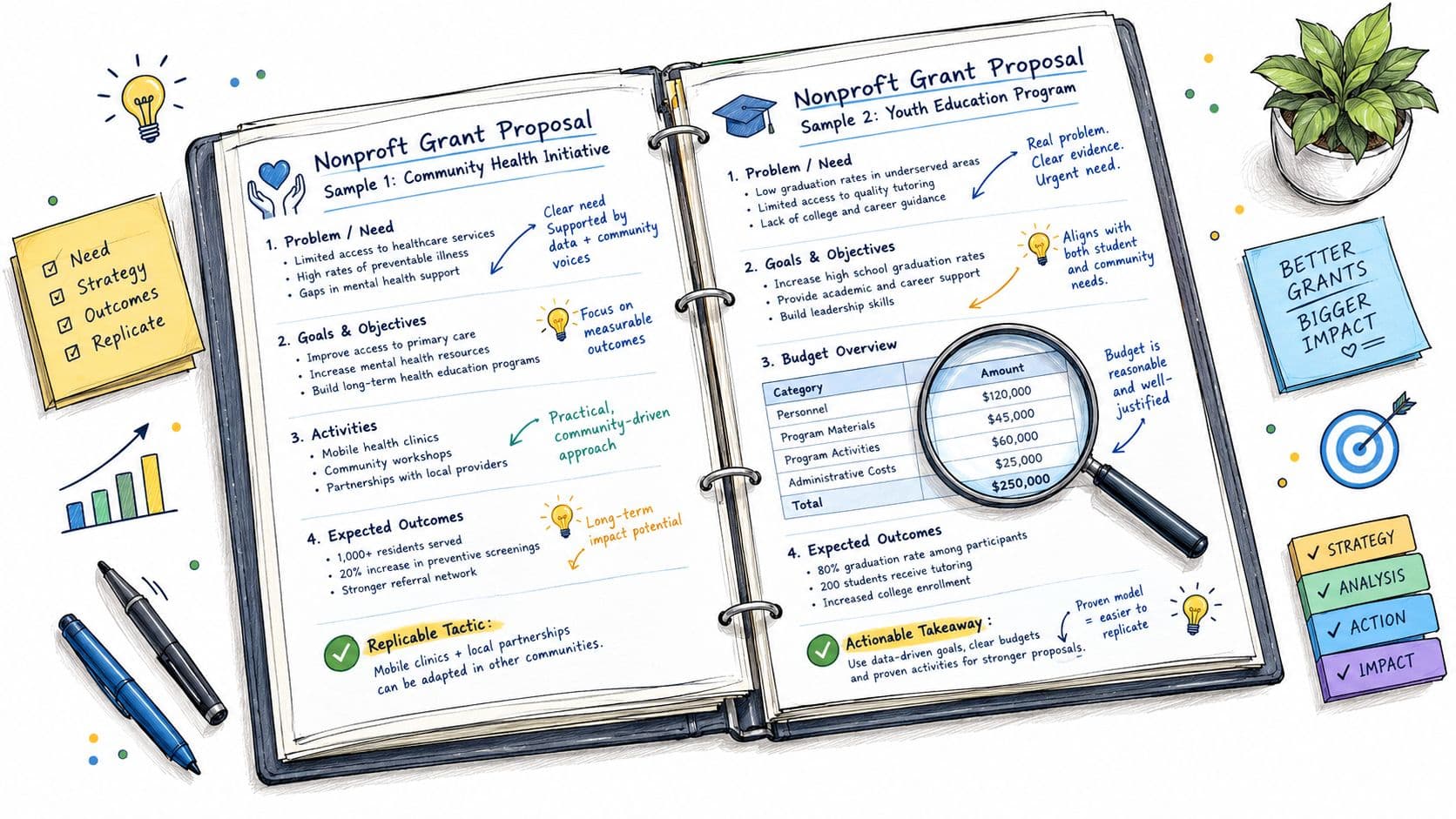
Reviewers don't need a proposal to sound literary. They need to understand what is wrong, what you will do, why it should work, what it will produce, and how you'll know. The narrative becomes easier to assess when it follows the same logic as the program itself.
Start with four working blocks:
- Problem statement: Define the population, geography, gap, and evidence of need.
- Theory of change and logic chain: Explain why the proposed activities should lead to the intended outcomes.
- Activities and outputs: Describe the work, deliverables, sequence, staff, partners, and participants.
- Evaluation: Identify what will be measured, when, by whom, and how the findings will shape delivery.
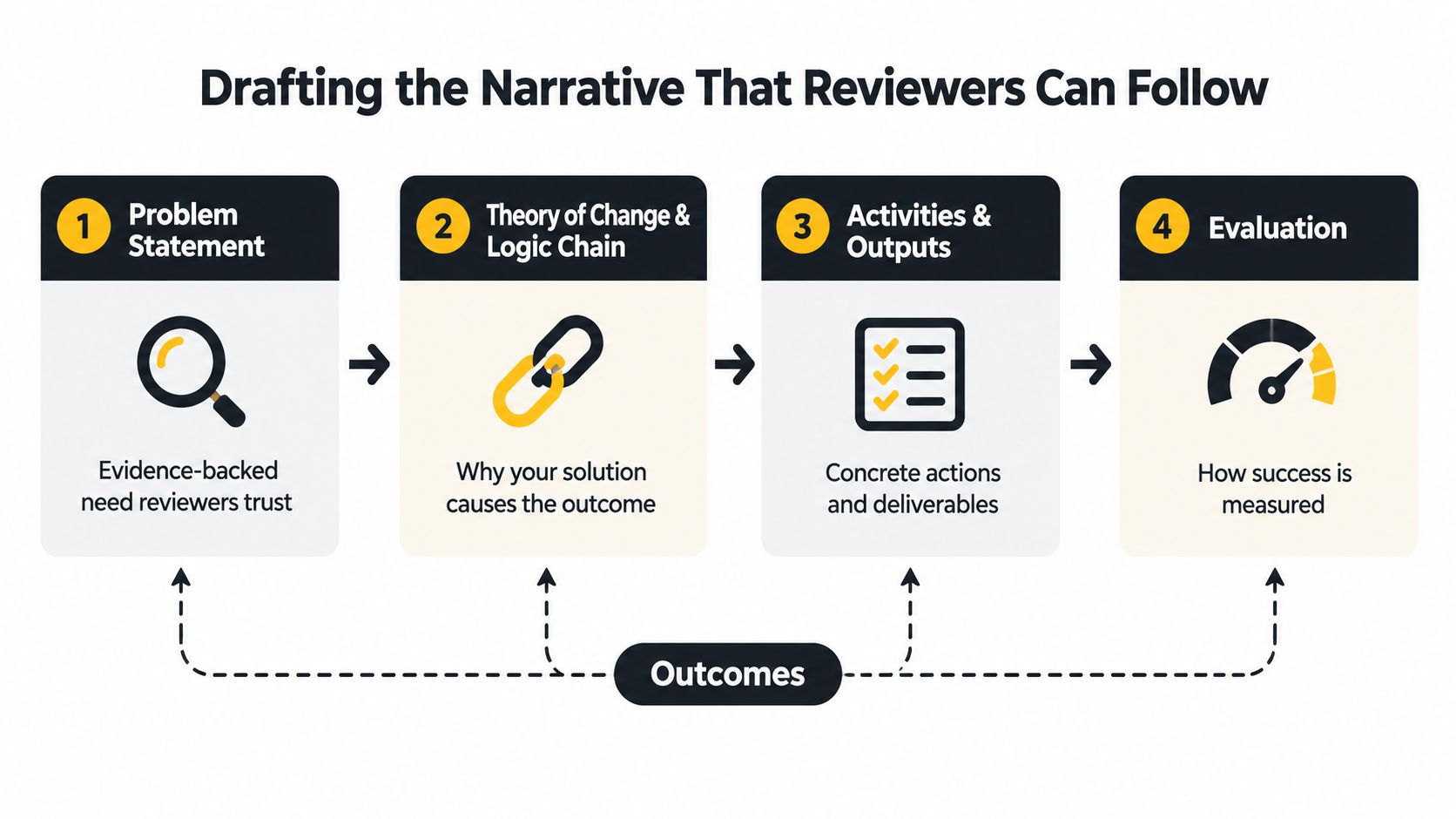
Make the logic visible
The opening should allow a skimming reviewer to place the proposal quickly. Name the community, location, unmet need, and evidence base early. Don't make the reader search through organizational history to discover the reason for the request.
Then draft the chain in plain language:
Need leads to intervention. The intervention produces outputs. Outputs contribute to outcomes. Outcomes advance the broader impact.
Each link needs a responsible verb. “Deliver workshops” is an activity. “Participants complete workshops” is an output. “Participants apply a new skill in a defined setting” describes an outcome. The proposal should explain how the first result contributes to the next, rather than placing a list of activities in an outcomes column and calling it a logic model.
The Grantlas examples of statements of need can help writers distinguish a general concern from a documented, fundable problem. Your own evidence should remain central, especially when it shows how the issue affects the specific population the project will serve.
A methodology guide from the University of Kansas emphasizes the importance of connecting the need, prior approaches, timeline, and budget. It also recommends a cohesive proposal in which the budget matches the narrative (University of Kansas grant-writing guidance). That connection is where many otherwise promising applications break down. The activities sound plausible, but the timeline doesn't allow them, the evaluation doesn't measure the stated outcomes, or the budget funds work the narrative never describes.
Write for the reviewer's working memory
Use descriptive subheads that tell the reviewer what the next passage answers. Keep paragraphs compact, vary sentence length, and put the most important point near the beginning of each section. Prepare an executive summary that can stand alone if separated from the rest of the application.
State the single primary ask early and use the same terminology throughout the proposal. If the opening calls the work “community-based mental health navigation,” don't later rename it “wellness outreach” unless the distinction matters. Consistent language reduces interpretation and makes it easier for multiple reviewers to compare the narrative, budget, and attachments.
The video below offers another visual explanation of proposal structure and reviewer readability.
Reviewers should never have to infer the connection between a task and a result. Write the connection explicitly, then check every objective, activity, output, and evaluation measure against the same logic chain.
Building a Budget That Mirrors Your Story
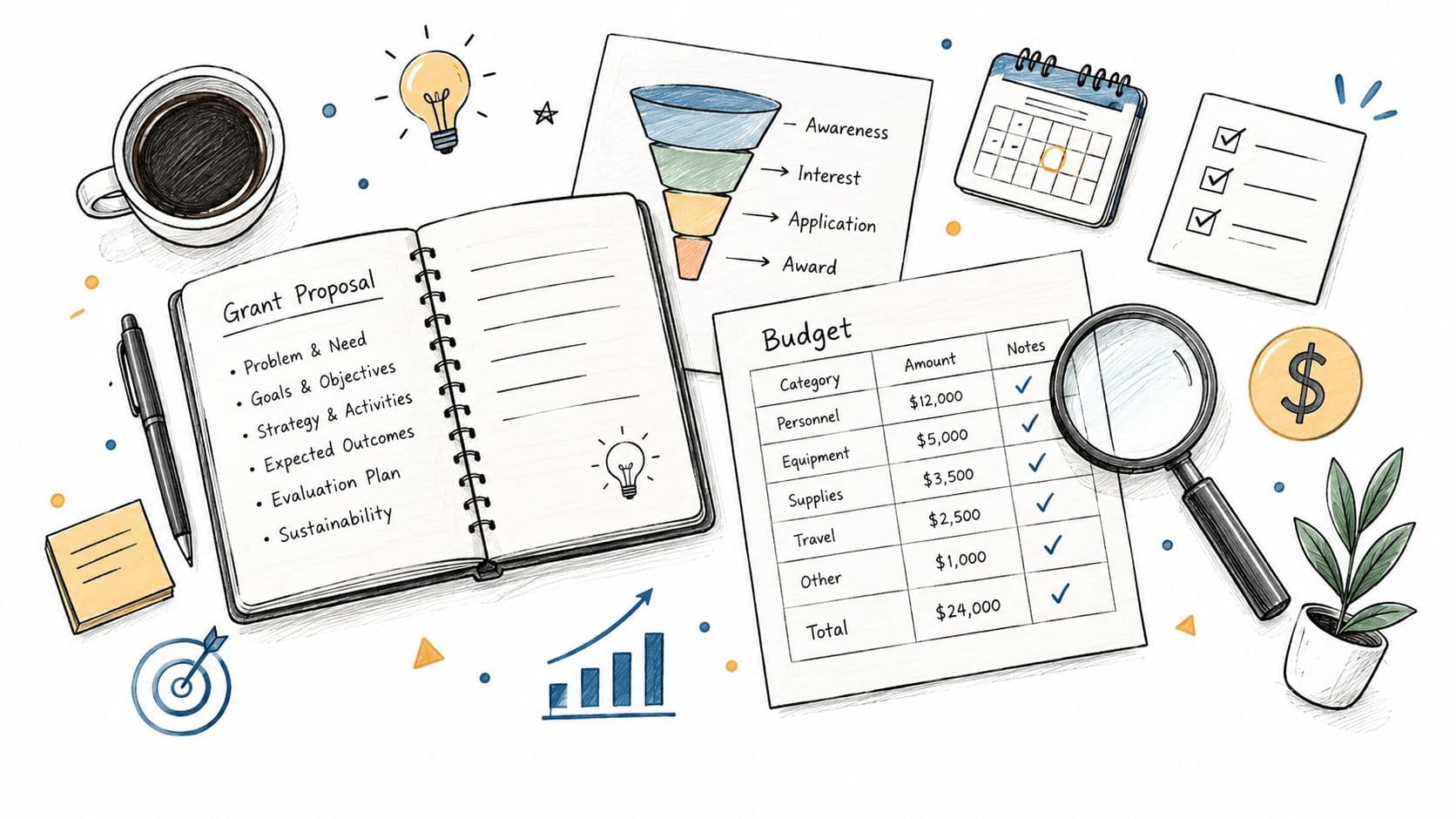
A budget is a second narrative. It shows whether your organization understands the true cost of delivery and has built a workable plan. A persuasive program description paired with an unexplained spreadsheet creates doubt, even when each individual cost appears reasonable. Treat the budget as a control point in the submission pipeline, where program design, finance, and compliance must agree.
Organize costs around the work described in the narrative. Personnel lines should identify the role, level of effort, and responsibility for delivery. Direct costs should name the activity they support. Indirect costs must follow the funder's rules and the organization's stated calculation method. Separate match and in-kind contributions by source, then explain how each supports the project. An unexplained total does not strengthen the application.
Trace every line to the work
A reviewer should be able to move from a budget line to a specific narrative passage without asking what the expense supports. Build a trace table while drafting:
| Budget Line | Narrative Section | Measurement |
|---|---|---|
| Program staff time | Staffing and activities | Work completed against the delivery schedule |
| Participant materials | Activities and outputs | Materials distributed or used |
| Partner services | Partnerships and implementation | Partner deliverables completed |
| Evaluation support | Evaluation plan | Data collected, analyzed, and reported |
| Administrative support | Management and sustainability | Required grant functions completed |
| Match or in-kind contribution | Sustainability and financing | Contribution documented by source |
The budget justification should answer who, what, when, and how the expense will be measured. “Supplies” leaves too much for the reviewer to interpret. State which supplies the project needs, which activity uses them, when the purchase occurs, and what record will confirm the expense.
Run the arithmetic before the final review. Common failures include totals that do not equal the requested amount, fringe calculations that conflict with the documented rate, and match that appears in the budget but nowhere in the narrative. These errors point to weak coordination between program and finance staff, not merely a typing mistake. University of Kansas guidance stresses that the budget must match the proposal narrative. For broader proposal development guidance on evidence, outcomes, organizational information, sustainability, and colleague review, see the University of Rochester proposal-writing guidance.
Use a template to impose order, not to make decisions. The Grantlas grant proposal budget template can help organize categories, while the funder's instructions determine allowable costs, caps, match requirements, and presentation. Reconcile the budget after every substantive program edit. A repeatable final check protects a strong application from an avoidable process error.
Attachments, Formatting, and the First-Read Checklist
A proposal can lose credibility before a reviewer reaches the narrative. The attachment package is an operational test: it shows whether the organization can track requirements, document authority, and submit a complete, usable file set. Reviewers look for evidence of eligibility, governance, financial stewardship, staff capability, program logic, and partner commitment.
Build a controlled attachment library, then verify every file against the current request. A standard folder is useful only when someone checks the version, date, signature, and upload field for each opportunity.
- 501(c)(3) determination letter: Confirms tax-exempt status when the funder requires it.
- IRS Form 990: Supplies organizational and financial information from the required filing.
- Audited financials: Give the funder information about financial controls and organizational health.
- Board list: Identifies current governance and relevant affiliations.
- Key bios: Show who will manage and deliver the proposed work.
- Logic model: Connects activities, outputs, and outcomes in a form reviewers can follow.
- Letters of commitment: Confirm that named partners understand and support their roles.
- RFP-specific forms: Complete declarations, certifications, disclosures, and other opportunity-specific requirements.
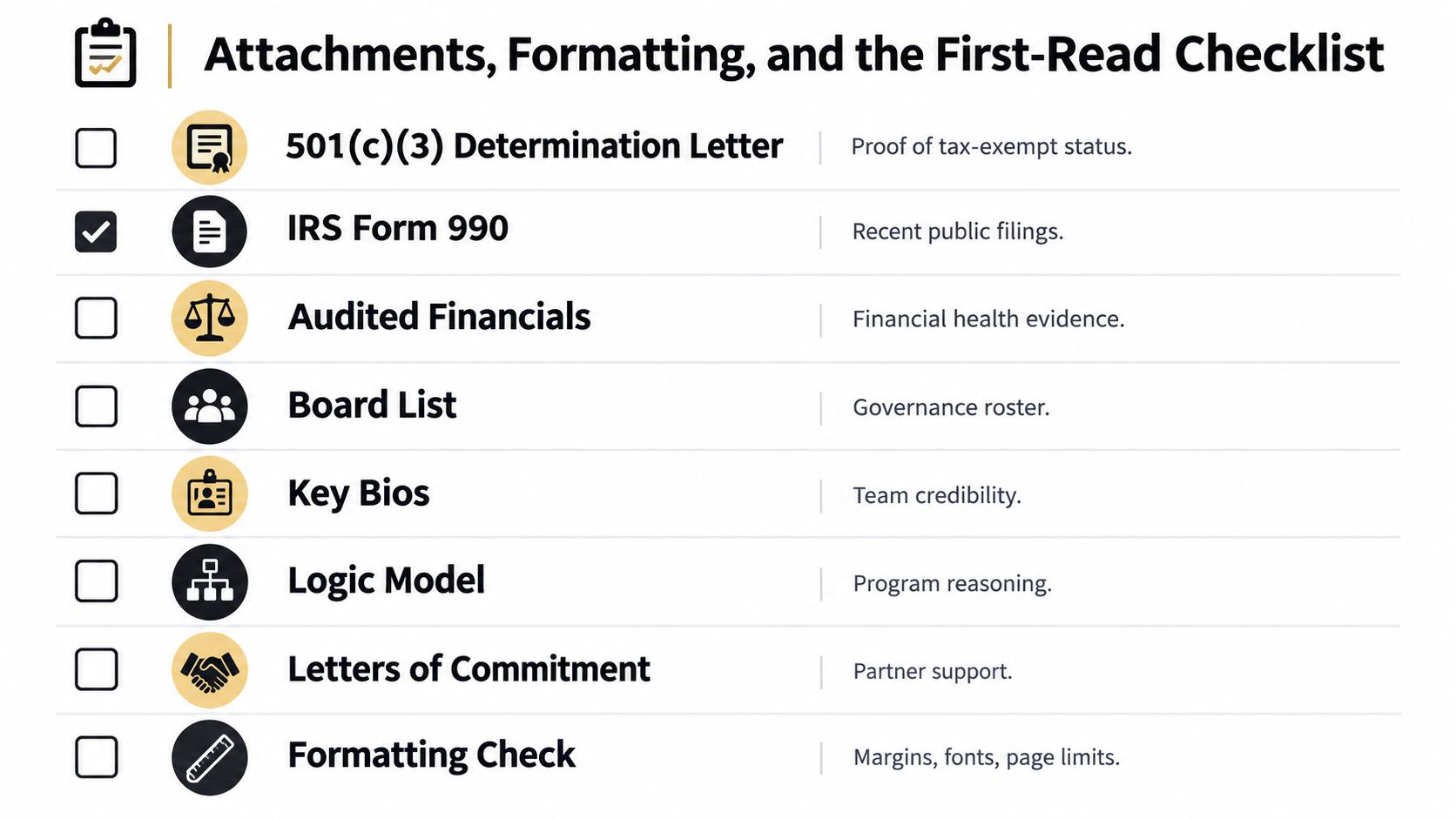
Read the application as a tired reviewer
A first-pass reviewer may find a clear narrative paired with an outdated form, missing signature, misplaced partner letter, or PDF with broken bookmarks. Those defects do not prove that the program is weak. They do signal that the applicant may struggle with award administration. A clean package reduces the number of questions the reviewer must resolve before assessing the idea.
Set a consistent visual standard, then follow the funder's instructions whenever they differ. Use readable body text, clear margins, page numbers, consistent subheads, and an applicant name and opportunity identifier in the header. Submit a PDF unless the portal requests an editable file. Keep required content within the stated page limit. Do not shrink text below the funder's limit or relocate required material to an attachment to evade the restriction.
Formatting is part of pipeline discipline. A reusable checklist, named owner, and version-controlled folder prevent the same avoidable defect from appearing across multiple submissions. The University of Rochester proposal-writing guidance also reinforces the value of following instructions, reviewing the package, and allowing time for corrections.
Submit two to three business days early when the opportunity permits. That buffer creates room for portal failures, missing approvals, signature problems, and document replacement. It also gives leadership time to resolve a disclosure issue without converting the final hours into an emergency.
Reserve a content-free final review
During the last review window, stop rewriting the narrative. Verify:
- Eligibility and registration status
- Correct opportunity number and applicant name
- Word, page, file-size, and file-format limits
- Signatures, dates, disclosures, and required forms
- Attachment names and upload fields
- Request amount and form consistency
- Portal metadata, contact information, and confirmation receipt
Assign one person who has not drafted the proposal to inspect the package from the reviewer's perspective. Record the submission confirmation in the shared pipeline, including the final file set and responsible contact. This separation keeps late editing from creating new inconsistencies when the team should be checking execution.
Turning Grant Writing Into a Repeatable Pipeline
A grant program becomes manageable when the team stops treating deadlines as isolated emergencies. Organize the work into a quarterly cycle with owners, deliverables, and exit criteria. The exact calendar will vary by sector and funder, but the operating principle stays stable: research continues while applications are being drafted, and post-award learning feeds the next prospecting cycle.
Use four operating cadences
Prospect research sprint: Review new funders and opportunities against the organizational profile. The deliverable is a ranked shortlist with fit reasoning, eligibility flags, deadlines, relationship notes, and a named owner. An opportunity exits this stage only when the team has enough information to decide whether to pursue it.
LOI batch cycle: Group suitable letters of inquiry into a production block. Each LOI should pass the sentence-level fit check, receive program and leadership review, and have a clear decision about whether a full proposal is worth preparing.
Narrative development block: Build the full proposal from approved core blocks, then tailor the problem statement, activities, outcomes, evidence, and language to the funder's instructions. The exit condition is alignment across narrative, evaluation, budget, and attachments.
Submission and reporting cycle: Complete compliance review, submit early, record the result, and maintain reporting obligations after an award. A funded application isn't the end of the pipeline. Strong reporting can support renewal conversations and provide evidence for future proposals.
Track a small dashboard, not a collection of vanity metrics. Useful fields include prospects screened, qualified opportunities, LOIs submitted, full proposals submitted, amount requested, awards received, decline reasons, and staff time spent. You can also calculate cost per dollar funded internally, provided the organization defines which staff and contractor costs it includes. The purpose is diagnosis. A crowded prospect list with few submissions indicates a production bottleneck. Many submissions with poor fit scores indicate weak qualification. Strong fit and well-reviewed proposals with repeated declines may point to program design, evidence, or relationship issues.
A shared prospect database, version-controlled attachment library, deadline reminders, and a post-decision debrief protect the process from staff turnover. Teams learning pipeline management from other disciplines may also browse Micro CRM sales funnel tips for ideas about stage definitions, ownership, and leakage. The language comes from sales, but the operational lesson applies to development work: every opportunity needs a next action, a responsible person, and a reason for moving forward or stopping.
Maintain a standing planning meeting for the next planning period, even when current applications are out the door. That meeting keeps the funnel populated, assigns capacity fairly, and prevents the organization from mistaking a busy deadline week for a functioning fundraising system.
Grantlas helps nonprofit teams identify prospective funders and open grant opportunities, create a scored shortlist with plain-English fit reasoning, and organize research from discovery toward submission. If your team needs a more disciplined way to qualify opportunities before drafting, visit Grantlas, build your organization profile, and use the resulting shortlist to decide which applications deserve staff time.