Private Foundation Grants for Nonprofits: A Practical Guide
Oct 12, 2026 · 11 min read

Your foundation prospect list is probably too long. A development director can spend an afternoon collecting names, another afternoon checking mission statements, and still have no answer to the only question that matters: which funders deserve scarce staff time?
That problem gets sharper when a grant deadline is close, a program budget is thin, and a new hire has only a few weeks of salary runway left. Ten plausible foundations may look productive in a spreadsheet, but a single invitation-only funder, geographic mismatch, or reporting-heavy award can consume the time needed for better prospects.
Private foundation grants for nonprofits are not won by maximizing submissions. They're won by identifying funders with a credible fit, verifying their actual giving patterns, and comparing the likely usable value of an award with the work required to pursue and manage it.
Table of Contents
- Why Chasing Private Foundation Grants Fails Small Nonprofits
- What Private Foundations Actually Are
- The 5% Payout Rule: What It Does and Does Not Tell You
- Reading Giving Data Without Misleading Yourself
- How to Tell Good Prospect Data From Bad
- A Practical Research Workflow for Foundations
- Why Fewer, Better-Fit Foundations Usually Win
- Approaching Foundations and Earning Renewals
Why Chasing Private Foundation Grants Fails Small Nonprofits
A small nonprofit can spend weeks building a foundation pipeline that produces little. The spreadsheet may include family foundations, corporate foundations, community foundations, and charitable trusts, each with a website, a stated interest, and a record of past grants. Without a disciplined ranking method, those names create activity rather than opportunity.
The waste usually appears after staff begin pursuing a prospect. They write a thoughtful application for a funder that rarely supports new grantees, prepare a proposal for an organization outside the foundation's service area, or chase a large award restricted to a narrow expense with demanding reporting. By the time those conditions surface, the deadline has passed and the staff hours are gone.
Practical rule: Qualify each prospect on five conditions: geography, applicant profile, grantmaking behavior, access rules, and award economics. Mission alignment alone qualifies nothing.
Separate finding funders from finding funders worth pursuing. Public records can show who holds assets and who has made grants. They cannot establish whether your team can reach decision-makers, whether the award offers usable flexibility, or whether the application and reporting burden fits your capacity.
Calculate net value before assigning work. Consider the likely award, restrictions, renewal potential, relationship effort, proposal time, and administrative load. A smaller flexible grant may serve the organization better than a larger restricted award that consumes program and development capacity.
Start with disqualification. Remove obvious mismatches before anyone drafts a letter of inquiry, then rank the remaining prospects by evidence, recency, relationship potential, and usable value. This approach turns public foundation data into a practical decision tool and keeps volume from masquerading as progress.
What Private Foundations Actually Are
A private foundation is a charitable organization funded by one or a small group of sources, often with invested assets that support its long-term giving. The legal category matters because it shapes reporting, distributions, governance, and the kind of public information available to prospective grantees.
Start with the operating distinction. A grantmaking private foundation primarily funds outside organizations. An operating foundation primarily runs its own charitable programs, although it may make some grants. For a nonprofit seeking support, that difference is decisive. An operating foundation may be mission-aligned but have little interest in accepting unsolicited proposals.
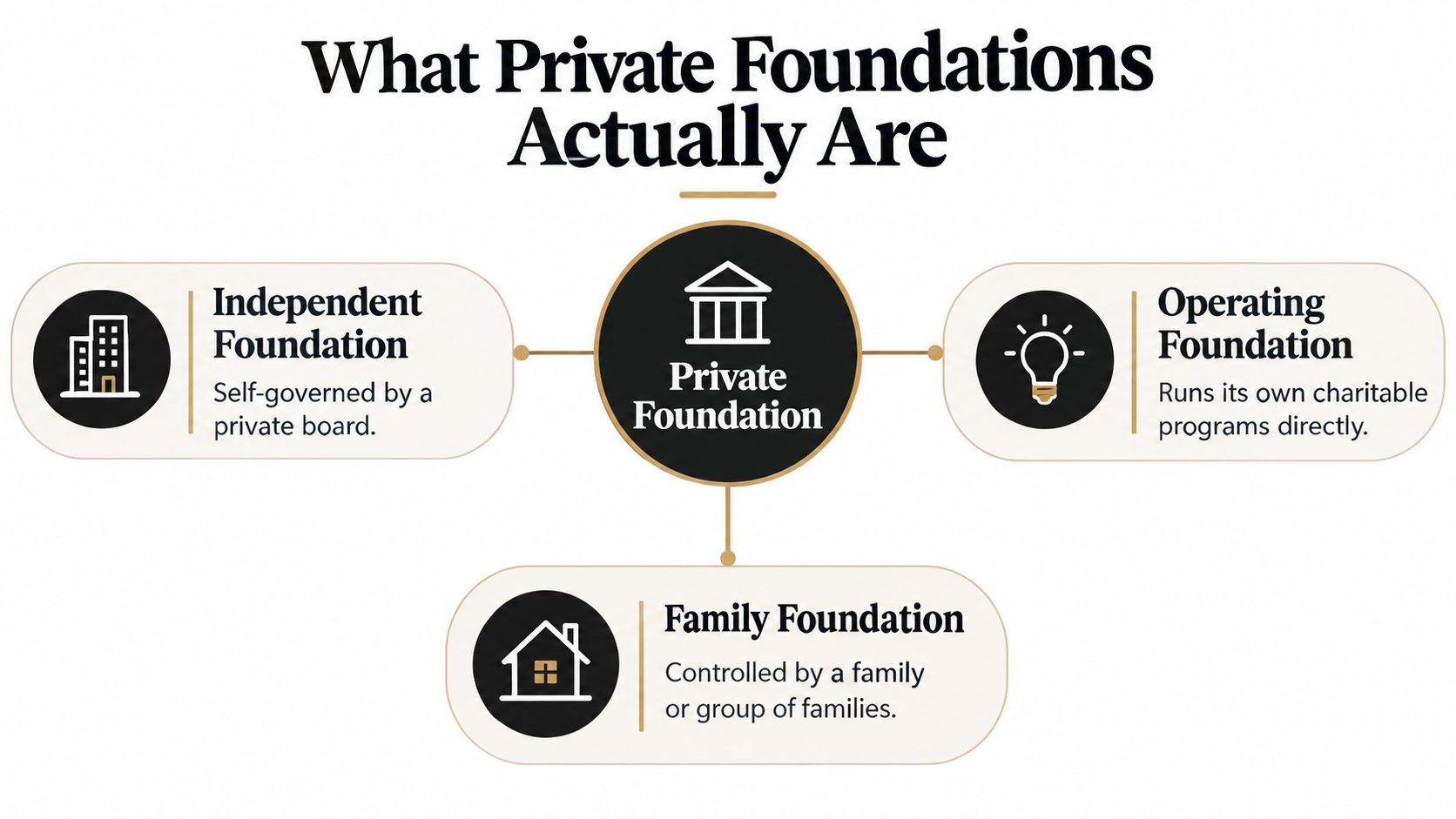
The vocabulary that improves prospecting
Independent foundations usually have their own endowment and a board that sets grantmaking priorities. Treat them as self-governed institutions. Their giving can be consistent, but their accessibility varies widely.
Family foundations are typically shaped by one family or several related family members. Personal relationships, trustees, family history, and regional ties may influence decisions as much as the published program language.
Corporate foundations operate as philanthropic arms connected to companies. Their priorities may reflect community investment, workforce goals, brand commitments, or the company's operating footprint. A strong program match isn't enough if the nonprofit has no meaningful connection to the company's geography or interests.
Community foundations are different in structure. They pool money from multiple donors and often manage competitive local funding programs. They may be excellent prospects for place-based nonprofits, but the relevant opportunity is usually a specific fund or grant cycle rather than the foundation's entire asset base.
Use these labels as research shortcuts, not as predictions. The foundation type tells you how to investigate. Its actual grant schedule, application instructions, recipient pattern, and stated purpose determine whether you should apply.
The 5% Payout Rule: What It Does and Does Not Tell You
A foundation can be required to distribute money and still be a poor prospect for your nonprofit. Private foundations generally must make qualifying distributions each year equal to roughly 5% of the value of their investment assets, after applicable adjustments, as described in the IRS statistics and historical foundation tables.
That requirement does not create a 5% pool of competitive nonprofit grants. Qualifying distributions are broader than grants. They may include direct charitable expenditures, charitable operating and administrative costs, program-related investments, and certain amounts reserved for future projects.

Why assets are a weak starting point
Large investment assets do not guarantee substantial outside grantmaking. A foundation may run its own programs, fund related entities, pay charitable administrative costs, make program-related investments, or reserve funds for later work. The payout requirement describes a legal obligation, not your likely award.
Read the foundation's Form 990-PF with one practical question: What did this funder distribute to organizations like mine? Review grant schedules, recipient names, award amounts, purpose statements, and patterns across recent filings. Compare those findings with the foundation's mission, eligibility rules, and application instructions.
The IRS historical series for domestic nonoperating foundations can help you examine activity across tax years and economic conditions. Use it to assess whether recent giving fits a longer pattern, then return to funder-level evidence before deciding whether the prospect deserves staff time.
The number that matters to a nonprofit is not the foundation's required payout. It is what the foundation recently granted, to whom, for what purpose, and under what conditions.
A foundation with smaller assets and a clear record of funding comparable nonprofits may deserve priority over a larger foundation with no relevant recipients. Rank prospects by actual grant distributions, giving cadence, recipient fit, and foundation purpose. Assets belong in your research file, not at the top of your shortlist.
Reading Giving Data Without Misleading Yourself
Aggregate giving figures are useful for context and dangerous for prioritization. Candid's survey of 496 foundations found that cumulative grant dollars rose from $25.8 billion in fiscal year 2022 to $26.2 billion in 2023, an unadjusted increase of 1.7%. The Candid analysis of foundation giving in 2023 also reported that the median foundation's giving changed by only 0.3%.
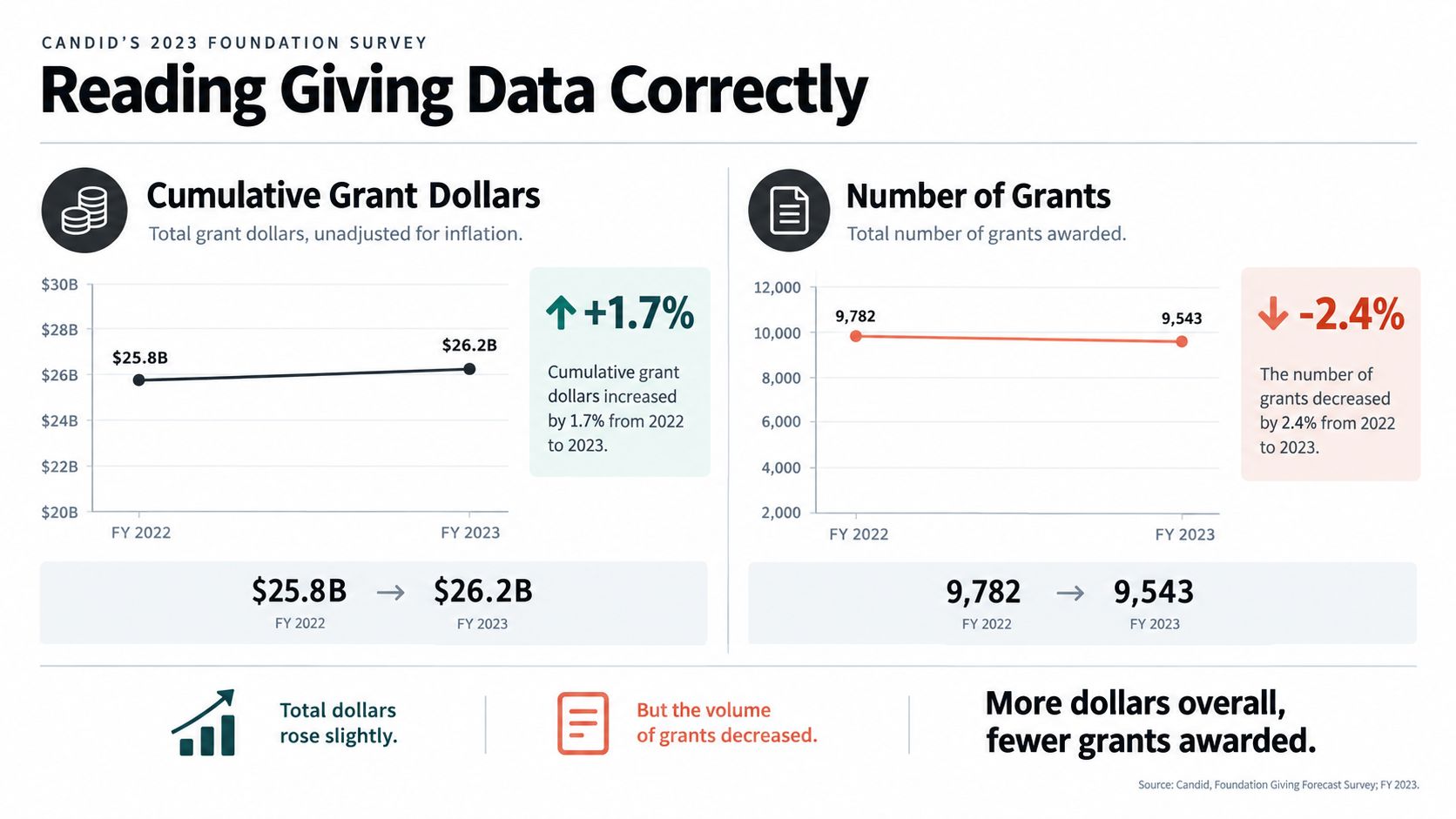
Those figures describe different realities. Total dollars can rise while the typical foundation changes very little, because larger increases at some funders offset flat or declining activity elsewhere. Candid found that median community-foundation grantmaking increased 6.6%, median corporate-foundation giving rose 1%, and median independent-foundation giving remained largely unchanged.
The median won't choose your prospects
Surveyed foundations varied sharply. Annual grant dollars ranged from a 75% decrease to an increase of more than 100%, according to Candid's reporting. That spread makes sector averages a poor substitute for foundation-specific research.
For your prospect list, translate the lesson into three questions:
- Recent movement: Has this foundation's giving increased, held steady, or contracted in its latest available filing?
- Recipient continuity: Does it keep funding organizations with a profile like yours?
- Strategic fit: Does its current behavior support the priorities described in its public materials?
The same Candid survey reported a 5% median payout rate in 2023 among 315 independent foundations, unchanged from the prior year. That benchmark can help you understand broad foundation behavior, but it can't tell you whether a particular foundation is preparing a new initiative, closing a program, or reserving funds for existing grantees.
Use market data to calibrate expectations, not to manufacture confidence. Your decision should rest on the prospect's own filing history and current access conditions.
How to Tell Good Prospect Data From Bad
Grant databases are research tools, not oracles. Candid's database contains more than 16 million grants awarded since 2003 and supports analysis by subject, population served, geography, matched dollars, and average grant size, as described in its documentation on giving statistics. That breadth is valuable, but breadth doesn't eliminate data-quality questions.
Foundation information often comes from Form 990-PF and related public reporting. Those filings arrive after the decisions they describe, so the record can lag behind current strategy. A database may also compare figures that aren't equivalent. Foundation-level giving can include grants, scholarships, and employee matching gifts, while some qualifying distributions, such as loans, program-related investments, set-asides, and administrative expenses, may be excluded from grant-level totals.
Record the context beside the prospect
Recent totals can change as additional grants are added. A historical award may show what a foundation did, but not what it will do next. Treat grant size, geography, recipient recurrence, and subject alignment as probabilistic signals, not promises.
Every prospect record should include:
- Filing year: Note which tax year supplied the financial and grant information.
- Data date: Record when your team reviewed the profile.
- Comparable records: Flag whether the displayed totals measure grants, broader distributions, or another category.
- Recency weight: Give more attention to recent behavior, while retaining older filings for pattern recognition.
- Missing evidence: Mark gaps rather than filling them with assumptions.
That discipline prevents false precision. A foundation appearing to make generous awards may have a narrow purpose, a closed intake process, or an outdated record. A funder with limited public detail may still be worth a relationship-building step, but it shouldn't receive the same score as a prospect supported by recent, comparable evidence.
A Practical Research Workflow for Foundations
A defensible shortlist doesn't require a complicated system. It requires gates that eliminate weak prospects before proposal writing begins.
Start with eligibility, not grant size
Filter the long list by geography, sector, applicant type, and grant size. A foundation that funds your issue but serves a different region is not a near miss. It's a disqualified prospect unless its guidelines say otherwise.
Next, read the foundation's own instructions. Check whether it accepts unsolicited applications, funds new grantees, supports general operating costs, and requires a letter of inquiry. Invitation-only status should change your plan from application preparation to relationship development.
Then inspect the latest available Form 990-PF and its grant schedule. Look for actual recipients, award amounts, purposes, and recurring patterns. Compare those records with your organization's budget, program scale, geography, and delivery model.
Research standard: Every shortlisted foundation should have a documented reason for inclusion and a documented reason it might fail.
A profile-matched index can reduce manual review by surfacing fit, flags, giving history, and similar organizations before staff open every filing. For a broader explanation of how an online directory can support prospecting, see this guide to foundation directories.
| Research Step | Manual 990 Review | Profile-Matched Index |
|---|---|---|
| Basic eligibility | Staff inspect filings and guidelines one prospect at a time | Profile filters surface geography, sector, applicant, and size mismatches |
| Giving history | Staff compile recipients and award patterns manually | Giving history is organized for faster comparison |
| Risk flags | Ineligibility may appear late in the process | Invitation-only status and other mismatches can be flagged early |
| Prioritization | Judgment sits in scattered notes and spreadsheets | A scored shortlist pairs fit signals with plain-English reasoning |
| Relationship planning | Staff search separately for trustees and peers | Board, trustee, and peer-funder context can sit beside the prospect |
Use the output as a starting point, not a final decision. Confirm important eligibility details on the foundation's current materials, record the evidence, and assign a next action. A good shortlist is small enough that someone can explain every prospect in a sentence.
Why Fewer, Better-Fit Foundations Usually Win
The advice to “apply to more foundations” sounds practical because it produces visible activity. For a small nonprofit, it can be financially reckless. The 2025 Nonprofit Finance Fund survey found that 44% of respondents considered application processes too onerous, 40% said compliance burdens were too heavy, and 30% waited longer to learn funding decisions. Only 9% experienced shorter wait times.
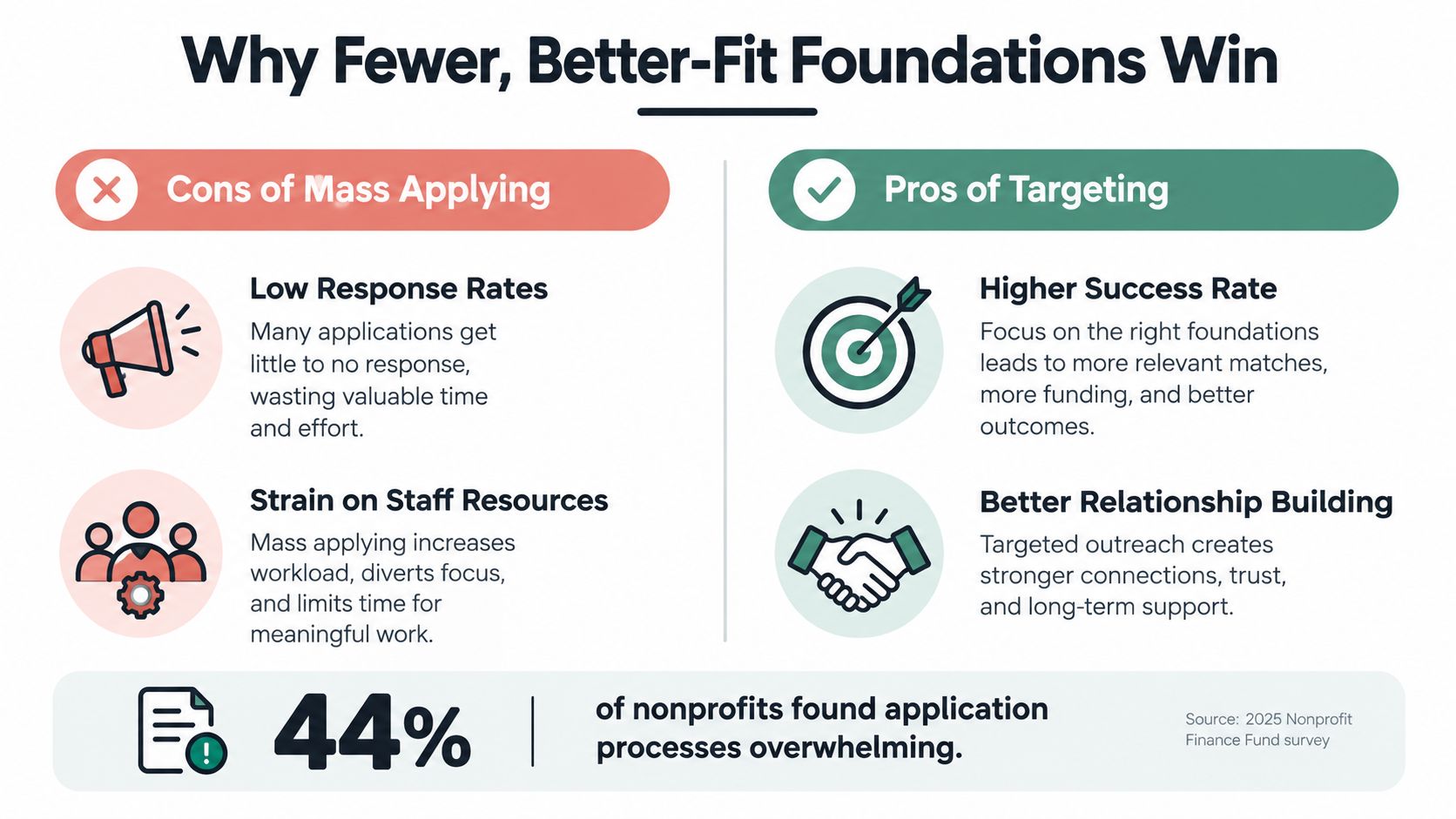
The application is only one cost. Staff must interpret guidelines, gather attachments, secure approvals, adapt budgets, answer follow-up questions, track restricted spending, and produce reports. Delayed decisions can also make a nominally attractive award less useful if the organization needs cash for an immediate obligation.
Calculate usable value
Use a simple expected-net-value test for every serious pursuit:
Expected net value = probability of award × unrestricted-equivalent value, minus application and reporting hours, payment-timing costs, and other compliance demands.
Add renewal likelihood to the discussion. A one-time restricted award may have less strategic value than a smaller, flexible award from a funder that understands your work and may renew support. The point isn't to pretend you can calculate probability perfectly. The point is to force an honest comparison.
Ask your team:
- Award fit: Would the money pay for a priority need, or create a new accounting and program silo?
- Access: Can you apply, or are you trying to bypass an invitation-only process?
- Workload: Who will write, administer, and report on the grant?
- Timing: Can your cash flow tolerate the decision and payment schedule?
- Future value: Could this award lead to durable support or a useful relationship?
A targeted approach doesn't mean abandoning ambition. It means protecting staff capacity so strong applications receive the attention they need. For practical prospecting options, compare your workflow with this overview of grants for nonprofits.
Approaching Foundations and Earning Renewals
A strong prospect list changes how you approach a foundation. Instead of sending a generic request to every funder with a matching keyword, you build a sequence around evidence.
First, write a concise letter of inquiry that mirrors the foundation's published priorities and recent giving behavior. State the problem, your approach, the population and geography served, the amount or type of support requested, and why the foundation's history makes the relationship plausible. This letter of inquiry guide can help structure the request without turning it into a template that ignores the funder.
Make the introduction count
Research should identify more than grant amounts. Look for trustees, board members, peer grantees, local partners, and existing relationships your board can activate. A warm introduction won't rescue a poor fit, but it can help your organization learn whether the foundation is accepting new conversations or has moved away from the relevant issue.
Don't ask a board member to forward a proposal blindly. Give them a short briefing with the foundation's purpose, recent comparable recipients, your specific fit, and the question you want answered. The objective is a useful conversation, not a ceremonial endorsement.
Treat the first award as an audition for trust
Reporting starts when the award is signed. Confirm restrictions, payment timing, reporting dates, required measures, and the person responsible for each deliverable. Send concise updates when appropriate, especially when a program changes or a barrier threatens the agreed plan.
Flexible funding is growing unevenly, so don't assume that a foundation's general operating language means unrestricted access. Candid reported that 90% of surveyed large U.S. private and community foundations awarded some general operating support, while the median share of grant dollars devoted to it was 30% in 2021 and 32% in 2022. A 2025 philanthropic-practice study cited by Candid reported a median share of 38%. The Candid discussion of unrestricted funding shows why you must distinguish nominal flexibility from accessible, usable support.
Before you pursue another foundation, update your organizational profile, refresh the shortlist, calendar the deadlines, and write a decline rule. Decline when the geography is wrong, access is closed, the restrictions undermine the purpose, or the expected net value doesn't justify the staff burden. That discipline leaves room to cultivate the funders that can become real partners.
Grantlas helps nonprofits turn foundation prospecting into a scored shortlist by matching an organization profile against private foundations and open grant opportunities, with plain-English fit reasoning and flags for issues such as invitation-only access, geography, applicant type, and grant size. Visit Grantlas to research private foundation grants for nonprofits with more context and less wasted proposal time.