7 Statement of Need Examples for Grant Proposals
Sep 20, 2026 · 16 min read

Most advice about statement of need examples is too soft. It tells you to “describe the problem,” add a story, and sound urgent. That's not enough. A strong need statement does more than describe a problem. It connects a defined problem to a specific population, place, program gap, or organizational condition, then shows why the funder should care.
The best grant writers treat this section as proof, not preface. Guidance from the Community Tool Box on writing a grant says a problem or needs statement should document the problem with text, statistics, and graphs or charts, describe causes, and identify prior approaches attempted. That's a much higher bar than a mission paragraph.
Below are seven statement of need examples built around seven different angles. For each one, use the same review pattern. Identify the need, inspect the evidence, test the funder connection, spot the weakness, and rewrite for clarity. If you're prospecting while you revise, Grantlas can help your team compare mission, geography, demographics, grant size, giving history, and other fit signals so you're not writing the same need statement for funders who were never a match.
Table of Contents
- 1. Mission-Driven Organization Statement of Need
- 2. Geographic Need Statement
- 3. Program-Specific Budget Constraint Statement of Need
- 4. Population-Served Demographic Statement of Need
- 5. Organizational Capacity and Readiness Statement of Need
- 6. Evidence-Based Program Outcomes Statement of Need
- 7. Equity and Racial Justice Statement of Need
- Comparison of 7 Statement of Need Examples
- Turn the Right Need Statement Into the Right Prospect List
1. Mission-Driven Organization Statement of Need
Some statements of need are really about fit. The underlying problem matters, but the immediate grant-writing task is proving that your organization works on a problem the funder already cares about.
A weak version usually sounds like this: “Our organization is dedicated to improving community well-being through education and support.” That sentence explains almost nothing. It doesn't name the population, place, or specific condition that creates urgency.
Sample and why it works
Our organization works with families facing persistent barriers to stable housing and school continuity in our service area. The need is not simply individual hardship. It is the ongoing gap between what local systems provide and what many families can actually access consistently. We respond through coordinated case management, school-facing advocacy, and practical stabilization support so children can remain enrolled, attend regularly, and avoid repeated disruption.
This works because it leads with the social condition, then narrows to the organization's lane. It also avoids a common mistake. It doesn't pretend the nonprofit solves “poverty” in general.
The trade-off is that mission-led statements can drift into branding language. When that happens, funders can't tell whether the applicant is describing a real need or reciting homepage copy.

Rewrite tactic
Start with the problem your mission addresses, not your founding story. Then make the funder connection explicit.
- Name the issue plainly: Use one sentence that identifies the social condition your organization addresses.
- Show organizational relevance: Explain why your programs are a practical response to that condition.
- Screen for mission fit early: Compare your framing against the funder's stated interests before drafting a full proposal.
If your mission statement keeps overpowering the need section, review a few sample nonprofit grant proposals and strip out every sentence that could sit on an About page. What remains is closer to a fundable need statement.
2. Geographic Need Statement
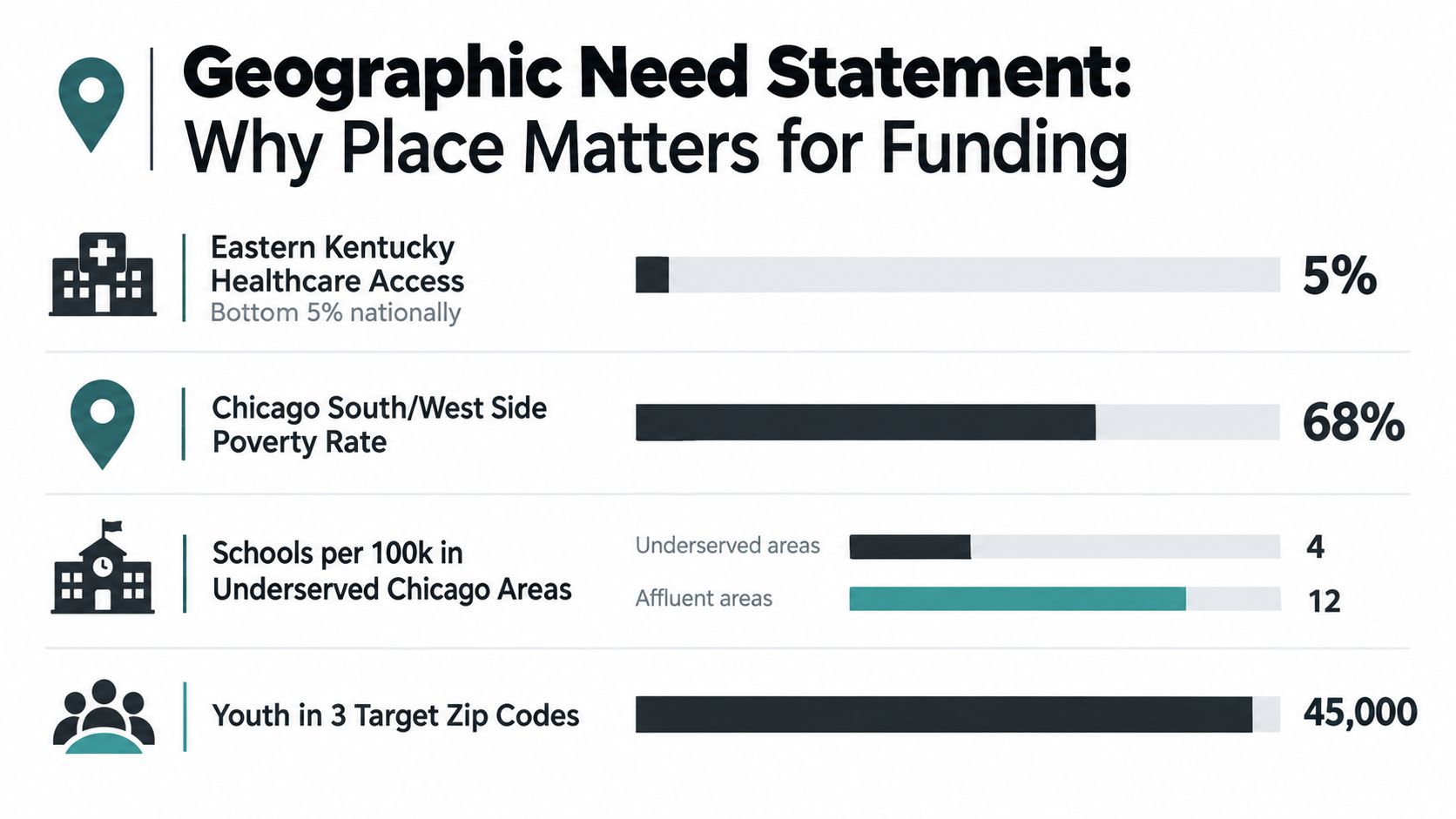
Geographic need is where weak proposals get exposed. A funder with a defined service map is not asking whether the problem exists in general. The reviewer is asking whether the gap exists in this county, these neighborhoods, or this tribal area, and whether your organization can reach people there in a practical way.
That changes the evidence you use. Broad issue data can support context, but place-based proposals win or lose on local access barriers, service distribution, and fit with the funder's footprint.
Here's a practical visual cue teams often use when they need to localize a proposal around place:
Sample and where teams go wrong
Residents in our service area face persistent access barriers tied to geography, transportation, and service concentration outside the neighborhoods where need is highest. While support programs exist in the broader region, families in the communities we serve still encounter long travel times, limited hours, and inconsistent entry points. Our request focuses on closing that place-based access gap while coordinating with existing providers in the region.
This sample works because it answers a funding question many applicants avoid. Why fund another organization in an area that already has services on paper?
The answer is proximity and access. A clinic forty minutes away, a referral process that requires multiple calls, or service hours that conflict with hourly work schedules can all justify a geographic need frame. Those details also shape budget logic. If the barrier is travel distance, transportation support or satellite delivery may fit. If the barrier is provider concentration in one part of the county, staffing for neighborhood-based outreach may make more sense than adding central office capacity.
The common mistake is writing a place-based need statement that could be pasted into any proposal in the state. Reviewers notice. So do funder databases.
Rewrite tactic
Build the paragraph in layers.
- Define the service area precisely: Name the county, corridor, neighborhoods, school districts, tribal lands, or rural region.
- Identify the barrier created by place: Distance, transit limits, language concentration, provider scarcity, broadband access, or office hours can each support a different geographic claim.
- Show the gap between regional availability and local access: Existing services elsewhere do not erase unmet need in the target area.
- Align the request with the barrier: Mobile delivery, transportation assistance, local staffing, or a neighborhood site should follow directly from the geography you describe.
In Grantlas, geographic fit matters before writing starts. If the funder only supports one region and your service map falls outside it, a strong need statement will not fix the mismatch. If the maps do align, a sharper geographic frame usually makes the prospect more usable because your evidence, service model, and budget can point to the same local gap.
Revision test
Ask these before you submit:
- Could another county use this paragraph unchanged: If yes, the statement is still too broad.
- Have you named the access barrier created by place: Travel time, transit gaps, referral friction, and uneven provider location are more persuasive than generic hardship language.
- Does the request follow from the map: A place-based need statement should make the delivery model and budget easier to defend.
- Have you shown coordination, not duplication: Funders often support local coverage gaps when applicants clearly explain how existing providers and your program differ by reach, location, or access point.
3. Program-Specific Budget Constraint Statement of Need
A weak need statement says the community needs more services. A strong one shows that the program is ready, the costs are known, and one defined funding gap is the reason delivery has not started or expanded.
This angle works best when the constraint is operational, not conceptual. The organization has demand, a service design, referral flow, staffing plan, and a budget that identifies what is already covered and what is still unfunded. Funders read this differently from a broad community-need argument. They want to see whether the request pays for a real gap or fills a general revenue shortfall.
Sample with budget logic
Families in our service area continue to seek support beyond our current program capacity. Our barrier is the unfunded cost of implementation for the next program phase. We have the staffing model, referral partnerships, and delivery plan in place, but current restricted revenue does not cover the program coordinator time, participant materials, and operating costs required to open additional slots. This request would cover the remaining program expense so the expansion can move from approved plan to active service delivery.
What makes this sample work is its discipline. It names the gap at the program level, not the organization level. It also avoids a common mistake: using demand as a substitute for budget logic. High demand helps. It does not explain why the request is for this amount, in this period, for these line items.
The strongest version usually ties three pieces together. Documented demand. Current covered resources. Remaining costs that prevent launch or expansion. The National Council of Nonprofits' guidance on program budgeting is useful here because it pushes organizations to connect activities and line items rather than describing need in broad financial terms.
Here's a simple visual reminder that location and resource distribution often intersect:
A practical rewrite tactic is to replace abstract growth language with cost drivers. "Expand services" is vague. "Add 40 counseling slots by funding 0.5 FTE clinician time, supervision, and client transportation support" gives the reviewer something they can price, assess, and fund. If your numbers are still shifting, this need angle is not ready yet.
In Grantlas, this is a funder-fit issue as much as a writing issue. If your gap is a $35,000 staffing and launch request, prospects that typically fund small capital purchases or one-time events are poor matches even if they like the mission. Request history and typical award size matter because budget-gap statements succeed only when the amount feels normal for that funder.
What to tighten before submission
- Separate community need from funding need: Show that people need the service, then show why a specific unfunded program cost is the current barrier.
- Name the uncovered line items: Staff time, supplies, technology, licensing, transportation, and evaluation read better than "general implementation support."
- Show what is already in place: Confirm what existing revenue, staff, partnerships, or infrastructure already cover so the ask does not read like a full program rescue.
- Keep the ask proportional: The cleaner your budget logic, the easier it is to screen prospects by typical grant size and past giving patterns.
4. Population-Served Demographic Statement of Need
Demographic need statements rise or fall on one question: does the named population face a distinct barrier that changes how the service must be delivered? If the answer is unclear, the paragraph reads like audience labeling, not need definition.
That distinction matters because population-based funders usually screen for fit fast. They want to see that age, disability status, language background, immigration experience, caregiver role, or another demographic factor changes access, trust, uptake, or outcomes. If the same service would work the same way for everyone, this angle is usually too thin.
Young people in our service area face consistent barriers to getting support through mainstream systems, including low trust, referral gaps, and service settings that do not reflect their cultural experience. These barriers reduce early help-seeking and increase disengagement once support begins. Our program is designed for this population with outreach, communication, and service delivery methods that match how young people enter care and stay connected to it.
Why this sample works:
- It names the population early.
- It identifies barriers tied to service design, not just identity.
- It gives the funder a reason the program should be population-specific.
- It sets up budget logic. Outreach methods, staff training, interpretation, peer support, and adapted communications all make more sense after this framing.
A weak version usually stacks descriptors and stops there. "Low-income immigrant youth of color in underserved neighborhoods" may be accurate, but accuracy alone does not make the case. Reviewers still need to know what those young people are running into, why generic delivery misses them, and what changes when your organization serves them well.
One useful framework comes from CharityGrantWriter's guide to writing a needs statement, which suggests grounding the case in who is affected, where the need shows up, why it occurs, and what happens if it goes unmet. For this need angle, I would add one more filter. Explain what the demographic lens changes operationally.
Here are the revisions that usually improve this section fastest:
| If your draft says | Rewrite toward |
|---|---|
| "Our target population faces many challenges" | Name the specific access or trust barrier affecting service use |
| "We serve seniors, veterans, and families" | Separate groups unless they share the same barrier and delivery implications |
| "Our culturally competent program helps clients thrive" | Show what is adapted: staffing, language access, hours, referral partners, curriculum, or intake process |
| "This community is underserved" | Explain how mainstream services fail to reach, retain, or work for this population |
Grantlas is useful here for more than finding mission-aligned funders. A demographic statement should also shape prospect selection. If the need hinges on language access for older adults, funders focused broadly on human services may be a weaker match than those with a clear history of aging, immigrant, or identity-based giving. Population fit affects more than approval odds. It also affects how much explanation your proposal needs.
5. Organizational Capacity and Readiness Statement of Need
Not every statement of need should revolve around client demand. Sometimes the most honest and fundable need is organizational readiness.
That's especially true for general operating support, infrastructure requests, and capacity-building proposals. If staffing, systems, governance, or evaluation limits your effectiveness, pretending the need is only programmatic usually weakens the proposal.
Sample for capacity support
Our organization has demonstrated demand for its services, but internal infrastructure has not kept pace with program complexity. The immediate need is stronger operational capacity in areas such as data systems, staff support, and cross-functional planning so that current services remain reliable and future growth does not compromise quality. This request addresses the organizational conditions required to deliver consistent results.
This version works because it doesn't apologize for asking for capacity. It ties internal strengthening directly to program reliability.
One underserved grant-writing angle is how to write a statement of need when the request is for operating support or systems-change work rather than a single program. Guidance on general operating grant proposals from Instrumentl points toward root causes, current efforts, consequences of inaction, and a bridge to solution, even though many examples still default to project grants.
A capacity need statement should answer one question clearly. What breaks, stalls, or stays fragile if the organization doesn't strengthen this internal function?
Practical edits that help
- Name the bottleneck: Data systems, supervision, finance workflow, governance, and staff retention are clearer than “organizational growth.”
- Tie infrastructure to service quality: Reviewers fund readiness more easily when they can see downstream program consequences.
- Prospect differently: In Grantlas, look for general operating support, capacity-building language, and funders that support new grantees. Those signals matter more here than a narrow program match.
If you need to compare how this type of framing shows up in longer applications, review a sample grant proposal for non profit organization and pay attention to how organizational context supports, rather than distracts from, the ask.
6. Evidence-Based Program Outcomes Statement of Need
A need statement built around outcomes asks for a different kind of proof. The issue is not only that a problem exists. The issue is whether your organization has a credible method for changing it.
That distinction changes funder fit. A foundation interested in innovation may accept a strong theory of change and early implementation data. A more conservative funder may want prior cohorts, comparison points, and clean definitions for success. If you cannot show that line from need to measurable change, this angle weakens fast.
Sample framed around measurable change
Community members are experiencing a documented barrier that persists even where basic services are available. Our program addresses that barrier through a defined intervention model, participant benchmarks, and outcome tracking tied to the condition we aim to change. Funding is needed because the gap is not service volume alone. The gap is access to an approach with a realistic path to improvement and a record of monitoring whether that improvement occurs.
Use this version when the program model is settled and staff can describe outcomes without stretching the evidence. Do not use it if your numbers stop at attendance, satisfaction, or anecdotal success stories. Reviewers will notice the gap.
A useful drafting test is simple. Could a reviewer point to each sentence in the need statement and identify the related activity, output, and outcome? District of Columbia grant-writing guidance makes that connection explicit in its statement of need training PDF, including the difference between short-term and long-term outcomes.

Three edits usually improve this type of statement:
First, replace broad verbs like "support," "improve," or "increase access" with the actual change the program is built to produce.
Second, separate outputs from outcomes. Serving 200 participants is an activity result. Participants completing job placement plans, improving school attendance, or sustaining housing stability are outcome claims, and each requires a different level of evidence.
Third, write to the funder's evidence standard, not your internal shorthand. If a prospect funds replication, implementation discipline matters. If it funds pilots, the argument may depend more on measurement design and learning plans. For teams tightening that distinction before prospecting, this guide to evaluating and monitoring grant-funded programs helps clarify what you can credibly claim now versus what you still need to measure.
The budget logic shifts too. An outcomes-based need statement makes data collection, case management time, supervision, and follow-up look less like overhead and more like the machinery that produces accountable results. That is often the revision move in this angle. You are not only proving need. You are proving that the proposed spending supports a model that can show change.
7. Equity and Racial Justice Statement of Need
Equity need statements fail when they stay abstract. Funders do not need another paragraph about historic inequity in general terms. They need to see which disparity you are addressing, how it shows up in service use or outcomes, and why a standard program design keeps missing the people you want to reach.
This angle changes more than wording. It changes proof, fit, and budget.
A race-conscious need statement usually needs a tighter chain of logic than a general community-need paragraph. If the claim is that Black families, Latino students, Indigenous patients, or another community face a distinct barrier, the proposal has to identify the barrier with precision. Language access, referral bias, documentation rules, clinic hours, transportation, prior harm by institutions, and staffing that does not reflect the community all lead to different program choices and different budget lines.
Here is a version that gives a reviewer something concrete to assess:
Black and Latino residents in our service area experience lower access to preventive health support, not because services are absent, but because current delivery models rely on referral pathways, operating hours, and intake practices that exclude many working families. Community members report delayed care, confusion during enrollment, and mistrust shaped by prior experiences with public systems. Our program addresses that gap through bilingual outreach, evening enrollment support, community-based navigation, and partnerships with trusted neighborhood organizations so residents can enter care earlier and stay connected to services.
What makes this sample work is its specificity. The inequity is named. The mechanism is named. The response follows directly from that mechanism. A reviewer can now judge whether bilingual outreach, evening hours, and navigation are reasonable answers to the stated gap.
That last point matters in practice. Equity language often attracts interest from funders, but it also raises the standard for coherence. If you describe structural racism and then submit a budget that only covers generic program delivery, the statement and the spend plan do not match.
Independent guidance on how to write a statement of need makes a useful point here. Existing services do not erase need. You still have to explain why current options fail to produce fair access or fair outcomes for the community in question.
A practical revision test helps. Read the paragraph and ask four questions:
- What is the disparity?
- What system or practice is producing it now?
- What does the program do differently because of that reality?
- Which budget items make that different approach possible?
If any answer stays vague, the need statement is not ready.
Grant selection changes too. Some funders use equity language as a values signal. Others consistently fund race-conscious implementation, community leadership, policy work, or culturally specific service models. In Grantlas, that distinction matters. Review peer grantees, grant descriptions, and giving history before treating an equity keyword as true alignment. That step saves time and prevents rewrites for funders who support inclusion broadly but avoid explicitly race-centered work.
Comparison of 7 Statement of Need Examples
| Statement Type | Implementation Complexity | Resource Requirements | Expected Outcomes | Ideal Use Cases | Key Advantages |
|---|---|---|---|---|---|
| Mission-Driven Organization Statement of Need | Low–Moderate, articulate mission and focus | Organizational history, mission text, sector examples | Strong mission-funder alignment; higher fit scores | Foundation grants seeking sector alignment | Emotional resonance; credibility; improves algorithmic matching |
| Geographic Need Statement | Moderate, gather and localize data | Local demographic/economic data, geographic identifiers (zip/FIPS) | Clear eligibility for place-based funders; fewer mismatches | Local, state, regional and place-based grants | Attracts local funders; filters geography-mismatched opportunities |
| Program-Specific Budget Constraint Statement of Need | High, develop detailed budgets and timelines | Program budgets, cost projections, funding-gap analysis | Accurate grant-size matches; precise budget narratives | Program expansions or single-initiative funding asks | Prevents pursuing undersized grants; shows cost-effectiveness |
| Population-Served Demographic Statement of Need | Moderate–High, collect sensitive demographic data | Participant-level demographic stats, privacy safeguards | Increased matches with demographic-focused funders | Grants targeting specific ages, races, incomes, disabilities | Targets niche funders; improves demographic fit scores |
| Organizational Capacity and Readiness Statement of Need | Moderate, internal assessment & planning | Capacity assessments, governance and staffing plans | Access to capacity-building and general-op support | Early-stage orgs or scaling organizations needing infrastructure | Appeals to funders for sustainability; signals readiness to improve |
| Evidence-Based Program Outcomes Statement of Need | High, rigorous evaluation and documentation | Evaluation expertise, data collection, possibly RCTs | Strong competitiveness for research-driven and large grants | Large foundations, federal grants, evaluation-prioritized RFPs | Demonstrates measurable impact; higher credibility for big funders |
| Equity and Racial Justice Statement of Need | Moderate–High, integrate DEI frameworks and data | Disaggregated outcome data, DEI policies, governance changes | Alignment with equity-focused funders; access to new funding streams | Racial-equity initiatives, systems-change and DEI-centered programs | Positions organization for growing equity funding; aligns with policy priorities |
Turn the Right Need Statement Into the Right Prospect List
These seven statement of need examples show a simple truth. There isn't one “best” format. The right structure depends on the dominant angle in the proposal. Sometimes that's mission alignment. Sometimes it's geography, population, capacity, budget gap, measurable outcomes, or structural inequity.
The revision process gets easier when you choose one lead frame first. If you try to make every need statement do everything at once, the section gets crowded fast. Pick the dominant type of need, define the affected population and context, add only supported evidence, and connect the problem directly to the response you're proposing.
Recent guidance has moved this section toward a more quantitative and specific standard. One source recommends at least three credible data citations in a needs statement and says the opening sentence should identify the population, geography, and problem with at least one data point, while also noting that some proposal formats keep the section to about five hundred words, according to GrantMetric's discussion of needs statement examples. Even when your final section is shorter or longer, that advice reflects the broader shift toward evidence-based justification.
A useful editing order looks like this:
- Choose the dominant need angle: Don't mix mission, geography, and capacity language without deciding which one leads.
- Define who is affected and where: Reviewers should be able to identify the population and service context quickly.
- Use supported evidence only: Add current, relevant proof. Cut claims you can't substantiate.
- Link need to response: Every major problem point should make the proposed activity feel necessary.
- State the gap clearly when relevant: If the request is for implementation, capacity, or operating support, name the missing condition directly.
- Tailor to the funder's priorities: A strong paragraph still fails when it's sent to the wrong prospect.
Prospect research stops being separate from writing. In Grantlas, you can build a profile from your website or EIN, filter by geography, sector, and grant size, review fit reasoning and giving history, compare peers, and save searches for ongoing alerts. That makes revision more strategic because you can shape the need statement around real prospect patterns instead of guessing what the market wants.
A strong statement of need is persuasive writing, but it's also a prospecting tool. When it's specific enough, it helps you decide not only how to write the proposal, but which proposals are worth writing at all.
Grantlas helps nonprofit teams turn a rough need statement into a sharper prospect list. You can build an organization profile, see scored funder matches with plain-English reasoning, filter out geography or grant-size mismatches, and track new opportunities as your priorities change. If you want a faster way to connect statement of need examples to actual funding research, visit Grantlas.