Evaluating and Monitoring Grants That Actually Works
Sep 16, 2026 · 12 min read
The reporting deadline is tomorrow. Your team has attendance figures, activity logs, invoices, and a narrative that says the work is progressing. Yet the most important question remains unanswered: what do these numbers mean for the grant, and what should someone do next?
That situation is common in nonprofit work. Teams collect more information than they can interpret, funders receive tables without context, and program staff lose time maintaining measures that never influence a decision. Effective evaluating and monitoring takes a different approach. It treats evidence as part of performance management, with each measure connected to a choice about implementation, support, continuation, or change.
Table of Contents
- Why Evaluating and Monitoring Decides Grant Success
- Designing Your Theory of Change and Logic Model
- Choosing Indicators That Drive Decisions Not Busywork
- Building a Practical Data Collection and Tracking System
- Reporting Learning and Iterating Without Overwhelm
- Making Your Monitoring Risk Based and Sustainable
Why Evaluating and Monitoring Decides Grant Success
Monitoring is the ongoing tracking of implementation and results. It follows inputs, activities, outputs, outcomes, and impacts over time, helping staff identify whether work is on course and whether early warning signs require action. BetterEvaluation's guidance on monitoring emphasizes that monitoring isn't merely data collection. It's a decision-support process, and numbers become useful only when teams connect them to targets, baselines, and explanatory context.
Evaluation serves a different purpose. It involves periodic judgment about relevance, implementation, effectiveness, or impact. Monitoring may tell you that participation has changed, while evaluation asks why it changed, whether the change matters, and what the evidence supports about the program's future.
The reporting problem
A grant report can accurately list workshops delivered, people reached, referrals completed, or materials distributed and still fail to demonstrate progress. Activity counts describe what the organization did. They don't necessarily show whether participants gained knowledge, changed behavior, accessed services, or experienced the intended benefit.
Context turns a figure into evidence. A useful report explains the expected result, the starting point, the current position, the reason for variance, and the action being taken. Without that narrative, a funder may see a missed target but not know whether the cause was weak delivery, a change in participant needs, delayed recruitment, an external disruption, or an unrealistic assumption in the original plan.
Practical rule: Every important number should answer three questions: compared with what, why does it matter, and what will change because of it?
Modern evaluation has a long history of serving this purpose. Evaluation practices appeared in areas such as education and public health before the major expansion of formal program evaluation in the United States after World War II. The field grew especially rapidly during the 1960s, when expanding federal social programs created demand for evidence that could justify public spending and assess effectiveness, as described in this history of monitoring and evaluation.
A lean system for real teams
Small nonprofit teams don't need a measurement architecture that consumes the program. They need a clear structure that separates three purposes:
- Compliance monitoring: Confirm that required activities, spending, safeguards, and deliverables are being completed.
- Program learning: Understand what is working, for whom, under which conditions, and what needs adjustment.
- Board reporting: Present a concise view of progress, risk, resource use, and strategic implications.
Those purposes may draw from the same underlying records, but they shouldn't demand identical reports or collection schedules. A practical grant plan begins with a theory of change, tracks implementation during delivery, and assesses results after completion. The grant management resources from Grantlas can support the surrounding prospect and deadline workflow, but the M&E plan itself must remain grounded in program decisions, not software features.
The standard to defend is simple: measure enough to manage responsibly, learn, and report credibly. More metrics aren't automatically stronger evidence.
Designing Your Theory of Change and Logic Model
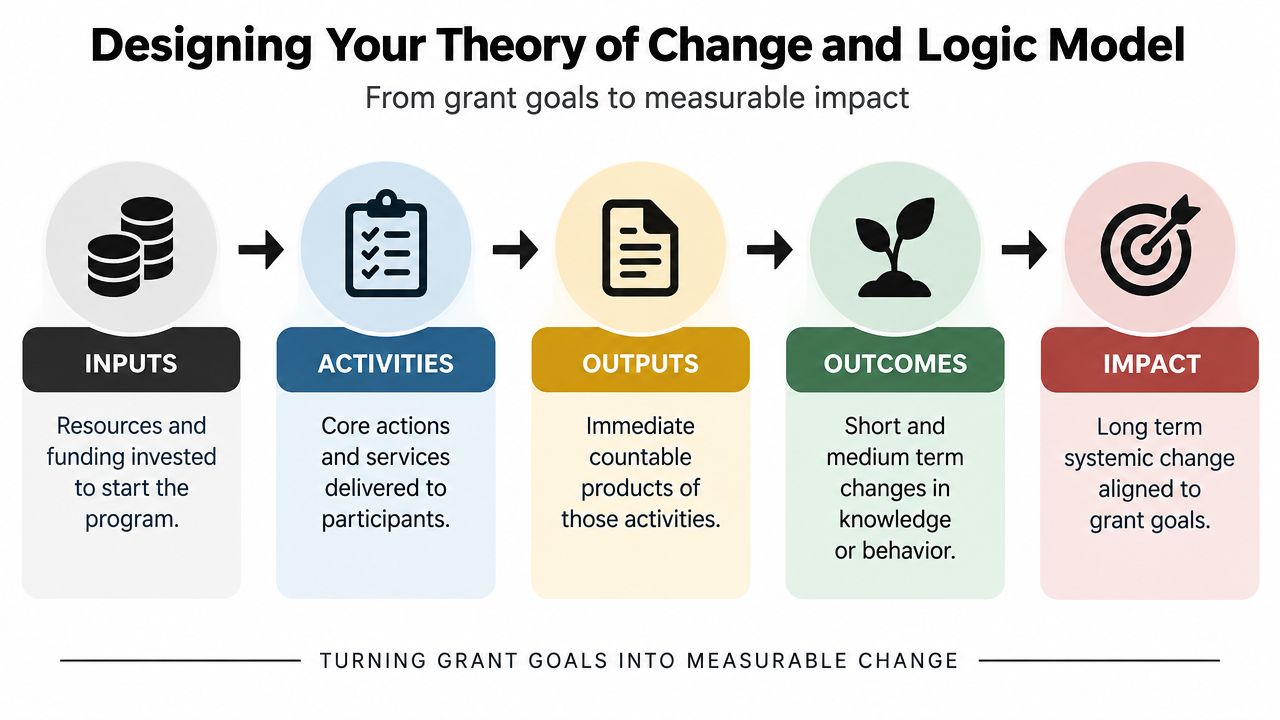
A theory of change explains why a grant's activities should lead to its intended results. A logic model makes that reasoning visible by connecting resources and actions to immediate products, changes, and longer-term impact. Without this foundation, teams often select indicators because they're easy to count, then discover during reporting that those indicators don't answer the funder's real questions.
Start with the grant goal, then work backward. Ask what must change, what conditions make that change possible, what the program will do, and what resources it needs. Keep the first version to one page. A model that program staff can't explain in a meeting won't guide daily decisions.
Build the chain from the grant goal
Use a left-to-right chain:
- Impact: Define the long-term condition the grant contributes to. Avoid claiming that one grant alone will create systemic change if the program only controls a small part of the pathway.
- Outcomes: State the changes participants, organizations, or communities should experience in the short or medium term. Use observable language such as increased knowledge, improved access, stronger retention, or changed practice.
- Outputs: Identify the immediate products of delivery, including services completed, participants engaged, referrals made, or resources produced.
- Activities: List the core actions that create those outputs. Include the delivery method and the people responsible.
- Inputs: Record the funding, staff time, partnerships, facilities, data, and other resources required to operate.
The order matters because each level supports a different measurement question. Inputs show capacity. Activities show implementation. Outputs show reach and delivery. Outcomes show change. Impact reflects the broader condition the work intends to influence.
Test the assumptions
A model becomes useful when it exposes uncertainty. For example, a program may assume that providing information will lead participants to change behavior. That assumption might be reasonable, but it still needs testing through participant feedback, follow-up records, observation, or another appropriate method.
Invite program staff, finance colleagues, data owners, and, where practical, grantees or participants to review the model. Each person sees different weaknesses. Finance may identify a resource dependency, frontline staff may challenge an unrealistic delivery sequence, and participants may explain why a proposed service doesn't fit their circumstances.
Write assumptions beside the arrows, not in a separate document nobody opens. Then attach a potential measure to the assumption that matters most. The result is a draft logic model that does more than satisfy a proposal requirement. It gives every later indicator a clear home.
Choosing Indicators That Drive Decisions Not Busywork
An indicator earns its place when a person can use it to make a decision. If nobody can explain what would change after seeing the result, the measure is probably decorative.
Start by separating indicators into four types:
- Input indicators track resources available, such as staffing, funding use, partnerships, or materials.
- Output indicators track what the program delivers, such as services, sessions, referrals, or completed products.
- Outcome indicators track changes in knowledge, behavior, access, condition, or practice.
- Impact indicators track longer-term changes that usually depend on multiple influences beyond the grant.
An output measure may be essential for compliance but weak for learning. An outcome measure may be valuable for strategy but too slow for weekly management. The right plan uses both, assigns each a purpose, and avoids pretending that every indicator can answer every question.
Apply the decision filter
For each candidate indicator, write the decision it informs. If the answer is vague, remove the measure or redesign it. The Advancing Evaluation Practices in Philanthropy guidance recommends tying indicators closely to decision-making and warns against overloading systems with low-value metrics.
| Indicator Type | Example Measure | Decision It Informs | Recommended Cadence |
|---|---|---|---|
| Input | Staff capacity available for planned delivery | Whether the work can begin or needs resourcing | At setup and when capacity changes |
| Output | Services completed against the implementation plan | Whether delivery is on track | During routine operational reviews |
| Outcome | Participant change connected to the program objective | Whether the intervention should continue or adapt | At meaningful program milestones |
| Impact | Longer-term change aligned with the grant goal | Whether the broader strategy remains appropriate | At evaluation points, not every reporting cycle |
Targets need baselines and definitions. A target without a baseline doesn't show the distance traveled. A baseline without a defined collection method won't remain comparable. Document who counts a participant, what qualifies as completion, when a result is recorded, and how missing information is handled.
Balance the three audiences
Compliance staff may need completion and expenditure evidence. Program managers need timely signals about quality, reach, and barriers. Boards need a concise view of progress, risk, and strategic choices. Put these into one data dictionary, but create different views or reports rather than asking every audience to consume the entire dataset.
Disaggregation can reveal whether results differ by the groups the grant intends to serve. Use it when the distinction will change support, implementation, or strategy. Don't collect sensitive or detailed demographic information because a dashboard can display it.
The same discipline applies outside nonprofit work. Teams looking for a clear explanation of metrics governance for SaaS metrics can borrow the underlying principle: define ownership, establish consistent terms, and connect each metric to a decision. The nonprofit context is different, but unmanaged definitions create the same problem everywhere. Reports become difficult to compare, and staff spend time debating the number instead of acting on it.
Building a Practical Data Collection and Tracking System
A workable data system begins with capacity, not ambition. Nonprofit literature identifies recurring gaps between evaluation expectations and available resources, with staff time, funding, and technical expertise frequently limiting what organizations can sustain. One cited survey reported time as the top barrier for 78% of respondents and financial resources for 53%, as documented in this Canadian nonprofit evaluation literature review.
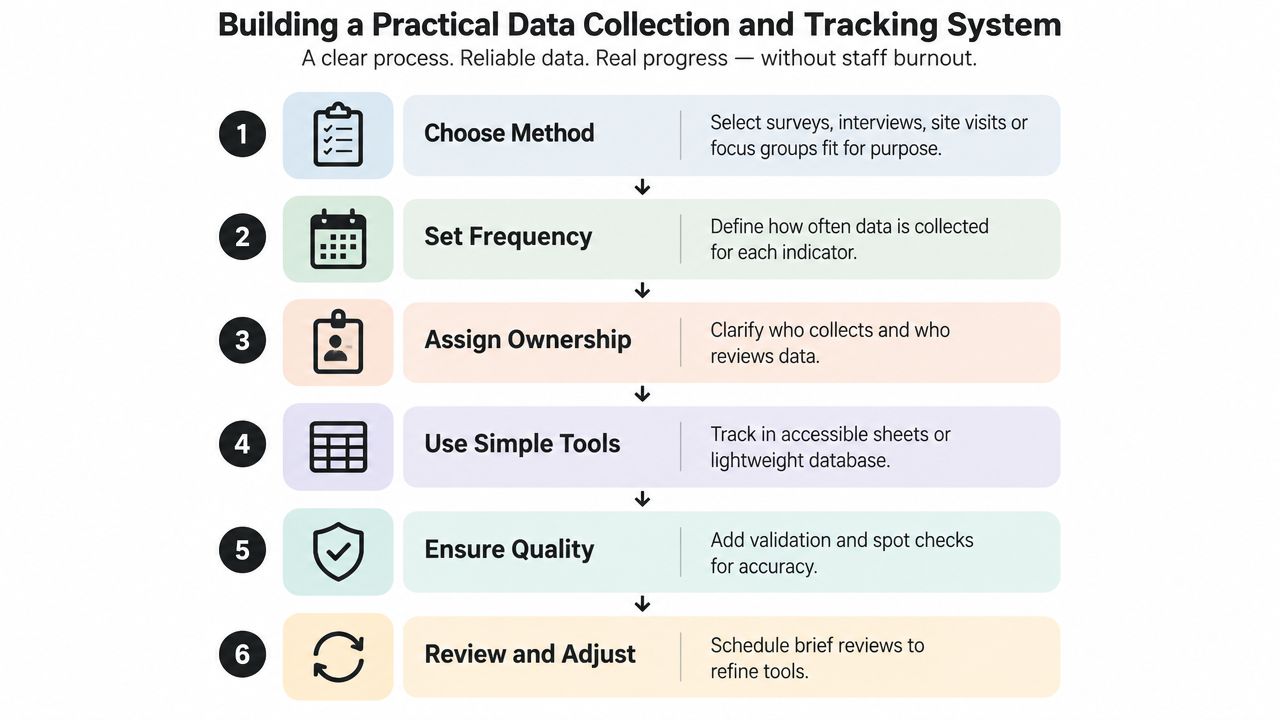
Choose the lightest method that can answer the question. A short survey may work for changes in knowledge or satisfaction. Interviews can explain why participation falls away. Site visits can test implementation conditions. Focus groups can surface shared experiences, while pre/post tests may be appropriate when the program aims to build defined knowledge or skills. Mobile field collection tools can reduce duplicate entry when staff work away from the office.
Match cadence to the decision
Not every measure deserves the same frequency. Operational indicators may need routine review because they can reveal delivery problems early. Outcome measures often need more time between collection points so participants have a reasonable opportunity to experience change. Impact questions usually belong in a periodic evaluation rather than a recurring activity report.
A simple collection calendar should specify:
- Method: What instrument or source will produce the information?
- Owner: Who collects, checks, approves, and interprets it?
- Timing: When does collection occur, and when must review happen?
- Population: Whose experience or activity is included?
- Action threshold: What variance or pattern triggers follow-up?
- Storage: Where does the clean version live, and who can access it?
A spreadsheet can be sufficient when definitions are stable and ownership is clear. Use separate tabs for the indicator dictionary, raw entries, validation notes, and reporting outputs. Protect formulas, retain version history, and avoid manually copying figures between multiple funder templates whenever a shared source record will work.
Add quality checks that people can actually perform
Quality control doesn't require a large data team. Assign one person to review missing fields, duplicate records, unexpected values, and changes from the previous period. Ask staff to record explanations at the time of entry rather than reconstructing them before a report is due.
Dashboards should highlight exceptions, not display every available field. A variance view can flag a delivery measure below target, a delayed milestone, an unusual change in participant composition, or an overdue safeguarding action. The dashboard doesn't replace judgment. It directs scarce attention toward questions that deserve it.
Use the video below as a practical prompt for thinking about an operational workflow, then adapt the approach to your own privacy, consent, and record-retention requirements.
Reporting Learning and Iterating Without Overwhelm
A report should help a reader understand the program's position and the next management decision. Start with the result, then show the comparison. Explain the variance, identify the evidence behind the explanation, and state what the team will do.
A useful internal review can fit on one page:
- Progress: What moved against the relevant baseline or target?
- Meaning: What does the result suggest about delivery or participant experience?
- Risk: What could prevent the intended result?
- Response: What action, support, or test will happen next?
- Owner and date: Who will follow up, and when will the team revisit it?

Separate operational review from strategic evaluation
Operational monitoring should be frequent enough to catch drift while the team can still respond. Review implementation progress, delivery constraints, participant flow, unresolved data issues, and material variances. Keep the meeting short and require each flagged issue to end with an owner and a next action.
Strategic evaluation is different. It asks whether the program model remains credible, whether observed changes align with the intended outcomes, and whether the grant should be continued, modified, expanded, or concluded. It needs a deeper look at context and alternative explanations, so forcing it into every monthly report usually produces shallow analysis.
Benchmarking can help teams interpret performance, but external comparisons need careful qualification. Organizations may serve different populations, operate in different settings, or define completion differently. Internal trend data, consistent definitions, and documented changes often provide a more defensible comparison than an attractive but poorly matched external benchmark.
Write for funders and for learning
A funder-friendly report can use a consistent anatomy:
- Purpose and period: Restate the grant objective and reporting window.
- Headline results: Show a small set of decision-relevant indicators.
- Narrative context: Explain achievement, variance, and unexpected effects.
- Implementation update: Describe what was delivered and what changed.
- Learning and adaptation: Record what the team learned and how it responded.
- Next decisions: State upcoming milestones, risks, and support requests.
Don't rewrite the entire M&E plan every time the program adapts. Maintain a change log with the date, decision, evidence considered, owner, and expected consequence. This preserves accountability while allowing responsible iteration.
A well-run reporting rhythm gives staff a place to act before a missed milestone becomes a failed grant. It also gives board members more than reassuring language. They receive a transparent account of progress, uncertainty, and stewardship. Teams looking for additional practical grant workflow materials can consult the Grantlas grant resources library, while keeping the reporting system specific to their own strategy and obligations.
Making Your Monitoring Risk Based and Sustainable
One monitoring schedule for every grantee is easy to administer and poor at allocating attention. A small, experienced subrecipient with straightforward delivery may need a lighter touch than a complex funding chain with new partners, unfamiliar controls, or a history of unresolved findings.
Risk-based monitoring doesn't mean reducing accountability. It means directing stronger checks, closer review, and more support where the likelihood or consequence of failure is greater. A GAO review of federal grant monitoring found weaknesses in a process that didn't cover all grants, used scoring more for prioritization than for identifying the highest-risk awards, and provided limited oversight of subrecipients even though nearly half of grant dollars flowed through them.
Build tiers instead of exceptions
Assess risk using factors such as past performance, reporting reliability, financial controls, program complexity, delivery geography, reliance on subrecipients, and the consequences of failure. Keep the assessment explainable. Staff should be able to say why an award sits in a given tier and what evidence would change that classification.
A practical structure might look like this:
- Light monitoring: Standard reports, required financial documentation, and exception-based follow-up.
- Standard monitoring: Routine progress review, a focused documentation check, and periodic conversations with program staff.
- Intensive monitoring: More frequent evidence review, targeted site visits or interviews, corrective-action tracking, and technical assistance.
Don't confuse intensity with volume. A long checklist can miss the central risk if it gives equal weight to minor administrative fields and material delivery or financial concerns. Recent guidance also emphasizes recalibrating oversight for subrecipient risk and accounting for the smaller scale of organizations below the $1 million Single Audit threshold, rather than imposing identical demands on every organization.
Keep the system alive
Use a short sustainability checklist:
- Define the purpose: Label each measure as compliance, learning, or board reporting.
- Assign ownership: Name the person responsible for collection, review, and action.
- Record definitions: Preserve the baseline, target, unit, population, and data source.
- Review risk: Revisit the tier when performance, scope, partners, or controls change.
- Reduce duplication: Reuse validated source records across funder reports.
- Close the loop: Document decisions, adaptations, and unresolved questions.
Automation can help route reviews, approvals, and corrective actions without turning the M&E plan into a technology project. For teams that need a clearer way to streamline approvals with automation, the useful principle is simple: automate handoffs and reminders, but keep interpretation with accountable people.
Pilot the system on one grant or one subrecipient group. Remove any field that doesn't support a decision, test the calendar with the people who will use it, and revise the risk tiers after the first review cycle. If the plan can survive a busy reporting month, it has a chance of becoming standard practice rather than another abandoned template.
For related proposal documentation, teams can also use this sample letter of support for a grant as part of a broader evidence and partnership file. The letter won't replace monitoring, but it can help document roles, commitments, and the context behind the work.
Grantlas helps nonprofit teams identify prospective private foundations and open federal grants, then prioritize opportunities using organization-fit reasoning, eligibility flags, funder history, saved searches, and deadline reminders. Visit Grantlas to build a more focused funding pipeline and protect the staff time you need for strong evaluating and monitoring after an award is secured.