Sample Grant Proposal for Non Profit Organization Guide
Sep 18, 2026 · 13 min read
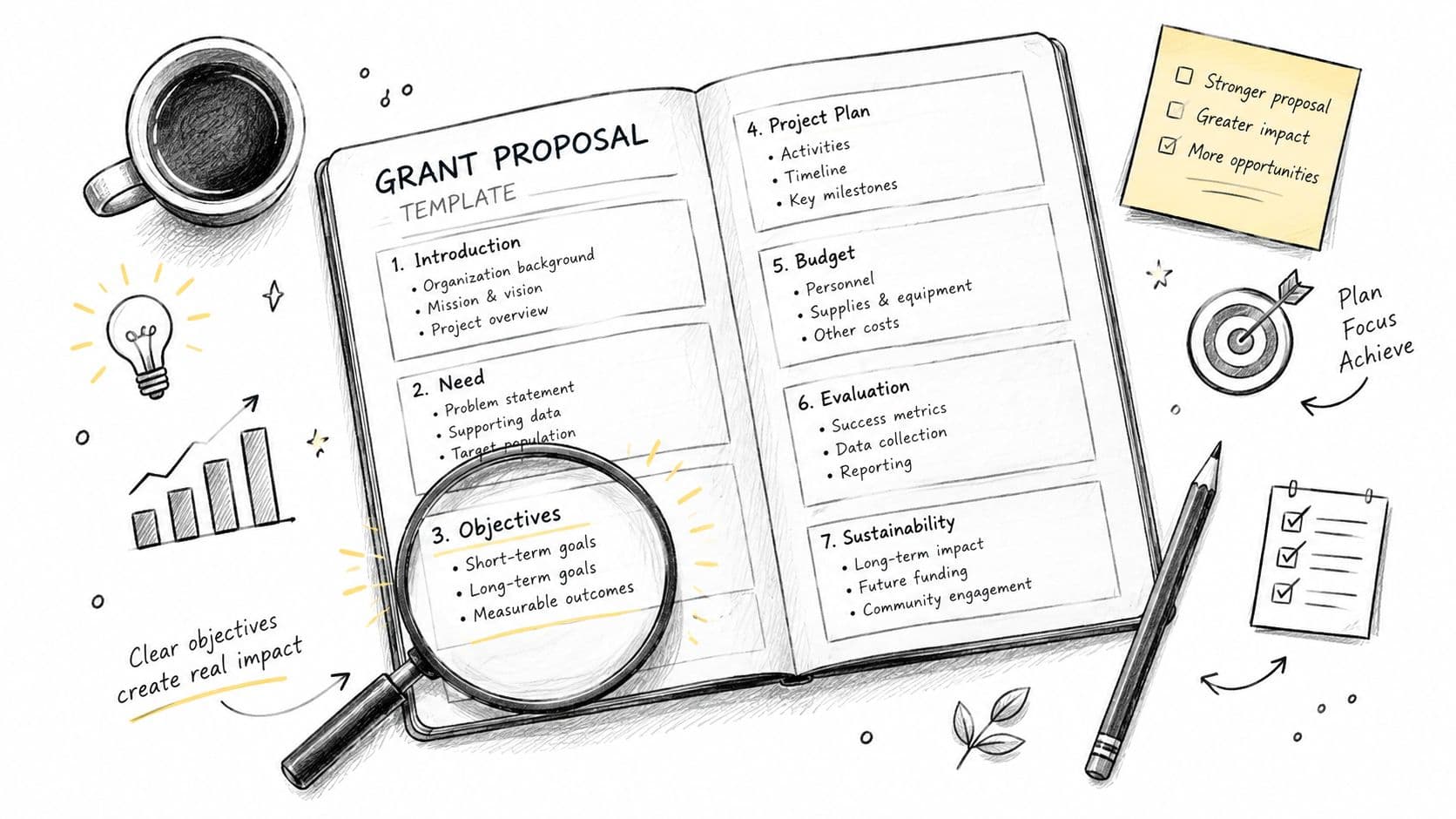
A sample grant proposal for a nonprofit organization is useful only when you know what to extract from it. Copying its language, budget, or outcomes can produce a polished application that still misses the target funder. The better approach is to identify the audience, map the problem to measurable objectives, inspect the methods and evaluation plan, and then convert the strongest structure into an editable template.
The seven resources below aren't interchangeable. Some provide real funded documents, others offer fictional teaching samples, and one functions mainly as a curated directory. For each, the practical question is the same: does this resource help you build a complete narrative, understand reviewer logic, align the budget, and adapt the result to your organization?
Before investing hours in drafting, research the prospect. Grantlas can help nonprofits review funder discovery, fit reasoning, eligibility flags, giving history, board context, and deadline alerts, so a sample is adapted for a plausible opportunity rather than used as a generic form.
Table of Contents
- 1. Candid Sample Documents Collection
- 2. NPGuides Full Private and Public Proposal Samples
- 3. Community Tool Box Example Grant Applications
- 4. NEH Sample Grant Application Narratives
- 5. Instrumentl Curated Successful Proposal Examples
- 6. The Digital Kit Annotated Nonprofit Proposal
- 7. GrantDraft Full Sample Proposal
- Comparison of 7 Sample Nonprofit Grant Proposals
- Turn Sample Language Into a Fundable Draft
1. Candid Sample Documents Collection
Candid's sample documents collection is the strongest first stop for writers who need to compare different grant documents rather than study one isolated proposal. The library includes real proposals, letters of inquiry, cover letters, and budgets from U.S. nonprofits, giving readers a view of how organizations present requests across stages of the funding process.
That breadth matters. A letter of inquiry has a different job from a full narrative, and a budget has to support the activities described elsewhere. Candid also connects many samples to proposal-writing and budgeting guidance, which makes the collection more useful than a folder of disconnected PDFs.
Candid's wider research context reinforces why historical comparison matters. Its Foundation Directory contains data on more than 16 million grants awarded since 2003, searchable by subject, population served, and geography, as described in Candid's giving statistics overview. That record can help a writer examine whether a proposed request resembles established giving patterns.
How to extract drafting value
Read each sample as a reviewer would, then annotate it with four questions:
- Funder audience: Who was expected to read this, and what priorities appear in the opening?
- Evidence: Which statements rely on local or organizational evidence, and which are assertions?
- Narrative sequence: How does the document move from need to activities, outcomes, and sustainability?
- Budget alignment: Can every major cost be traced to an activity in the narrative?
Candid's samples are authoritative and usually accessible without a login, but coverage isn't uniform. Some causes, organization sizes, and document eras may be missing, and older formats shouldn't be copied without checking the current application instructions.
Use the structure as a research scaffold, not a phrase bank. For related outreach language, compare the proposal with this guide to a sample letter of support for a grant, then create a fresh document whose claims come from your own records.
2. NPGuides Full Private and Public Proposal Samples
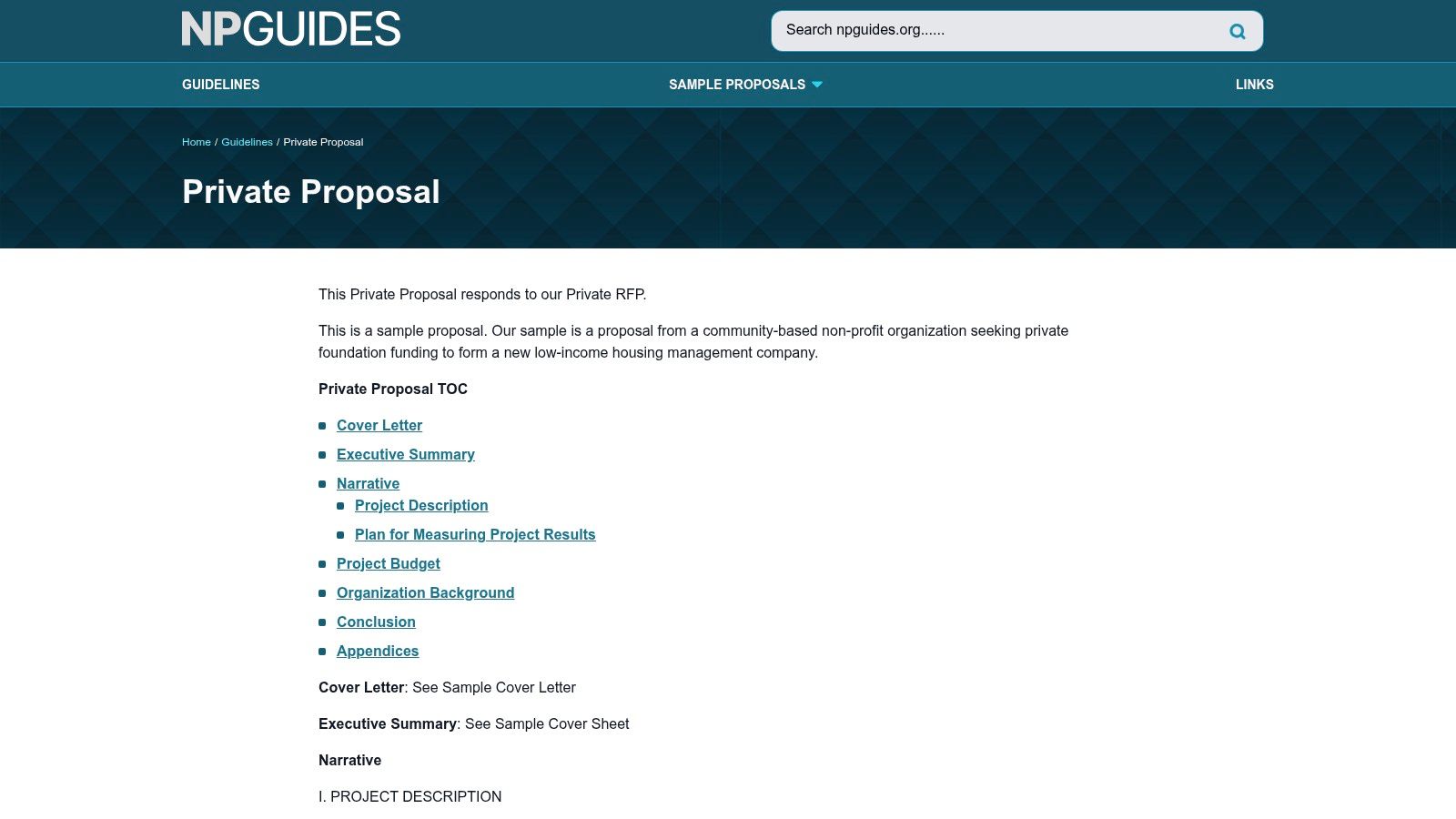
A complete sample can teach more than isolated paragraphs, but only if the writer examines its decisions rather than copies its language. NPGuides' full proposal examples provide two end-to-end models, one for a private foundation and one for a public agency. The collection also includes a cover letter, explanations of proposal components, and budget examples.
Its strongest drafting value is the side-by-side audience comparison. The private foundation example emphasizes concise fit and relationship context. The public agency example gives greater attention to formal requirements, attachments, implementation detail, and evidence. Comparing them shows how one organization's story can be reshaped for different review environments, including changes in emphasis, documentation, and compliance.
The samples are fictional teaching models rather than evidence of funded awards, and they lack reviewer annotations. Their language and formatting also feel dated. Those limits make them poor guides to current presentation standards, but useful maps of proposal architecture. A writer can trace the movement from need statement to objectives, activities, outcomes, and budget justification, then decide which elements belong in a current application.
Use the resource as a conversion exercise. For each section, record the information it communicates, the audience adjustment it makes, the level of evidence it uses, and the question an editable template should ask. A comparison table can separate private-foundation expectations from public-agency requirements without reproducing the article's wording.
Then replace the sample context with your mission, target population, service model, and documented capacity. A measurable objective still fails if your organization cannot track it or the funder does not permit that type of outcome. Check every proposed attachment, cost, and reporting commitment against the specific request for proposals.
Practical drafting path: outline the sample's sequence, label each section's purpose, insert your own evidence, connect costs to activities, and complete a compliance check before submission.
NPGuides earns strong marks for end-to-end visibility and beginner accessibility. It offers less help with current reviewer commentary, sector-specific terminology, and funder compliance. For a visual reference, NPGuides, full private and public proposal samples supports the private-foundation comparison. Use the finished outline as a starting template, not as proof that a request fits a particular opportunity.

3. Community Tool Box Example Grant Applications
The Community Tool Box example grant applications are useful because they show how a community-based nonprofit can turn a local problem into a service plan. The collection includes full narratives about a healthcare access clinic and a disability access or technology project. These are teaching models, not evidence that the programs received funding, so their value lies in structure rather than precedent.
Read them for the chain connecting goals, methods, timelines, and evaluation. A nonprofit writer can trace how the need leads to activities, how staff or partners deliver those activities, and how the organization documents results. That sequence provides a practical route from sample analysis to an editable program narrative.
The examples are older and cover limited sectors. Update dated language, replace general statements with current organizational evidence, and check terminology against the target funder's request. Housing, arts, and environmental organizations can adapt the reasoning, but should not treat these samples as guides to eligibility, required attachments, or funder-specific outcomes.
A useful review method is to annotate the sample before drafting. Mark each passage as Goal, Method, Timeline, or Measurement. Then create a worksheet that pairs every proposed activity with its milestone, responsible party, record, survey, assessment, or observation. Missing links become visible quickly. A goal without a method remains aspirational. A method without measurement leaves implementation difficult to verify. A budget item without a related activity needs reconsideration.
The collection's plain-language presentation makes it accessible to small and midsize organizations. It offers little reviewer annotation, recent federal context, or specialized technical guidance, so it works best as a narrative model rather than a complete submission blueprint.
The same problem-to-method sequence can support a focused letter of inquiry for a grant, provided the shorter document uses the organization's own evidence instead of compressing unsupported claims.
Financial assumptions also need a post-award test. The Bookkeeping and Accounting of Florida grant tips can help connect proposed costs and reporting expectations with later recordkeeping.
4. NEH Sample Grant Application Narratives
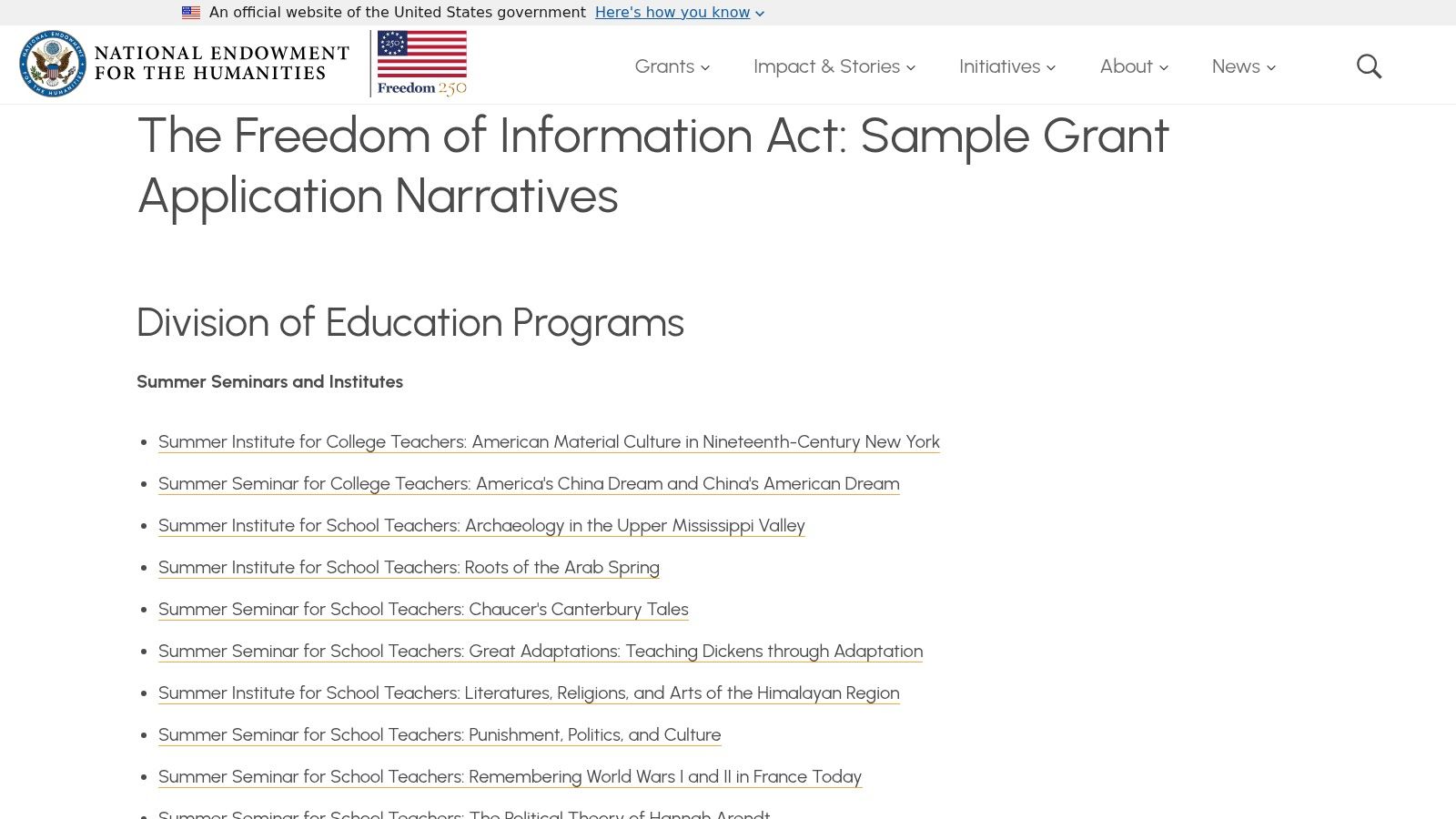
The National Endowment for the Humanities sample grant application narratives provide redacted narratives from successful applications released through FOIA, giving them evidentiary value that fictional teaching samples lack. The collection centers on humanities projects from nonprofit museums, libraries, and cultural organizations. Its drafting lessons still apply elsewhere because the narratives show how applicants translate program ideas into reviewable plans.
Their strongest practical value is the connection between activities, objectives, evaluation, and budgets. A nonprofit writer can examine how each funded applicant makes implementation visible: what happens, who is responsible, when the work occurs, and what evidence will show whether the intended result was achieved. The subject matter should be replaced, not copied. The sequence of reasoning is the reusable asset.
Extract the narrative logic
Read one document in layers. Mark passages as Need, Activity, Capacity, Evaluation, or Sustainability, then note where a paragraph serves more than one function. This produces a clearer route from source analysis to an editable nonprofit template: create matching headings, transfer only the logic that fits, and replace every specialized assumption with the organization's own activities, evidence, and language.
The collection also supports reviewer-focused editing. Flag dense prose, technical terms that hide public benefit, and program conditions that do not match the target opportunity. A successful federal narrative demonstrates fit with its original program. It does not establish that the same structure, evidence, or level of detail will satisfy another funder.
For practical drafting, NEH ranks high for real funded evidence, work-plan detail, and evaluation modeling. It ranks lower as a ready-to-edit template for small nonprofits without federal grant experience, particularly when a PDF is long or technically written. Writers should extract a short framework rather than imitate the document's scale.
5. Instrumentl Curated Successful Proposal Examples
A single “successful” proposal can mislead. Instrumentl's successful proposal examples are more useful as a comparison set, bringing together funded proposals, letters of inquiry, and examples from different sectors and funder types. The value lies in testing which drafting choices transfer across opportunities, rather than copying one model.
Review each sample for five practical signals: whether it presents a complete narrative, makes the applicant's capacity credible, connects activities to outcomes, explains the budget, and gives reviewers enough evidence to assess fit. Compare tone, length, use of research, and the balance between community need and organizational context. A government narrative may provide stronger work-plan detail, while a foundation letter may show how to state a case with less space.
Instrumentl's success-rate analysis reports average rates of about 43% to 46% across grant types and defines the internal calculation as grants won divided by grants submitted, as explained in its grant success-rate analysis. Treat that figure as a planning metric, not a forecast for one application. A weak internal rate can indicate poor prospect selection or eligibility screening, not only weak writing.
Build a reusable comparison record
For each document, capture:
- Sector and population: How closely does the service context match yours?
- Funder type: What expectations shape the proposal?
- Narrative sequence: How does it move from need to activities, outcomes, and evidence?
- Budget guidance: Are costs tied clearly to the work plan?
- Template value: Which headings, prompts, and transitions can become an editable nonprofit template without importing unsupported claims?
The collection is strongest for benchmarking and reviewer-focused editing. Pair its examples with eligibility checks and opportunity research, including grants for nonprofits. That step prevents a polished sample from directing effort toward an unsuitable funder.
6. The Digital Kit Annotated Nonprofit Proposal
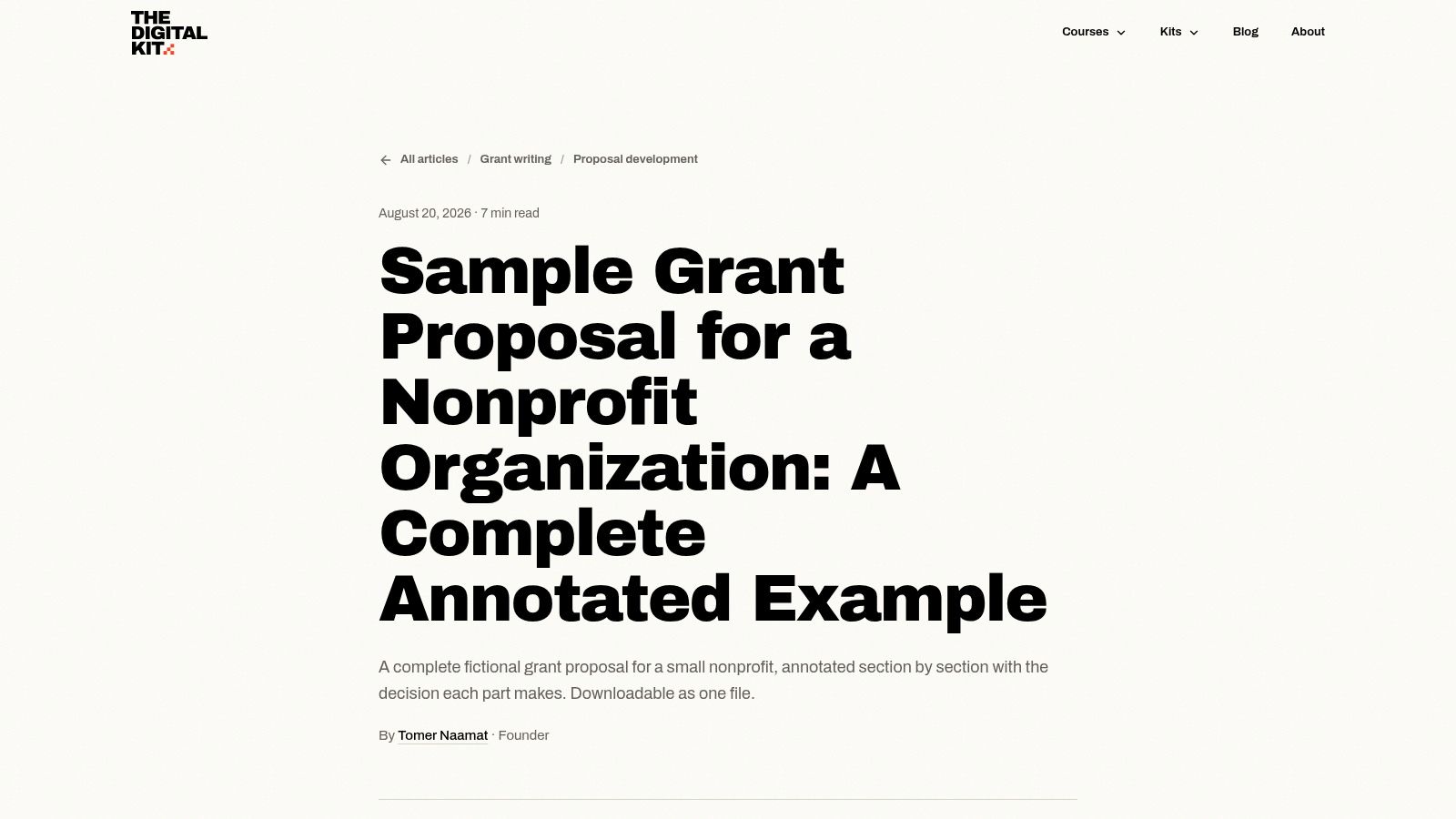
The Digital Kit's annotated nonprofit proposal is the clearest choice for writers who need to understand why a passage works. It presents a full fictional U.S. foundation proposal with margin notes that explain what each passage demonstrates to a reviewer, alongside a companion template organized around standard proposal sections.
The fictional status matters. This isn't a real funded submission, so it can't establish what a particular funder has approved. Its strength is instructional: the annotations make reviewer logic visible, especially around objectives, evaluation, budget justification, and sustainability.
Turn annotations into prompts
Read the sample once for flow. On the second pass, label every paragraph by its job. Then convert each margin note into a prompt inside your own working template.
For example, a paragraph that establishes organizational capacity can become a prompt asking for a documented example of relevant delivery, partnership, or financial management. A paragraph that states an objective can become a prompt requiring the target population, intended change, measurement method, and timeframe. Don't fill the prompt with a plausible-sounding claim until your staff can identify the record supporting it.
A fictional sample can teach you how to reason like a reviewer, but it can't supply evidence for your organization.
The nine-section companion template makes the resource easy to adapt for private or family foundation requests. Its limitation is the single program scenario. A food access nonprofit, arts organization, or youth service provider will need to transpose the logic rather than replace a few nouns.
The best output from this resource isn't a copied proposal. It's an editable document in which every section contains a drafting question, an evidence field, and a funder-fit note. That design reduces the temptation to borrow unsupported outcomes and makes later revisions easier.
For teams building branded outreach or presentation materials around the proposal, Wideo's nonprofit templates may help with supporting communications, but those assets shouldn't replace the evidence and compliance work in the application.
7. GrantDraft Full Sample Proposal
GrantDraft's nonprofit proposal example uses a recent, narrative-style fictional case involving a small youth-serving nonprofit. It walks through a cover letter, need statement, goals, methods, evaluation, budget narrative, and sustainability, with explanatory notes that identify what reviewers need to understand.
Its practical advantage is economy. The sample uses plain language and keeps outcomes and measurement visible without burying the reader in technical prose. That makes it a useful model for small and midsize organizations that need reusable boilerplate but don't want boilerplate to become vague.
The case is fictional and limited to one program setting. It shouldn't be treated as a funded-document benchmark or as a universal model for another sector. Its best use is to extract prompts and sentence functions.
Run a section-by-section extraction exercise
Copy the headings into a blank document, then perform three passes:
- Retain the prompt: Keep the question each section answers, such as why the need exists or how progress will be measured.
- Replace the case: Remove the sample population, activities, outcomes, and budget assumptions.
- Test for fit: Compare every sentence with the target funder's priorities, eligibility rules, requested format, and evaluation expectations.
The final test is whether a reviewer can distinguish your organization's actual evidence from generic nonprofit language. Replace broad descriptions with approved internal records, current service information, and a budget that reflects the activities you've written.
GrantDraft is strongest as a first-draft accelerator. It's weaker for sector diversity and real funded evidence, so pair it with a source such as Candid or NEH when you need to study documents that passed an actual funding process.
Teams turning extracted language into a broader communications system can also review Contesimal's proposal-paper topic guidance, while keeping the grant narrative matched to the application rather than to general content marketing.
Comparison of 7 Sample Nonprofit Grant Proposals
| Resource | Implementation complexity | Resource requirements | Expected outcomes | Ideal use cases | Key advantages |
|---|---|---|---|---|---|
| Candid, Sample Documents Collection | Low–Medium: browseable samples; annotation adds effort | Minimal: free access to many items | Broad view of real funded documents; reusable language for templates | Comparative starting point for mapping document types and funder fit | Authoritative curation, many real funded samples, linked guidance |
| NPGuides, Full Private and Public Proposal Samples | Low: complete end‑to‑end models; conversion to modular templates requires moderate work | Minimal: downloadable examples | Full-length proposals illustrating private vs public framing | First-time proposal writers needing end‑to‑end examples | Complete proposals for both funder types; plain‑English section explanations |
| Community Tool Box, Example Grant Applications | Low–Medium: practical narratives but may need modernizing | Minimal: open web access | Practitioner-focused proposals linking goals, methods, timelines, evaluation | Small-to-midsize community nonprofits building program proposals | Concrete, practitioner narratives and strong structure for goals→methods→evaluation |
| NEH, Sample Grant Application Narratives | Medium–High: detailed federal narratives require careful adaptation | Minimal (FOIA PDFs) but time‑intensive review | Models of reviewer‑facing objectives, work plans, evaluation, budgets | Applicants to federal or similarly rigorous review contexts | Real funded federal narratives; strong modeling for evaluation and sustainability |
| Instrumentl, Curated Successful Proposal Examples | Low: aggregation hub; benchmarking requires comparing linked examples | Minimal: single page links to external samples (quality varies) | Benchmarks for tone, length, evidence across sectors | Early‑stage research and cross‑sector comparison | Time‑saving aggregation and broad sector coverage |
| The Digital Kit, Annotated Nonprofit Proposal | Low–Medium: annotated sample simplifies learning; mapping annotations to templates takes work | Minimal: sample + companion template | Clear reviewer‑logic understanding; prompts for editable templates | Learning reviewer‑oriented writing and structure | Line‑by‑line annotations that explain why passages work |
| GrantDraft, Full Sample Proposal | Low: modern, concise example with section notes; extraction exercise recommended | Minimal: single modern example | Reusable boilerplate and concise outcome/measurement language | Small/midsize nonprofits creating boilerplate and measurement text | Plain‑language, modern formatting focused on outcomes and measurement |
Turn Sample Language Into a Fundable Draft
The strongest sample grant proposal for a nonprofit organization isn't necessarily the longest document or the most polished template. It's the resource that helps your team make defensible decisions about fit, evidence, activities, evaluation, and cost. Real funded narratives are valuable for seeing what survived review, while fictional annotated samples are often better at explaining the reasoning behind each paragraph.
Use a repeatable workflow:
- Choose one complete sample: Start with Candid, NPGuides, Community Tool Box, NEH, or another resource whose funder type resembles your opportunity.
- Annotate every section: Write down the purpose of each passage, the evidence it uses, and the reviewer question it answers.
- Verify eligibility and alignment: Check geography, applicant status, program scope, funding purpose, attachments, and submission requirements before drafting.
- Replace borrowed claims: Remove sample statistics, populations, outcomes, and budget assumptions. Insert evidence your organization can document.
- Connect activities and costs: Every major activity should have financial support, and every significant cost should be explained in the narrative.
- Save a versioned template: Preserve the prompts, evidence fields, and revision notes so the next application starts from a tested structure without carrying forward stale claims.
Targeting deserves equal attention. Foundation success rates commonly fall around 15% to 30% of applicants, while nonprofits win roughly 25% of federal applications overall, and highly competitive NIH and NSF programs often fund only 13% to 25% of proposals, according to GrantWatch's grant-odds summary. Those differences make prospect selection part of proposal quality, not a separate administrative task.
Program-specific variation can be even wider. An analysis of National Endowment for the Humanities nonprofit-project proposals reported an overall success rate of about 16%, with program-level rates ranging from roughly 6% to 40%, as described in this study of NEH grant proposals. A strong template can't compensate for a poor match.
Funders' expectations are also shifting. Recent reporting says general operating support reached 38% of grants in 2025, compared with a long-running norm of about 20%, while nearly 40% of foundations simplified application and reporting processes and 42% made more unrestricted grants, according to Inside Philanthropy's coverage. That means your template should include both a project-request version and a capacity or unrestricted-support version. The latter still needs specificity, including the organizational function supported, the problem it enables you to address, and the evidence of responsible use.
Data volatility demands the same discipline. An independent analysis reported that direct federal grants to 501(c)(3) charities fell to $36.3 billion from $43.5 billion in FY2024, a 16.5% decline, with the post-transition window down 40.9% from February 1 to September 30, as reported by Granted AI's analysis. If your service counts, target population, or funding mix changed, rebuild the need statement and outcome framework instead of recycling last year's figures.
Grantlas can support that front-end work by helping you prioritize suitable private foundations and federal opportunities, review plain-English fit reasons and automatic mismatch flags, inspect giving history and board context, and track saved searches, digests, reminders, and deadlines before you commit to a full application.
Grantlas helps nonprofits find private foundations and open federal grants, then ranks prospects with fit reasoning, eligibility flags, giving history, and deadline tools. Use it to identify the right opportunity before adapting one of these samples, and visit Grantlas to build a focused funder shortlist.