How to Write a Grant Proposal That Actually Wins Funding
Oct 19, 2026 · 11 min read
A 2025 Canadian survey found that 27% of charities spend 16–30 hours on each grant application, while another 9% spend at least 30 hours. Yet only 28% reported a high success rate, and almost 40% succeeded on half or fewer of their applications (Canadian survey on grant writing). The lesson isn't to write faster. It's to stop spending serious time on opportunities your organization was never well positioned to win.
How to write a grant proposal that earns funding starts before the first draft: decide whether to apply, learn what the funder evaluates, and calculate what winning will require. Then write a focused execution plan, not a general appeal for support. A persuasive proposal connects the funder's criteria to your activities, outcomes, budget, and ability to deliver.
Table of Contents
- Why Most Grant Proposals Fail Before the Writing Starts
- A Go or No-Go Framework Before You Open a Document
- Researching the Funder and Extracting Their Scoring Criteria
- Writing Each Section to Match the Reviewer's Criteria
- Building a Budget That Holds Up to Scrutiny
- The Hidden Cost of Reporting, Evaluation, and Restricted Funds
- The Pre-Submission Checklist That Catches the Easy Rejections
Why Most Grant Proposals Fail Before the Writing Starts
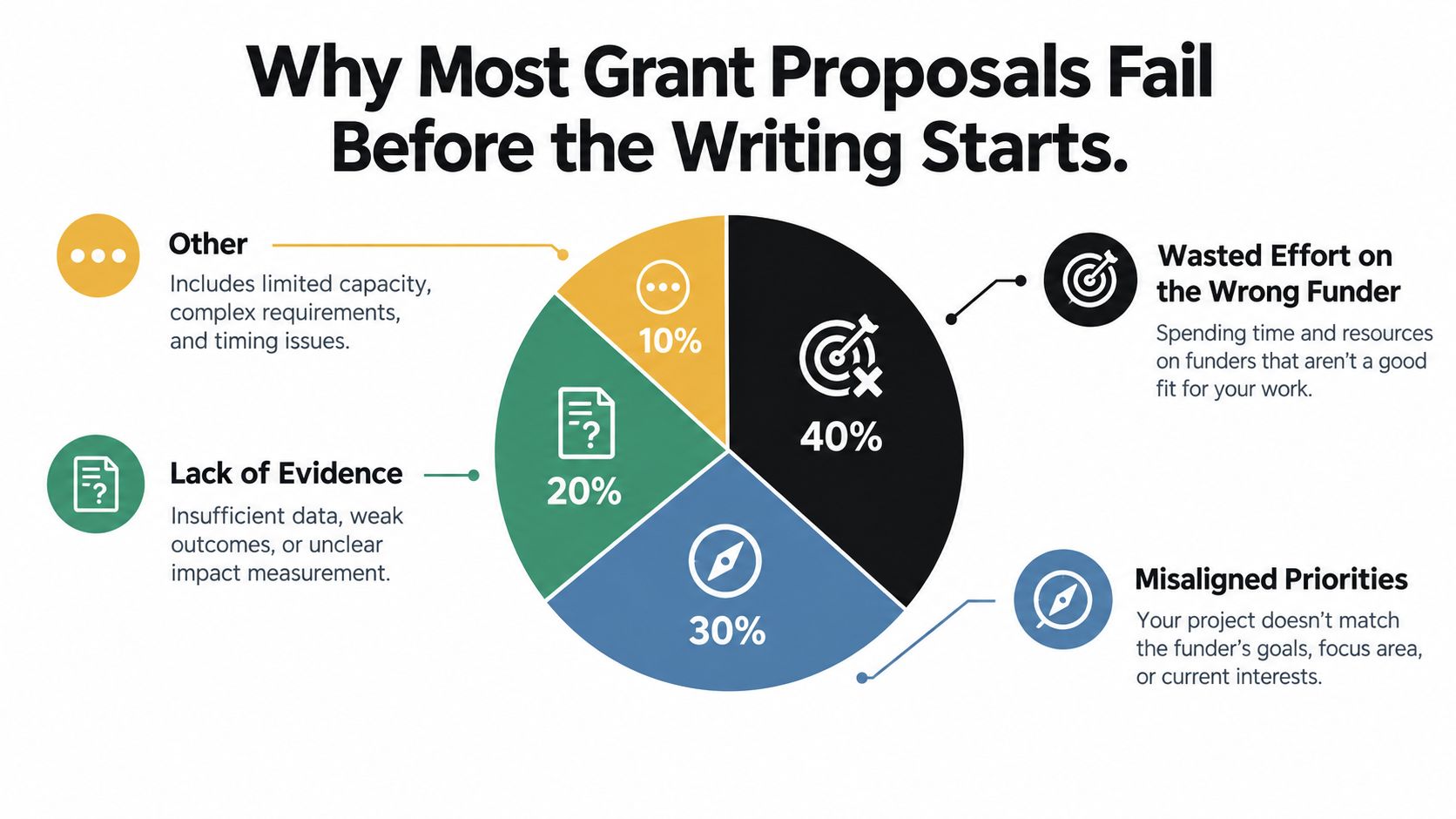
Better prose cannot fix a poor match. I have seen clean, moving applications die in review because the funder did not support the applicant's geography, population, project type, or stage of work. Narrative-first advice teaches polish. It does not tell you whether the opportunity deserved the hour cost.
That cost is concrete. When staff capacity is tight, a weak-fit application pulls people from stronger prospects, program delivery, and funder relationships. The team spends its best energy proving fit it never had, then enters the next cycle tired and behind.
The strategic shift: Judge a pursuit by eligibility, alignment, odds, and post-award workload, not by the prestige of the funder's name.
Start with evidence, not hope. Confirm that you qualify, that the funder has backed work like yours, and that the deadline leaves room for an approved submission. Then price the win: reporting, evaluation, restricted spending, and the staff time those obligations will consume. For organizations also weighing European funding, ELECTE spiega i fondi strutturali shows how fit rules differ by funder type.
A template can organize a credible application. It cannot make an ineligible project eligible or turn a funder's indifference into alignment. Decide first. Write when the evidence says yes.
A Go or No-Go Framework Before You Open a Document
A go/no-go decision should be defensible, not instinctive. Rate each opportunity against six factors: eligibility certainty, alignment with the funder's giving, openness to new applicants, award relative to effort, deadline feasibility, and probability-adjusted value. Use a simple scale, but treat hard eligibility rules as gates. If you don't qualify, stop.
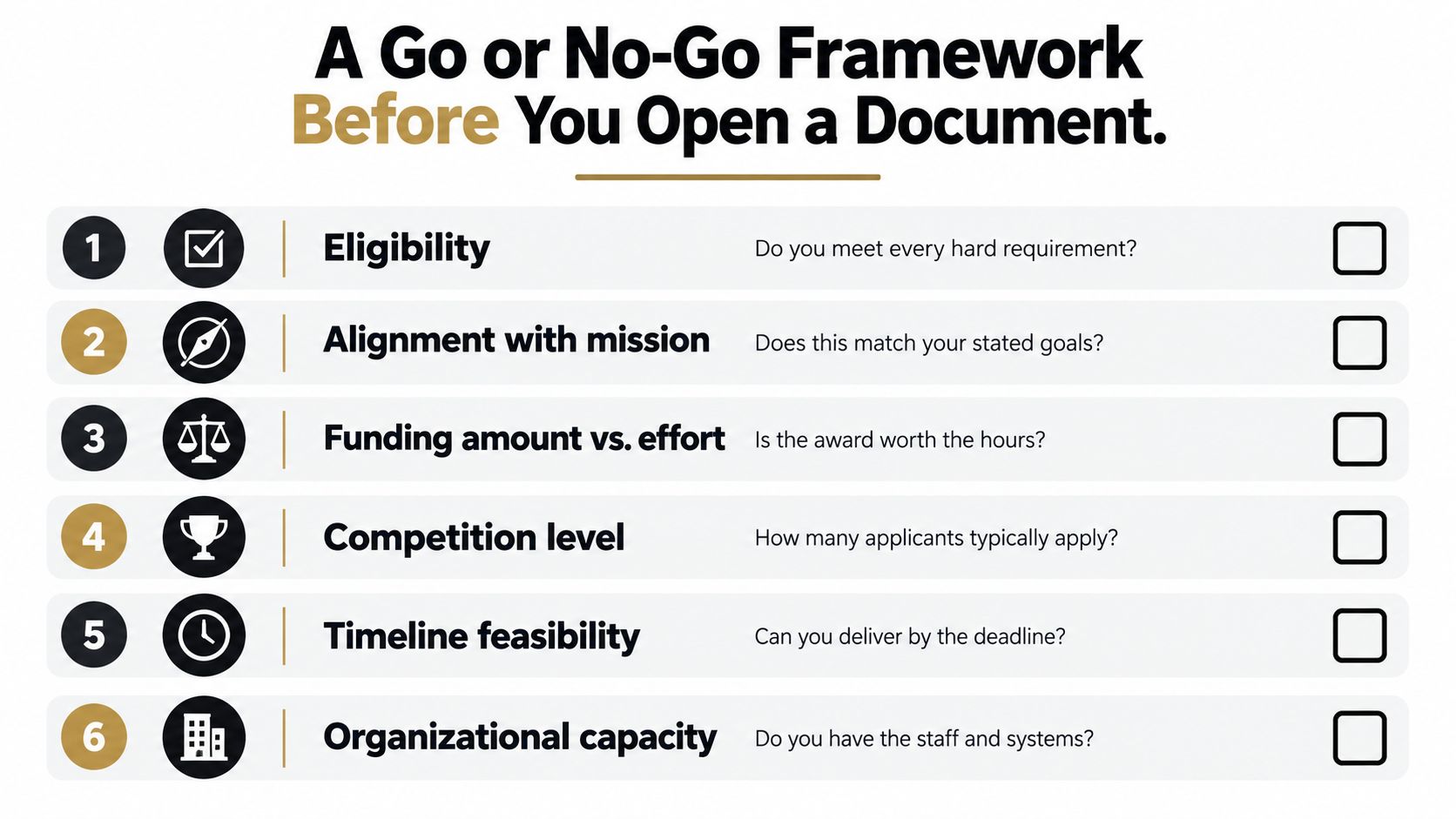
| Factor | What to check | Decision signal |
|---|---|---|
| Eligibility certainty | Do you meet every requirement? | Any hard mismatch means no-go. |
| Giving alignment | Has the funder supported work like yours? | A clear connection strengthens the case. |
| Openness to new applicants | Does its history suggest new organizations can enter? | An invitation-only pattern demands a different strategy. |
| Award relative to effort | Is the likely funding worth preparation and delivery time? | Consider the full workload, not the headline amount. |
| Deadline feasibility | Can you produce a complete, approved submission on time? | A rushed application often creates avoidable errors. |
| Probability-adjusted value | Is the realistic prospect of funding worth the cost of applying? | Compare against other uses of staff time. |
Consider a small community-arts nonprofit choosing between a prestigious national foundation and a regional funder with a record of supporting similar organizations. The national opportunity may offer greater visibility, but suppose its eligibility is uncertain, it rarely funds first-time applicants, and its application demands extensive partner documentation. The regional prospect may be less prominent yet closely aligned, accessible to new applicants, and more manageable for the team. Even without inventing a win-rate estimate, those factors make the regional application the stronger use of limited capacity.
For a practical way to organize ownership, approvals, and deadlines, borrow a project management framework. Grant research should lead to a short, ranked pipeline, not an endless list. If you're building that pipeline, start with prospects suited to grants for nonprofits.
Researching the Funder and Extracting Their Scoring Criteria
A prospect that passes your go/no-go screen can still produce a losing proposal if you write it against the wrong rubric. Reviewers score against published criteria, and most rejected drafts answered questions the applicant never bothered to copy down. Read the solicitation the way a reviewer will read your submission: as a checklist of scored items, not an invitation to tell your story.
Build a one-page funder brief
Pull these items into a single working document before anyone opens a draft:
- Eligibility: applicant type, geography, population served, partnership requirements, and any other stated restriction.
- Required deliverables: every narrative section, attachment, approval, and budget component.
- Scoring criteria: copy each criterion word for word and note the evidence that would earn points against it.
- Format and submission rules: page limits, templates, file requirements, and the submission system.
- Funding history: past grantees, award sizes, public filings, board or trustee listings, and whether the funder supports first-time applicants.
Two things fall out of this exercise. You learn whether your evidence matches the rubric, and if the criteria demand outcomes you cannot measure, that is a no-go signal that polished prose will not fix. You also end up with a checklist the finished draft can be audited against before submission.

The National Science Foundation shows what criteria-led review looks like in practice. NSF evaluates proposals against two National Science Board-approved criteria: intellectual merit, the potential to advance knowledge, and broader impacts, the potential to benefit society (NSF proposal processing and review). Its project summary requires an overview plus separate statements addressing each criterion, which forces applicants to answer the scored questions where reviewers can find them.
Private foundations rarely publish rubrics that explicit, so reconstruct theirs from guidelines, past awards, and repeated language in annual reports. A funder that mentions community reach in every filing is telling you what reviewers will weigh. Match your evidence to their criteria, or move to the next prospect on your ranked list.
Writing Each Section to Match the Reviewer's Criteria
The criteria-led review model described above applies to narrative sections as well. Reviewers score what they can find quickly, so each part of the proposal should answer a definite prompt with evidence, an owner, and a result. If a draft cannot produce those three things for a scored section, treat that as a leftover go/no-go problem. Better prose will not rescue a missing measure or an unnamed responsible lead.
Write the criterion at the top of each drafting file before you compose the section. Then delete every sentence that does not help a reviewer check that box.
| Proposal section | Reviewer prompt answered | Common mistake |
|---|---|---|
| Problem statement | What need or knowledge gap does this project address? | Describing organizational hardship without defining the problem |
| Objectives | What will the project accomplish? | Using broad aspirations instead of assessable objectives |
| Methods and activities | How will the work happen, and why is this approach credible? | Listing activities without linking them to outcomes |
| Timeline | Can the team complete the work within the grant period? | Leaving milestones or dependencies unclear |
| Evaluation plan | How will the team know whether it worked? | Promising impact without identifying measures |
| Organizational capacity | Who will deliver the work, and what resources are available? | Claiming readiness without evidence or named responsibility |
| Broader benefits | Who benefits, and what wider outcomes may result? | Making sweeping claims disconnected from the project |
Draft in the order of the argument
Start with the problem statement. Name who is affected, what is changing, and why action is justified now. Use evidence your organization can defend if a program officer asks for the source. Weak drafts often spend paragraphs proving the applicant is busy; strong drafts prove the problem is specific enough to solve.
State objectives so a reviewer can test them. Each one should identify the target group, the expected result, and the point at which progress can be judged. “Expand access” gives reviewers nothing to score. A defined population, service level, and endpoint give them a standard.
In methods and activities, connect work to objectives one by one. Say who performs each activity, which partner is committed, what resource is required, and why the approach fits the setting. The timeline should expose sequencing and dependencies, including approvals, recruitment, data collection windows, and reporting dates. An activity with no owner reads as risk.
The evaluation plan should name measures, collection methods, frequency, and decision use. The capacity section should map staff expertise, facilities, partner roles, and available systems to the actual workload. For broader benefits, stay disciplined: claim only the wider effects your project can plausibly influence, and show the line from deliverable to outcome.
A strong proposal makes scoring easy because the answer to each criterion is explicit, supported, and consistent across the narrative. For a related lens on organizing a persuasive request, see this guide to a structure for proposals clients can't ignore.
Building a Budget That Holds Up to Scrutiny
The budget is a second version of the work plan. Reviewers must be able to trace every major cost to an activity or deliverable, and they must be able to find the same activity in the narrative. A neat spreadsheet can't rescue a budget that leaves out the people, data collection, or administration required to carry out the project.
Cost the real work
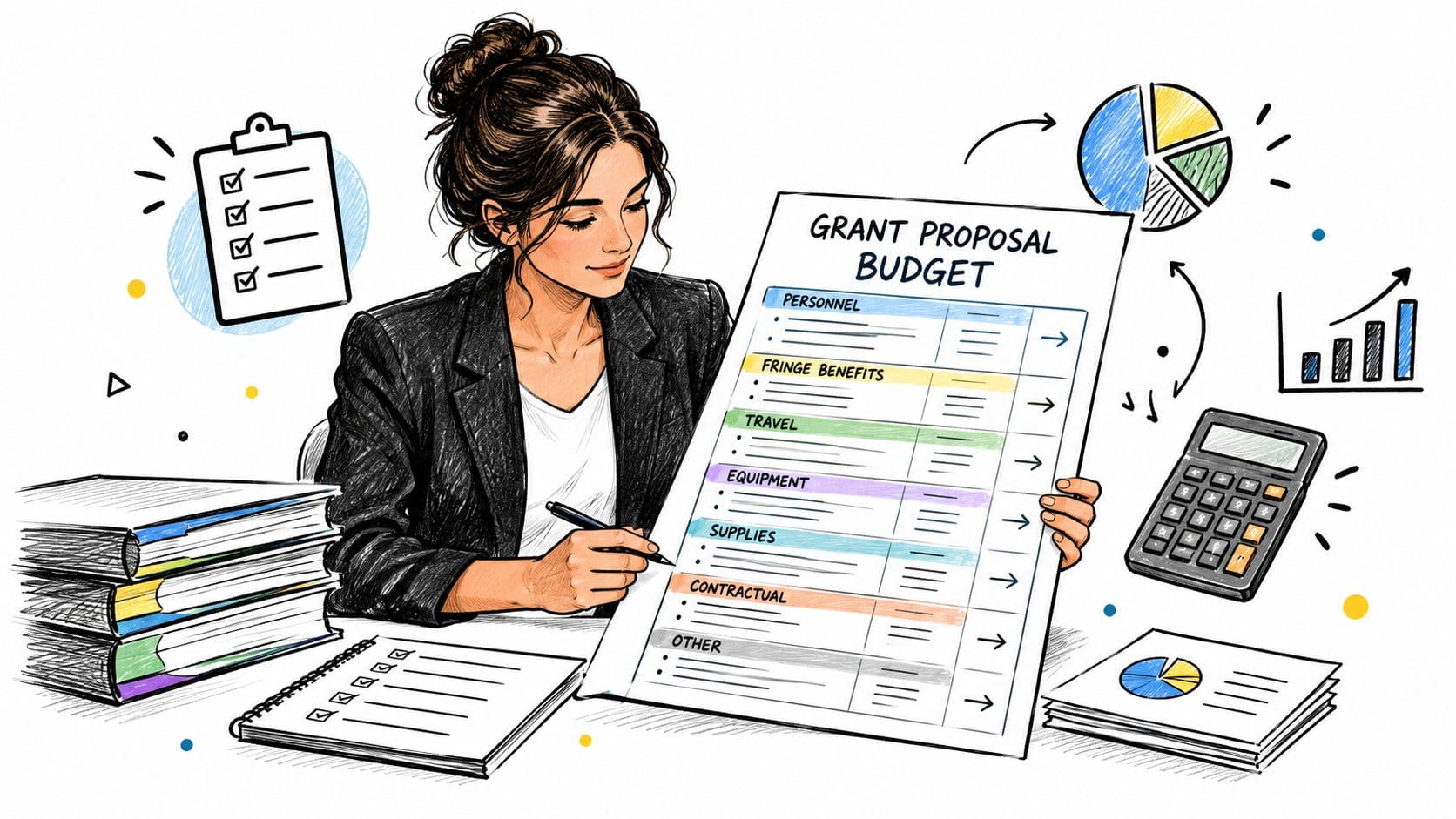
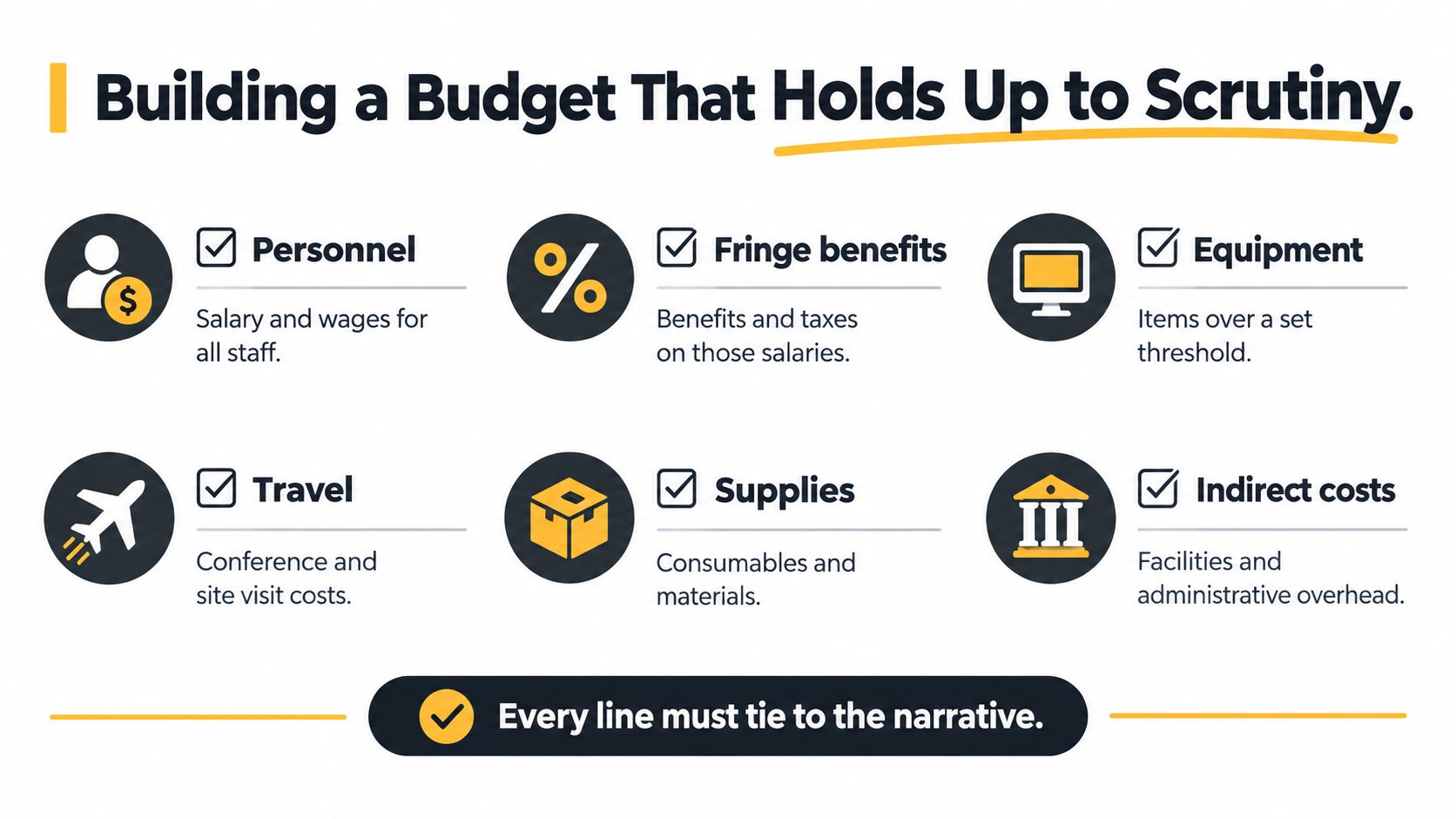
Begin with personnel. Specify who will work on the project, what they'll do, and how their time relates to the proposed activities. Include fringe benefits according to your organization's applicable rates and policies. Don't hide delivery work in vague categories or assume existing staff can absorb a new project without consequences.
Then account for equipment, travel, supplies, partner agreements, and indirect costs. Follow the solicitation's rules for allowable expenses, thresholds, and cost treatment. If your organization uses an approved indirect-cost rate, apply it as permitted; if the funder imposes a different rule, follow that rule and make the treatment clear.
Give each cost a narrative
The budget justification should explain why each requested cost is necessary. Connect staff time to responsibilities, travel to a project purpose, equipment to a specific activity, and partner funding to an agreed role. The methods and budget must tell the same story, including who will perform evaluation and data collection.
Budget test: If a reviewer can't identify the activity behind a cost, explain the cost in plain language before submission.
Budgeting for evaluation and reporting matters, too. A project may need staff time to gather information, review results, prepare reports, and coordinate with partners. Leaving that work out doesn't make it disappear; it shifts the burden onto an organization that may already be stretched.
Use a grant proposal budget template as a starting point, not a substitute for the funder's instructions. Check each line against the solicitation, organizational policy, and proposed activities. Flag assumptions clearly, and don't promise a scope the requested funds can't support.
The Hidden Cost of Reporting, Evaluation, and Restricted Funds
A grant is revenue with a price tag attached. The headline amount tells you what the funder will pay; it says nothing about the staff hours, reporting cycles, and spending restrictions you'll absorb to keep it. I've watched organizations celebrate awards that cost more to administer than they delivered in usable funding.
The compliance load is heavier than applicants assume. The 2025 National Study of Philanthropic Practice found that 68% of grantmakers still require interim reports for multiyear grants, often with no added funding for that work. The strain runs both directions: Nonprofit Finance Fund's 2025 survey reported that 44% of respondents considered the application process too onerous and 14% said the award didn't fully cover the work it required.
Price the obligations before you accept
Treat every application as a cost-benefit decision, not a writing exercise. Before you commit, pin down the reporting cadence, evaluation expectations, spending restrictions, and renewal terms. Where the guidelines stay vague, ask the program officer directly. Then run the math: estimate the staff hours reporting and evaluation will consume, apply your real cost per hour, and subtract that figure from the award. The remainder is what the grant is worth to you.
Restricted funds work well when they bankroll a project you already planned to run. They become a drain when delivery demands unfunded administration the award won't cover. Flexible or multiyear support usually produces a better return, provided the reporting terms stay manageable.
The blunt rule: take the grant your organization can deliver without subsidizing it from operating reserves, even when a bigger award sits on the table.
Build your compliance estimate around monitoring work your team can realistically execute. A grant evaluation and monitoring approach that fits both the funder's requirements and your staffing capacity keeps reporting predictable after the money arrives.
The Pre-Submission Checklist That Catches the Easy Rejections
A persuasive proposal can still fail on execution. Missing documents, incorrect formatting, incomplete approvals, or a submission that never reaches the funder can undo strong project design. Treat submission as a managed handoff, not a last-minute upload.
NSF gives applicants a minimum of 90 days from a funding announcement to prepare and submit a proposal (NSF funding overview). That example reinforces a practical rule: work backward from the deadline and reserve time for review, revisions, and system submission. Don't let the final days become the first time your organization checks every attachment.
Run the checks in sequence
- Reconfirm the opportunity rules. Check eligibility, required sections, page limits, templates, allowable costs, and submission instructions against the current solicitation.
- Lock the scope and roles. Make sure the project fits the grant period and staffing plan. Confirm partner responsibilities and secure their approvals before the narrative depends on them.
- Review the narrative against the criteria. For each evaluation point, identify the exact passage that answers it. Check that objectives, activities, outcomes, and measurements agree across the proposal.
- Verify the budget. Reconcile figures with the narrative, confirm that cost categories follow the funder's rules, and ensure the request covers the work you've promised.
- Check every file. Confirm that attachments are complete, current, correctly named, and within format and page requirements. Collect required signatures and institutional approvals.
- Upload and confirm. Submit with enough time to resolve system problems. Verify that the system records the submission and retain the confirmation for your files.
Build a buffer into the calendar for internal review and partner sign-offs. Your final reviewer should not be the person who wrote every section; a fresh reader can catch missing logic, contradictions, and unclear claims more easily. Keep a definitive checklist that assigns each task to a named owner.
The decision rule is simple: apply only when the fit is clear, the work is feasible, and the expected value justifies the full cost of applying and delivering. Before drafting, answer three questions: Are we eligible? Does this funder support work like ours? Can we afford the workload if we win? Then test the proposal's logic: does every activity support an objective, and does every outcome have a measurement? Finally, check whether the award pays for the work and the obligations that come with it.
Grantlas helps nonprofits identify prospective funders and open grant opportunities, then pairs a scored shortlist with plain-English fit reasoning and flags for issues such as eligibility, geography, and grant size. Build a more deliberate funding pipeline before committing staff hours to the next proposal, and explore Grantlas to find opportunities that fit your organization.