Grant Proposal Budget Template: A Complete Guide
Sep 25, 2026 · 12 min read
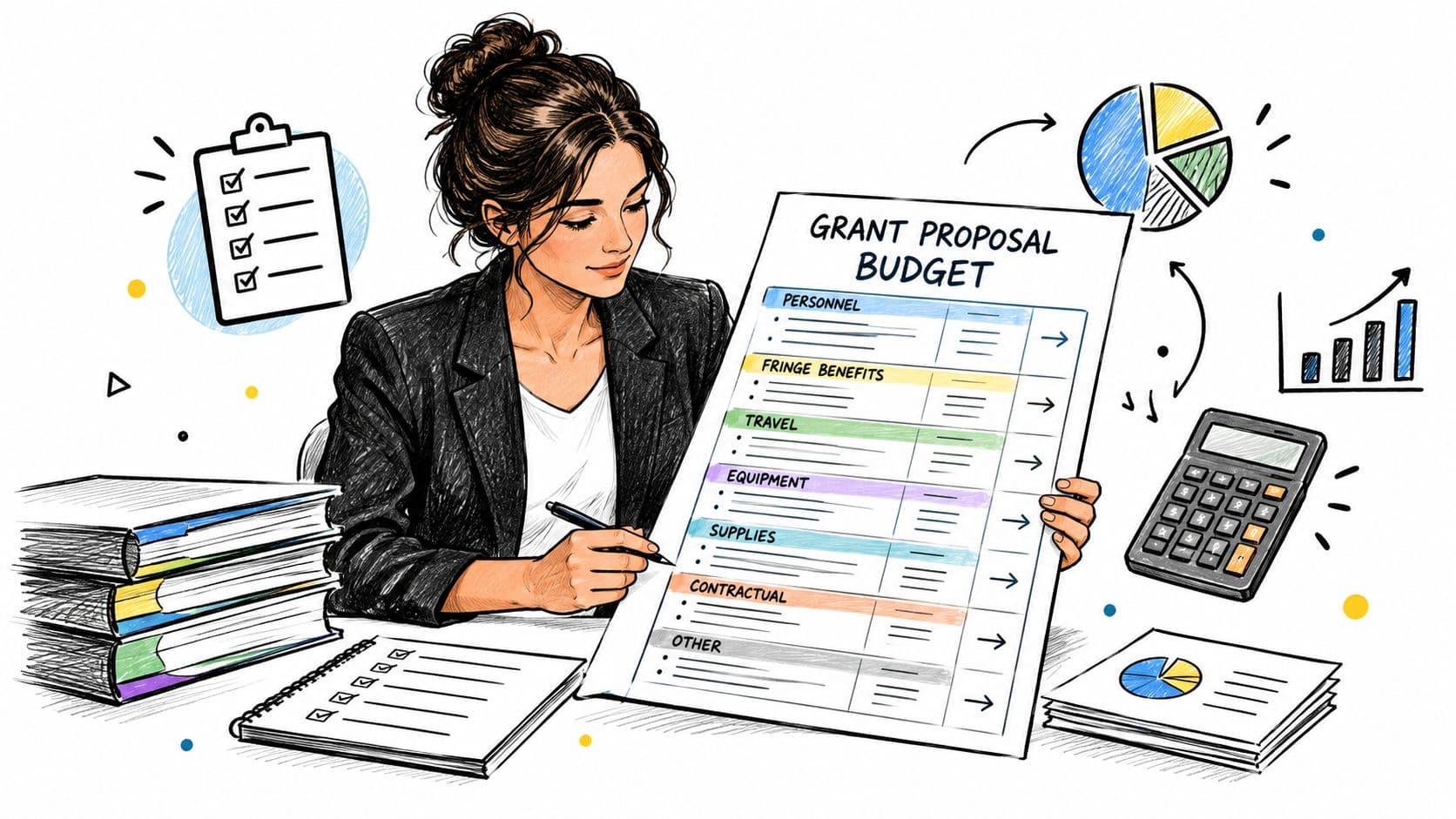
A strong grant proposal budget template is a compliant, line-item spreadsheet with a matched narrative, not a decorative table. Federal guidance expects direct costs itemized by category, indirect costs separated, and the budget narrative written after the spreadsheet so reviewers can verify the numbers quickly.
That's the difference between a budget that just “looks organized” and one that can survive review. If the math is clean but the categories are off, or the narrative wanders away from the spreadsheet, the proposal can stumble before anyone gets to the program story.
Table of Contents
- Why a Grant Proposal Budget Template Is a Compliance Document
- Understanding Grant Budget Categories and Cost Principles
- How to Build a Line-Item Budget in the Right Order
- Federal Templates Versus Private Foundation Formats
- What Reviewers Actually Check in Your Budget
- Using Funder Research Tools to Strengthen Budget Planning
- Building a Multi-Year Federal Budget Example
- Common Budget Mistakes That Hurt Competitiveness
- Final Budget Verification Checklist Before Submission
Why a Grant Proposal Budget Template Is a Compliance Document
A weak budget can sink a strong proposal fast. A reviewer opens a polished narrative, then lands on a budget that mixes staff time, overhead, and project costs in one blob, and the application suddenly looks underdeveloped.
A grant proposal budget template works because it forces the writer to show the logic behind every dollar. Federal guidance expects direct costs to be itemized in clear categories, subtotals to roll up cleanly, and the narrative to come after the budget so the justification reflects the final numbers, not a draft version. That's why compliance as strategic advantage is more than a business slogan, it's the reason budgets win trust.
Practical rule: if a reviewer has to guess what a number means, the budget is already working against you.
Why the structure matters
The OJP guidance is explicit that the narrative should be written after the budget is complete, and Grants.gov instructions require applicants to use the opportunity's Excel-based budget template, keep the category structure intact, and add as many rows as needed to show all project costs. For multi-year awards, the template may call for a separate tab for each year, and in one example opportunity applicants were told to propose the same total dollar amount for each of the five years, even when line items changed. That's not just formatting, it's a compliance rule that keeps costs readable, auditable, and aligned with award conditions, as described in the OJP budget guidance.
The practical takeaway is simple. Don't treat the budget as a late-stage spreadsheet exercise. Treat it as a document that proves the request fits the funder's rules, the project scope, and the reviewer's need for fast verification.
Understanding Grant Budget Categories and Cost Principles
Misclassifying costs is one of the fastest ways to damage a budget. Personnel belongs in personnel, equipment belongs where the sponsor allows it, and shared overhead shouldn't be disguised as a project expense just because the project needs money.
Direct costs and indirect costs are not interchangeable
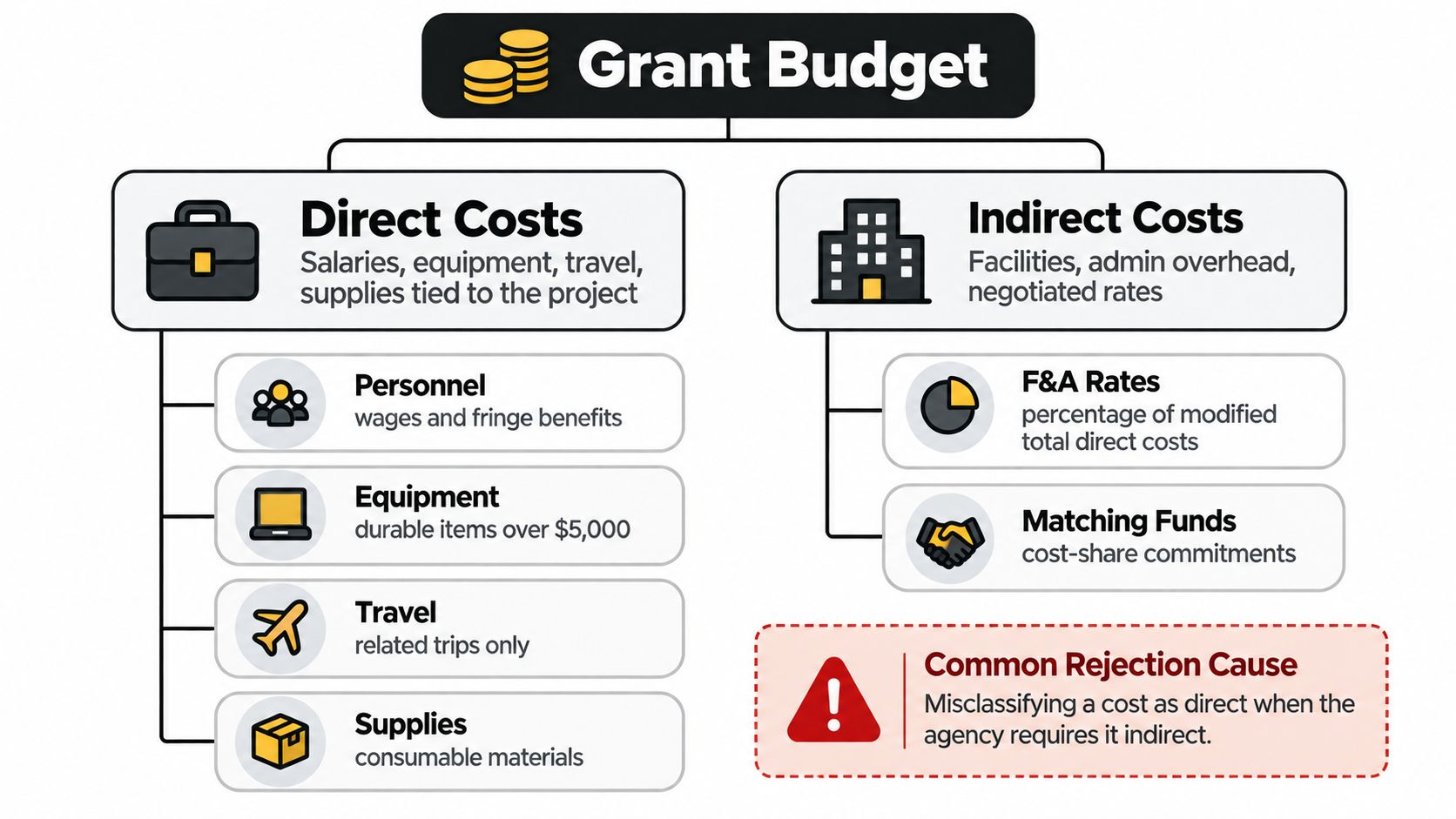
NIH guidance defines direct costs as expenses that can be identified specifically with a sponsored project. Universities usually describe indirect costs or Facilities and Administrative costs as shared overhead, things like electricity, building maintenance, libraries, and administration that can't be traced to one project with high precision. That distinction matters because a reviewer is looking for a budget that shows clean boundaries between project spending and organizational overhead, as explained in the NIH budget guidance and the federal categories summarized in CRS budget guidance.
The line-item categories that most often appear in successful templates are familiar, but they have to be handled carefully:
- Personnel for staff salaries and wages tied to the project.
- Fringe benefits for payroll taxes, insurance, and retirement.
- Equipment for durable items the sponsor allows.
- Supplies for consumable materials.
- Travel for project-related trips only.
- Consultant fees for outside expertise with a defined scope.
- Software when the sponsor allows the cost and it serves the project.
- Subawards or subcontractors when partner organizations carry part of the work.
A good template keeps those lines separate because each one raises a different review question. Is the cost necessary? Is it reasonable? Is it allocable to the project? Those are the questions that shape whether the budget feels disciplined or improvised.
Cost share belongs in the picture when it's required
Federal instructions also state that budget estimates should include all project costs, whether paid with federal, non-federal, or third-party funds, and cost-sharing amounts must be included when required. A strong template doesn't hide match or bury overhead inside a vague "other" line. It makes the funding structure visible, which is exactly what reviewers want when they're checking whether the proposal reflects the true cost of delivery.
A budget that separates shared overhead from project-eligible spending is easier to defend, easier to audit, and harder to misread.
For grantseekers who also handle capture work, the same discipline shows up in articles for capture managers, where the structure of the cost story matters as much as the total.
How to Build a Line-Item Budget in the Right Order
The most common drafting error is starting with the narrative and forcing the budget to fit it later. That usually creates mismatches, because the story sounds neat on paper while the numbers still need reality checks.
Build the spreadsheet first
Start with the detailed line items. Put each cost in a named category, give it a calculation, and make sure the amount is traceable. Only after that should you total the sheet and write the justification.
That sequence protects you in two ways. First, it keeps the math from drifting when you revise scope. Second, it lets the narrative mirror the same order as the spreadsheet, which is what federal guidance expects and what reviewers use when they scan for reasonableness and allocability. If the budget says “supplies” before “travel,” the narrative should follow that same order, not jump around based on how the draft was written.
Use calculation logic, not rounded guesses
A line item should tell the reviewer exactly how the number came together. State the unit cost, quantity, and time period, then note any escalation assumptions if the award spans multiple years. That's especially important for staff time, consultant fees, and anything that changes by year.
Here's the simplest way to keep the budget honest:
- List the activity. Tie the cost to the work plan.
- Assign the category. Put it where the sponsor expects to see it.
- Show the math. Quantity times rate, or another clear calculation.
- Write the justification. Explain why the cost is necessary.
The budget summary comes last. If you total first and write later, you usually end up with a clean-looking sheet that doesn't match the project.
For a deeper practical walkthrough, the practical budgeting course online is useful if your team needs a refresher on building calculation logic that finance staff can follow quickly.
Federal Templates Versus Private Foundation Formats
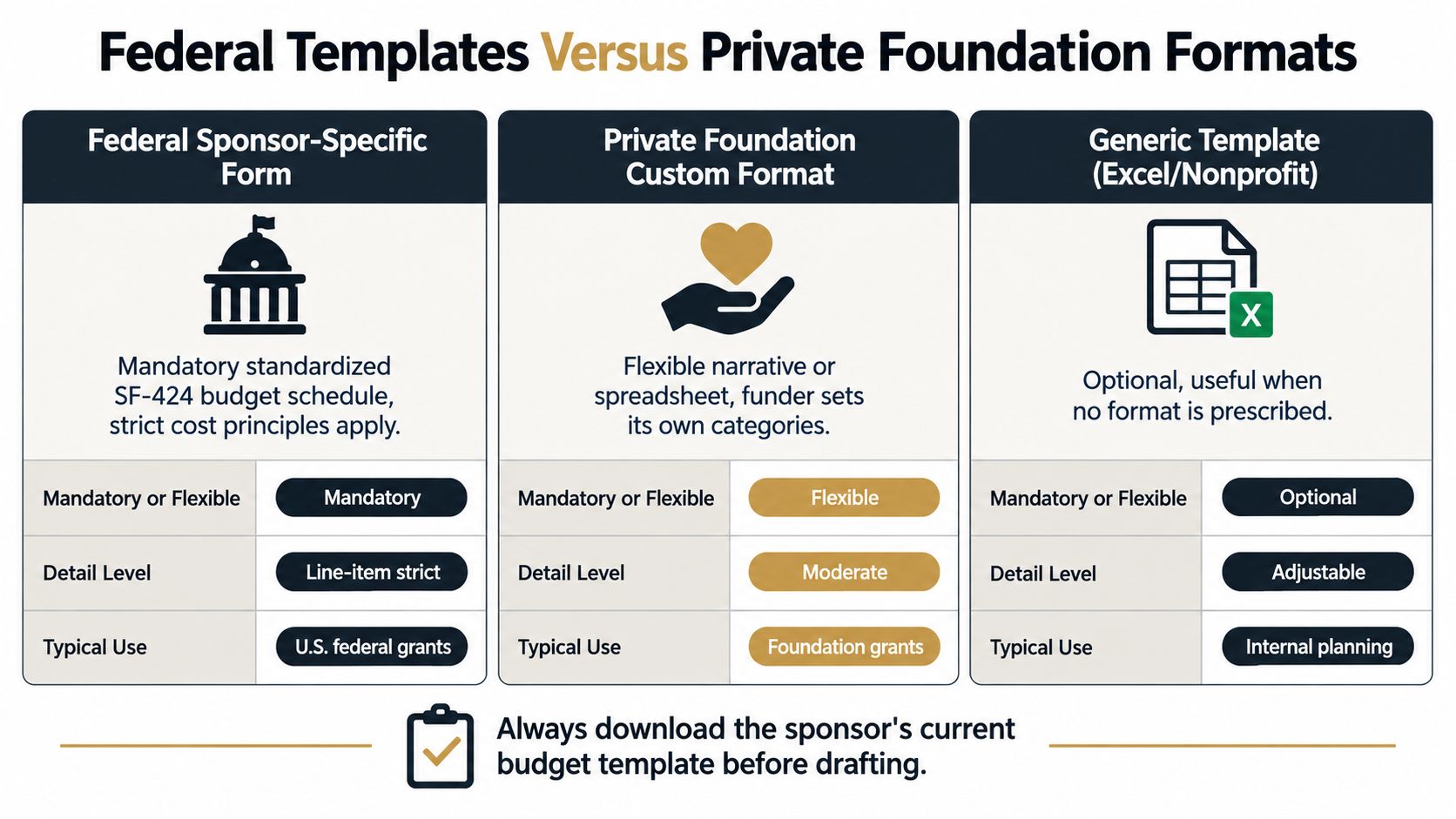
Applicants often assume there's one universal budget format. There isn't. Federal agencies, private foundations, and internal planning documents each ask different questions, and the format should match the question.
Three formats, three different levels of rigidity
Federal opportunities often require a sponsor-specific worksheet in addition to standard forms such as SF-424A. The instructions may say the budget must be submitted in Excel and that a separate Word narrative is required, and some agencies require a distinct table for each subrecipient or subcontractor. A self-designed format can be allowed in some cases, but only if every required category is covered and the funder's rules are still followed.
Private foundations are usually more flexible, but flexible doesn't mean casual. They still want clarity about what the money will pay for, how the project will be managed, and whether the request fits their typical giving pattern. Generic nonprofit templates are useful for internal planning, but they're only safe for submission when the funder hasn't prescribed its own format.
A quick comparison helps:
| Format type | Best use | Risk if used carelessly |
|---|---|---|
| Federal sponsor-specific form | U.S. federal grants | Nonresponsiveness if categories or attachments are missed |
| Private foundation custom format | Foundation grants | Weak fit if the request doesn't match the funder's style |
| Generic Excel template | Internal planning | Compliance gaps if copied into a portal without edits |
Always download the sponsor's current template before drafting. The requirements can change, and the current file is the one reviewers will use.
Where proposals usually break
The failures are rarely dramatic. More often, someone leaves out a required category, uses the wrong table for a subaward, or writes a justification that doesn't match the worksheet exactly. That kind of mismatch can make the proposal nonresponsive or trigger a clarification cycle during review.
If you're comparing budget formats for different funders, the Grantlas overview of grant types is a useful internal reference point because it helps teams match the request to the opportunity before they spend time building the wrong version.
What Reviewers Actually Check in Your Budget
Reviewers don't read budgets like accountants. They scan for signals, and those signals tell them whether the project feels controlled, realistic, and worth funding.
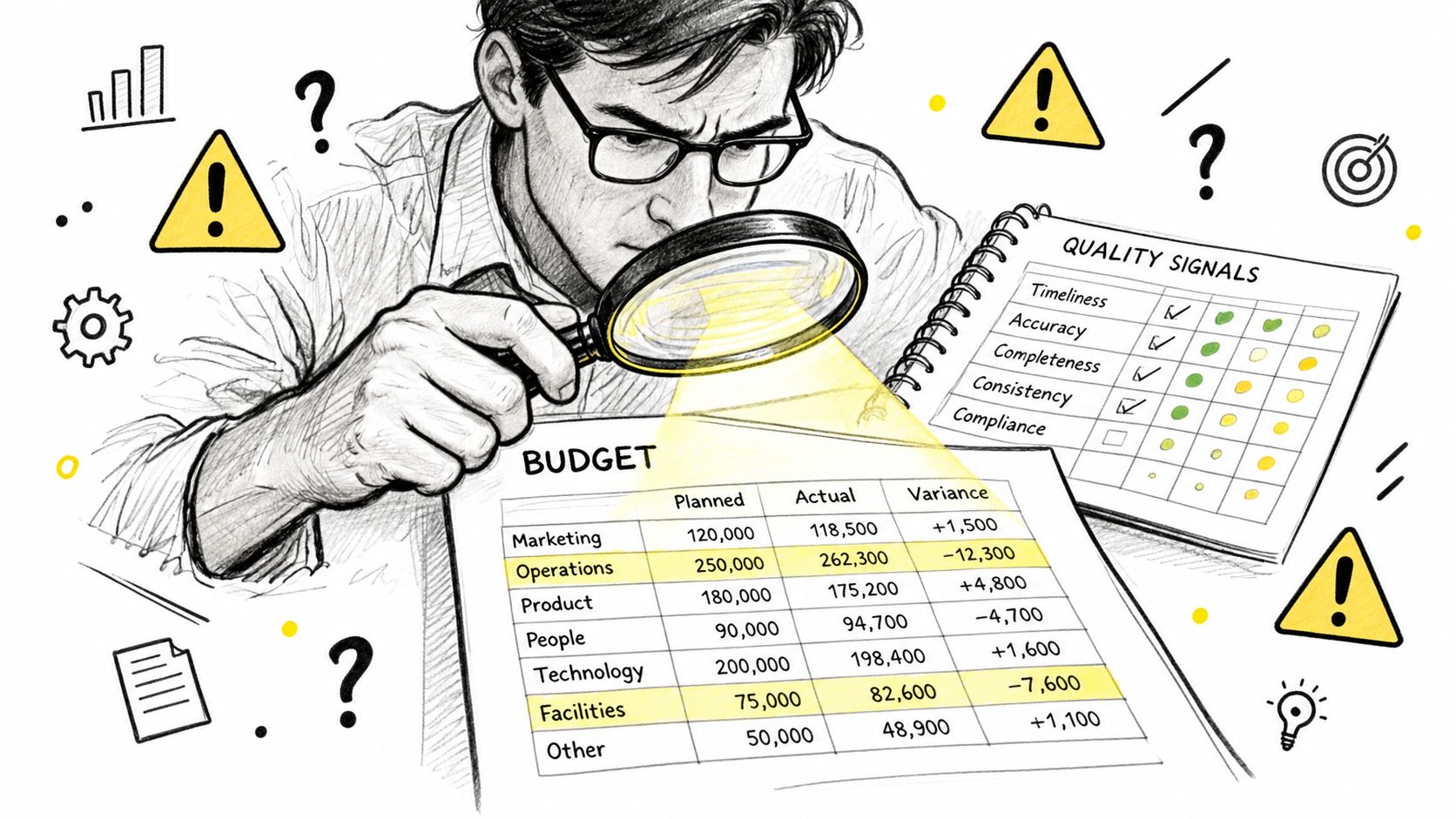
Reviewer mindset: the budget is a fast test of whether the plan is built from real activities or from optimistic guesses.
The three checks reviewers make fast
First, they test allocability. Can each line item be tied directly to project activity? If a cost can't be connected to the work plan, it looks soft.
Second, they judge reasonableness. Do the quantities and unit costs make sense together? A vague travel line or a consultant fee with no scope usually fails this check.
Third, they assess necessity. Does the project really need this expense, or was it added to make the total look fuller?
Those three checks are why consistent formatting matters. If the budget and narrative use different category names, different order, or different assumptions, the reviewer has to spend time reconciling them. That friction doesn't help your score.
Multi-year assumptions need to be visible
When a project spans several years, reviewers look for escalation logic, year-to-year continuity, and clear tab structure. If the opportunity expects the same total dollar amount each year, the budget has to follow that rule even when the line items change underneath it. If the narrative doesn't reflect those shifts, the reviewer sees uncertainty, not flexibility.
The video below is a useful companion for teams that want to see how budget scrutiny tends to unfold in practice.
A budget that anticipates these checks feels easier to trust. A budget that ignores them forces the reviewer to do extra work, and extra work is rarely your friend.
Using Funder Research Tools to Strengthen Budget Planning
Budgeting gets much better when the team knows the funder before writing the numbers. If you know a funder's typical grant size, whether they support new grantees, and what geography they cover, you can avoid building a request that's dead on arrival.
Saved searches, deadline reminders, and weekly digests are more than convenience features. They keep development teams from wasting time on opportunities that don't fit the organization's budget range, eligibility, or geography. That matters because the budget should be sized for the opportunity, not for wishful thinking.
A practical workflow looks like this:
- Build a profile first. Use the organization's website, EIN, and core facts to match likely funders.
- Filter by fit. Check geography, sector, grant size, and applicant eligibility before drafting.
- Review giving history. Look at typical grant size and whether the funder funds new grantees.
- Set alerts. Use reminders so deadlines don't force a rushed budget rewrite.
- Prioritize outreach. Board and trustee listings can help sequence contacts before you submit.
Grantlas follows that pattern by combining funder discovery, fit scoring, giving history, board and trustee listings, saved searches, weekly digests, and deadline reminders in one workflow. Used well, that kind of research reduces the chance that your team sizes the budget badly and only discovers the mismatch after the narrative is already written.
For teams building prospecting lists, the Grantlas guide for nonprofits is a good place to see how research habits connect to budget planning instead of sitting apart from it.
Building a Multi-Year Federal Budget Example
A multi-year budget gets messy when writers try to hold the whole thing in their head. The safer approach is to build one year at a time, then check whether the totals and assumptions still make sense across the award period.
Suppose a project includes personnel, fringe benefits, travel, supplies, equipment, software, consultant fees, and subawards. The first year should show the full direct-cost structure, with each category subtotaled. If the opportunity requires a separate tab for each year, copy the structure forward and adjust the assumptions only where the work changes.
A workable year-by-year structure
Year one usually carries the heaviest setup load. Staff onboarding, equipment purchase, and consultant startup support tend to appear there, while later years often shift toward program delivery and maintenance. If the sponsor says the same total dollar amount must be proposed for each year, the internal mix can still change, but the year totals can't.
That means the narrative has to stay honest while the spreadsheet stays compliant. If software renews in year two, say that. If a subaward grows because implementation expands, note that the calculation changed. The reviewer doesn't need a novel, but they do need a reason.
Keep the narrative and sheet in lockstep
The easiest way to lose control of a multi-year budget is to write one justification for year one and forget to update the other tabs. The safer path is to create a master list of categories, then mirror that list in every tab and in the narrative. If a line item disappears in year three, explain why. If a cost grows, identify the logic.
A strong example always shows the same habits:
- Personnel are tied to specific roles.
- Travel is tied to program activities, not generic mileage.
- Supplies are quantified, not just named.
- Subawards carry their own justification.
- Equipment purchases are isolated and justified clearly.
That pattern makes the budget audit-ready without making it bloated. Reviewers can follow the money, and finance staff can later compare the approved award against actual spend without guessing what the original intent was.
Common Budget Mistakes That Hurt Competitiveness
Bigger budgets don't automatically score better. Inflated requests often look weaker because they signal drift, not ambition.
The most common mistake is stuffing personnel lines with percentages that don't match the work plan. If the team says the project is modest, but the budget reads like a full-time operation with no clear workload, reviewers notice. The same problem shows up with equipment. An expensive purchase without a visible role in the project can make the request feel padded.
The mistakes reviewers spot quickly
- Unexplained equipment. Durable items need a clear project purpose.
- Vague subrecipient allocations. Partner budgets need more than a lump sum.
- Missing indirect-cost treatment. If the funder allows it, show it correctly.
- Cost-share claims without proof. Unverified match weakens credibility.
- Copied templates with no tailoring. Generic lines create compliance noise.
A budget should look deliberate, not decorative. If the organization uses a template from another application and never adjusts for the current scope, the reviewer sees a shortcut.
The hidden cost of these mistakes is time. Clarification cycles slow review, and some proposals become nonresponsive when the required category structure or justification doesn't line up. Even when the application survives, sloppy budgeting can lower confidence in the organization's ability to manage the award.
The best budgets are rarely the flashiest. They're the ones that fit the project, fit the sponsor, and make the financial logic obvious without asking for interpretation.
Final Budget Verification Checklist Before Submission
The last pass should be mechanical, not creative. This is the point where the team stops drafting and starts testing.
The fastest audit is a line-by-line cross-check between the budget and the narrative. Every major cost should have a matching justification, and every justification should point back to a real project activity. If a cost sits in the budget but never appears in the narrative, remove it or explain it. If the narrative promises work that has no funding line, fix the budget or revise the scope.
For finance-minded review, the sample nonprofit financial statements guide can help teams sanity-check whether the budget lines fit the organization's real structure before submission.
Final checks worth doing every time
- Confirm all subtotals and totals. One broken formula can undermine the whole sheet.
- Match every category to a justification. No orphaned costs.
- Verify indirect-cost treatment. Use the sponsor's rules, not the organization's habit.
- Check required cost share. Include it where required and document it properly.
- Review multi-year tabs. Make sure the structure is consistent across years.
- Open the sponsor worksheet. Confirm every required field is complete.
- Scan for vague language. Replace “miscellaneous” and “other” with specific items when possible.
Last-pass rule: if a reviewer can't trace a number in under a minute, the budget needs another edit.
A grant proposal budget template earns its keep when it makes review easy. It should help the reviewer see that the project is necessary, the costs are allowed, and the request is structured with enough discipline to manage after award.
If you want a faster way to build funder-fit proposals, use Grantlas to find opportunities, compare typical grant size and funding history, and narrow your list before you draft the budget. It helps teams connect fit research to proposal planning, so you spend less time on misaligned applications and more time refining budgets that reviewers can approve.