Letter of Inquiry for Grant Funding That Wins
Sep 14, 2026 · 12 min read
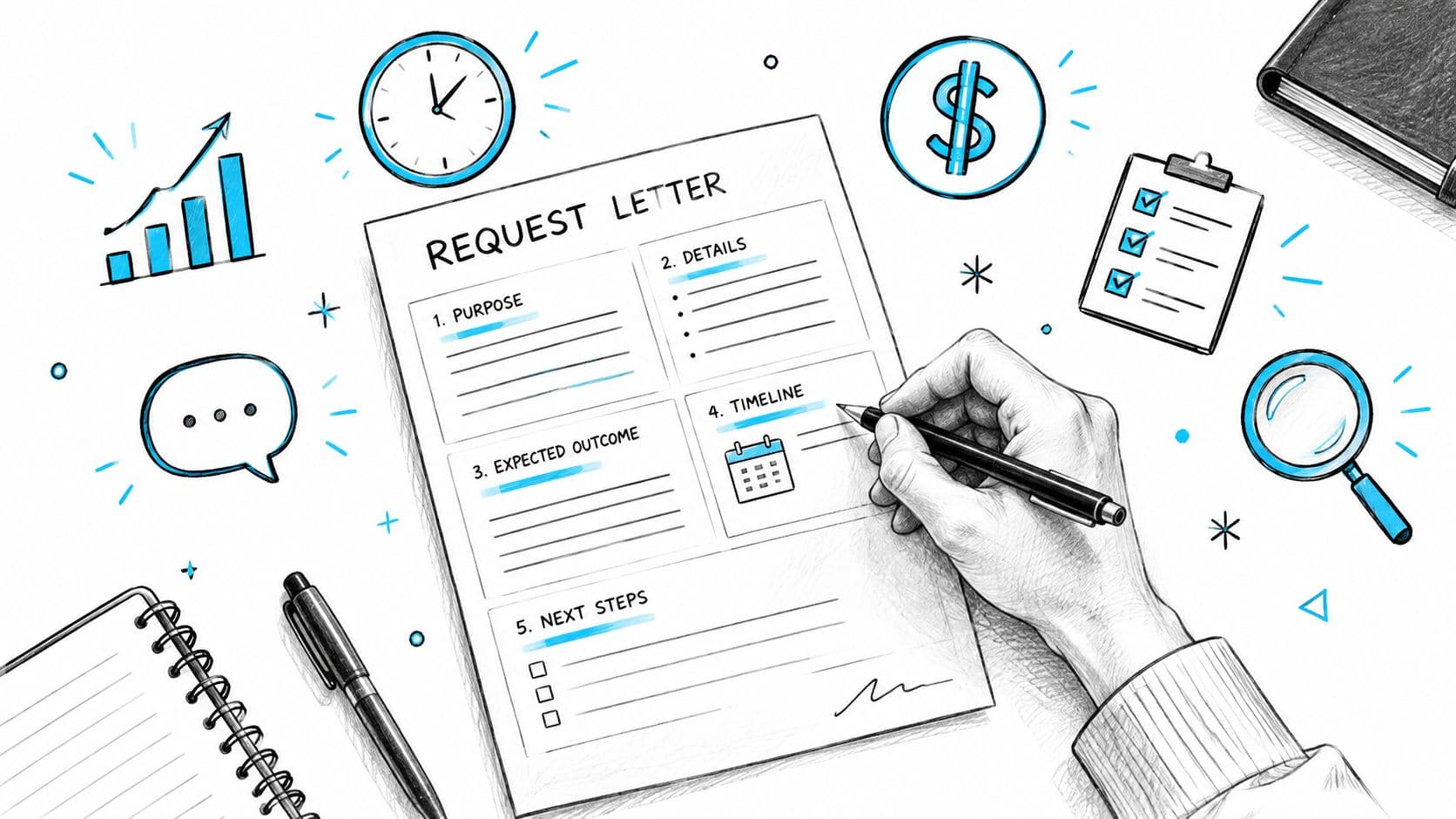
You're staring at a blank letter of inquiry template, trying to decide whether to begin with your organization's history, the community's need, or the amount you want to request. Before you draft a sentence, make a more consequential decision: is this funder's process and portfolio a credible fit for your project?
A letter of inquiry for grant funding is usually the first contact with a foundation. It's commonly limited to one to three pages, and Candid's guidance says it should still identify the organization, requested amount, project, qualifications, evaluation approach, and timetable. (Michigan Tech's grant-writing guidance reinforces that concise structure.) The document isn't a miniature version of your full proposal. It's a screening instrument that helps a funder decide whether your project deserves a deeper review.
Table of Contents
- Why Your LOI Is a Screening Document First
- The Six Building Blocks of Every Strong LOI
- Drafting Each Section With a Real Sample
- How to Test Fit Before You Write a Word
- Common LOI Mistakes and How to Avoid Them
- Submitting, Following Up, and Tracking Results
- A Quick Pre-Submission Checklist
Why Your LOI Is a Screening Document First
A program officer opens your LOI with a decision in mind: should this applicant be invited to invest more time in a full proposal? The letter earns that next step by making the fit easy to verify, not by sounding like a polished essay.
Reviewers usually test several conditions together. Is the organization eligible? Does its geography match the foundation's service area? Does the project fit a stated program interest? Does the requested support resemble the funder's giving pattern? A strong narrative cannot correct an ineligible applicant or a project outside the funder's geographic scope.
The reviewer is also judging risk and clarity. An organization may appear aligned on paper yet lack the partnerships, access, or relevant experience needed to deliver the work. A large request may seem unreasonable beside the proposed activities. A promising idea may still be too vague for a program officer to explain to colleagues.
What the funder is screening
- Mission alignment: Does the project address a named funding interest, rather than a nearby theme?
- Eligibility: Can this organization apply under the funder's rules?
- Project scale: Is the proposed work feasible for the requested support?
- Credibility: Does the team show relevant experience, relationships, and community access?
- Decision readiness: Can the reviewer summarize the project and request after reading the letter?
Practical rule: Before improving a weak-fit LOI, decide whether the LOI should exist at all.
The short format adds another test: can your team present a complete decision case without burying the relevant facts? Guidance from Candid, summarized by Michigan Tech, treats the LOI as a brief document that still needs the project, request, qualifications, evaluation approach, and timetable. Use those requirements as a completeness check, then give priority to the information that resolves the reviewer's uncertainties.
Many applicants lose the opportunity before a full proposal is requested. The cause may be unclear alignment, a budget with no connection to the work, a missing timeline, or a project outside the funder's established grantmaking. Better sentences do not repair those defects. They can even make a poor fit look more deliberate, which wastes staff time and makes the submission harder to withdraw.
The cost of skipping the gate
An LOI consumes more than drafting hours. Research, internal review, approvals, and follow-up all compete with stronger prospects. A rushed submission can create avoidable questions, miss application instructions, or signal that the team did not study the program.
Treat the letter as a conditional step. Check the funder's process, priorities, eligibility rules, giving history, and typical award pattern before writing. If those facts support a credible match, draft for fast, informed review. If they do not, move on and preserve the time for a funder whose process and portfolio fit.
The Six Building Blocks of Every Strong LOI
A strong LOI is a fit-screening document. Each element should help the funder decide whether the organization, project, request, and process align well enough to justify a full proposal. Some elements can share a paragraph, but each must answer a different question.
Candid guidance identifies six core components: the organization, request, project, qualifications, evaluation approach, and timetable. Use those components as a completeness check, then test whether the information supports a credible funding decision.
| LOI Element | Reviewer's Question | Most Common Gap |
|---|---|---|
| Organizational credibility | Why should this organization lead the work? | History without relevant evidence of capacity |
| Statement of need | What problem requires this project? | Broad claims without local or population-specific support |
| Project description | What will happen, for whom, and when? | Ambitious activities with no practical scope |
| Requested amount and budget logic | Why this amount for this work? | A figure disconnected from the project plan |
| Outcomes and evaluation | How will the team know whether progress occurred? | Aspirational language without measures |
| Sustainability or next step | What happens after this support or this phase? | No path beyond the initial grant |
1. Organizational credibility
The opening organizational paragraph should establish relevance rather than repeat a founding story. Name the population, place, or issue you serve, then connect that work to the proposed project. The reviewer is assessing whether your organization has the relationships, knowledge, staffing, or infrastructure to deliver.
2. Statement of need
Make the problem concrete. Use the strongest available evidence, but remove background that does not affect the proposed intervention. The reader should understand who is affected, what remains unresolved, and why this project fits the problem. A broad concern may attract attention, but a defined need supports a funding decision.
3. Project description
Describe the work in operational terms. Identify the main activities, intended participants, responsible staff or partners, and expected timetable. The project does not need a finished full-proposal design, but the reviewer must be able to picture how the work will happen and judge whether its scope is realistic.
4. Ask and budget logic
State the requested amount directly when the funder asks for it. Explain what that amount enables, linking costs to activities, staffing, access, materials, or evaluation. A persuasive budget narrative gives the figure a job. Descriptive language cannot replace financial reasoning.
5. Outcomes and evaluation
Outcomes state what will change. Evaluation explains how the team will assess that change. Match the method to the project's size and stage, then name the evidence you will review, such as participation, completed work, service reach, or other defined progress indicators. The aim is a credible assessment plan, not a research design that overwhelms the LOI.
6. Sustainability or next step
Every project needs a forward view, even when it does not require permanent funding. Explain whether the grant supports a defined phase, prepares the organization for implementation, or works alongside other funding sources. Keep the claim realistic. If the project depends on future support, describe the next funding or operating decision rather than implying that continuation is guaranteed.
If one block cannot be filled with specific, funder-relevant information, the LOI is not ready. Polish can improve readability, but it cannot resolve a missing fit, unclear work plan, or unsupported request.
Drafting Each Section With a Real Sample
A reviewer should understand the request before deciding whether the organization fits the funder's process. Consider a hypothetical community oral history organization seeking $25,000 for a humanities project. The example is illustrative, not a reported case study. It shows how each section can carry specific information without becoming a full proposal.
Opening paragraph
Lead with the funder's priority and the decision you want the reader to consider. Keep this to one short paragraph and identify the organization, project, amount, community, and alignment.
“River County Oral History Collaborative requests $25,000 from the Heritage Access Fund to document and preserve oral histories from longtime residents of three rural communities. The project supports the fund's interest in expanding public access to local history by pairing recorded interviews with a community archive and public listening program.”
The request and fit are immediately clear. The reviewer does not need to infer why the organization is writing or how the project relates to the program.
Organizational credibility
Use the next paragraph to establish capacity for this work. A hypothetical version might read:
“Founded to preserve community memory through resident-led documentation, River County Oral History Collaborative trains local volunteers to conduct interviews, manages an audio archive, and presents public history programs through libraries and schools. Our project director has led oral history workshops, while partner libraries will provide interview space and public access points.”
Choose evidence that shows readiness for this project. Relevant staff experience, existing systems, and confirmed partners carry more weight than a catalogue of every program the organization operates.
Statement of need
Define the affected community and the gap the project will address. Use local evidence when available, and identify the residents, collections, or access barriers involved. A broad statement about stories being lost gives the reviewer little basis for judging urgency.
“Residents in the county's smaller communities have limited access to locally documented history, particularly materials created by older residents and families whose experiences aren't represented in existing collections. The project responds to that gap by collecting firsthand accounts and making edited recordings available through trusted community institutions.”
The paragraph should connect the need to the proposed work. It should not claim more than the organization can support.
Project, budget, and outcomes
Describe the activities, scope, and timing in a compact paragraph. The 12-month timeline belongs to this hypothetical scenario, not to LOIs generally.
“During the 12-month project period, staff will recruit participants, train volunteer interviewers, record and preserve oral histories, edit selected excerpts, and create a public listening series. The requested $25,000 will support project coordination, interviewer training, recording and preservation costs, editing, and community presentations. Progress will be reviewed through activity tracking, participant feedback, completed recordings, and public program attendance.”
Give the budget a clear job. The reviewer should see how the amount supports the proposed activities and why the scope is realistic. Do not add unsupported line items to make the request appear more detailed. If the funder asks for a separate budget or attachments, follow its format rather than forcing those details into the LOI.
For examples of professional structure and tone, funding proposal letter samples can help you compare openings, transitions, and closings. Use them to study organization, not to copy language from another applicant.
Closing paragraph
End with the next step the funder's process permits. Do not use the closing to introduce a new argument or repeat the need.
“River County Oral History Collaborative would welcome the opportunity to submit a full proposal describing the interview protocol, preservation plan, partnerships, and evaluation process. Thank you for considering this request.”
The decision case should already be complete by this point. A short, specific closing makes the appropriate response clear without pleading for attention. If the funder does not invite full proposals, revise the final sentence to match its actual process.
How to Test Fit Before You Write a Word
Fit quality is the main optimization lever in an LOI. Practitioner guidance reports that strong, well-matched LOIs can receive meaningful invitation rates, including a reported roughly 50% to 60% invitation rate in one expert source and about 90% in some established programs. The same source notes that only a minority of LOIs in a cycle are typically invited to full proposal. (Fundsprout's LOI guidance provides that practitioner benchmark and highlights fit, specificity, and tailoring as the central variables.)
Test the prospect before opening your document template.
Confirm the process. Check the current guidelines, application portal, or program contact. Does the funder explicitly accept an LOI, and is it required, encouraged, or absent? A funder that already uses a short application may not want an extra preliminary document.
Compare priorities with actual giving. Read the current program language, recent grantee lists, annual reports, and available Form 990 or 990-PF filings. A project may sound aligned with a broad mission but still fall outside the foundation's practical grantmaking.
Verify applicant and geography eligibility. Look for restrictions on nonprofit status, service area, institution type, population, or project location. A clear exclusion is a stop signal, not an invitation to explain your exceptional circumstances.
Check award logic. Compare your proposed request and total project budget with published ranges and recent grants. If the amount is outside the funder's pattern, determine whether the guidelines explain why. Don't force a request into a range that makes the project infeasible.
Match the timeline. Review the funder's decision window, project start restrictions, and cycle schedule. A strong project that needs funds before the foundation can decide is not operationally ready for that opportunity.
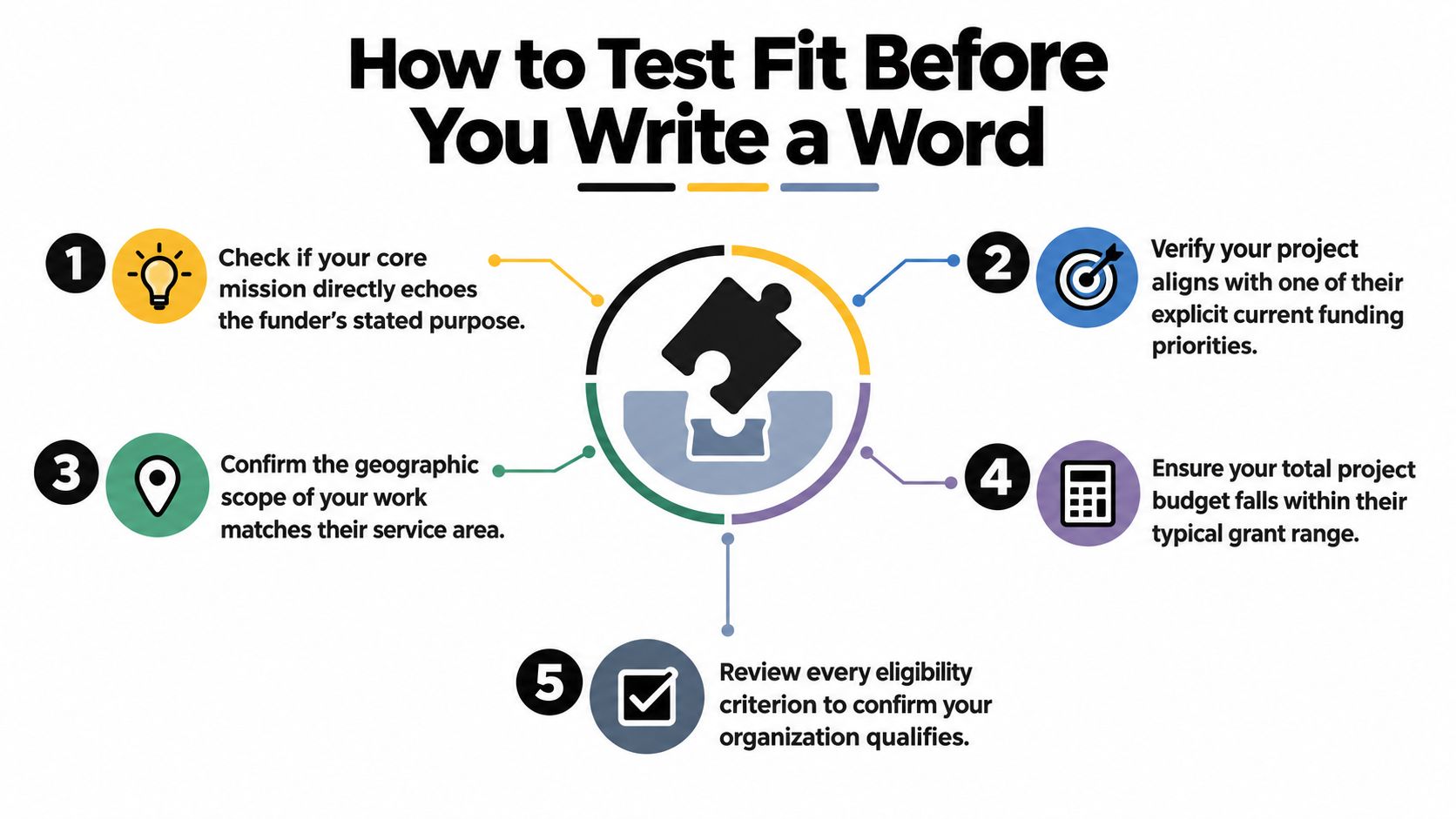
Use Grantlas's grant research resources to organize this evidence, but keep the decision human. Pass all five checks, then draft. Fail a fundamental check, and redirect the time to a better prospect.
Common LOI Mistakes and How to Avoid Them
A reviewer may understand your mission and still reject the LOI after finding a basic screening problem. The letter must make fit, scope, and compliance easy to verify.
| Mistake | Specific Fix |
|---|---|
| Burying the ask in paragraph four | State the organization, project, amount, and purpose in the opening when the guidelines request them |
| Leading with organizational history | Start with the problem and proposed work, then include history that demonstrates capacity |
| Exceeding the page limit | Edit to the stated limit. Treat formatting rules as part of eligibility |
| Repeating the funder's language | Convert each priority into a defined activity, population, place, or outcome |
| Using vague budget categories | Connect each major cost to an activity and the project's scope |
| Omitting measurement language | Name the intended outcome and how you will assess progress |
| Missing required contact details or attachments | Use the requested contact, check the submission requirements, and include only permitted attachments |
What these errors signal
A buried request makes the reviewer search for the decision the LOI presents. A history-heavy opening delays the problem and proposed response. Both weaken the fit-screening function of the letter.
Page limits are procedural requirements, not cosmetic preferences. The Ahmanson Foundation's LOI instructions call for concise presentation of project need, methodology, expected outcomes, and submission compliance. The instructions also show that some funders ask for information about recent foundation or corporate grants. If that information is requested, leaving it out creates a completeness issue even when the narrative is persuasive.
“Specificity is not decoration in an LOI. It is evidence that the project has been scoped.”
A budget line such as “program support” or “community engagement” may be accurate but gives the reviewer little to assess. Name the function each cost serves and connect it to the work described in the letter. Measurement does not require an elaborate evaluation design. It does require more than “we'll create impact.” State what you will track, how you will collect the information, and how the results will shape the next phase.
Before submission, have someone unfamiliar with the project identify the organization, request, activity, population, expected result, and required materials quickly. If any answer is difficult to find, revise the letter before asking a funder to screen it.
Submitting, Following Up, and Tracking Results
A regional humanities team can lose time by treating submission as the finish line. First confirm the named program officer, accepted channel, required file format, and any receipt notification. Address the correct contact, submit through the requested portal, email, or mailed PDF, then save the final letter with the funder, program, project, and submission confirmation clearly identified.
Record the funder, program, amount requested, submission date, follow-up date, decision date, and outcome notes in one shared tracker. Use the review window published by the funder to set expectations. If no timeline appears, a brief follow-up after 30 days can confirm receipt without asking staff to accelerate the review. Grantlas can support prospect and workflow tracking, while the team remains responsible for its own records and commitments.
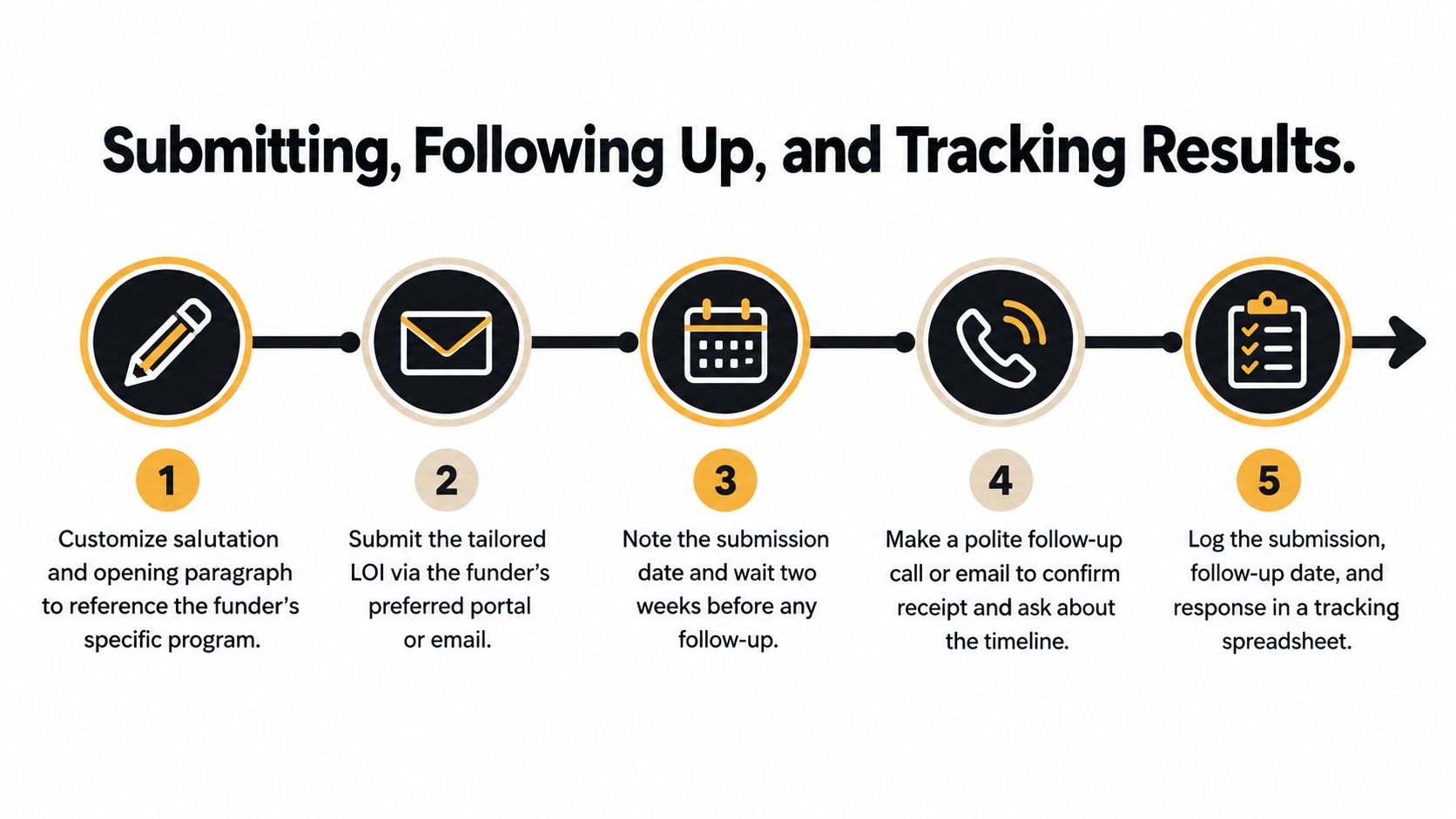
Use a short, serviceable message:
Subject: Follow-up on letter of inquiry
Dear [Name], I'm following up to confirm receipt of our letter of inquiry regarding [project]. We submitted it on [date] and would appreciate any update on the review timeline. Thank you for your time.
Sincerely, [Name]
Keep the record after a decline. Outcome notes may expose recurring eligibility problems, timing patterns, or funder preferences. Those observations should influence future prospecting and help the organization decide whether to revise the project, approach a different funder, or stop pursuing a poor fit.
A Quick Pre-Submission Checklist
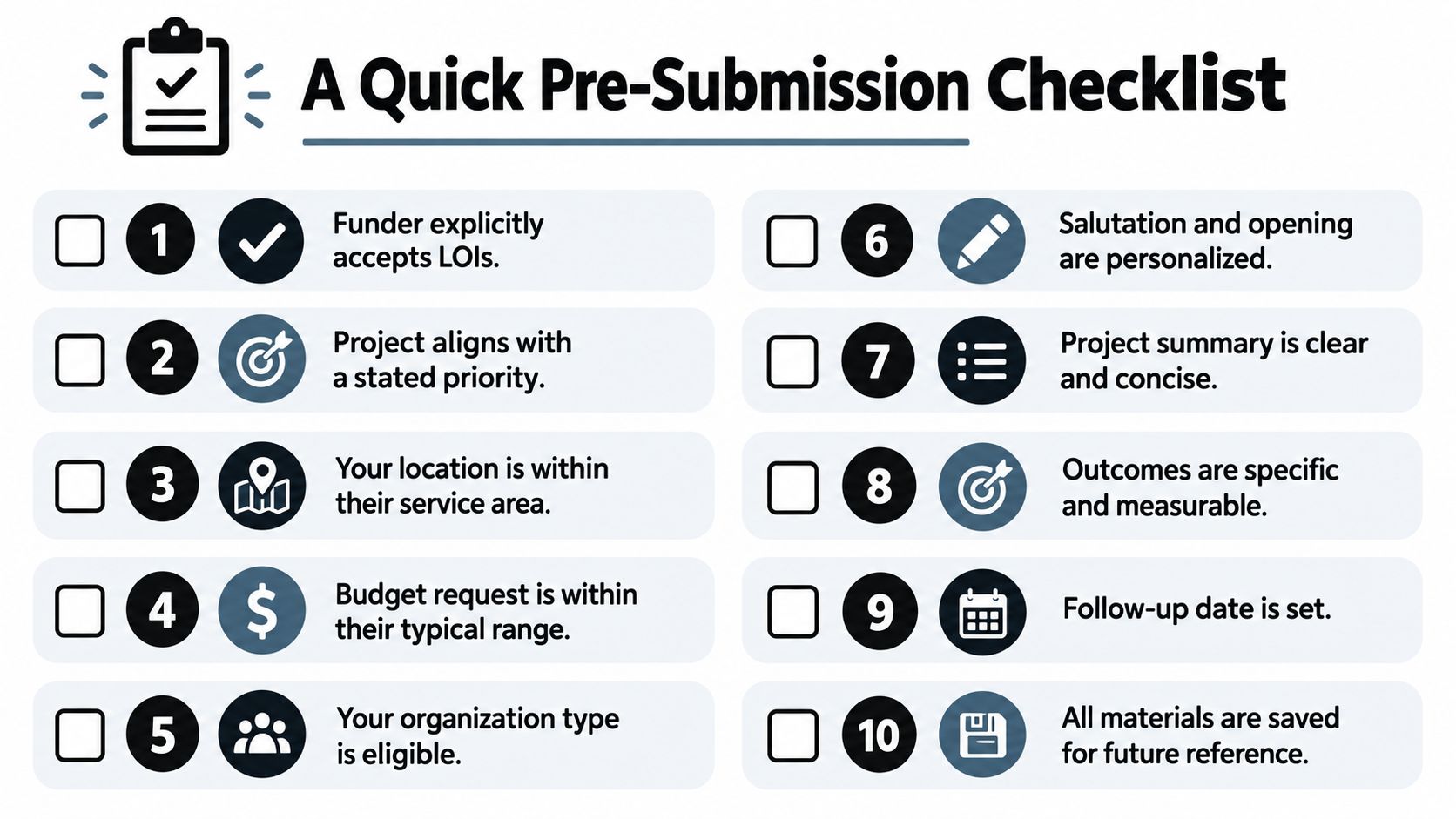
A polished LOI can still fail before review if the funder does not accept this format or the project falls outside its priorities. Treat the final check as a fit-screening decision, not a proofreading exercise. Any “no” should stop submission until someone resolves it.
- Process confirmed: Does the funder explicitly accept LOIs, and are they part of its screening process?
- Priority matched: Does the project address a stated funding interest supported by relevant prior grants?
- Geography verified: Is the organization or service area in an eligible location?
- Amount tested: Does the request fit the funder's published or observable grant pattern?
- Applicant eligible: Does the organization meet the funder's nonprofit, institutional, and program requirements?
- Opening personalized: Is the salutation addressed to the right contact, with the specific program fit stated immediately?
- Project clear: Can an outside reader explain what will happen, who benefits, and during what period?
- Outcomes stated: Are the expected results practical, with a credible way to assess progress?
- Materials saved: Are the final LOI, budget, attachments, and submission confirmation stored for reference?
Administrative details can determine whether a strong fit receives a fair review. Confirm the required file format, attachment names, contact information, submission channel, deadline instructions, and any timezone requirement. Keep the budget consistent with the LOI, and resolve financial-record gaps before submitting. Nonprofit teams can review options to choose compliant bookkeeping services that support cleaner grant budgets and reporting.
Save the submitted version exactly as sent, including attachments and confirmation. That record makes later revisions easier and helps the team identify whether a rejection resulted from fit, eligibility, presentation, or an administrative error.
A complete checklist gives the funder a clear reason to continue. An unresolved “no” gives reviewers a reason to stop.