Federal Grants for Nonprofits: A Practical Funding Guide
Oct 14, 2026 · 13 min read

A development director finds a federal notice that appears made for her nonprofit. The mission fits, the service area fits, and the deadline looks manageable. After weeks of assembling the narrative and budget, the organization discovers that its SAM registration expired, or that its UEI never connected correctly to the Grants.gov applicant profile. The proposal can't be submitted.
That failure isn't unusual, and it isn't caused by weak writing. Federal grants for nonprofits demand operational preparation that quick-start guides routinely ignore. The organizations that compete well treat registration, opportunity research, subaward intelligence, budgeting, and compliance as one connected funding system.
Federal money is substantial, but the number of competitions that a particular nonprofit can pursue is limited. Searching harder won't solve a fit problem, a registration problem, or a bad financial deal. The practical advantage comes from preparing early, looking beyond direct awards, and testing whether an award is worth accepting before the proposal consumes staff time.
Table of Contents
- Why Most Nonprofit Federal Grant Searches End in Frustration
- What Counts as a Federal Grant for Nonprofits
- The Federal Funders and Program Areas Worth Knowing
- SAM Registration and Grants.gov Setup Before You Apply
- Finding Federal Funds Through Prime Recipients and Subawards
- The Compliance Reality of Accepting a Federal Award
- Building a Repeatable Federal Grant Search Workflow
- Your 30-Day Federal Grant Readiness Plan
Why Most Nonprofit Federal Grant Searches End in Frustration
A nonprofit can spend weeks shaping a strong application, then lose the opportunity because its SAM.gov record is inactive. A legal-name mismatch, an unlinked UEI, or an incomplete Grants.gov role can block submission before reviewers see the first page.
That failure exposes the starting point: submission readiness. Grants.gov is only the application channel. Before staff interpret a notice, design a project, recruit partners, or build a compliant budget, confirm that the organization can apply electronically and that its registration details match across systems.
Senior advisor's rule: Do not begin proposal drafting until the organization passes a basic submission-readiness check.
A federal opportunity can fit the mission and still produce a poor funding decision. Staff time, reimbursement timing, reporting requirements, indirect-cost limits, and termination exposure all affect the award's net value. A grant that funds the program but leaves the organization carrying unrecovered costs may create pressure rather than capacity.
Federal support also reaches nonprofits through routes that do not resemble an open competition. The Government Accountability Office reported that this support included direct grants, contracts, fee-for-service payments, and pass-through funding. In fiscal year 2001, approximately $115 billion went directly to nonprofit organizations, while an estimated $84 billion reached them indirectly through state and local governments, for a combined $199 billion. Hospitals received most direct funding through Medicare, showing why a nonprofit may depend heavily on federal resources without regularly applying through Grants.gov. The Government Accountability Office review of federal support for nonprofits describes this distinction.
Three practical advantages deserve priority:
- Registration readiness: Keep SAM.gov, the UEI, and Grants.gov aligned before a deadline appears.
- Subaward intelligence: Find prime recipients that distribute federal funds in your field or service area.
- Net-value testing: Review reimbursement, overhead treatment, reporting, and termination terms before committing staff time.
Federal grants can be won, but they are not emergency revenue. Treat each pursuit as a project with dependencies, evidence, and a clear go-or-no-go decision.
What Counts as a Federal Grant for Nonprofits
A nonprofit can depend on federal money without ever winning a competitive grant. Medicare payments, state-administered allocations, federal contracts, and subawards all support nonprofit work, but each follows different rules and involves different decision-makers.
Federal funding reaches nonprofits through four main mechanisms:
| Mechanism | How It's Awarded | Where to Find It | Typical Nonprofit Fit |
|---|---|---|---|
| Discretionary competitive grant | An agency publishes a notice and evaluates eligible applications against stated criteria. | Grants.gov and agency funding pages | Organizations with a defined project, eligible population, and capacity to compete |
| Formula grant | Congress or an agency distributes funds according to a statutory formula, often through states or local governments. | Agency program pages and state administering agencies | Service providers operating within a defined geography or population |
| Block grant | Federal funds support a broad policy area, with states or local entities setting implementation priorities within federal rules. | State plans, agency notices, and administering departments | Community organizations aligned with state or local priorities |
| Pass-through or subaward | A prime recipient receives the federal award and distributes part of it to partners or subrecipients. | USAspending.gov, prime-recipient websites, procurement pages, and local networks | Smaller nonprofits that can deliver a defined service without serving as the lead applicant |
Competitive grants receive the most attention because they are visible on Grants.gov. They are only one route. Federal support also moves through payment systems and pass-through arrangements. Hospitals, for example, have historically received substantial direct federal support through Medicare. That distinction matters: federal dependence is not the same as direct grant competition. The GAO analysis of nonprofit funding mechanisms provides the underlying context.
Restricted money is not flexible money
Federal awards normally restrict how funds may be spent, which activities they support, and what the recipient must report. A large award can still leave a nonprofit short of cash when it fails to cover management, technology, facilities, insurance, finance, or program administration.
Indirect-cost treatment deserves a hard review before an application reaches the submission stage. If the opportunity limits, excludes, or fails to reimburse those costs, calculate the gap and decide whether the project remains viable. Chasing an award that increases unrecovered overhead is poor fundraising strategy.
Contracts, fee-for-service arrangements, and subawards also have distinct economics. A contract pays for specified deliverables. A fee-for-service arrangement reimburses eligible services. A subaward may transfer requirements from the prime award, including documentation, performance measures, and reporting deadlines. None should be treated as unrestricted operating support.
Use the mechanism that matches the organization's actual need. For project funding, assess competitive notices. For access to a state-administered service system, examine the state agency and its implementation rules. For a practical entry route into a federal program, identify prime recipients and assess whether the nonprofit can deliver a defined scope as a subrecipient. Before pursuing any route, confirm SAM readiness, eligibility, cost treatment, and the reporting burden.
The Federal Funders and Program Areas Worth Knowing
Start with the mission, not the agency acronym. A nonprofit serving older adults, a youth literacy organization, and a reentry provider may all find federal opportunities, but their useful search terms and likely intermediaries differ sharply.
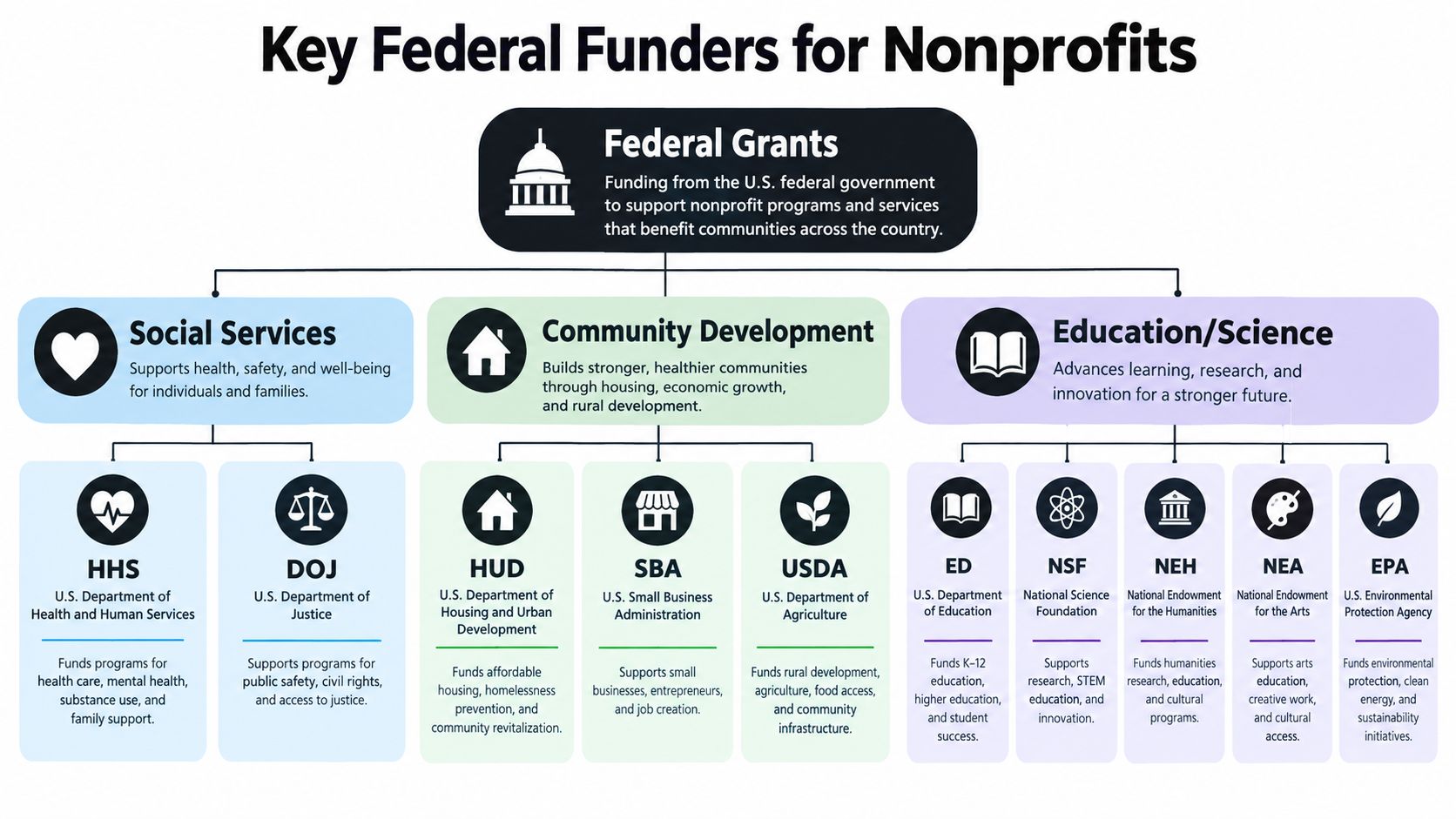
Match mission to program family
Health and human services usually points toward the Department of Health and Human Services, including public health, behavioral health, aging, family services, and community care. The Department of Justice can be relevant for victim services, violence prevention, legal assistance, and reentry.
Education and youth commonly involves the Department of Education, especially programs connected to students, schools, postsecondary access, disability services, and educational improvement. The Department of Labor may fit workforce development, employment pathways, apprenticeships, and skills programs.
Community and economic development often leads to HUD, USDA, and SBA. Housing stability, neighborhood revitalization, rural development, food systems, entrepreneurship, and local economic capacity may sit in different programs with different eligible applicants.
Arts, humanities, environment, and research can involve NEA, NEH, EPA, and NSF. Research-adjacent nonprofits should inspect whether the notice expects a research institution, a government entity, a nonprofit organization, or a partnership.
For a broader starting point, use Grantlas's guide to federal grant opportunities, then verify every potential match against the agency's own notice and current instructions.
The most disqualifying line in any notice is “eligible applicant.” Read it before the purpose, before the priorities, and before the award amount.
Read the NOFO like a screening document
A Notice of Funding Opportunity is not marketing copy. Check the applicant types, required geography, eligible activities, required partnerships, match rules, indirect-cost language, performance period, and submission method. Then inspect amendments and frequently asked questions. An apparently perfect program may exclude your organization type or reserve applications for governments and designated institutions.
Bookmark agency forecast pages and subscribe to program-specific mailing lists. Forecasts and amendments can reveal whether a program is recurring, changing, delayed, or moving toward a different applicant pool. Your aim isn't to collect agency names. It's to identify the few program families where your mission, geography, legal structure, and delivery capacity align.
SAM Registration and Grants.gov Setup Before You Apply
SAM.gov registration is a project milestone, not clerical housekeeping. Grants.gov requires an organization to complete the federal entity-registration process before applying, and an EIN alone doesn't satisfy that requirement.
Complete the identity chain
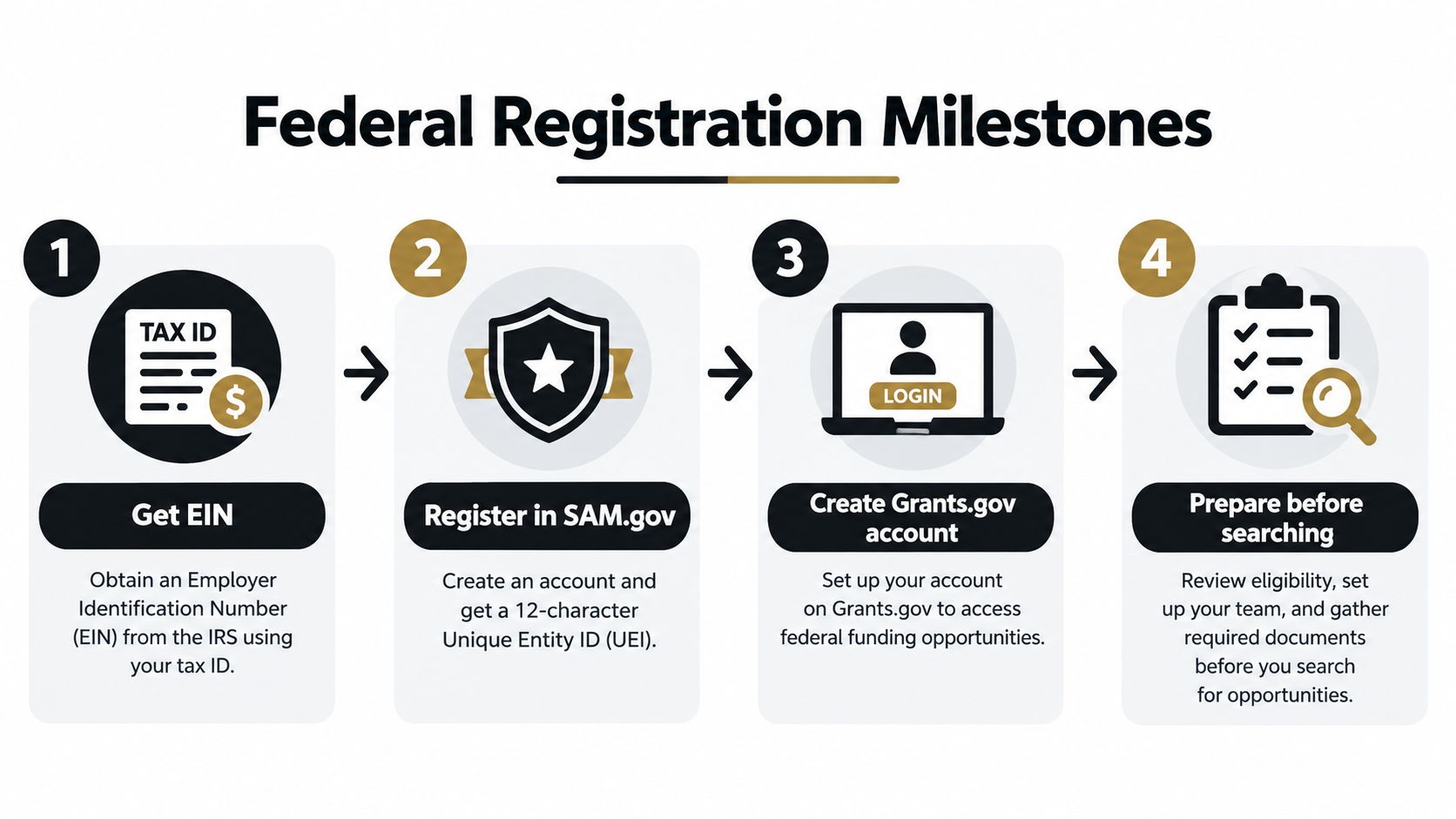
Follow the sequence carefully:
- Confirm the legal entity information. The organization's legal name and address must match federal records. Resolve discrepancies before connecting systems.
- Register in SAM.gov. The registration produces a 12-character Unique Entity ID, or UEI.
- Designate the Electronic Business Point of Contact. This role helps manage the organization's federal application permissions.
- Create or update the Grants.gov applicant profile. Connect the organization's identity and assign the appropriate user roles.
- Test the account before a live deadline. Don't wait until the final submission window to discover that a role, password, or authorization is missing.
SAM.gov processing can take approximately 7–10 business days, and registration must be renewed annually. Grants.gov's applicant registration guidance sets out the required relationship among SAM.gov, the UEI, the Electronic Business Point of Contact, and Grants.gov.
Prevent avoidable rejection
The most common problems are predictable:
- Legal-name mismatch: The name on the application doesn't match the active federal entity record.
- Expired SAM registration: The organization assumed an earlier registration remained active.
- Incomplete role setup: The organization hasn't properly designated or connected the required point of contact.
- Wrong UEI: The application uses a UEI that doesn't belong to the active SAM record.
Start the process at least a month before the first deadline you might pursue. That isn't a federal rule. It's a practical buffer for corrections, renewal, internal approvals, and staff availability. Save confirmation records, document who controls each account, and review the registration status as part of every opportunity's go or no-go decision.
Finding Federal Funds Through Prime Recipients and Subawards
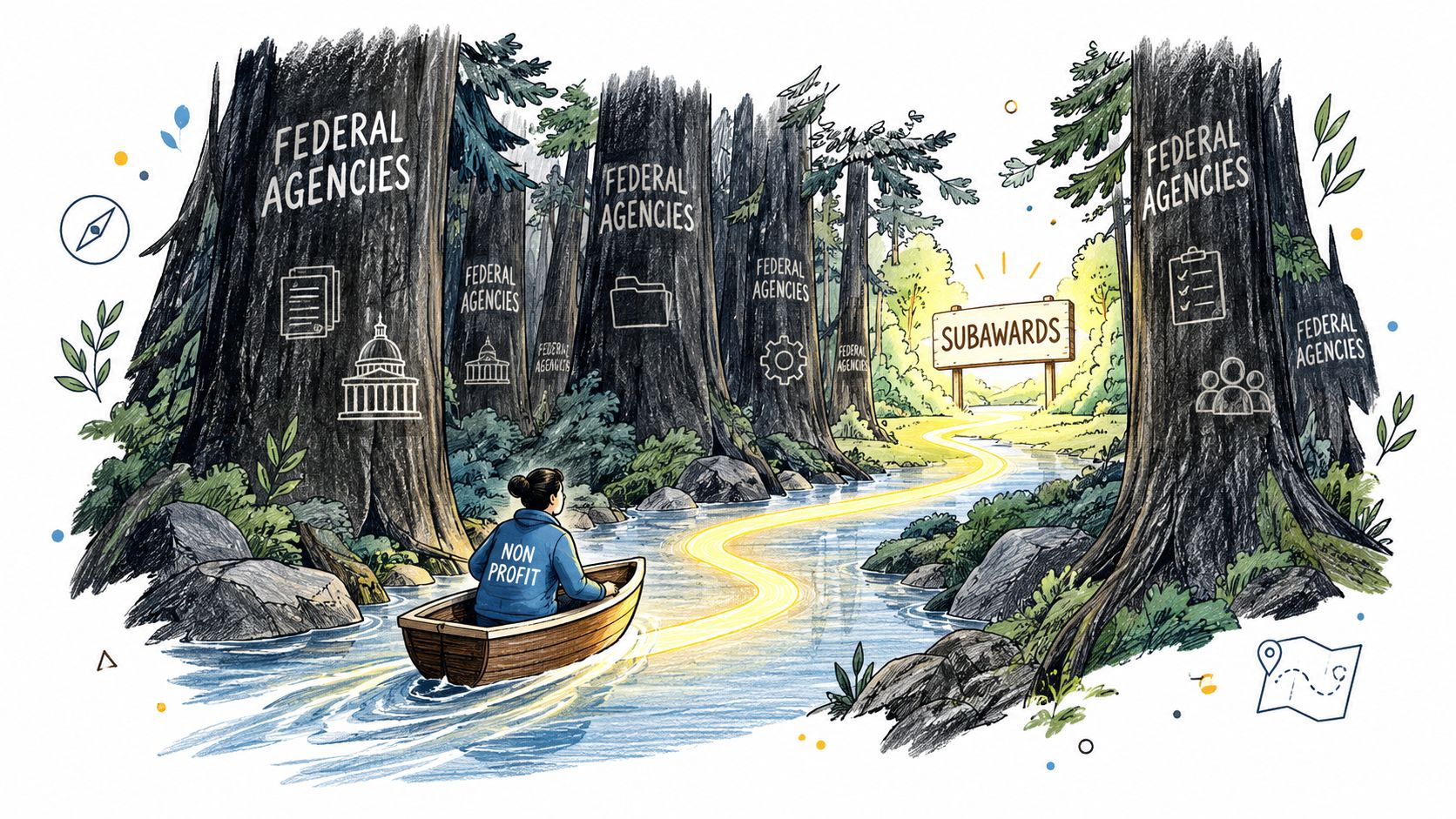
The best federal prospect for a small nonprofit may not be an open notice. It may be a prime recipient that already has federal money, local relationships, and a reason to add a delivery partner.
A prime award is reported by the federal agency to the recipient. A first-tier subaward is reported by the prime recipient, which may be a nonprofit, government, university, or business. USAspending.gov includes both categories, making it useful for investigating who distributes funds in a place or program.
Use an evidence-first search
Work through the data in a disciplined order:
- Search the program and geography. Use the relevant agency, program name, state, county, ZIP code, congressional district, or service area.
- Identify repeat prime recipients. A recipient appearing across multiple award periods may be a continuing operator rather than a one-time winner.
- Inspect subaward history. Look for organizations that receive downstream funds in the locations and service categories you care about.
- Build a relationship list. Contact program staff, partnership leads, or procurement teams with a specific delivery proposition, not a generic request for funding.
This route changes the question from “Which notice can we win?” to “Who already holds the award and needs credible implementation capacity?” A food-access nonprofit might approach a regional prime recipient about local distribution. A workforce organization might offer participant recruitment, training delivery, or employer coordination. A community health group might become a local service partner.
Treat the data as directional
Subaward reporting isn't perfectly uniform. Reporting timing can lag, agencies and prime recipients can differ in how they publish information, and the absence of a visible subaward doesn't prove that no partnership exists. Use USAspending.gov to form and test hypotheses, then confirm the program structure with the prime recipient and the agency documentation.
The relationship still needs a business case. Explain the population served, geographic reach, delivery capability, evidence of responsible operations, and the specific work your organization could perform. A subaward is not a shortcut around compliance. It is a different entry point into the same federal funding architecture.
The Compliance Reality of Accepting a Federal Award
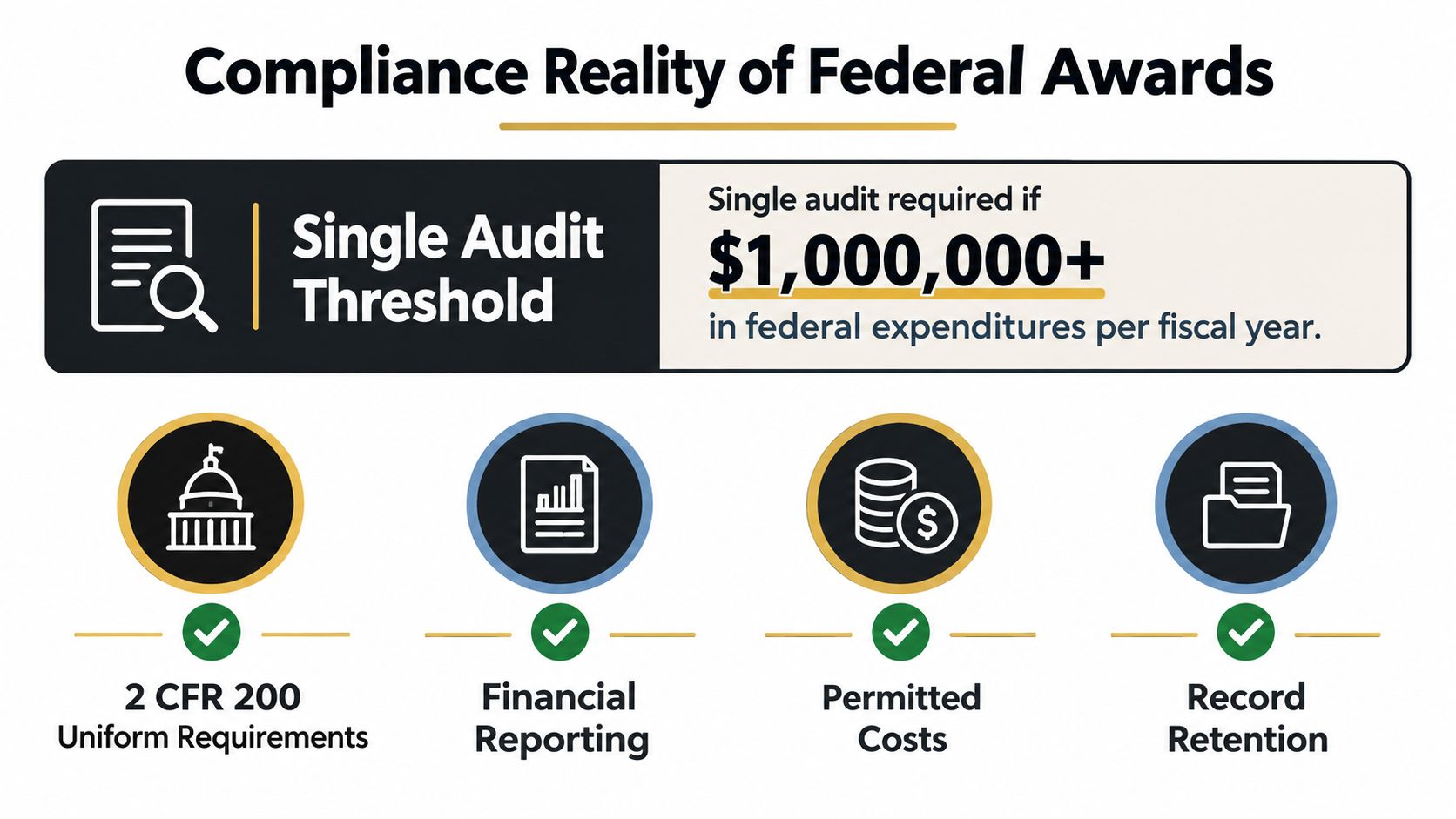
Winning an award can create a financial problem if the organization prices only the program activity and ignores the operating system required to deliver it. Federal funding brings record retention, cost classification, reporting, monitoring, and possible audit exposure.
Under 2 CFR 200.501, a nonprofit or other nonfederal entity that expends $1,000,000 or more in federal awards during its fiscal year must obtain a single audit or program-specific audit for that year. The threshold applies to total federal award expenditures, not one grant viewed in isolation. The applicable federal regulation also requires records to remain available for review even when the organization is below the audit threshold.
Build the cost model before the proposal
Federal cost rules affect both the narrative budget and the organization's accounting system. Mission-related activities performed primarily as a service to members, clients, or the public generally belong in direct costs. An equitable share of indirect costs must also be allocated through a defensible methodology.
That means the proposal team needs more than a spreadsheet. It needs a way to connect staff time, shared facilities, technology, finance, procurement, documentation, and reporting to the proposed work. A practical nonprofit fund accounting guide can help finance and development staff establish that connection.
The current risk environment makes this analysis more important. An August 2025 executive order directed agencies to revise grantmaking procedures, prioritize organizations with lower indirect-cost rates, and limit discretionary funding for facilities and administration. The executive order on federal grantmaking describes that policy direction.
Apply a net-value test
Before committing staff time, calculate whether the award makes operational sense:
- Allowable direct costs: Which personnel, supplies, travel, and services can the award reimburse?
- Unreimbursed overhead: What will the organization absorb for finance, compliance, facilities, technology, insurance, and management?
- Cash-flow timing: Can the nonprofit operate while reimbursement or payment is pending?
- Matching requirements: Is cash or in-kind support required, and can the organization document it?
- Reporting workload: Who will track outputs, expenses, procurement, participant records, and amendments?
- Termination exposure: What happens to staff, vendors, leases, and services if the award ends or is terminated?
A lower indirect-cost rate may look competitive while shifting real expenses onto the nonprofit. Don't submit because an award is available. Submit when the service value, reimbursement structure, compliance burden, and downside risk fit the organization's capacity.
Use a structured grant proposal budget template to expose missing cost assumptions before the narrative hardens around an unrealistic number.
Building a Repeatable Federal Grant Search Workflow
A serious search runs on a cadence, not on panic. Assign ownership, define the search universe, and make the team review a small number of plausible opportunities every week.
Begin with four recurring data feeds:
- Grants.gov saved searches: Filter by agency, keyword, applicant type, and relevant program language.
- Agency forecasts and mailing lists: Track anticipated notices, continuations, amendments, and policy changes.
- USAspending.gov queries: Watch prime recipients and subaward activity in your service geography.
- A deadline digest: Record the notice, eligibility decision, internal owner, required partners, budget issue, and next action.
The key is to score fit before drafting. A usable profile includes the organization's mission, legal structure, EIN, service geography, population, program capabilities, and realistic budget range. Compare that profile with applicant eligibility, geographic requirements, program purpose, award structure, match expectations, and administrative burden.
Rank opportunities instead of collecting them
Your shortlist should answer three questions:
- Can we apply?
- Can we deliver the required work?
- Can we afford the award's full operating consequences?
Use explicit flags for invitation-only programs, geography mismatches, ineligible applicant types, unrealistic budget ranges, and missing partnerships. A long list creates false productivity. A short list with a documented reason for each decision gives the development team something it can act on.
Organizations that want to compress this research can use Grantlas, which builds a nonprofit profile from a website URL or EIN, matches it against prospective funders and federal opportunities, and presents fit reasoning and eligibility flags alongside search and deadline tools. That can support, but not replace, reading the official notice.
For broader operating discipline, review these grant management best practices and adapt the controls to your organization's size and award mix. The objective is a living pipeline, not a static spreadsheet.
A useful guide to how to find grants for nonprofits can help standardize the research process across development staff, consultants, and program leaders. Re-score the pipeline when the organization changes its geography, programs, budget, or delivery model.
Your 30-Day Federal Grant Readiness Plan
Use the first month to remove preventable barriers and test one real opportunity. Don't begin by writing a generic federal proposal. Begin by proving that the organization can submit, deliver, and account for the money.
Week 1
Confirm that SAM.gov is active. Check that the legal name and address are accurate, the UEI matches the organization, the renewal status is current, and the Grants.gov profile connects to the correct entity. Document the account owners and keep confirmation records where the finance and development teams can access them.
Week 2
Create a funder profile with the mission, EIN, geography, populations served, program capabilities, budget range, and partnership strengths. Run a first-fit search across relevant agency programs, then discard anything that fails the applicant or geography test.
Week 3
Use USAspending.gov to investigate prime recipients and first-tier subawards connected to the likely program area. Search the organization's relevant geography and identify recurring operators. Shortlist two relationship targets, then prepare a concise partnership note explaining the local need, your delivery role, and the evidence of organizational readiness.
Week 4
Select one open notice and run the full decision test. Confirm eligibility, registration, project fit, required partners, direct costs, indirect-cost treatment, reporting demands, cash-flow exposure, matching requirements, and termination risk. Choose one of three paths:
- Apply directly if the organization can submit and deliver responsibly.
- Pass if the net value doesn't justify the burden.
- Pursue indirect access if a prime recipient is the more realistic route.
This approach turns federal grants for nonprofits into an operating discipline. Registration readiness protects the submission. Subaward intelligence expands the opportunity set. Net-value testing prevents the organization from accepting revenue that weakens its finances.
Revisit all three routinely. Federal programs change, registrations expire, prime recipients shift, and an attractive notice can still be a poor deal. The nonprofits that compete repeatedly aren't searching endlessly. They're maintaining readiness, evidence, relationships, and financial judgment.
Grantlas helps nonprofits build an organization profile, identify prospective federal and private funding opportunities, score fit, flag eligibility concerns, and track deadlines in a repeatable pipeline. Visit Grantlas to create a funding profile and turn your next federal grant search into a prioritized set of decisions.