How to Get a Federal Grant: A Practical 2026 Walkthrough
Oct 18, 2026 · 11 min read
You've found a federal funding announcement that sounds like your nonprofit's work. Your executive director wants to pursue it, the program team has an idea, and you're already thinking about the narrative. Before you open that document, find out who controls your federal registrations, whether your organization is eligible, and exactly how the agency expects the package to arrive.
Learning how to get a federal grant starts with controlling those dependencies, not polishing your mission statement. Treat the application as a compliance engineering project with a persuasive proposal inside it. That approach gives your team a practical way to decide what to pursue, what to submit, and what it can responsibly manage if funded.
Table of Contents
- Why Federal Grants Break the Model Most Applicants Bring
- Setting Up SAM.gov, Your UEI, and the Grants.gov Workspace
- Reading a Funding Opportunity Announcement for Real Eligibility
- Writing the Proposal Backward from the Review Rubric
- Submission Engineering and the 48-Hour Buffer
- Post-Award Reality, Reporting, and Volatility Planning
Why Federal Grants Break the Model Most Applicants Bring
The wrong starting question is whether you can write a compelling proposal. The right question is whether your organization can pass every required gate and deliver the proposed work.
Federal funding isn't a general-purpose application process. Under the Grants.gov grant lifecycle, applicants identify a mission-fit opportunity, examine its complete instructions, assess their capabilities, develop the project, register, and assemble the application. After submission, agencies generally screen for completeness and minimum requirements before conducting programmatic and financial reviews and making an award decision.
That sequence changes how you should allocate effort. A missing required component or an ineligible applicant can prevent a strong project from reaching substantive review. Narrative quality matters, but it can't repair a failed eligibility or submission gate.
Use milestones rather than a writing deadline
Build your internal plan around these practical milestones:
- Find a mission-fit announcement. Start with the agency's purpose and your organization's actual work, not the availability of money.
- Verify eligibility. Record the language that permits your organization and proposed project to apply.
- Complete required registrations. Assign responsibility for access, status checks, and organizational identity.
- Submit a complete package. Include every required component through the specified channel before the deadline.
- Monitor communications and prepare for administration. Name the people responsible for agency responses and eventual reporting.
Don't make the grant writer the default owner of every milestone. Assign program design to the people who'll implement it, financial assumptions to finance, and organizational authorization to the appropriate decision-maker. The writer should coordinate those inputs, not invent them.
Practical rule: Don't authorize full proposal development until someone can explain why the organization is eligible and how the completed package will be submitted.
Separate competitive strength from basic readiness
Use distinct internal reviews. A compliance review asks whether the package satisfies the announcement. A competitive review asks whether the proposed work convincingly addresses the agency's priorities.
Grants.gov describes a common peer-review format involving at least three reviewers who independently assess and score applications, as explained in its grant lifecycle guidance above. Make the reviewer's job straightforward: show the evidence, explain the delivery plan, and answer the stated criteria explicitly.
Before committing, also ask whether the organization can perform the work without stretching staff or financial systems beyond their capacity. My recommendation is simple: pass on an opportunity when the project requires your organization to become something it isn't. A grant should finance a defensible program, not an improvised identity.
Setting Up SAM.gov, Your UEI, and the Grants.gov Workspace
Your organization's federal identity needs an owner. If nobody knows who maintains the registration or controls submission authority, resolve that before drafting.
The Grants.gov organizational registration instructions identify a 12-character Unique Entity Identifier, active SAM registration, and a Grants.gov account as prerequisites, and state that SAM registration must be renewed annually. Keep these administrative requirements on the same project schedule as the narrative and budget.
Use this checklist to organize the setup work.
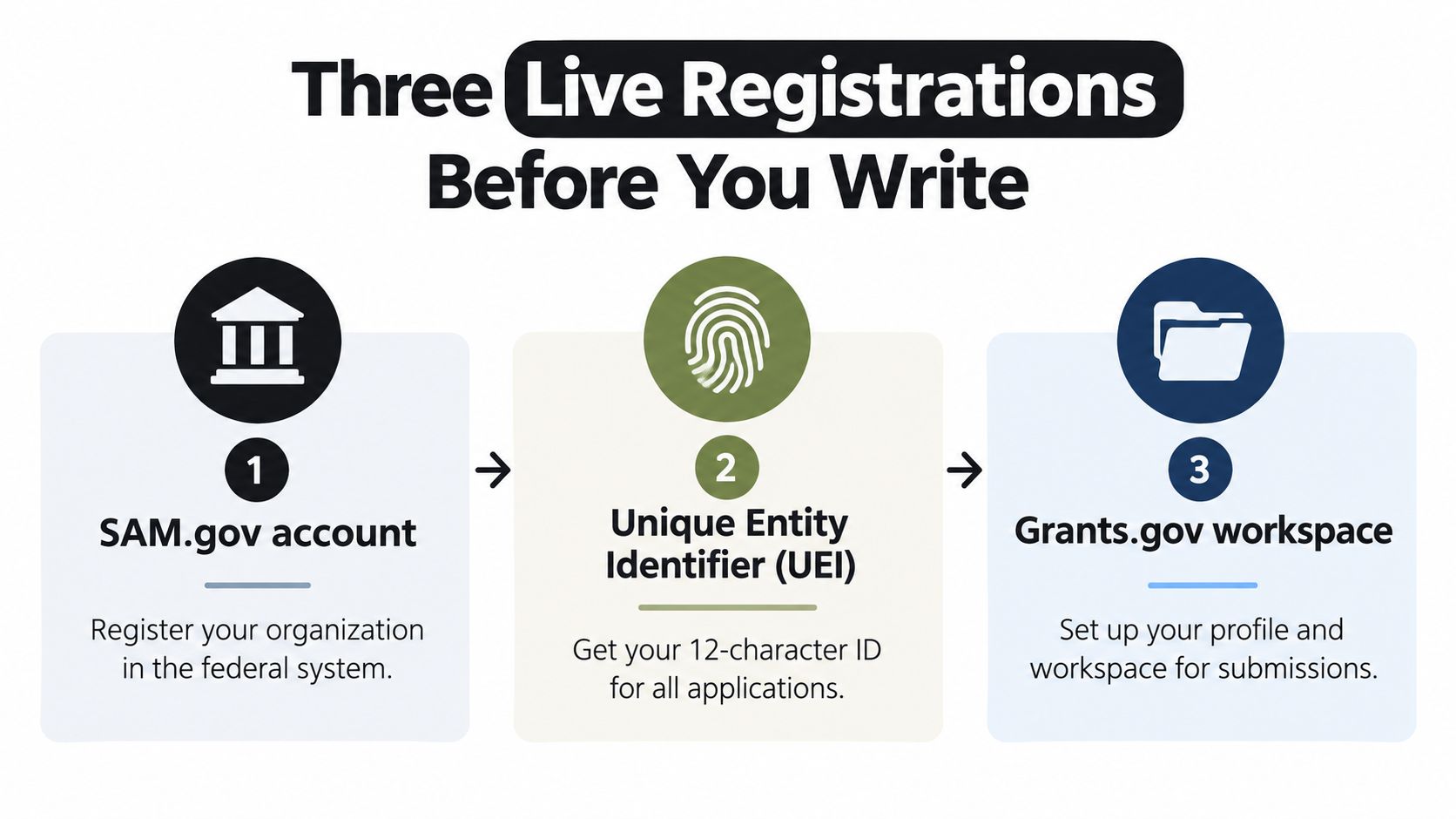
Establish the entity record before arranging submission
Begin with your organization's SAM.gov record. Confirm whether an existing registration exists before starting a new registration effort, and establish who will maintain it. Don't confuse having access to an account with having an active organizational registration.
Obtain and verify the organization's UEI as part of that work. Then create or confirm the Grants.gov organizational profile and arrange the appropriate Authorized Organization Representative, or AOR, access. Build the application workspace for the selected opportunity using the correct organizational identity.
Keep a controlled identity sheet available to everyone preparing forms. It should contain:
- Legal organization name and address. Use the verified entity information, not a shortened brand name.
- EIN/TIN and UEI. Copy these from the confirmed records rather than an old proposal.
- Registration owner and authorized representative. Record who maintains access and who can authorize submission.
- Status evidence and renewal responsibility. Save confirmation of the checks and assign the next maintenance task.
Test access while there's still time to act
Ask the intended submitter to verify access to the actual application workspace. Don't accept a general assurance that someone submitted a grant previously. Your working question is whether the correct person can act for the correct organization on this application.
Give collaborators defined responsibilities for forms and attachments, and designate a final package owner. That person should know which files are approved, which are still drafts, and who can resolve outstanding questions.
Prepare the SF-424 early rather than leaving it for submission day. The organizational instructions cited above specify a 30-character project title limit, so settle on a compliant title before the team reproduces it across attachments.
My recommendation is to make registration verification a go/no-go condition for the application calendar. Don't invent a standard completion time for your team. Start early enough to resolve problems, and base your drafting schedule on verified access rather than optimism.
Reading a Funding Opportunity Announcement for Real Eligibility
A funding announcement can describe exactly the population you serve and still exclude your organization. Mission alignment and legal eligibility are separate tests.
USAGov's explanation of government grants identifies organization-oriented public funding and explains that each program establishes its own eligible applicant categories, requirements, procedures, and deadlines. Universities, research laboratories, governments, businesses, and qualifying organizations may be eligible under particular programs, but that doesn't make every opportunity open to every applicant.
Read the complete Funding Opportunity Announcement, or FOA, sometimes labeled a Notice of Funding Opportunity, or NOFO. Use the actual announcement to make your decision, not a search result summary or an appealing program description.
Make a documented pursue-or-pass decision
Check the applicant category against your legal entity. Then examine the geographic restrictions, intended beneficiaries, allowable activities, project period, and cost-sharing conditions. Treat every mismatch as a question requiring resolution, not an inconvenience the narrative can explain away.
For example, if an announcement restricts the applicant category, serving an eligible population doesn't necessarily make your organization eligible. If matching funds are required, enthusiasm from a potential partner isn't a substitute for a defensible contribution plan.
Use federal grant opportunities research to build a shortlist, then return to the agency's announcement for the controlling requirements. Discovery should narrow your reading workload, not replace your eligibility review.
| Decision area | What to record | Reason to pause |
|---|---|---|
| Applicant eligibility | Exact qualifying language | Your legal entity doesn't clearly fit |
| Geography and beneficiaries | Permitted service area and population | The proposed work falls outside the scope |
| Activities and period | Eligible work and delivery window | The project requires excluded activities |
| Cost share | Required contribution and documentation | Finance can't substantiate the commitment |
| Submission rules | Required channel and deadline time zone | Your team can't meet the process |
Turn instructions into a requirement matrix
Create a working matrix with columns for requirement, announcement location, responsible person, evidence, and status. Include mandatory attachments, page limits, formatting, evaluation criteria, submission channel, and deadline time zone.
Don't paraphrase a difficult requirement into something easier to satisfy. Preserve the relevant language and document how your team will comply. Where the instructions are unclear, contact the agency's designated contact and retain the response with your application records.
A promising opportunity isn't a commitment. Your team can pass when the requirements don't fit.
Finish with a capability decision. Can staff deliver the work, can finance support the proposed arrangements, and can leadership accept the obligations? Require affirmative answers backed by identified people and resources before approving the application.
Writing the Proposal Backward from the Review Rubric
Start with the scoring criteria, not your organization's history. Reviewers need to locate answers, evaluate evidence, and understand whether your proposed work is feasible.
The approach in the application development and budget instructions connects evaluation criteria to measurable results, assigned activities, and reconciled costs. Use that connection as your drafting method: each scored criterion should have a visible response, supporting evidence, and any necessary budget provision.
Keep the rubric beside the draft throughout development.
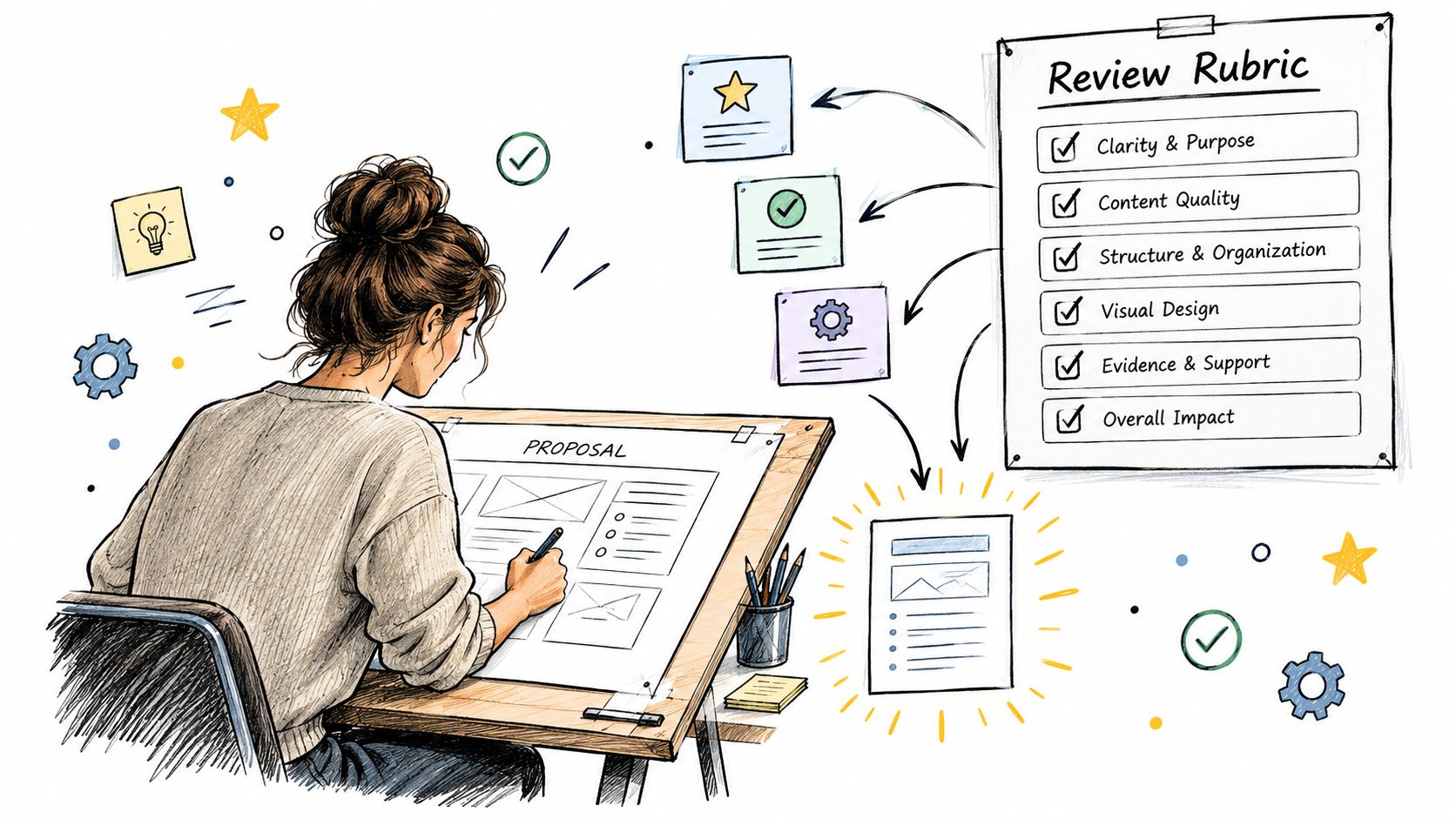
Build an evidence chain reviewers can follow
Define the target population and baseline before promising outcomes. Explain the problem, the proposed activity, and why that activity should produce the intended result. Distinguish outputs, what your team delivers, from outcomes, what changes for participants or the target population.
Specify who performs each activity and when. For measurement, identify the instrument, collection frequency, denominator, and success threshold your team will use. Choose targets from defensible project assumptions and available evidence, not from what sounds impressive.
Proposal Rubric Crosswalk Example
This illustrative crosswalk shows a planning structure, not an actual agency rubric or funded project.
| Evaluation Criterion | Where It Is Answered | Evidence or Metric | Supporting Budget Line |
|---|---|---|---|
| Statement of need | Needs assessment | Documented baseline for the target population | Data acquisition, if needed |
| Program design | Work plan | Activities connected to intended outcomes | Program personnel |
| Organizational capacity | Staffing and management plan | Relevant responsibilities and qualifications | Project management effort |
| Evaluation | Measurement plan | Defined instruments and success thresholds | Evaluation personnel or services |
| Budget justification | Budget narrative | Explained assumptions for each activity | Applicable detailed cost line |
Avoid unsupported descriptions such as high need or transformative impact. Give reviewers a baseline, a causal explanation, and a risk plan with triggers for corrective action. If evidence is limited, state the limitation and explain how you'll address it.
Reconcile the narrative with the money
Complete the SF-424 core fields before finalizing dependent forms. Reconcile the federal request, applicant contribution, worksheets, and budget narrative, keeping federal and nonfederal contributions separate and avoiding double-counting.
Every promised activity should have a delivery resource. Every promised outcome should have a funded measurement method. Check personnel effort, contracted services, equipment, travel, indirect costs, and matching funds against the actual work plan.
For drafting support, use a guide to writing a grant to organize the narrative. Teams seeking external help can also consider Bidwell's grant proposal assistance for SMEs, while retaining responsibility for eligibility, evidence, and final compliance.
Ask an independent reviewer to identify unanswered criteria and unsupported budget assumptions. Don't request a general impression. Request a list of defects your team can fix.
Submission Engineering and the 48-Hour Buffer
A finished narrative isn't a submitted application. Treat transmission, validation, and confirmation as separate tasks with their own acceptance checks.
The Grants.gov electronic submission guidance recommends beginning submission at least 48 hours before the deadline so applicants can correct errors. It also identifies rejection risks including a UEI that differs from the one associated with the AOR registration, duplicate attachment filenames, incompatible Adobe Reader versions, missing mandatory forms, and problematic filenames or formats.
Use that buffer for troubleshooting, not another round of optional prose edits. Set an internal content freeze that leaves the package owner time to inspect the actual submission files.
This workflow makes technical checks visible rather than leaving them to the final click.
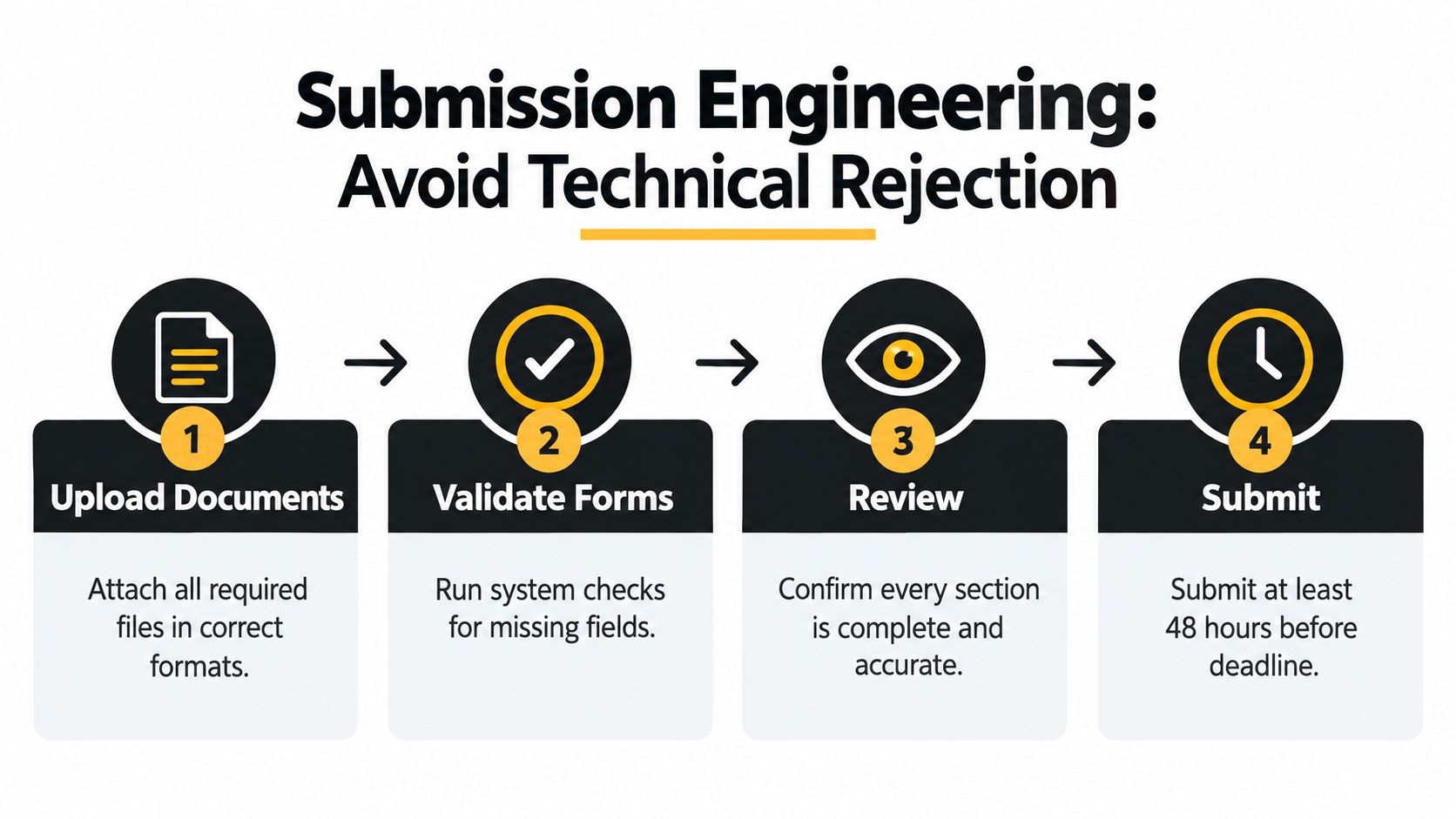
Inspect the package you'll actually send
Review exported documents, not just their editable originals. Check page counts, accessibility, attachment compatibility, package size, and applicable file requirements. Run virus scanning and complete a test upload well before the deadline.
Use a field-by-field comparison rather than a quick visual skim:
- Identity consistency. Reconcile legal name, EIN/TIN, UEI, and address across the forms and attachments.
- Project consistency. Match project dates, title, and requested amounts to the approved package.
- Authorization. Verify the authorized signer's information and the permitted handwritten or certified digital signature.
- Attachment completeness. Compare the uploaded files with the mandatory-attachment list, including program-specific documents.
- Transmission requirements. Confirm the specified portal and the announcement's deadline time zone.
The SF-424 requirements discussed earlier belong in this inspection, not in someone's memory. Assign another person to compare the approved identity sheet and requirement matrix with the final forms.
Submission standard: The package owner should be able to show what was submitted and what confirmation was received.
Preserve confirmation and investigate errors
Run the portal's validation checks and investigate the messages. If you replace an attachment or correct a field, check the affected package again. Don't assume the earlier validation still applies.
Save submission confirmation, relevant status messages, and the final submitted package in a shared location. Monitor the status and respond to identified problems through the required process.
Keep the submission walkthrough available for the person handling transmission.
Don't describe a transmission attempt as success without inspecting the available confirmation. Administrative mistakes are preventable, but preventing them requires an owner, a checklist, and time to act. Your team can't control the competition; it can control whether it sends a coherent, processable package.
Post-Award Reality, Reporting, and Volatility Planning
An award notice should trigger a management review, not an assumption that the organization can immediately spend without constraints. Examine the award terms, required reporting, payment arrangements, and implementation conditions before authorizing commitments.
Federal recipients enter administrative, financial, programmatic, and reporting obligations under the lifecycle described earlier. Build an award-specific responsibility map that identifies who manages delivery, expenditure records, reporting, and communication with the agency.
The people who wrote the proposal shouldn't be the only people who understand its promises. Give program and finance staff the final application, approved budget, and award documents. Resolve differences between what the organization proposed and what the agency approved.
Plan for interrupted administration
Federal grant readiness also requires a response to administrative volatility. The Government Accountability Office's account of federal grant disruptions reports that on January 28, 2025, the Department of Homeland Security placed a hold on disbursements and application assessments for grants to nonprofits or grants touching immigration, disrupting program activities; it also describes fiscal-year 2025 restrictions on FEMA's external communications with state partners.
That example doesn't mean every federal program will experience a pause. It does mean your operating plan shouldn't assume uninterrupted assessments, communication, or payments.
Document the assumptions that support hiring, procurement, partner agreements, and the delivery schedule. Ask finance what happens if anticipated reimbursements arrive later than planned, and ask leadership which commitments can safely proceed under that scenario.
| Planning question | Recommended control |
|---|---|
| Who monitors agency changes? | Named owner and shared communications record |
| Which commitments depend on payment timing? | Documented cash-flow assumptions |
| What happens if implementation conditions change? | Revised-work-plan decision process |
| Which services depend heavily on this award? | Leadership-approved continuity options |
| Who authorizes a response? | Clear escalation and approval responsibilities |
Track decisions as well as deadlines
Use a grant tracking software checklist to evaluate how your team records obligations. Whatever tool you choose, keep award terms, reporting dates, agency messages, and internal decisions accessible to the people responsible for acting.
Build contingency options before a disruption forces an urgent choice. Identify spending that can wait, alternative resources that leadership could approve, and service commitments the organization must protect. Do not change the funded work because the original schedule becomes inconvenient; check the applicable requirements and agency instructions.
This week, choose a candidate announcement and produce a documented eligibility decision. Verify submission access, assign compliance and budget owners, and ask finance to review delivery assumptions. A grant-ready organization can apply, execute, document, and adapt, not merely write an attractive proposal.
As one discovery option alongside Grants.gov, Grantlas helps nonprofits identify prospective funders and open federal opportunities through organization profiles, scored shortlists, and plain-English fit explanations. Visit it to build your profile and review potential matches, then verify each shortlisted opportunity against its official announcement before committing proposal time.