Grant Funding Opportunities: Where to Find and Qualify
Oct 31, 2026 · 12 min read

You've found a grant that sounds perfect. The funder supports your cause, the deadline looks manageable, and your team already has a program that needs money. Then you open the guidelines: there's a registration requirement, a detailed budget, partner letters, and reporting work nobody has time assigned to do.
Finding grant funding opportunities is only part of the job. The harder decision is whether an opportunity fits your mission, pays enough to deliver the work, and justifies the staff hours you'll spend pursuing it.
Table of Contents
- What a Grant Funding Opportunity Really Is
- Four Funder Types and What Each Offers
- Eligibility Rules That Decide Your Shortlist
- Application Timelines from Search to Deadline
- Search Strategies That Surface Open Opportunities
- How to Rank Opportunities by Fit and Pursuit Cost
- Confirm Fit and Eligibility Before You Apply
What a Grant Funding Opportunity Really Is
A grant funding opportunity is a published offer from a funder to pay for defined work, with rules about who can apply, what funding is available, when to submit, and what responsibilities follow an award.
Think of a grant notice as closer to a job posting than an unrestricted donation. The funder describes the work it wants supported. Your organization decides whether it's qualified, whether the assignment fits, and whether the resources are adequate.
A straightforward donation may arrive without a proposal, project budget, or reporting agreement. A grant typically involves a more structured exchange: you propose activities and outcomes, and the funder evaluates them against its priorities. Receiving the money can also mean accepting restrictions on spending, documentation, and reporting.
Read the offer as a complete agreement
Every useful opportunity record should capture these connected parts:
- Funder priorities: The problem, population, place, or outcome the funder wants to support.
- Applicant requirements: The organizational status, service area, experience, and other conditions applicants must meet.
- Application and award process: The submission route, budget rules, review stages, and obligations after funding.
Say a youth literacy nonprofit finds a notice supporting after-school reading programs in its county. The program sounds relevant, but the team still needs to check whether its organizational status qualifies, whether the award covers the proposed activities, and whether the application can be completed on time.
That distinction matters: a relevant cause isn't the same as an eligible, affordable project. Don't reshape your whole organization around a notice before checking the terms.
For each opportunity, write a plain-language sentence naming its purpose, eligible applicants, award amount, and deadline. Then name the program you already run that fits that sentence. If you can't make that connection without inventing new work, keep searching.
Four Funder Types and What Each Offers
Grant funder types compared
| Funder type | Where to find it | How applications usually work | Best fit for |
|---|---|---|---|
| Federal | Grants.gov and agency notices | Fixed Notices of Funding Opportunity with set deadlines | Organizations with registration in place and capacity for compliance |
| State and local | State grant portals, state arts agencies, humanities councils, community foundation sites | Published calls, often with set deadlines | Organizations serving a specific state or community |
| Private foundations | Foundation websites, foundation directories, and IRS Form 990-PF filings | Some accept requests year-round; others run set cycles | Organizations aligned with a foundation's stated focus |
| Corporate giving | Company giving pages and community programs | Letter of inquiry or online form; check award terms | Organizations near company operations or with a shared cause |
Use this map to narrow your search before opening individual notices. A community-based organization might begin with local opportunities and foundations serving its region. An established nonprofit with financial controls and dedicated grant staff may be better positioned to assess federal programs.
Federal funding can support substantial, defined work, but the application is only the beginning of the administrative commitment. Read the notice for documentation, payment, monitoring, and reporting requirements.
State and local funding deserves a separate search routine. California's and Illinois's grant portals, state arts agencies, humanities councils, and community foundation websites are useful discovery channels. Community foundations are charitable funders, not government agencies, even when their opportunities appear beside local public programs.
Foundation size changes the prospecting strategy
According to the IRS Statistics of Income analysis for tax year 2022, private foundations with at least $100 million in assets represented 1.5% of filed returns but accounted for 64.6% of contributions, gifts, and grants paid.
Large institutions therefore deserve attention, but their resources don't make them your best prospects automatically. Smaller foundations may be more closely aligned with a particular neighborhood, population, or specialized service. Our guide to private foundation grants for nonprofits explains how to investigate that fit.
Corporate giving needs a different lens: look for a connection between your work and the company's communities or stated charitable priorities. Don't assume sponsorships, charitable grants, and employee giving programs use the same application route.
When comparing funding information with project-level evidence, you can also view Murphyproxies project metrics on Fundl. Treat project metrics as context, not as proof that an organization is eligible for a grant.
Choose the funding channels your team can realistically manage, rather than searching every channel equally.
Eligibility Rules That Decide Your Shortlist
An inactive federal registration can stop an otherwise suitable application. According to Grants.gov's applicant registration guidance, organizational applicants need an active SAM.gov registration, a 12-character Unique Entity ID, an Electronic Business Point of Contact, and an organizational association with Grants.gov; SAM activation can take up to 10 business days, and registration must be renewed annually.
Don't confuse receiving an identifier with completing registration. A team may have its UEI while other activation steps remain unfinished.
Hard eligibility requirements by funder type
| Requirement | Federal | Private foundation | State and local |
|---|---|---|---|
| Registration | Active SAM.gov registration and UEI | Federal registration not usually required; check funder registration instructions | Follow the program's portal and registration rules |
| Tax status | Tax ID validated in SAM.gov; applicant type must qualify under the notice | Check required charitable status and any fiscal sponsorship provisions | Set by each program notice |
| Location | Area set by each notice | Often tied to the funder's region or cause | Usually limited to the state or community served |
| Applicant route | Open or restricted by notice | Some accept requests; others are invitation only | Open calls, sometimes restricted |
| Annual check | Renew SAM registration annually | Confirm current guidelines | Confirm requirements at each new cycle |
Check the organization before the program
Start with registration and tax status. Your EIN identifies the organization for tax purposes; your UEI identifies it in the federal award workflow. They aren't interchangeable fields.
Next, check geography carefully. A funder may distinguish between where your office sits and where people receive services. Record the actual wording rather than reducing it to a state abbreviation.
Finally, check the applicant route. An invitation-only foundation isn't an open application prospect merely because its mission matches yours. A contact email doesn't override a restriction on unsolicited proposals.
Practical rule: Resolve hard eligibility before spending time on persuasive writing. Strong storytelling can't repair an ineligible applicant.
A mismatch in legal name, address, or tax information can interrupt federal processing even when the proposed program is appropriate. Assign someone to compare your registration record with your organizational documents, not just confirm that an account exists.
For a broader assessment of public funding readiness, use our guide to nonprofit government grants. In your own tracker, record each requirement, the person who checked it, and the verification date so colleagues can distinguish confirmed facts from assumptions.
Application Timelines from Search to Deadline
Work backward from the submission deadline and give each task an owner. The lead times below are planning stages, not promises about how quickly a funder will review or award an application.
Use the timeline as a scheduling aid, then adapt it to the actual notice.
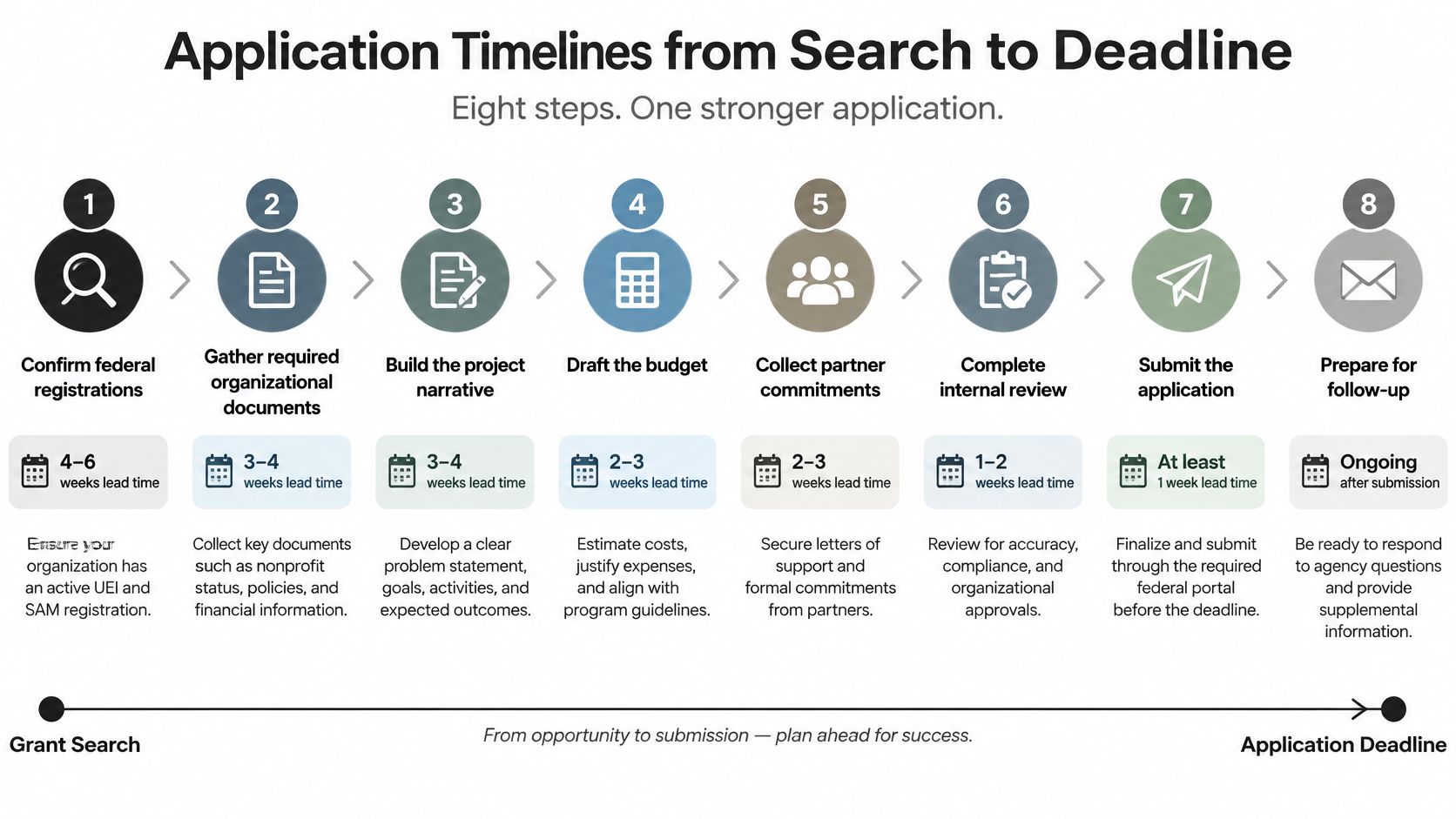
Build the application in dependency order
Confirm federal registrations
Lead time: before committing to the application. Recheck activation, authorized contacts, and account access even if eligibility has already been reviewed. Treat an unresolved registration as a scheduling dependency, not a task for submission day.Gather required organizational documents
Lead time: at the start of preparation. Read the full notice and collect financial statements, organizational records, and required policies. For foundations in our Accepting requests list, there's no deadline, so contact the funder first to establish the request process.Build the project narrative
Lead time: after confirming the application route. If a letter of inquiry or pre-proposal is required, complete that stage and await the required response before drafting the full request. Describe activities, responsibilities, outcomes, and how you'll document progress.Draft the budget
Lead time: alongside the narrative. Price the work you've described, including administration and evaluation. Check cost sharing, allowable expenses, indirect-cost treatment, and payment arrangements before finalizing the request.Collect partner commitments
Lead time: while scope and budget are still adjustable. Ask partners to confirm their responsibilities and any required contributions. Don't leave a signature or commitment letter until the rest of the application is finished.Complete internal review
Lead time: before your internal submission cutoff. Have program and finance staff check that the narrative, budget, and attachments agree. Confirm the authorized submitter can access the correct application workspace.Submit the application
Lead time: ahead of the posted deadline. Leave room to correct validation errors or missing attachments. Save the submission confirmation and verify its status.Prepare for follow-up
Lead time: immediately after submission and upon award. Store the final application and assign responsibility for questions or revisions. If funded, calendar reporting, payment requests, and registration renewal tasks from the award terms.
Build a shared calendar for your next target. Include decision points as well as writing tasks, so your team knows when to stop if a prerequisite remains unresolved.
Search Strategies That Surface Open Opportunities
A useful search routine produces a qualified pipeline, not a folder full of promising bookmarks. Start with a description of your organization that another staff member could use without guessing what you mean.
Keep your profile beside you while reviewing search results.
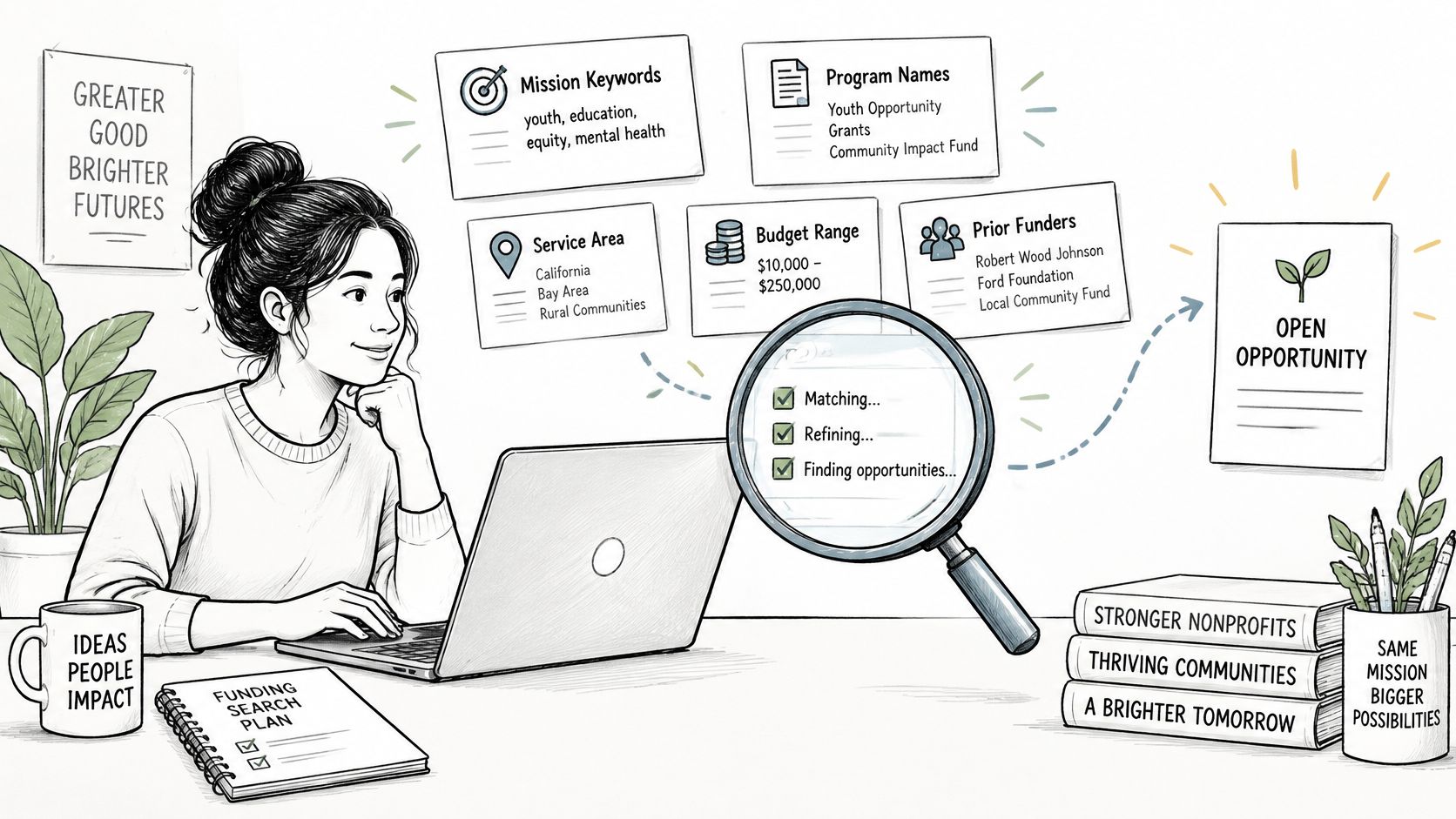
Build a repeatable search routine
Define the work you want funded.
Record mission keywords, program names, populations served, service area, and the funding purpose. Search both your professional terminology and the plain-language description a funder might use, such as reading support alongside literacy.Search distinct source types.
Use Grants.gov for federal notices, state portals for public programs, and arts agencies or humanities councils for relevant disciplines. Search community foundation websites and private foundation records separately. Foundation information comes from IRS filings, while public and community opportunities come through their respective portals and organizations.Filter by grant purpose and financial scale.
Don't treat every education funder as a prospect for operating support. In Foundation Source's analysis of private foundations, described by Candid, 49.4% of analyzed 2024 grants from smaller foundations provided general operating support, compared with 26.9% among larger foundations. That's a reason to investigate smaller funders, not a guarantee that a particular foundation will fund your overhead.Save searches with meaningful filters.
Combine cause, geography, applicant type, and funding purpose. Set alerts where available, but reserve time to read the underlying notices rather than treating an alert as a completed qualification check.Use peer prospecting.
Identify organizations with similar programs and service areas, then investigate their funders. Check whether those funders accept new applicants; a peer's award doesn't establish your access.Log what you verified.
Save the funder's application page, status, deadline, next action, and date checked. Separate open applications from historical awards and potential relationship-building prospects.
Interpret giving history rather than collecting totals
A foundation's total historical giving won't tell you whether it supports organizations like yours. Compare its asset scale, typical awards, grant purposes, recipient profile, and willingness to fund new grantees.
Code grants as operating, project, capital, or another identifiable purpose. Keep the filing year visible. Otherwise, an old restricted award can look like evidence of a current flexible funding opportunity.
For another format to accompany your research routine, use this video.
Our guide to grant research tools can help you evaluate which parts of this work to automate. At Grantlas, we can build a profile from your website URL or EIN and generate a scored shortlist with plain-English fit reasons.
We compile grant and funder information from public sources and third-party data, and we give no warranty that it's complete, current, or accurate. Confirm the live notice on the funder's own page before committing staff time.
How to Rank Opportunities by Fit and Pursuit Cost
Say your team is comparing a larger federal award with a smaller local grant. The federal application needs extensive coordination and ongoing financial reporting; the local request uses an existing program budget and a brief application. The larger award isn't automatically the better choice.
Estimate total pursuit hours, including research, drafting, budgeting, attachments, partner coordination, and review. Then estimate post-award administration separately, including reporting and financial tracking. Dividing the potential award by those combined hours gives you a workload comparison, not a profit estimate or a prediction of success.
Use that comparison alongside actual delivery costs. An award can look attractive per administrative hour while still leaving the program underfunded.
The decision needs both program and finance input.
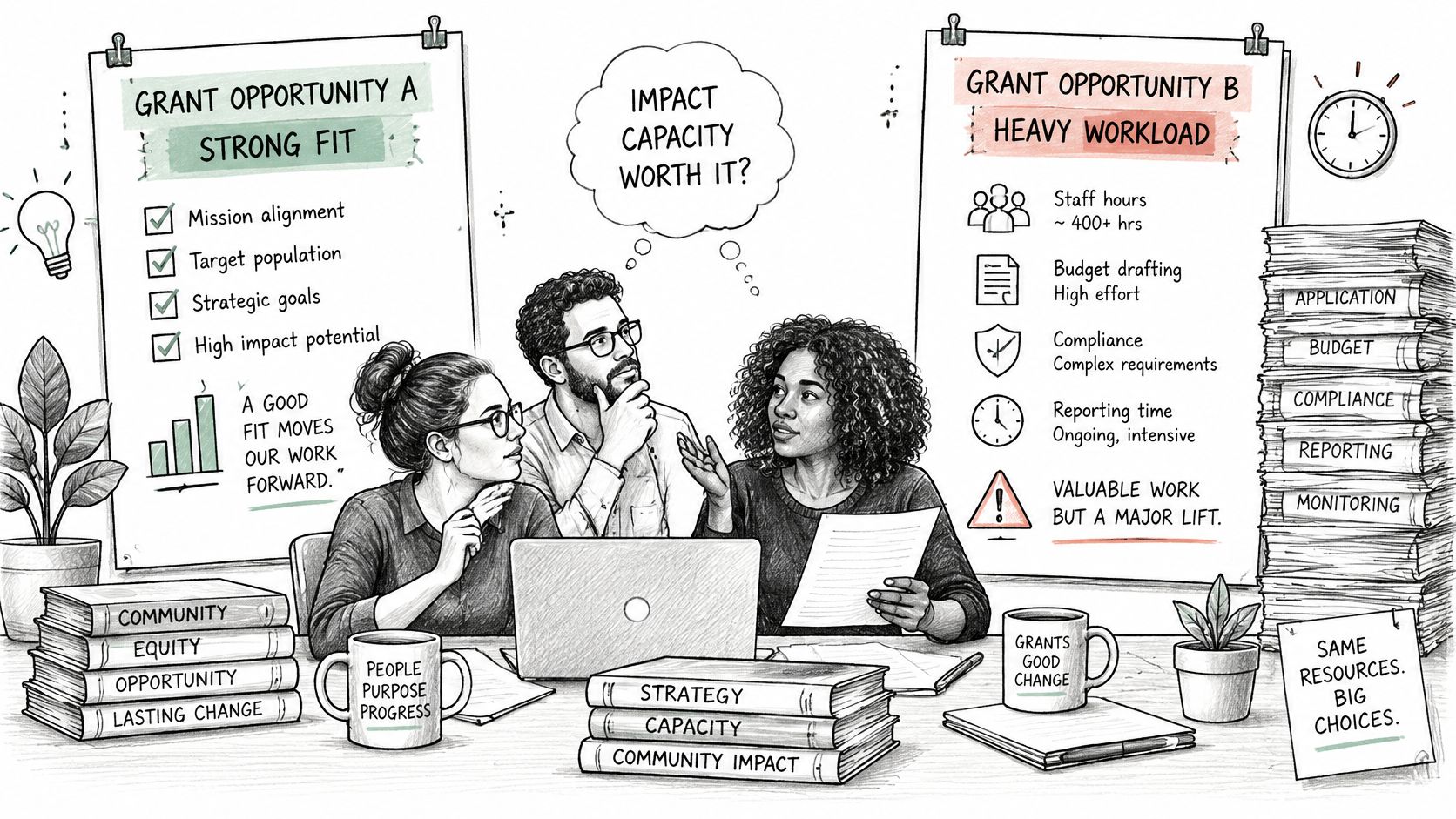
Score the work your team would actually accept
Fit and pursuit cost criteria
| Criterion | Good fit looks like | Red flag |
|---|---|---|
| Mission fit | A named funding priority matches a current program | The purpose requires an unrelated new program |
| Award size | The likely award adequately supports delivery | The award leaves an unfunded delivery gap |
| Application burden | Drafting, budgeting, and attachments fit available staff time | Required hours exceed capacity before the deadline |
| Reporting load | Report frequency and detail match staff capacity | Financial reports are required without staff to produce them |
| Funder history | Typical size and cadence are known, and new grantees receive support | Recent giving shows no new grantees |
| Indirect costs | Overhead is allowed or responsibly covered | Required overhead has no funding source |
Mark each criterion strong, uncertain, or weak, and write the reason beside it. Don't average away a serious problem: strong mission alignment shouldn't cancel out an unaffordable delivery commitment.
The 2025 Nonprofit Finance Fund survey found that among organizations that never applied for government funding, 44% considered the application process too onerous and 40% cited compliance burden. Those barriers belong in the decision, not merely in a discussion after staff are overloaded.
Account for readiness without inventing win odds
The 2025 State of Grantseeking Government Report found that 6.8% of small organizations received federal funding, compared with 47.1% of medium-sized organizations. These are reported funding-receipt figures, not your application's probability of success.
Use your own experience, funder history, and readiness to judge competitiveness. If you lack enough information, label success prospects uncertain rather than assigning a confident percentage.
A grant is worth pursuing when the funded work is useful, affordable, and manageable, not simply because the organization is eligible.
Keep separate columns for mission fit, award adequacy, and staff hours. Defer opportunities with strong thematic alignment but an unresolved funding gap or workload your team can't absorb.
Confirm Fit and Eligibility Before You Apply
Make this week's decision concrete: select the opportunities your team can responsibly advance, and give everything else a clear status. A deferred opportunity isn't a failure. It may be a better candidate after a staffing change, a funder conversation, or a stronger financial plan.
Turn the shortlist into assigned work
Use a compact decision record rather than another general research note:
- Evidence checked: Record the current notice, eligibility verification date, and any unresolved questions.
- Program owner: Identify who can confirm the scope, outcomes, and delivery capacity.
- Financial decision: State whether the likely award covers the work and how any remaining costs will be funded.
- Next action: Assign a person and an internal due date for contact, preparation, or submission.
- Decision status: Mark pursue, clarify, defer, or decline so colleagues don't restart the same evaluation.
For each opportunity you advance, create a small evidence folder containing the notice, guidelines, correspondence, and approved budget assumptions. When someone asks why the team chose it, the answer should be visible without searching email threads.
Use unresolved questions to guide funder contact. Ask about the specific issue that changes your decision, such as whether your service area qualifies or a proposed expense is allowable. Avoid sending a full unsolicited proposal when the application route hasn't been established.
We don't apply for grants on your behalf, and we don't guarantee a funding outcome. Your team remains responsible for confirming final requirements and deciding which commitments it can accept.
Choose the next actionable opportunity, not the longest possible list. Before drafting, make sure someone owns the application, someone has approved the financial assumptions, and everyone understands the work an award would require.
Grantlas helps nonprofits identify prospective funders and grant opportunities, with fit scores, plain-English reasons, and eligibility red flags to support a more focused shortlist. Visit Grantlas to build your organization's profile and compare potential matches before committing your team's writing time.