How Do You Qualify for a Grant: A Step-by-Step Checklist
Nov 11, 2026 · 10 min read

Most grant rejections don't start with a weak proposal. They start with a document nobody read closely enough, the eligibility section of a notice or a funder's guidelines.
Ask a development director whether their nonprofit qualifies for a grant and you'll usually hear one answer: "We're a 501(c)(3)." That replies to a narrower question than the one asked. Tax status opens some doors. It says nothing about whether this funder accepts your applicant type, funds work in your county, writes awards at your scale, or wants a cash match your balance sheet can't produce.
So how do you qualify for a grant, really? You answer three questions in sequence. Are you legally allowed to receive the money. Can you compete for it. Can you deliver and report on it. Most guidance flattens all three into a checklist, but only the first is a yes or no.
Table of Contents
- Eligibility Checklist by Applicant Type
- A Five-Step Screen to Test Your Fit
- How Federal Eligibility Is Set for Each Opportunity
- Foundation Rules That Decide Who Can Receive Funds
- Telling Legal Fit Apart From Competitiveness
- Deciding Whether to Apply, Partner or Skip
Eligibility Checklist by Applicant Type
| Applicant type | Federal opportunities | Private foundations | What to check first |
|---|---|---|---|
| 501(c)(3) public charity | Usually eligible under the nonprofit category, but each notice sets its own conditions | Clearest route to eligibility, though not an automatic entitlement | Program purpose and geographic limits |
| 501(c)(4) social welfare group | Allowed in some programs and excluded in others | Grants generally treated as taxable unless the foundation exercises expenditure responsibility | Applicant list in the specific notice |
| Fiscally sponsored project | Usually applies through the sponsor, which must hold eligible status | Usually receives funds through the sponsor | Who holds the legal status and signs the agreement |
| Newer or unincorporated group | Often ineligible without 501(c)(3) or another listed status | Needs a public-charity host or fiscal sponsor | Whether a sponsor can apply on your behalf |
| Government or tribal entity | Eligible in many federal programs | Rarely a typical foundation grantee | Whether the notice lists your government type |
| Higher-education institution | Eligible in many federal programs, sometimes limited to certain institution types | Less common; awards usually run through a named program or a faculty relationship | Institutional role in the proposed project |
| Individual | Excluded from most organizational opportunities | Grants to individuals follow separate rules | Whether an eligible organization can apply instead |
Find your row, then close the table and open the source document. A row tells you where to look, not whether you pass.
The 501(c)(3) public charity sits at the top because it's both the most common applicant and the most misunderstood. Public-charity status is the clearest route to foundation money, yet it's never an automatic entitlement: a foundation can only fund purposes its own governing documents allow, and a federal notice can name your category and still stack conditions on top of it.
The two rows that surprise people
A 501(c)(4) social welfare group isn't automatically out. Federal programs vary in ways the category label hides. For the FY2024-FY2025 Continuum of Care competition, the notice published on Simpler.Grants.gov named nonprofit organizations, state and local governments, Indian Tribes and public housing agencies as eligible applicants, and excluded individuals, foreign entities and sole proprietorships. Note what that list doesn't say: 501(c)(3). Read the applicant list in the notice, then read it again.
A fiscally sponsored project is the other one. The project normally applies through its sponsor, because the sponsor holds the legal status, signs the agreement and receives the funds. If you operate under someone else's umbrella, your first question isn't "are we eligible" but "will our sponsor apply, and who signs the paperwork".
Individuals can't borrow an organization's status either. Most organizational opportunities exclude them, so the workable path is an eligible organization willing to apply for the project. If you're weighing structures, the trade-offs between an LLC and a nonprofit for grant access are laid out in this comparison of nonprofit vs LLC.
A Five-Step Screen to Test Your Fit
Run these five checks in order and stop at the first one you fail. The ordering is deliberate: each check costs more time than the one before, so a mismatch caught at step one saves the three hours you'd have spent reading guidelines.
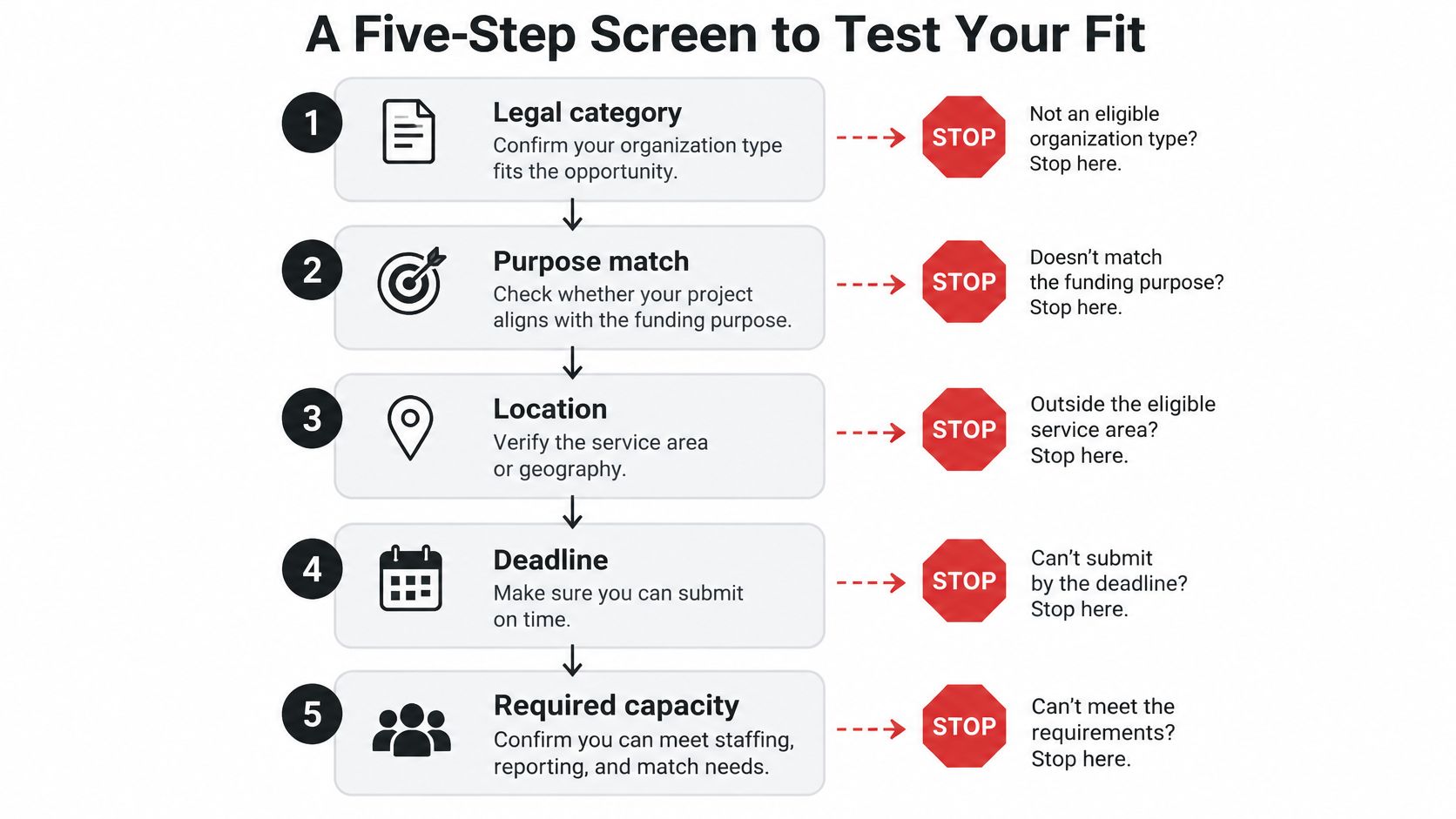
1. Legal category. Confirm your organization is one of the applicant types the funder names, and have your determination letter or other proof of status within reach. If your type isn't on the list, nothing later in the screen rescues the application.
2. Geography. Check whether the funder or notice limits awards to a state, region, county or service area, then check whether your programs reach those people. A foundation that gives only in its home metro won't stretch for a strong proposal from three states away.
3. Budget and grant size. Compare your annual budget and the funder's typical or maximum award against the project you'd run. A gap too wide to close in either direction, an award five times your annual budget or a minimum project size larger than your revenue, is a stop sign rather than a stretch goal.
4. Project purpose. Match your proposed activity to the funder's stated focus, not just the broad category it funds. "We fund youth" frequently means one specific outcome for one age band in one neighborhood.
5. Match, capacity and access. Note any cost-share requirement, plus experience or partnership rules, and confirm whether the funder accepts unsolicited proposals or works only by invitation. That last detail decides whether your calendar has room for this application at all.
For each check, write one sentence on what you found and one on how confident you are. Then sort every funder into three piles: disqualified, fixable, ready to draft.
A failed check is a no-go unless you can fix it before the deadline. "We'll work out the match later" is how organizations win an award they can't accept.
How Federal Eligibility Is Set for Each Opportunity
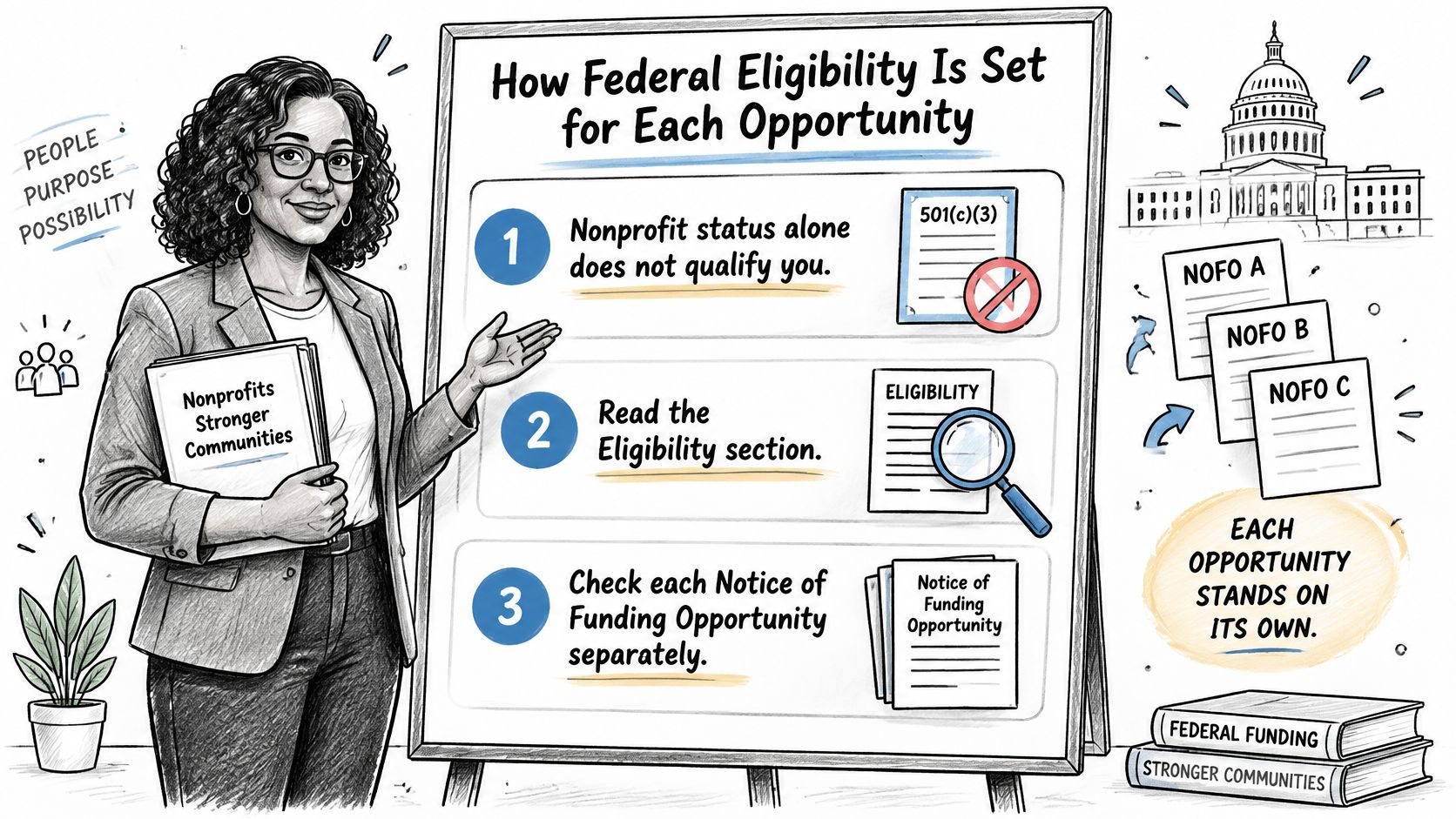
Nonprofit status does not qualify you for a federal grant. The notice does. Grants.gov's eligibility guidance describes the mechanism plainly: qualification is settled opportunity by opportunity rather than by a universal rule, and every Notice of Funding Opportunity carries its own eligibility section that applicants must follow.
Three tests in order
Legal applicant category. The federal framework recognizes state, county, city or township and special-district governments; federally recognized and other tribal governments; public and private higher-education institutions; public-housing authorities; nonprofits with IRS 501(c)(3) status; nonprofits without that status; for-profit organizations; and small businesses. Your type has to appear in that notice, not just somewhere in the federal system.
Program fit. Does your purpose and service area match what the program was created to fund? A generic match on sector isn't enough when the appropriation names a specific population or region.
Compliance. Can you meet every instruction, including registration and formatting rules? A perfect project in the wrong file format scores zero.
A listed category can still be narrowed by geography, organizational size, project purpose, institutional role or technical capacity. One Grants.gov opportunity admitted nonprofits, for-profits, public and private agencies and universities, then required applicants to show the ability and capacity to conduct scientifically valid research. That sentence does more filtering than the whole category list above it.
For a walkthrough of how registration, notices and submission fit together, this session covers the sequence end to end.
When a requirement is unclear, contact the named program officer, ask in writing, and keep the answer on file. A written reply from the program office is defensible; a phone recollection isn't. Before you draft a word, mark every requirement as disqualifying, curable or competitive. The full sequence for getting a federal grant follows that same order.
Foundation Rules That Decide Who Can Receive Funds
Here's the rule most applicants never hear. A private foundation's grant to an organization is generally treated as a taxable expenditure unless the recipient is a public charity or the foundation exercises expenditure responsibility over the grant, according to IRS guidance on private foundation grants to organizations. That single sentence explains why some funders ask for proof of status before they'll take a meeting.
The tax framework also limits what counts as a permissible charitable purpose: religious, charitable, scientific, literary or educational work, fostering qualifying amateur sports competition, and preventing cruelty to children or animals. A project outside that list is unfundable no matter how compelling the narrative is.
When a grantee sits outside the usual 501(c)(3) structure, the foundation must generally be reasonably assured the money will be used exclusively for permitted purposes. Sometimes the recipient has to hold the funds in a separate account, and the grantor follows expenditure-responsibility procedures on top. Grants made to individuals follow separate rules again, which is why a public charity that controls a project and selects recipients is often the cleaner route.
Read the 990-PF before you write a word
Assemble the documents first: status letter, mission statement, project budget, governance documents and a description of your financial controls. Then open the funder's most recent Form 990-PF and read the grants-paid list.
Look at three things. The typical award size, the type of recipient, and whether organizations resembling yours appear at all.
Practical rule: If the last few filings show no grants to organizations of your size, type or geography, your status letter won't change the outcome. Move on quietly.
Public-charity status gets you considered. It doesn't get you funded. If you want the fuller picture on how foundation money moves, this guide to private foundation grants for nonprofits covers the reporting side.
Telling Legal Fit Apart From Competitiveness
Eligibility is a yes or no. Competitiveness is a probability. A three-year-old community group with no reserves can be perfectly eligible for a notice and still lose, because the award assumes infrastructure it hasn't built yet.
Federal opportunities routinely add geographic targeting, prior delivery experience, partnership requirements or budget thresholds, and some require a 20 to 50 percent match, as noted in this Grants.gov opportunity listing. A nonprofit can therefore qualify on paper and remain operationally uncompetitive, short on unrestricted cash, evaluation staff, partner commitments or a documented track record.
| Requirement | Effect on eligibility | Can it be fixed? | Example |
|---|---|---|---|
| Legal applicant category | Disqualifying | Only by changing structure or using a sponsor | An individual applying for an organizational grant |
| Geographic targeting | Disqualifying | Rarely, unless a partner in the area can apply | A grant limited to a named state |
| Budget or grant size range | Disqualifying when out of range | Sometimes, by scaling the project | A minimum project budget above your annual revenue |
| Matching funds (cost share) | Lowers the odds or disqualifies | Yes, with reserves, in-kind support or partner funds | A cash match written into the notice |
| Invitation-only status | Disqualifying for open applications | Not curable without an invitation | A foundation accepting proposals only from invited grantees |
| Prior delivery track record | Lowers the odds | Over time, through a pilot or partnership | A first-year program applying for a multi-year award |
| Evaluation or reporting capacity | Lowers the odds | Yes, by budgeting an evaluator | Outcomes reporting required from year one |
The match that decides the answer
Say a notice requires a $30,000 cash match on a $150,000 award, and a community group with no reserves wants to apply. It qualifies legally. The decision now turns on whether the match comes from reserves, in-kind contributions a funder will count, or a partner's cash. If none of those exists, the honest answer is skip, not "we'll find it after we win".
Five moves improve fit without changing who you are. Name a fiscal sponsor or lead partner that holds the eligible status. Budget evaluator time and reporting hours from year one. Run a small pilot to build the delivery record multi-year awards expect. Set match funds aside before you apply, not after an award letter arrives. Ask whether the funder accepts unsolicited proposals before you invest a week in outreach.
Then label every row above for your own organization. Disqualifying requirements end the conversation. Curable ones get a date and an owner. Competitive ones set priority.
Deciding Whether to Apply, Partner or Skip
The reason most nonprofits don't pursue foundation money isn't ineligibility. Candid's research on why nonprofits don't apply found that lack of capacity was the most common reason organizations gave for not seeking foundation grants, more than one-third cited not knowing how to apply, and perceived ineligibility came in at less than one-third. Capacity is the barrier, and capacity can be changed in ways a legal structure cannot.
The sector's math is odd. In the same analysis, many funders reported trimming application requirements and simplifying reporting, while many nonprofit CEOs still said foundation grants had become harder to secure since January 2025. Easier forms do not make every opportunity cheap to chase.
The hidden cost of qualifying
Treat qualification as a decision problem with a price tag. Estimate writing hours, reporting hours and the likely award size. Compare the expected return against those hours. Then run the quick no-go screens before drafting: cash match, invitation-only status, budget mismatch, weak geographic fit. Any funder failing two or more screens drops off the list.
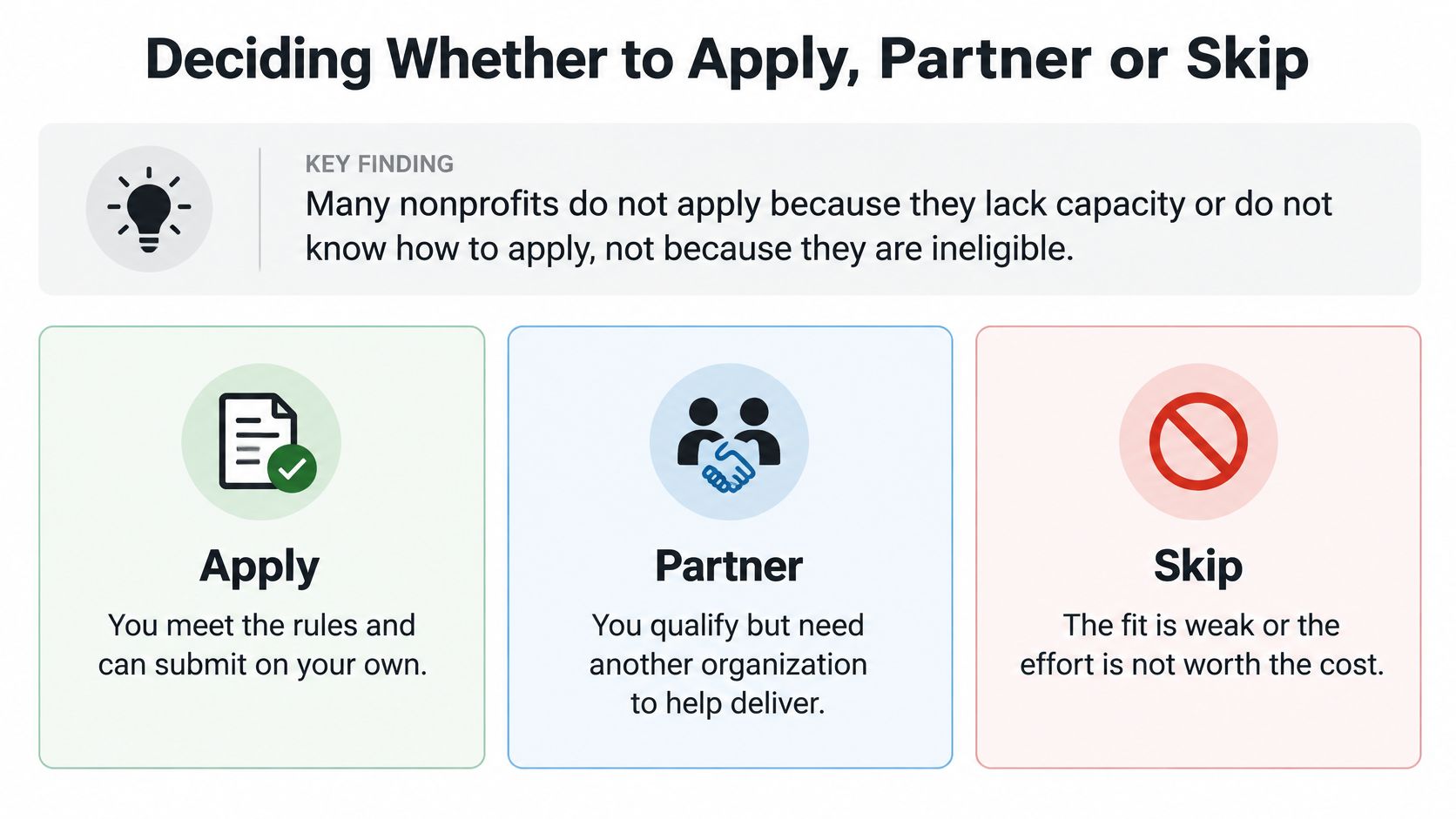
When a grant fits but capacity doesn't, choose the least expensive repair. Batch applications by fit rather than scattering them. Join a coalition already delivering the work. Bring in a fiscal sponsor when eligibility or controls sit outside your organization. Small, newer, rural and community-led organizations absorb unpaid proposal labor hardest, so protecting staff time belongs in the strategy.
Four things close the loop. Write a verdict of apply, partner or skip for every funder, with the notice or guideline page cited. Keep one documentation folder holding your status letter, mission statement, budget and governance documents. Build a deadline calendar with a named contact for each unclear requirement. Decide in advance what you do when a funder fails a disqualifying check, so the question stays settled.
Grantlas shortens the front end of this work by reading your website or EIN, building your profile, and matching foundations and federal, state and local grants to it. It does not apply on your behalf or guarantee any funding outcome. The final eligibility call always rests on the funder's published rules.
If you're tired of reading 990 filings and eligibility pages one at a time, Grantlas builds a scored shortlist of foundations and open federal grants from your website or EIN, with plain-English reasoning and flags for invitation-only funders, geography mismatches, awards out of your range, and cases where you were never an eligible applicant. You still make the call on each one, using the reasoning Grantlas provides alongside each match. Start a profile at Grantlas and see which opportunities fit before you write another word.