Non Profit vs LLC: How to Choose the Right Entity
Sep 28, 2026 · 12 min read

You've built a promising program, found potential funders, and started thinking about hiring. Then someone asks the question that can reshape everything: Should this be a nonprofit or an LLC? The answer isn't a matter of choosing the cheaper filing or the structure with the friendlier tax treatment. It depends on who should control the organization, where the money will come from, and whether surplus belongs to founders or to the mission.
Choosing incorrectly can create expensive friction later. An LLC may limit access to charitable grants and tax-deductible donations. A nonprofit may prevent founders from taking distributions and require governance they never intended to share. The right entity is the one whose capital flow, accountability rules, and funding model match the organization you're building.
| Decision factor | LLC | Nonprofit corporation with 501(c)(3) status |
|---|---|---|
| Primary purpose | Generate revenue and profit for members | Advance a charitable or other exempt mission |
| Ownership | Members hold equity | No private owners; a board governs |
| Surplus | May be distributed to members | Must support the mission |
| Typical funding | Sales, loans, member investment, investors | Donations, foundation grants, government grants, earned revenue |
| Federal tax treatment | Generally pass-through taxation | Exempt from federal income tax on related exempt-purpose income |
| Founder control | Members or managers control decisions | Board holds legal authority |
| Donor deductibility | Contributions generally aren't charitable deductions | Qualifying 501(c)(3) donations generally can be deductible |
| Compliance profile | Operating agreement, state filings, tax returns | Board records, Form 990, charitable registrations, IRS and state compliance |
Table of Contents
- Defining the Core Purpose and Capital Flow
- Formation and Legal Structure Requirements
- Tax Implications and the Non-Distribution Constraint
- Governance, Ownership, and Operational Control
- Fundraising, Grants, and Donor Expectations
- The Reality of Hybrid Models and State-Specific Rules
- How to Choose the Right Entity for Your Mission
Defining the Core Purpose and Capital Flow
A founder often starts with a simple idea: sell a service, support a community, and reinvest some of the money into a cause. That sounds like one organization, but it may contain two different legal missions. If the business needs investors and the founder expects to take profits, an LLC fits the economic reality. If the organization exists primarily to deliver a public benefit and relies on donations or grants, a nonprofit corporation is usually the sounder choice.
The fundamental difference is where surplus is allowed to go. An LLC is designed to create profit for its members. The operating agreement can define ownership, voting rights, management authority, and distributions. Members can build value in the company and benefit personally when the business earns more than it spends.
A nonprofit is “ownerless.” It can earn revenue and generate a surplus, but the surplus is subject to the non-distribution constraint. It must remain dedicated to the organization's exempt purpose rather than being paid to founders or other private insiders. The organization's assets belong to the entity and its mission, not to the person who conceived the idea. IRS historical data on the scale and distinct structure of the nonprofit sector helps put this distinction in context. Nonprofits represent a major economic category with governance and tax rules that differ from ordinary for-profit activity.
Practical rule: Decide who should receive the economic upside before you choose the filing. If the answer is the members, form an LLC. If the answer is the mission, form a nonprofit.
This choice affects more than annual tax work. An LLC can pivot into new products, accept equity investment, sell ownership, or distribute cash according to its agreement. A nonprofit can grow substantially, hire executives, sell products, and pay reasonable compensation, but it can't turn organizational growth into founder equity.
Before filing, draft a basic operating budget and revenue map. A useful starting point is a set of sample nonprofit financial statements, not because a nonprofit is an LLC without owners, but because the statements force you to separate earned revenue, restricted support, operating costs, and mission spending. That exercise often reveals the correct structure faster than a tax comparison.
Formation and Legal Structure Requirements
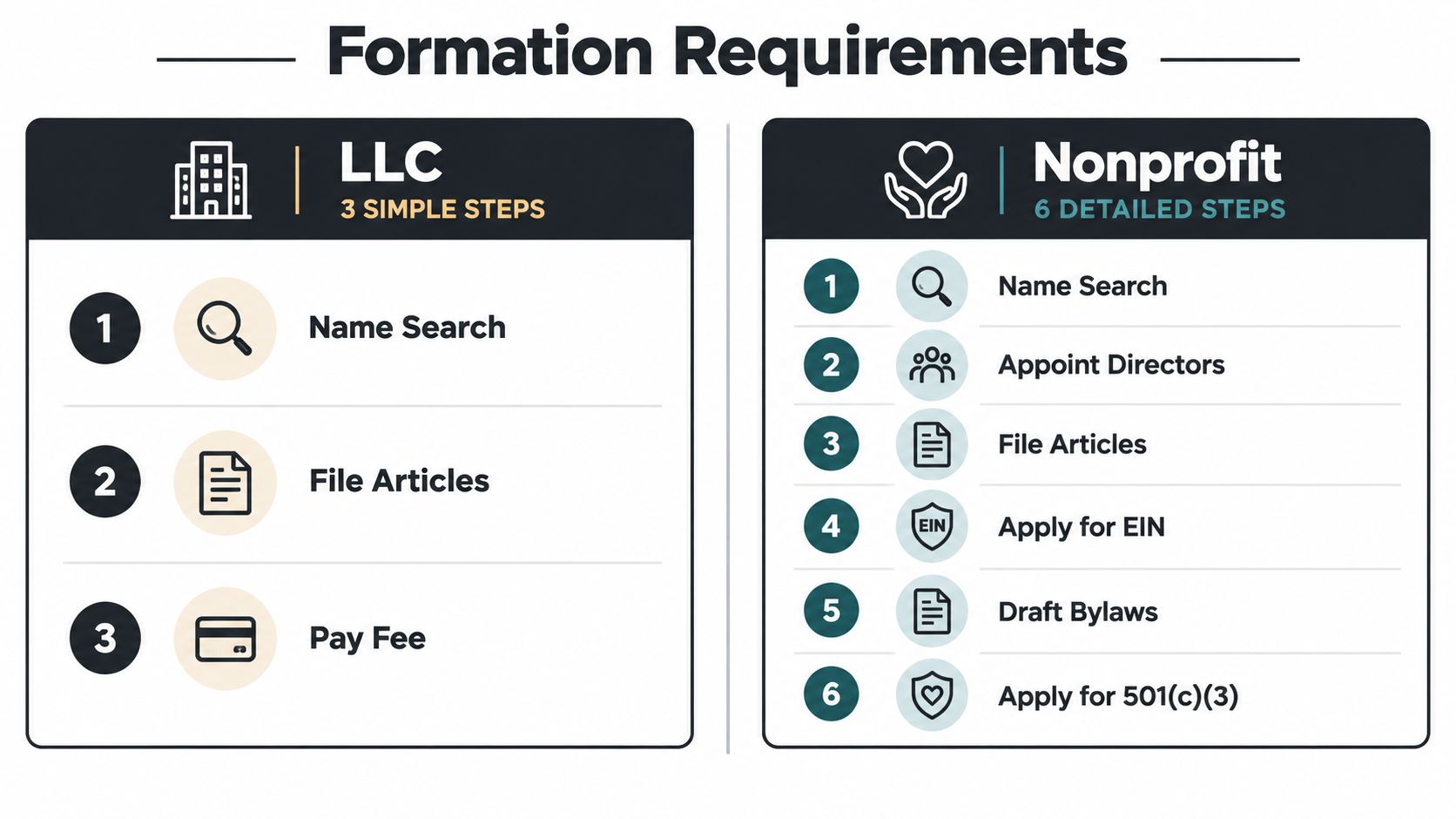
An LLC typically follows a direct state-level path. The founder selects an available name, files articles of organization, pays the required state fee, and adopts an operating agreement. The agreement can establish whether the company is member-managed or manager-managed, how profits are allocated, and what happens if a member leaves.
A charitable nonprofit takes more planning. The organizers generally incorporate under state law, appoint a board, prepare articles with appropriate charitable-purpose and dissolution language, obtain an EIN, adopt bylaws, establish governance policies, and apply separately to the IRS for recognition under section 501(c)(3). State incorporation creates the entity. It doesn't by itself create federal tax-exempt status.
The filing is only the beginning
An LLC can often begin operating once its state formation documents and internal agreement are in place. The organization still needs appropriate licenses, bookkeeping, contracts, payroll processes, and tax compliance, but the federal entity-recognition step is generally absent.
A nonprofit needs a governance system that can survive beyond the founder. Directors owe fiduciary duties to the organization, and the bylaws should address meetings, voting, officer roles, conflicts, and board authority. The IRS application must also demonstrate that the organization's activities and documents support an exempt purpose. The IRS guidance on nonprofit LLC eligibility shows why the federal review is not a formality. Organizational documents, activities, dissolution provisions, and membership restrictions all matter.
Build the compliance calendar early
Don't form a nonprofit and postpone administration until the first grant arrives. Create a calendar for board meetings, minutes, financial approvals, annual reporting, charitable solicitation registrations, conflict disclosures, and donor records. For an LLC, document ownership, signing authority, distributions, and related-party transactions from the start.
Founders who want a practical overview of the federal process can also review Fundl's 501c3 setup advice. Use it as a planning aid, then have qualified legal and tax professionals review the documents for your state and activities. Formation is easier to fix than a misaligned funding model, but neither structure should be treated as a casual paperwork exercise.
Tax Implications and the Non-Distribution Constraint
The tax question is important, but founders often ask it in the wrong order. They ask which structure pays less tax before asking whether the entity can legally receive the money they need or distribute the money they want. Tax treatment follows the structure's purpose and operations, and neither form eliminates every tax obligation.
An LLC is generally taxed as a pass-through entity. The company's profits and losses flow through to its members' personal tax returns rather than being taxed at the federal entity level under the default treatment. That can be efficient, but it means the founder may owe personal tax on allocated income even when cash remains in the business. The IRS-based comparison of LLC and nonprofit tax treatment describes this owner-level flow and the distribution flexibility that comes with it.
A qualifying nonprofit corporation with 501(c)(3) status can be exempt from federal income tax on income related to its exempt purpose. That exemption doesn't convert the organization into a private wallet. The organization must use its resources to advance the mission, and insiders can't receive the surplus just because they founded the entity.
What founders can and can't take out
A nonprofit founder can be paid for real work. Compensation must be reasonable for the services performed and approved through a process that protects the organization from private benefit. The founder can receive a salary or professional fee when properly documented, but can't take dividends or an ownership-based distribution.
An LLC member has a broader economic role. The member may receive compensation for work and distributions tied to ownership, subject to the operating agreement and applicable tax rules. That flexibility is often decisive for consultants, product companies, agencies, and social enterprises that need to reward founders directly.
| Cash-flow question | LLC | Nonprofit |
|---|---|---|
| Can the entity earn revenue? | Yes | Yes |
| Can the founder receive compensation? | Yes, under the company's arrangements | Yes, for actual services at reasonable compensation |
| Can surplus be distributed as owner profit? | Yes, subject to the agreement | No |
| Who benefits from retained surplus? | The company and its members | The mission and the public-benefit program |
| Does tax exemption cover every activity? | No federal exemption under default treatment | No, unrelated business activity may create tax obligations |
Nonprofit status also doesn't eliminate payroll taxes, state obligations, or tax on every revenue stream. Income from a regularly conducted trade or business that isn't substantially related to the exempt purpose may be subject to unrelated business income tax. A nonprofit selling merchandise or operating a commercial activity should analyze whether that activity advances the mission or functions as an unrelated business.
For a related comparison of exempt organizations and their purposes, see Grantlas's guide to 501(c)(3) and 501(c)(6). The decision shouldn't be reduced to “tax-free versus taxable.” It is a choice between owner-level economics and mission-locked capital.
Governance, Ownership, and Operational Control
If you want to own the organization, an LLC gives you an ownership framework. Members hold equity, and the operating agreement can assign voting power, management duties, profit rights, and transfer restrictions. A single founder can retain concentrated control, while multiple members can negotiate governance that reflects their contributions.
A nonprofit has no founder equity to hold, sell, or inherit. The corporation exists for its stated exempt purpose, and the board of directors governs it. The founder may serve as an officer or director, but that role doesn't create personal ownership.
The board is not decorative
A nonprofit board has legal responsibility for the organization's direction and stewardship. Directors oversee finances, approve major decisions, monitor conflicts, and protect the mission. They aren't merely a group assembled to satisfy a filing requirement. A weak or passive board creates operational risk, particularly when the founder handles fundraising, spending, hiring, and program decisions without meaningful oversight.
This governance model can feel restrictive to a founder used to moving alone. It also creates credibility with donors and institutional funders because the organization must answer to a governing body rather than one person's preferences.
Control has a price in both directions
An LLC gives founders speed and authority, but that freedom brings direct exposure to business performance. The member decides whether to reinvest, borrow, hire, pivot, or distribute cash. Investors or additional members may later dilute control, but the structure makes those rights explicit.
A nonprofit gives the founder less unilateral authority, yet it can make the mission more durable. The board can preserve the organization's purpose when the founder leaves, loses interest, or proposes a change that conflicts with the public benefit. The trade-off is clear:
- Choose an LLC if control, equity, and flexible commercial decisions are central to your plan.
- Choose a nonprofit if independent oversight and mission continuity matter more than personal ownership.
- Don't recruit nominal directors just to secure tax status. Recruit people prepared to ask difficult financial and strategic questions.
The founder's personality matters. If you need every decision to follow your personal direction, an LLC is usually the honest choice. If the work belongs to a community or public mission, accepting shared governance is part of the bargain.
Fundraising, Grants, and Donor Expectations
Entity choice determines which fundraising conversations you can credibly enter. A qualifying 501(c)(3) nonprofit can generally offer tax-deductible donations and pursue most charitable foundation and government grants. A standard LLC generally can't offer donors that charitable deduction, and many grant programs restrict eligibility to recognized tax-exempt organizations.
That difference changes your development strategy from the first day. An LLC usually builds capital through customers, contracts, loans, member investment, or impact-oriented investors. A nonprofit can combine earned income with individual donations, foundation support, government grants, and mission-aligned partnerships.

Test the funding model before filing
Ask three direct questions:
- Who pays? If customers pay for a product or service and the organization must respond to market demand, an LLC may fit better.
- Why will they pay? If donors and grantmakers pay because the program serves a public purpose, nonprofit status is usually necessary.
- What proof will funders require? Institutional funders commonly examine exempt status, governance, financial controls, program outcomes, and reporting capacity.
Only qualifying nonprofits with 501(c)(3) status can generally offer tax-deductible donations and access most grants, as summarized in this comparison of LLC and nonprofit structures. State registration, funder-specific rules, and applicant restrictions still apply. Tax-exempt status opens a door, but it doesn't guarantee an award.
Donor expectations create operating obligations
Donors expect restricted gifts to support the stated purpose. Grantmakers expect accurate budgets, measurable activities, timely reports, and consistent governance. A nonprofit that treats grant money like unrestricted founder capital will eventually face serious trust and compliance problems.
For practical prospecting, Grantlas's grants for nonprofits resource is relevant to organizations that have already chosen a nonprofit path and need to identify potential funders. Grant research should begin with eligibility, geography, program fit, and reporting capacity, not with a generic list of awards.
An LLC can still pursue social impact contracts and mission-related investment. It can sell products that create measurable benefits and attract investors who value both financial and social returns. But don't call a commercial financing strategy philanthropy. If your plan depends on charitable contributions and foundation support, forming an LLC first usually creates a structural obstacle rather than a clever shortcut.
The Reality of Hybrid Models and State-Specific Rules
“Nonprofit LLC” sounds like the obvious compromise. Founders imagine an LLC's flexibility paired with a 501(c)(3)’s grant access. In practice, the model is narrow, highly dependent on federal requirements, and unsuitable for most independent charitable startups.
The IRS places strict conditions on an LLC seeking 501(c)(3) recognition. Its organizational documents must limit activities to exempt purposes, include charitable dissolution language, and generally restrict membership to already tax-exempt organizations or governmental units. A solo founder usually can't just form an LLC, label it nonprofit, and obtain charitable status.
State formation doesn't equal federal exemption
State law adds another layer of confusion. Current references identify California, Tennessee, North Dakota, and Minnesota as states that permit nonprofit LLCs, according to this overview of nonprofit LLCs and nonprofit corporations. That doesn't mean a nonprofit LLC formed in one of those states automatically receives federal exemption or becomes eligible for every grant program.
A multi-state organization must also consider charitable solicitation registration, donor communications, contracts, employment, and program operations outside its formation state. Local entity recognition won't erase those obligations.
Why the hybrid shortcut usually fails
The hybrid structure can make sense when exempt organizations are collaborating on a controlled project. It rarely makes sense for a founder who wants personal control, broad fundraising access, and ordinary LLC economics in one package.
The compliance envelope is tighter, not looser. Membership restrictions can limit who participates, the operating agreement must mirror nonprofit rules, and federal recognition remains central. For most charitable ventures, a nonprofit corporation is the cleaner vehicle. For most commercial social enterprises, a standard LLC is more workable. Use a hybrid only after an attorney and tax adviser confirm that its ownership, activities, funding, and state-law treatment align.
How to Choose the Right Entity for Your Mission
Start with the money, then test the mission and governance. Don't choose a nonprofit because the word sounds more respectable, and don't choose an LLC because filing feels easier. The correct structure should still make sense after your first major funder, employee, investor, board dispute, or program expansion.
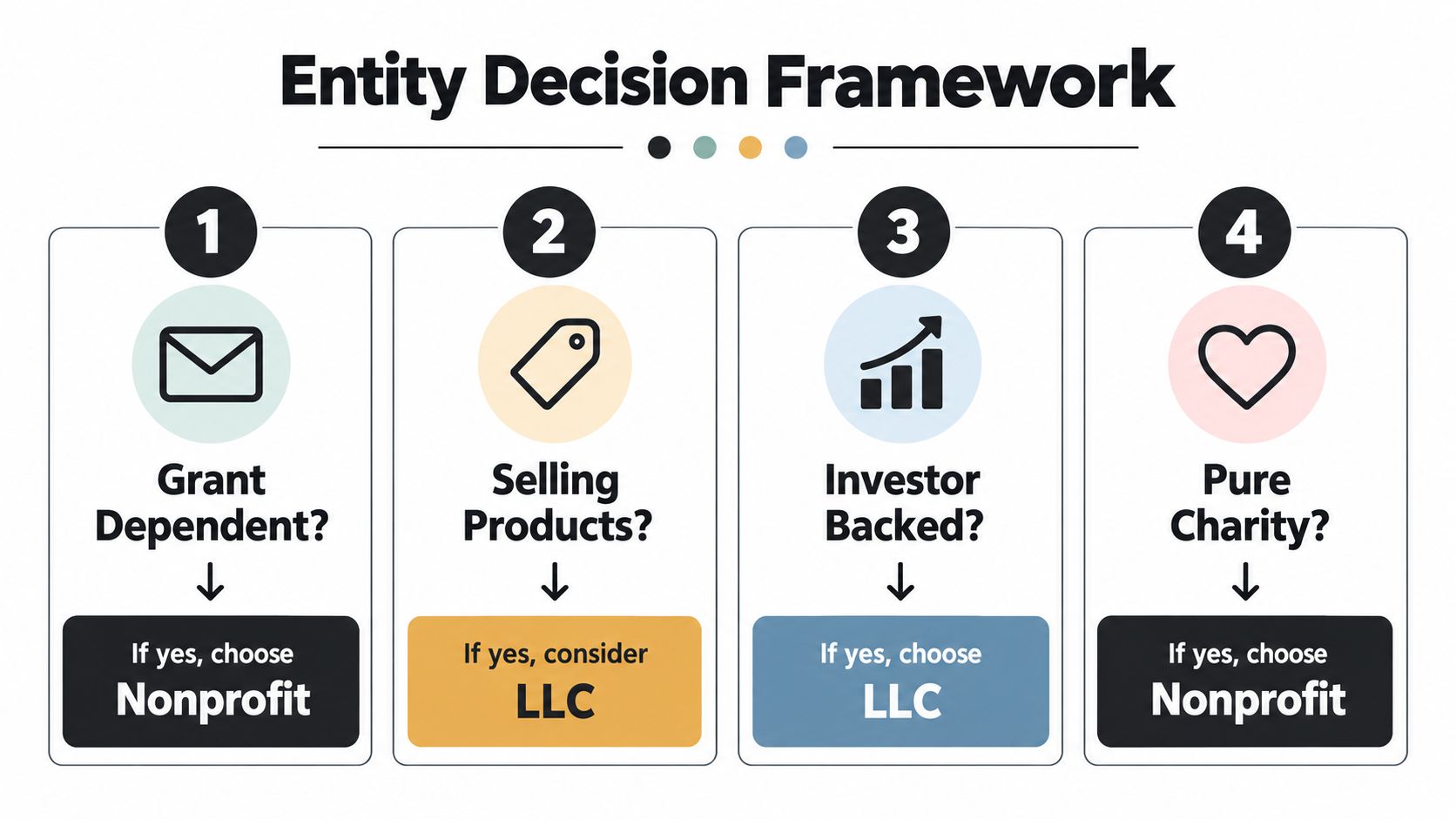
Use this decision framework:
- Grant dependent: Choose a nonprofit corporation and pursue 501(c)(3) recognition. Your funding model requires a structure that can generally receive tax-deductible donations and apply for charitable grants.
- Product or service led: Consider an LLC when customers, contracts, and operating revenue will carry the organization.
- Investor backed: Choose an LLC if outside investors need ownership, return potential, or defined equity rights.
- Pure charity: Choose a nonprofit when the central purpose is public benefit and surplus must remain dedicated to that purpose.
- Founder income dependent: Choose an LLC if distributions are necessary to your personal financial plan. Choose a nonprofit only if reasonable compensation, without ownership distributions, meets your needs.
- Community governed: Choose a nonprofit if independent directors should protect the mission and hold leadership accountable.
Make the decision with a written test
Write a one-page plan that names your primary beneficiaries, expected revenue sources, founder compensation, governance model, and five-year capital needs. Then mark each sentence as commercial, charitable, or mixed. If most of the plan describes customers, products, investors, and distributions, form an LLC. If it describes donors, grants, public benefit, and mission-locked surplus, form a nonprofit corporation.
Mixed plans deserve more scrutiny, not an automatic hybrid. Some founders may eventually use separate nonprofit and commercial entities, but related-party transactions, intellectual property, shared staff, and cost allocation require careful documentation. A structure that looks elegant on paper can become an accounting and governance burden.
For founders comparing for-profit alternatives, the Coto Waddington guide on LLC vs S offers useful context on how business entity choices can affect control and financial planning. It doesn't replace advice about nonprofit law, but it reinforces the larger point: entity selection should follow the operating model.
Choose the nonprofit when philanthropy is essential and you're prepared to surrender personal ownership. Choose the LLC when commercial revenue, founder control, and profit participation are essential. Before filing, have counsel review the governing documents, have a tax professional model compensation and revenue treatment, and ask prospective funders which applicant types they accept.
Grantlas helps nonprofit teams identify prospective private foundations and open federal grant opportunities, then prioritize them using organization-specific fit reasoning and eligibility flags. If your mission requires charitable funding, create a clear nonprofit profile and visit Grantlas to turn your funding strategy into a focused prospecting pipeline.