Nonprofit Government Grants: A Practical Guide for 2026
Oct 28, 2026 · 12 min read

You've got a board asking why you aren't chasing the big government money, a program you can't fully fund, and a notice that closes in three weeks. That's precisely when nonprofits make their most costly mistake. They start writing before they've answered two simple questions: do we qualify, and can we afford to win?
Nonprofit government grants aren't free money with paperwork attached. They're conditional funding with eligibility gates, reimbursement mechanics, and audit exposure built in. Check the gates and the cash flow first. If either one fails, walk away, no matter how good the mission fit looks on page one.
Table of Contents
- What Nonprofit Government Grants Are and Who Gets Them
- Eligibility Rules That Decide Whether You Can Apply
- Major Federal Programs and Who Actually Receives the Money
- State and Local Grants Where Your Chances Are Often Better
- How to Find Open Government Grant Opportunities
- Application Steps That Pass Compliance Screening
- Compliance Thresholds and Cash-Flow Risk After You Win
- Confirm Which Grants to Pursue This Quarter
What Nonprofit Government Grants Are and Who Gets Them
A government grant is money from a federal, state, tribal, or local agency to fund a public purpose, awarded competitively or by formula, with reporting conditions attached.
Say a youth mentoring nonprofit sees three offers in one month. Don't treat them as the same thing. A grant funds your program to deliver a public benefit. A contract buys defined services from you, on the buyer's terms and timeline. A reimbursement pays you back for allowable costs you've already spent and documented. The third one is where cash gets tight, and it's the structure behind many grants.
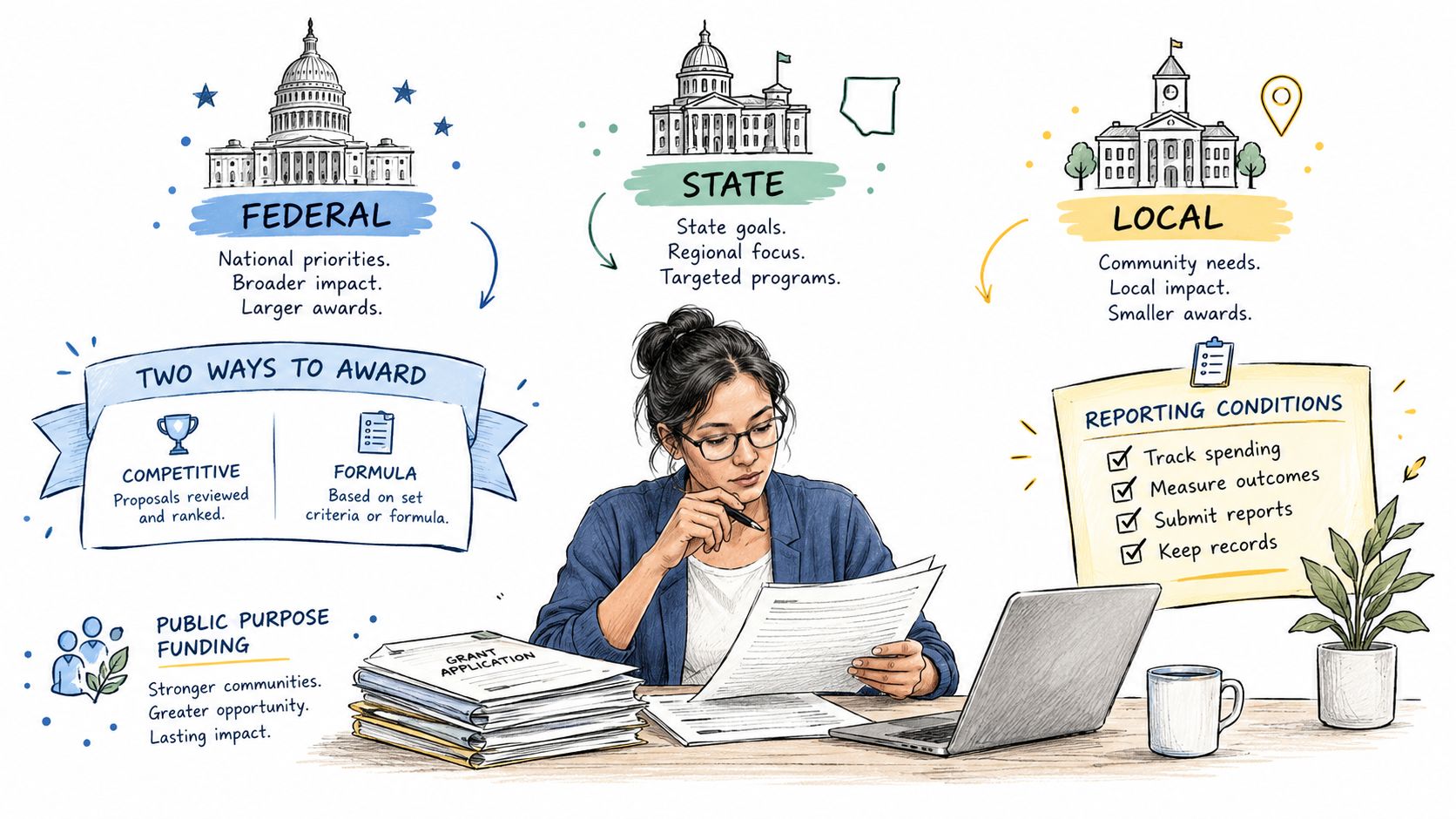
Most nonprofits touch this money at some level. A nationally representative study in the Urban Institute 2023 panel data tables found 63% of nonprofits received at least one government grant or contract in 2023. Local funding reached 46%, state funding 43%, and federal funding 27%, while 43% received at least one government grant and 27% received a government contract.
How Much Reliance Is Normal
Government sources accounted for one-quarter of nonprofit revenue on average in 2023. More than one-third of nonprofits obtained over 25% of their revenue from government sources, and roughly 20% obtained more than half.
Federal money is also the most policy-sensitive layer. The share of nonprofits receiving federal grants fell from 38% in 2019 to 2020 to 27% in 2022, a decline tied to the end of major COVID-19 relief programs.
Don't start with a program name. Start by naming which level of government funds your mission area, because that choice determines the portal, the rules, and the applicant definition you'll be judged against.
If your county funds youth services and your state funds workforce programs, those are your real markets. Search there first.
Eligibility Rules That Decide Whether You Can Apply
Eligibility is pass or fail. Scoring only ranks applications that passed. A brilliant narrative can't rescue a failed gate, and reviewers won't see it if screening stops you.
| Requirement | Federal | State | Local |
|---|---|---|---|
| Legal status | 501(c)(3) or another listed type, per notice | 501(c)(3) plus state charity registration in most states | 501(c)(3) or local registration |
| SAM.gov registration with UEI | Required for direct awards; most subawards also need a UEI | Not required for state-only funds | Not required for local-only funds |
| Grants.gov account | Required to apply through Grants.gov | State portal account required | City or county portal account required |
| Service area | Must serve the program's defined population or area | Must serve state residents or a defined region | Must serve city or county residents |
| Audit requirement | Single Audit at $750,000 or more in federal expenditures | Audit rule stated in state award terms | Audit rule stated in local award terms |
| Financial and past performance review | Commonly reviewed | Commonly reviewed | Commonly reviewed |
Legal Status and Registration
501(c)(3) status is common, not universal. Some programs accept tribal organizations, government entities, or other nonprofit types, and some exclude types you'd expect to qualify. The applicant definition in the notice decides it, not your mission statement. A fiscally sponsored project usually applies through its sponsor, so the sponsor's status and track record are what's reviewed.
For direct federal awards, you need active SAM.gov registration and a Unique Entity ID. Most federal subawards also need a UEI. Registration and renewals can take weeks when entity validation hits a mismatch. Start before you find a deadline, not after.
Geography and Financial Readiness
Many programs limit funds to residents of a city, county, or state. A national organization may qualify only for the slice of work inside that boundary, and it must budget only that slice. If your service area crosses a county line the funder doesn't cover, that's a partial fit at best.
Funders also review financial statements and past performance. A newly formed nonprofit often lacks the audit history or delivery record a notice requires, even if its program design is strong. That's not unfair. It's risk screening.
Before you draft a word, list every gate in the notice and mark pass or fail next to each one. One fail ends the conversation.
Major Federal Programs and Who Actually Receives the Money
Read the third column first. That's where nonprofits misjudge federal programs, because the named recipient is often a city, county, or state that later subawards the money.
| Program | Federal agency | Who receives the money | What it typically funds |
|---|---|---|---|
| Community Development Block Grant (CDBG) | HUD | Cities and counties, which subaward to nonprofits | Affordable housing, facilities, public services |
| Community Services Block Grant (CSBG) | HHS (Administration for Children and Families) | States, which fund local community action agencies and nonprofits | Poverty reduction, employment, emergency aid |
| Head Start and Early Head Start | HHS (Administration for Children and Families) | Local grantees, including many nonprofits | Early childhood education and family services |
| Older Americans Act Title III | HHS (Administration for Community Living) | State agencies on aging, which fund local providers | Senior nutrition and caregiver support |
| Substance use prevention and treatment grants | SAMHSA | States and nonprofits, direct or through states | Treatment, recovery and prevention services |
| Byrne Justice Assistance Grant | Department of Justice (Bureau of Justice Assistance) | States and localities, which subaward | Crime prevention and victim services |
| AmeriCorps program grants | AmeriCorps | Nonprofit host sponsors | Member service positions and community service |
| Grants for Arts Projects | National Endowment for the Arts | Arts nonprofits directly | Arts projects and cultural programming |
Formula Money Versus Competitive Money
A formula grant distributes funds by a statutory allocation, often based on population or need. You don't win it by outscoring another applicant at the federal level. You access it when the state, city, or county that received the allocation runs its own process. CDBG, CSBG, and Byrne funds commonly reach nonprofits this way.
A competitive grant works differently. The agency publishes criteria, scores applications, and funds the highest-ranked proposals within its budget. SAMHSA discretionary grants, AmeriCorps program grants, and NEA Grants for Arts Projects fit this pattern more closely, though each notice sets its own rules.
Practical rule: If the recipient column names a government, your prospect is that government, not the federal agency. Build the relationship and watch its procurement calendar.
Search by Assistance Listing number, formerly the CFDA number, not by program nickname. Program names change in headlines. The listing number ties the notice, the award terms, and your audit schedule together.
Head Start and Early Head Start are notable because local grantees, including many nonprofits, hold awards directly and carry heavy performance standards. Older Americans Act Title III money flows through state agencies on aging to local providers, so your entry point is usually an Area Agency on Aging process.
Don't rely on last year's notice. Confirm each program's current notice of funding opportunity on Grants.gov before you plan staff time, especially after a year of funding cuts, delays, and reorganizations across federal programs. If there's no current notice, there's no opportunity, whatever an old PDF says.
State and Local Grants Where Your Chances Are Often Better
State money comes in two streams, and they behave differently in a budget fight. Formula pass-through money starts federal, then the state distributes it under federal rules. State general-fund appropriations start with the legislature, and a legislature can cut them in any budget year. Know which stream you're chasing before you forecast renewal.
State grants come from human services, health, workforce, housing, and criminal justice agencies, plus state arts councils. Local grants come from city and county housing, health, parks, and youth offices, and from public school districts funding youth programs. The applicant pools are smaller, the geography is narrower, and program officers are easier to reach.
The reach is broad. Urban Institute analysis of IRS Form 990 filings found government-grant-funded nonprofits exist in every U.S. state, every congressional district, and more than 95% of U.S. counties. Almost 9 in 10 nonprofits with annual expenses of $10 million or more received government funding, and government sources represented 54% of their revenue on average.
Smaller organizations participate too, but on different terms. More than half of nonprofits with less than $100,000 in annual expenses reported government funding, although it represented only 13% of their revenue on average. State participation ranged from 21% to 47%, with Vermont highest at 47%, followed by Alaska at 46% and West Virginia at 44%.
That gap by size tells you something useful. Large organizations build systems to absorb government reporting and payment timing. Small organizations often take a modest local award first, prove they can document costs, and then move up. That's the right sequence.
For any state or local program, ask three questions before you apply:
- Administering agency: Which agency or office runs the award and approves payment?
- Award method: Is it formula, competitive, or a legislative earmark with its own conditions?
- Funding durability: Is the money appropriated annually or fixed by statute?
If staff can't answer those, you don't understand the opportunity yet.
How to Find Open Government Grant Opportunities
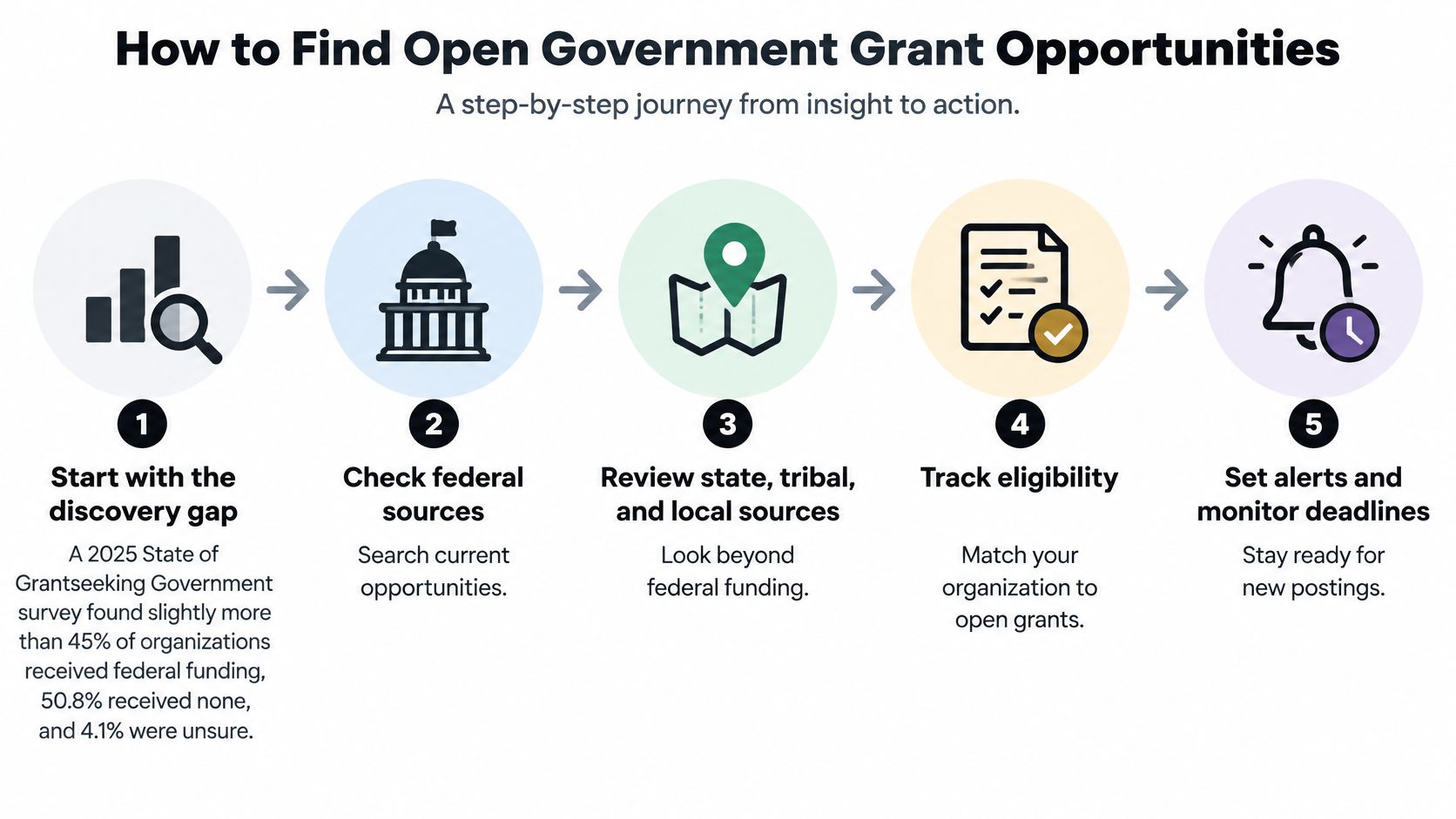
Federal discovery isn't a complete market. In the 2025 State of Grantseeking Government Report, slightly more than 45% of surveyed organizations reported receiving federal funding, while 50.8% reported none and 4.1% were unsure whether they had received federal support. Among recipients, nearly one in three experienced reductions or cancellations, and the median largest federal award was $265,000.
Money also flows through states, universities, and nonprofit intermediaries, so a Grants.gov search alone misses pass-through routes. And finding a notice isn't the same as surviving it. A 2025 California survey found about 40% of nonprofit respondents did not receive advance payment, roughly two-thirds faced burdensome reporting requirements, nearly 60% did not receive enough funding for indirect costs, and nearly 60% found applications challenging or complex. Score the economics while you're still prospecting.
Use this routine, in order:
- Activate SAM.gov and your UEI first. Registration blocks everything downstream for direct federal awards. Fix name and address mismatches now.
- Create Grants.gov saved searches by Assistance Listing number and agency. Saved searches catch new notices and amendments without daily manual checks. Broaden your view of funnels and deadlines with this capture planning guide for federal teams if your staff also tracks contract-style opportunities.
- Check state agency grant pages and the state budget. Appropriations signal which competitive solicitations are coming. Compare prospecting workflows using these grant research tools for building a repeatable search process so searches don't live in one person's bookmarks.
- Contact county and city housing, health, and parks offices. Ask when requests for proposals open and whether prior awards are public. Local calendars rarely sync with federal tools.
- Ask intermediaries about planned subawards. Community action agencies, Area Agencies on Aging, and state pass-through entities often issue subawards that never appear as federal listings.
- Build a deadline calendar with 30-day and 7-day reminders. Track question deadlines separately from submission deadlines. Miss the question window and you'll guess at requirements.
The visual below maps that discovery sequence from first check to deadline monitoring.
Watch this walkthrough before you set up your first saved searches, then replicate the steps in your own accounts.
State and local openings still need direct checks. Federal search tools don't capture them reliably, and pretending they do is how good local fits get missed.
Application Steps That Pass Compliance Screening
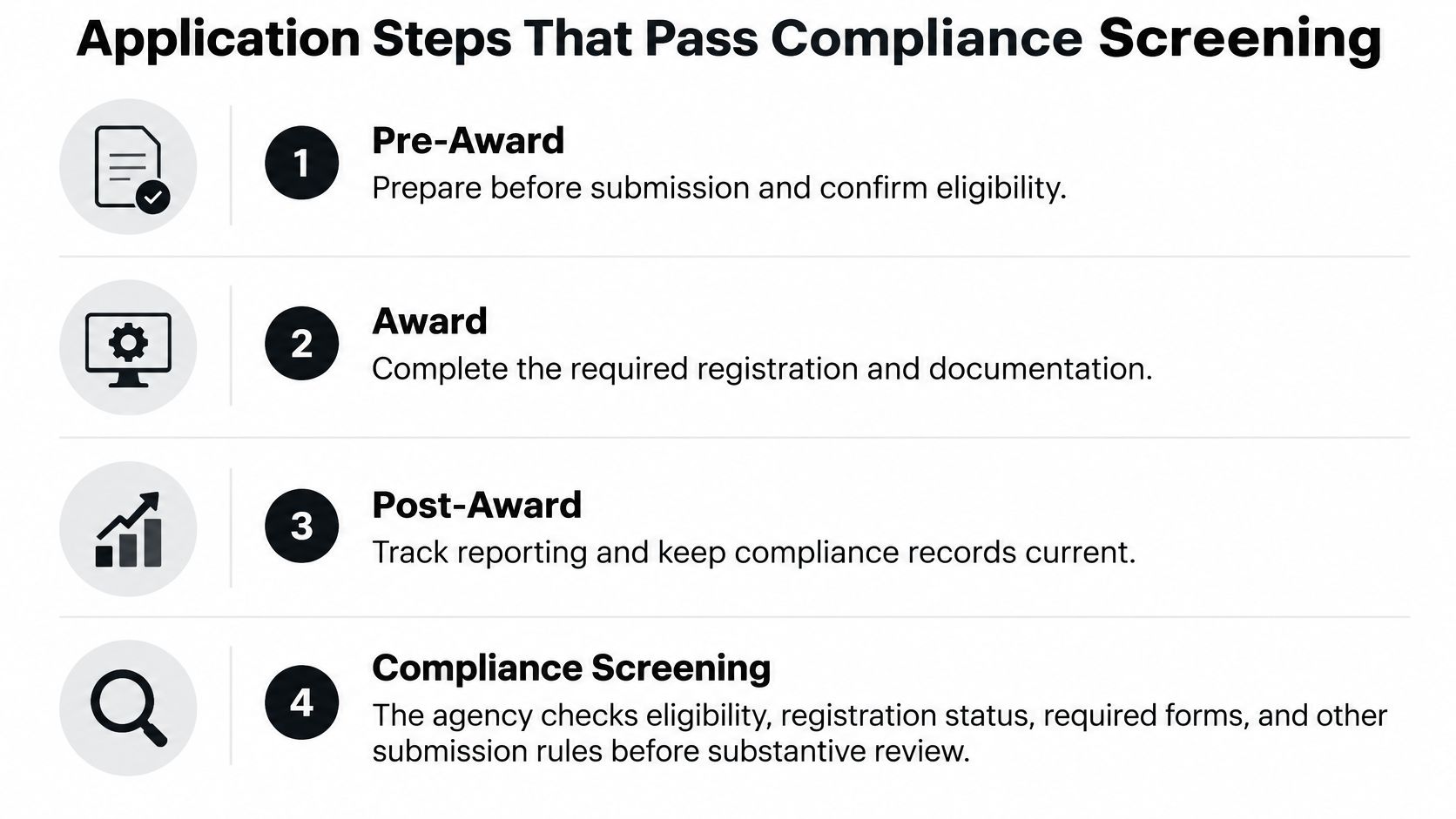
Federal grant seeking is a lifecycle, not a single submission event. Grants.gov's grant lifecycle guide defines pre-award, award, and post-award phases. During pre-award, applicants identify an opportunity, verify eligibility and mission fit, complete required registrations, and submit an application containing organizational, programmatic, and financial information. After submission, the awarding agency performs compliance screening before substantive review.
Treat eligibility, registration status, required attachments, and submission validation as gates. They're not ranking factors you can offset with a strong needs statement.
The checklist below shows where screening sits in that lifecycle.
The Submission Sequence
Read the notice's applicant definition, funding restrictions, cost categories, page limits, and required forms before you outline. Then confirm SAM.gov, Grants.gov, and any agency portal accounts are active for the person who will submit. Submit questions before the question deadline, in writing, and keep the answers with the file.
Build the budget to the notice's categories and ceiling. If personnel, fringe, travel, equipment, supplies, contractual, and indirect costs are the prescribed lines, use those lines. Draft the narrative around the measurable outputs the program asks for, not every good thing your organization does. When you're structuring that narrative, follow a disciplined draft process like the one in this step-by-step grant proposal writing guide and keep claims tied to evidence you can report later.
Run pre-submission validation early enough to fix errors. Check file names, signatures, attachment order, budget math, and portal error messages. For the governance and recordkeeping that sit behind a clean submission, this nonprofit compliance guide for 2026 is a useful companion checklist.
Submit days ahead, not hours ahead. A portal rejection at 4 p.m. on deadline day is usually final.
Failures That End Applications Early
- Expired SAM.gov registration: The system blocks submission or award until it's active.
- Missing or unsigned attachments: Screening staff don't chase you for corrections.
- Budget above the ceiling or in wrong categories: The application can be returned without review.
- Last-hour upload errors: You can't correct a failed validation after the deadline.
A finished package includes organizational, programmatic, and financial information, plus your acceptance of post-award reporting, cost restrictions, and closeout duties. Price those duties into your decision now.
Compliance Thresholds and Cash-Flow Risk After You Win
A bigger award isn't always a better award. Sometimes it's a larger unfunded compliance obligation with a program attached.
Under the Uniform Guidance framework described by the Government Accountability Office, a nonfederal entity that expends $750,000 or more in federal awards during a fiscal year generally must obtain a Single Audit, unless a limited program-specific-audit exception applies. The audit examines financial statements and the Schedule of Expenditures of Federal Awards, evaluates internal controls over financial reporting, and tests compliance with requirements that could materially affect federal programs.
The Threshold Counts Spending, Not Awards
The trigger is annual federal expenditures across awards. Three moderate awards spent in the same fiscal year can create the same audit duty as one large award. Model cumulative spending by fiscal year before you accept another award, and separate award commitments from actual expenditures.
Your accounting system must track each award by Assistance Listing, project, and allowable-cost category. If staff can't produce that schedule cleanly, you're not audit-ready. Set up award-level tracking before spending starts, using a system and review cadence like those covered in this overview of grant tracking software options, and reconcile it monthly.
Run the Cash-Flow Math
Say you win a hypothetical $300,000 reimbursable award paid quarterly in arrears. You must cover roughly $75,000 in payroll and program costs before the first reimbursement arrives, and you repeat that float every quarter. If payment slips, the float grows. That's working capital you either have, borrow, or don't have.
Indirect costs aren't optional overhead. They're rent, insurance, technology, finance staff, and management time required to deliver the funded work. If a notice caps or excludes those costs, your unrestricted funds subsidize the government program. Check whether you have a negotiated indirect cost rate or qualify for a de minimis election under the current Uniform Guidance and the notice terms, then budget the full allowable amount.
A grant with strong program fit can still weaken a small organization if it requires fronting payroll and excludes the infrastructure that makes delivery possible.
Ask about advance payment, payment timing, reporting frequency, and cost documentation before you sign. If the answers break your cash position, decline or negotiate within the rules. Don't hope the float resolves itself.
Confirm Which Grants to Pursue This Quarter
Pursue a grant only when it passes all four tests.
- Eligibility test: Do we meet every gate in the notice, with registrations active?
- Fit test: Is mission fit strong enough to justify proposal time against other prospects?
- Cash-flow test: Can we cover costs through the longest likely reimbursement gap?
- Capacity test: Do we have reporting and audit capacity for our total federal exposure?
Deprioritize any grant that fails the cash-flow or capacity test, even when fit is strong. Build a shortlist of five to ten opportunities across federal, state, and local sources, with a 90-day calendar for submission and question deadlines.
Your first action is simple. List every notice's gates, ceiling, payment method, and deadlines in one sheet. Then create a Grantlas profile from your website or EIN to generate a scored shortlist with reasons and flags, and recheck the top matches on Grants.gov or the state portal before you commit staff time.
Stop spending proposal hours on grants you'd fail at screening or can't afford to carry. Grantlas builds a scored shortlist of federal grants and private foundations from your website or EIN, flags ineligible applicants, geography mismatches, and size mismatches in plain English, and sends deadline reminders so qualified opportunities don't slip. Create your profile, review the flags, and pursue only the grants that pass all four tests this quarter.