Nonprofit Grant Proposal Template That Wins Funding
Oct 20, 2026 · 13 min read

You have a deadline in three weeks, a folder of last year's proposals, and a program director who keeps revising the numbers. You open a blank document, paste in your mission statement, and start reshaping old paragraphs to fit new questions. The writing isn't your biggest problem. You don't yet know if you're eligible, whether the budget covers its real costs, or which attachments will disqualify you.
Table of Contents
- What a Nonprofit Grant Proposal Template Actually Is
- The Ten Core Sections Every Template Should Include
- Reusable Narrative vs Funder-Specific Shell
- Section Prompts for Executive Summary, Need Statement, and Project Description
- Designing the Budget Template as a Traceable Cost Model
- An Honest Sustainability Section for Scarce Unrestricted Funding
- A Go or No-Go Gate Before You Open the Template
- Pre-Submission Compliance Checklist
- Putting the Template, Gate, and Checklist Together
- Quick Reference for Common Mistakes and Final Prompts
What a Nonprofit Grant Proposal Template Actually Is
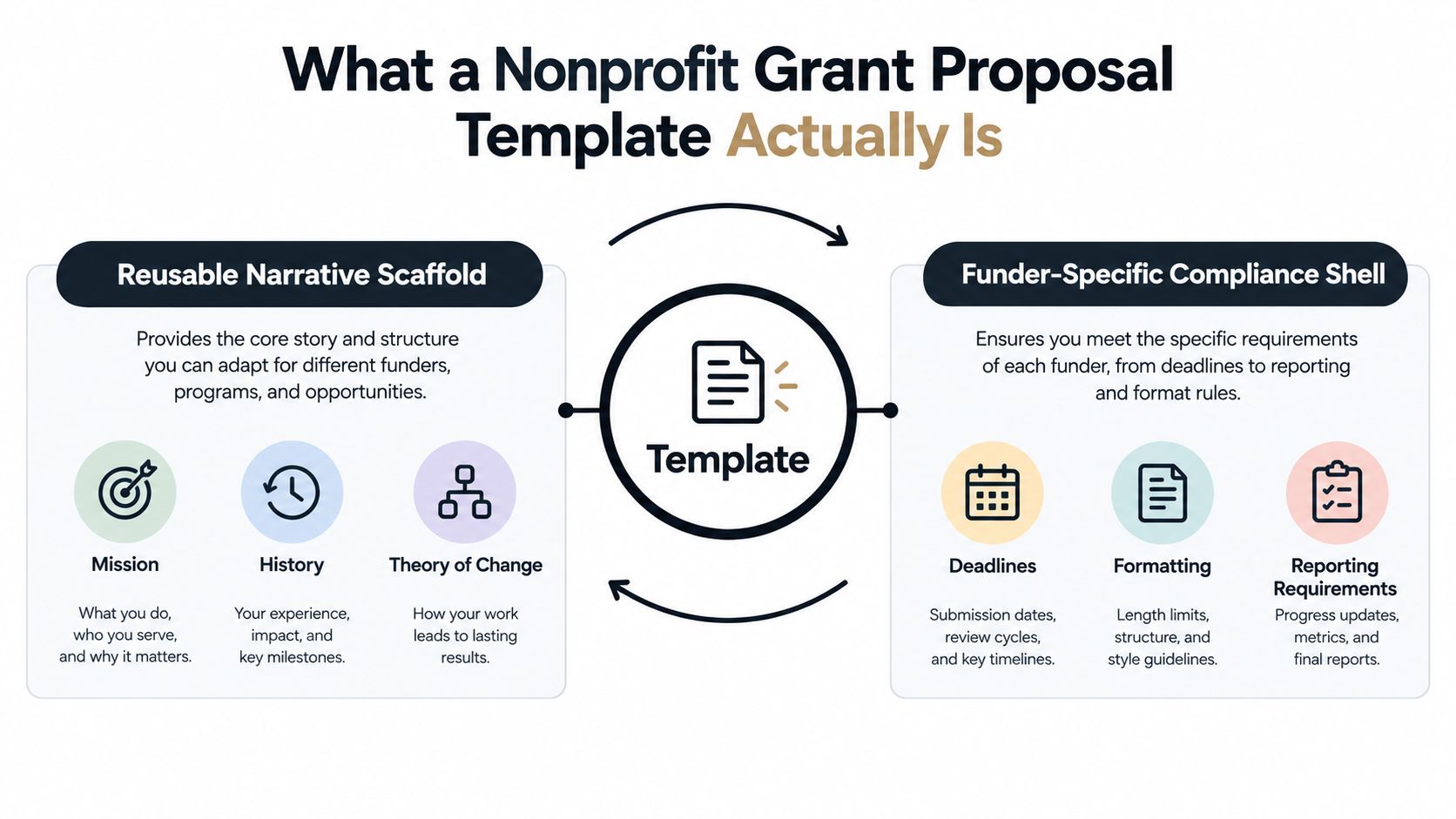
Stop treating a nonprofit grant proposal template as a fill in the blanks form. It's a two layer system. The top layer is a reusable narrative scaffold. The bottom layer is a funder specific compliance shell. If you merge them into one master document, you'll copy the wrong deadline, the wrong geography, or last year's budget into a polished proposal that was never eligible.
What belongs in the scaffold
Keep content here that only changes when your strategy changes. That includes mission and history, your theory of change, leadership bios, evaluation approach, and a clean description of your core model. Draft it once, review it quarterly, and pull from it deliberately.
What belongs in the shell
The shell mirrors one funder's instructions. It holds applicant type, geography, requested amount, deadline, page limit, required attachments, and submission fields. Build it fresh for every opportunity. Don't trust memory.
Candid's recurring components include a needs statement, proposed solution, activities, outputs and outcomes, evaluation, sustainability, organizational information, budget, and supporting documents, as set out in Candid's grant proposal guidance on core components. That same guidance tells you to follow each funder's specific instructions. Both rules matter. The template organizes reusable material, the shell protects you from basic ineligibility.
Practical rule: If a field would be wrong for a different funder, it belongs in the shell, not the scaffold.
This structure works for a solo grant writer, a development director juggling renewals, a consultant with multiple clients, and a founder writing a first request. It also sits behind a go or no go gate. You qualify the opportunity first. Only then do you open the template and spend scarce writing time where reviewers award points.
The Ten Core Sections Every Template Should Include
Reviewers score in the order the funder asks, not the order you prefer. Build your template in the sequence most funders expect, then rename and reorder it to match each solicitation. Ordering matters because it lets a reviewer find evidence without hunting. A familiar filename won't save a proposal that answers questions out of sequence.
If you're adapting material from an academic context, a research proposal approval guide can help you separate a scholarly argument from a funder facing case for support. Don't import academic structure wholesale. Grant reviewers want delivery, cost, and measurement, not a literature review.
Core Sections at a Glance
| Section | Reviewer Question | Reusable? |
|---|---|---|
| Executive summary | Is this clear, fundable, and aligned? | No, rewrite last |
| Statement of need | Is the problem specific and evidenced? | Partly |
| Project description and goals | What will change, for whom? | No |
| Activities and timeline | Can this be delivered on schedule? | Partly |
| Outcomes and evaluation | How will success be proven? | Methods only |
| Organizational capacity | Can this team manage the award? | Mostly |
| Sustainability plan | What happens after the grant? | No |
| Detailed budget | Do the numbers match the plan? | No |
| Budget narrative | Is every cost justified? | No |
| Required attachments | Is the package complete? | Shell only |
Two mistakes sink otherwise sound applications. First, writers reuse the need statement and project description as if they were boilerplate. They're not. Local data, target population, and activities must match this funder's priorities and geography. Second, writers bury the request amount and primary outcome deep in the text. Put both where a busy reviewer sees them immediately.
Treat organizational capacity as your most reusable section. Update it when leadership, financials, or track record change. Treat everything tied to amount, dates, targets, and costs as new writing every time. That's where customization earns its keep.
Reusable Narrative vs Funder-Specific Shell
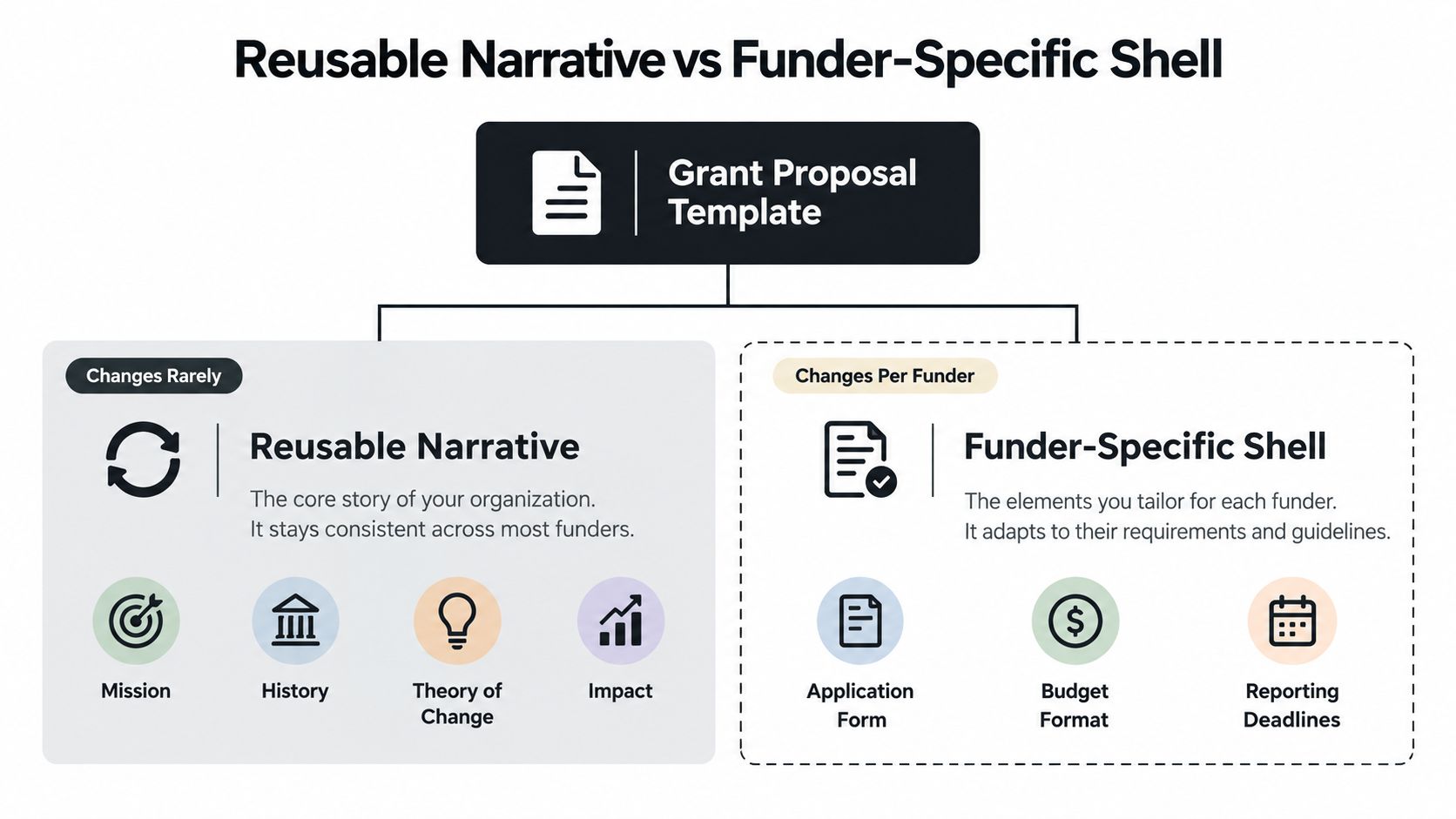
A single universal document feels efficient. It isn't. It forces you to edit boilerplate and compliance fields in the same pass, which is how wrong opportunity numbers and stale budget totals survive to submission. A dual layer design takes an hour to set up and saves you from that error on every application after.
The reusable narrative layer
Store approved language for mission history, theory of change, leadership bios, evaluation methodology, and financial capacity. Tag each block with a review date and an owner. When your strategy or staffing changes, update the block once. Don't let individual proposals become competing versions of the truth.
The funder specific shell
Build placeholders for agency identifier, funding opportunity number, certification pages, abstract limits, and page limit warnings. Federal practice shows why this separation works. The SF-424 family is described as a government wide standard data set and application cover sheet family in Grants.gov guidance on standard federal forms, with related budget and disclosure forms including SF-424A-D and SF-LLL. The persuasive narrative sits alongside that standardized shell. It doesn't replace it.
Tag every template field with one of two labels.
- Boilerplate: Pull approved text, then check names, dates, and figures still hold.
- Rewrite: Draft from this funder's prompts, scoring criteria, and limits.
A template that doesn't tell your team which fields to rewrite is just a prettier blank page.
For a small foundation letter of inquiry, the shell may be six fields. For a federal application, it's a full intake packet. The narrative modules stay stable either way, and that's the point. You preserve numeric targets, budget totals, and compliance statements in clearly labeled fields instead of scattering them through prose where nobody can audit them.
Section Prompts for Executive Summary, Need Statement, and Project Description
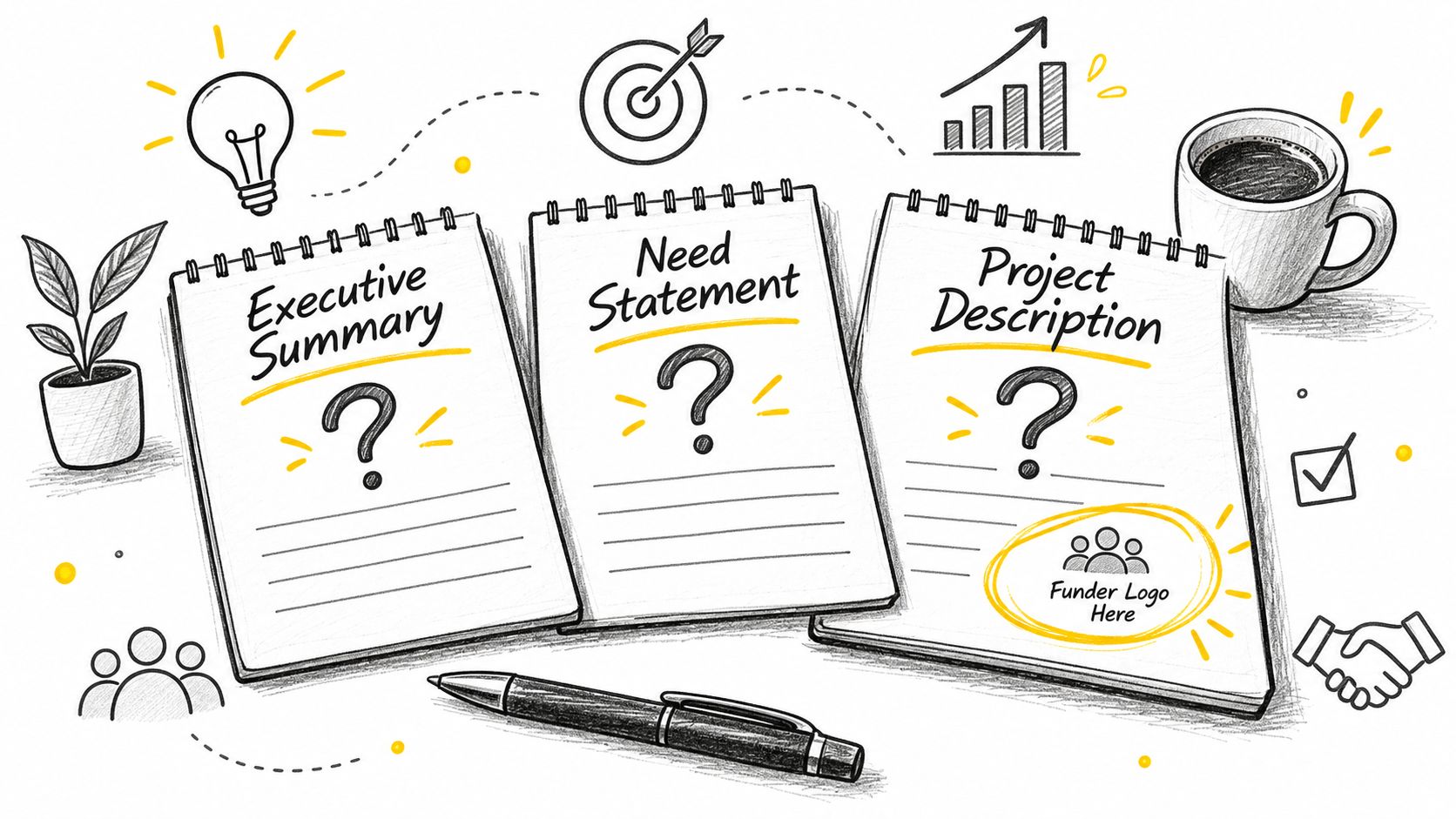
These three sections lose the most points for vagueness. Use prompts that force specifics, then write. Don't start with adjectives. Start with who, where, how much, and what changes.
The visual below is a useful reminder to keep the three drafts separate until each one can stand on its own.
Executive summary prompts
Write this last, in 100 to 150 words. Answer five things. Who's the funder and what's the requested amount? Who's the target population and where are they? What's the primary outcome? How does the request match the funder's stated priorities? What period does the funding cover? If a reviewer read only this paragraph, they'd know whether to keep reading.
Need statement prompts
Name the local problem, the population affected, and the service gap. Cite credible studies, statistics, reports, and data that a reviewer can check. National figures alone won't carry a local request. For worked approaches to framing evidence without padding, review these statement of need examples for grant proposals before you draft. Then close the loop. Show why existing services don't already solve the problem and why your approach fits the gap you've documented.
Project description prompts
Build a visible logic chain. Input, activity, output, outcome, impact. For each activity, state who delivers it, where, how often, and what it produces. Connect every objective to an indicator, a data collection method, a responsible staff member, and a measurement date. Reviewers shouldn't have to reconstruct your theory of change from scattered clues.
Watch how an experienced writer tightens these sections under real limits in the walkthrough below.
Cut any sentence that could appear in a competitor's proposal unchanged. Specificity is differentiation. Generic commitment language is filler reviewers have read a hundred times.
Designing the Budget Template as a Traceable Cost Model
Your budget isn't a total with decoration around it. Reviewers read it as a test of whether you understand your own program. If the narrative promises weekly services and the budget funds a few hours a month, you've told them the plan isn't real. Build the worksheet so every line can be traced back to a named activity.
For the underlying category structure, start from a tested grant proposal budget template with standard cost categories and then adapt it to the funder's format. Don't submit your internal layout if the funder supplies its own form. Map your model onto theirs.
Fields every line item needs
- Cost category: Personnel, fringe benefits, travel, equipment, supplies, consultants or contracts, other costs, or indirect costs.
- Calculation: Unit or quantity multiplied by rate, shown in the cell or the narrative.
- Period and source: When the cost occurs and which funding source covers it.
- Activity link: The named activity or deliverable this cost supports.
Pair the worksheet with a budget narrative that reconciles mathematically to it. Federal guidance on pairing a detailed worksheet with a narrative explaining cost methods is covered in Department of Justice guidance on writing a proposal budget. Use the narrative to show why each cost is necessary, reasonable, allowable, and allocable. Those four tests aren't bureaucratic decoration. They're how reviewers decide whether to trust your numbers.
Add a cross check column before submission. Walk the narrative top to bottom. Every promised activity should appear in the budget. Every major cost should appear in the narrative. Every promised result should have a measurement method and, where measurement costs money, a line that pays for it.
Don't hide shared costs to make the request look lean. Reviewers who manage grants for a living spot a budget with no supervision, no data time, and no finance support. They read it as risk, not efficiency.
An Honest Sustainability Section for Scarce Unrestricted Funding
A program director writes "we will seek additional funding to continue this work" for the third grant running. Every applicant writes that sentence. Delete it. Reviewers read it as a placeholder because it answers nothing about what happens when this award ends. Replace it with scenarios, named choices, and an honest account of what your work costs.
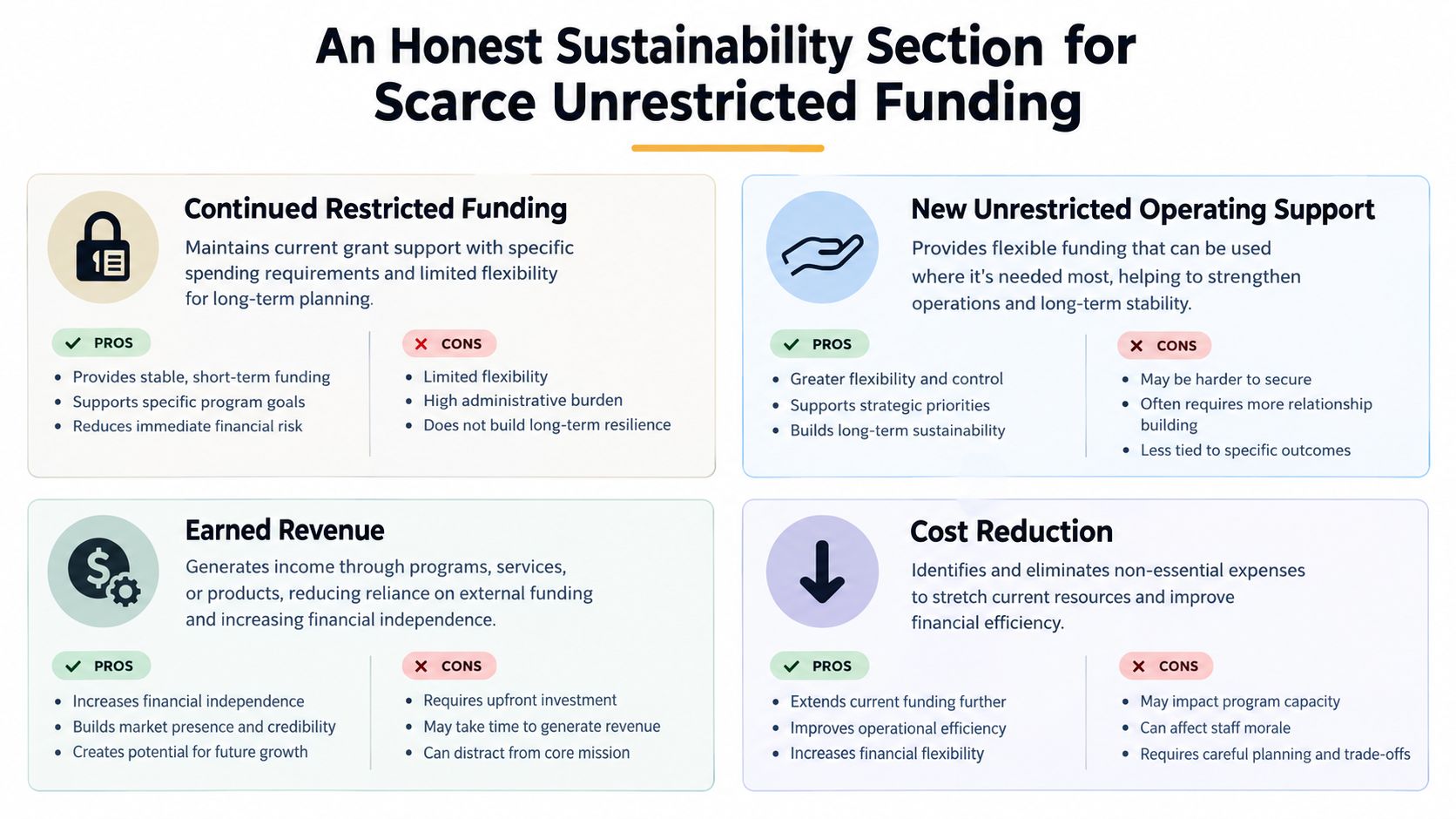
The pressure behind that advice is measurable. The 64% of nonprofits that received less than half their 2024 grants and donations as unrestricted funding, alongside 75% reporting that raising unrestricted dollars was a challenge, are documented in the 2025 sector survey on nonprofit funding conditions. Nearly half of respondents also reported foundation grant sizes had shrunk. A sustainability paragraph that assumes easy replacement funding ignores the market you are asking reviewers to believe in.
Write four scenarios instead of one promise. Continued restricted funding: name the likely sources and the evidence from this grant that supports renewal. Unrestricted operating support: state how much flexibility your model needs and what you protect first. Earned revenue: show the payer, the price logic, and the ramp, or drop the claim entirely. Planned scale down: identify which outcomes stay protected, which costs keep running, and which activities stop.
A credible scale down plan beats an invented promise to continue at full scale forever.
The section's last job is pricing honesty. Separate direct project costs from the shared administrative and infrastructure costs beneath them, and disclose whatever your request leaves uncovered. If you charge indirect costs, say in operational terms what they buy: finance capacity, compliance work, supervision the project uses. Reviewers rarely score down candor about cost. They score down discovering, mid-grant, that a project drains core operations. Before you adapt this section, check whether the funder has a history of supporting realistic full costs. That single fact should set how boldly you write it.
A Go or No-Go Gate Before You Open the Template
A program officer opens your application, reads the eligibility line, and closes it. Three weeks of writing died in ninety seconds because nobody asked the gate questions first. Run the gate before you draft a sentence. It takes under an hour, and a polished proposal to the wrong funder still earns a zero.
Discipline matters more when competition tightens. In a 2025 funder survey on application volume and burden, 58.1% of respondents expected applications to increase and 55% expected requested amounts to increase, while only 33.3% prioritized reducing grantee burden. Disciplined disqualification often produces more value than polishing every prospect, regardless of how much detail you add.
Six questions fit on one page:
- Does the funder accept new grantees, or is this effectively a renewal pool?
- Does your legal status match the eligible applicant categories exactly?
- Does your service area fall inside the funder's stated footprint?
- Does your realistic request sit inside the funder's typical award range?
- Is the opportunity open, or invitation only and dependent on a prior relationship?
- Does the expected award justify the application and reporting burden?
Score each item pass, fail, or unknown. A fail on eligibility, geography, or access ends the conversation. A stack of unknowns means you research before drafting, never during.
Two operating rules keep the gate honest. Define a minimum viable proposal for small long-shot opportunities so effort stays proportionate to the prize. Set an escalation trigger: high-effort or high-value applications go to a senior reviewer early, while there is still time to kill or reshape them. When the gate says no, record why and move on. That record stops the same weak prospect from resurfacing next quarter.
Pre-Submission Compliance Checklist
A strong narrative loses to a missing signature more often than grant teams admit. Build this checklist straight from the funder's notice of funding opportunity, line by line, and treat every requirement as a row that names an owner and points to the exact template field or attachment that satisfies it. A row with no owner does not get done.
Federal applications commonly combine eligibility, a program narrative, and a budget attachment, as described in Grants.gov guidance on the pre award phase. Federal guidance also imposes hard caps, including a tight character limit on the proposal abstract that a padded first draft will blow past. Limits like that belong on the checklist on day one, not in a panicked final edit.
Map each demand in the notice to a location and a failure mode:
| Requirement in the notice | Where it lives in your package | The failure it catches |
|---|---|---|
| Eligibility evidence: applicant type, geography, registrations | Cover form and eligibility section | Status described loosely instead of matching the notice's exact categories |
| Narrative sections in the required order, within page or character limits | Narrative attachment | Boilerplate left in and pushing past the page cap |
| Budget worksheet totals | Budget attachment and any standard forms | Totals that disagree with the narrative and the summary |
| IRS determination letter, board list, financials, indirect cost agreement, lobbying disclosure | Attachment slots | Right file, wrong portal slot, file name improvised at deadline |
| Signed certifications | Certification slot | Signature chase nobody owned |
| Performance measures: indicators, data methods, collection timing | Evaluation narrative or logic model | Indicators listed with no method behind them |
Run the table twice. Once when you build the shell, while structural gaps are still cheap to fix. Once in the final days before submission, when the administrative errors that strong prose hides tend to surface.
Keep two worked examples in the template itself. One row built for a private foundation letter of inquiry, covering amount, fit statement, and requested financials. One built for a federal SF-424 application, covering forms, abstract, narrative, and budget attachments. Placed side by side, they teach the team that compliance is a mapping exercise: every funder demand gets a location, an owner, and a status.
Putting the Template, Gate, and Checklist Together
Use the three tools in sequence and the workflow gets simpler, not heavier. Run the gate. Open the template. Run the checklist. Each tool does one job. The gate stops wasted effort. The template standardizes reusable content and forces funder specific rewriting where it counts. The checklist catches administrative errors that strong prose would otherwise hide.
Start with qualification data, not drafting. A platform such as Grantlas, which scores funder fit with plain English reasoning and flags invitation only status, geography mismatch, and out of range grant size, can feed the gate before your team commits hours. Whatever source you use, record the reason behind each pursue or pass decision. Future you will thank present you.
Then draft in a deliberate order. Build the shell from the guidelines. Pull narrative modules into it. Write the budget as a cost model while the activities are still flexible. Draft the sustainability scenarios before the executive summary, because the summary shouldn't promise more continuity than your scenarios support. Finish the summary last.
To see how finished pieces hold together under these rules, study sample nonprofit grant proposals with complete section flow and mark where each one passes or fails your checklist. Reading samples critically teaches faster than reading them admiringly.
After internal review, run the compliance pass with fresh eyes. Ideally, the checker isn't the writer. Writers see what they meant. Checkers see what's on the page. Proposal preparation is the back half of a search to award pipeline. Treat it that way and your template becomes an operating system, not a document you rediscover under deadline pressure.
Quick Reference for Common Mistakes and Final Prompts
Pin this next to your drafting workspace. It's built for use during an active deadline, not for leisurely reading.
Mistakes that cost you points or eligibility
- Uncited need: Local claims with no checkable evidence behind them.
- Disconnected evaluation: Measures that don't map to stated objectives or activities.
- Unreconciled budget: Totals that differ between narrative, worksheet, and summary.
- Wrong applicant type or geography: Eligibility failures discovered after drafting.
- Missing certifications: Unsigned forms or attachments in the wrong slot.
- Ignored limits: Page, word, or character limits treated as suggestions.
- Generic sustainability: Replacement funding promised with no scenario or source.
- Thin capacity section: History offered instead of evidence you can manage this award.
- Sloppy file names: Attachments a reviewer can't identify at a glance.
One sentence prompt for each core section
Summary, what's requested and what changes. Need, what local evidence proves the gap. Project, what activities produce which outcomes. Evaluation, how each objective gets measured and by whom. Budget, what each cost buys and why it's allowable. Sustainability, what happens under each realistic funding scenario.
Before you submit, answer three questions out loud. Are we eligible on every stated criterion? Does every cost support a named activity and every result have a measurement method? Could a reviewer find the amount, population, timeline, and primary outcome in under a minute? If any answer is no, you're not done. Fix that item today, while the fix is still cheap.
Stop spending your best writing hours on funders who were never a fit, and let Grantlas score prospects against your profile with plain English reasons, giving history, and early flags for invitation only or out of range opportunities. Build your profile, run your shortlist through the go or no go gate in this guide, and open your template only for the opportunities worth winning.