10 Sample Non Profit Financial Statements
Sep 24, 2026 · 14 min read
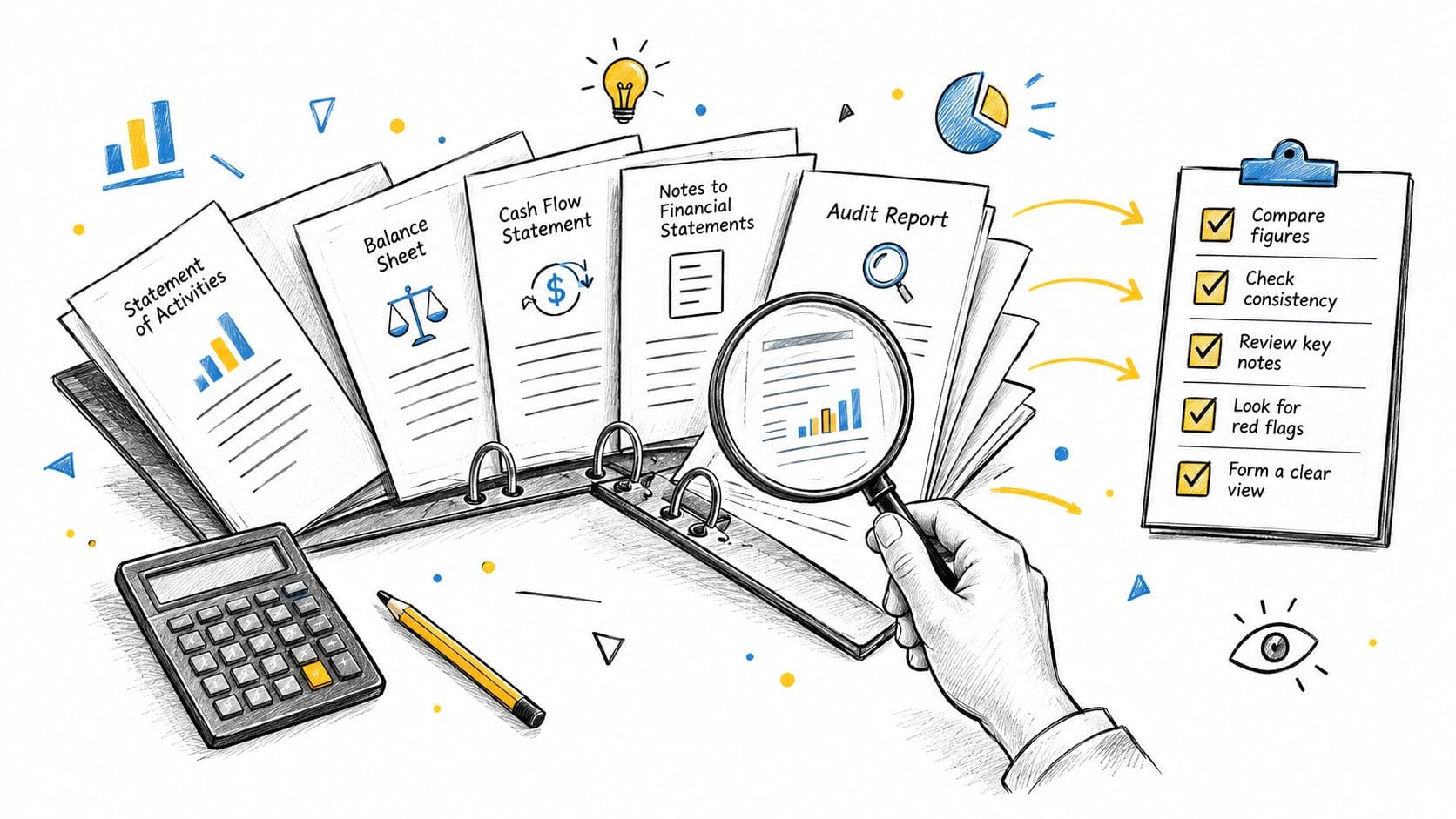
Choose the right model before you copy a number. The best sample non profit financial statements are comparison tools, not plug-and-play templates, because a statement that works for a national federation can mislead a small local charity if you import every note, every disclosure, and every allocation rule without thinking. Start by identifying the statement of financial position, statement of activities, statement of functional expenses, statement of cash flows, the notes, and the auditor's report, then match each example to the nonprofit's size, funding model, restrictions, and reporting audience. Funders want presentation that stays readable and consistent, while specialized disclosures from large or international organizations may never fit a smaller U.S. nonprofit.
That's why a prospecting tool like Grantlas can help at the front end of the process. Its funder profiles, fit reasoning, and deadline reminders can support grant prioritization, but they don't replace accounting judgment or a careful review of the statements themselves.
Table of Contents
- 1. AICPA Illustrative Financial Statements Save Our Charities
- 2. AICPA Not For Profit Illustrative Financial Statement Disclosures Resource Hub
- 3. AICPA Not For Profit Entities Best Practices in Presentation and Disclosure
- 4. American Red Cross Audited Consolidated Financial Statements
- 5. United Way Worldwide Consolidated Financial Statements
- 6. Feeding America Auditor's Reports and Financials
- 7. Habitat for Humanity International Audited Consolidated Financial Statements
- 8. YMCA of the USA Audited Consolidated Financial Statements
- 9. World Wildlife Fund US Consolidated Financial Statements
- 10. Doctors Without Borders US Financial Statements
- Comparison of 10 Sample Nonprofit Financial Statements
- Turn Examples Into a Funder-Ready Reporting System
1. AICPA Illustrative Financial Statements Save Our Charities
A polished model can mislead if you copy it line by line. The AICPA's Save Our Charities illustrative set is still the strongest free baseline for comparing nonprofit reports, because it presents the full package in a format controllers and board members can follow. It is a model, not a filing, but it reflects US nonprofit GAAP and gives finance teams a practical reference for drafting accounting policies and notes. AICPA's illustrative financial statements page
What the model gives you
The set places the statement of financial position, statement of activities, statement of functional expenses, statement of cash flows, and notes together. Its ASC 958 presentation gives teams a useful reference point before they compare the nine audited statements from different nonprofit operating models elsewhere in the article. Restricted net assets, liquidity, and contributed services are good examples of note topics to adapt. Before drafting, map your funder audience and reporting sequence with this sample report walkthrough, which shows how a finished package comes together.
Practical rule: Borrow the structure, not the story. Use the model to improve headings, sequencing, and note language, then replace its facts with classifications and disclosures that match your organization.
When the model stops helping
The example becomes less useful when your facts differ sharply from its assumptions. A regional arts nonprofit, food bank, and small advocacy group may share statement headings while reporting different revenue mixes, restrictions, and note detail. The model cannot decide whether your grant belongs in a particular category or whether an unusual transaction requires separate disclosure.
Because AICPA's example is non-authoritative, treat it as a drafting and consistency aid, not a universal template. Borrow only the formatting, revenue, restriction, and functional-expense ideas that fit your own reports and funder requirements.
2. AICPA Not For Profit Illustrative Financial Statement Disclosures Resource Hub
The AICPA disclosure hub is the better companion when the question isn't “What does the statement look like?” but “What should the notes say?” It's organized around disclosure topics, so finance teams can jump directly to the area they're refining instead of flipping through a generic template. For teams that already have a draft, that saves time during year-end cleanup and auditor review. AICPA's nonprofit disclosure hub
Best use case for a finance team
This hub works best when staff are checking whether their notes align with current nonprofit presentation norms and recent FASB-related updates. It's also helpful when a controller needs to compare a draft note against profession-standard examples without committing to a full paid guide. That makes it especially valuable for organizations that want note quality without overbuilding a report package.
- Use it for note gaps: Find examples for policies, restrictions, and presentation issues that often get missed in first drafts.
- Use it for wording discipline: Keep the language clear and comparable across years so the report doesn't drift.
- Use it for audit prep: The hub helps you see what a professional note set should cover before the auditor starts redlining.
Trade-off to keep in mind
The hub isn't a single complete model, and some linked materials may sit behind membership or purchase requirements. That means the value is in the navigation and curation, not in assuming every linked document is free or equally relevant. Smaller nonprofits should use it as a reference shelf, then stop once the notes answer the organization's actual reporting questions.
3. AICPA Not For Profit Entities Best Practices in Presentation and Disclosure
A paid AICPA publication earns its place on this list because it gives you real audited examples instead of an abstract template. That matters when the reporting question is about acceptable variation, not just compliance minimums. Controllers, CFOs, and auditors often need to see how similar organizations handled presentation choices in a live annual report. AICPA best practices publication
Why paid examples can be worth it
The main advantage is context. A curated publication can show how different nonprofit types present the same core statements while still staying within accepted nonprofit reporting practice. That's useful when your team is deciding whether a line belongs in revenue, other income, or a note, and when you need a defensible presentation rather than just a clean-looking one.
Paid guidance is most useful when the organization already knows its reporting problem. If you're still trying to decide whether a disclosure belongs in the notes, the activities statement, or a separate policy memo, the examples help more than a blank template.
When it's too much
Small nonprofits can overpay for detail they won't use. If the organization has simple grants, limited in-kind revenue, and no complicated net asset structure, a heavyweight reference can become a distraction. Use the publication when the annual report needs judgment calls, not when the staff only needs a basic drafting scaffold.
4. American Red Cross Audited Consolidated Financial Statements
The American Red Cross is a good real-world model when you need to see how a large nonprofit handles volume, complexity, and highly detailed notes without losing readability. Its audited consolidated statements show what happens when a nonprofit has to explain scope, multi-year context, and disclosures that go far beyond a classroom example. For larger organizations, that's often more useful than a clean but artificial sample.
What to borrow from it
The useful part isn't the size, it's the discipline. The Red Cross archive gives you a multi-year view of audited consolidated reporting, which is exactly the kind of presentation that helps boards compare trend lines rather than stare at one year in isolation. It also shows how major nonprofits explain contributed goods and services and other detailed note areas without making the statements unusable for readers. American Red Cross governance and audited financial statements
Where smaller nonprofits should stop
This kind of reporting can quickly become overkill. Consolidation language, broad program structures, and large-scale note detail can crowd out the clarity a smaller organization needs for funders, donors, and board members. If your nonprofit doesn't operate across multiple entities or major program lines, borrow the tone and the clarity, then leave the rest behind.
5. United Way Worldwide Consolidated Financial Statements
United Way Worldwide is especially useful if your organization works inside a federated structure or moves money through affiliates. The report package shows how a central office can present grants, gifts, and affiliate flows without making the financials unreadable. That's a real drafting problem for networks, because the report has to explain both what the headquarters did and what moved out to local partners. United Way Worldwide public reporting
Why federated reporting matters
A federated nonprofit has to make affiliation transparent without overloading the reader. That means the notes need to explain how money moves, what stays at headquarters, and what gets passed through to local entities. For a finance team, the lesson is not the brand name, it's how to separate the world office's obligations from the broader network story.
Use of Grantlas can help development teams prioritize which funders belong in the pipeline, but reporting still needs to stand on its own. The Grantlas grants for nonprofits guide is useful for prospect work, while the statements themselves need to show clean accounting and clear restriction logic.
Where the model can mislead
A single-entity nonprofit can get tripped up by federated examples. Affiliate accounting, network distributions, and system-level narrative can make the report look more complex than necessary. If your organization doesn't manage a national or regional network, don't force that structure into your own notes just because it appears polished.
6. Feeding America Auditor's Reports and Financials
Feeding America is a useful reference for nonprofits whose reporting depends heavily on donated food and other goods. Its statements show a specific challenge: valuation must reflect the basis used by the organization, while the presentation must remain understandable to funders, auditors, and board members. The model is most useful for studying valuation methodology, not copying an entire report package.
Best borrowed idea
Focus on how the notes support the valuation of contributed nonfinancial assets. For donated inventory, a nonprofit may need to distinguish a wholesale-based valuation from a retail-based one, depending on what was received and how its accounting policy applies. That choice affects reported contribution revenue, program costs, and the explanation a funder sees in the notes. Feeding America's financial statements and auditor's reports provide a practical reference for testing whether the valuation policy is clear and consistently applied. Feeding America financials and auditor's reports
Strong in-kind valuation notes also support grant applications. See these sample nonprofit grant proposals for how financial explanations can support a funder-facing case.
Practical rule: Match the valuation method to the asset and document the policy. A retail figure can overstate the economic value of goods that would normally be distributed at wholesale, while a vague note leaves readers unable to assess the reported amount.
Why not every nonprofit should mimic it
A service-only nonprofit or small community group may have little donated inventory and no reason to build an elaborate valuation note. Use Feeding America's method as a reference for policy clarity, then scale the disclosure to the goods received, the accounting judgment involved, and the questions funders ask.
7. Habitat for Humanity International Audited Consolidated Financial Statements
Habitat for Humanity International is a strong reference for organizations that deal with housing programs, loans, affiliates, and international complexity in the same report package. The statements show how a nonprofit can stay accessible while still explaining matters that touch several reporting layers at once. For finance teams, that balance is hard to build from scratch.
What stands out
The useful part is the way grants, loans, microfinance elements, and multi-currency or affiliate matters sit inside one presentation framework. That helps a nonprofit with cross-border work decide how much detail the notes need before the report becomes unreadable. The example also reinforces the point that a clear statement of activities can still support a complex operating model. Habitat for Humanity annual reports and 990s
Scale-specific caution
Smaller U.S. nonprofits should resist the urge to copy every disclosure. International structure brings currency issues, affiliate relationships, and operational complexity that many local organizations do not have. The right move is to borrow the way Habitat separates issues, then leave out anything that doesn't match the books.
8. YMCA of the USA Audited Consolidated Financial Statements
YMCA of the USA is useful because it sits in a familiar brand category while still showing real national-level reporting complexity. The statements and transparency materials offer a clean benchmark for revenue streams, allocation logic, and comparative presentation. That makes it a practical example for organizations that want polished reporting without drifting into unnecessary jargon.
Why this example is practical
National-affiliate structures often have revenue sources and allocation methods that need careful explanation. YMCA of the USA shows how comparative years and functional expense breakdowns can support that explanation without overwhelming the reader. Its transparency hub also makes the statements easy to find, which is a simple but important signal for funders and board members. YMCA financial transparency hub
What not to copy blindly
Local YMCAs and smaller charities may not use the same revenue mix or allocation methods as the national office. Dues, membership structures, and affiliate allocations can look straightforward on paper but require very different treatment in a smaller setting. Use the organization as a presentation reference, not as proof that your own chart of accounts should look the same.
9. World Wildlife Fund US Consolidated Financial Statements
WWF-US is a strong example when the reporting needs to reflect restricted versus unrestricted net assets, investments, and endowment-related disclosures. Environmental nonprofits often have layered funding relationships, and this set of statements makes that structure visible without hiding the core operating picture. For finance teams, the value is in seeing how a large nonprofit explains flexibility and constraint at the same time.
Why it helps with restriction analysis
This example is useful when leadership needs to understand how much of the organization's balance sheet is available for current operations. The note structure helps separate donor intent from operational flexibility, which is often the first thing board members want clarified when they read a report. WWF-US financials
A good report doesn't just show totals. It shows what the organization can actually use, what it has to protect, and what still sits behind donor restrictions.
The limitation for smaller nonprofits
Investment pools and endowment accounting can be too advanced for a small group that mainly runs grant-funded programming. If your organization doesn't manage long-term investments or restricted assets at scale, don't imitate the complexity. Take the presentation approach, then simplify the note stack until it matches the actual balance sheet.
10. Doctors Without Borders US Financial Statements
Doctors Without Borders US is a solid model for organizations with substantial restricted funding and significant international program spending. The statements are useful because they connect accounting detail to accountability materials, which helps readers understand how the organization uses gifts across multiple geographies and program obligations. That's the kind of transparency many nonprofits want, but fewer know how to present clearly.
Why it stands out
The best lesson is the way restricted and unrestricted resources are handled alongside grants and contributed nonfinancial assets. For a finance team, that gives a practical reference for explaining donor intent without making the statement of activities unreadable. The organization also ties the statements to broader accountability materials, which is useful when funders want more than a static PDF. MSF US finances, reporting, and accountability
What to watch for
International program structure can make the report feel more complex than a local nonprofit needs. If your work is community-based, the disclosures around cross-border activity may be irrelevant and distracting. Use the example to sharpen transparency, then keep your own report focused on the facts your stakeholders need.
Comparison of 10 Sample Nonprofit Financial Statements
| Resource | Core offering | Best for (target audience) | Key strength / USP | Cost / access |
|---|---|---|---|---|
| AICPA, Illustrative Financial Statements: Save Our Charities | Complete ASC 958‑aligned illustrative financials and notes (PDF) | Controllers, preparers, small–mid NFPs | Free, readable GAAP‑aligned model for drafting statements and notes | Free PDF download |
| AICPA, Not‑for‑Profit Illustrative Financial Statement Disclosures (hub) | Topic‑organized disclosure examples and links to tools | Accountants and preparers seeking topic samples | Curated, up‑to‑date AICPA examples organized by topic | Mixed: free + member/paid items |
| AICPA, Not‑for‑Profit Entities: Best Practices in Presentation and Disclosure (2026) | Paid guide with real audited examples and presentation guidance | Controllers, auditors, advanced preparers | Expert‑curated examples showing acceptable presentation variations | Paid AICPA publication |
| American Red Cross, Audited Consolidated Financial Statements | Multi‑year audited consolidated statements and detailed notes (2021–2025) | Large NFP benchmarking, complex consolidated reporting | Real-world, detailed disclosures including contributed goods/services | Free public reports |
| United Way Worldwide, Consolidated Financial Statements | Annual audited statements plus Form 990s; affiliate flows notes | Federated networks and affiliate accounting teams | Clear model for pass‑throughs, affiliate reporting and comparatives | Free public reports |
| Feeding America, Auditor's Reports and Financials | Annual audited statements with GIK valuation notes | Food banks and GIK‑heavy organizations | Strong example of gifts‑in‑kind accounting and disclosures | Free public reports |
| Habitat for Humanity International, Audited Consolidated Financial Statements | Consolidated statements and notes addressing grants, loans, multi‑currency | International or housing NFPs with affiliates | Illustrates grant/loan accounting and multi‑currency/affiliate issues | Free public reports |
| YMCA of the USA, Audited Consolidated Financial Statements | Consolidated statements with revenue/dues notes and comparatives | Membership‑based NFPs and national affiliates | Clean presentation, functional expense breakdowns, dues accounting | Free public reports |
| World Wildlife Fund (WWF‑US), Consolidated Financial Statements | Full statements with endowment and investment disclosures (FY2024) | NFPs with investments or endowments | Clear restricted vs unrestricted net asset and endowment disclosures | Free public reports |
| Doctors Without Borders (MSF USA), Financial Statements | Audited financials with notes on restricted gifts and international programs | Charities with substantial restricted/international funding | High‑quality transparency and detailed restricted‑fund reporting | Free public reports |
Turn Examples Into a Funder-Ready Reporting System
The right way to use sample non profit financial statements is to select the example closest to your operating model, then strip it down to the parts that fit your books. Start with the statement of financial position, statement of activities, statement of functional expenses, and statement of cash flows, then check whether the notes explain restrictions, revenue recognition, and any special funding arrangements your organization has. If a disclosure doesn't apply, remove it instead of copying it for polish.
The next step is consistency. Comparative periods should use the same terminology, the same classification logic, and the same level of detail from year to year, because funders and auditors both notice when presentation drifts. The sample set works best when you use it to spot gaps, not to create a report that looks impressive but misstates how the organization operates. For teams that need to tie financial presentation to broader accountability, it helps to keep the reporting narrative concise and readable, then validate the package with the accountant or auditor before publication.
A good internal review also checks whether the statement package matches what grant reviewers and board members need to see. That means the notes should clarify restricted funds, liquidity, and any unusual revenue streams without turning the report into a technical dump. Public transparency guidance now pushes organizations toward clearer disclosure around the four core statements, separate restricted and unrestricted reporting, functional expense allocation, and liquidity, so the report should make those items easy to find and easy to explain. The cleaner the structure, the easier it is to reconcile the statements with the organization's Form 990 and audited financials.
Don't confuse financial-statement preparation with funder discovery. Grantlas can help your team prioritize prospects, filter open opportunities, and manage deadlines, while the statements themselves must stay faithful to the books and the organization's reporting obligations. Use track cross-platform reach metrics for content measurement elsewhere, but for nonprofit finance, keep the focus on clarity, comparability, and truthful reporting.
Grantlas helps nonprofit teams find funders that fit their profile, with scored reasoning, deadline reminders, and national coverage in one place. If you're tightening your reporting process and also trying to line up the right prospects, visit Grantlas to see how it can support grant research alongside your financial review workflow.