Grants for Nonprofits: A Strategic Funding Guide
Sep 17, 2026 · 12 min read
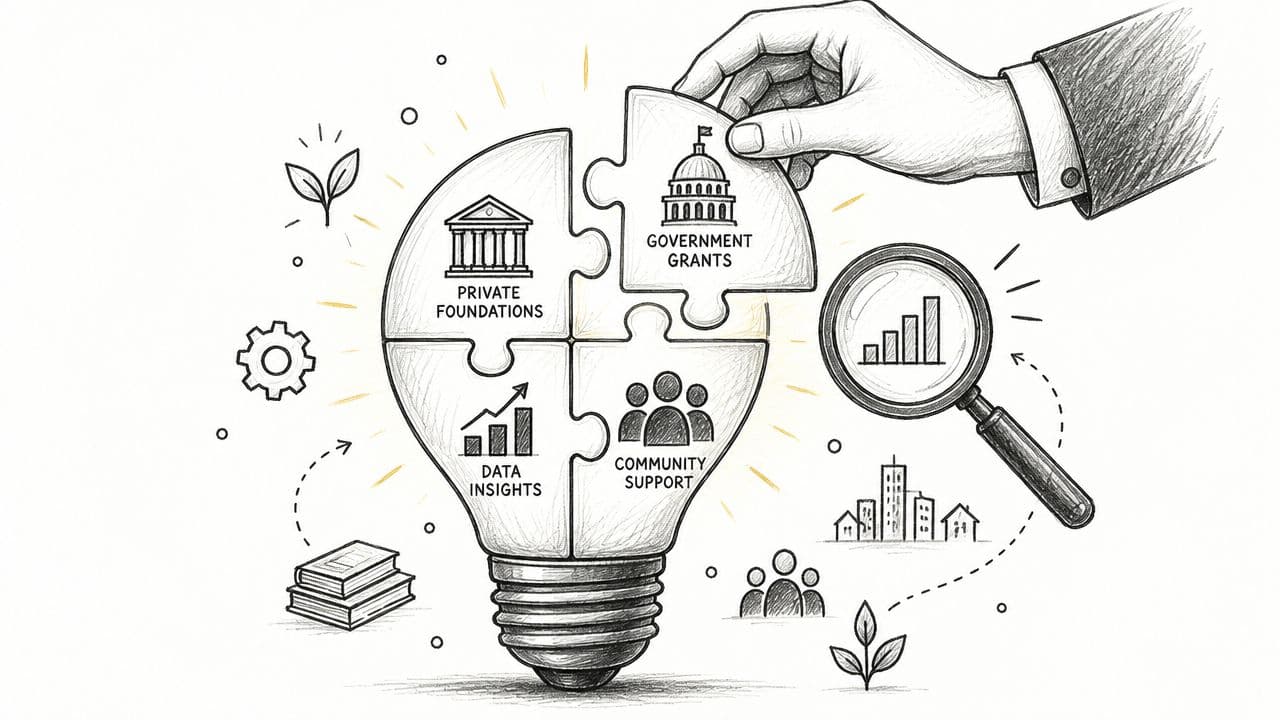
Most advice about grants for nonprofits starts in the wrong place. It tells teams to write better narratives, sharpen outcomes language, and apply to more opportunities, as if volume and polish can compensate for a bad fit. In practice, the smartest organizations win by saying no faster, because every application carries hidden labor, reporting, and compliance costs that can turn a headline award into a weak bet.
The right question isn't, “Can we apply?” It's, “What is the net value after staff time, compliance burden, and probability of success?” Project Streamline's findings describe this problem clearly, nonprofits don't just receive gross awards, they receive net grants after accounting for the work of applying, reporting, and complying, and some opportunities become uneconomic when the transaction cost is too high relative to the award size (Project Streamline findings on grant application and reporting burden).
Table of Contents
- The Hidden Costs of Chasing Grant Funding
- Understanding Private Foundations and Federal Opportunities
- Auditing Your Organizational Readiness and Fit
- Modernizing Your Prospect Research Workflow
- Prioritizing Prospects with Data-Driven Scoring
- Leveraging Peer Networks and Board Connections
- Building a Sustainable Grant Management Pipeline
The Hidden Costs of Chasing Grant Funding
A grant can look generous on paper and still drain the team that pursues it. The mistake is treating every open RFP as free money. Award size matters, but so do the staff hours, review cycles, tracking, and reporting work required to earn and keep the funds.
Practical rule: If the reporting burden is high and the award is small, the grant may be a distraction rather than support.
Net grant value is the better screen. Project Streamline's findings make that clear, some opportunities become net negative once labor and overhead are included, because the cost is not just the application itself, but the time diverted from higher-probability prospects (Project Streamline findings on grant application and reporting burden).
A simple cost check makes the trade-off visible. If a proposal takes 18 staff hours and the blended hourly cost is $45, the internal cost is $810 before reporting starts. If the likely award is only a little above that, the organization may be working for thin margin, especially once restricted spending and follow-up reporting are added.
Why small awards can be expensive
Small grants often come with the same administrative load as larger ones. Teams still draft the proposal, build the budget, gather attachments, route approvals, track restricted dollars, and file reports. If the funder is demanding, the internal cost can outrun the benefit even when the grant is won.
That burden hits smaller development shops hardest. A grant manager who spends days on a low-fit application is not researching better prospects, stewarding current funders, or preparing renewals. The smarter habit is to score each opportunity by expected return on staff time, then disqualify weak fits early.
A few filters protect capacity:
- Award size versus effort. If the likely award will not justify the reporting load, pass.
- Restriction level. Highly restricted dollars can create more bookkeeping than they solve.
- Probability of fit. A polished proposal to the wrong funder is still wasted labor.
- Future value. Some funders become long-term partners, others become recurring chores.
The strongest development teams protect their calendar the same way they protect cash. They pursue the grants that justify the work.
Understanding Private Foundations and Federal Opportunities
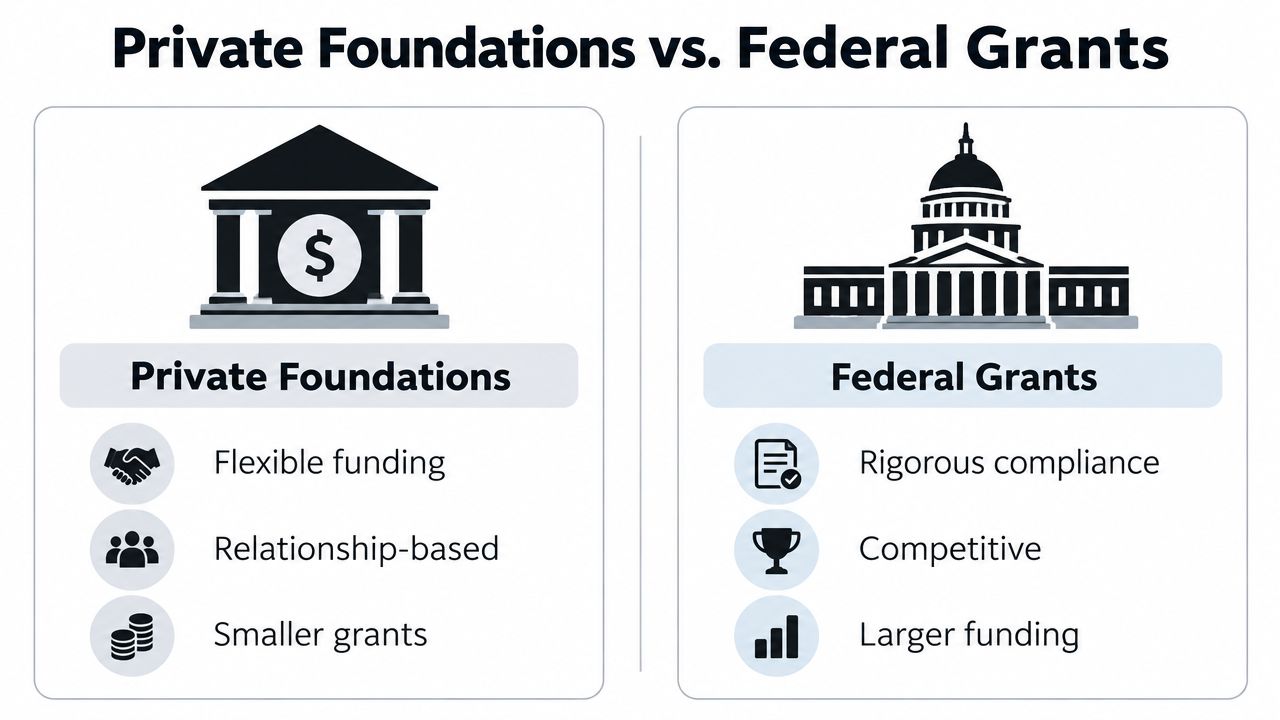
Private foundations and federal grants run on different rules. Federal opportunities usually bring stricter registrations, heavier compliance, and more documentation than a small team can absorb without planning. Private foundations often feel easier at first, but their real filters can be just as tight, especially when giving is narrow, relationship-based, or shaped by a small set of priorities.
The bigger issue is fit, not category. Independent grant datasets spanning 2021–2025 aggregate 2,319,883 grant line items across 127,983 grantmakers, totaling $165.3 billion in paid grants, with a median foundation grant of $7,500 (GrantCue foundation directory data). That mix matters because many foundations make modest awards, so a funder having money does not mean your request belongs in front of them.
How the two funding sources behave differently
Private foundations can look flexible because they may support general operating needs and sometimes move faster than public agencies. The trade-off is that their preferences can be narrow. Geography, program theory, and applicant profile often matter more than they first appear, and those constraints may only surface after a careful review or a conversation with a program officer.
Federal grants are usually clearer about eligibility and process, but clarity does not equal fit. A nonprofit without the staff capacity to handle strict compliance cycles can spend a lot of time chasing an award that creates more strain than value. The right call depends on operational readiness, not prestige.
Some grants function like infrastructure tests. If the reporting load outstrips your systems, the money is not really usable yet.
What the median check size implies
The $7,500 median foundation grant in the dataset is a signal, not a verdict. It suggests that many foundations operate at a scale where tightly matched requests make sense. Asking for a large program grant from a funder whose history clusters around smaller awards usually leads to avoidable rejection.
That is why prospect scoring matters before you write. Separate federal and foundation pipelines, then qualify them by different standards. Federal opportunities reward process discipline and compliance capacity. Private foundations reward precision, relationship context, and a clean historical match.
Auditing Your Organizational Readiness and Fit
The fastest way to waste grant time is to prospect before defining your own boundaries. Start with your organization's profile, not a funder list. If you can't name your essential requirements, every opportunity will look tempting, and that's where good teams drift into bad ROI.
Build a hard-stop profile
Pull the basics from your website, IRS records, and governing documents. Write down your legal status, service geography, core program areas, annual budget range, and whether you can accept restricted funds cleanly. Then add the constraints that matter most in practice, such as whether you can pursue grants only as a 501(c)(3), whether fiscal sponsorship is allowed, and which program areas are staffed.
Use a system that keeps those details current. If your team is already sorting compliance files, it helps to keep them in one place with software for SORP and grant tracking, because grant readiness and accounting discipline tend to fail in the same places.
Identify disqualifiers before research starts
A serious audit should surface the obvious no's quickly. Geography is the clearest one. If a funder only backs a specific county or state and you're outside it, don't spend hours writing around the gap. Applicant type is another. If the funder doesn't support your legal structure, move on.
Budget mismatch is just as important. A funder whose typical grants are much smaller than your request is not a “stretch” opportunity, it's a mismatch. The same goes for funders that almost never take new grantees. If a history of first-time support doesn't exist, the odds are low enough to deprioritize.
Document the profile once, reuse it everywhere
Keep a concise profile sheet that includes:
- Legal and tax status. Make eligibility visible at a glance.
- Primary geography. Don't let staff guess where you can operate.
- Program priorities. Separate the mission-critical work from the nice-to-have work.
- Budget range. Use it to filter funders whose usual award size doesn't line up.
- Grant readiness notes. Flag reporting capacity, finance systems, and who owns deadlines.
A clean profile reduces internal debate. When the same screening questions get answered the same way every time, the team stops chasing shiny prospects and starts focusing on real matches.
Modernizing Your Prospect Research Workflow
Manual research still has a place, but it is a slow way to spend staff time if the goal is a strong grant pipeline. Reading each IRS Form 990-PF filing one by one can consume development hours without telling you which prospects deserve a call, a letter of inquiry, or a full proposal. Spreadsheets organize the work, but they do not remove the sorting problem.
Manual review versus database-driven discovery
The old process is familiar. Staff search a funder name, open a filing, scan for prior grants, jot down notes, and repeat. It works for a short list, then breaks down when you need volume, recency, and consistency. It also makes side-by-side comparison of private foundations and federal opportunities harder than it should be.
Modern research platforms change that by consolidating grantmaker data, surfacing funder behavior, and turning filing history into filters you can act on. Grantlas, for example, is built around discovery across private foundations and open federal grants in all 50 states and DC, which matters because many nonprofits do not need more raw information, they need better sorting. That shifts the work from scavenging to decision-making.
What smarter discovery should surface
A useful research workflow should tell you more than whether a funder exists. It should show whether the funder fits your current reality, in plain English, not buried in a spreadsheet column. The best filters cut weak prospects early.
Natural-language search and clear fit explanations matter here. A search interface should let staff describe the need in normal terms, then return prospects that match sector, geography, and grant size. It should also flag invitation-only funders, geography mismatches, and applicant ineligibility before anyone drafts a paragraph.
If your team also manages routine web upkeep, WordPress maintenance guides are a useful reminder that digital systems need upkeep to stay reliable. Prospect research software works the same way. Stale profiles produce stale results, and stale results waste time.
Best practice: Research tools should reduce uncertainty, not create another queue of items to check later.
A cleaner workflow for small teams
The strongest workflow is simple. Build an organizational profile once, search against it, and save the best-fit prospects with notes on why they made the cut. When a prospect passes the fit flags, move to outreach with a concise letter of inquiry for grant before drafting a full proposal. Then revisit the list as new data arrives, rather than rebuilding it from scratch every month.
That approach does not remove judgment. It puts judgment where it belongs, on the funders worth a serious pursuit.
Prioritizing Prospects with Data-Driven Scoring
A long list of potential funders is not a strategy. It's a backlog. Development teams need a way to decide who gets the first call, the first letter of inquiry, and the first proposal draft, because sequencing is where grant ROI starts to improve.
What a score should actually mean
A good score should combine historical giving behavior with your organization's real constraints. That means looking at typical grant size, giving cadence, and whether the funder has supported new grantees before. If a funder has a pattern of small, infrequent gifts and never seems to back new applicants, it should not sit near the top of your list.
Automated reasoning helps. A fit score is most useful when it explains itself in plain English. A number alone can't tell you whether the issue is geography, budget range, or applicant type. Clear flags let staff focus on what can be fixed and skip what can't.
Grant Prospect Prioritization Matrix
| Evaluation Criteria | High Priority, Pursue | Low Priority, Pass |
|---|---|---|
| Geography | Funders already active in your service area | Funders outside your geography |
| Typical grant size | Historical gifts align with your request | Grants usually far below your need |
| New grantee behavior | Repeated history of funding new applicants | Mostly closed or invitation-only patterns |
| Applicant eligibility | Your legal structure is clearly supported | Your status is excluded or unclear |
| Reporting burden | Requirements match your team's capacity | Heavy compliance for a small award |
How to turn data into an outreach order
Once prospects are scored, sort them by probability and return. The highest-priority targets are the ones where your mission, geography, and budget align, and where the funder has a history of supporting organizations like yours. Low-priority prospects are not always dead ends, but they should move to the bottom of the queue until a relationship changes the equation.
Don't confuse a funder's public visibility with their actual fit. The biggest-name option isn't always the right one to chase first.
The scoring process also protects morale. Teams lose energy when they spend weeks on proposals that were structurally unlikely from the start. A disciplined prioritization system keeps grant writing tied to outcomes, not optimism.
Leveraging Peer Networks and Board Connections
A small arts nonprofit I worked with had a funder list that looked strong on paper and weak in practice. The team kept losing time on cold outreach, then realized the better path wasn't more applications, it was better introductions. They shifted to peer prospecting, studied who was already funding similar organizations, and used that pattern to identify the most plausible entry points.
Find the funders who already understand your work
Peer prospecting works because it exposes behavior, not just names. If a foundation has repeatedly backed organizations with a similar budget profile, mission mix, or community base, that funder has already signaled some openness. That doesn't guarantee success, but it gives you a more credible reason to approach them.
The same nonprofit mapped its board against the foundation's trustee list and found an indirect connection through a shared civic association. That didn't produce a grant by itself. It produced a conversation, which is the gate in many foundation relationships.
For organizations using this tactic, a sample letter of support for grant can help shape the right ask after an introduction is secured. The point isn't to over-script the relationship. It's to make the outreach specific enough that a connector understands what's being requested.
Use board connections without forcing them
Board mapping works best when it's honest and targeted. Ask board members where they know people, then compare those connections against trustee and staff lists. Don't force a warm lead just because a name sounds familiar. A weak referral can damage credibility if the person introducing you doesn't really know the funder.
A better sequence looks like this:
- Identify shared spaces. Civic boards, professional associations, alumni groups, and issue coalitions often reveal overlap.
- Check the relationship quality. One real introduction beats five vague name drops.
- Tailor the ask. Ask for a conversation, not money on the first pass.
- Follow the funder's mode. Some funders want a brief note first, others want a letter of inquiry.
The underlying discipline is simple. Data shows where to look. Relationships determine who gets the meeting.
Building a Sustainable Grant Management Pipeline
Winning a grant isn't the finish line. It's the start of a management cycle that can either strengthen your organization or swamp it. If deadlines, reporting, and renewal planning live in people's heads, the pipeline will crack under pressure.
Set the pipeline up before the award lands
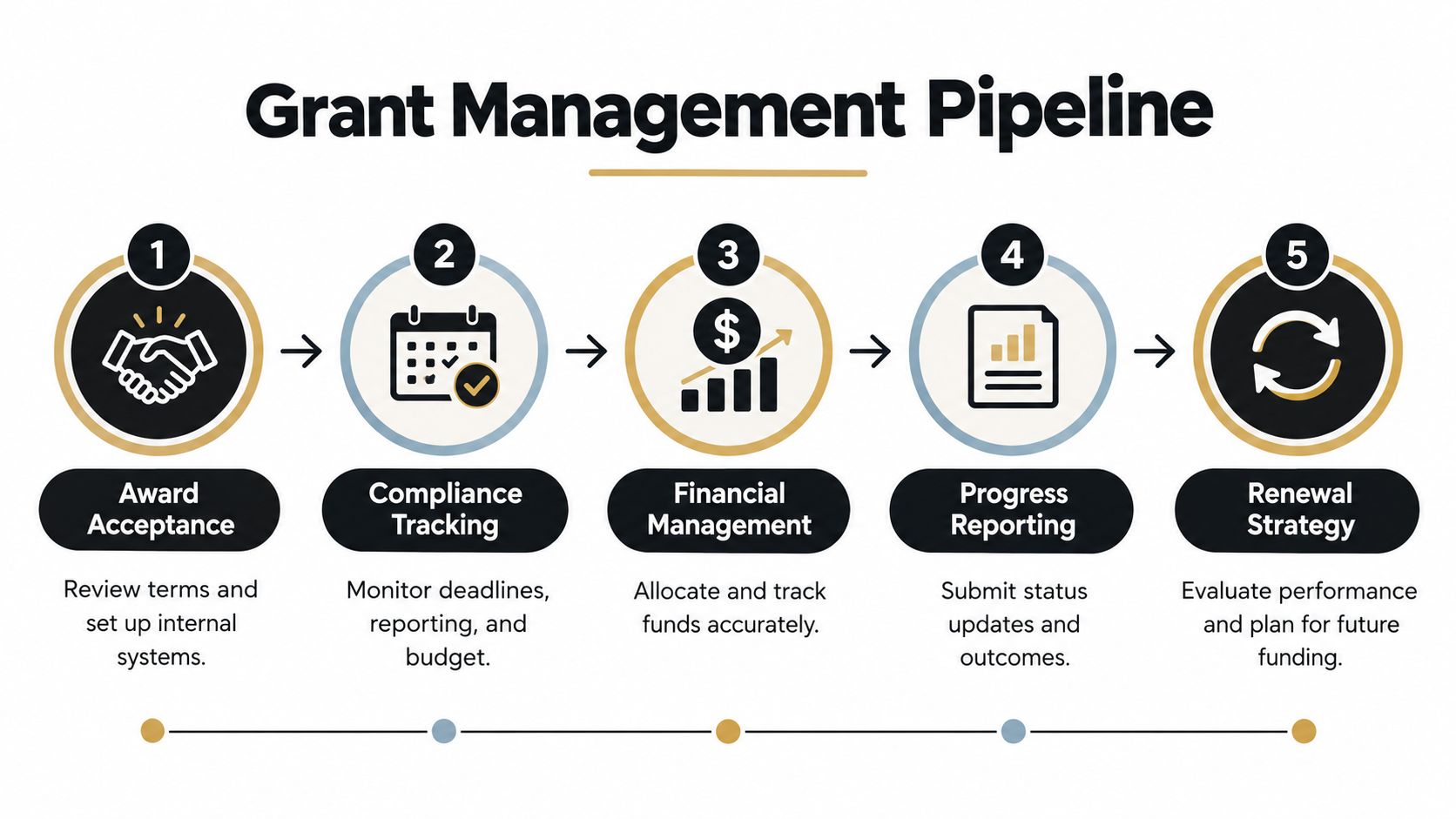
The first step is award acceptance, which should trigger an internal checklist, not a celebration-only email. Capture the grant terms, reporting dates, budget rules, and who owns each action item. The sooner the team translates an award letter into tasks, the less likely it is that a deadline gets missed.
Next comes compliance tracking. A shared calendar, deadline reminders, and one owner per report keep the work visible. It's also where a strong finance process matters, because restricted funds need to be tracked accurately from the start.
Keep renewal work from becoming emergency work
Monthly database rescans are useful because funder priorities change, new opportunities open, and old assumptions go stale. If your system can recheck saved profiles and resurface matches, the team can catch shifts before they become missed opportunities. That makes renewal strategy much calmer, because you're not starting from scratch each cycle.
The fourth step is progress reporting. Don't wait until the end of the grant period to discover missing data. Build outcome tracking into the same workflow that manages the program, so reporting becomes a continuation of program management rather than a scramble.
For teams refining their internal review process, evaluating and monitoring grants is worth folding into the same operating rhythm. Once the award is live, the question becomes whether the grant is performing as expected, both financially and strategically.
Operational rule: If a grant can't be tracked cleanly, it shouldn't have been pursued aggressively in the first place.
Make the system sustainable
The strongest pipeline is boring in the best way. Saved searches feed weekly digests, reminders keep deadlines visible, and monthly rescans keep the list fresh. That rhythm protects staff from the all-too-common cycle of prospecting in bursts, then forgetting follow-up until the next crisis.
It's also where brand discipline matters. A clear, consistent external message makes grant tracking easier because the organization presents a stable story across proposals, reports, and renewal conversations. For teams that want to sharpen that consistency, the branding insights blog is a useful reference point, not for grant tactics alone, but for the broader signal a nonprofit sends to funders.
The end goal is a pipeline that runs predictably enough for staff to trust it. That's what turns grants from a reactive scramble into a revenue system that can support planning, not just survival.
If you want a faster way to score fit, disqualify weak prospects early, and keep your grant pipeline organized without extra busywork, visit Grantlas. It's built for nonprofit teams that need better prospecting decisions, clearer reasoning, and a more disciplined path from research to award.