10 Best Instrumentl Alternatives for Grant Research in 2026
Nov 17, 2026 · 15 min read

Does a solo grant writer chasing three foundation deadlines need the same platform as a five-person development office running forty applications a year? Ranked lists tend to skip that question and sort tools by database size. Teams searching for Instrumentl alternatives usually want one of three things: a lower entry price, coverage that better matches their funding mix, or a tool built for one person rather than a department.
The list below is organized around what breaks a grant program: price you can carry, data you can verify, workflow you'll maintain, and whether the tool matches your team's shape. Each entry is judged on what it does well, what it leaves out, and the team profile it suits. Prices were checked against each vendor's official pricing page on the day of writing. Where a vendor doesn't publish a number, the entry says price not specified rather than guessing.
The tools split into three camps. Some are research databases for finding funders, some are trackers for managing deadlines, tasks and awards, and one is a free government portal. Fit, tracking and coverage are different jobs, and treating them as interchangeable is how teams end up paying for a database nobody opens twice. For software that sits around a grant platform, TopToolAdvisor's nonprofit software shortlist covers the adjacent categories worth knowing.
Here's the list.
Table of Contents
- 1. Grantlas
- 2. Candid Search
- 3. GrantStation
- 4. GrantWatch
- 5. Grantable
- 6. Grant Frog
- 7. Grantseeker
- 8. FoundationSearch
- 9. GrantForward
- 10. Grants.gov
- Instrumentl alternatives at a glance
- Choosing the Right Platform for Your Team
1. Grantlas
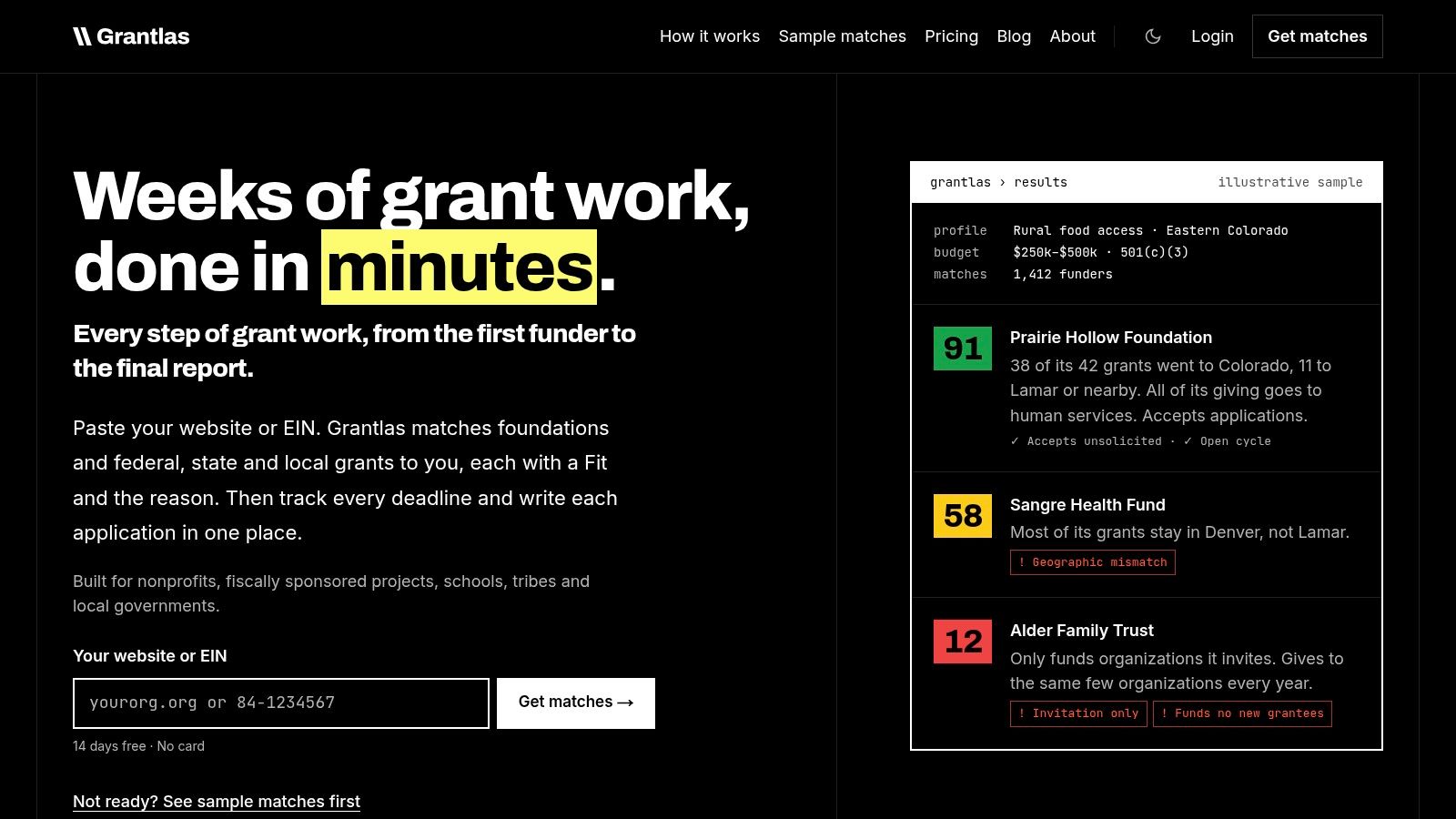
The fastest way to judge a prospecting tool is to watch it work on your own organization. Grantlas builds a profile from a pasted website URL or an EIN, with no onboarding call, then returns ranked matches across private foundations and open federal, state and local grants. Each match carries a Fit score out of 100, two plain sentences explaining why, and red flags for the problems that waste real weeks: invitation-only funders, wrong geography, grant size out of range, and cases where you were never an eligible applicant.
Why the record count is the wrong headline
Private foundation money is concentrated in a small number of filers. In tax year 2022, foundations holding at least $100 million in assets filed just 1.5% of returns but controlled 68.3% of total assets and accounted for 64.6% of contributions, gifts and grants paid, according to IRS statistics on private foundations. A tool that treats every record as equally valuable buries the funders with money to move. The same data puts the median private-foundation payout rate at 5.71% for 2022, which is the number to check when a funder looks rich on paper but distributes little.
Screening rule: deprioritize any foundation whose filing year is stale or whose recent charitable distributions sit well below the payout median, then spend your reading time on the ones that clear both tests.
Solicitation policy is the other filter that belongs up front. Form 990-PF asks directly whether a foundation makes contributions only to preselected charities and does not accept unsolicited requests, as the 2024 Form 990-PF field listings show. Surfacing that checkbox before you draft a letter of inquiry saves more hours than any match score.
Where the money goes and what it costs
Coverage runs to private foundations and grantmaking charities in all 50 states and DC, plus federal, state and local grants, with 2,839 open and upcoming grants updated nightly. Search is unlimited on every plan with no credit caps, and queries can be written in plain English, such as "Colorado foundations funding youth arts that take unsolicited proposals," without building filters. Solo is $99/month or $990/year for one user and one organization. Pro is $199/month or $1,990/year for 3 users and 5 clients. Agency is $599/month or $5,990/year for 6 users and 10 clients. The free 14-day trial lets you build a profile and see fit scores for those funders before entering a payment method, with no sales calls.
The Tracker, a pipeline from research to award with reminders and a board view, is included on every plan. It takes an imported spreadsheet, holds stages, tasks, notes and awards in one list, and exports anytime. On Pro and Agency, a REST API keeps Airtable, your CRM, Zapier, Make or n8n in sync with tracked funders, deadlines and saved searches for every client. A published comparison puts the entry price below Instrumentl Discover at $349/month and Grant Frog Professional at $199/month, based on the vendors' own pricing pages verified September 9, 2026.
Who it suits. Small teams and solo writers who want private-foundation prospecting and federal coverage in one index, with a working pipeline bundled in rather than bought as a second subscription.
What it leaves out. The $99 entry point is still a real recurring cost for a cash-constrained nonprofit. Fit scores, reasoning, eligibility reads and red flags are AI outputs, not legal, financial, tax or professional advice, so records should be checked against the original funder source before you apply. The platform also doesn't submit applications. Drafts stay drafts, and you own every word.
2. Candid Search
Candid Search is what Foundation Directory Online became, and it answers a different question than a pipeline tool. It tells you who a funder has paid, which organizations resemble yours, and what the filings say. Reach for it when you need defensible foundation intelligence rather than a list of what's open this month.
What the return actually shows
The dataset is worth paying for because of how it's built. Private foundations must file Form 990-PF annually, reporting charitable distributions, administrative expenditures, investment income, assets, liabilities and excise tax information, and the IRS separates operating foundations from the nonoperating foundations that make up the majority, as the IRS Statistics of Income program lays out. Standardized, recurring filings let you compare two funders on giving behavior instead of on website copy.
Read the return itself when a funder matters. Form 990-PF itemizes grants and contributions in Part XIV or an attached schedule, and the IRS Form 990-PF draft instructions define grants payable as the unpaid portion of awards a foundation has committed to pay, whether or not the commitment has been communicated to recipients. A funder carrying heavy payables has already allocated much of its capacity.
Where it fits
- Best for research-first shops. Development directors who build a prospect list once a quarter and work it by hand.
- Weak for deadline management. There's no pipeline, no reminders, and no stage tracking.
- Budget for the paid tier. A limited free plan exists, but full research access is paid and some downloads carry monthly caps.
If you're weighing research tools against discovery tools, this comparison of grant search software for nonprofits covers the difference in workflow terms.
3. GrantStation
GrantStation bundles two products into one subscription: a funding database and a training library. The database indexes U.S. and international funding sources across government, private, corporate and community funders, and the proposal-development resources and online courses sit beside the search itself. For a team where someone is new to grant seeking, the instructional material can be worth as much as the listings.
Breadth has a cost in triage time. Even a cause with national visibility draws a small share of foundation giving: Candid's analysis put democracy funding at an estimated 1.3% of total foundation grantmaking in 2024, per its foundation funding for democracy analysis. A loosely worded search in a large index returns plenty of funders whose stated mission touches your issue and whose actual grantmaking never reaches your budget, geography or applicant type.
Relevance can't be inferred from a foundation's general charitable identity. It has to be read off the grants it actually made.
What it leaves out
- No fit scoring. You assess suitability yourself, one record at a time.
- No pipeline. Deadlines, tasks and awards live somewhere else, usually a spreadsheet.
- No published discount rate. Partner programs sometimes cut the price, but eligibility varies, so treat any reduced rate as a current offer rather than a baseline.
The regular one-year subscription costs more than several simpler listing services, which is a fair trade only if your team uses the training and searches weekly. It suits a small shop that will use both halves of the bundle; a team that only needs listings pays for coursework it never opens. Confirm the current rate on the vendor's page before you compare it with anything else on this list.
4. GrantWatch
GrantWatch sells listings, and it's fairly direct about that. Subscriptions run from weekly to annual, which suits two kinds of buyer: an organization testing the water before committing, and one that needs a burst of searching before a deadline cluster. The provider says its descriptions are reviewed against funder information, and paid tiers layer on pipeline, CRM and writing features.
Here's the question to ask before buying any listing service. Recent grantseeking data reports median grant funding of just over $10,000 for organizations with budgets under $100,000, against approximately $200,000 across all respondents, according to GrantStation's state of grantseeking figures. Many small nonprofits receive no grants or only one a year. For that reader, more technically eligible opportunities isn't the bottleneck. Two or three realistic ones is.
A shortlist you can actually write beats a long list you can't triage.
Where it fits
- Good for a first look. A weekly subscription costs little and tells you whether the listings match your program area.
- Good for mixed applicant types. Listings span nonprofits, schools, businesses and other applicants, which helps when you partner with a public agency.
- Weak on personalization. Listings aren't fit assessments, so eligibility, geography and budget range are yours to verify.
Broad coverage also produces noise. Expect to screen out a good share of results, and check AI usage limits per plan, since they vary by tier.
5. Grantable
Grantable pairs funder research with assisted drafting, which is a different bet than a pure database. You search funders, pull an RFP or a past proposal into the workspace, and draft against it. The research tab gets a team started. The writing workspace is where the hours go.
Test export before anything else
Interoperability decides whether that workspace pays off. A 2025 nonprofit technology survey found 90% of organizations used at least three third-party systems beyond their primary CRM, according to the Omatic nonprofit tech trends report. One more tab is cheap. One more place to retype the same award data is not. Export a real record first, then judge the rest.
Pricing lowers the stakes on that test. There's a free plan, so you can run the research and drafting workflow on a live application before paying for a tier. Paid plans carry AI usage budgets, and every AI draft needs human fact-checking before it goes near a submission portal. A model that paraphrases your last proposal will just as happily paraphrase last year's budget figure if nobody reads it.
Practical rule: keep your application tracker where the whole team already looks, and use a writing tool for the drafting stage only.
The fit profile is specific. Grantable suits a team drafting several applications a month that wants research and writing under one login. It leaves out the system-of-record side: a portfolio of twenty awards with reporting deadlines attached needs a tracker, not a writing workspace. Treat it as drafting plus light research rather than pipeline coverage, and the trade-off makes sense.
6. Grant Frog
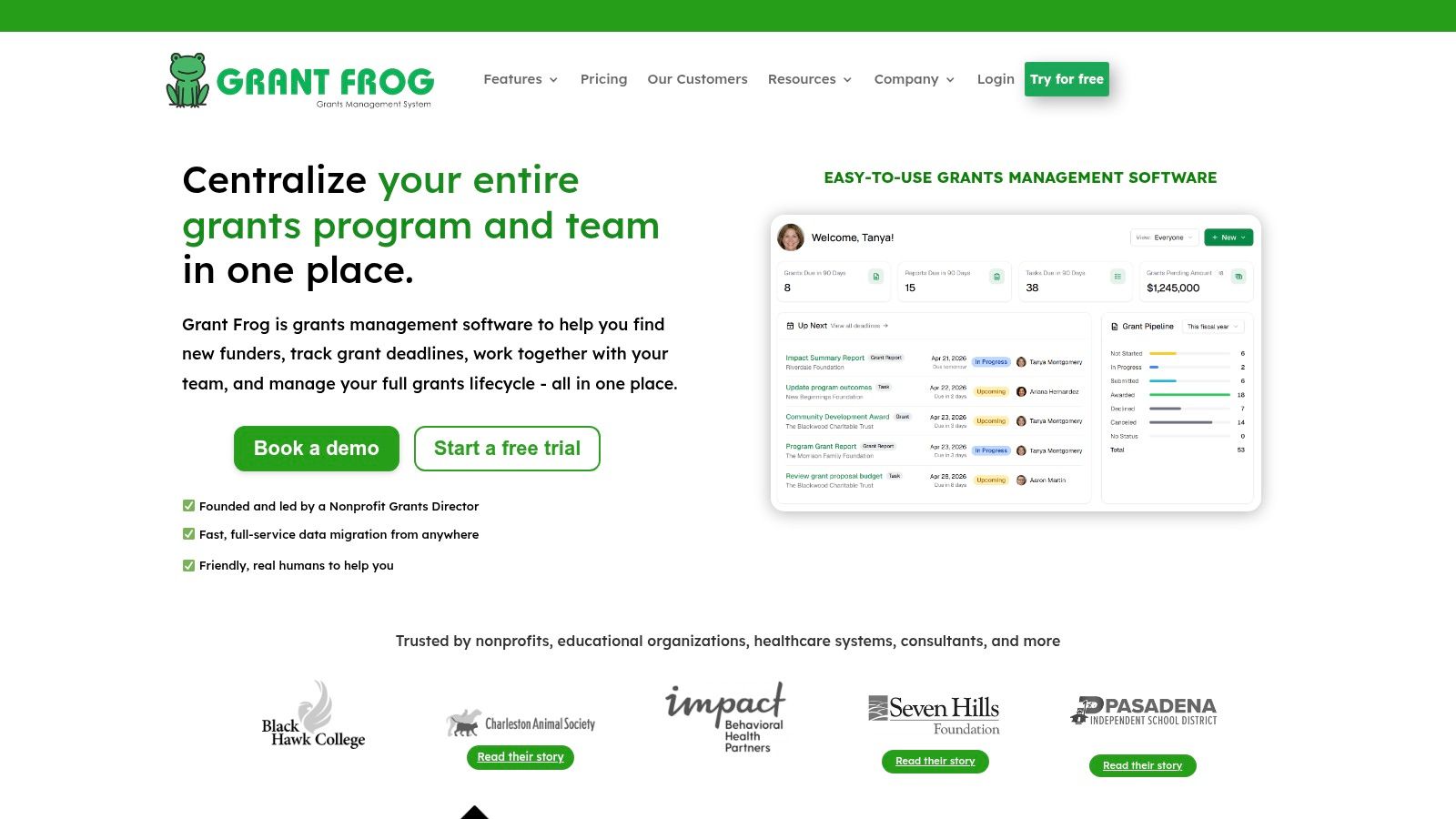
Grant Frog wants to be the only tab you open. Research sits next to grant tracking, task and report deadlines, budgets and expenses, document storage and writing assistance. If your operation currently lives in a funder spreadsheet, a deadline calendar and a budget workbook, consolidation is the appeal.
Where it stops short
Research coverage leans toward private, corporate and community foundations. If a meaningful share of your revenue comes from federal or state programs, confirm coverage before you commit, because a foundation-centered index won't replace Grants.gov. The Professional plan lists three users at $199/month on annual billing, and plans include a 14-day trial.
Annual billing is the catch for a small shop. A full year paid up front is a real commitment when your grant revenue is uncertain, and it only makes sense if the whole team moves into the workspace.
Consolidation pays when everyone moves. A shared workspace that two people use and three people ignore becomes another reconciliation job.
Who it suits
- Good for a development office running a dozen or more awards who wants tracking, budgets and research under one login.
- Good for teams that already know their funder universe and need administration more than discovery.
- Weak for federal-heavy portfolios and for organizations that only need prospecting.
7. Grantseeker
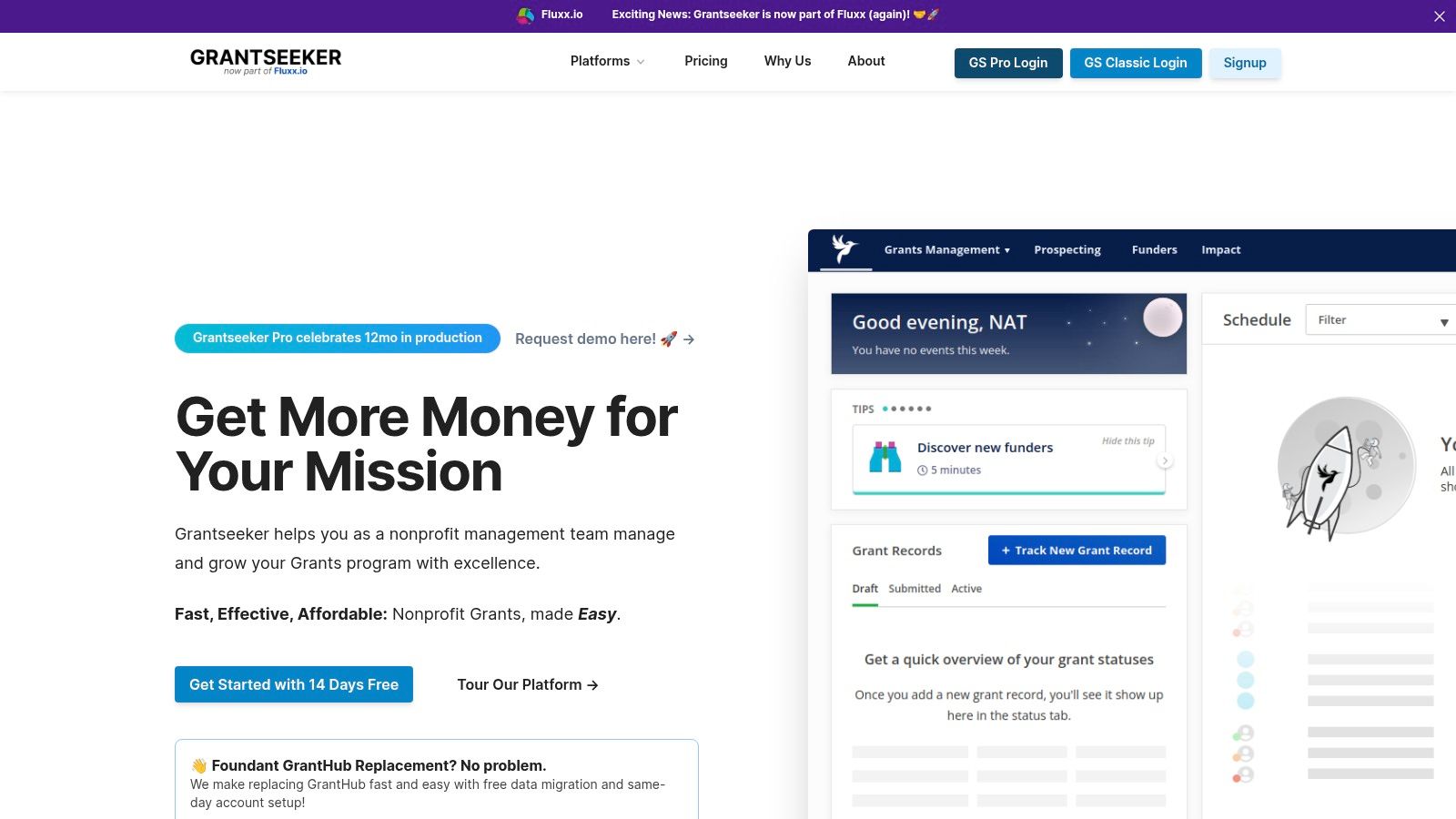
Grantseeker began as a tracker and added prospecting later, which explains its shape. The lower tiers organize grants, deadlines, tasks and documents with calendar integration. The Prospecting tier adds foundation search, giving reports and 990 data.
Who it suits
Published prices for the tracking and prospecting tiers sit below what many full-service platforms charge, and the Premium tier advertises unlimited users and documents, which is unusual and useful for a committee-run organization. A free plan and 14-day trials are advertised.
The limitation is the one that matters most for discovery work. Grantseeker doesn't currently list available grants from funders, so it won't tell you what's open or when it closes. It's a place to organize the awards and applications you already have, with foundation prospecting bolted on for teams that want it.
- Best for a small organization with awards in hand that needs deadlines, tasks and documents in one place.
- Best for collaborative teams, given the unlimited users on the listed Premium plan.
- Not a discovery engine. Pair it with a listings source or a portal search.
8. FoundationSearch
FoundationSearch is a research service for organizations that pursue private foundations seriously. Prospect analysis works from your project's funding needs rather than a keyword list, which is a better starting point than a blank search box. Pricing is quote-based, so there's no list price to compare. Ask for data sources, refresh schedule and what the quote covers before you sign.
Timing signals most researchers skip
Filing detail is what justifies this kind of research. Form 990-PF requires foundations to report grants receivable from governmental agencies, foundations and other organizations at both the beginning and end of the year, while grants payable represent committed but unpaid awards, per the IRS Form 990-PF instructions. Receivables tell you support is expected. Payables tell you capacity is already spoken for. A single annual grant total hides both.
If you're building a foundation list from scratch, this walkthrough of how to find foundation grants covers the filing-by-filing approach.
What it leaves out
- No published price. Quote-based pricing makes side-by-side comparison harder, so request a written scope.
- No deadline alerts or application tracking. It's research, not a pipeline.
- Verify recency. Ask how often records refresh and where the underlying data comes from.
The related BIG Online offering covers a broader mix of funders, which matters if corporate and government sources are part of your plan.
9. GrantForward
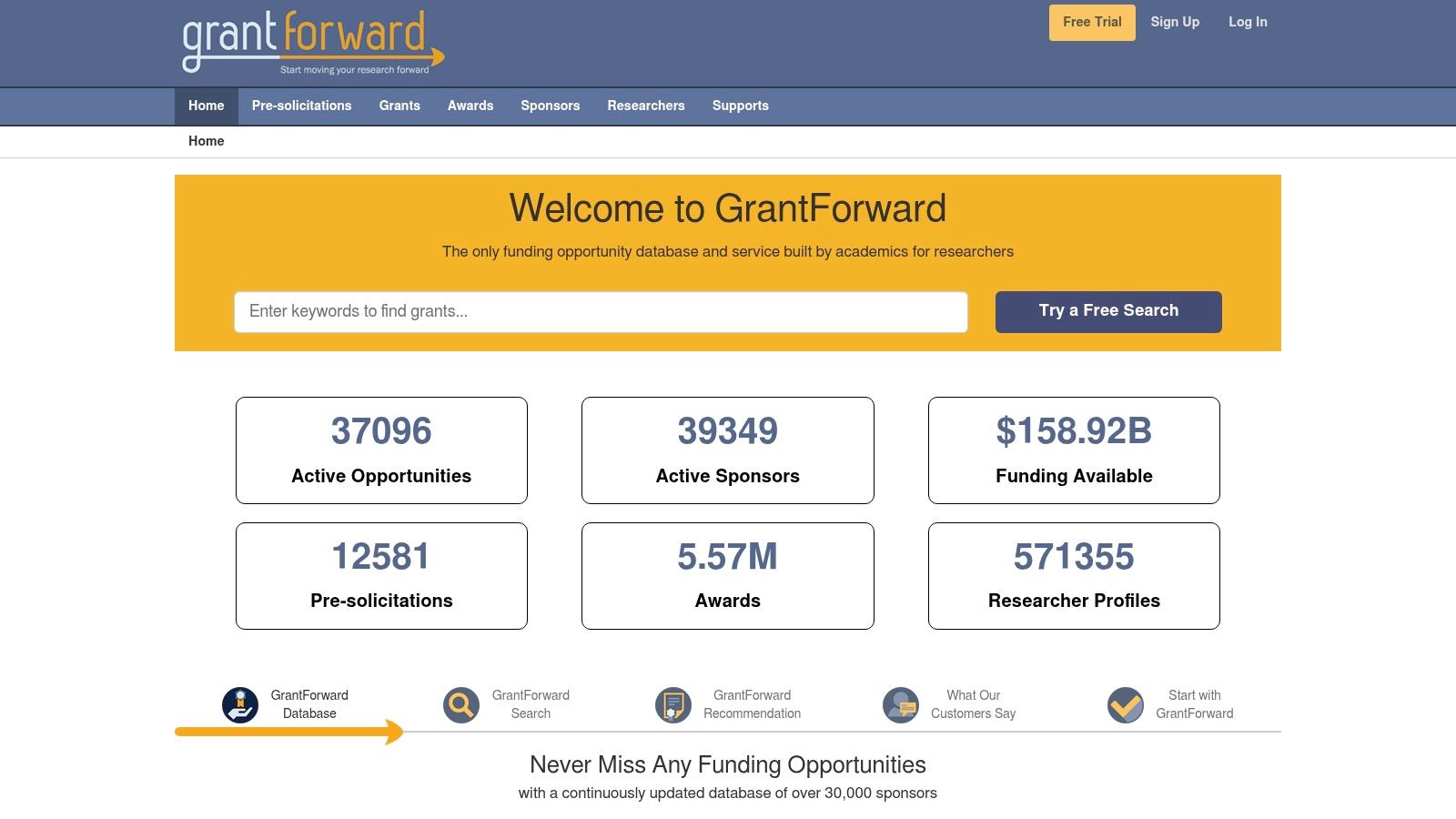
GrantForward is built for research administration, not community fundraising. It searches federal, corporate and private sponsors, builds researcher profiles, pushes recommendations, and lets an institution share lists and alerts across departments. A 30-day institutional trial is offered.
Applicant type decides more than topic
Eligibility screening matters as much in academia as in community work. A filed Form 990-PF identifies the funder's EIN, organization type, accounting method and address, distinguishes a private foundation from a related nonexempt charitable trust, and asks separately about grants to individuals for travel, study or similar purposes, which the instructions treat as taxable expenditures under section 4945(d), as a sample filed Form 990-PF shows. Fellowship money and program money are not the same money.
Where it stops short
- Institutional pricing. Cost depends on institutional size and research expenditures, so it isn't comparable to a flat seat price.
- Subscription through the institution. An individual investigator usually can't buy in alone.
- Research-centric coverage. Less useful for a community organization seeking local charitable grants.
The features are built for universities and labs, and sharing opportunities across departments is the kind of thing general nonprofit tools do poorly.
10. Grants.gov
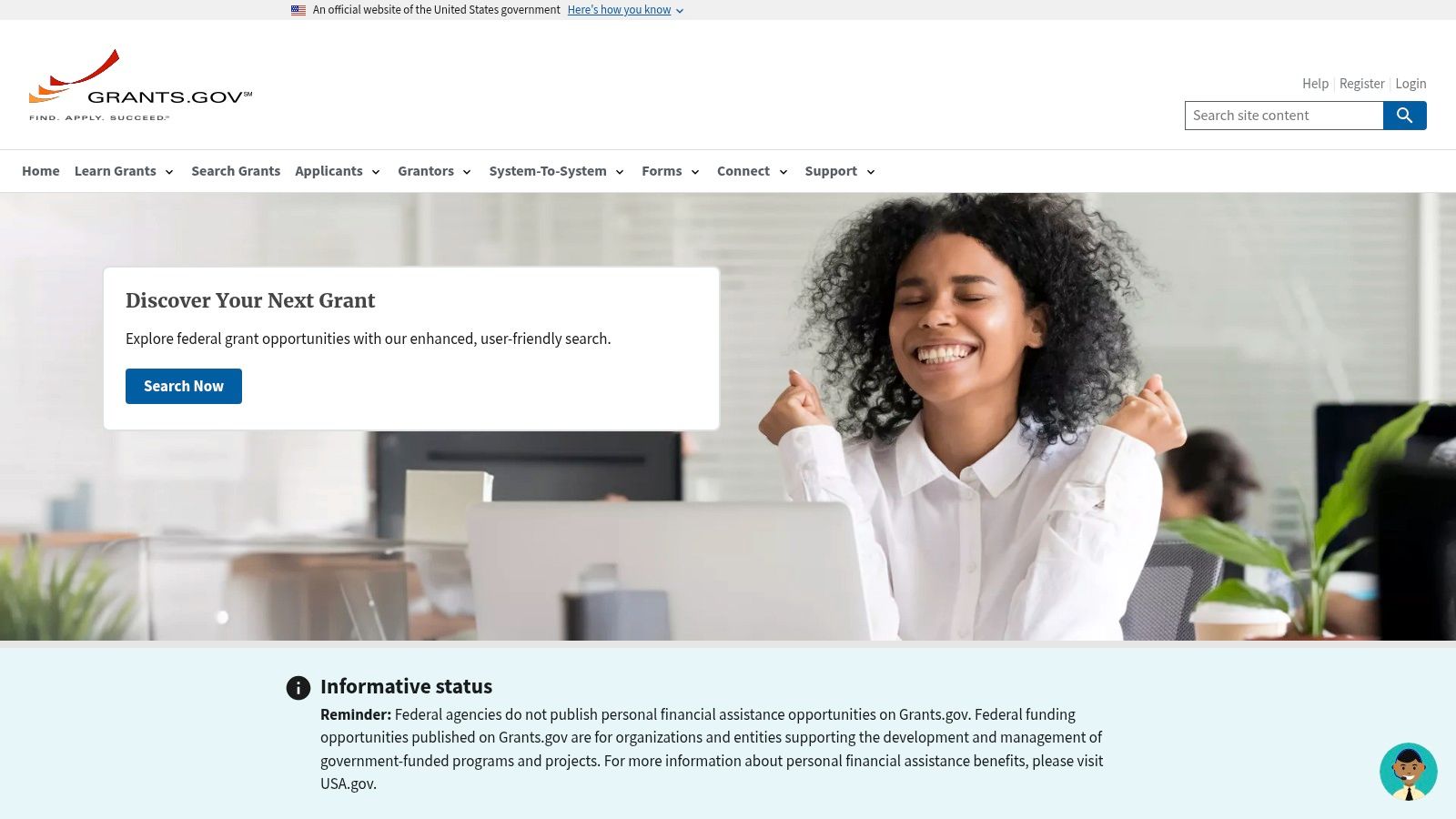
Grants.gov is the official federal portal and it costs nothing. You get funding opportunity notices, eligibility rules, application packages and instructions, searchable by status, agency, funding instrument and applicant type. Every organization pursuing federal money should start here, and no paid platform replaces it.
Eligibility isn't the same as viability
What the portal can't tell you is whether a federal award is survivable. In a 2025 survey, 41% of organizations that never applied for government funding said they were unaware of relevant grants, while 44% cited onerous applications and 40% cited compliance burden, according to the Nonprofit Finance Fund 2025 survey results. A larger award with thin indirect-cost recovery and heavy reporting can cost more than it pays.
Read the notice for indirect cost terms, advance payment, reporting frequency and award timing before you commit staff hours.
For a free-source stack that covers federal, state and foundation money, this list of free grant databases is a practical starting point.
What it leaves out
- Federal only. No private foundations and no most local charitable grants.
- No pipeline. Nothing tracks stages, owners or reminders across a portfolio.
- Manual fit assessment. You read each notice and decide.
Instrumentl alternatives at a glance
The platforms below do different jobs: some build prospect lists, some track a pipeline, some help you draft. Read the coverage column before the price column. Grantseeker, for instance, lists no open grants at all, and Grants.gov covers federal money only.
| Platform | Starting price | Trial or free plan | Best for | Data coverage |
|---|---|---|---|---|
| Grantlas (recommended) | $99/month | Free trial; no credit card required | Grant discovery, fit insights, and application management in one subscription | Foundations and open federal, state, and local grants across all 50 states and DC |
| Candid Search | Paid plans available; price not specified | Limited free plan | Foundation research and prospect lists | Foundations, nonprofits, and grant records |
| GrantStation | Paid plans available; price not specified | Partner discounts may be available to eligible organizations | Broad funding research and grant-seeking resources | U.S. and international government, private, corporate, and community funders |
| GrantWatch | Paid plans available; price not specified | Short-term subscriptions available | Lower-cost access to searchable grant listings | Grants across applicant types and funding areas |
| Grantable | Paid plans available; price not specified | Free plan; discounts for qualifying small nonprofits | Combining funder research and AI-supported grant writing | Funder research and grant opportunities; specific coverage not detailed |
| Grant Frog | Paid plans available; price not specified | 14-day free trial | Foundation research and grant administration | Private, corporate, and community foundations |
| Grantseeker | Paid plans available; price not specified | Free plan and 14-day trials advertised | Grant tracking and targeted foundation prospecting | Foundation search and contribution data; does not list available grants |
| FoundationSearch | Quote-based pricing | Not specified | In-depth private foundation prospect research | U.S. foundations; broader funder coverage may be available through BIG Online |
| GrantForward | Institution-based pricing; amount not specified | 30-day institutional trial | Universities and research organizations seeking funding | Federal, corporate, and private research sponsors |
| Grants.gov | Free | Free access | Finding and applying for U.S. federal grants | Federal grant opportunities only |
Grantlas pairs that discovery work with a built-in pipeline: stages, tasks, notes and awards in one list, exportable anytime. Most other rows here do one job well and assume you own a spreadsheet for the rest.
Choosing the Right Platform for Your Team
Match the tool to the bottleneck, not to the longest feature list. A discovery platform earns its keep when it surfaces funders you did not already know and explains why they fit. A tracker earns its keep after the list exists, when stages, tasks, notes, deadlines and awards need to keep moving. A writing workspace matters when drafts, files and review cycles are the slow part. Coverage comes last: private foundations are not federal grants, and a database that lists both still has to match your applicant type, geography and award range.
Use any trial that lets you test before payment, then run the same search on every candidate: your own EIN, your website URL, or one specific program area. Count only results you would pursue. Ten realistic prospects in a week beats a thousand records you will never open. If the output is mostly funders already on your board list, the subscription is not adding research capacity.
Verify before you apply. Every listing on this page is downstream of a funder's own guidelines, and those guidelines can change mid-cycle. Read the funder page for eligibility, deadline, award range and submission method before you spend a day on a draft. Treat published prices as a snapshot too: vendors move features between tiers, shift monthly users to annual invoices, and quote-based research services need scope and first-year total in writing before comparison to a flat monthly rate.
For a team whose gap is qualified discovery, Grantlas is built to test that job directly: paste a URL or EIN, get a ranked shortlist across private foundations and open federal, state and local grants, and see a Fit out of 100 with two plain sentences and red flags such as invitation-only status, wrong geography, grant size out of range or an ineligible applicant. Its index lists 2,839 open and upcoming grants updated nightly, and the free 14-day trial lets you build a profile and see fit scores before entering a payment method. If the list is fine but follow-through is weak, weigh its Tracker instead: import your spreadsheet, keep stages, tasks, notes and awards in one list, and export anytime.
A prospecting platform saves research time. It does not submit applications, create eligibility, or write the final version; the grant writer still owns the draft and the last eligibility check.