Grants for New Nonprofits: Where to Start in 2026
Nov 14, 2026 · 12 min read
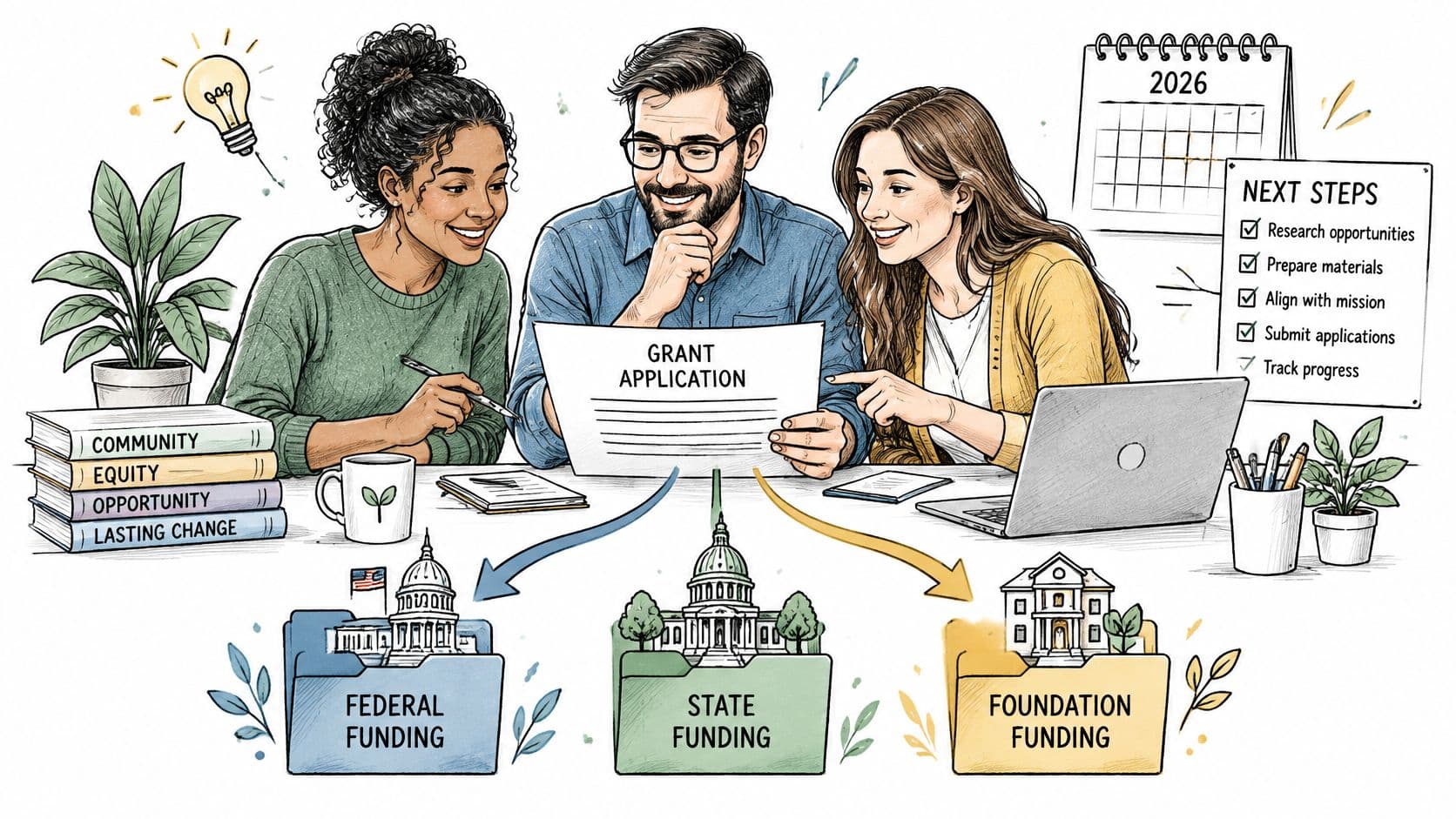
Your founding team has a mission, a board, a program that's already running, and a bank account that makes the treasurer nervous. Then you open a foundation's online application and read the first eligibility line: applicants must submit two years of audited financial statements. Or three years of 990s. Or a documented giving history. The tab closes.
That gap between mission and paperwork is the defining problem of grants for new nonprofits. Money exists. What's scarce is a funder whose rules you already satisfy.
Government money is the largest pool, and it isn't only federal. Urban Institute's national findings on government grants and contracts report that 68% of U.S. nonprofits received a government grant or contract in 2022, and that more nonprofits received government grants at the local level than at the federal level. Private foundations are the other pool, and the ones that fund small, young organizations are usually not the household names.
The list below is built around that first-year problem. Each entry says which funder type it covers, which eligibility limit tends to disqualify a new organization, and one action a team can take this week.
Table of Contents
- 1. Grantlas
- 2. Grants.gov
- 3. Candid Search
- 4. Instrumentl
- 5. GrantStation
- 6. GrantWatch
- 7. Grantmakers.io
- How the Seven Sources Differ by Funder Coverage, Best Use, and Access
- Build a Shortlist Before You Write a Word
1. Grantlas
A realistic first-year shortlist rarely comes from one funder type. It usually combines a local community foundation, a family foundation with a stated interest in your field, and a government program or two, and Grantlas indexes all of them: private foundations and grantmaking charities in all 50 states and DC, plus federal, state, and local grants.
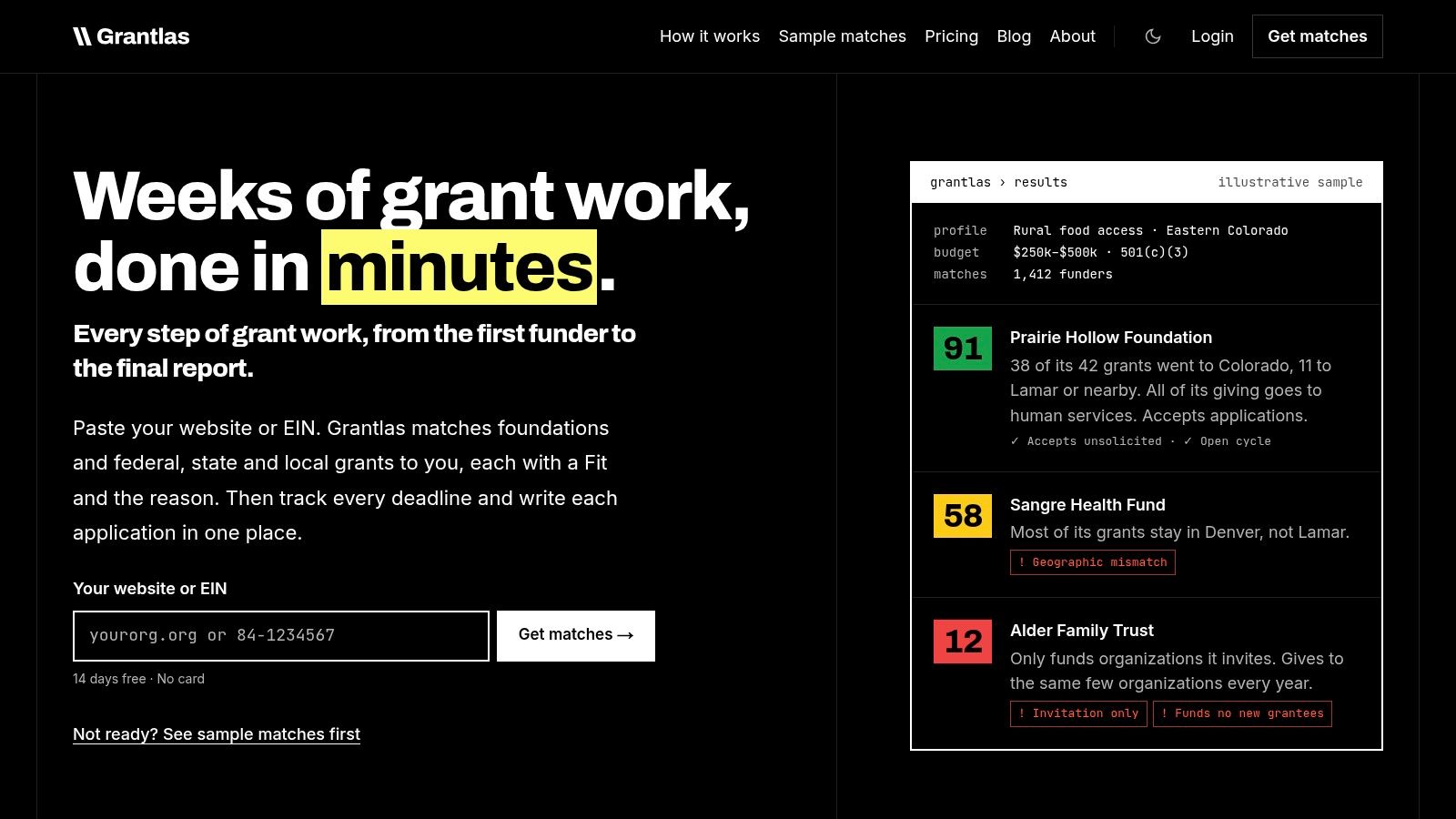
Setup is a paste, not a sales call. You enter a website URL or EIN, the platform builds an organization profile, and it returns ranked matches with a Fit score, a plain-English reason behind it, and red flags. The flags are the part that saves hours: invitation-only funders, geographic mismatches, grant sizes outside your budget range, and cases where you were never an eligible applicant. You see all of that before you write a word of the application.
What to check before you trust a match
Foundation eligibility isn't a single yes or no. The IRS instructions for Form 990-PF require foundations to report restrictions by geographic area, charitable field, and recipient type, plus dollar limits for each award category. Those are exactly the fields that decide whether your application gets read at all.
Funders are also cautious by default. The Center for Effective Philanthropy's current-context research treats risk aversion as a documented barrier in foundation decision-making, which is why organizations without a track record get passed over even when the program fits. Giving history is the counterweight: each funder record shows typical grant size, how often the funder gives, and whether it ever funds someone new, alongside board and trustee listings you can use to plan outreach.
Practical rule: sort your shortlist by whether a funder makes first-time grants, not by award size. A $10,000 grant from a foundation that funds startups beats a $100,000 application that gets filtered out at eligibility.
What one team can do this week
Build the profile, then use peer prospecting to pull every funder that has backed an organization with a similar mission and a similar budget. Take the top five to their own websites and check for a current deadline or an invitation requirement. Everything else goes into the Tracker, the pipeline that carries each prospect from research to award with reminders and a board view you can pull up at your next meeting.
Searches of the national index are unlimited, with filters for sector, geography, and grant size, plus natural-language search for plain-English queries. Saved profiles get a monthly matching scan of their most relevant funders, with saved searches, weekly digests, and deadline reminders on top. Pricing is $99/month or $990/year on Solo (1 user, 1 organization), $199/month or $1,990/year on Pro (up to 3 users, up to 5 clients), and $599/month or $5,990/year on Agency (up to 6 users, up to 10 clients). The Tracker is included on every plan, and a REST API comes with Pro and Agency. You can build the profile and see initial matches before entering a payment method. grantlas.com
2. Grants.gov
Federal money plays by different rules for a new nonprofit. Grants.gov covers federal opportunities only, and it covers them completely. It's the government's own portal, free to search, and the place where a notice of funding opportunity lives in full, including the eligibility language that decides your fate before anyone reads your narrative.
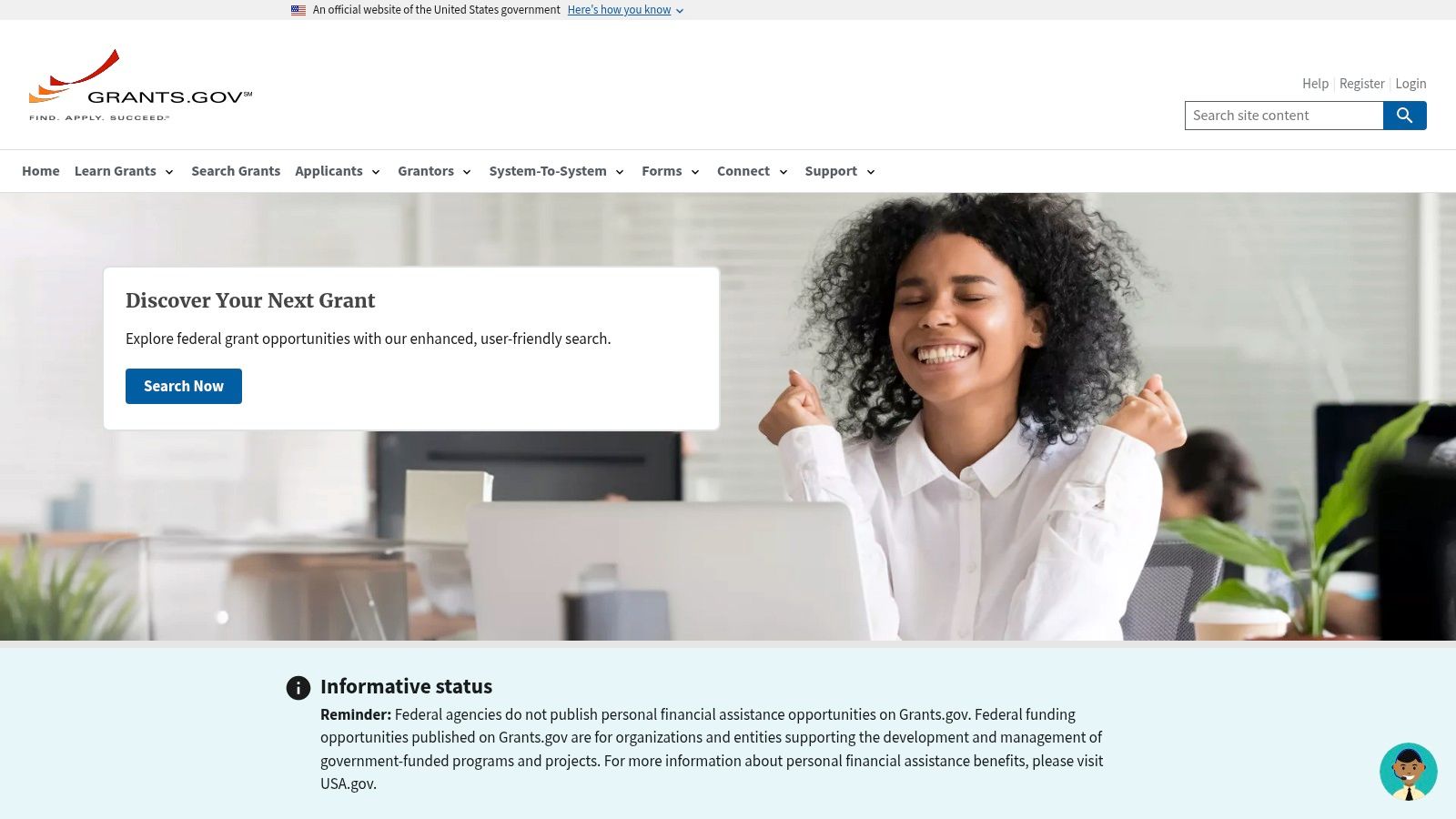
The applicant-type filter is where new organizations disappear. In the Grants.gov search interface, nonprofit status is split into two separate applicant categories, one for nonprofits with 501(c)(3) status and one for nonprofits without it, and a single indexed search displayed 846 opportunities for the first group and 750 for the second. That gap is the point. Your tax status determines which notices you can even see, so screen by applicant type before you read a single program description.
Registration comes before writing
Incorporation doesn't get you in. Per Grants.gov applicant registration, an organization must register in SAM.gov, designate an Electronic Business Point of Contact, and obtain a Unique Entity ID, a 12-character alphanumeric identifier, before it can create a Grants.gov applicant profile. Each step depends on the one before it, so a team that waits until it finds a deadline to start registration is already behind.
Time it right: federal registration is a prerequisite, not a formality, and it has nothing to do with the quality of your proposal.
This week's action: choose one open notice that matches your program, read only its eligibility section, and write down the applicant types, geography, and cost-share rules. If you're still eligible afterward, start registration the same day. For the full sequence from registration to submission, see this guide to nonprofit government grants. grants.gov
3. Candid Search
Covers private foundations, grantmaking public charities, and some open opportunities, built on IRS filings plus self-reported profiles. It's the closest thing the sector has to a research library, and it's where most experienced prospect researchers start.
Foundation money is rarely the whole budget, and it shouldn't be presented that way to your board. Only a small fraction of nonprofits rely on foundation grants as their sole revenue source, a pattern that Candid's analysis of nonprofit revenue sources lays out across the sector. Read a research platform accordingly: it helps you find the two or three foundations that will fund a specific program, not construct an entire revenue plan. For a first-year organization, that framing matters. You're looking for proof that a funder has backed work like yours before, because that's the closest substitute you have for a track record.
Limits to check before you fall for a prospect
- Filing lag: grant history arrives months after the money moves, because it starts with a filed 990 or 990-PF. A funder's most recent visible grant can be a year old or more.
- History isn't an open door: a foundation that funded your kind of work may have no current application process. Confirm guidelines on the funder's own site.
- Repeat-grantee pattern: a profile whose listed recipients are the same organizations year after year is signaling loyalty. Weight those prospects lower while you have no track record, and prioritize funders whose history shows variety.
- Access tiers: the free level shows less. Deeper profiles, grant data, downloads, and the AI-assisted tools sit behind paid plans, and eligible small nonprofits can apply for a free year of Premium access through Candid's Go for Gold offer.
Historical giving tells you who might say yes. It never tells you who is accepting applications today.
This week's action: pull three funders that have given to organizations with a similar mission and a comparable budget, then read each profile for grant size range and any stated process. Our roundup of foundation research tools shows how to combine that with free 990 data. candid.org
4. Instrumentl
Covers a range of funder types, and its real value is pipeline management rather than any single search. It's built for the stage after you've accepted that prospecting is a weekly job, not a one-time hunt.
For a first-year team, that matters more than it does for an established shop. Most funders prefer some operating history, so a new nonprofit works a longer list: more prospects in motion, more deadlines, more follow-ups that slip without a system. The Nonprofit Finance Fund's 2025 State of the Nonprofit Sector Survey found that among nonprofits that had never applied for government funding, 44% called the application process too onerous and 41% said they were unaware of relevant grants or contracts, based on 2,206 qualifying responses. Those are discovery and workload problems. A better writer doesn't fix either one.
What to verify before you pay
- Seats and tiers: plans differ in how many users they include and which research, tracking, and collaboration tools sit at each level. A solo grantwriter and a three-person development shop need different plans, so confirm current seat limits and feature placement on the pricing page before budgeting.
- Fit for a thin track record: whatever the pool, your list still needs screening for funders that accept applicants with little history. Search results are leads, not clearances.
- Funder rules: every result still needs checking against the funder's own eligibility language, including whether new organizations qualify at all.
This week's action: if you're weighing it, start whatever trial or demo the vendor currently offers and load ten prospects for one busy week. One person tracking three prospects needs a spreadsheet. Three people tracking thirty need a pipeline with owners and dates. instrumentl.com
5. GrantStation
Covers a broad mix of foundation, corporate, and government funders, packaged with training. It's less a prospecting engine than a research and learning subscription, which makes it a reasonable fit for a team where nobody has run a grant search before.
Where it helps a first-year team
New grantseekers usually know how to write and not how to research. GrantStation's value sits in the second skill: funder profiles, deadline-driven updates, and educational material that turn prospecting into a repeatable monthly ritual instead of a panic before a deadline.
- Build the ritual: block two hours a month to screen ten new funders, and log each decision with a reason.
- Separate learning from eligibility: a subscription teaches you how to look. It doesn't make a funder accept an organization with no operating history.
- Confirm current terms: pricing and included access change, so check the membership page before you commit budget.
A tool can teach you where to look. It can't give you a track record, and it can't make a funder's eligibility rules bend.
This week's action: read three funder profiles in your field and write one paragraph each on why they would or wouldn't fund a first-year organization. That paragraph becomes the opening of your outreach email. grantstation.com
6. GrantWatch
A county arts council grant or a small-city community development award often never reaches the national foundation databases. GrantWatch earns its keep on geography: one searchable feed of government, foundation, and corporate listings across locations and subject areas, so searching your county name alongside your program area surfaces opportunities that bigger databases miss. Membership adds alerts and pipeline tracking on top of the listings.
The trade-off is verification. A listing service gives you breadth, and you carry the burden of confirming every lead yourself. For a first-year team that check matters twice over, because plenty of listings look open until you read the fine print on operating history.
Eligibility checks that matter here
- Experience requirements: some listings ask for prior grant history or a documented track record, which is the exact wall a new organization hits. Screen these out before you draft anything.
- Match requirements: some programs require matching funds or in-kind contributions you would have to raise first, so count the actual cost of applying.
- Deadline drift: confirm dates and requirements on the funder's own page, not in the listing summary, because aggregated postings go stale.
The listing is a lead. The funder's own guidelines are the rule.
This week's action: run one search for your county plus your program area, and one for your state plus your field. Note how many results are open to organizations under three years old. If the answer is two, those two are your week. grantwatch.com
7. Grantmakers.io
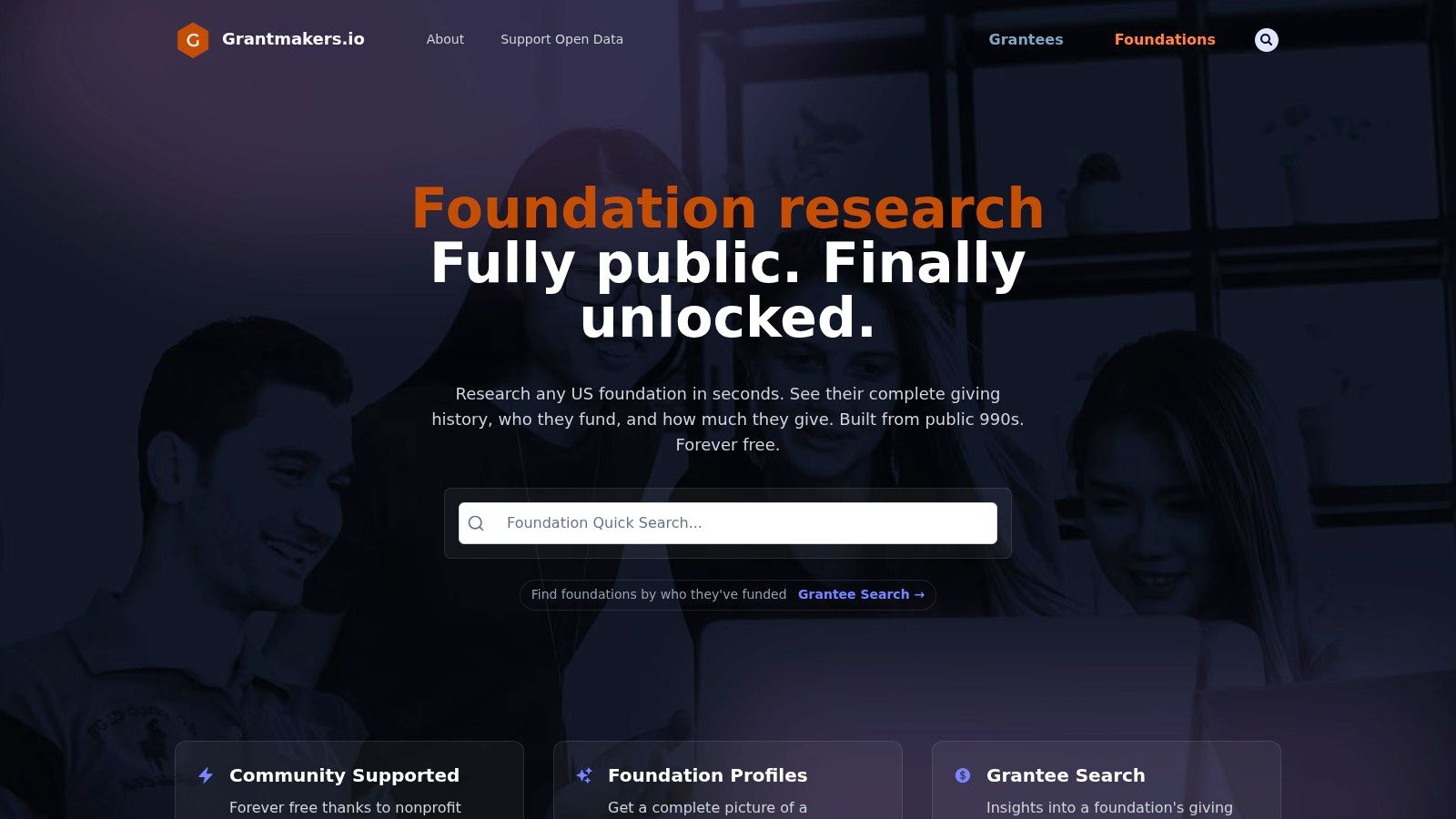
Covers private foundations that file Form 990-PF, and nothing else. No federal grants, no corporate giving programs, no public charities. That narrowness is a feature when your research budget is zero, because it's free, needs no login, and reads the filings directly.
Why mid-sized foundations deserve your attention
Every private foundation, including nonexempt trusts treated as private foundations, must file Form 990-PF annually, and the form carries supplementary information on grant, scholarship, fellowship, and loan programs with the restrictions attached, per the IRS guidance on private foundations. That's an official record of who a foundation will fund and how much.
Scale data explains why the smaller names matter. IRS Statistics of Income data compiled from Form 990-PF filings show that in 2017, foundations with at least $100 million in assets were just 1% of all private-foundation returns, yet they held 65% of total assets and accounted for 47% of contributions, gifts, and grants paid, according to the IRS Statistics of Income bulletin on private foundations. The rest of the grant dollars came from everyone else, and those foundations get a fraction of the applications a national giant receives.
The best first-year prospect list is unglamorous. Local, mid-sized, and already funding organizations your size.
Limits to check
- Historical only: no open deadlines, no application portals, no current guidelines.
- Filing lag: recent grants may not appear in the data for a year or more.
- One form only: corporate funders and public charities are invisible here.
This week's action: find five foundations that gave to organizations with similar missions in your state, and look at the smallest grants in each history. Those are the right first asks. For the full method, read how to find foundation grants. grantmakers.io
How the Seven Sources Differ by Funder Coverage, Best Use, and Access
Read Funder Types first when your organization has no history.
| Item | Funder Types Covered | Best For | Access Model |
|---|---|---|---|
| Grantlas | Private foundations; federal, state, and local funders | U.S. nonprofits seeking ranked matches and end-to-end grant workflow tools | Paid plans from $99/month; trial profile and matches before a payment method |
| Grants.gov | Federal government agencies | Finding and applying for federal funding opportunities | Free public search and application portal |
| Candid Search | Foundations and other funders; nonprofit research | Funder research, giving histories, and prospect lists | Limited free access; paid plans and potential free Premium access for eligible nonprofits |
| Instrumentl | Private foundations; selected federal and state opportunities | Grant discovery, deadline tracking, and team workflows | Paid plans; 14-day free trial |
| GrantStation | Foundation, corporate, and government funders | Grantseeking research, training, and building a repeatable process | Subscription-based; confirm current pricing and access terms |
| GrantWatch | Government, foundation, and corporate funders | Searching opportunities by location, subject, and other criteria | Paid subscriptions with varying terms |
| Grantmakers.io | Private foundations | Free prospect research using historical foundation grants | Free; no account or subscription required |
Build a Shortlist Before You Write a Word
Three tools are enough for a first year. Pick one federal or state source, one foundation research source, and one place to track what you find. Add a fourth only when the third is full.
Then run every shortlisted prospect through the same four questions before you draft anything. Does the funder accept your applicant type? Is your geography inside their stated area? Is your request inside their usual range? And is the process open, invitation-only, or closed until a relationship exists?
Sequence the work, not just the list
Federal money runs on a calendar you don't control. Grants.gov's organization registration guidance notes that a Unique Entity ID can take a day to arrive after the E-Business Point of Contact information is entered in SAM.gov, and that the SAM registration itself averages 7 to 10 business days once all required information is in. Start that clock the week you find an eligible notice, not the week the deadline looms.
Foundation money rewards sequencing instead. Ask for a small program grant first, report on it carefully, then ask for general operating support once the program officer knows your name.
Match the money to what you actually need
Sort your shortlist by unrestrictedness and cadence, not just by size. Flexible funding is expanding but uneven: in 2025, 42% of foundations reported increasing unrestricted grants and 28% reported increasing multiyear grants, while 64% reported providing emergency or rapid-response grants, according to the Center for Effective Philanthropy's State of Nonprofits 2025. None of that guarantees a first-time applicant access, and rapid-response money usually reaches organizations that already have a relationship.
Judge a first-year funder by how fast it pays and how little it restricts, not by the headline figure in the guidelines.
If a paid tool fits your budget, test it before committing. Grantlas's 14-day trial requires no credit card and lets you build a profile to see how its Fit scores and red flags compare with your own review.
A first-year team doesn't need more grant listings. It needs a credible shortlist. Grantlas builds one from your website or EIN, scoring funders and open grants with a plain-English reason and red flags for invitation-only processes, geographic mismatches, and award sizes out of range. Visit Grantlas to create a profile and see your first matches before you enter a payment method.