10 Foundation Research Tools Compared for Fundraisers
Oct 15, 2026 · 14 min read
You've got 300 possible funders, six weeks before a deadline, and no reliable way to tell which records deserve an hour of research. The problem isn't finding names. It's deciding whether a foundation's giving history is relevant, recent enough, open to an organization like yours, and worth the staff time required to pursue it.
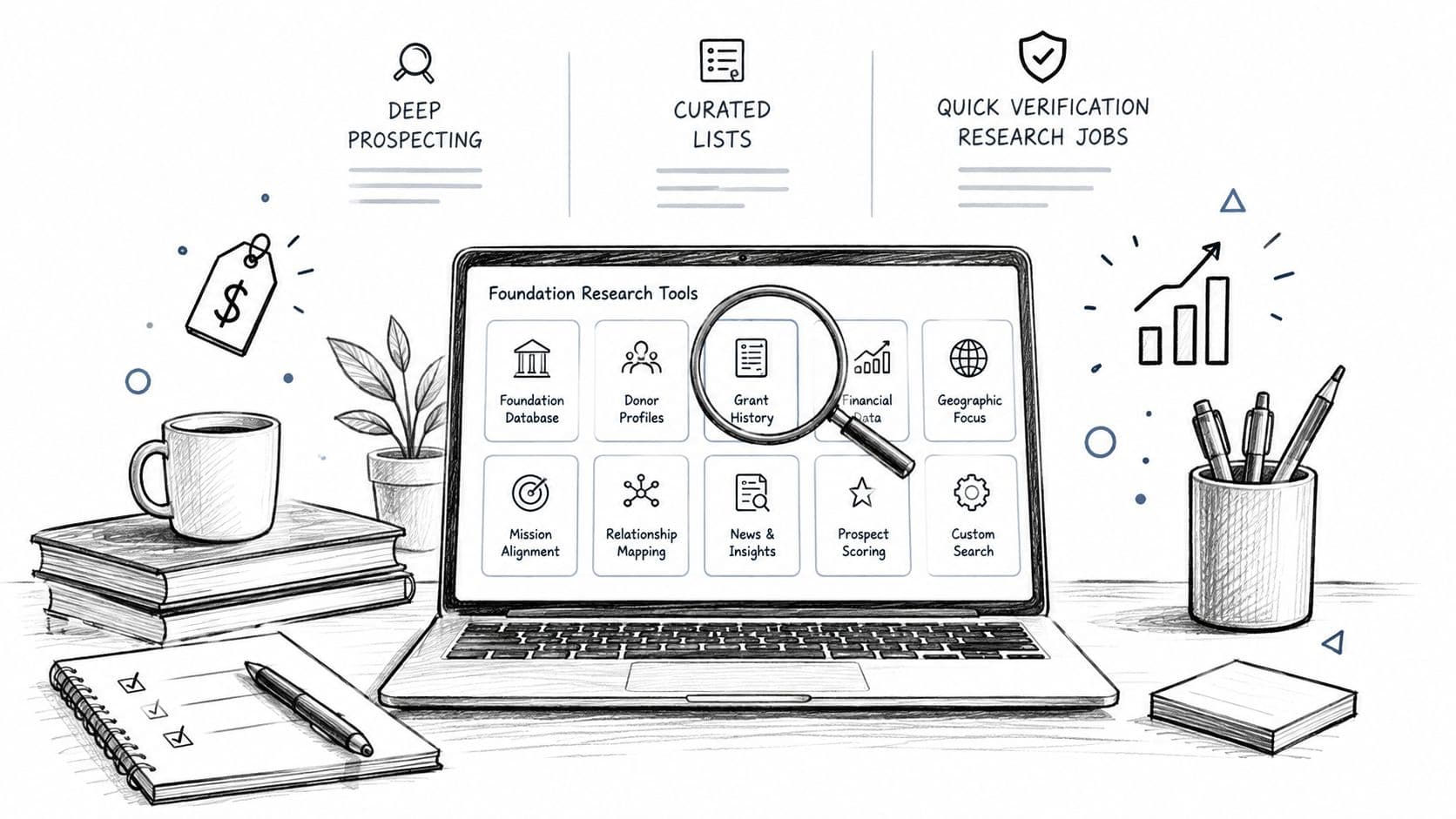
The best foundation research tools serve different jobs. Some are built for deep, Form 990-based prospecting. Others offer budget-friendly curated listings and current opportunity scanning. A third group helps you verify a shortlist for free before you invest in outreach or proposal development.
This comparison groups ten tools by those research jobs rather than pretending they belong on one universal ranking. Each entry considers data depth, workflow usefulness, price transparency, and practical limitations. The due-diligence step matters just as much as the search interface. A promising record still needs checking against primary filings, current guidelines, eligibility rules, and the funder's recent activity.
Table of Contents
- 1. Candid Foundation Directory
- 2. FoundationSearch by Metasoft
- 3. Cause IQ Foundation Search
- 4. Instrumentl
- 5. GrantFrog
- 6. GrantStation
- 7. GrantWatch
- 8. Grantmakers.io
- 9. ProPublica Nonprofit Explorer
- 10. Grants.gov and Simpler.Grants.gov
- Top 10 Foundation Research Tools Comparison
- Pick the Tool That Fits Your Research Job
1. Candid Foundation Directory
Candid's Foundation Directory remains the reference point for deep U.S. private-foundation prospecting. Its strength is breadth combined with the ability to inspect the evidence behind a prospect. Paid access provides extensive profiles, giving histories, financial information, guidelines, personnel, board details, saved searches, lists, dashboards, and grant-data downloads. Candid also offers an AI Fundraising Assistant for natural-language queries.
For a development director building a serious prospect list, the platform's filters are more useful than a simple directory search. You can narrow funders by geography, subject area, recipient characteristics, and historical giving patterns, then move from discovery into due diligence without changing systems. Its training resources also help new staff learn how to interpret foundation records rather than treating every match as equally actionable.
The trade-off is cost and complexity. Pricing can be difficult for small organizations to absorb, and the interface rewards users who understand how to combine filters and evaluate exports. Free onsite access through partner libraries and occasional eligibility promotions can change the calculation, so check whether your team qualifies before purchasing.
Due-diligence step: Check the filing year, recent grant recipients, current guidelines, and whether the foundation appears to accept unsolicited requests before moving a prospect into outreach.
Candid is the strongest fit when your job is deep 990-based research at scale. For a broader explanation of how online directories differ, see this guide to foundation directories online, then review the Candid Foundation Directory directly for current access options.
2. FoundationSearch by Metasoft
FoundationSearch takes an analytics-oriented approach to prospecting. Its My Best Prospects feature is designed to surface aligned funders quickly, while Grant Analyzer and related tools help teams examine funder behavior rather than relying only on mission keywords. The platform also includes prospect and donor management functions, alerts, training resources, and coverage extending across the United States and Canada through BIG Online.
That makes it useful for teams that already know their basic search criteria and want help turning a broad funder universe into a workable shortlist. A consultant managing several client profiles may value the ability to combine prospecting, analysis, and alerts in one environment. The platform's long market history and support materials are also practical advantages when several staff members need a shared research process.
The limitation is transparency. Pricing isn't publicly listed, so a small organization has to request a quote before it can compare the platform with alternatives. Some users may also find the interface and workflows dated or labor-intensive, particularly if they expect a lightweight, modern search experience.
Where FoundationSearch earns its place
FoundationSearch works best when prospect ranking and donor management matter as much as browsing individual foundation profiles. It's less attractive for a one-time list build where the team wants immediate self-service pricing and minimal setup.
Before outreach, compare the automated ranking with the underlying evidence. Open the funder's profile, inspect its recent recipients and geographic pattern, and confirm that the apparent fit isn't driven only by a broad subject label. Then record the source year and any missing information in your CRM.
Visit FoundationSearch to confirm current products, coverage, and quote requirements.
3. Cause IQ Foundation Search
Cause IQ is built more like a business-intelligence system than a traditional grant opportunity board. Its foundation finder supports detailed segmentation across grant traits, recipients, personnel, organizational characteristics, and related nonprofit data. Downloadable foundation, grant, and personnel lists make it especially useful for teams that need to build an outreach universe or compare groups of similar funders.
The platform earns its keep when prospecting involves more than identifying likely grantmakers. A consultant can use it to map peer organizations, examine funder relationships, identify trustees or personnel connected to relevant institutions, and create structured lists for later review. Teams conducting market scans or benchmarking exercises will usually get more value from the broader intelligence layer than from a single prospect search.
Cause IQ publishes per-seat pricing, which makes budgeting easier than with quote-only systems. Still, plan limits and download caps apply, so the most useful workflow depends on how frequently your team exports data. It's also not designed primarily for live deadline discovery. Treat it as a 990-driven research and segmentation tool, not as a complete replacement for an opportunity calendar.
Start with one real organization profile. Export a small prospect set, then manually confirm several recipients, geographic signals, and personnel records before paying for a larger workflow.
The due-diligence question here is whether the record supports a specific fundraising decision. A foundation that looks similar by sector may still fund only institutions, work through invitations, or support a geography your organization can't reach. Use Cause IQ to assess current filters, seats, and export terms.
4. Instrumentl
Instrumentl is a strong option when foundation research and grant tracking need to live together. It combines private funder discovery with public opportunities, relevance scoring, 990 insights, deadline alerts, pipeline management, collaboration, and CRM synchronization. Its AI Apply assistant, content reuse tools, and award-letter parsing push the product beyond research into pre-award operations.
The user experience is one of its clearest advantages. Small and midsize teams can usually get from profile setup to saved searches and deadline tracking without building a complicated internal system first. That matters when the development director is also writing proposals, managing relationships, and reporting to leadership.
Instrumentl's trade-off is focus. It provides useful foundation intelligence, but it's oriented toward opportunity tracking and workflow management rather than the deepest possible 990 investigation. Solo users may also find the price difficult to justify if they only need occasional prospect research.
Test the score before trusting the pipeline
Run a real organization through the platform and inspect why opportunities receive their relevance ranking. Check whether the score reflects geography, applicant type, grant size, and program fit, or whether it mostly reflects keyword overlap. Then open the original opportunity notice and compare its deadline, restrictions, and submission requirements with the record in Instrumentl.
That exercise tells you whether the tool can support actual grant decisions, not just attractive search results. It also exposes whether your organization profile needs more precise information before alerts become useful.
Review current features and plans on Instrumentl, and compare its workflow emphasis with this overview of a grant search tool.
5. GrantFrog
GrantFrog combines foundation discovery with a grants CRM, task management, collaboration, reporting, document management, and AI writing support through Lily AI. Its positioning is straightforward: a small team may be able to replace several disconnected tools with one application instead of maintaining a separate database, task board, content library, and proposal workspace.
That integrated approach is practical for organizations where research records routinely disappear into spreadsheets. Staff can connect a prospect to tasks, shared documents, internal notes, and a pipeline without recreating the same funder information in multiple places. Transparent tiered pricing and multi-user allowances also make initial budgeting easier than quote-based platforms.
The caution is maturity. GrantFrog is a newer entrant, with a smaller ecosystem and fewer independent reviews than established research databases. Its foundation coverage and research depth may still be developing, so teams with demanding historical prospecting requirements should test actual records rather than judging the product by its workflow features.
The right fit for a small operating team
GrantFrog makes the most sense when workflow consolidation is the priority. It's less obviously suitable when the research question requires extensive historical comparisons across many foundations or highly specialized exports.
Before signing up, choose a foundation your team already knows. Compare its displayed grant history, recipient information, and eligibility details with primary filings and current funder materials. If the core record holds up, test whether tasks, documents, and collaboration reduce manual handoffs.
Check current plans and capabilities on GrantFrog. Ask specifically about data coverage, update timing, export options, and how the platform handles incomplete foundation records.
6. GrantStation
GrantStation is a budget-conscious choice for teams that want curated listings alongside practical grantseeking guidance. It covers U.S. private funders and public opportunities, publishes curated updates, and adds strategy guides, proposal templates, and State of Grantseeking reports. Member networks such as TechSoup and nonprofit associations may also provide access or discounts.
The platform is useful when staff need help with both discovery and the mechanics of grantseeking. A newer grant writer can find an opportunity and then use the accompanying educational material to improve a concept paper, build a prospecting routine, or understand common application expectations. That combination is often more valuable than a larger database that nobody on the team has time to learn.
GrantStation gives up analytical depth compared with premium 990-focused systems. It isn't the best choice for detailed funder modeling, complex exports, or broad relationship mapping. Basic membership terms may also restrict sharing, so confirm whether your intended users can access the same account.
Practical rule: Use GrantStation to generate and learn from a shortlist, then verify every serious prospect against the funder's own website and an IRS-based record.
That two-source process prevents a curated listing from becoming an outdated assumption. Review the opportunity's current deadline, eligibility, geographic scope, and contact instructions before assigning proposal work. GrantStation is worth considering when low out-of-pocket cost and guidance matter more than advanced analytics.
7. GrantWatch
GrantWatch serves a different research job: quick scanning of current listings with minimal onboarding. It aggregates human-verified U.S. opportunities, supports category and state filters, and offers short-term weekly or monthly plans, alerts, and intelligence tokens. That structure can appeal to a small nonprofit that needs to canvass opportunities without committing to a long software contract.
The interface is simple enough for rapid browsing. Teams can scan listings, identify potentially relevant private or corporate funders, and decide which records deserve deeper review. Short-term access also lets an organization test the usefulness of the database against a live deadline cycle rather than making a large commitment upfront.
GrantWatch is not a substitute for deep funder history. Its records are more useful for finding possible opportunities than for understanding a foundation's long-term giving behavior, trustees, financial position, or relationship patterns. User feedback about value and subscription policies is mixed, so start with a short plan and read renewal terms carefully.
A fast scan still needs a second source
For each promising listing, open the funder's official website and look for current guidelines, eligibility restrictions, application instructions, and evidence that the opportunity is still active. Don't assume that a listing's presence means your organization is eligible or that the deadline has not changed.
The platform works best as a low-cost discovery layer, especially when the immediate question is what's available now. It works poorly as the sole basis for a major prospect decision. See the current access options on GrantWatch before subscribing.
8. Grantmakers.io
Grantmakers.io is a free, focused interface for reviewing U.S. private foundations through IRS Form 990-PF data. It provides foundation profiles, giving histories, grant amounts, recipients, and links or connections to primary public information. The design is lightweight, which makes it useful when a development associate needs to validate a name quickly without waiting for a paid database export.
Its value is strongest at the verification stage. Suppose a consultant receives a list from a board member or a colleague. Grantmakers.io can help determine whether the foundation has a relevant giving history, whether its grants appear consistent with the proposed project, and whether the name in the list matches the correct legal entity.
There are clear limits. The site doesn't offer the advanced scoring, saved workflows, alerts, or broad opportunity coverage found in commercial platforms. IRS release timing also means the available information may lag current foundation activity. The dataset should be treated as evidence, not as a complete picture of present priorities.
Use the record as a confidence check
Open the foundation's giving history and compare recipients, subjects, geography, and filing year with what the foundation currently says about its programs. Pay particular attention to missing or partial grantee information. Public foundation research depends heavily on standardized filings, but a clean-looking record doesn't guarantee that every relevant grant has been disclosed or captured.
That caution matters because IRS-related analyses have identified missing or partial grant data across private-foundation filings. The IRS private-foundation statistics explain the broader reporting framework, while Grantmakers.io provides a practical free interface for checking individual records.
9. ProPublica Nonprofit Explorer
A board member sends a foundation name, or a paid database surfaces a promising match. ProPublica Nonprofit Explorer provides a free way to check whether the organization is the right legal entity and whether its public filings support further research. It includes nonprofit summaries, full filing PDFs, e-file data, and an API for scripted or bulk workflows.
The original filing is most useful when a profile summary leaves questions unanswered. Review the Form 990 or 990-PF for program descriptions, financial fields, officers, directors, and other details that a curated record may shorten or omit. The same records can support diligence on foundations, operating charities, intermediaries, and potential partners.
This tool requires interpretation. It does not rank prospects, curate open opportunities, or indicate which foundation deserves attention first. Staff still need to turn filing details into a fundraising judgment, and filing information may not reflect current priorities.
When a prospect matters, read the filing, not only the profile summary. The original document may reveal restrictions or relationships hidden by a search result.
Before outreach, compare the legal name, EIN, filing year, grant recipients, and leadership with the prospect record and the organization's current materials. This step can catch a mistaken identity or expose a mismatch between past activity and your proposed project.
Start with ProPublica Nonprofit Explorer and decide whether your team needs the API for bulk workflows.
10. Grants.gov and Simpler.Grants.gov
Grants.gov is the official federal portal for competitive grant opportunities across agencies. It's essential for nonprofits pursuing federal awards because it centralizes posted opportunities, supports saved searches and alerts, provides Application Workspace and tracking, and includes applicant guides and Learning Center resources. Simpler.Grants.gov is part of the effort to improve the federal search experience.
Federal research deserves its own workflow rather than being treated as an extension of private-foundation prospecting. Federal grantmaking has expanded substantially over time. In constant fiscal-year-2017 dollars, federal outlays for grants to state and local governments rose from $17.7 billion in fiscal year 1940 to $882.8 billion in fiscal year 2024, according to the Congressional Research Service overview of federal grants. As of fiscal year 2025, the same source identified at least 1,183 funded federal grant programs, which makes structured filtering essential.
The portal's weakness is operational overhead. Organizations may need UEI and SAM registration, authorized organization representative processes, and agency-specific requirements before applying. Grants.gov also won't provide the private-foundation histories, relationship signals, or board context that a foundation database offers.
Confirm the full notice before assigning work
Use the official opportunity notice as the controlling document. Check applicant eligibility, required registrations, matching or cost-share language, attachments, submission method, and the actual deadline. Don't build a proposal from a summary or third-party listing when the federal notice is available.
The federal system is authoritative, free, and necessary for this research job. It isn't a replacement for private-foundation tools. Review Grants.gov and this guide to federal grant opportunities before deciding whether your team needs a separate discovery layer.
Top 10 Foundation Research Tools Comparison
| Product | Core coverage | Key features | UX & Price | Best for | Main limitation |
|---|---|---|---|---|---|
| Candid, Foundation Directory (Candid Premium) | Deep U.S. private foundation coverage & giving histories | Robust filters, 990-derived grant data, saved lists, AI Fundraising Assistant | Feature-rich UX; higher-priced on paid tiers; free library access | Mid–large nonprofit development teams, due diligence | Costly for small orgs; steeper learning curve |
| FoundationSearch (Metasoft) | Large foundation index (U.S. + Canada with BIG Online) | My Best Prospects ranking, Grant Analyzer, prospect management & alerts | Enterprise/quote pricing; powerful but older UI | Research teams and institutional prospectors | Pricing opaque; workflows can feel dated |
| Cause IQ, Foundation Search | U.S. nonprofits & foundations with market intelligence | 30+ filters, downloadable lists, org & market data exports | Clear per-seat pricing; strong export capabilities | Consultants, analysts, segmentation work | Not an opportunity board; export limits by plan |
| Instrumentl | Combined private foundations + public opportunities | Relevance scoring, pipeline tracking, deadline alerts, AI apply assistant | Modern, user-friendly UX; priced for teams (can be steep for solos) | Small–mid nonprofit teams needing research + workflow | Pricier for solo users; less deep 990 focus than some |
| GrantFrog | Foundation research + grants CRM | Funder discovery, pipeline, collaboration, AI writing tools | Transparent tiered pricing aimed at small teams | Small teams/agencies seeking all-in-one tool | Newer product; coverage and ecosystem still maturing |
| GrantStation | Curated U.S. funder listings + strategy resources | Weekly curated updates, proposal templates, strategy guides | Budget-friendly; discounts via memberships/partners | Small nonprofits, associations, member organizations | Smaller dataset and fewer analytics than top-tier tools |
| GrantWatch | Aggregated, human-verified live opportunity listings | Category/state filters, short-term plans, alerts | Very affordable weekly/monthly pricing; simple interface | Budget-conscious orgs scanning current openings | Less depth on funder histories; mixed user reviews |
| Grantmakers.io | Open-data access to IRS 990-PF (private foundations) | Searchable 990-PF giving history, links to primary IRS filings | Free and fast; lightweight interface | Early prospecting, list scrubbing, verification | No scoring, alerts, or advanced analytics; data lags possible |
| ProPublica Nonprofit Explorer | Forms 990/990-PF filings across nonprofits & foundations | Filings browse, PDF links, developer API for bulk access | Free, reputable dataset; API available | Due diligence, researchers, developers building pipelines | Not a curated opportunities database; manual analysis needed |
| Grants.gov (and Simpler.Grants.gov) | Official U.S. federal grant opportunities across agencies | Central federal search, Application Workspace, saved searches & alerts | Free and authoritative; improving UX but requires registrations | Orgs pursuing federal funding and grant managers | Not a private foundation database; SAM/UEI setup and workflows add complexity |
Pick the Tool That Fits Your Research Job
The right choice depends less on the number of records in a database than on the decision your team needs to make. If you're investigating private foundations, comparing historical giving, and studying recipients, start with a deep 990-based platform such as Candid, FoundationSearch, or Cause IQ. If you need current listings, deadline alerts, and a working pipeline, Instrumentl, GrantFrog, GrantStation, and GrantWatch address more of the operational process. If you already have a shortlist, Grantmakers.io and ProPublica Nonprofit Explorer can provide free verification before you spend staff time on outreach.
A practical selection process has three steps.
Define the research job. Decide whether you need historical foundation intelligence, current opportunity discovery, free record verification, federal searching, or a combination. Also define the output your team needs. A spreadsheet of names is different from a ranked pipeline with deadlines, eligibility flags, source dates, and ownership.
Run the same test in two tools. Use a real organization profile and ask both platforms to produce a shortlist. Compare the funders they return, the reasons behind the matches, the recency of the records, the quality of grant histories, and the effort required to confirm eligibility. Don't judge a system from a demo built around an idealized example.
Confirm current pricing and terms directly. Product limits, user allowances, exports, integrations, and pricing can change. Verify them on each vendor's website before committing, especially if your team needs shared access, CRM synchronization, API use, or frequent downloads.
Whatever platform you choose, don't treat a score as a decision. Check filing year, current guidelines, recent recipients, geography, applicant type, grant size, invitation requirements, and whether the foundation appears open to new grantees. The IRS data framework supports useful prospecting, but missing grantee information, delayed filings, inconsistent reporting, and changing priorities can make a historical pattern look more complete or current than it is. Your research process should expose that uncertainty instead of hiding it.
Capacity matters too. The 2025 State of Grantseeking findings identified lack of time or staff as the leading challenge, cited by 19.3% of respondents. The same report found that 81.3% applied for private-foundation funding, compared with 38.5% applying for federal funding, which reinforces the need to manage the two channels deliberately rather than treating every match as equally actionable. A strong prospecting process should help you reject opportunities that demand more effort than your team can support.
For teams that want one scored shortlist spanning private foundations and open federal grants, Grantlas is one option. It offers unlimited searches, fit scores with plain-English reasoning, and published plans of $99 per month or $999 per year for Solo, and $199 per month or $1,999 per year for Pro, with current pricing to be confirmed on the site. Its workflow is designed to turn an organization profile into ranked prospects, while source dates and fit explanations give staff a basis for review. Pair any automated shortlist with the discipline required to craft winning grant proposals, then verify the best prospects through free IRS-based sources before making contact.
Grantlas combines private-foundation research and open federal opportunity discovery in one searchable index, with fit scores, reasoning, giving history, and eligibility flags to help small teams prioritize limited staff time. Visit Grantlas to build an organization profile, test a scored shortlist, and compare current plans before your next funding cycle.