AI for Grant Writing: What Works and What to Verify
Nov 16, 2026 · 12 min read
75% of more than 4,000 nonprofits surveyed by Google.org in 2024 said generative AI could transform their marketing, particularly content creation and personalization, and Google's report names grant-proposal writing as a potential use. That's a strong signal of interest, not proof that generated proposals are ready to submit. The useful question is which tasks AI can accelerate without creating more verification work than it saves.
For AI for grant writing, the practical unit of accountability isn't the finished proposal. It's the individual claim, eligibility decision, budget calculation, and community story, each assigned to a person who can defend it.
Table of Contents
- Where AI Fits in Grant Work
- Using AI to Research and Shortlist Funders
- Funder Rules on AI Use and Disclosure
- Federal Deadlines, Registration and Budget Rules
- How to Draft a Proposal with AI Step by Step
- Checking Facts Budgets and Community Voice
- Start a Small, Documented AI Pilot This Quarter
Where AI Fits in Grant Work
AI use is becoming routine: in an April 2025 survey of more than 9,000 nonprofit organizations, 68% reported at least some employees using AI tools, up from 58% in 2023, according to Google for Nonprofits. But using a tool doesn't establish who checks its output.
Grant work sits between administration and mission delivery. Stanford's Human-Centered AI working paper summarizes findings that approximately 80% of AI users applied it to supportive functions, including finance, human resources, technology, and communications, while about 60% used it for mission-related activities.
A proposal moves through research, shortlisting, drafting, budgeting, review, and submission. AI can assist along that path, but the owner should change with the task.
AI role, staff owner and risk by grant task
| Task | AI can help with | Staff must own | Risk |
|---|---|---|---|
| Funder research and shortlisting | Summarizing funder priorities and giving history | Grant writer judges real fit and eligibility | Medium. An inaccurate summary can waste proposal effort. |
| Brainstorming project framing | Generating angles and questions to test | Development director chooses the strategy | Low. Staff can discard unsuitable ideas before drafting. |
| First draft of boilerplate | Reformatting approved text for a new call | Grant writer confirms every fact | Medium. Old facts can become new promises. |
| Community or lived-experience narrative | Grammar and clarity edits only | Program lead writes from staff and community input | High. Misrepresentation can harm people and relationships. |
| Outcomes and statistics | Formatting tables and charts | Evaluation lead sources and verifies every number | High. Unsupported results undermine the application. |
| Budget narrative | Turning budget lines into plain language | Finance lead reconciles figures and indirect-cost rates | High. Errors can misstate the funding request. |
| Edits for length and clarity | Tightening sentences to word limits | Grant writer checks final voice and accuracy | Low. Compare edits against the approved original. |
| Disclosure statement | Drafting a template | Submission lead confirms the funder's rule and files the statement | Medium. An incomplete disclosure can breach instructions. |
Assign a person, not just a department
Put an actual name beside each role in your working document. In a small nonprofit, the executive director might hold several roles, but each approval still needs to be explicit.
Choose AI tools for nonprofits around these handoffs, rather than choosing a tool and giving it the whole application.
Practical rule: If a wrong answer would embarrass the organization or break a funder rule, a human owns the task from start to finish. AI only supports that person.
Using AI to Research and Shortlist Funders
Start with a shortlist, not a generated proposal. A research assistant can organize prospects around your mission, service area, applicant type, and funding request, then summarize priorities, typical grant size, and openness to unsolicited proposals.
Use this sequence:
- Search broadly by cause and geography. Describe the actual work and population served, rather than relying on your organization's broad mission statement.
- Filter for practical eligibility. Check grant size, applicant restrictions, deadlines, and whether the opportunity supports your proposed activities.
- Read the funder's own guidelines and recent grantees. Decide whether its stated priorities and funding behavior support an application.
At Grantlas, our foundation data comes from IRS filings, while federal, state, and local grants come from government grant portals, state arts agencies, humanities councils, and community foundations. Those source types serve different purposes: a filing documents past giving; an opportunity page provides application instructions.
Catch the mismatches before writing
Older filings can describe a previous strategy. A funder may have supported your field historically without accepting applications for that work now. Record the filing year and compare historical giving with current guidelines.
Geographic language can hide a hard boundary. A foundation's office location isn't necessarily its service area. Confirm where the proposed project must operate and who must benefit.
Invitation-only funding isn't an open application opportunity. Keep relationship prospects separate from calls your team can pursue. Otherwise, a promising research list becomes a misleading submission calendar.
A high match score can reflect a shared keyword rather than genuine fit. Read the explanation and test the weakest assumption. A youth-development organization and a funder supporting youth medical research may share language without sharing a funding purpose.
No funder enters the active application pipeline until the grant writer has opened the funder's own site and confirmed an open call.
Keep a decision note for every prospect: retained, rejected, or held for relationship development, with the reason. A consistent foundation prospect research process makes those decisions reusable and prevents colleagues from researching the same unsuitable prospect again.
Funder Rules on AI Use and Disclosure
No single AI rule covers every funder. Permission to use an assistant for editing doesn't automatically permit generated narrative, and disclosure doesn't make a prohibited use acceptable.
Devex's reporting on AI in development grantmaking describes different approaches at the Spencer Foundation, Wellcome, UK Research and Innovation, and the Robins Foundation. Treat these reported policies as prompts to inspect the current call, not as permanent permission.
Stated AI policies by funder
| Funder | Stated AI policy | What the applicant should do |
|---|---|---|
| Spencer Foundation | Reportedly bars verbatim AI-generated drafts | Write original text and confirm the current rule before using any AI draft |
| Wellcome | Requires disclosure of most AI use | Log each AI task and include a disclosure statement |
| UK Research and Innovation | Requires disclosure of most AI use | Log each AI task and check the call's disclosure format |
| Robins Foundation | Permits AI assistance; applicants must review accuracy and avoid confidential or personally identifiable information unless they understand the service's data practices | Review every claim and remove personal data from prompts |
| Other funders | The current call and funder policy determine permitted use | Ask the program officer before submission and keep the reply |
Make permission part of proposal setup
Before drafting, search the guidelines, application portal, and applicant FAQs for AI language. Save the relevant wording with the application materials so the team works from the same interpretation.
Then prepare a disclosure record naming the tools, the tasks, and the human reviewer. Update it when the workflow changes. If an assistant moves from outlining to generating paragraphs, the original record no longer describes what happened.
When the rule is unclear, email the program officer with a concrete question. Describe the intended task, such as editing staff-written text for length, rather than asking whether AI is allowed in general. Keep the response in the application folder.
Minimize what enters the tool
Brainstorming, outlining, and grammar checks on non-sensitive text are lower-risk choices, provided the funder permits them. Personal narratives, confidential budget detail, and community testimony need a different level of care.
Remove names, client details, health information, and identifying combinations of circumstances before pasting text into an assistant. Replacing a name isn't enough if the remaining story still identifies the person.
Keep a brief review record showing who approved the output and which passages they checked. A disclosure statement should describe the actual workflow, not offer blanket reassurance.
Use this template only when it accurately reflects the work:
AI tools were used for outlining and language editing; all facts, figures and narratives were written and verified by staff.
Federal Deadlines, Registration and Budget Rules
An AI draft can look complete while the organization remains unable to submit. Registration, authorized access, and budget mechanics need their own checklist, separate from narrative review.
Federal instructions also require careful reading across time. Use the current funding notice and applicable rules, rather than treating an older application package as a universal federal standard.
Federal application checkpoints and their rules
| Checkpoint | Requirement | Timing or rule | Owner |
|---|---|---|---|
| SAM.gov registration | Active registration before applying | Grants.gov's registration guidance advises allowing up to 10 business days for activation | Executive director or finance lead |
| Unique Entity ID | Required for applications and obtained through the federal registration process | Confirm the identifier used in Grants.gov matches the SAM record | Grant writer |
| Grants.gov submission | Electronic submission through Grants.gov | The cited application instructions specify 11:59 p.m. Eastern Time on the stated date; verify the current notice's cutoff | Grant writer |
| Indirect-cost rate | Establish an authorized basis before charging indirect costs | The cited opportunity attachment restricts charges without an approved rate, provides an eligible 10% de minimis option, and addresses negotiated-rate documentation; check current applicability | Finance |
| Negotiated rate agreement | Current agreement included when required for the claimed negotiated rate | Attach the applicable agreement and confirm its effective period | Finance |
| Budget reconciliation | Rate type, base, and indirect amount must agree with the narrative | The Grants.gov budget-form guidance distinguishes provisional, predetermined, final, and fixed rates and requires the applicable percentage and calculation base | Grant writer and finance |
The UEI comes through SAM.gov registration, not from Grants.gov assigning a separate organizational identifier. That distinction matters when staff troubleshoot mismatched records.
Reconcile before submission day
- Confirm registration status now. Don't wait until the final week to discover an inactive record or missing access.
- Pull the current rate agreement. Finance should identify the rate and period that apply to this application.
- Recalculate indirect costs from the stated base. Use the approved spreadsheet, not generated arithmetic.
- Match the narrative to the budget form. Check terminology, exclusions, totals, and attachments together.
- Aim to submit at least a day early. Treat that as an internal buffer, not a substitute for the official deadline.
For example, a narrative describing a de minimis approach while the budget form uses a negotiated rate creates a review problem even if both passages read well. Resolve that contradiction before polishing the prose.
Use a federal grant preparation checklist to assign the administrative work alongside the writing schedule.
How to Draft a Proposal with AI Step by Step
A useful drafting workflow starts with approved inputs and ends with a documented human decision. Don't ask an assistant to fill organizational gaps with plausible language.
Keep the process visible while the team works:
Prepare the inputs and control generation
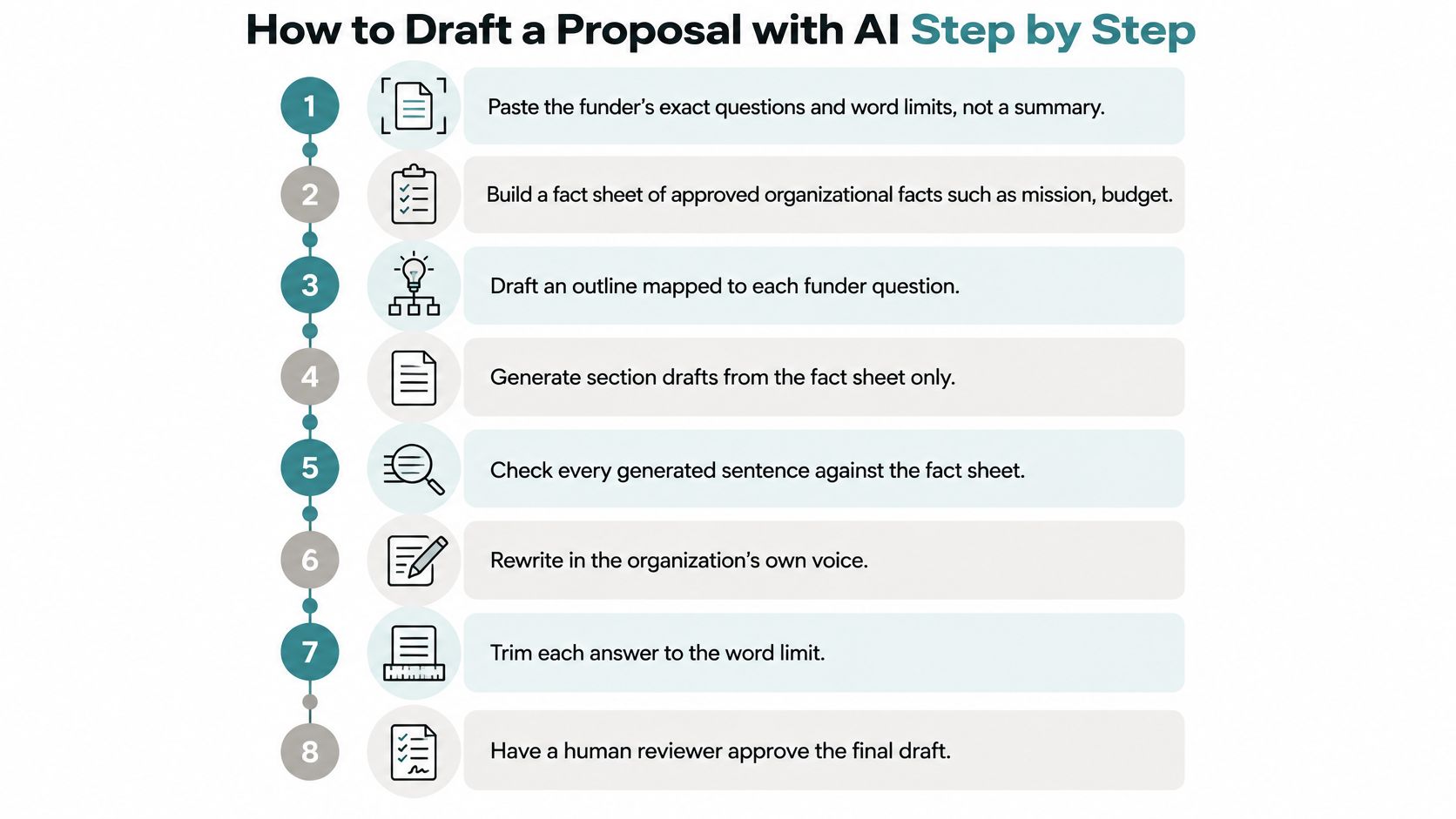
Paste the funder's exact questions and word limits, not a summary. Include scoring criteria and required subparts so the outline answers the actual application. A paraphrased question can omit the detail reviewers need.
Build an approved organizational fact sheet. Include mission, budget, outcomes, staff roles, and a source reference for each line, with approval status and reporting period. Skipping this step invites invented program details or the reuse of outdated results.
Request an outline and alternative framings, then choose the strategy yourself. Compare how each framing connects the documented need, proposed activities, and funder criteria. Don't let polished wording persuade you to promise work the program team hasn't approved.
Draft a section at a time from the fact sheet and funder criteria. Tell the assistant to mark missing information instead of completing it. Asking for the entire proposal at once makes unsupported assumptions harder to isolate.
A useful prompt is: Use only the approved facts below. Identify missing evidence explicitly. Don't infer partnerships, outcomes, staffing commitments, or funding history.
Review meaning before polishing language
Mark sentences containing a number, name, or substantive claim. Attach the relevant fact-sheet reference so reviewers can trace the wording. Checking only obvious statistics misses claims about organizational capacity, demand, and partner commitments.
Rewrite the opening, community voice, and personal stories by hand. Use authorized interview notes and language the organization would use. Don't accept emotionally polished testimony that no participant provided.
Run a verification pass against the fact sheet and funder rules. Check eligibility, required attachments, permitted AI use, answer completeness, and word limits. Shortening an answer can remove a qualification or turn a target into an achieved result.
Save prompts, drafts, and edits in a version log. Record who changed substantive claims and who approved the final text. Without a log, the team may be unable to explain why a promise appeared or which source supported it.
This accompanying video can support a team discussion about the drafting process:
A good draft is traceable, not merely fluent. Every claim connects to an approved source line, and the finished voice sounds like the organization at its best.
Checking Facts Budgets and Community Voice
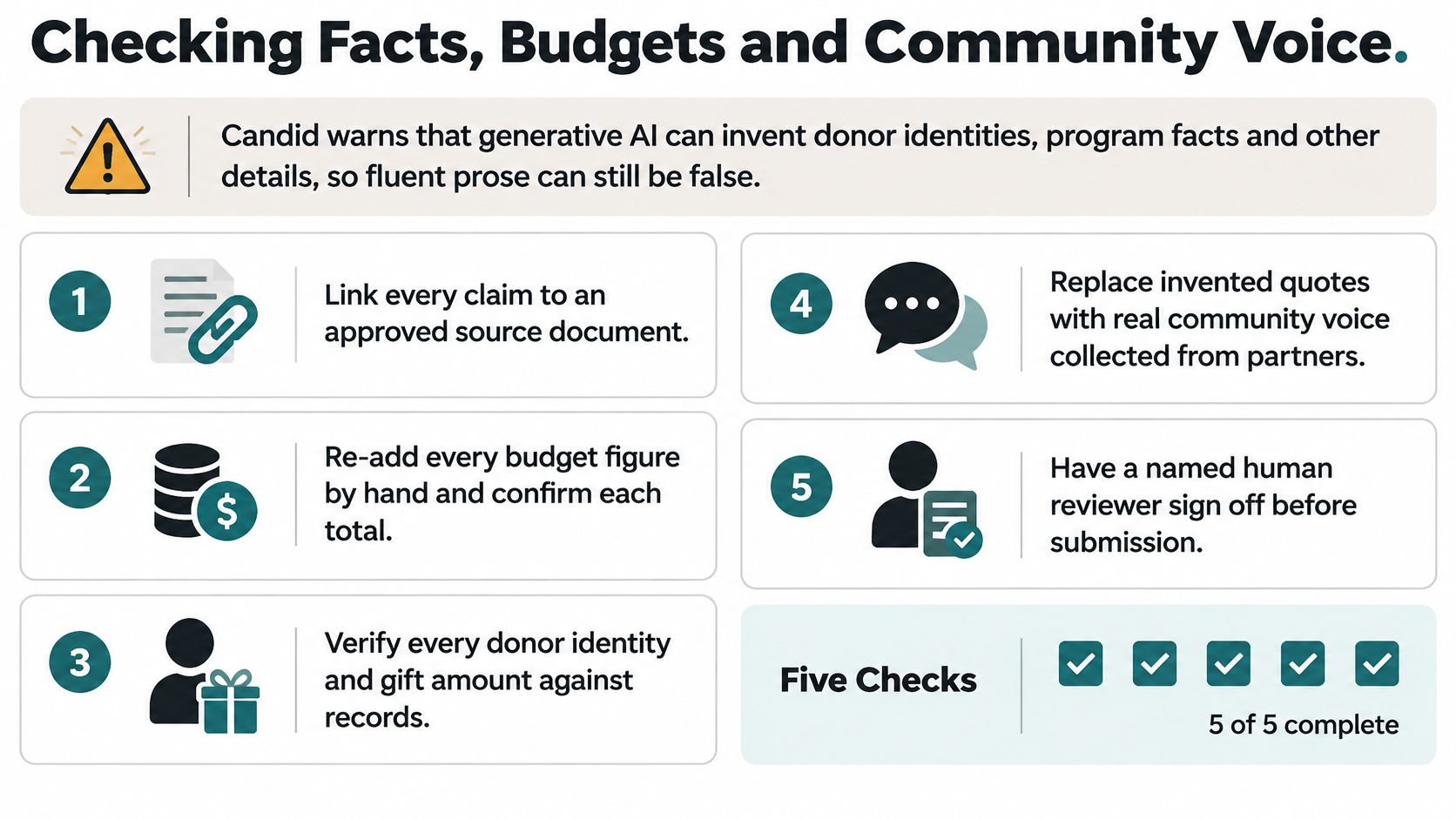
Candid warns that generative AI can invent donor identities, program facts, and other details. Fluent prose can still be false, and a believable invention can survive a casual read because it sounds consistent with the surrounding proposal.
Judge the draft by factual accuracy, funder fit, specificity, and community voice, not smoothness. The reviewer's job is to test the substance, not just improve the sentences.
Use this visual checklist at the review desk:
Apply checks that leave an evidence trail
- Link claims to approved sources. Use board-approved plans, program records, signed partner documents, and authoritative external publications. A generated citation isn't evidence until someone opens it.
- Keep a fact ledger. For budget lines and outcomes, record the value, definition, period, source, owner, and approved wording. Distinguish people served from attendances and projected outcomes from completed results.
- Flag unsupported statistics. Remove a statistic if the team can't locate a source that supports its exact scope. Don't replace an unavailable local measure with a national figure without explaining the distinction.
- Ask program staff to verify delivery. The program manager should confirm activities, partners, staffing, and results. Development staff shouldn't approve operational promises alone.
- Ask community reviewers to assess representation. Where appropriate and with consent, invite people represented in the narrative to review stories and equity claims. Give them a genuine opportunity to change or decline the wording.
Keep culturally sensitive narratives, lived-experience testimony, safeguarding details, and equity claims under human authorship. Limit AI assistance on those passages to permitted grammar edits on appropriately de-identified text.
For a quick diagnostic, run a ten-minute spot check: trace three numbers and two named partners to their sources. Fix or remove any miss, then expand the review if the sample exposes weak sourcing. Confirm eligibility on the funder's own page rather than accepting the shortlist summary.
At Grantlas, we compile grant and funder information from public sources and third-party data, and we give no warranty that it's complete, current, or accurate. Discovery information needs application-level confirmation.
Test the workflow against realistic failures
These are hypothetical cases, not performance claims:
| Task | AI contribution | Failure | Catching check |
|---|---|---|---|
| A food pantry shortlists fifteen funders | Compresses a planned week of research into a day | Roughly half the prospects are invitation-only | The grant writer checks current application pages and removes them from the active list |
| A youth-arts team drafts a program description | Organizes activities into a readable narrative | Invents a partner and participation figure | The program manager compares the text with interview notes and rewrites it |
| A development associate prepares a budget justification | Explains approved expense lines | States an indirect amount inconsistent with the rate agreement | Finance recalculates the amount and corrects both documents |
Track drafting time and verification time separately. Productivity counts only when the verification effort stays below the time saved, without lowering the approval standard.
Start a Small, Documented AI Pilot This Quarter
Choose an upcoming proposal and limit the first pilot to funder research and outlining, where mistakes are cheapest to catch. Assign every stage a risk level and a named owner before drafting starts: a grant writer owns the shortlist, a development lead approves the outline, and the person who submits owns the final review. Prepare the disclosure statement and fact ledger up front.
Measure the work in a simple pilot record:
- Owner sign-offs. Note who approved each stage and what they checked, so every approval reflects a named person's judgement.
- Errors caught by staff. Record the type and severity, not just the total, so a fabricated partner isn't treated like a punctuation fix.
- Funder questions raised. Log ambiguities about eligibility, AI permission, and submission requirements, including how staff resolved them.
Grantlas helps small US nonprofits shortlist foundations and federal, state, and local grants from an organization profile, with a fit score, a plain-English reason, and red flags such as invitation-only funders shown before you write, while staff decide whom to approach and what to write.
Grantlas does not apply for grants on a customer's behalf and does not guarantee any funding outcome. Review the pilot after the application cycle and expand only the tasks that met your accuracy and review standards.
Keep AI on research and outlines until the checks hold. Then add drafting for low-risk sections, with a named reviewer and the same documented approval process.
Visit Grantlas to build an organization profile and evaluate prospective funders with fit explanations and eligibility red flags. Use that shortlist for a documented AI grant-writing pilot, then have your grant writer verify the opportunities before committing proposal time.