10 AI Tools for Nonprofits to Work Smarter
Oct 8, 2026 · 16 min read

Most nonprofits don't need another general-purpose AI assistant. They need a tool that improves a specific workflow, with enough trustworthy data and staff capacity to make the output useful.
The practical jobs are distinct: finding funders, preparing fundraising work, prioritizing donors, and extending an existing CRM. A grant-discovery platform may be valuable to a grant writer but irrelevant to a major-gifts team. A donor-scoring model may help a mature development department while creating noise for an organization with incomplete giving records. The right choice depends on current systems, data quality, team capacity, budget, and governance.
This comparison focuses on use case, implementation effort, AI maturity, limitations, pricing transparency, and repeatability. That last criterion matters most. Google for Nonprofits found that 37% of surveyed organizations had developed concrete generative-AI ideas, while only 22% said at least half of their organization used generative-AI tools in its 2025 survey. Interest is spreading faster than coordinated deployment.
The list begins with Grantlas because organizations that need eligibility-aware prospecting across private foundations and federal opportunities should solve funder research before adding more drafting or donor automation. Teams can also use the Prometheus Agency's AI playbook to think through workflow design before buying software.
Table of Contents
- 1. Grantlas
- 2. Instrumentl
- 3. Candid Search
- 4. Dataro
- 5. Gravyty
- 6. Keela
- 7. Bloomerang Penny AI Assistant
- 8. Blackbaud Raiser's Edge NXT
- 9. Givebutter Magic
- 10. Salesforce Nonprofit Cloud and Einstein Copilot
- Top 10 AI Tools for Nonprofits, Feature Comparison
- Build a Small, Governed AI Stack
1. Grantlas
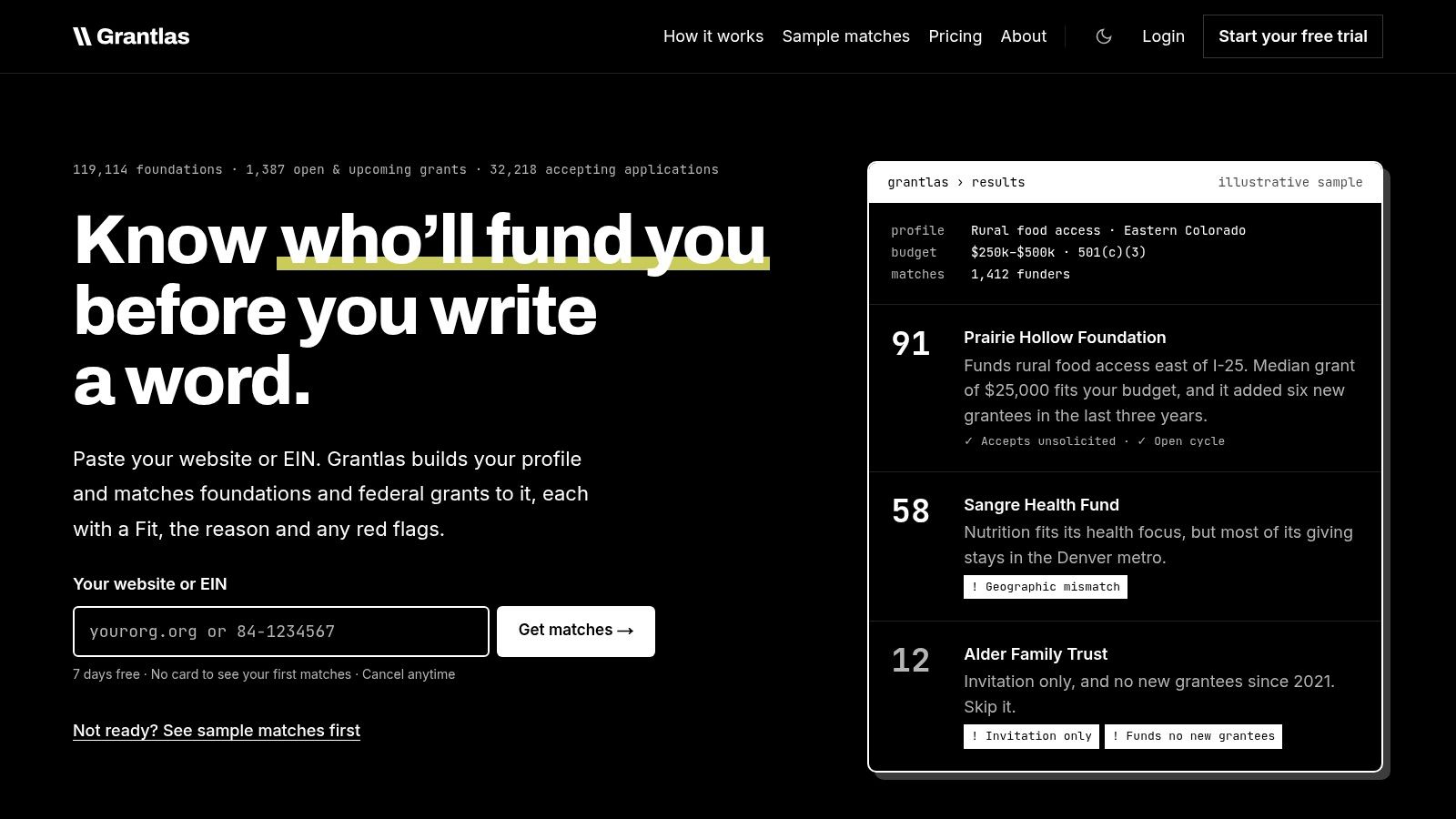
Grantlas is built for the first fundraising question, which funders are realistic prospects for this organization? U.S.-based nonprofits and grant consultants can create a profile from a website URL or EIN, then receive a scored shortlist of private foundations and open federal opportunities. The platform draws on IRS 990-PF filings and Grants.gov, and each result pairs a Fit score with plain-English reasoning and warnings for issues such as invitation-only funding, geography, grant size, budget, or applicant eligibility.
That design addresses a costly research failure. A long list of funders isn't useful if staff still have to read every filing to discover that the organization isn't eligible. Grantlas instead makes the mismatch visible early, while giving history helps users judge typical grant size, funding cadence, and openness to new grantees.
Why the workflow matters
Grantlas combines discovery with practical pipeline work. Users can run unlimited searches, search in natural language, examine peer organizations, review board and trustee listings, save searches, receive weekly digests, export deadlines to a calendar, and set reminders. A monthly full-database rescan re-scores saved profiles as new information arrives, while opportunities are scanned nightly.
The database covers private foundations and federal opportunities across all 50 states and DC. That breadth is useful, but it isn't universal. State and local programs, corporate giving programs, and funders that don't file 990-PF may sit outside the platform's core coverage.
Practical rule: Treat a Fit score as a prioritization aid, not a funding prediction. Verify the original opportunity, current eligibility, filing year, and application instructions before assigning proposal work.
Grantlas is a strong fit for small and midsize nonprofits, freelance grant writers, and boutique consulting teams that need low-friction research. The Solo plan is $99 per month or $999 per year, with one user and one organization. Pro costs $199 per month or $1,999 per year, supporting up to three users and up to ten organizations. Users can build a profile and see initial matches during a seven-day free trial without entering a card, and no sales call is required. Teams should still account for user and organization limits, plus the fact that some connected AI integrations may require separate third-party plans.
2. Instrumentl
Instrumentl sits between grant discovery and fundraising execution. It combines intelligent matching, prospect tracking, collaboration, and AI-assisted proposal drafting through Apply and Apply Advisor. That makes it more appropriate than a standalone search database for teams that want to move directly from identifying an opportunity to organizing a submission.
The main advantage is workflow continuity. Staff can keep prospect notes, deadlines, assignments, and proposal activity in one environment instead of exporting a promising grant into a separate project system. AI drafting can also reduce the blank-page problem, but it doesn't remove the need to supply accurate organizational facts, program details, outcomes, and funder-specific language.
Implementation and buying limits
Instrumentl's AI features are plan-dependent, so buyers should confirm which subscription includes drafting and pre-award functionality. Pricing specifics may require a sales conversation or vary by plan, which makes total-cost comparison harder for small organizations working within fixed budgets.
A team should also distinguish between draft acceleration and prospect quality. A faster proposal draft isn't valuable if the underlying match is weak, the opportunity is closed, or the application requirements don't fit the nonprofit's capacity. Instrumentl is therefore strongest where a team already has a disciplined review process and wants discovery, collaboration, and drafting in one grant workflow.
For a broader comparison of discovery platforms, see this guide to a grant search tool. Instrumentl's implementation effort is moderate. It requires users to maintain prospect records and learn the platform's workflow, but it doesn't demand the CRM transformation associated with enterprise systems.
3. Candid Search
Candid Search is the natural choice for organizations that previously relied on Foundation Directory Online and want a successor that combines nonprofit, grantmaker, and grants data. Its AI features generate funder recommendations, surface patterns, and help draft letters of inquiry within a fundraising workspace.
The platform's value comes from data depth rather than low-friction experimentation. Teams researching institutional philanthropy can search connected nonprofit and grantmaker information, then use AI to accelerate interpretation and early outreach. That makes it particularly useful for development departments with experienced researchers who can challenge weak recommendations and validate the original records.
A stronger research layer, with more commitment
Candid Search is more than just a writing assistant. It supports a research-heavy workflow in which staff compare funder priorities, giving patterns, nonprofit profiles, and potential relationships. The AI layer can shorten the route from data to a working hypothesis, but it shouldn't replace review of funder materials or direct confirmation of current priorities.
The transition from Foundation Directory Online may require adjustment for existing users, especially where familiar workflows or interface expectations have changed. Cost also deserves scrutiny for smaller organizations. Candid's official site lists Premium plans starting at $1,199 per year, so buyers should compare the value of deeper research data against the organization's prospecting volume and staff expertise.
This is a better fit for a research-led development function than for a small team seeking immediate eligibility flags and a short actionable list. Organizations comparing database options can also review this analysis of the best grant database for nonprofits. The key buying question is whether the team needs broad institutional data or a faster route to qualified prospects.
4. Dataro
Dataro addresses a different fundraising problem, which existing donors should receive attention next? Its predictive models score donor propensity and support next-best-action decisions for appeals, upgrades, reactivation, and related campaigns. Integrations with Raiser's Edge NXT, Salesforce Nonprofit Cloud or NPSP, and HubSpot connect the analysis to systems where fundraisers already manage relationships.
That makes Dataro a campaign-prioritization tool, not a grant-discovery platform. It needs historical donor records, usable segmentation, campaign activity, and enough volume for patterns to be meaningful. If a nonprofit's CRM contains inconsistent dates, duplicate contacts, sparse gift history, or poorly recorded interactions, the model may rank donors with a false sense of precision.
Testing the model against real decisions
Dataro's strongest use case is a repeatable outbound process. A development team can use scores to select appeal audiences, compare targeted outreach with its current selection method, and review whether recommended actions make sense to fundraisers. The organization should measure quality after human review, not just the number of names produced.
Pricing varies with database size and features, so the product is easier to justify when the organization already runs campaigns at scale and can connect recommendations to a clear fundraising process. Smaller nonprofits may get more value from improving CRM hygiene first. Dataro's AI maturity is relatively high for donor prioritization, but its results remain dependent on the records supplied to it.
5. Gravyty
Gravyty focuses on front-line fundraiser productivity, especially donor and alumni engagement. It helps teams identify and prioritize outreach, personalize communications, manage portfolios and pipelines, and use engagement analytics to guide relationship work. The platform is particularly aligned with higher education and organizations that have multiple fundraisers managing active portfolios.
Unlike a grant database, Gravyty doesn't solve the question of who funds a program. It helps a fundraiser decide which known supporter deserves attention and what action should happen next. That distinction matters because the implementation burden is tied to portfolio design, relationship history, contact records, and management expectations.
Best for coordinated fundraising teams
Gravyty's enterprise orientation can be an advantage for organizations with established front-line teams, but it can be excessive for a small nonprofit where one development director manages every relationship. Pricing typically requires a demo or quote, which limits pricing transparency and makes a structured procurement process important.
Before adopting it, leadership should define the human workflow around the recommendations. Who reviews suggested priorities? Who records the outcome of a call? How does a manager distinguish a useful prompt from an inappropriate or poorly timed outreach suggestion? Without those answers, AI can increase the number of tasks without improving donor relationships.
Gravyty is most suitable when portfolio management is already a shared discipline. Its AI can extend that discipline, but it won't create clean relationship practices from incomplete data.
6. Keela
Keela embeds fundraising intelligence inside a nonprofit CRM, making it a practical option for small and midsize organizations that want fewer disconnected tools. Its Smart Ask feature suggests personalized ask amounts using donor information and wealth indicators, while email, forms, campaigns, and donation processing remain part of the same nonprofit-oriented environment.
The advantage is context. A recommendation that appears inside the CRM can be easier for staff to use than a separate model that requires exports, interpretation, and manual updates. Keela also supports payment processing through Stripe and PayPal, with nonprofit rates available through those payment providers.
Embedded assistance versus long-term cost
Keela's implementation effort is lower than an enterprise CRM deployment because the product is designed around nonprofit fundraising workflows. Staff still need to maintain contact records, record interactions, and review suggested asks before sending them. Wealth indicators should inform judgment, not determine a donor's value or dictate an inappropriate request.
Pricing is contact-based, so the subscription can scale with the size of the organization's list. Buyers should model the cost of growth, inactive contacts, data cleanup, payment processing, and any features that become necessary as fundraising becomes more complex.
Keela is a good fit when the nonprofit wants an all-in-one operating base with AI nudges, rather than a separate predictive layer on top of an established CRM. It is less compelling for an organization that already has a mature system and needs advanced cross-platform modeling.
7. Bloomerang Penny AI Assistant
Bloomerang's Penny brings chat-based assistance into a donor management and giving platform. It can help users interpret CRM data, identify priorities, develop action plans, and generate fundraising content. Optional Intelligent Giving modules, including PredictAI and ProspectAI, add deeper donor intelligence for organizations that need more than basic CRM assistance.
The product's center of gravity is retention and stewardship. A small development team may use Penny to turn CRM records into a working list of follow-ups or to draft an email that staff then edit for accuracy, warmth, and voice. That is different from a model designed to optimize large campaign audiences or identify new foundation prospects.
Governance inside the CRM
Bloomerang positions Penny around ethical AI and privacy, including opt-out options. That matters because CRM-based assistants can expose sensitive donor context to staff who may not understand how recommendations were generated. Penny is in beta, so teams should test its consistency and usefulness with their own records rather than assuming every prompt will produce a reliable action plan.
Platform changes and pricing can also affect the buying decision. Organizations should evaluate the core CRM, AI modules, contact limits, migration requirements, permissions, and support together. A low-friction assistant isn't a substitute for a clear data policy.
For a broader look at systems in this category, see this guide to nonprofit fundraising software. Bloomerang fits teams that want AI close to everyday donor management, especially where staff need practical prompts more than advanced custom modeling.
8. Blackbaud Raiser's Edge NXT
Blackbaud's AI capabilities are designed for organizations already operating in Raiser's Edge NXT. Prospect Insights and Prospect Insights Pro support modeling, segmentation, and outcome analysis for major giving, while tools such as Cultivation Assistant and Chat for Blackbaud AI connect assistance to Raiser's Edge NXT data.
This is CRM augmentation for major-gift teams, not an entry-level fundraising tool. Its value grows when the organization has established prospect portfolios, cultivation stages, interaction records, and leadership support for relationship management. Native integration reduces the friction of moving data between systems, but it also ties the organization more closely to Blackbaud's data model and product roadmap.
Enterprise capability carries enterprise overhead
Prospect Insights and Pro are paid add-ons, and pricing isn't publicly listed. Implementation may require enablement, configuration, and staff training, so the subscription price is only one part of the investment. A buyer should ask how recommendations are explained, what data feeds each model, how permissions work, and how staff can correct inaccurate assumptions.
The platform is strongest for organizations that already use Raiser's Edge NXT and want deeper major-gift intelligence without replacing their core system. It is a poor starting point for a small nonprofit that has not yet established reliable donor records or a consistent cultivation process.
Blackbaud's ongoing Intelligence for Good roadmap may make the ecosystem more capable over time, but buyers should assess currently available features rather than purchase based on future promises.
9. Givebutter Magic
Givebutter Magic adds AI to a fundraising platform built around forms, events, campaigns, and peer-to-peer activity. It can analyze campaign performance, surface supporter trends, and assist with fundraising content. Because the features sit inside the platform, a small team can adopt them without selecting a separate analytics or donor-intelligence system.
Givebutter's main strength is low-friction execution. A nonprofit already using its forms or event tools can ask questions about campaign activity and generate content within the same environment. The platform's core fundraising suite is free, with an optional Plus tier, which can make experimentation easier for organizations with limited technical resources.
Useful for campaign operators, lighter as a CRM
The analytics become more useful when Givebutter is the organization's primary campaign platform. If donor information is split across another CRM, spreadsheets, event tools, and email systems, Magic may see only part of the relationship. That limits the quality of any supporter trend or prioritization insight.
Givebutter is better viewed as a fundraising execution layer with CRM-lite capabilities than as a replacement for a dedicated donor management system. It fits volunteer-led organizations, small teams, and nonprofits running event or peer-to-peer campaigns. Teams with complex relationship histories, major-gift portfolios, or cross-program reporting may eventually need a more specialized CRM.
The buying decision should focus on whether convenience outweighs data fragmentation. For organizations already inside Givebutter, the answer may be yes. For organizations choosing a new system, compare its data model and reporting depth with the complexity of the fundraising operation.
10. Salesforce Nonprofit Cloud and Einstein Copilot
Salesforce Nonprofit Cloud with Einstein and Copilot capabilities is the most extensible option on this list. It can bring generative assistance into fundraising operations, including drafting gift proposals from CRM data, while the broader Salesforce ecosystem connects fundraising with programs, marketing, reporting, and integrations.
The platform is designed for organizations that want to build a configurable operating environment rather than adopt a narrowly defined fundraising workflow. That flexibility can support complex permissions, custom objects, cross-team reporting, and organization-specific processes. It also means the nonprofit must make more decisions about architecture, governance, implementation, and ongoing administration.
Choose it for a system strategy
Salesforce offers nonprofit access through the Power of Us program, including donated or discounted licenses subject to eligibility and program terms. AI capabilities may require separate Einstein or Copilot add-ons, so donated licenses don't make the complete solution free. Buyers should request a full cost and implementation view that includes consultants, integrations, data migration, training, support, and administration.
Salesforce's strongest fit is an organization that already standardizes on Salesforce or has a clear reason to unify fundraising, programs, and marketing. A small nonprofit seeking quick grant matches or simple donor follow-up may find the platform's complexity disproportionate.
AI also increases the importance of permission design. Teams should determine what donor and program data Copilot can access, which outputs require review, and how staff will distinguish source facts from generated language before a proposal or donor communication leaves the organization.
Top 10 AI Tools for Nonprofits, Feature Comparison
| Product | Core coverage & focus | Key features & UX | Target audience & value | Price / Trial | Standout / USP |
|---|---|---|---|---|---|
| Grantlas | Nationwide private foundations (990‑PF) + open federal grants | Profile from URL/EIN, Fit score + 2‑sentence reasoning & flags, unlimited searches, natural‑language AI, monthly rescans, giving history, board lists | Small–mid nonprofits, in‑house & freelance grant writers, boutique consultants, fast, eligibility‑aware prospecting | Solo $99/mo or $999/yr; Pro $199/mo or $1,999/yr; 7‑day free trial (no card) | Affordable, combined private+federal index, readable Fit reasoning, unlimited searches, monthly re‑scoring |
| Instrumentl | Unified prospecting + pre‑award management | Intelligent matching, collaboration & tracking, AI‑assisted proposal drafting (Apply/Advisor) | Teams that want discovery plus generative drafting and workflow management | Pricing varies; may require contacting sales | Integrated AI drafting + pre‑award workflow |
| Candid Search (FDO successor) | Deep foundation & nonprofit data (GuideStar/FDO) | AI funder recommendations, LOI drafting, fundraising workspace | Organizations that relied on FDO and need rich grants data and AI suggestions | Candid Premium from ~ $1,199/yr (per published plans) | Legacy FDO data depth combined with AI‑driven recommendations |
| Dataro | Donor scoring & campaign optimization | Donor propensity scoring, next‑best‑action, CRM integrations, analytics | Mid‑large orgs with donor volume seeking testable lift in appeals & reactivation | Pricing tiered by database size/features | Proven, measurable uplift for targeted campaigns via CRM integrations |
| Gravyty | Donor & alumni engagement at scale | AI outreach prioritization, personalized communications, portfolio/productivity tools | Higher‑ed and large fundraising teams focused on frontline fundraisers | Enterprise pricing; demo/quote required | Scales fundraiser workflows; strong benchmarking & institutional use |
| Keela | All‑in‑one nonprofit CRM + fundraising intelligence | Smart Ask (suggested amounts), campaign automation, payments integrations | Small–mid teams wanting CRM with built‑in AI nudges and payment processing | Contact‑based pricing; scales with list size | CRM built specifically for nonprofits with integrated donor tools |
| Bloomerang (Penny) | Donor management + in‑app AI assistant | Penny chat assistant, AI content generator, optional PredictAI/ProspectAI add‑ons | Small–mid orgs focused on retention, stewardship, and CRM‑centric AI | Transparent module pricing; Penny in beta | Ethical AI positioning, CRM‑centric insights, modular add‑ons |
| Blackbaud Raiser's Edge NXT | Major‑donor modeling & cultivation (native CRM) | Prospect Insights/Pro, cultivation assistants, embedded AI tied to RE NXT | Organizations standardized on Raiser's Edge for major‑gift workflows | Add‑ons paid; pricing by quote | Deep native integration with RE NXT and major‑gift workflows |
| Givebutter Magic | Fundraising forms/events + AI insights | Campaign analysis, donor trend detection, content generation, CRM‑lite | Small teams using Givebutter for forms, events, P2P who want low‑friction AI | Core platform free; Plus tier optional | Low barrier to AI features inside a free core fundraising suite |
| Salesforce Nonprofit Cloud + Einstein (Copilot) | Extensible CRM + enterprise AI across fundraising & programs | Copilot Actions for proposals, broad integrations, platform customization, Power of Us discounts | Organizations standardized on Salesforce seeking extensible AI across ops | Einstein/Copilot add‑ons extra; licensing and implementation costs vary | Highly customizable platform ecosystem with Copilot for CRM‑driven AI |
Build a Small, Governed AI Stack
There isn't a universal winner among AI tools for nonprofits because the tools solve different operational problems. Grantlas and Instrumentl focus on grant discovery and pre-award work. Candid Search emphasizes deep funder and nonprofit research. Dataro and Gravyty prioritize known donors and fundraiser action. Keela, Bloomerang, Givebutter, Blackbaud, and Salesforce embed assistance into broader fundraising systems, with very different levels of implementation effort.
Start with one workflow that has a clear owner and a visible decision point. For example, a grant team might measure whether a prospecting tool produces more verified matches, fewer wasted reviews, or a better-organized deadline pipeline. A donor team might test whether scoring improves audience selection after human review, rather than measuring success by the number of recommendations generated.
The data audit comes first. Ask what records the tool needs, whether those records are complete, how often they change, and whether staff can inspect the source behind a recommendation. For grant eligibility, reviewers should confirm geography, applicant type, budget fit, current deadlines, invitation status, and the original funder instructions. For donor communications, staff should review names, history, preferences, relationship context, and the tone of every generated message.
The nonprofit sector's adoption gap makes this discipline essential. The 2026 research summarized by The Chronicle of Philanthropy found that marketing and communications was the most common nonprofit AI use, cited by 70% of respondents, while only about 4% reported full operational integration in the survey of more than 900 nonprofit executives and staff. The same research reported that fewer than 40% had written safe-use policies and nearly 60% lacked a one- to two-year AI roadmap. Adoption without governance creates more review work, not less.
A useful evaluation should cover a 30-, 60-, and 90-day period. Track verified-match precision, false positives, false negatives, time saved after quality review, representation of marginalized communities, new-funder conversion, and staff trust. The Center for Effective Philanthropy found that 73% of nonprofit leaders identified misinformation or inaccurate results as a leading AI concern, while 58% cited insufficient staff expertise or capacity in its 2025 research. Those concerns should shape the test design, not appear as an afterthought.
Compare total implementation effort, not only subscription price. Include CRM integration, staff training, data permissions, add-ons, migration, support, and ongoing oversight. Organizations can also use established guidance on enterprise social operations AI controls when they need a more formal governance approach.
The likely choice depends on the starting point:
- Funder research: Choose Grantlas or another prospecting platform when the priority is identifying realistic foundation and federal opportunities.
- Proposal workflow: Choose Instrumentl when discovery, collaboration, tracking, and AI-assisted drafting need to sit together.
- Institutional research: Choose Candid Search when deep funder and nonprofit data matters more than the lightest onboarding.
- Campaign prioritization: Choose Dataro when the organization has usable donor history and wants to test targeted appeals, upgrades, or reactivation.
- Embedded CRM assistance: Choose Keela, Bloomerang, or Givebutter when staff want AI inside everyday fundraising operations.
- Established enterprise systems: Choose Blackbaud for Raiser's Edge NXT major-gift workflows or Salesforce for extensibility across fundraising, programs, and marketing.
The strongest AI stack is usually small at first. Pick the workflow, inspect the data, define human review, measure the result against the current process, and expand only when the evidence supports it.
Grantlas helps U.S. nonprofits and grant consultants discover private foundations and open federal opportunities, then prioritize them with Fit scores, plain-English reasoning, and eligibility warnings. Visit Grantlas to build your organization profile, review initial matches during the free trial, and turn funder research into a repeatable pipeline.