What Is a Community Foundation? a Plain-English Guide
Nov 12, 2026 · 11 min read

A community foundation is a place-based public charity that pools charitable gifts and grants them toward local needs across several causes.
If a foundation has a strong local reputation and substantial assets, why might your nonprofit still have no grant to apply for? Because the foundation's total resources and the money available through an open application process aren't the same thing.
For nonprofit staff asking what is a community foundation, the useful answer goes beyond a definition. You need to understand which fund holds the money, who decides where it goes, and whether your organization has a route to request it.
Table of Contents
- What a Community Foundation Is in Plain Terms
- Community Foundations Compared With Private Foundations
- How Governance and Funding Work Together
- Fund Types and Who Decides Where Money Goes
- San Francisco and Three Situations
- Limits and Misconceptions Before You Apply
- Check Eligibility and Make Your First Approach
What a Community Foundation Is in Plain Terms
Think of a community foundation as a shared charitable home for a place. Residents, businesses, and other donors contribute gifts, while the foundation manages charitable funds and supports needs such as education, housing, health, and the arts.
It's more like a building containing different rooms than a single pot of money. The foundation oversees the building, but each room can have its own purpose and rules.
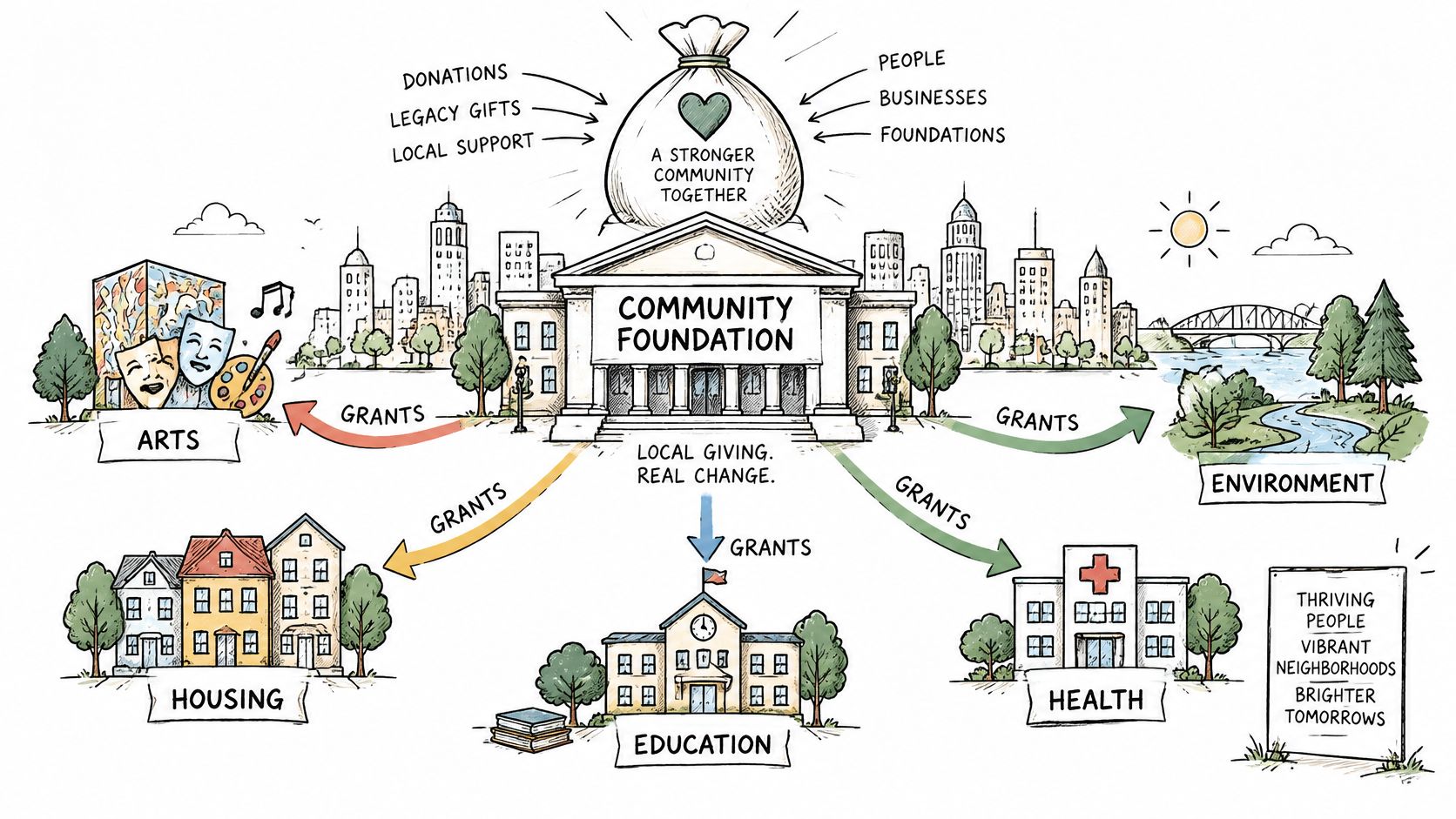
The modern movement began with the Cleveland Foundation, established in 1914, and the Community Foundation Atlas identified more than 1,800 community foundations worldwide, with almost three-quarters created during the preceding 25 years.
The model also has substantial reach in the United States: the Council on Foundations describes more than 900 community foundations operating across all 50 states, serving urban and rural communities.
What makes the model distinctive
- Local accountability: The foundation is rooted in a defined community rather than organized solely around a single cause.
- Flexible grantmaking: It can address changing priorities through funds that allow the foundation to choose recipients.
- Several charitable vehicles: It can house donor-advised funds, endowments, and other funds under one institution. An endowment is invested charitable money intended to support giving over time.
These features describe a model, not a standardized national program. Foundations differ in their service areas, staffing, resources, and relationships with local nonprofits.
A community foundation can also connect organizations, share local knowledge, and bring residents and donors together around a problem. Those roles help explain its local reputation, but they don't establish grant eligibility. It's a real grantmaker, not a promise that every local organization can access every fund.
Community Foundations Compared With Private Foundations
The main distinction is where the charitable resources come from and how the institution is organized.
Community foundation versus private foundation at a glance
| Feature | Community foundation | Private foundation |
|---|---|---|
| Source of money | Many donors, public giving, and bequests | Usually one family, company, or individual |
| Geographic focus | A defined local area or region, with some giving beyond it | Geography chosen by the founder or governing board |
| Public charity status | Generally organized as a publicly supported charity | Organized under private foundation rules |
| Deduction limit for cash gifts | Determined by applicable public-charity tax rules and the donor's circumstances | Determined by applicable private-foundation tax rules and the donor's circumstances |
| Annual payout | Read the foundation's spending policy and fund restrictions | Read applicable private-foundation distribution rules |
| Donor-advised funds | Commonly hosted | Generally not a donor-service offering |
| Open applications | Check the specific fund for open rounds, deadlines, or invitations | Check guidelines for unsolicited requests or invitation-only giving |
For a grant writer, the tax distinction is background rather than the first screening tool. Donors considering a gift need advice about their own deductions; applicants need to identify an accessible funding program.
The label also doesn't tell you everything about a foundation's priorities. A community foundation may address many issues through separate funds, while a private foundation may concentrate its giving around interests selected by its founder.
What the differences mean for applicants
- Look for an actual application route. A community foundation may publish competitive grant rounds while administering other funds that don't accept proposals. A private foundation may welcome requests or work only with selected organizations.
- Read the priorities, not just the name. A broad community mission doesn't make every project a fit. A founder's narrow interest can sometimes make a private foundation the more relevant prospect.
- Keep both models in your search. Youth development, environmental work, and arts programming can fit either model. Institutional type alone shouldn't determine your shortlist.
Say your nonprofit provides after-school music instruction. A community foundation's education program might exclude arts activities, while a private foundation explicitly supports music access. The smaller or less familiar institution could be the stronger prospect.
Start with access: Who supplies the charitable resources, and how does this particular funding program accept requests?
How Governance and Funding Work Together
Governance means who has authority and what rules they must follow. For community foundations, it explains why a donor, a program officer, and a governing board can each influence a grant without having interchangeable roles.
Under the IRS framework for community trusts, many community foundations qualify as publicly supported charities under IRC sections 509(a)(1) and 170(b)(1)(A)(vi), while some qualify as supporting organizations under section 509(a)(3). For single-entity treatment, the guidance describes a common governing instrument, a common governing body or distribution committee, and authority over distributions, alongside public-support requirements.
A governing instrument is the set of documents establishing the organization's rules. A distribution committee is a body authorized to oversee charitable distributions. These aren't just administrative details: they help establish who is responsible for the money.
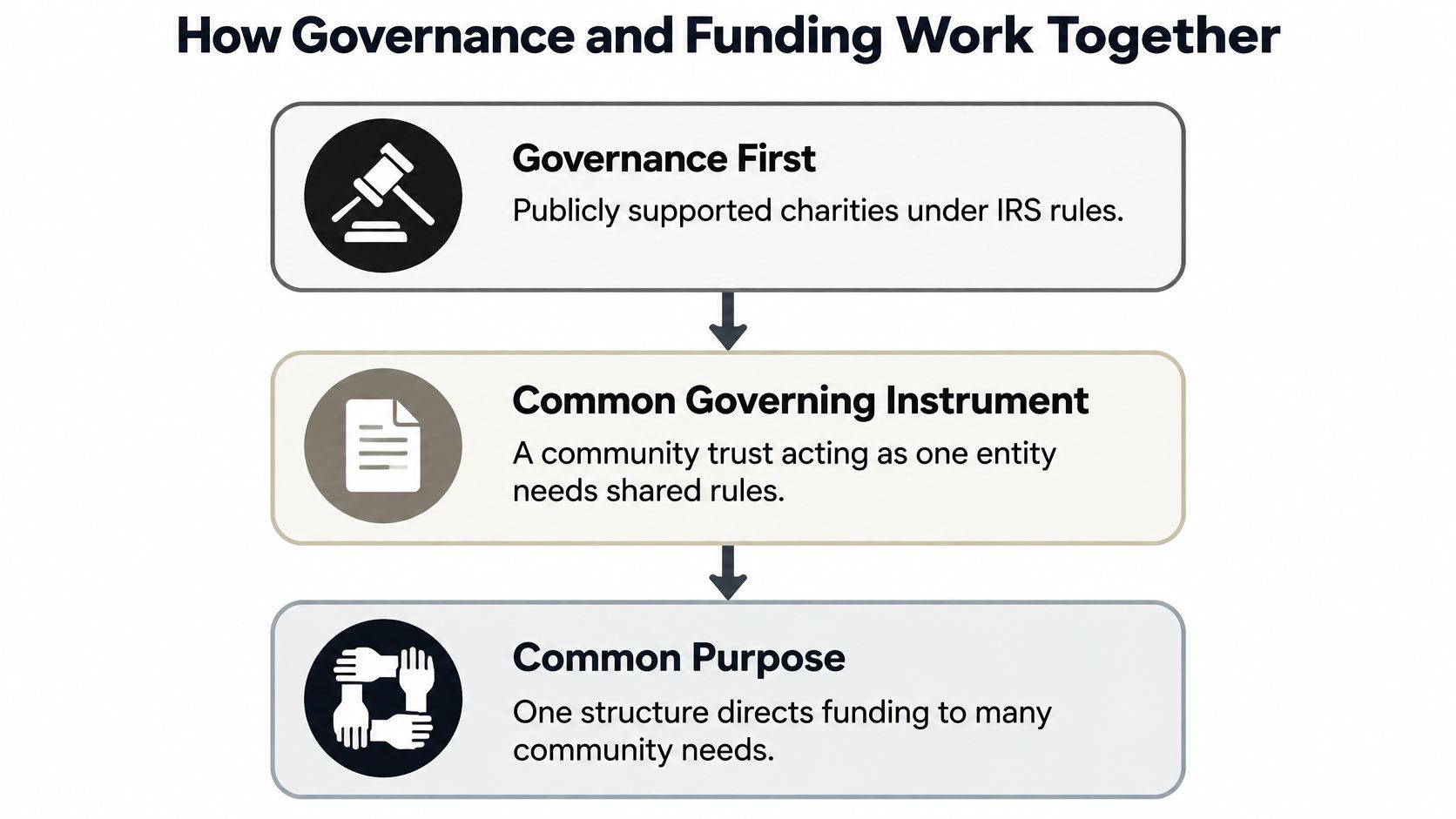
How a gift becomes a grant
The precise route changes with the fund, but a typical endowed community fund works like this:
- A donor contributes an asset. This might be cash, securities, or a bequest, meaning a gift left through an estate.
- The foundation assigns the gift to a fund. The fund's terms establish its charitable purpose and any restrictions. Some gifts support immediate grantmaking; others become long-term invested assets.
- Authorized decision-makers select priorities and recipients. For discretionary community funding, the board or distribution committee makes decisions, often with staff recommendations.
- The foundation awards grants. Staff confirm eligibility and process awards under the relevant rules.
- Investment results and spending policies shape future distributions. An endowment supports an ongoing cycle, rather than necessarily being spent when the original gift arrives.
The board's authority doesn't mean it can disregard every donor restriction. It means the foundation must make decisions within its legal responsibilities and the terms governing the fund.
For applicants, this separates influence from decision authority. A donor might care about your neighborhood, but that interest alone doesn't create an application program or authorize a grant.
Before approaching staff, identify the published priorities and the body or process responsible for selecting recipients. You'll then be able to ask a focused question about your fit, rather than assuming a friendly connection is permission to submit a proposal.
Fund Types and Who Decides Where Money Goes
Community foundation fund types and who decides
| Fund type | Who recommends grants | Who makes the final decision | What a nonprofit can expect |
|---|---|---|---|
| Unrestricted community fund | Foundation staff and board | Foundation board or authorized committee | Potential open rounds addressing community priorities; check deadlines |
| Donor-advised fund | Donor or named advisers | Foundation, legally | Usually no direct open application to the fund |
| Designated fund | Donor identifies beneficiary charities | Foundation administers distributions and confirms eligibility | Support directed to the named charities |
| Field-of-interest fund | Staff or board within the stated field | Foundation board or authorized committee | Opportunities limited to a purpose, such as youth arts |
| Scholarship fund | Criteria guide recommendations by reviewers | Authorized selection committee or foundation | Usually awards to individuals rather than organizations |
A donor-advised contribution is irrevocable and generally eligible for an immediate tax deduction, according to the National Center for Family Philanthropy's donor-advised fund guide. The donor can recommend grants, but the foundation retains legal authority over distributions.
That distinction matters because a donor-advised fund isn't a personal account from which the donor can pay any request. Nor should an applicant assume that the foundation's general application portal reaches every donor-advised fund it administers.
Read the purpose and the route separately
A field-of-interest fund establishes what the money should support without necessarily naming a recipient. A youth arts fund, for example, might support several eligible organizations working within that purpose.
A designated fund starts with the beneficiary already identified. Your nonprofit's work could closely resemble the beneficiary's work and still have no application route to that fund.
An unrestricted community fund gives the foundation more room to respond to local needs. However, unrestricted describes the foundation's discretion; it doesn't guarantee unrestricted operating grants to applicants.
Scholarship funds create another common misunderstanding. A nonprofit running an education program shouldn't assume it qualifies because the foundation awards scholarships. The intended applicants may be students.
Before drafting: Ask which fund would support the request and obtain that fund's current eligibility and application instructions.
Treat the table as a way to classify opportunities, not as a substitute for local guidelines. A foundation may combine funds in a grant round or administer a special initiative with its own selection process. The practical question is whether your organization can enter that process.
San Francisco and Three Situations
In fiscal year 2025, San Francisco Foundation distributed $216 million in total grants, including $49.5 million in programmatic grants to 424 community organizations, according to its annual report.
The distinction between total and programmatic giving matters when interpreting a foundation's reach. The illustration below highlights the community needs that grantmaking can address.
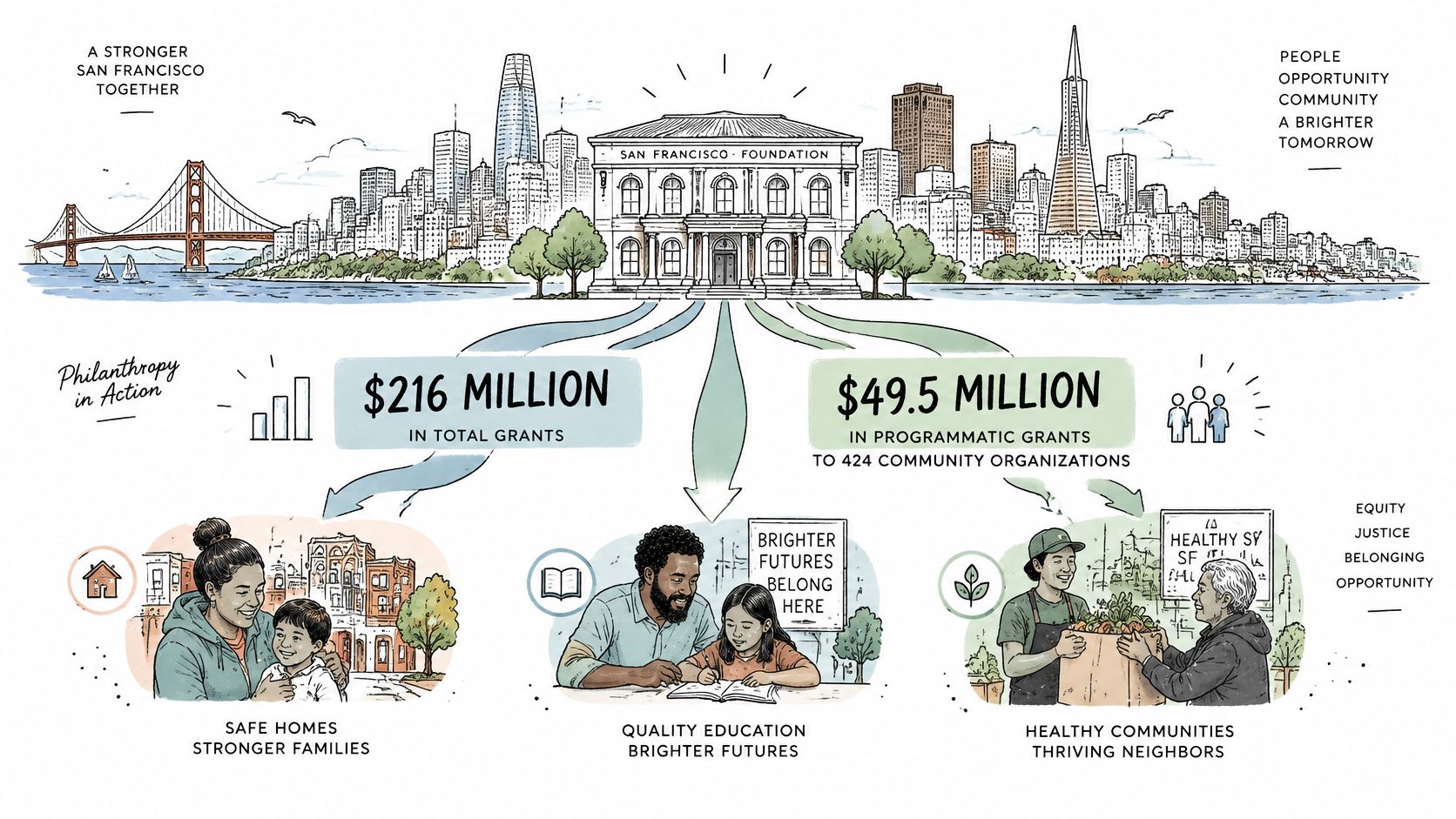
Total grants aren't an advertised application budget. Programmatic giving is a useful place to investigate mission-driven opportunities, but even that category shouldn't be assumed to consist entirely of open competitions.
The figures alone don't establish the application status of each award or explain every other grantmaking channel. When researching San Francisco funders, connect each institution's giving to specific guidelines rather than treating its annual total as money you can request.
Illustrative situations, not reported awards
Fund, route and first question by situation
| Situation | Fund to target | Likely route | First question to ask |
|---|---|---|---|
| Youth tutoring nonprofit | Field-of-interest education fund | Published round within the education field, if offered | Does the education fund accept tutoring programs in our county? |
| Arts group needing project support | Field-of-interest arts fund | Open round or invitation under the fund's rules | Does the arts fund cover project costs, not only operating support? |
| Disaster relief organization | Emergency or unrestricted community fund | Community grant round or emergency selection process | Does the foundation run a relevant fund, and who can apply? |
For the tutoring nonprofit, subject fit isn't enough if the education fund excludes its county. For the arts group, the decisive detail might be whether the fund supports a temporary project rather than ongoing operations.
The disaster relief organization needs to establish whether an emergency process exists at all. An urgent community need doesn't automatically mean the foundation has launched an emergency fund or opened applications.
The accompanying video offers another format for exploring the topic.
Across these scenarios, the useful match is organization to fund, not organization to a familiar foundation name.
Limits and Misconceptions Before You Apply
Strong investment performance doesn't automatically create accessible grant funding: in a 2025 survey of 114 community foundations, average endowment returns reached 14.7%, up from 11.0% in 2024, according to Commonfund's foundation endowment study.
An investment return measures investment performance, not the amount available for a new operating grant. Staff still have to follow endowment restrictions, designated purposes, spending policies, geographic rules, and board priorities.
That's why a nonprofit can reasonably ask for general operating support and still receive a refusal from a financially strong institution. The problem may be the relevant fund's rules rather than the quality of the organization's work.
Replace assumptions with fund-level checks
- Misconception: Local means eligible. A foundation's service area can be broader than an individual fund's eligible geography. Check whether the rules concern your office location, the people served, or the location of the proposed activity.
- Misconception: A large foundation means open grants. Assets include resources held for purposes other than competitive grantmaking. Check typical award size, grant cadence, and whether the relevant program accepts new grantees.
Discretionary dollars are funds the foundation can allocate within its governing rules. Donor-directed dollars are shaped by donor recommendations or specified beneficiaries. Neither category should be confused with a published opportunity accepting proposals today.
A foundation's wealth tells you about its resources. Its current guidelines tell you whether to spend staff time applying.
A useful prospect record therefore separates assets, annual grants, fund type, application status, and the support available. Don't compress those details into a single judgment that the institution is generous.
When evaluating foundation grants for nonprofits, record an explicit next action: apply, make an eligibility inquiry, monitor a future round, or remove the prospect. That decision is more valuable than collecting another impressive foundation name.
A closed route isn't necessarily permanent, but it isn't an invitation either. Respect the published process and keep proposal-writing time for opportunities with a plausible path to an award.
Check Eligibility and Make Your First Approach
Before writing a proposal, confirm that your organization fits the specific fund. Start by searching your county name alongside community foundation, then verify the service area on the foundation's own website.
Build a short qualification record with these checks:
- Confirm geographic eligibility. Compare the fund's boundaries with where your proposed work happens and whom it serves. Don't rely only on your mailing address.
- Identify eligible applicants and purposes. Establish whether the fund supports organizations, individual students, or named charities. Check that the proposed expense is allowed.
- Verify the request process. Find current guidelines stating whether unsolicited requests are accepted. If the answer is unclear, contact staff before drafting; don't treat a general contact form as an application invitation.
- Review giving history. Look for typical grant size, how often awards occur, and evidence that new organizations receive support. Use those details to choose an appropriate request, not to assume past recipients define current eligibility.
- Check board and trustee listings. Look for a legitimate warm introduction that could help you understand fit. A personal connection should support the published process, not bypass it.
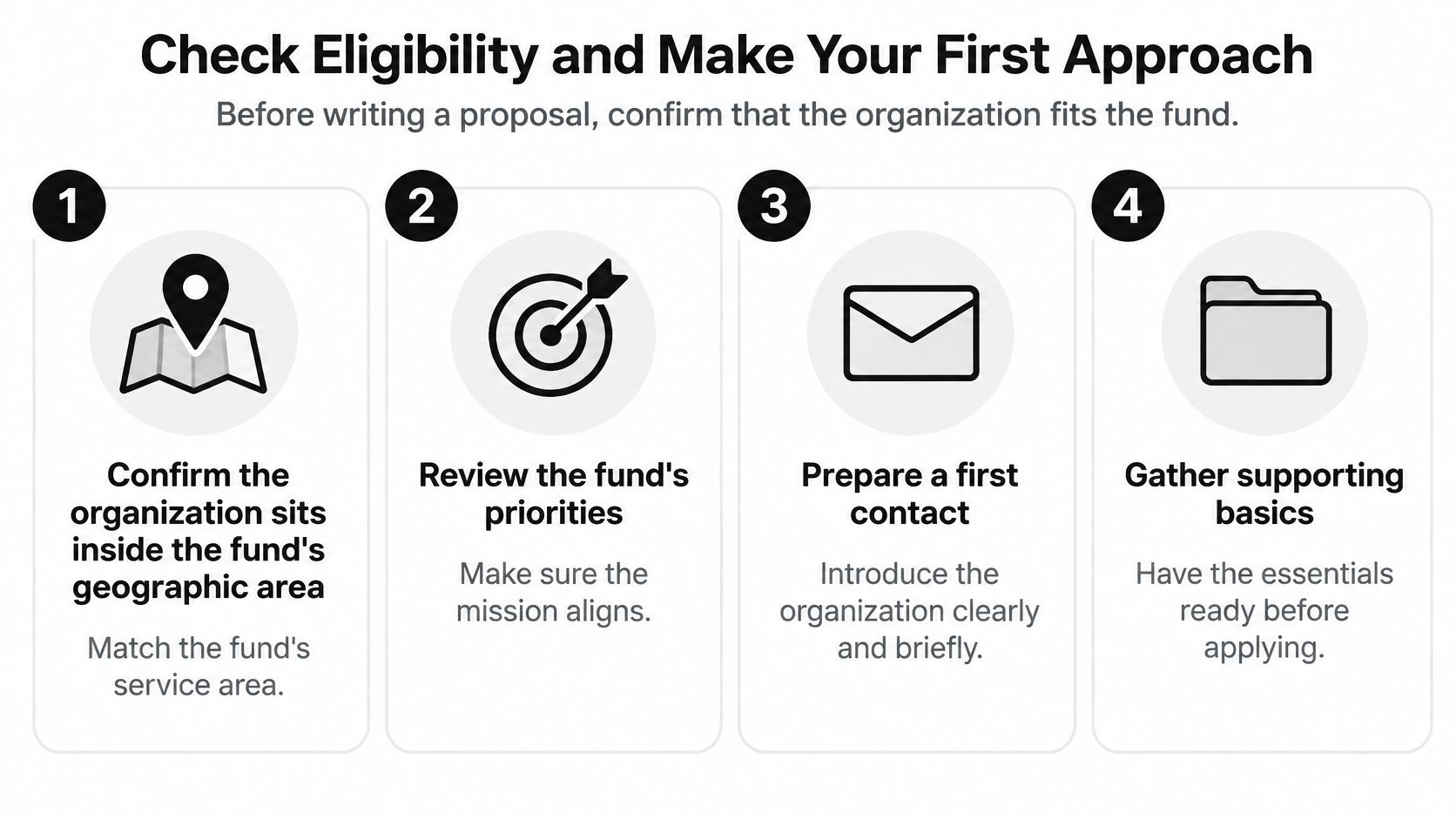
Turn qualification into a brief inquiry
Use current guidelines for eligibility, annual reports for context, and public tax filings for historical giving and governance information. Community foundations generally file Form 990, while private foundations generally file Form 990-PF; neither replaces current application instructions.
For systematic foundation prospect research, record the document date and the reason behind each eligibility decision. An old award is useful evidence of past activity, not proof that a program remains open.
We build Grantlas's foundation data from IRS filings and gather grant opportunities from government portals and other grantmaking sources, pairing website- or EIN-based matching with giving history and board listings. Foundations in our Accepting requests list have no deadline, so contact the funder first rather than assuming there's a scheduled round.
Shortlist funds that pass the checks, then send a concise inquiry. Introduce your organization, describe the proposed work and service area, name the fund, and ask whether the request fits its current process.
Keep the first contact focused on permission and fit. You're trying to establish the right next step, not submit a full proposal before anyone has requested one.
Grantlas helps nonprofits identify prospective funders and open opportunities, with fit reasoning, eligibility flags, and giving history to support screening. Build a profile from your website or EIN, then use the matches to investigate accessible funds before committing time to a proposal.