10 Unrestricted Grants for Nonprofits That Fund Flexibly
Oct 24, 2026 · 13 min read

Your rent, payroll, and lights do not pause because a grant is restricted to one program. Unrestricted grants for nonprofits are the dollars that can cover those costs, yet most awards still pin every line to a project. In the Nonprofit Finance Fund's 2025 State of the Nonprofit Sector Survey of 1,967 nonprofits, 64% said less than half of their 2024 grants and donations were unrestricted, and 75% said raising unrestricted dollars was challenging, including 46% who called it a major challenge (Nonprofit Finance Fund 2025 full results).
That scarcity is why a short, checked list beats a vague search for “general support.” The 10 funders below are real operating-grant programs, sorted by place, award size, and whether you can still apply. Each entry covers who qualifies, what you can request, what the process asks, and whether the window is open, closed, or rolling.
Geography is the fastest filter. A national poetry press will waste a week on a Napa safety-net fund. A Brooklyn youth group should not chase an Albuquerque cycle. Put open and rolling programs first if you need cash this year. Closed 2026 cycles belong on next year's calendar, not this month's proposal queue.
For a wider scan of operating support beyond this list, start with EmailScout's funding resources, then pressure-test each prospect against recent awards rather than a mission statement alone.
Table of Contents
- 1. Elaine Jones Safety Net Fund, Napa Valley Community Foundation
- 2. Brooklyn Org, General BKO Funding
- 3. TOGETHER Initiative, Foundation for Louisiana
- 4. James A. & Faith Knight Foundation, General Operating Support
- 5. Menorah Heritage Foundation, Unrestricted Operating Support Cycle
- 6. Community Grants Program, The Denver Foundation
- 7. Perenchio Foundation, General Operating Support
- 8. Poetry Foundation, General Operating Support
- 9. Annual Grant Cycle, Albuquerque Community Foundation
- 10. General Operating Grants, Spur Community Foundation
- 10 Unrestricted Nonprofit Grant Programs Compared
- Turn This List Into Your Next Award
1. Elaine Jones Safety Net Fund, Napa Valley Community Foundation
If you run established safety-net services for Napa County residents, this is one of the few open, clearly sized operating grants on this list. The Elaine Jones Safety Net Fund offers one-year unrestricted general operating support of up to $100,000, scaled to budget and funding gaps. Eligible work includes food security, housing, health-care access, childcare, disability assistance, legal support, mental health, and survivor services.
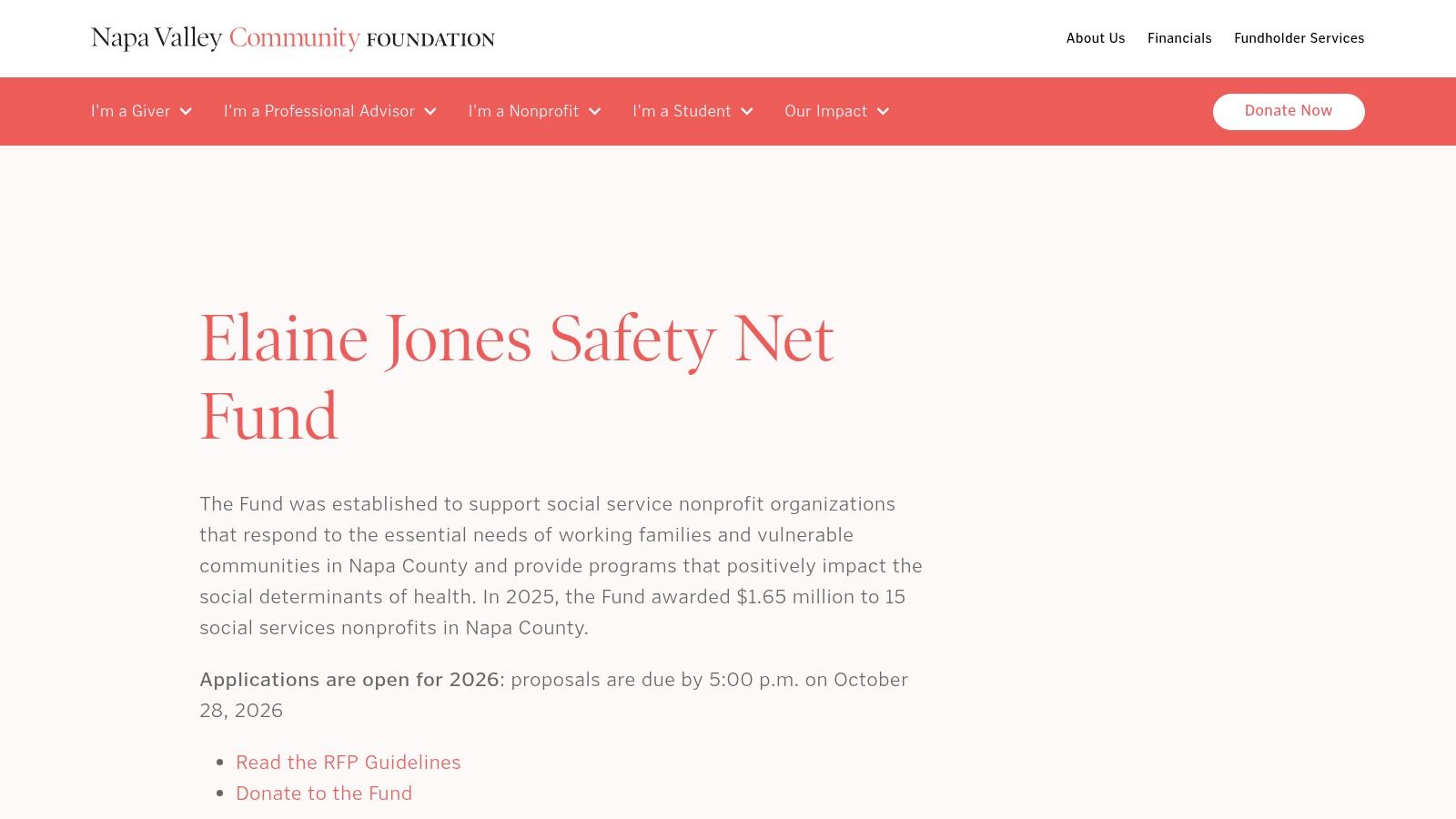
The 2026 application is open. Proposals are due October 28, 2026, at 5 p.m. Grantees must join a two-day capacity-building intensive. That is extra staff time, not a hidden restriction on the dollars, but it is a real commitment. In 2025 the fund awarded $1.65 million to 15 nonprofits, so the ceiling is meaningful for direct-service groups that already work primarily in the county.
Fit check:
- Place: Skip it if Napa County is not your primary service area.
- Use of funds: Organization-wide operating support, not a single project line.
- Trade-off: A close deadline plus a required intensive. Apply only if leadership can attend.
Practical rule: Treat the intensive as part of the award cost. If two staff days would break your service schedule, do not force the application.
2. Brooklyn Org, General BKO Funding
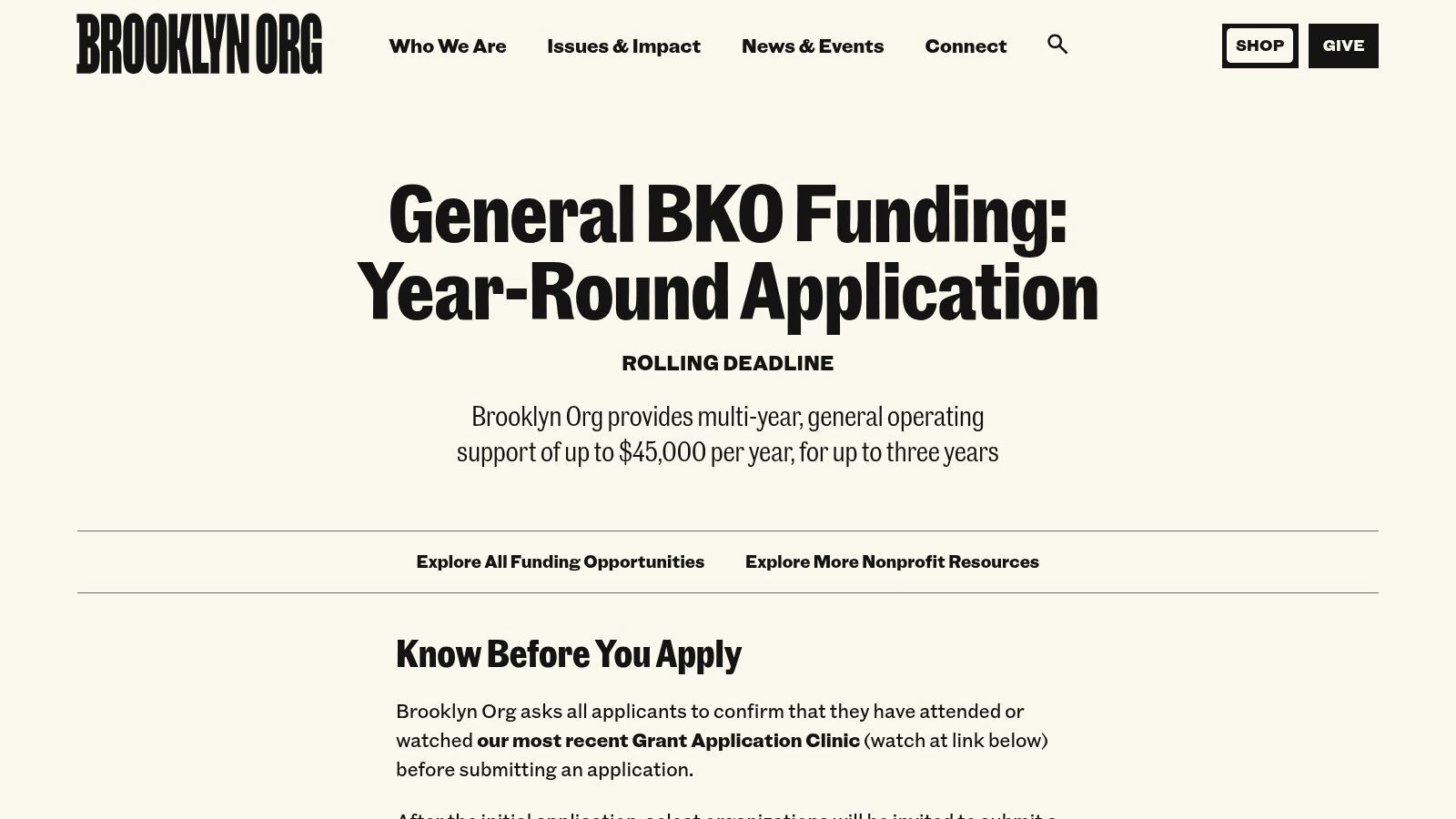
Brooklyn Org is the rolling option for groups working in Brooklyn. General BKO Funding provides multi-year general operating support of up to $45,000 per year for up to three years. The first application is accepted year-round, with awards twice a year. Work can span direct services, advocacy, coalition-building, and community leadership. Fiscal sponsors may apply for eligible organizations.
You need a regular physical presence in Brooklyn, or clearly relevant Brooklyn-based work. The minimum annual budget is $100,000, and the grant cannot exceed 20% of that budget. Applicants must watch or attend the latest grant application clinic. Selected groups then complete a full proposal and a site visit, and they do get status notifications.
What the multi-year piece is worth
Three years of flexible support is more useful for staffing plans than a one-time project check of the same headline size. The cost is process. Clinic, full proposal, and site visit add weeks. If your budget is under the floor, or Brooklyn is only a small slice of your work, stop here and look elsewhere.
3. TOGETHER Initiative, Foundation for Louisiana
The TOGETHER Initiative offered 12 months of unrestricted general operating support, including $50,000 awards in the 2026 cycle, to organizations serving young people ages 10–25 in East Baton Rouge Parish. The model is participatory. Residents with lived experience help set priorities, which can fit grassroots youth work better than a distant program officer's rubric.
You may be headquartered elsewhere, and fiscal sponsors are allowed, including sponsors based outside Louisiana. You still have to show that at least 50% of the work is in East Baton Rouge Parish. The 2026 application period closed October 2, 2026.
Do not write a proposal against a closed page. Calendar the official site and rebuild the file only when a new cycle posts.
- Keep: Youth ages 10–25, parish concentration, and sponsor documents if you are not the legal applicant.
- Drop: Adult-only services, or youth work that is mostly outside the parish.
- Next step: Note the closed status in your pipeline so staff do not rediscover it in March.
4. James A. & Faith Knight Foundation, General Operating Support
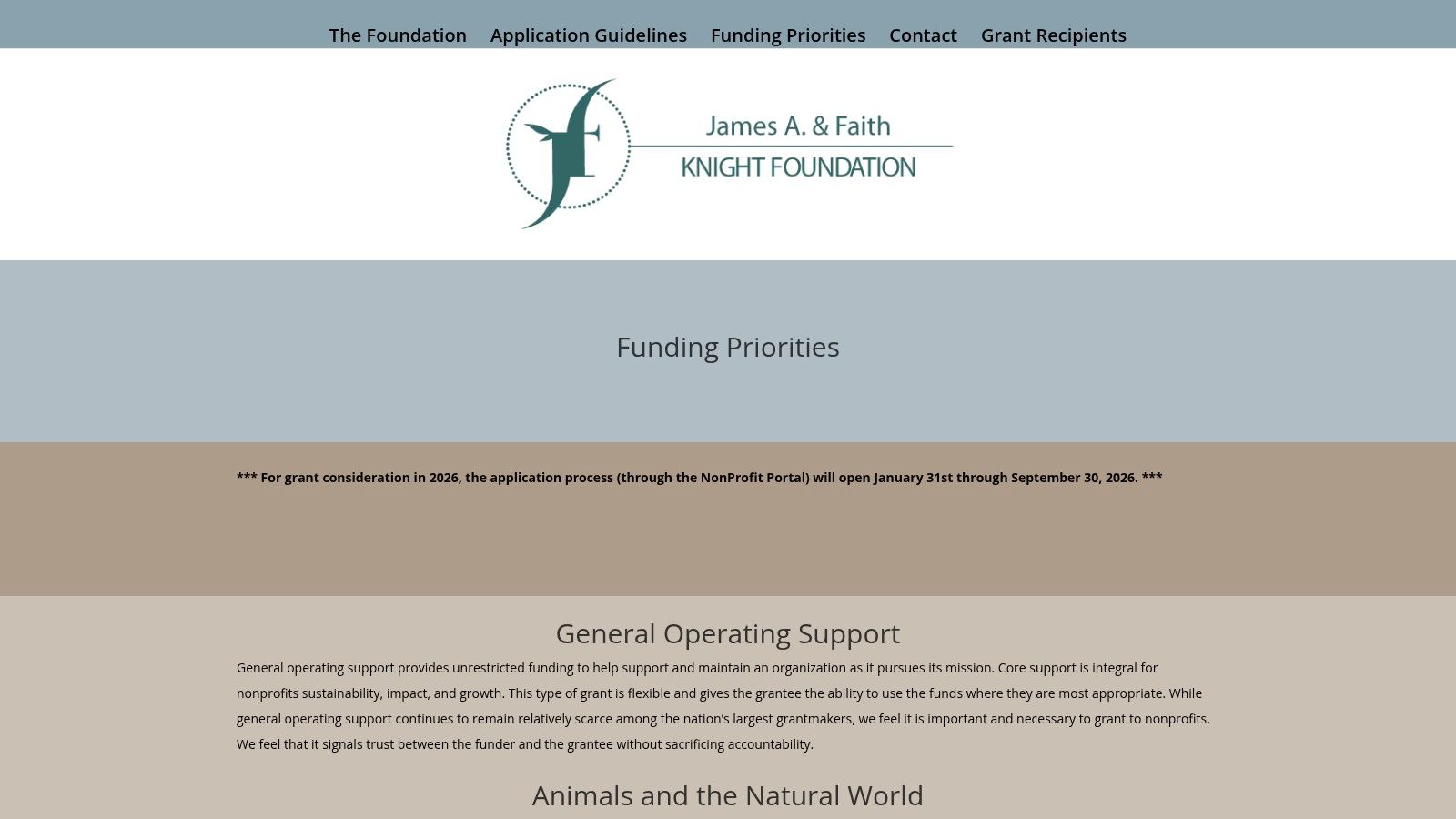
This private foundation states the thing many funders only imply. The James A. & Faith Knight Foundation provides unrestricted general operating support, framed as flexible dollars paired with accountability. Priorities include animal welfare and the natural world, plus work that benefits women and girls. Applications go through an online nonprofit portal.
The 2026 window ran from January 31 through September 30 and is closed. Award size and geographic eligibility are not something to guess from a priorities page. Read the current guidelines before you build a narrative around “women and girls” or animal welfare that the foundation does not fund in your state.
If you are sorting private foundations from community funds and corporate programs, this short guide to private foundation grants for nonprofits is the right companion before you invest in a portal account.
A clear “we fund general operating support” sentence is a starting point, not proof you will get an award. Confirm place, size, and whether new applicants are invited.
5. Menorah Heritage Foundation, Unrestricted Operating Support Cycle
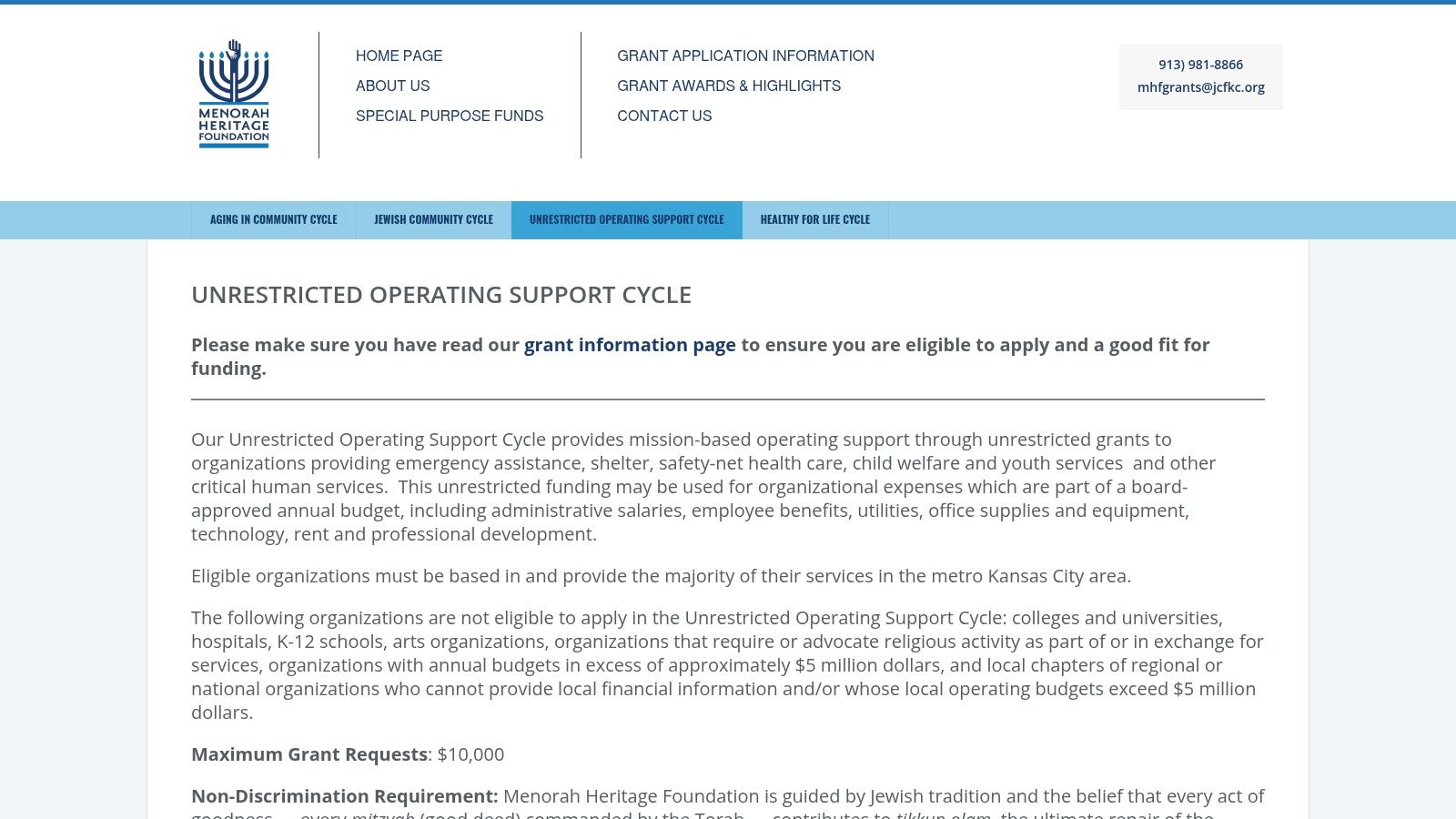
Menorah Heritage is explicit about the bills unrestricted money is supposed to pay. The general community core cycle funds mission-based operating support for emergency assistance, shelter, safety-net health care, child welfare, youth services, and other critical human services. Eligible costs include budgeted salaries, benefits, rent, utilities, supplies, and technology.
You start with a letter of intent. Selected applicants are invited to a full application. A letter does not guarantee that invitation, so do not staff a full proposal until you are asked.
Who is out
You must be based in and primarily serve metro Kansas City. A Kansas City mailing address with most services elsewhere will not carry it. Colleges, hospitals, schools, arts organizations, and some larger organizations are excluded. If you are unsure whether your award would be operating support, a program grant, or something else, compare the different types of grant before you label this prospect “flexible” in your tracker.
6. Community Grants Program, The Denver Foundation
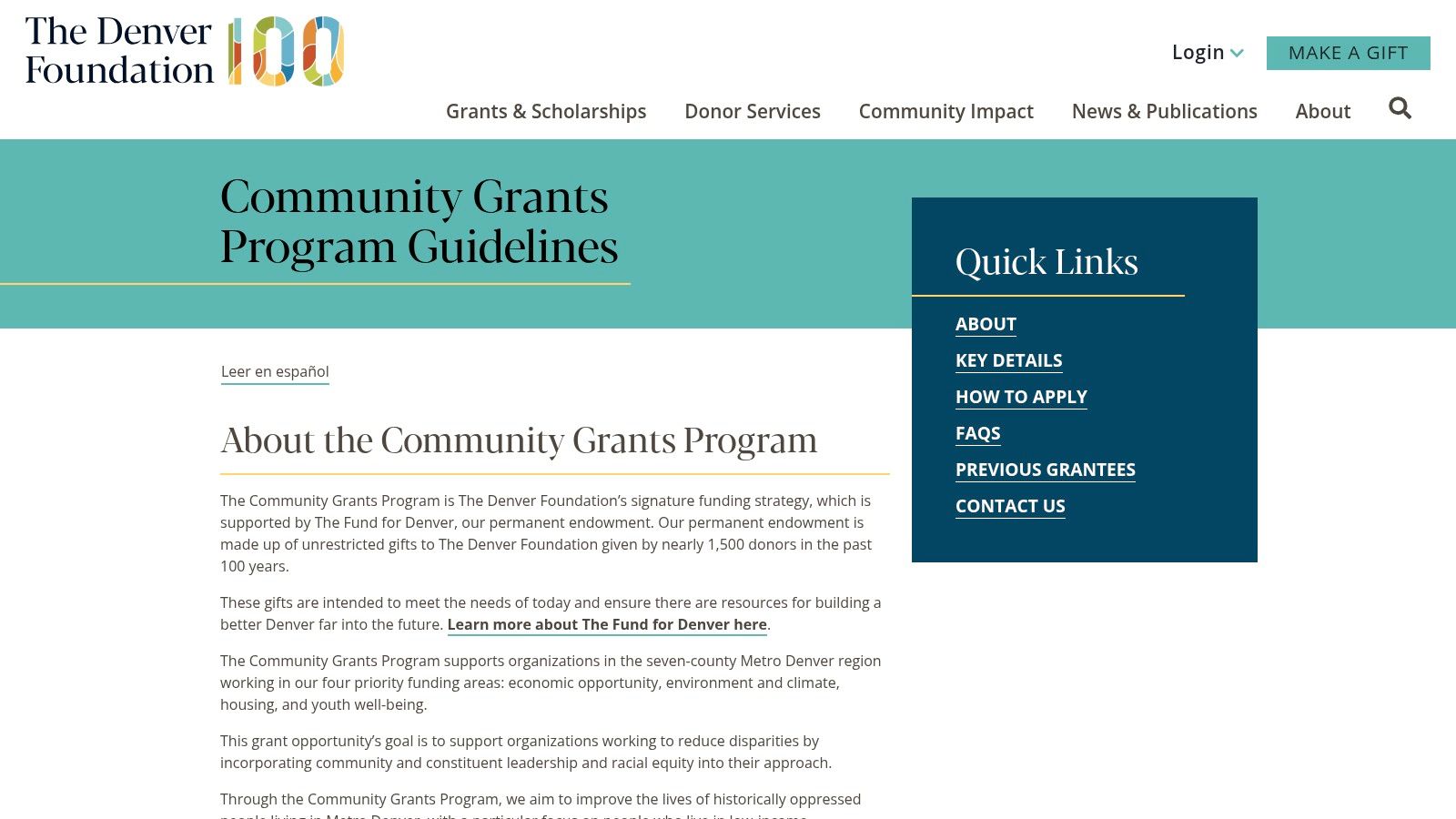
The Denver Foundation prefers general operating support and will still consider program requests. The Community Grants Program generally awards $20,000–$50,000 for work in the seven-county Metro Denver region. Priority areas are economic opportunity, environment and climate, housing, and youth well-being. First-time applicants may apply. Fiscal-sponsor applicants are eligible. Review looks at community leadership and racial equity, not only a tidy logic model.
The 2026 Cycle 2 deadline was August 3, 2026, so that cycle is closed. Check the site for the next round rather than recycling a late packet.
Use this when:
- Impact is local: You can show results in Metro Denver, not a statewide average.
- The work matches a priority: At least one stated area has to be real, not a stretched keyword.
- The organization is established enough: Brand-new organizations and brand-new programs may not qualify.
Published ranges help you decide whether the award covers a real operating gap. For the wider menu of where those dollars come from, see nonprofit funding sources and keep community foundations in their own column.
7. Perenchio Foundation, General Operating Support
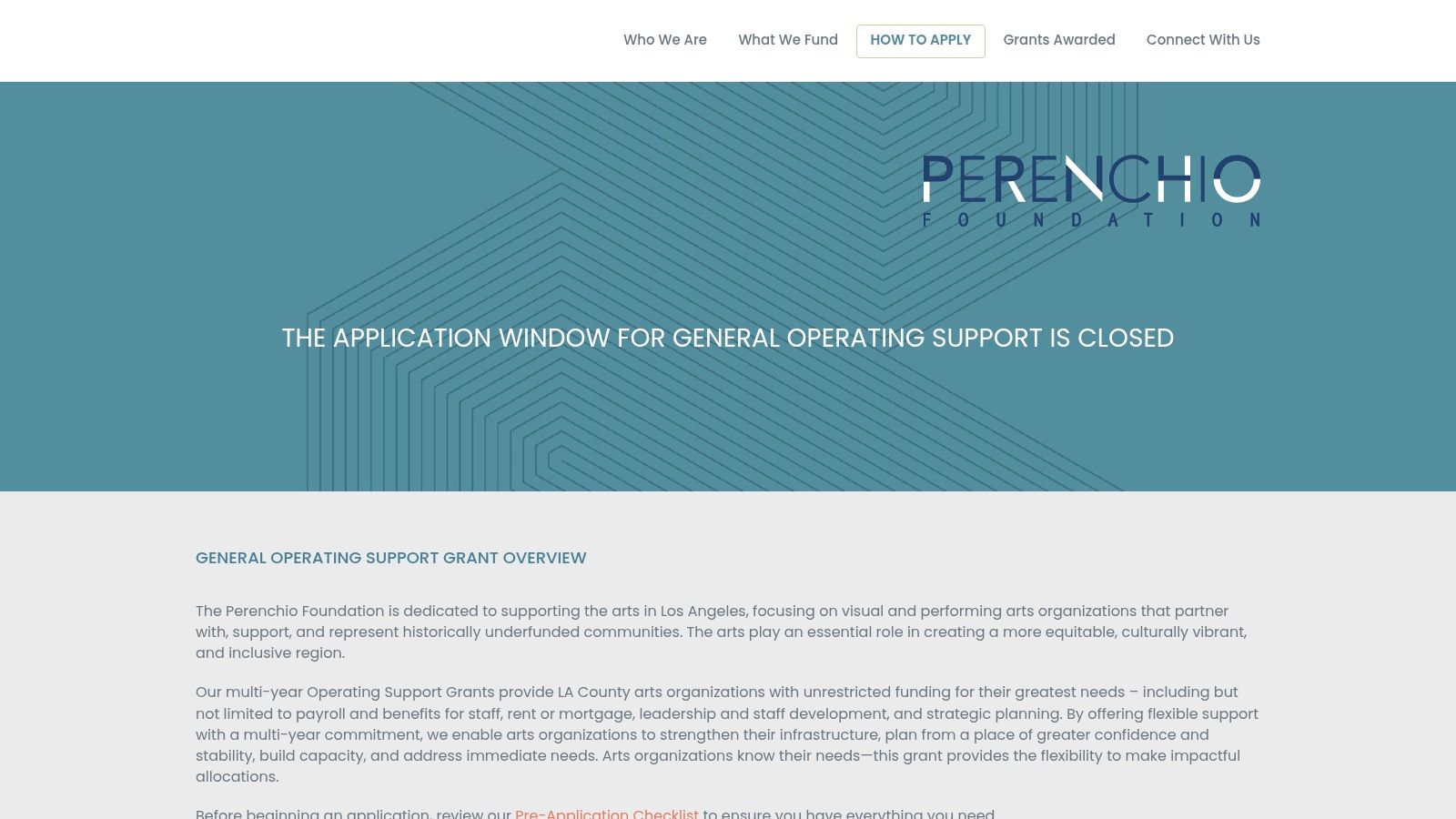
Arts groups in Los Angeles County have a narrower, and often more useful, operating-grant market than national “culture” searches suggest. The Perenchio Foundation operating grants are multi-year unrestricted awards for eligible visual and performing arts organizations headquartered in and serving Los Angeles County. The foundation looks especially at groups that partner with, support, or represent historically underfunded communities.
Funds may cover staff compensation, rent, staff development, and strategic planning. That mix matters. Flexible multi-year support can hold a salary and a planning process at the same time, which a single exhibition grant rarely does. Eligibility and timelines are published, which makes the no-fit decision faster.
The 2026 application window has closed. Organizations outside visual and performing arts, or outside the county, should not stretch the equity language to cover a different discipline.
Calendar the next opening only after you confirm headquarters, service area, and art form still match. A closed cycle with a clean fit is worth a reminder. A closed cycle with a fuzzy fit is not.
8. Poetry Foundation, General Operating Support
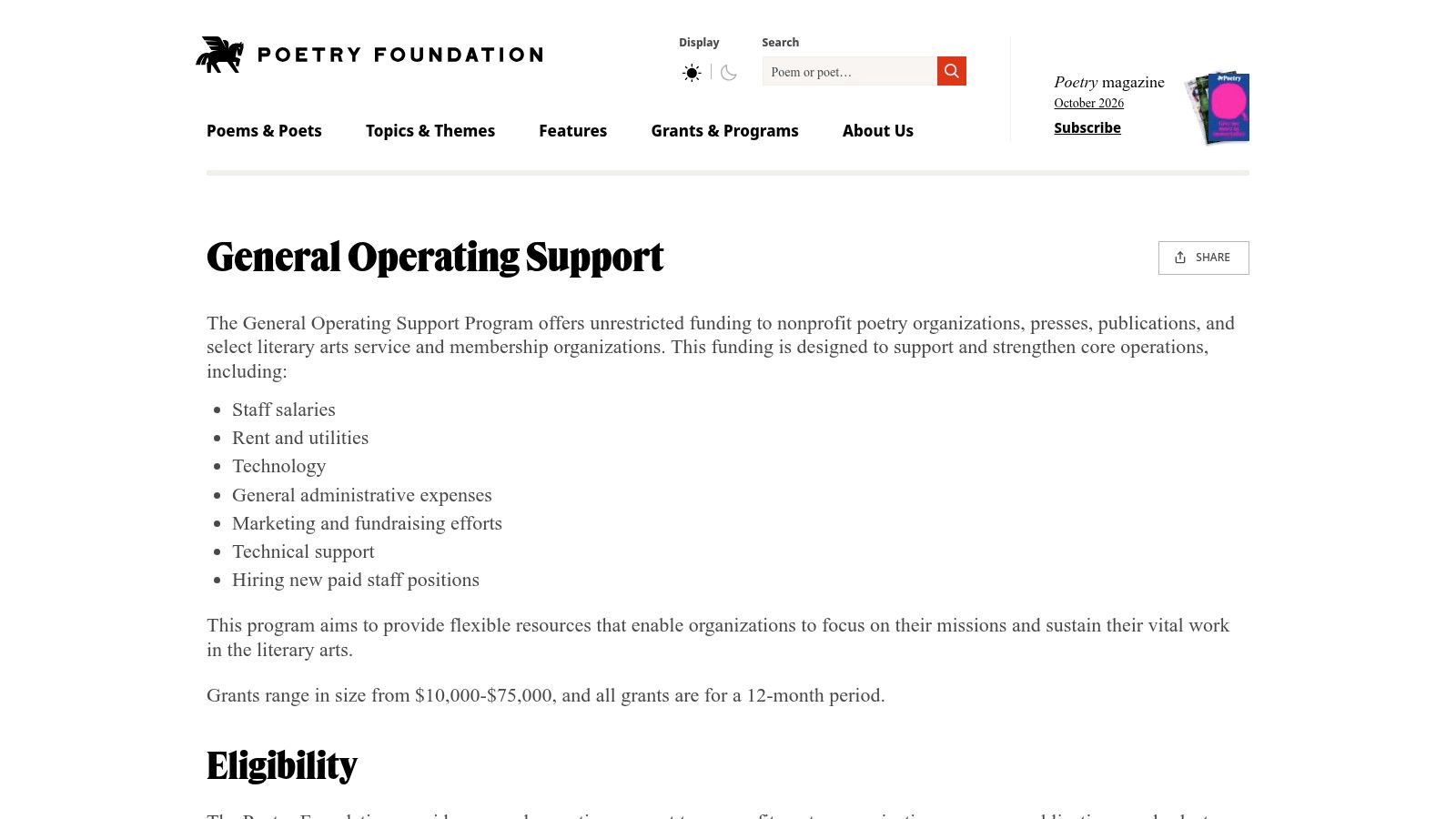
This is the national option on an otherwise local list. The Poetry Foundation general operating support program offers unrestricted 12-month grants of $10,000–$75,000 to U.S.-based nonprofit poetry organizations, presses, publications, and select literary arts service and membership organizations. Eligible core costs include salaries, rent, utilities, technology, administration, marketing, and fundraising.
The 2026 window ran June 1–July 15 and is closed. A final report is due within 30 days of the grant period's end. That is lighter than a monthly restricted budget, and it is still a hard date. Past recipients and award amounts are public, so you can see whether groups like yours have been funded before you draft.
When the national label still fails
“U.S.-based” does not mean every literary nonprofit. A general arts center, a fiction-only press, or a youth writing program with little poetry focus will read as a mismatch. Use the recipient list as the fit test, then wait for the next posted window instead of sending an off-cycle inquiry that the guidelines do not invite.
9. Annual Grant Cycle, Albuquerque Community Foundation
Albuquerque's annual cycle is smaller and unusually plain about use. Annual Grant Cycle criteria make every award in the cycle a general operating grant of $10,000–$20,000. The money is unrestricted and can cover needs through the year, including administrative salaries, utilities, supplies, and technology maintenance. It may also support project, capital, technology, or professional-development costs, which is wider than a pure overhead stipend.
You generally need to serve the Greater Albuquerque metropolitan area and meet the foundation's criteria and fields of interest. Several years of nonprofit experience are typical, with specific exceptions. Some newer groups may qualify through a fiscal agent or parent organization. Government entities, and organizations whose only purpose is regranting, are not eligible for operating support.
A $10,000–$20,000 operating grant will not replace a major restricted contract. It can cover the costs those contracts refuse, if you already serve this metro and can document the years of operation the criteria expect.
10. General Operating Grants, Spur Community Foundation
Spur is a local operating option with more than one door each year, and with less published certainty on size. Spur Community Foundation grant opportunities include unrestricted support for core operating expenses for organizations in Idaho's Wood River Valley. Grantees direct the funds to pressing needs. Applications are reviewed and approved twice a year.
Separate categories cover operating support, programs and projects, and capacity building. The foundation also offers nonprofit assessments meant to support strategic development and donor connections. That assessment can be useful even when an operating request is the wrong category.
Eligibility, request limits, award amounts, and deadlines depend on the specific opportunity. Confirm them on the site before you promise a board a dollar figure. This is not a nationwide grant. If the valley is not your service area, the twice-yearly schedule does not make it a prospect.
10 Unrestricted Nonprofit Grant Programs Compared
| Grant Opportunity | Funding and Support | Target Applicants and Geography | Timing / Status | Key Considerations |
|---|---|---|---|---|
| Elaine Jones Safety Net Fund, Napa Valley Community Foundation | Unrestricted operating support up to $100,000 | Established nonprofits providing essential safety-net services in Napa County | 2026 applications due October 28, 2026 | Two-day capacity-building intensive required |
| Brooklyn Org, General BKO Funding | Up to $45,000 per year for up to three years | Organizations serving Brooklyn; fiscal sponsors may apply | Initial applications accepted year-round; awards twice yearly | Minimum $100,000 annual budget; selected applicants complete a full proposal and site visit |
| TOGETHER Initiative, Foundation for Louisiana | $50,000 for 12 months of unrestricted support | Organizations serving youth ages 10–25 in East Baton Rouge Parish | 2026 application closed October 2, 2026 | At least 50% of work must be in the parish; fiscal sponsors allowed |
| James A. & Faith Knight Foundation, General Operating Support | Unrestricted operating support; award amount not specified | Organizations aligned with animal welfare, the natural world, or women and girls | 2026 application closed September 30, 2026 | Confirm geographic eligibility and award details in the guidelines |
| Menorah Heritage Foundation, Unrestricted Operating Support Cycle | Unrestricted support for core operating expenses | Human-services organizations based in and primarily serving metro Kansas City | Letter of intent required; check current cycle dates | Some organization types are excluded; full applications are by invitation |
| Community Grants Program, The Denver Foundation | Generally $20,000–$50,000; prefers operating support | Organizations serving the seven-county Metro Denver region | 2026 Cycle 2 closed August 3, 2026 | Must align with a priority area; new organizations or programs may not qualify |
| Perenchio Foundation, General Operating Support | Multi-year unrestricted operating grants | Visual and performing arts organizations headquartered in and serving Los Angeles County | 2026 application window closed | Focus on organizations serving historically underfunded communities |
| Poetry Foundation, General Operating Support | $10,000–$75,000 for 12 months | U.S.-based poetry and qualifying literary arts nonprofits | 2026 application window closed July 15, 2026 | Final report required within 30 days after the grant period |
| Annual Grant Cycle, Albuquerque Community Foundation | Unrestricted operating grants of $10,000–$20,000 | Organizations generally serving Greater Albuquerque | Check the foundation for current cycle dates | Some newer groups may qualify through a fiscal agent or parent organization |
| General Operating Grants, Spur Community Foundation | Unrestricted support for core operating expenses | Organizations in Idaho's Wood River Valley | Applications reviewed twice yearly; confirm current dates | Award amounts and eligibility vary by opportunity |
Turn This List Into Your Next Award
Sort this list before you write. Open or rolling comes first: Elaine Jones if you are a Napa safety-net provider and can meet October 28, 2026, and Brooklyn Org if you clear the budget floor and the clinic. Menorah Heritage is a letter-of-intent screen for metro Kansas City human services, not a full proposal on day one. Spur is twice yearly, but only after you confirm the current Wood River Valley rules. Everything else on this page had a 2026 window that is already closed. Calendar those cycles. Do not staff them this month.
Skip geography mismatches in the first pass. East Baton Rouge youth work, Metro Denver priorities, Los Angeles visual and performing arts, Greater Albuquerque, and national poetry organizations are not interchangeable “flexible funders.” A smaller unrestricted grant can beat a larger restricted award when you count staff time, reporting, renewal odds, cash timing, and how much can sit in overhead. Headline size alone is a weak comparison.
The market has moved, and it has not become easy. An estimated 26% of U.S. grants were unrestricted general operating support in 2005. By 2021, 61% of 284 foundation leaders surveyed said they provided some unrestricted funding, and at least 65% planned to continue, though those figures measure funders, not dollars (research on unrestricted support). Before 2020 the share of foundation grants that were unrestricted had stayed around 20% for years. A later study of 277 nonprofits found unusually large unrestricted gifts from $1 million to $250 million, median $8 million, equal to 69% of contributed revenue for the median recipient, and 88% said it was their largest-ever unrestricted grant (Center for Effective Philanthropy big gifts study). Those awards are not the typical experience.
Donor-advised data shows flexible designations cluster with repeat giving. Fidelity Charitable reported that 64% of 2024 grant recommendations were “where needed most,” and 77% went to charities donors had supported before. The National Philanthropic Trust reported 105,909 grants, 66% of its FY25 grants, as unrestricted (Fidelity Charitable 2025 Giving Report). Use that as a benchmark for relationship-driven flexibility, not as the share of all grants.
Funders are also getting pickier on size. In 2025, 40% of nonprofit respondents said foundation grants had become less restrictive since late 2022, while 48% said grant sizes had shrunk. Separately, 42% of foundations were providing more unrestricted grants than before 2025, and 17% were considering it. The share of funders in one regional review that support both 501(c)(3)s and fiscally sponsored groups rose from 46% to 76% between 2023 and 2025 (Nonprofit Finance Fund 2025 survey report). Read the grant agreement anyway. A “where needed most” label can still hide reporting rules, amendment limits, or a recommendation that is not the same thing as a legal operating grant.
Grantlas can extend this shortlist. You build a profile from your website or EIN, then review scored private-foundation and government prospects with plain-English fit notes, flags for geography or budget mismatches, giving history, and deadline reminders. That is a faster way to find the next unrestricted match than rereading every 990 by hand.
Grantlas helps nonprofits find private foundations and open grants that may include general operating support, with a fit score, short reasoning, and flags when place, budget, or applicant type do not match. Use it to turn this list's geography and open-versus-closed checks into a scored pipeline for your own organization. Visit Grantlas to build a profile and see which unrestricted prospects are worth a proposal.