Special Education Grants: 10 Programs to Check in 2026
Oct 27, 2026 · 13 min read
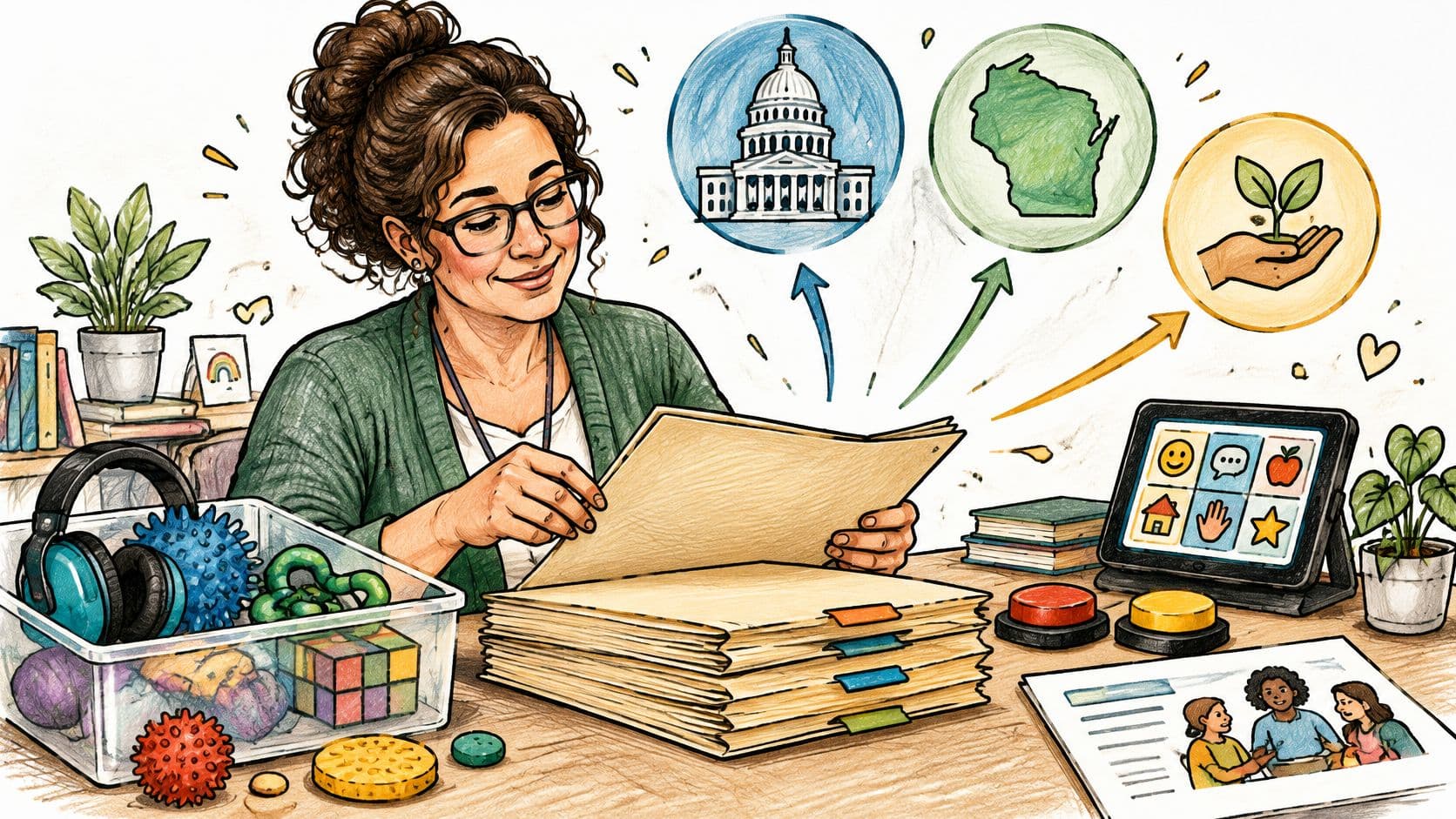
A resource teacher needs a $900 sensory kit the building budget will not buy. A nonprofit wants to fund a parent workshop. A university team is weighing a federal research competition. All three type the same search, special education grants, and get one blended list.
The rules split them. A classroom award will not run a nonprofit workshop. A state formula payment will not land in a lab account. Public money starts with the Individuals with Disabilities Education Act. The Congressional Research Service overview of IDEA shows Part B Grants to States rising from about $4.99 billion in fiscal year 2000 to $14.19 billion in fiscal year 2023, with about 7.9 million children ages 3 through 21 served under Part B in the 2023-2024 school year.
That growth still leaves most of the bill with states and districts. Congress authorized a federal share of up to 40% of excess special education cost, often called full funding, and that mark has never been reached. Historical federal contributions have generally run from about 7% to 19% of excess cost. The ERIC record of the Congressional Research Service brief reports a 10.2% share in fiscal year 2025, with total IDEA appropriations of about $15.4 billion.
The list below is sorted by who can apply, classroom educators, nonprofits, universities, or states, and by 2026 status. Closed windows are flagged up front. You will see federal programs, state formula streams, and private foundations, each with eligibility, a published award size where one exists, and whether you can apply now. Classroom requests land better when you can point to differentiated teaching examples and say what the materials change for students.
Table of Contents
- 1. U.S. Department of Education Special Education and Disabilities Grant Programs
- 2. IDEA Part B and Part C State Formula Grants
- 3. Grants.gov
- 4. IES Transformative Research in Special Education (84.324T)
- 5. Educational Technology, Media, and Materials for Individuals with Disabilities (84.327)
- 6. AdoptAClassroom.org Inclusive Classroom Fund
- 7. The Hambrick Foundation Grants
- 8. Philanthropic Ventures Foundation Special Education Resource Grants
- 9. National Foundation for Autism Research (NFAR) Teacher Grants
- 10. Foundation for Developmental Disabilities Program Grants
- How the 10 special education grant programs compare on award size, eligibility, and 2026 status
- Build a Shortlist Before the Next Deadline Closes
1. U.S. Department of Education Special Education and Disabilities Grant Programs
Universities, state agencies, nonprofits, and other organizations named in a notice can use this hub. A classroom teacher cannot treat it as a supply catalog. A listing on the page does not mean a 2026 competition is open.
Discretionary awards are a thin slice next to formula funds, and they cluster around people, not carts. The Office of Special Education Programs personnel preparation summary reports that in FY2024 OSEP awarded more than $17.9 million across 78 new Personnel Preparation and Professional Development awards, with planned five-year funding of about $104.1 million.
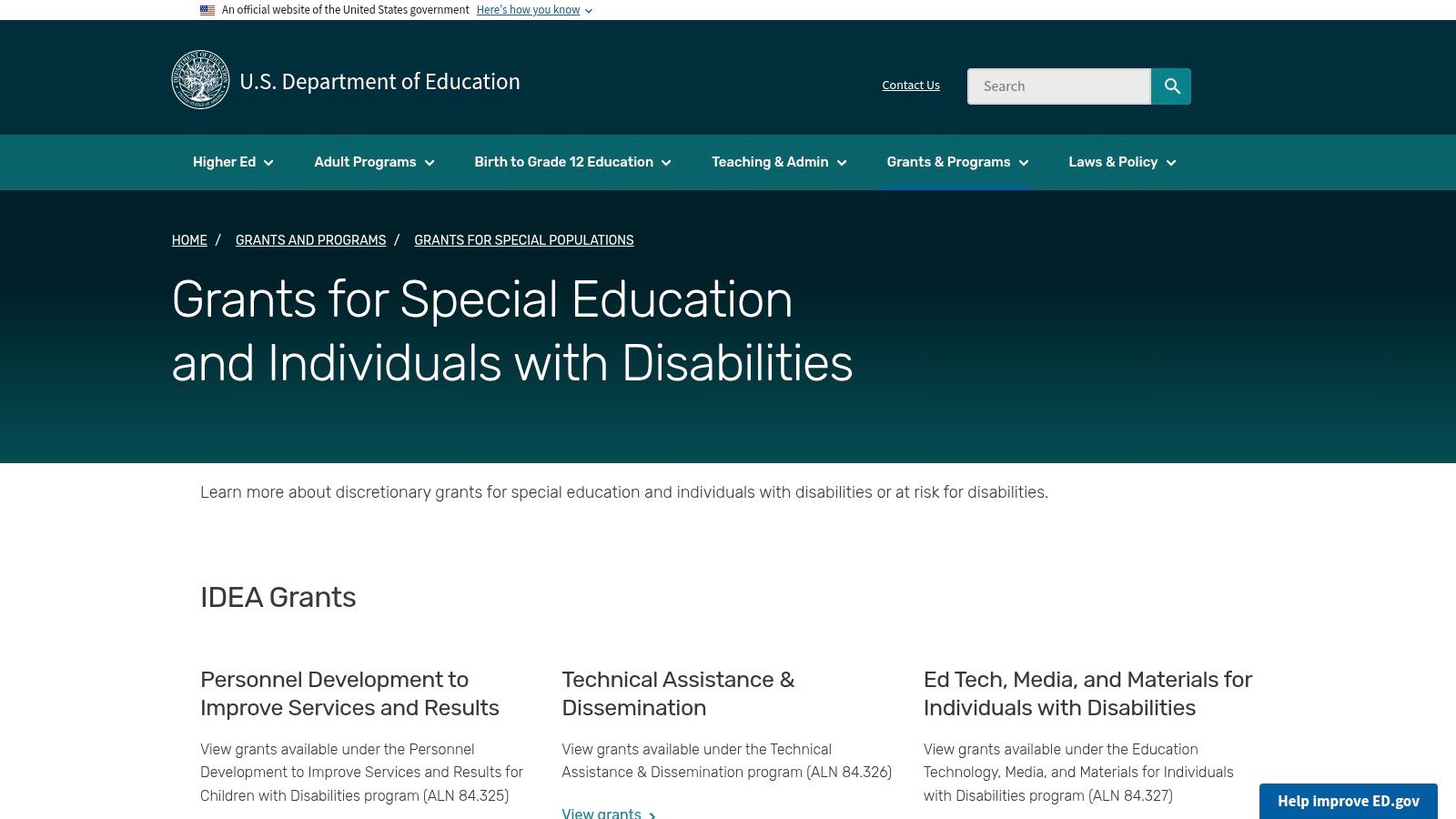
What the hub sorts:
- Personnel and leadership: preparation and continuing professional learning.
- Technical assistance and parent centers: systems and family information, not one classroom order.
- Accessible materials and research: separate programs, each with an Assistance Listing number and its own clock.
Start at the special education and disabilities grant programs page. Pick two listing numbers that name your entity type. Ignore the rest until a notice is posted.
Practical rule: If the notice does not list your organization, stop. A week on the narrative will not fix eligibility.
Federal packages take staff time, registrations, and a match between your mission and the competition. Breadth is the advantage. The open-or-closed question is the trap.
2. IDEA Part B and Part C State Formula Grants
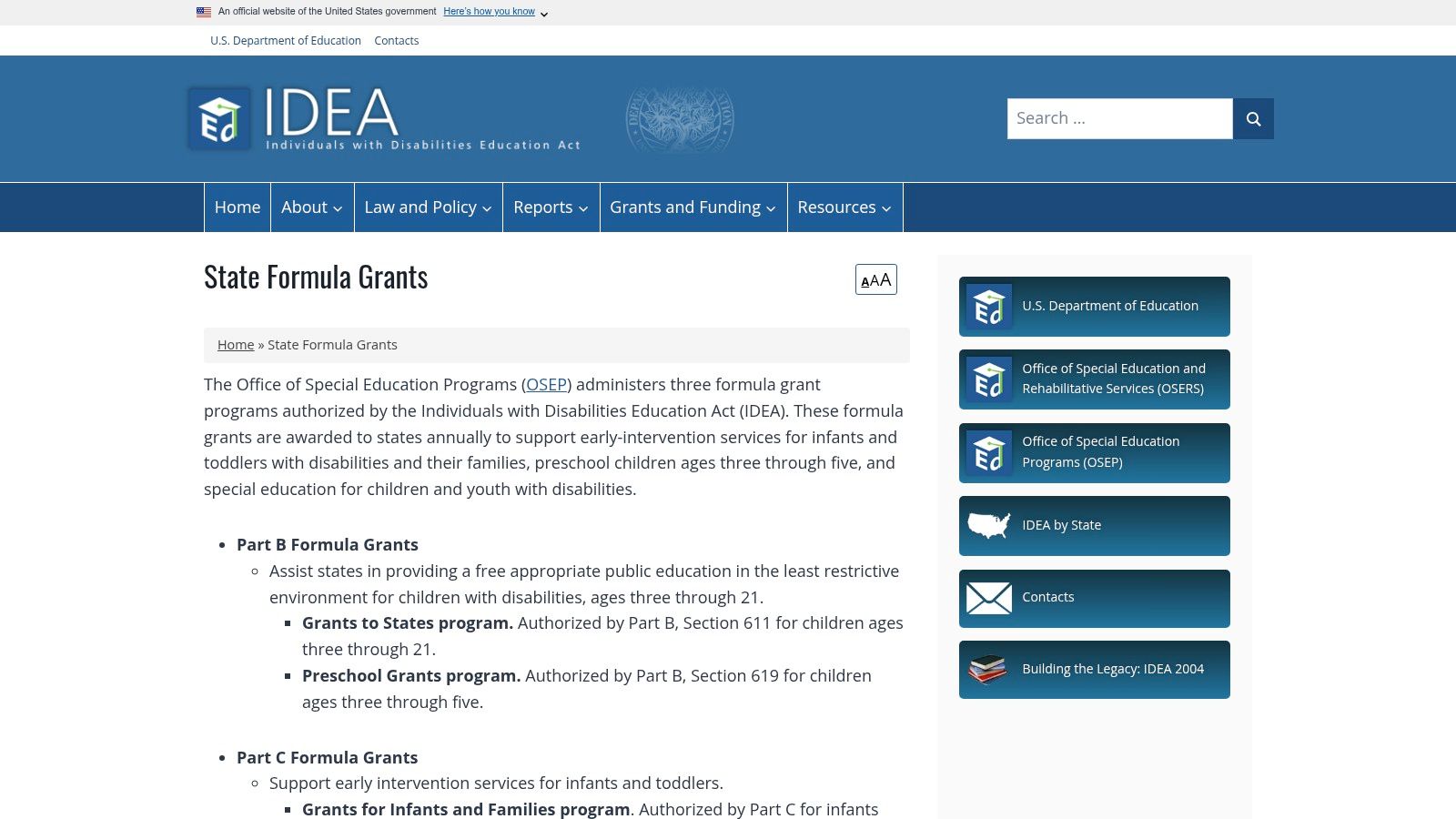
States are the applicants. Local education agencies receive most of the pass-through. A nonprofit, therapist, rural provider, or parent group cannot file for the federal formula award itself.
Part B supports special education for ages 3 through 21, including preschool. Part C supports early intervention from birth through age 2 and the child's family. The Congressional Research Service product on IDEA funding puts FY2025 Section 611 grants to states at about $14.21 billion and notes that FY2025 allocations generally included hold harmless amounts equal to prior-year funding. A state's award may not track this year's caseload or rising costs.
Paths that are not a direct federal application:
- Partner or contractor: ask the district or early-intervention lead if a local agreement exists.
- State subgrant: some agencies regrant a slice. The rules are theirs, not a national form.
- Keyword trap: a budget line that says special education is not an open competition for your nonprofit.
There is no single 2026 nonprofit deadline, because this stream is not a competition in that sense. Use the IDEA state formula grants site for award letters and funding tables, then call the office that holds the local channel. Headline federal totals overstate what a small group can touch. Most of the money is already moving through state and district systems.
3. Grants.gov
This portal is a search desk, not a special education funder. Individuals rarely qualify. Nonprofits, universities, and public agencies do, and only when the notice names them.
Search "special education," "disabilities," and "IDEA." Filter by applicant type, agency, and status so you see open notices rather than archived ones. Competitions from agencies outside the Department of Education show up here too. Read eligibility on the notice before you read the abstract a second time.
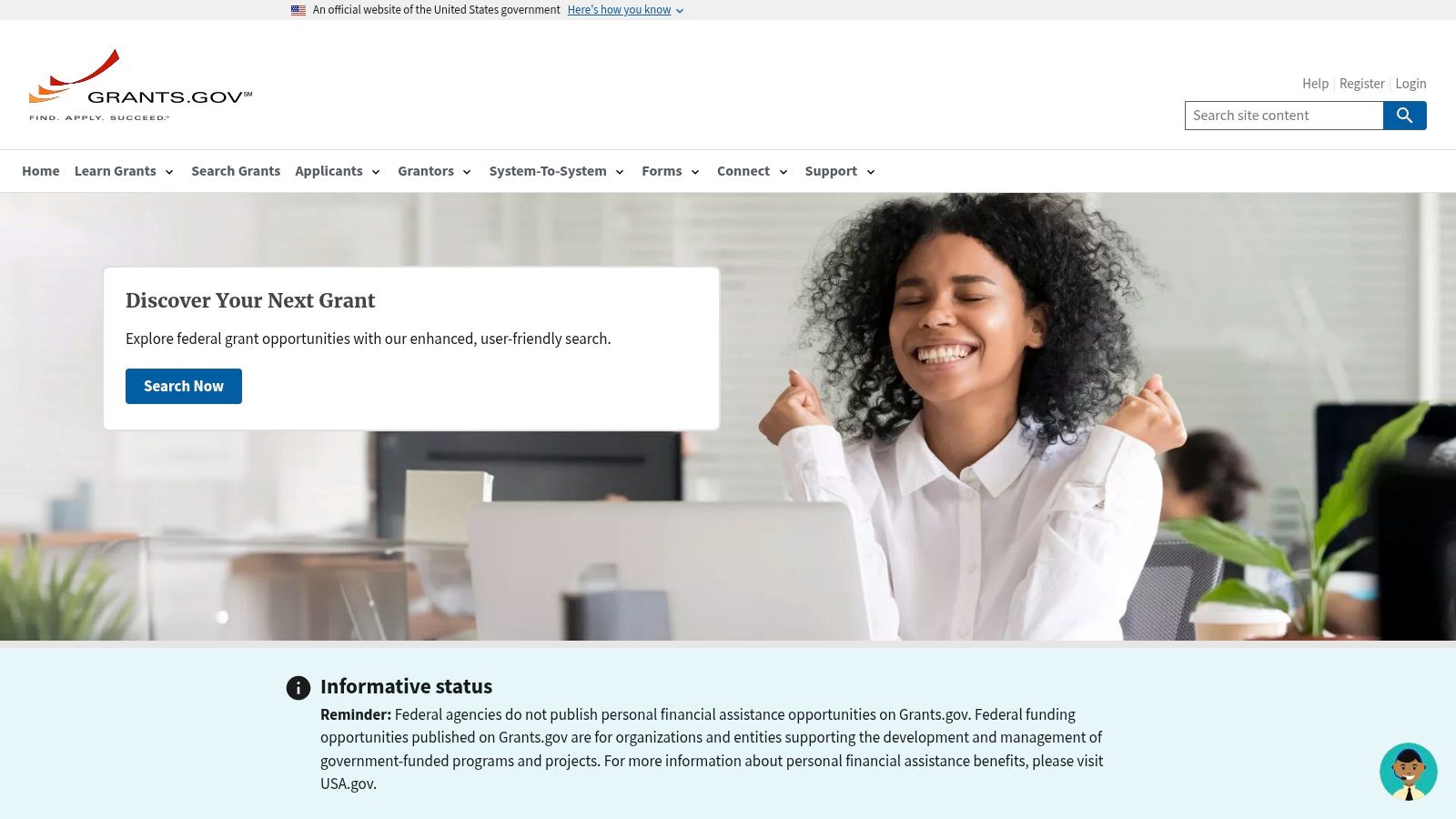
Registration is the hurdle that blows a deadline. Credentials and an organizational account need to exist before the last week. If your team has never filed a federal package, how to get a federal grant lays out the sequence. Subscribe to the opportunities you might actually be eligible for, and download the full instructions rather than a blog summary.
Private foundations will not appear. I keep Grants.gov as the federal half of a shortlist and look for foundation money somewhere else. Free search is the pro. Complex eligibility, and the fact that a hit is not an invitation, is the con.
4. IES Transformative Research in Special Education (84.324T)
Higher-education institutions and other organizations that can run scientifically valid research are the applicants. A resource teacher cannot use this for a sensory kit. A nonprofit belongs only if it can carry the research role, usually beside a university partner.
The FY 2027 competition focuses on Phase 1 work to improve preservice systems so they attract, train, and retain qualified pre-K through grade 12 general and special education teachers. The listed deadline is December 11, 2026. The notice lists an award ceiling of $3.75 million and requires cost sharing or matching. That date is still ahead. The design bar is the true filter.
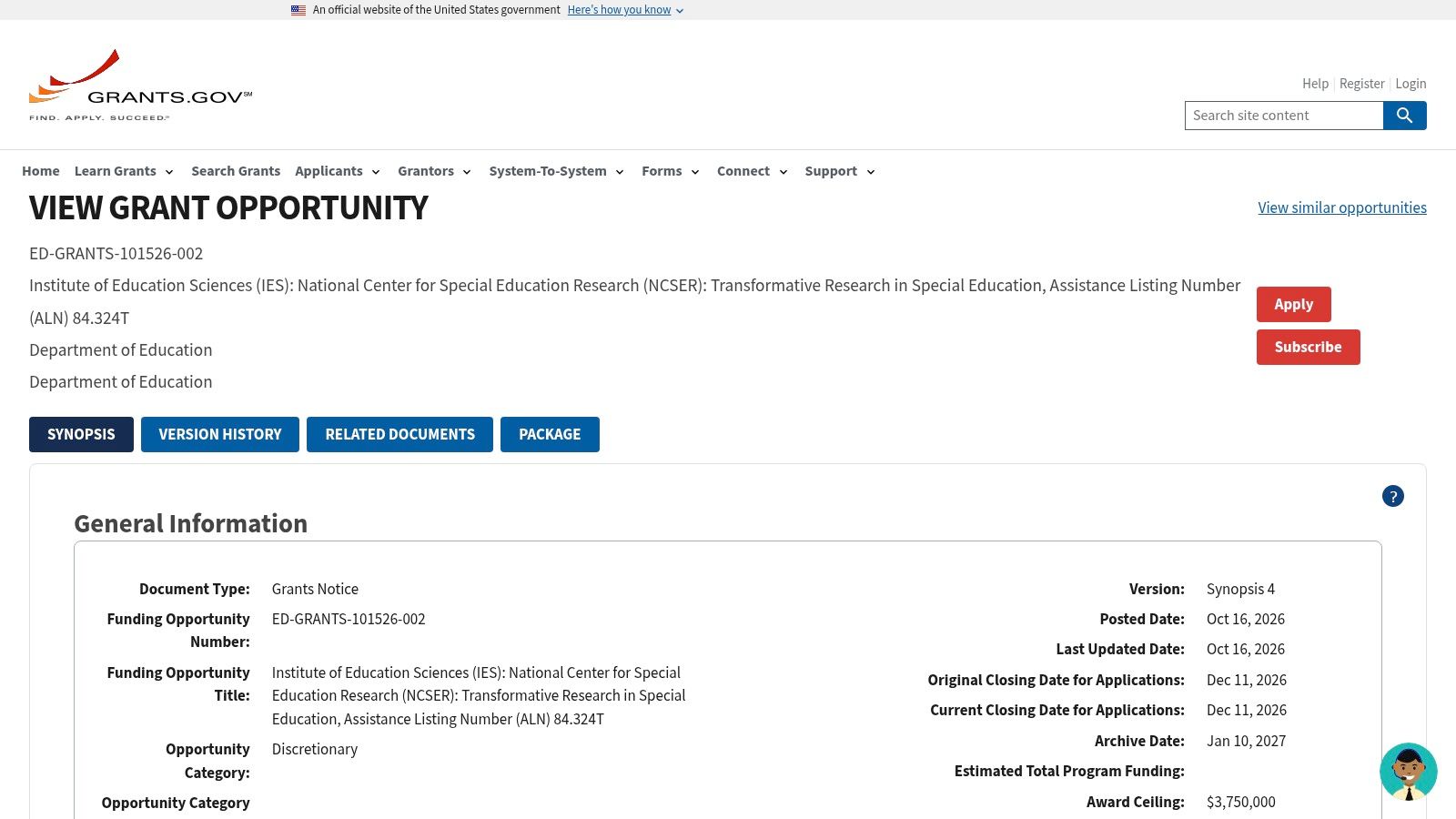
A $3.75 million ceiling does not turn this into a flexible program grant. If you cannot defend the methods, skip the date.
Reviewers want a research plan and a scalable approach to a special education problem, not a service narrative from one school. The IES 84.324T notice on Grants.gov is the document that counts. I would enter only with a named principal investigator and a sourced match. Otherwise December 11 is a distraction from smaller awards you can finish.
5. Educational Technology, Media, and Materials for Individuals with Disabilities (84.327)
Nonprofits, colleges, state or local education agencies, and similar groups with a systems project should look here. Teachers buying one classroom set should not. There is no standing 2026 application that every organization can file today. Funding depends on a specific competition under Assistance Listing 84.327.
The work covers accessible educational technology, media, and materials. That includes accessible-format textbooks, captioning, described video, and technology meant to improve access and outcomes for students with disabilities. A proposal that only says "we will buy devices" does not match the program.
Fit check before anyone drafts:
- Scale: the material or tool should serve beyond a single building.
- A defined product: say who produces it, who distributes it, and how you will know students can use it.
- The notice: match the competition's eligible applicants, not the program nickname.
The 84.327 program page is the right description. Then confirm a live notice. If nothing under this listing is open, wait. Recycling last year's narrative into a closed competition wastes the only scarce thing you have, staff time.
6. AdoptAClassroom.org Inclusive Classroom Fund
Classroom educators can apply. Nonprofits cannot use this for general operations. The 2026 fall cycle is open. Applications are due November 2, 2026, with at least 50 grants of $500 each.
The fund names special education students, English learners, and students pushed to the margins by social or economic conditions. You need a registered teacher account and a classroom page that states the need and the student benefit. Selection is competitive. High-needs schools, and educators with little recent funding on the platform, tend to sit closer to the front.
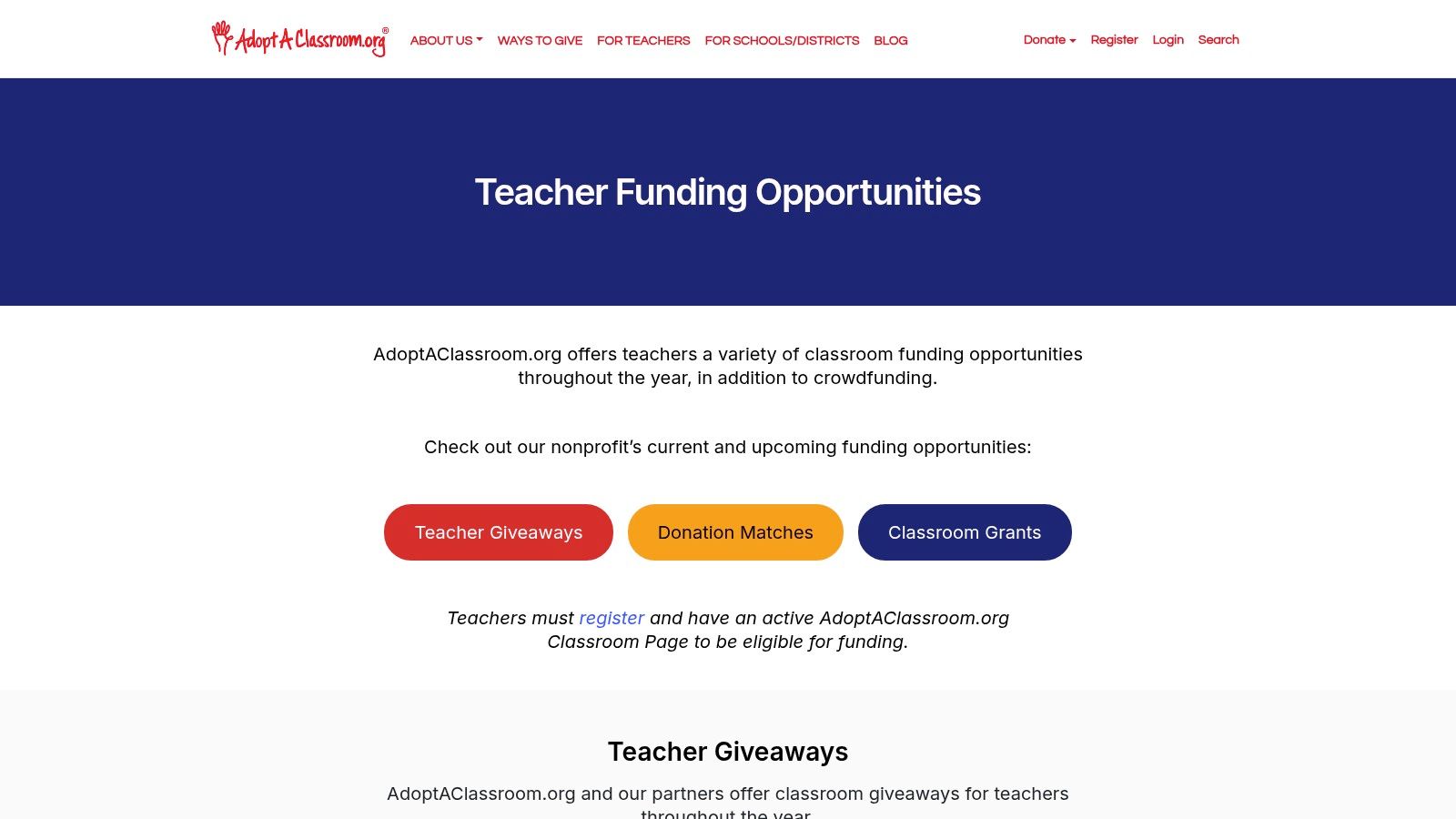
Five hundred dollars covers part of a $900 sensory kit. It will not fund a parent-workshop series or a nonprofit's payroll. Name one access barrier and one tool. Teachers who describe following spoken conversations with on-screen text give a reviewer a concrete use, not the word "technology."
Apply on the AdoptAClassroom teacher funding page. The classroom page can keep drawing other donations after the decision, which is the feature I would not skip. One tight paragraph, the students served, and a submit before November 2. A half-built dashboard is not an application.
7. The Hambrick Foundation Grants
The 2026 cycle is closed. The published window is August 1 through September 30, so a new request will not be read until the foundation opens the next round.
When it is open, U.S. special-needs educators can request up to $3,000 for adaptive tools, sensory resources, software, books, and equipment. You generally must be tied to a nonprofit 501(c)(3). The population served must be at least 75% people with special needs, aside from exceptions the foundation states. Routine expenses, curriculum, and permanent facility work are out.
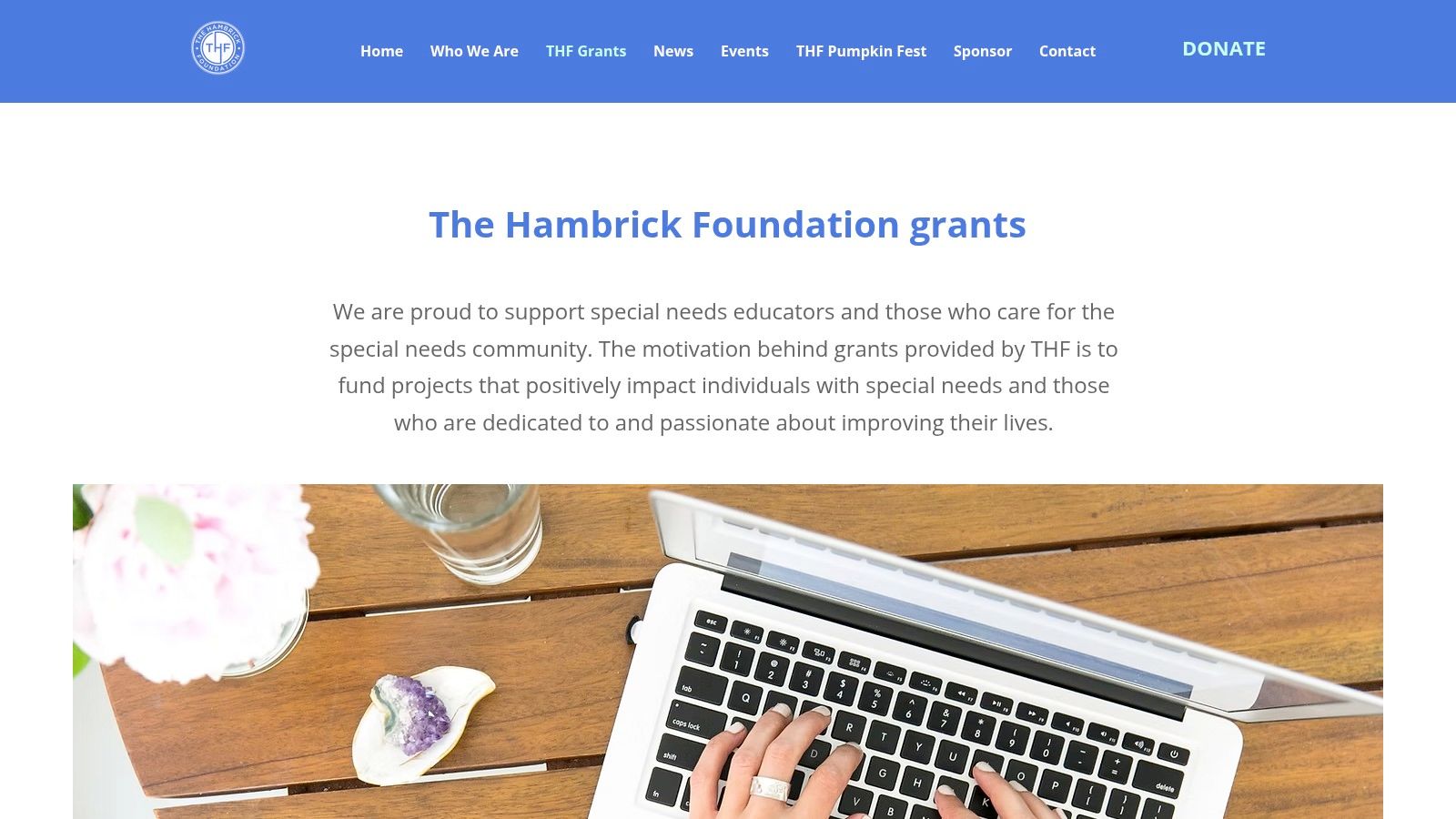
The affiliation rule is what knocks out solo teachers. If the school or a partner charity will not be the applicant, you are not eligible. That is a harder bar than most $500 classroom funds, and the higher ceiling is why people still watch it.
What to copy from published recipients:
- One project: a single classroom or program, not a wish list.
- The 75% test: show who is served, not a slogan about inclusion.
- Named items: tools and equipment, not "supplies and curriculum."
Read the Hambrick Foundation grant page before you sketch next year's project. For how private awards differ from federal notices, see private foundation grants for nonprofits. I would set a reminder for July. An August 1 open and a September 30 close is a short runway.
8. Philanthropic Ventures Foundation Special Education Resource Grants
Teachers and therapists can apply. Nonprofits seeking general support cannot. Applications are being accepted for the 2026-2027 school year, so this window is open.
Awards go up to $1,000 for TK-12 students with moderate to severe disabilities at eligible low-income public schools in Alameda, Contra Costa, San Francisco, and San Mateo Counties. Materials, sensory and speech-language resources, field trips, and professional development can fit. A principal must sign. The check goes to the school, district, or PTA, not to the teacher.
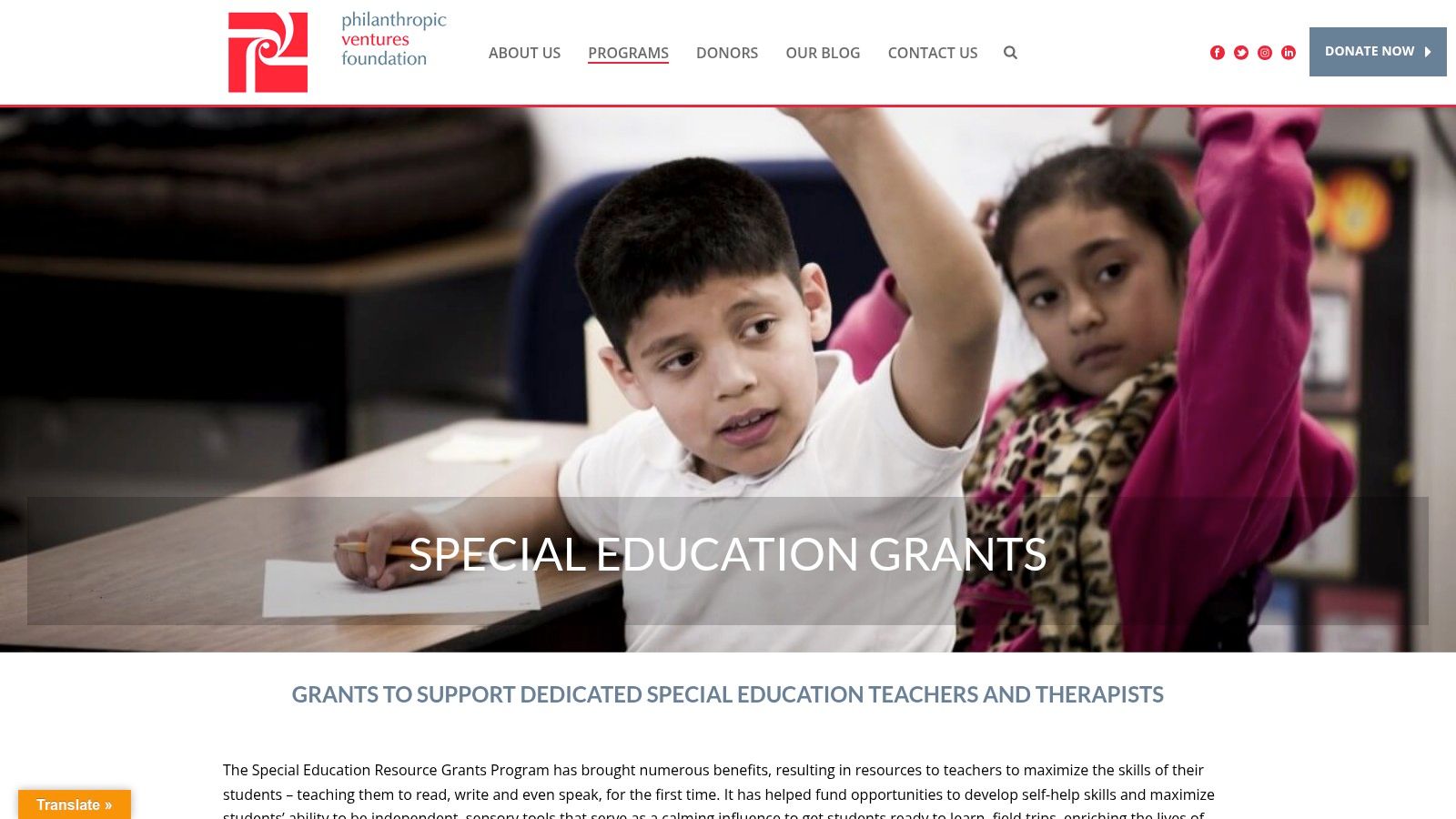
Geography ends more applications than weak writing. A careful sensory request from outside those four counties fails. So does a request from a school that is not an eligible low-income public school.
If the payment cannot go to the school, district, or PTA, do not apply.
The special education resource grants program posts the details and prior recipient examples. If the county test fails, look at other education funder listings instead of stretching this form. Ask the principal for the signature early. A complete packet with no signature is still incomplete.
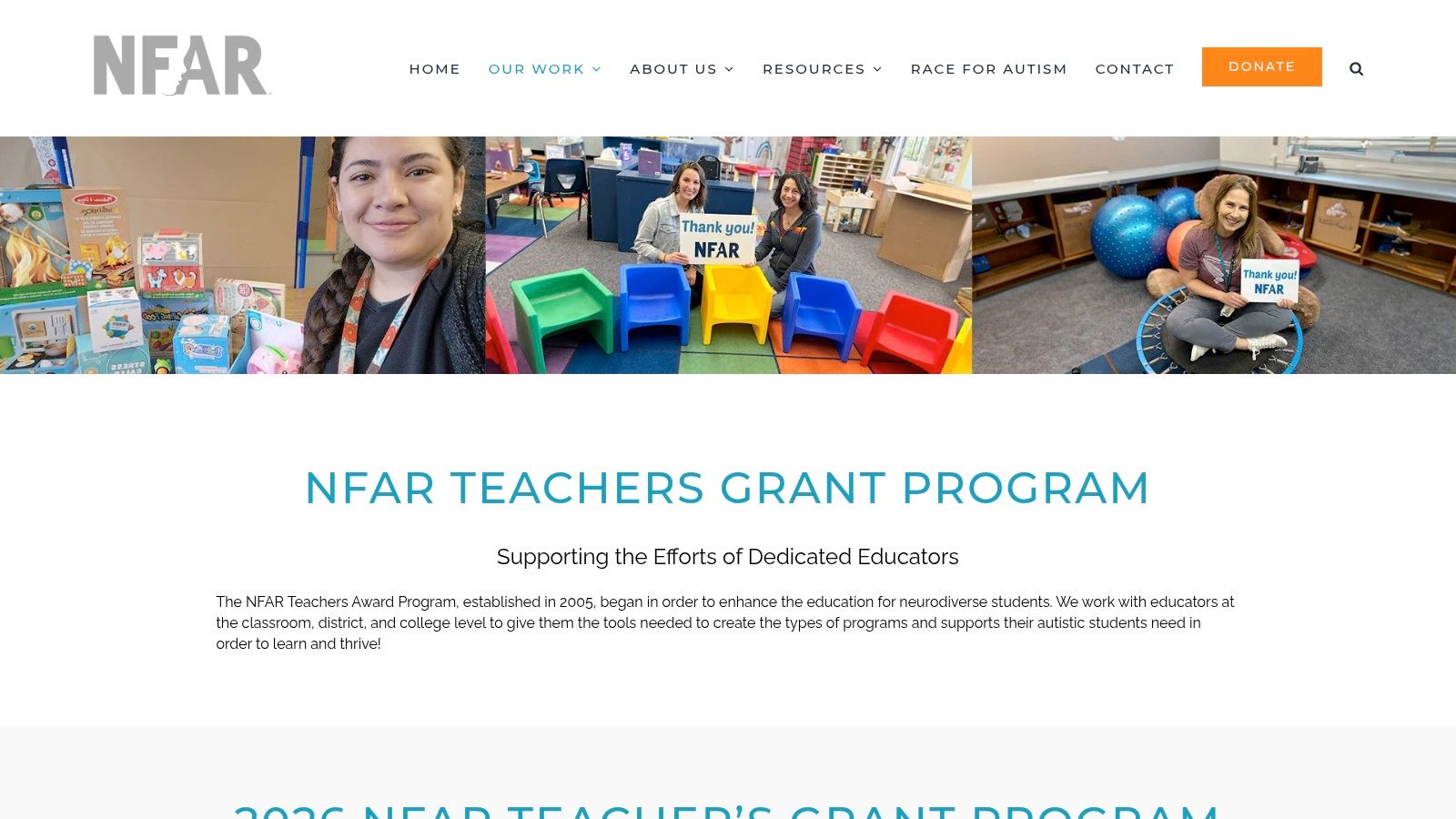
9. National Foundation for Autism Research (NFAR) Teacher Grants
The 2026-2027 deadline has passed. Applications were due September 30, 2026. Do not build a new packet for this cycle.
When the program is open, it is limited to San Diego County educators who support autistic students. Autism specialists, teachers, speech-language pathologists, occupational and physical therapists, and resource teachers can apply, from pre-K through transition and specialized college programs. Funds can cover educational programs, materials, equipment, communication and social-skills work, and tools aimed at sensory or behavioral barriers. Awards average $500, and requests can go up to $1,000. The foundation does not take multiple requests for the same classroom or initiative.
County lines matter more than the quality of the idea. A nonprofit cannot reroute this teacher award into its own operating budget, and an educator outside San Diego County cannot qualify by serving autistic students somewhere else.
The NFAR teacher awards page lists recent awardees, which is the best preview of what has been funded. For the next opening, keep one request per classroom, stay inside the county, and treat $1,000 as a ceiling rather than a number you must hit. A named material and a named barrier beat a vague line about autism supports.
10. Foundation for Developmental Disabilities Program Grants
Eligible local nonprofits can apply. Individuals cannot. The next listed deadline is December 17, 2026, so this window is still ahead if you missed earlier 2026 dates.
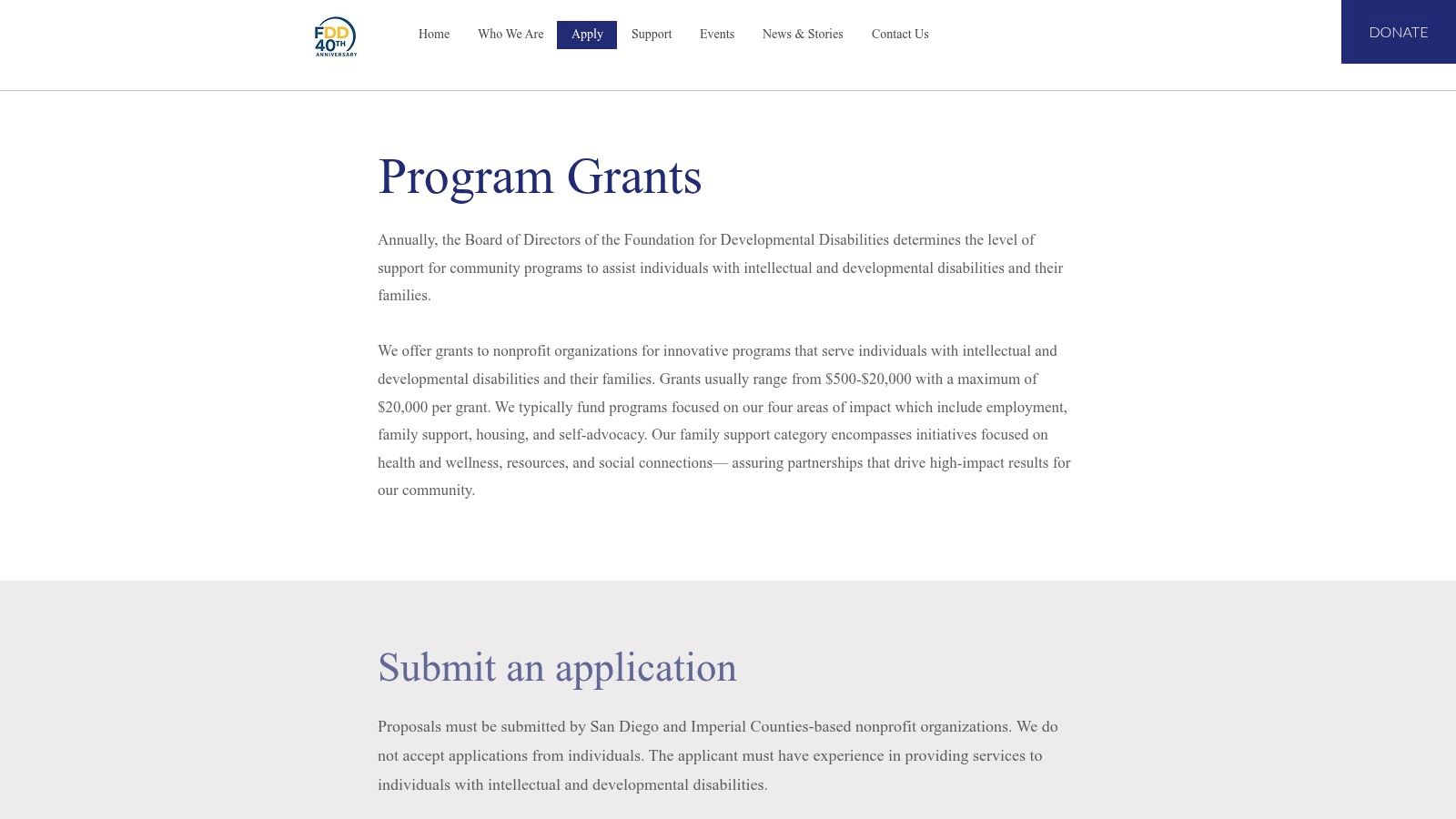
The foundation serves people with intellectual and developmental disabilities and their families in San Diego and Imperial Counties. Typical awards run from $500 to $20,000 for family support, employment, housing, self-advocacy, and related work. An education project can fit when it lines up with those priorities. You generally get one program per organization per fiscal year. Capital items costing $500 or more are ineligible, and indirect costs are generally expected below 20%. Relevant local service experience is part of the test.
Screen the budget before the story:
- Place: San Diego or Imperial County, not a statewide claim.
- One program: a second request in the same fiscal year is out.
- Costs: drop capital at $500 or more, and keep indirects inside the posted limit.
The program grants page lists the 2026 dates. December 17 is the one to calendar. A school-based nonprofit can compete here in a way it cannot compete for a teacher mini-grant. A teacher without an eligible nonprofit cannot. That split is the whole point of sorting special education grants by applicant instead of by keyword.
How the 10 special education grant programs compare on award size, eligibility, and 2026 status
| Item | Typical Award | Who Can Apply | Deadline or Status | Geography |
|---|---|---|---|---|
| U.S. Department of Education: Special Education and Disabilities Grant Programs | Varies by program | Eligible organizations vary by program | Program listings; deadlines vary | United States |
| IDEA Part B and Part C State Formula Grants | Varies by state and formula | States receive federal funds; nonprofits may seek local partnerships or subgrants | Recurring state formula funding; local opportunities vary | United States |
| Grants.gov | Varies by opportunity | Eligibility varies by federal opportunity | Search portal; deadlines vary by opportunity | United States |
| IES Transformative Research in Special Education (84.324T) | Up to $3.75 million | Higher-education institutions and other organizations able to conduct valid research | Applications due December 11, 2026 | United States |
| Educational Technology, Media, and Materials for Individuals with Disabilities (84.327) | Varies by competition | Nonprofits, higher-education institutions, education agencies, and other eligible organizations | Competition schedule varies | United States |
| AdoptAClassroom.org Inclusive Classroom Fund | $500 per selected classroom | Educators with a registered teacher account and classroom page | Applications due November 2, 2026 | Nationwide |
| The Hambrick Foundation Grants | Up to $3,000 | U.S. special-needs educators generally affiliated with a 501(c)(3) serving a qualifying population | 2026 cycle closed; usual window is August 1–September 30 | United States |
| Philanthropic Ventures Foundation: Special Education Resource Grants | Up to $1,000 | Teachers and therapists at eligible low-income public schools | Accepting applications for the 2026–2027 school year | Alameda, Contra Costa, San Francisco, and San Mateo Counties, California |
| National Foundation for Autism Research (NFAR) Teacher Grants | Average $500; requests up to $1,000 | Educators supporting autistic students | 2026–2027 deadline passed September 30, 2026 | San Diego County, California |
| Foundation for Developmental Disabilities Program Grants | Typically $500–$20,000 | Eligible local nonprofits serving people with intellectual and developmental disabilities and their families | Next listed deadline is December 17, 2026 | San Diego and Imperial Counties, California |
Build a Shortlist Before the Next Deadline Closes
Confirm who can apply before you open a form. Classroom educators still have AdoptAClassroom through November 2, 2026, and Philanthropic Ventures Foundation for the 2026-2027 school year inside four Bay Area counties. Hambrick's August-September 2026 window is closed. NFAR's September 30, 2026 deadline has passed. Nonprofits in San Diego or Imperial County should look at the Foundation for Developmental Disabilities on December 17, 2026. Universities with research capacity have IES 84.324T on December 11, 2026, and that is not a service grant. State agencies sit on Part B and Part C formula funds. Everyone else reaches that money only through a state or district channel.
Side doors matter because the federal formula does not keep pace with identification. Bellwether's FY2024 analysis reports about 7.8 million public-school students identified for special education, nearly 16% of enrollment, while IDEA Grants to States stayed roughly flat at $14.2 billion. After inflation that was an estimated 6% year-over-year decline, and inflation-adjusted federal funding per individualized-education-program student fell from about $2,270 in FY2016 to $1,820 in FY2024.
Save two or three programs that match your applicant type, your geography, and a window that is open. Put December 11 and December 17, 2026 on a calendar if those two fit, and November 2 if you are the teacher with the sensory kit. Grantlas can score private foundations and open federal grants against an organization profile and flag a geography, budget, or applicant mismatch before anyone drafts. That beats another unsifted list of special education grants.
Check every program on its official page before you apply. Dates move, county rules do not soften, and a closed cycle stays closed even when an old link still loads.
Grantlas builds a scored shortlist of private foundations and open federal grants from your nonprofit's website or EIN, including special education grants a community group can actually receive. Each score includes plain-English reasons and flags for geography, applicant type, and grant size, so you stop drafting for awards that were never open to you. Visit Grantlas and run your profile against the next deadlines before another window closes.