7 Sample Nonprofit Grant Proposals to Study
Sep 19, 2026 · 14 min read
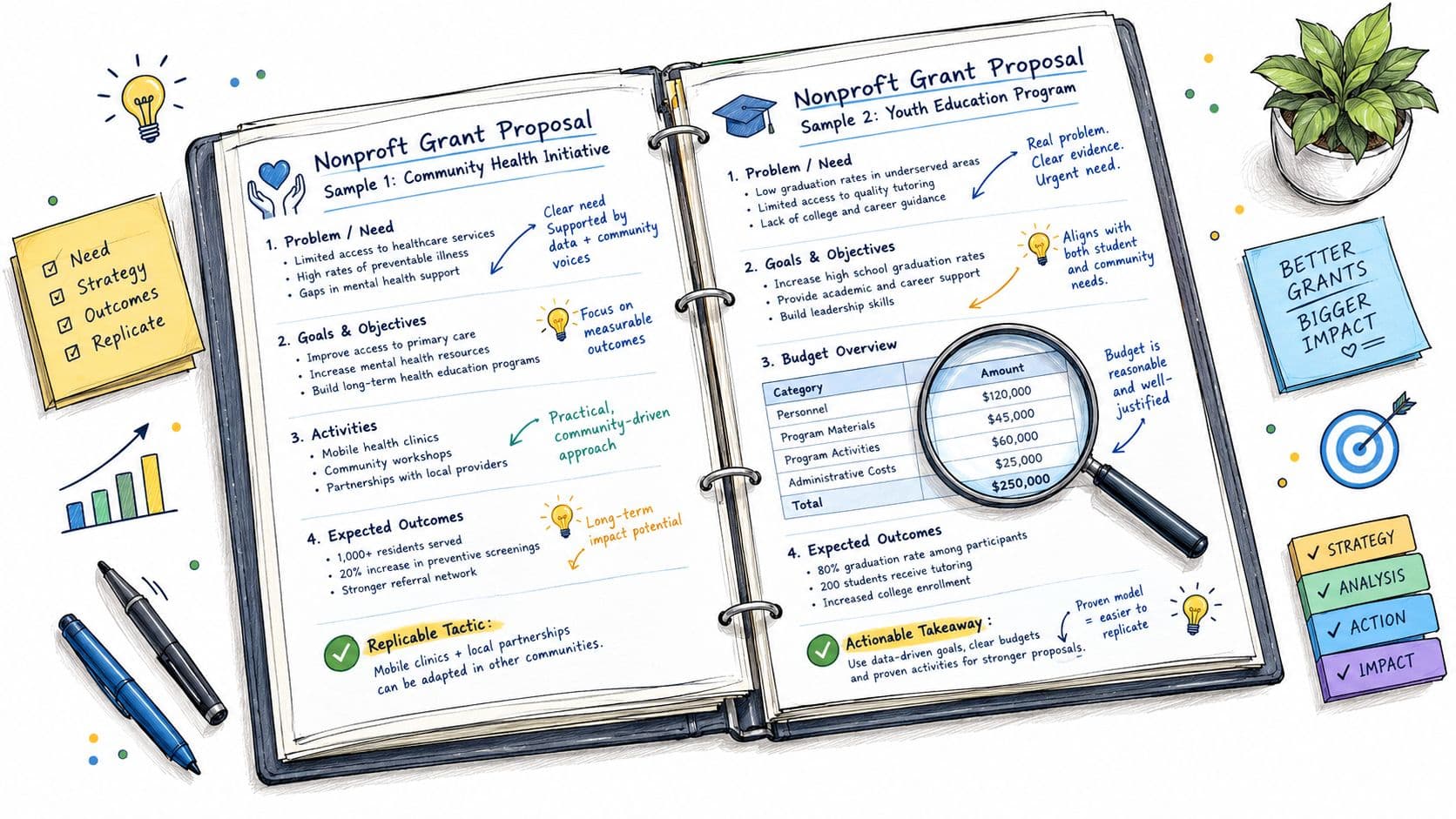
Most advice about sample nonprofit grant proposals is too literal. It treats a funded example like a reusable script, when the value sits somewhere else: in the match between the proposal and the funder that asked for it. A private foundation narrative, a federal research application, and an arts education project summary may all be “samples,” but they answer different reviewer questions, use different evidence standards, and tolerate very different levels of technical detail.
Read samples like an analyst, not a copier. First, identify the request the sample is answering. Then trace the logic from need to activities to outcomes. Next, inspect how the budget supports the narrative, especially where staffing, evaluation, and partnerships appear. Finally, verify every section against the current guidance for your target funder, because a persuasive structure can survive across competitions even when wording, attachments, and review criteria change.
That matters in a crowded environment. Recent fundraising survey figures compiled by Double the Donation report that 91% of respondents submitted at least one grant application in the prior year, 38.9% applied for more than 10 grants in 2025, and 88% of those who applied received at least one grant award. For writers studying sample nonprofit grant proposals, the lesson isn't “copy faster.” It's build drafts that can be adapted repeatedly over long timelines.
Before tailoring any sample, use Grantlas to identify funders that fit your organization. Its fit reasoning and eligibility flags help you avoid adapting a strong proposal to a mismatched private foundation or an ineligible federal opportunity.
Table of Contents
- 1. Candid Learning, Sample Documents Library
- 2. The Grantsmanship Center, Model Proposal + Sample Proposals
- 3. Nonprofit Guides (npguides.org), Full Private and Public Sample Proposals
- 4. NIH, Sample Applications and Summary Statements
- 5. NEH, Sample Funded Narratives (FOIA)
- 6. NEA, Sample Arts Education Narratives (plus program guidance)
- 7. U.S. EPA, Superfund TAG Sample Application Package
- 7 Sample Nonprofit Grant Proposal Comparison
- Turn Examples Into a Fundable Draft
1. Candid Learning, Sample Documents Library
Candid Learning's Sample Documents Library is the best starting point if you need range instead of one idealized model. It collects funded materials from nonprofits, including proposals, letters of inquiry, budgets, cover letters, and related documents. That mix matters because many writers overfocus on the narrative and under-study the support pieces that frame reviewer expectations.
The library works especially well for private foundation and corporate giving research. You can compare how different organizations package the same core elements, then decide which moves are structural and which are situational.
What it demonstrates well
A large library teaches pattern recognition. You start seeing how often funded requests simplify the story, foreground fit, and keep the budget logic close to the activities.
Use it for these moves:
- Compare document sets: Don't just read the main proposal. Read the cover letter, budget, and any attached plan to see what the applicant chose to explain where.
- Track recurring sections: Note how often funded examples move from need to program design to evaluation, even when headings differ.
- Study funder-facing tone: Strong samples usually sound specific and calm, not ornamental.
Practical rule: When several funded examples explain staffing, partnerships, or evaluation in similar ways, copy the function of that section, not the wording.
Candid is also useful when your nonprofit is building reusable proposal modules for multiple funders. If you're still early in prospecting, pair it with a funder search workflow such as Grantlas's guide to grants for nonprofits so the sample you study matches a realistic target list.
Where writers misuse it
The main risk is age and drift. Some examples are older, and none are created for your live opportunity's exact language. That's not a flaw in the library. It just means you should treat each sample as evidence of what has worked somewhere, not what will satisfy your next submission portal.
A 2004 Candid/Foundation Center survey found that 35% of 878 grantmakers funded 50% or more of the requests they received, while only 11% of foundations in the high-volume group receiving more than 1,000 proposals funded at least half of requests. The useful inference is sharper than “grantmaking is competitive.” Reviewer context changes with proposal volume and funder scale, so a sample from one setting may teach formatting but not selectivity strategy.
2. The Grantsmanship Center, Model Proposal + Sample Proposals
The Grantsmanship Center sample proposal resources are less about browsing examples and more about learning proposal anatomy. The value is the model itself. It gives first-time writers a stable structure for private foundation requests, especially when the funder doesn't prescribe a rigid federal-style sequence.
This is the strongest resource on the list for learning section purpose. If your team struggles to distinguish need from methods, or objectives from evaluation, the model helps.
Best for first-draft discipline
The Grantsmanship Center's long-running framework is useful because it imposes order. Writers can draft one section at a time, then check whether each claim earns its place.
Try these adaptation moves:
- Translate broad headings into funder language: Keep the logic, but rename sections to match the application form.
- Tighten support materials: If the funder asks for letters, align them with the proposal's exact goals and partnerships. A sample letter of support for grant requests can help you standardize that package.
- Strip out generic mission filler: The model invites clarity. Use it to reduce organizational background to what's necessary for reviewer confidence.
A model proposal is most useful when your draft is vague. It's less useful when your draft is already specific and the real problem is funder mismatch.
Where it falls short
Its examples are intentionally generic. That helps with teaching, but it can also hide the harder question: whether your project fills a real service gap rather than describing a real problem.
That distinction has become more important. One recent grant writing guide argues that “Funders fund gaps, not problems”, which is a better lens for using a model proposal than filling in standard sections. The model tells you where the need statement goes. You still have to prove that current services are insufficient, who else is serving the space, and why your organization's intervention is the necessary one.
3. Nonprofit Guides (npguides.org), Full Private and Public Sample Proposals
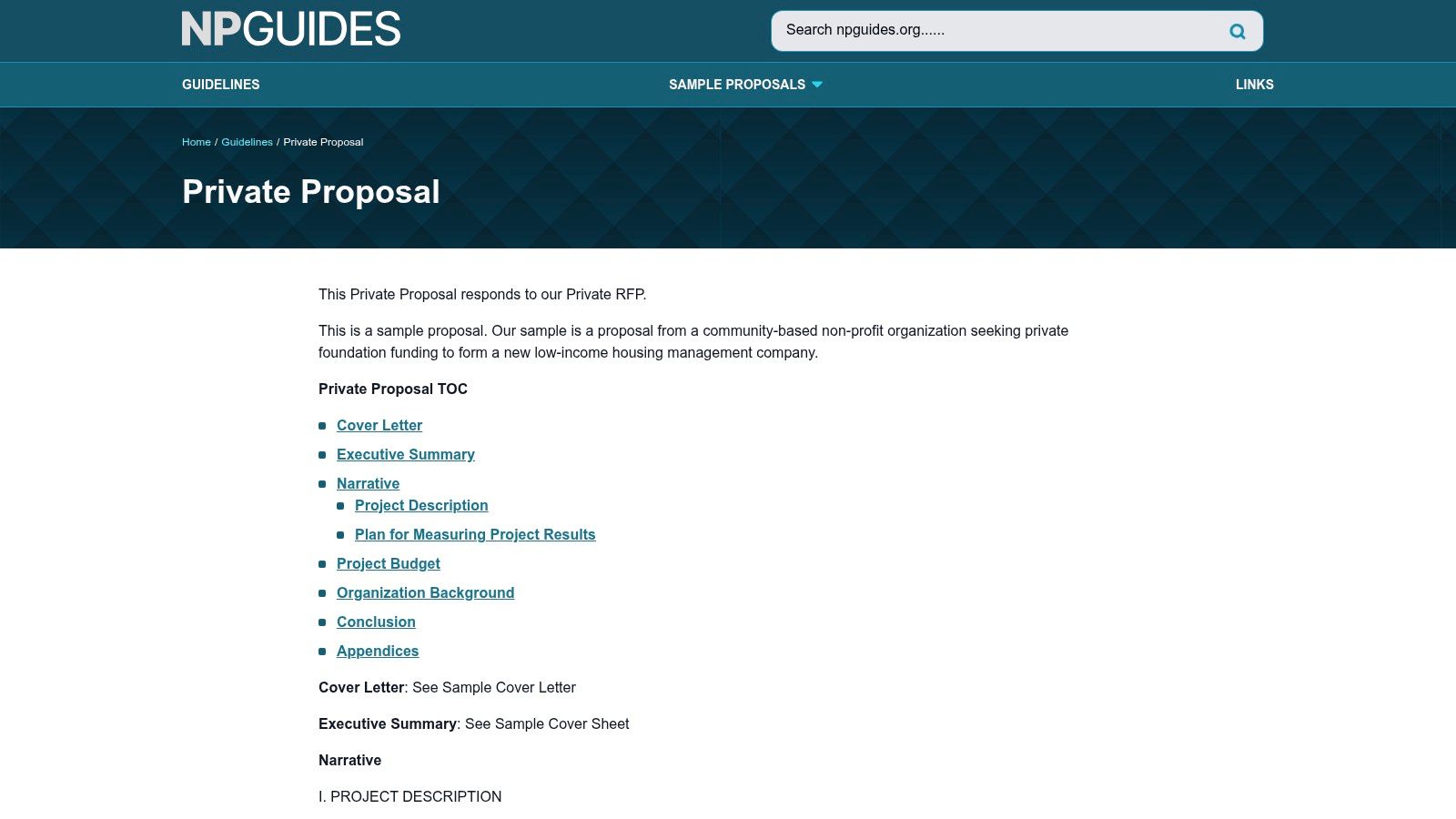
Nonprofit Guides offers something many resource libraries don't: complete, plain-English proposals you can read end to end in one sitting. One sample targets a private foundation. Another mirrors a public agency style. That contrast is the point.
If you've only seen fragments, this site helps you understand pacing. You can watch how a proposal opens, narrows the problem, explains implementation, and closes the loop.
Read the pair side by side
The private and public examples reveal how audience changes emphasis. Foundation-oriented writing usually grants more room for mission fit and organizational story. Government-oriented writing pushes harder on program mechanics and explicit compliance cues.
Use the pair to ask:
- What changed because the funder changed: Look for differences in tone, section order, and operational detail.
- What stayed stable: Need, approach, capacity, and budget logic still have to connect.
- What must be rebuilt: Dates, formatting norms, and submission requirements need a full refresh.
For teams creating a reusable institutional draft, this sample grant proposal for non profit organization guide can help bridge from a broad model to a proposal set.
The hidden lesson in these older samples
Because the formatting is dated, many writers dismiss them too quickly. That's a mistake. Their real usefulness is comparative. They show how the same organization could frame work differently for a private versus public audience.
A scan of foundation applications reported by Grantboost found that 91% of 75 foundation applications did not ask applicants to show how their work would contribute to measurable foundation-level outcomes, and only 9% explicitly required applicants to connect to population-level foundation outcomes. That makes these side-by-side samples more instructive than they first appear. If many competitors still write at the activity level, your adaptation advantage is to keep the accessible structure but rewrite outputs as funder-aligned outcomes.
4. NIH, Sample Applications and Summary Statements
NIH sample applications and documents are useful precisely because they are not general nonprofit templates. They reflect a review environment with explicit scoring criteria, specialized peer reviewers, and a higher burden of proof than many private foundation applications. That makes them a strong comparison point for health nonprofits, behavioral health organizations, research partnerships, and any team applying where method quality will be examined closely.
The most instructive resource is not just the funded application. It is the paired summary statement. A funded narrative shows the final product. The reviewer comments show what the panel still questioned, what it valued, and which weaknesses were tolerated because other strengths were persuasive.
Read NIH samples as a two-column exercise:
Application: how the applicant framed significance, aims, methods, and capacity
Summary statement: how reviewers translated that framing into strengths, weaknesses, and score-driving concerns
That pairing reveals something many sample libraries cannot. Fundability is not only about sounding credible. It is about reducing reviewer uncertainty in the places the rubric rewards.
What NIH demonstrates, and what nonprofit writers should adapt
NIH samples demonstrate a specific evidence standard. They are built to survive scrutiny on design logic, feasibility, investigator capacity, and measurement. Few nonprofits should copy the length, structure, or technical density unless they are pursuing NIH or a similar federal research grant.
The transferable moves are narrower and more useful:
- Lead with the testable claim. State what will change, for whom, and how you will know.
- Define the method before the promise. Reviewers trust impact claims more when staffing, procedures, and data collection appear early.
- Write to anticipated objections. If recruitment is hard, data quality is uncertain, or implementation depends on partners, address that inside the narrative.
- Separate significance from approach. A strong need statement does not substitute for a credible execution plan.
A practical way to mine these samples
Instead of reading for inspiration, annotate for reviewer pressure points.
Use this checklist:
- Mark every place the applicant makes a claim about need, intervention quality, or expected outcomes.
- Check whether the next paragraph supplies evidence, protocol detail, or prior results.
- Compare those passages against reviewer comments in the summary statement.
- Note which concerns were about science, which were about implementation, and which were about clarity.
That distinction matters outside NIH. A community health nonprofit may not need a research design section at NIH depth, but it still benefits from knowing whether a likely reviewer concern is about program theory, staffing, data collection, or organizational readiness.
Best use case
Use NIH samples if your proposal will be judged by specialists, if your outcomes claims are ambitious, or if your program relies on evaluation credibility to win. Use them less as formatting models and more as calibration tools for evidence expectations.
5. NEH, Sample Funded Narratives (FOIA)
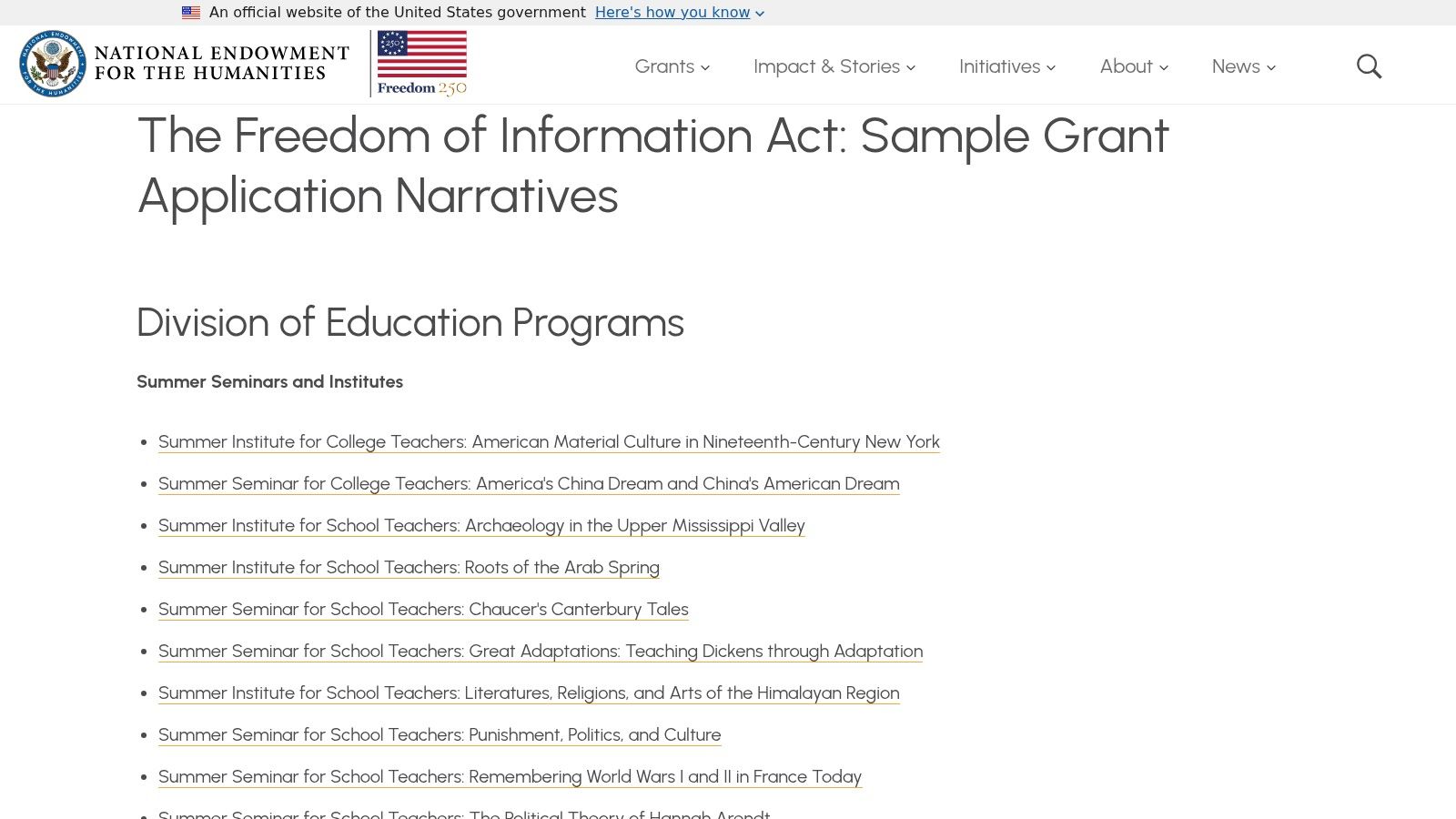
The mistake with NEH samples is assuming they function like generic grant templates. They do not. NEH sample grant application narratives are better used as evidence of how a specific humanities program defines merit, feasibility, and public value.
That distinction matters because NEH review is highly program-bound. A preservation project, a public humanities initiative, and a teaching-focused proposal may all sound "humanities-centered" internally while being judged against different standards in practice.
A Nova Southeastern University analysis of NEH nonprofit project proposals found wide variation in program-level success rates and an overall low funding rate of 16% in the study. The practical conclusion is simple. Sample selection matters almost as much as sample quality.
Read each funded narrative as a record of reviewer expectations under a particular set of conditions:
What counts as a strong argument at NEH depends on the program's theory of value. Some competitions reward scholarly contribution first. Others put more pressure on access, audience reach, or implementation detail.
That changes how a nonprofit should annotate these examples.
If you run a museum, archive, library, or public history organization, look for four signals:
- Boundary control: The proposal limits the project to work that can be finished with the staff, time, and materials named.
- Humanities rationale: The narrative explains why the content, interpretation, or preservation work belongs in a humanities competition rather than only a general community program.
- Audience pathway: Public benefit is specified. Who will use the resource, attend the program, access the archive, or engage the interpretation.
- Operational proof: Staffing, partnerships, rights, collections access, or technical workflow appear clearly enough that the plan can be judged as executable.
One useful contrast with foundation proposals: elegant mission language carries less weight here if the work plan is thin. NEH samples often succeed because they convert cultural significance into reviewable tasks, sequence, and outputs.
Use that pattern directly in your own draft. If a sample spends two paragraphs establishing scholarly context before introducing activities, ask whether your funder expects that order. If a sample names advisors, collections, and production steps early, that signals a reviewer concern about feasibility, not style.
Adaptation moves
Copy the logic, not the prose.
- Match your sample to the exact NEH program before borrowing any structure.
- Separate intellectual significance from project management so each can be evaluated on its own terms.
- Replace broad claims about "community impact" with a concrete access route, exhibition, curriculum use, digitized collection, public program series, or publication plan.
- Trim any activity your team cannot document with staffing, timeline, permissions, or partner commitments.
The best NEH samples show restraint. They promise work that fits the evidence, the budget, and the institution's actual capacity. For humanities nonprofits, that is the lesson to carry over.
6. NEA, Sample Arts Education Narratives (plus program guidance)
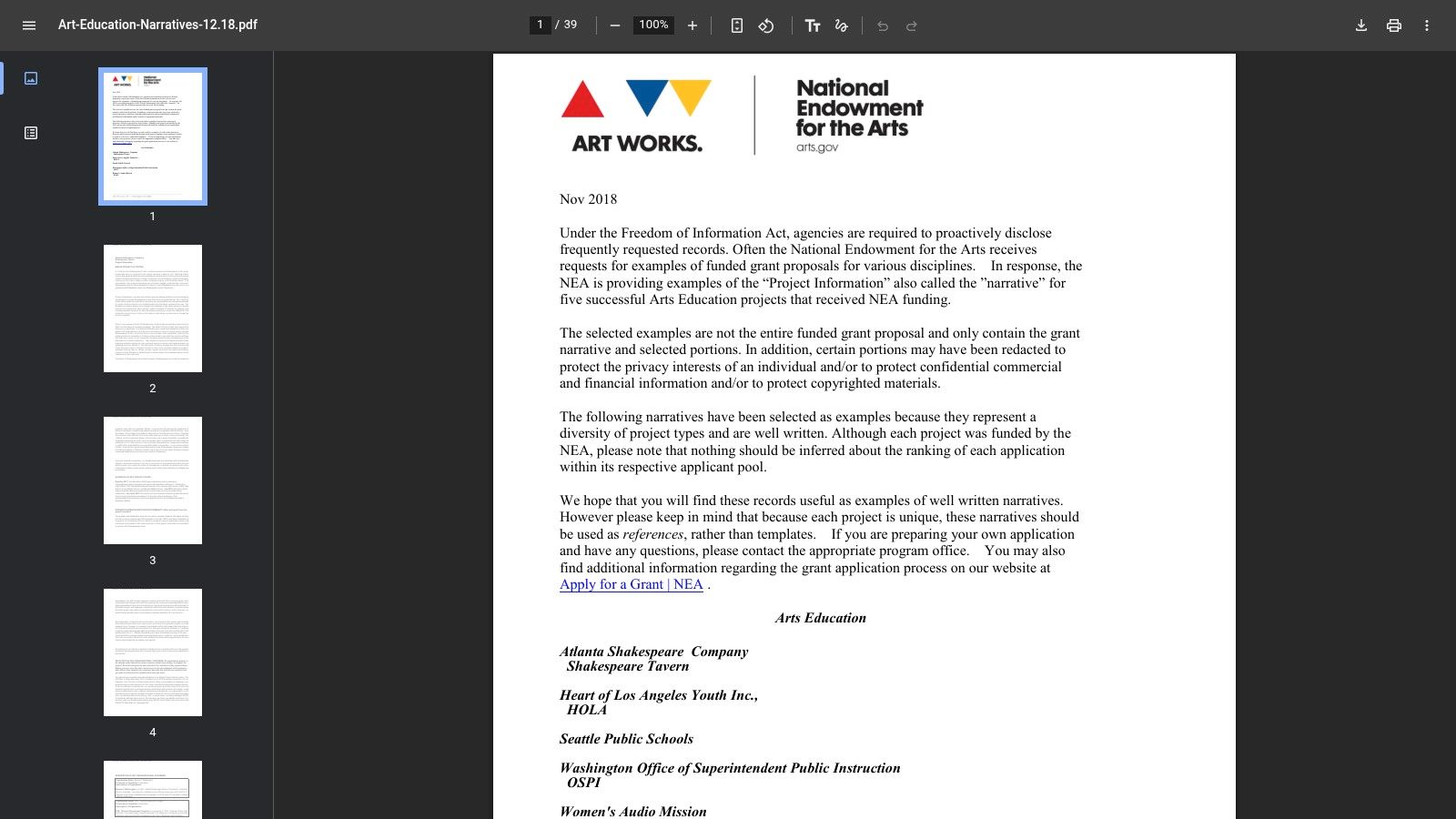
The NEA Arts Education sample narratives PDF is short, which is exactly why it's useful. Many arts nonprofits don't need another long theory of grant writing. They need to see how a funded narrative compresses need, artistic approach, partnerships, and public benefit into a form reviewers can score quickly.
These examples also work well for organizations outside pure arts education if their programs blend community engagement, instruction, and outcome reporting. The prose is concise, and the structure rewards clarity.
What arts nonprofits should copy
Not the language. The compression.
Strong adaptation tactics include:
- Lead with the project, not the institution: Reviewers need to know what will happen first.
- Name the participants precisely: General audience language weakens community benefit claims.
- Show measurement without overengineering it: Enough evaluation to prove learning or access, not pages of abstract methodology.
A good NEA-style narrative often feels lighter than a federal research proposal but more disciplined than a typical foundation request. That's a useful middle ground for many sample nonprofit grant proposals.
The common mistake with these examples
Writers often treat concise narratives as easy narratives. They aren't. Brevity leaves no room for unsupported claims or vague partnerships. If the sample mentions collaboration, your version needs named roles, concrete activities, and a visible link to outcomes.
Use the sample as a drafting ceiling. If your arts proposal needs many more words to explain the same project logic, the project design probably isn't tight enough yet.
7. U.S. EPA, Superfund TAG Sample Application Package
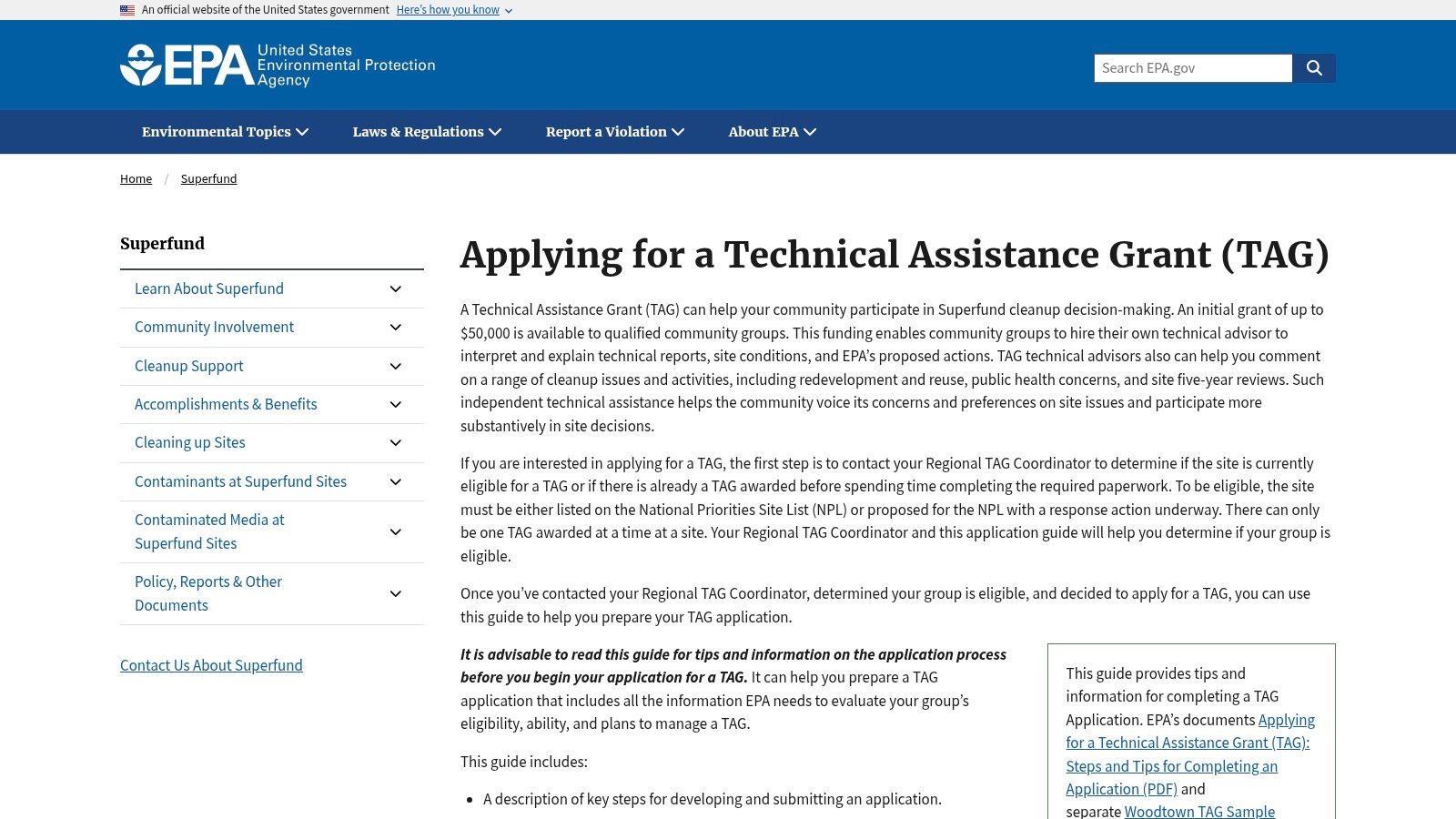
Broad sample proposals are often overrated. The EPA Technical Assistance Grant application page is more useful for some nonprofits precisely because it is narrow, procedural, and tied to a single federal program.
That constraint changes what the example teaches. This package is less helpful as prose to imitate and more helpful as a record of reviewer expectations in a regulated, community-accountability setting. It shows how a funder expects applicants to document representation, define technical assistance, and connect line-item spending to resident benefit.
What this sample demonstrates: a federal reviewer may care as much about applicant structure and community legitimacy as narrative style.
For environmental justice groups, neighborhood coalitions, and public health nonprofits, that is a meaningful distinction. A private foundation sample usually rewards a persuasive case for support. This EPA package rewards operational credibility.
Use it to pressure-test four parts of your own draft:
- Constituency definition: Identify who the applicant represents, not just who is affected.
- Work plan discipline: Describe what advisors, consultants, or technical experts will do.
- Outcome logic: Separate resident participation, technical review, and resulting community benefit.
- Budget traceability: Make each major cost easy to locate in the narrative.
The practical lesson is adaptation, not copying. If your proposal involves community oversight, environmental risk, public meetings, resident education, or outside expertise, this sample shows how to convert informal community work into reviewable grant components.
What should be adapted carefully? Program terms, compliance language, and Superfund-specific requirements. What should be used almost directly as a writing tactic? The way the package forces alignment between community role, project tasks, and budget evidence.
7 Sample Nonprofit Grant Proposal Comparison
| Resource | Implementation complexity | Resource requirements | Expected outcomes | Ideal use cases | Key advantages | Typical limitations |
|---|---|---|---|---|---|---|
| Candid Learning, Sample Documents Library | Low | Minimal, internet access and review time | Diverse real-funded proposal examples (narratives, budgets, LOIs) | Nonprofit grantseekers seeking varied real-world models | Free, curated, broad sector coverage | Depth varies by topic/year; not tailored to specific funders |
| The Grantsmanship Center, Model Proposal + Samples | Low–Medium | Time to learn framework; basic grantwriting skills | Well-structured foundation-style proposals following an 8-section model | First-time writers and applicants to private foundations | Time-tested, step-by-step structure promoting clarity and alignment | Generic examples; focuses on foundation rather than federal formats |
| Nonprofit Guides, Full Private and Public Sample Proposals | Low | Minimal, ready-to-mirror plain-English examples | End-to-end sample proposals for private and public funders | Users who need complete proposal exemplars to adapt | Straightforward, full-length templates mapping to typical sections | Legacy dates/formatting; fewer sector variations |
| NIH, Sample Applications and Summary Statements | High | Significant, research expertise and time to interpret reviews | Rigorous funded research applications with reviewer critiques | Health/behavioral research nonprofits and outcome-driven proposals | Shows what meets federal review standards; reviewer feedback explains success | Highly technical; structure differs from foundation/corporate formats |
| NEH, Sample Funded Narratives (FOIA) | Medium | Moderate, must align to NEH program requirements | Complete humanities-focused narratives demonstrating scope and evaluation | Cultural, historical, museum, library, and education nonprofits | Real project narratives across NEH programs; strong program fit | Program-specific language; some samples may be outdated |
| NEA, Sample Arts Education Narratives + Guidance | Low–Medium | Minimal to moderate, align examples to NEA criteria | Concise, outcomes-focused arts education narratives | Arts and arts-education applicants seeking NEA-aligned language | Clear alignment to NEA outcomes; succinct practical examples | Example PDFs can be older; limited relevance outside arts sector |
| U.S. EPA, Superfund TAG Sample Application Package | Medium | Moderate, familiarity with EPA program rules and jargon | Section-by-section federal application example (narrative, budget) | Environmental and community health groups applying to EPA programs | Concrete federal example beyond research; practical outputs/outcomes framing | Highly program-specific (TAG); strong EPA/Superfund terminology |
Turn Examples Into a Fundable Draft
The right sample is rarely the most polished one. It's the one closest to your target funder, sector, and review environment. A Candid document may help you shape a private foundation narrative. An NIH package may sharpen your evaluation logic. An NEH or NEA sample may teach you how to fit a mission-rich project into concise, reviewer-friendly language. The move is to extract logic, not copy voice.
Start by identifying the sample's real assignment. Was it written for a private foundation, a public agency, or a federal program with technical attachments and scored criteria? Then rebuild that structure around your organization's evidence. Replace every generic sentence with organization-specific facts, current local need, named partners, and a clear explanation of why your approach fills a gap that existing services don't.
Next, connect activities to measurable outcomes. Many weak drafts stop at outputs because samples can make implementation look smoother than it is. Your version needs a visible chain from problem to intervention to evidence of change. If the sample includes a budget, don't borrow categories blindly. Rebuild the budget from the live instructions and make sure every staffing, evaluation, travel, and partnership line appears in the narrative in plain terms.
Before submission, run a final check against the current application package:
- Eligibility check: Confirm applicant type, geography, and program fit.
- Date check: Verify deadlines, project period, and attachment recency.
- Format check: Match page limits, portal fields, file naming, and required section order.
- Evidence check: Replace placeholders and broad claims with current, local, relevant support.
- Evaluation check: Make sure outcomes, measures, and collection methods align.
- Budget check: Confirm that every requested cost is justified in the narrative and every promised activity is funded.
- Consistency check: Reconcile figures, dates, staff titles, and partner roles across all documents.
The most efficient proposal process starts before writing. Use Grantlas to prioritize funders whose geography, applicant eligibility, grant size, and giving history match your organization. That way, you spend your adaptation time on opportunities where a customized draft has a real chance, not just a familiar template behind it.
Grantlas helps nonprofits find private foundations and open federal grants in one place, then ranks them with fit reasoning and eligibility flags so you can see which opportunities are worth tailoring a proposal for. If you're studying sample nonprofit grant proposals, that context matters because the best draft still fails when the funder is a poor match. Visit Grantlas to build a shortlist before you start adapting your next proposal.