Sample Letter of Support for Grant: Free Templates
Sep 15, 2026 · 14 min read
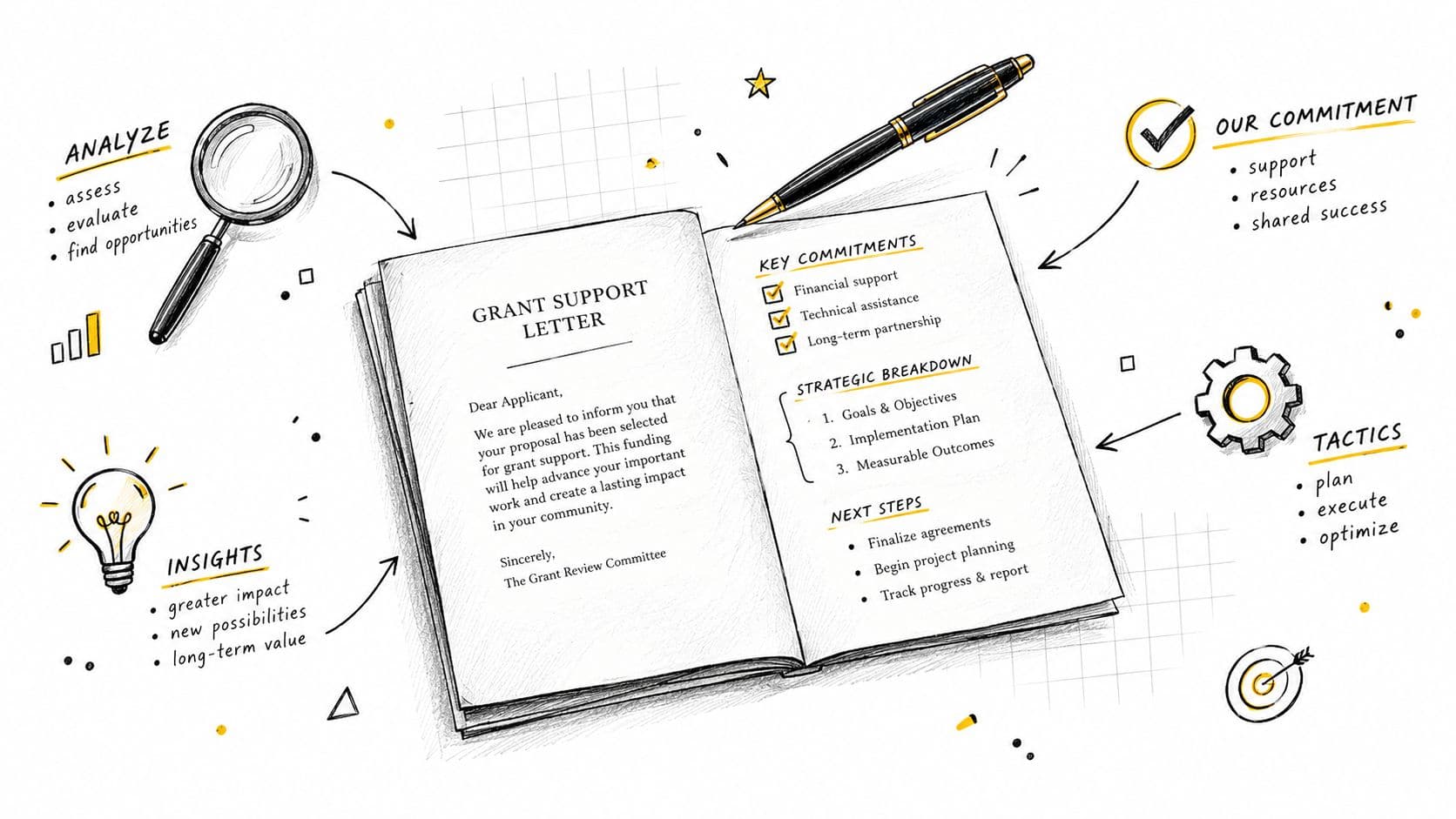
A strong grant support letter can influence the funding decision far more than its page count suggests. A widely cited 2026 analysis of more than 10,000 grant submissions found that applications with strong community-partner letters had a 35% higher approval rate than applications without those endorsements (analysis of grant support letters). The advantage doesn't come from enthusiasm alone. A persuasive letter establishes a credible relationship, validates the applicant's need and capacity, and connects the proposed work to a tangible community benefit.
The seven models below show how that logic changes across healthcare, education, conservation, arts, social services, international development, and workforce programs. Use each sample letter of support for grant as a structure, not a script. The strongest versions identify the writer's authority, state a specific commitment, provide relevant evidence, align with the funder's priorities, use an appropriate tone, and reflect the actual partnership. A support letter isn't a generic endorsement or a second executive summary. It's an evidentiary document that helps a reviewer verify access, collaboration, feasibility, and implementation capacity. That distinction also matters when organizing the financial side of a proposal, including the master fund accounting services guide.
Table of Contents
- 1. Healthcare and Medical Research Letter of Support
- 2. Education and Youth Development Letter of Support
- 3. Environmental Conservation and Climate Action Letter of Support
- 4. Arts, Culture and Community Development Letter of Support
- 5. Social Services and Poverty Alleviation Letter of Support
- 6. International Development and Global Impact Letter of Support
- 7. Workforce Development and Economic Opportunity Letter of Support
- 7-Point Comparison: Letters of Support for Grants
- Turn the Best Template Into a Targeted Letter
1. Healthcare and Medical Research Letter of Support
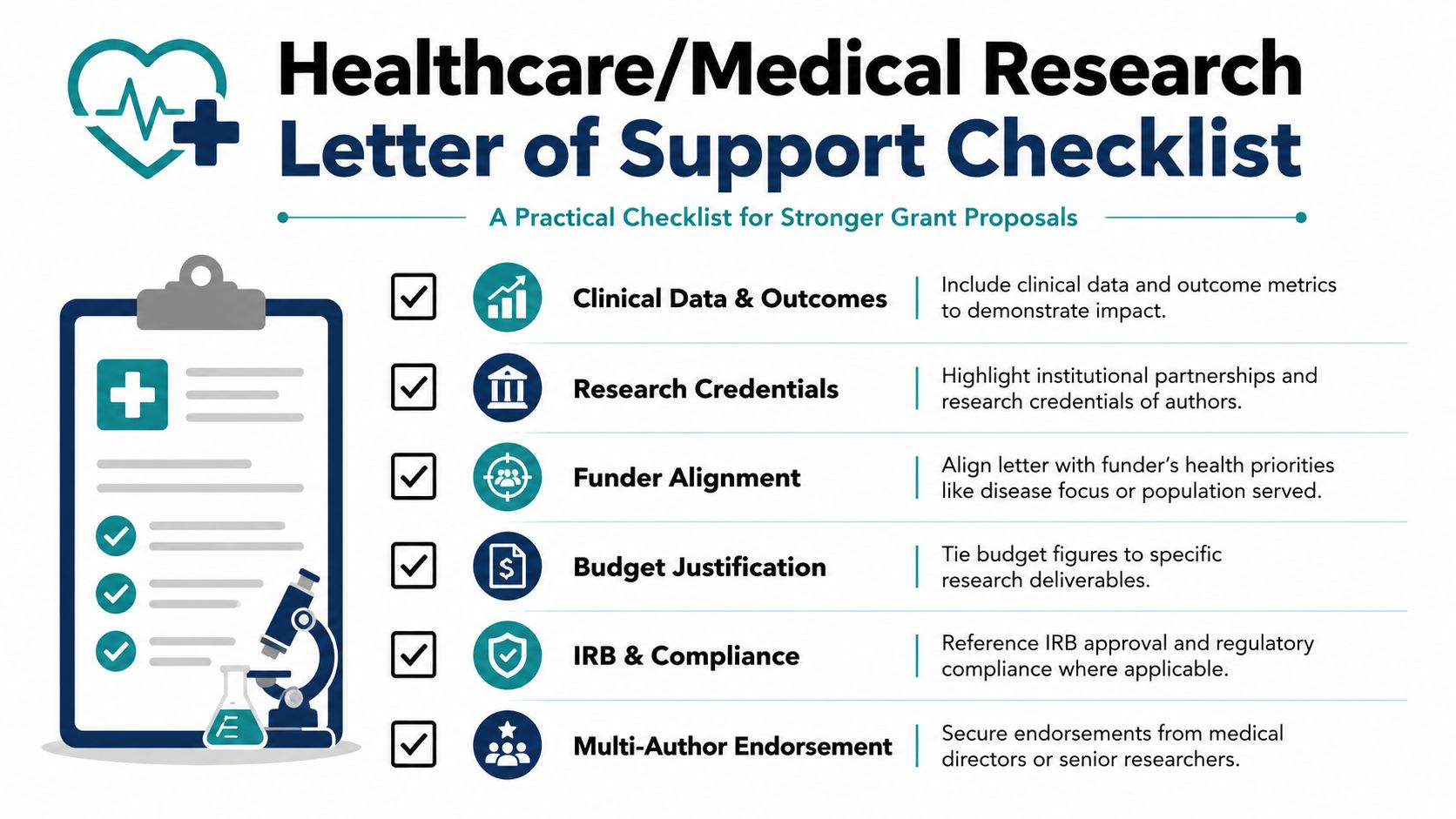
Healthcare letters work best when they connect technical capability to patient benefit. A hospital leader, clinical partner, public health director, or research collaborator should explain the proposed project in practical terms, then identify exactly how the partnership will improve care, access, prevention, or scientific understanding.
A useful opening might read:
On behalf of [institution], I support [applicant]'s proposal to [project]. Our organizations have worked together through [relationship], and we understand the need for [population] to receive [service, treatment, or intervention]. We will provide [facility access, clinical referrals, data, staff time, or implementation support] during the project period.
That structure gives the reviewer four things quickly: the project identity, the relationship, the need, and the commitment. NIH guidance treats support letters as evidence of institutional commitment, resources, collaboration, project roles, or intended use of the proposed resource. It also says these letters should be combined into a single PDF and shouldn't include preliminary data, figures, tables, or background material that belongs in the research strategy (NIH guidance on reference and support letters).
What makes the model credible
Lead with the patient or community consequence before describing the methodology. A clinical partner might state which population can be reached, what referral pathway already exists, and who will manage access to records or facilities. A research institution should name the relevant expertise, equipment, data source, or personnel contribution without turning the letter into a duplicate research plan.
Before requesting a letter, use Grantlas guidance on letters of inquiry for grants and prospect research to confirm that the funder has a history of supporting the relevant health issue, geography, or research approach. Referencing a funder's prior work can demonstrate fit, but the signer should only mention projects or priorities they have reviewed.
Include recent publications, validated internal findings, or other approved evidence when it strengthens credibility. Don't ask a clinician to promise patient outcomes they can't control. The useful commitment is access, coordination, recruitment, expertise, or service delivery, not an unsupported prediction.
2. Education and Youth Development Letter of Support
Education support letters should make student progress understandable to a reviewer who may not know the school, district, or neighborhood. A principal, superintendent, teacher, college partner, employer, parent leader, or youth-serving organization can add credibility by explaining both the local need and the applicant's ability to deliver.
A teacher's version might begin with a student experience, then connect that experience to program evidence:
I work directly with students participating in [program], and I've seen how [specific activity] affects their confidence, attendance, academic engagement, or access to opportunity. [Applicant] has earned our trust through [prior relationship], and our school will support the proposed work by [providing space, coordinating referrals, releasing staff time, or helping with family engagement].
The story should have a job. It can show why the problem matters, but it shouldn't replace outcome evidence. Strong letters pair a human account with the organization's own verified results, such as participation, retention, academic progress, credential completion, or postsecondary transition data.
Show sustained and equitable value
A support letter becomes more useful when it clarifies who benefits and how implementation will happen. If a school is providing classrooms, identify the facilities and access process. If teachers will advise curriculum design, name that role. If an employer will host career exposure, specify the activity and responsible contact.
Disaggregated evidence can show whether the project addresses inequity rather than reporting an overall average. The writer should use only data they can verify and should avoid claiming that a program caused an outcome unless the evidence supports that conclusion.
- Student voice: Include a participant perspective when consent and safeguarding procedures allow it.
- Teacher credibility: Explain what staff members have observed and what they will contribute.
- Workforce connection: For career programs, describe the skills, pathways, or employer relationships that make the training relevant.
- Funder alignment: Connect the project to the funder's stated interests in learning, access, youth development, or opportunity.
A school partner's letter shouldn't praise the applicant as “excellent” without explaining why. The stronger alternative is a sentence describing consistent communication, reliable delivery, family trust, or a concrete implementation responsibility. That evidence gives the funder something they can evaluate.

3. Environmental Conservation and Climate Action Letter of Support
Environmental letters persuade when they connect scientific goals to a specific place, responsible stakeholders, and work the applicant can carry out. A landowner, tribal representative, conservation scientist, municipal official, watershed partner, or community organization can explain the local need and define its role in implementation.
Start with the specific place-based threat rather than a broad climate statement:
[Applicant] is addressing [specific threat] in [place], where the proposed work will support [habitat, water system, species, or community]. Our organization has worked with [applicant] through [relationship]. We will contribute [land access, monitoring, technical expertise, volunteer coordination, policy support, or stewardship capacity] and will participate in [specific activity].
The model works because it combines four persuasive choices: evidence tied to the site, a stakeholder with relevant authority, a clear implementation contribution, and language matched to the funder's priorities. A letter that repeats environmental benefits without identifying who can provide access, monitor results, or sustain the work gives reviewers little basis for judging feasibility.

Evidence should serve permanence
A strong letter addresses what happens after the funded activity. It can identify the monitoring method, maintenance responsibility, community role, or policy connection that supports lasting results. Possible measures include habitat protected, restoration completed, water quality improved, species supported, carbon benefits, or jobs created. The signer should include only outcomes the partnership can document.
Use plain language for technical work. Define acronyms, explain why the site matters, and connect environmental gains to community health, safety, access, or economic opportunity when that connection is genuine. Avoid forcing every project into all of these outcomes.
Prospect research through Grantlas can help confirm whether a foundation supports conservation, climate, environmental justice, or the relevant geography. Fit does not guarantee funding, but it helps determine whether the letter should emphasize habitat, resilience, public access, community stewardship, or policy implementation. Validate that choice against the funder's published priorities before asking a partner to sign.
Place the video after the substantive discussion, not directly beside the image.
4. Arts, Culture and Community Development Letter of Support
Arts letters persuade through a combination of lived experience, artistic credibility, and public value. An artist, curator, venue partner, neighborhood leader, participant, school, or local business can show why the work matters to a community and why the applicant can deliver it responsibly.
A community artist might write:
I have collaborated with [applicant] through [program or prior project], and I support this proposal because it creates [specific opportunity] for [artists, residents, youth, or audiences]. My role will be [teaching, performing, advising, creating, recruiting, or evaluating]. The organization has demonstrated its commitment to [access, cultural representation, artist leadership, or neighborhood connection] by [verifiable example].
The best letters don't force arts work into a purely economic framework. They explain the artistic or cultural value first, then show broader benefits such as belonging, education, healing, local identity, or neighborhood revitalization when those outcomes are part of the project.
Balance reach with depth
A useful letter can distinguish between the number of people reached and the intensity of engagement. An opening-night audience, a recurring workshop participant, and an artist-in-residence may all represent different forms of value. The signer should help the reviewer understand that difference rather than offering a single inflated description of “community impact.”
Artist and participant voices matter because they reveal whether the organization shares decision-making power. A venue partner can describe attendance coordination or accessible space. A neighborhood organization can explain how residents shaped the program. A school or health partner can connect arts participation to a broader community need, but shouldn't claim outcomes they haven't observed.
Testimonials may add emotional force, while participation records and program documentation add verification. Use both carefully. Generic statements such as “this organization is vital” sound warm but don't explain what the signer will do. Concrete commitments, including rehearsal space, artist participation, outreach support, co-programming, or promotion, turn appreciation into evidence of feasibility.
5. Social Services and Poverty Alleviation Letter of Support
A social services letter should center client dignity while proving that the proposed service can operate within a real support network. Useful signers include clients with informed consent, housing authorities, health systems, schools, food access partners, government agencies, referral organizations, and employers.
A referral partner might state:
Our team refers eligible [clients or families] to [applicant] because the organization provides [specific service] that addresses [documented need]. We will support the proposed project by [referrals, coordinated case planning, space, data-sharing under an approved agreement, or participation in a referral process]. This collaboration will help clients move from [barrier] toward [service or outcome].
This approach makes the partnership operational. It tells the funder who sends clients, what happens after referral, and which organization handles each responsibility. It also avoids treating people receiving services as abstract units.
Show coordination without overpromising
Support letters in housing, food security, disability services, family support, and aging programs often carry more weight when they clarify coordination with public systems and healthcare providers. A partner can verify that a service gap exists, explain how duplication will be avoided, and identify the resources it will contribute.
Use outcome evidence that the organization can defend. Housing stability, food access, service completion, family stability, or client-reported progress may all be relevant, but the letter shouldn't add figures that aren't documented. Disaggregated results can show attention to racial, gender, age, disability, or other inequities when the organization collects that information responsibly.
- Client leadership: Explain how people with lived experience shape design, oversight, or governance.
- Partner coordination: Identify referral, case-management, health, housing, or government responsibilities.
- Cost logic: Describe efficient use of existing resources without making unsupported comparisons.
- Safety and privacy: State how confidential information will be handled when data-sharing is involved.
A letter that says “we strongly support this important work” contributes little. A letter that commits to referrals, shared space, coordinated care, or participation in implementation gives the reviewer a basis for assessing readiness. The National Fish and Wildlife Foundation's support-letter guidance illustrates the broader compliance principle: letters should identify the proposal number, project title, applicant organization, and current date when the program requires those details.

6. International Development and Global Impact Letter of Support
International letters should make local leadership visible. A local nonprofit, community institution, ministry, health facility, school, women's association, or municipal partner should describe the relationship in its own terms, rather than serving as a decorative endorsement for an externally designed program.
A local partner's letter might say:
[Local organization] has worked with [applicant] on [prior activity or relationship]. We support the proposed project because it responds to [locally identified need]. Our team will lead or contribute to [training, community engagement, service delivery, monitoring, procurement, or local coordination]. The approach has been adapted to [language, cultural practice, infrastructure, policy, or community context], and we will help maintain the work through [capacity-building or institutional process].
That structure addresses a central risk in global grantmaking: a proposal can sound technically polished while leaving local decision-making unclear. The letter should identify who defines the problem, who controls implementation, who owns the data, and who will continue essential functions after grant support ends.
Treat adaptation as evidence of capacity
Avoid broad claims about “helping vulnerable communities” without naming the community's priorities and the partner's authority. A credible letter can explain how the project adapts to local systems, manages travel or supply uncertainty, protects participants, and responds when conditions change.
Use country-level evidence only when the source and interpretation are clear. A local partner can validate service access, staffing, community participation, or institutional capacity. It shouldn't be asked to endorse outcomes that depend on factors outside its control.
The same principles apply whether the proposal addresses health, education, women's economic participation, climate adaptation, or poverty. Funder alignment may include a stated development goal, but don't insert a framework merely to satisfy a keyword. Connect the goal to the actual activity, partner role, and intended change.
A letter from an international partner is strongest when it shows shared ownership. Translate commitments accurately, obtain informed approval for the final wording, and confirm that the signer has authority to make promises about staff, facilities, data, or funds.
7. Workforce Development and Economic Opportunity Letter of Support
Workforce letters persuade when employers, participants, and public partners describe one credible path from training to economic opportunity. A participant can explain why the training matters. An employer can confirm curriculum relevance, hiring needs, and support such as interviews, work-based learning, mentoring, or placement assistance. A workforce board or public agency can connect the project to regional systems and referral networks.
A strong employer letter might state:
[Employer] has reviewed [applicant]'s proposed training and considers [skills or credentials] relevant to our hiring needs. We will support implementation through [curriculum input, site visits, interviews, internships, equipment, mentors, or hiring consideration]. [Applicant] has demonstrated its ability to prepare participants through [specific observed relationship or prior collaboration].
Keep hiring intent separate from a guaranteed job offer. The signer can describe relevant roles, skills, screening procedures, or available engagement without promising employment outside the employer's control. That distinction protects credibility while preserving a useful employer voice.
Show the career ladder
Placement represents only one stage of economic opportunity. The letter should connect entry-level training with credentials, advancement, wage progression, retention, or further education. Participant stories should preserve dignity and agency. Outcome evidence should identify the population served and explain how progress is tracked.
Disaggregate results when the project addresses unequal access to training or employment. The signer can describe how recruitment, accommodations, transportation, language access, childcare, or employer practices affect participation. Avoid unsupported claims about demographic outcomes.
Use Grantlas's grant research resources to check whether prospective funders support workforce development, economic mobility, reentry, apprenticeships, or sector-specific training. Review giving history, geography, applicant eligibility, typical grant focus, and openness to new grantees before asking an employer to invest time in a letter. Fit research determines which commitments deserve emphasis.
The strongest commitments are often practical. A hiring manager reviews the curriculum. An employer provides equipment or mentors. A workforce agency makes referrals. A participant advisory group shapes delivery. These details show that the program responds to an actual labor market, while leaving room to customize the letter for each funder's priorities and risk concerns.
7-Point Comparison: Letters of Support for Grants
| Program / Template | Implementation complexity | Resource requirements | Expected outcomes | Ideal use cases | Key advantages |
|---|---|---|---|---|---|
| Healthcare / Medical Research Letter of Support | High, IRB, technical methodology, multi-author sign-off | High, clinical data, institutional partners, compliance resources | Measurable clinical outcomes, research publications, patient-impact metrics | Hospitals, research universities, clinical trials, disease-focused research | Strong credibility with federal/foundation funders; demonstrates scientific feasibility |
| Education & Youth Development Letter of Support | Medium, longitudinal data and equity reporting | Moderate, student data systems, PD, program evaluation | Improved graduation, test scores, college enrollment, equity indicators | K-12 schools, youth orgs, STEM/literacy programs, district partnerships | Broad funder appeal; supports scalability and equity narratives |
| Environmental Conservation & Climate Action Letter of Support | High, scientific monitoring, long-term management, policy work | High, ecological monitoring, research partners, adaptive management plans | Acres protected, carbon sequestered, species/biodiversity metrics, policy impact | Land trusts, conservation NGOs, climate action programs | Clear ROI for climate funders; aligns with ESG and major environmental grants |
| Arts, Culture & Community Development Letter of Support | Medium, balancing artistic goals with impact measurement | Moderate, audience tracking, artist support, community engagement efforts | Audience reach, participant depth, cultural equity, economic/community impact | Museums, theaters, community arts centers, cultural equity initiatives | Bridges artistic excellence with social impact; broadens funding sources |
| Social Services & Poverty Alleviation Letter of Support | Medium–High, rigorous outcomes, privacy, system partnerships | Moderate to high, case management, data privacy safeguards, partnerships | Client stability, housing/employment outcomes, cost-per-client metrics | Food banks, homeless services, family support, disability services | Large, stable funding pool; standardized outcome measures; high demand |
| International Development & Global Impact Letter of Support | High, local partnerships, security, currency and logistics risks | High, local capacity building, remote M&E, risk mitigation resources | Sustainable local capacity, SDG-aligned development indicators, measurable impact in context | Global health, development agencies, country-level programs, capacity building | Access to major international funders and government grants; SDG alignment |
| Workforce Development & Economic Opportunity Letter of Support | Medium, long-term tracking, employer coordination | Moderate, employer partnerships, credentialing, labor-market research | Job placement, wage progression, credential attainment, employer hires | Job training programs, reentry services, industry-aligned workforce initiatives | Strong employer/corporate alignment; ROI-focused metrics attractive to funders |
Turn the Best Template Into a Targeted Letter
A sample letter of support for grant is a starting structure, not evidence you can borrow. Before drafting, identify the supporter who has the clearest relationship to the project and the authority to make the proposed commitment. A senior title helps only when the person can speak knowledgeably about the partnership, resources, access, or implementation role.
Use this final review before submission:
- Confirm the relationship: State how the signer knows the applicant, how long the organizations have worked together if relevant, and what the signer has personally reviewed.
- Match the funder: Use the funder's stated priorities, geographic focus, applicant requirements, and program language. Don't force an alignment that isn't visible in the opportunity.
- Replace praise with proof: Ask for one or two verifiable commitments, such as referrals, data access, facility use, staff participation, co-delivery, technical assistance, or employer engagement.
- Connect evidence to the project: Every outcome, community statement, or capacity claim should support the specific proposal rather than the organization's general reputation.
- Check compliance: Follow the funder's file format, date, identifier, page, signature, and submission rules. Foundation-relations guidance from Tufts recommends that a private-foundation request letter generally stay within two pages and use brief, supportive data in the problem statement (Tufts guidance on effective support letters).
- Obtain approval: Give the signer enough context to verify every statement, then secure approval of the final version before uploading it.
Prospect research belongs before outreach, not after a letter has been drafted. Grantlas can help nonprofits narrow prospective funders by sector, geography, grant size, giving history, and signals about new-grantee activity. Its fit scoring pairs a shortlist with plain-English reasoning and flags issues such as invitation-only opportunities, geography mismatch, applicant ineligibility, or a grant size or budget outside the apparent range. That early validation helps you avoid asking a respected partner to support an opportunity that isn't a genuine fit.
Use the platform's giving history, peer prospecting, board and trustee information, saved searches, alerts, and deadline reminders to prioritize outreach. The point isn't to replace relationship-building. It's to focus that work where the funder's records and stated priorities support a credible case.
A support letter should be easy for a reviewer to evaluate. Keep the project name consistent, identify the partner's role, explain the need in relevant terms, and state what will happen if the grant is awarded. Adapt the structure of these models, but don't copy unsupported claims, invented results, or commitments your organization can't deliver. For a useful contrast in how evidence and specificity shape credibility, review these testimonial templates for websites. Then ask each signer to make the final letter their own, specific, current, and grounded in the partnership.
Grantlas helps nonprofit teams identify private foundations and open federal grant opportunities, score funder fit, and understand why a prospect may or may not be worth pursuing. Use Grantlas to validate prospects before requesting support letters, then build a focused outreach pipeline around credible partnerships and funder alignment.