8 Letter of Inquiry Examples for Grant Seekers
Sep 26, 2026 · 15 min read
A generic letter of inquiry rarely works as well as people expect. An exploratory note to a program officer, a formal preliminary proposal, an administrative request for current guidelines, a relationship-building message to a trustee, and a follow-up after a meeting may all be called “inquiries,” but they serve different decisions and different readers.
That distinction matters because the wrong format can make a qualified organization look unprepared. The examples below separate eight outreach situations by intent, audience, funding model, and decision stage. Use them to identify what you need from the funder, adapt the structure, verify eligibility and fit, and choose a realistic next step instead of copying a universal template.
Research tools can help before you write. Grantlas can support comparisons of private foundations and federal opportunities, show fit reasoning and giving history, surface board and trustee context, and flag mismatches involving geography, applicant type, grant size, or budget range. It can't replace direct communication with a funder, especially when instructions are unclear or a program officer needs to confirm eligibility.
Table of Contents
- 1. General Inquiry Letter to Foundation Program Officers
- 2. Letter of Inquiry for Foundation Grants
- 3. Exploratory Letter to Federal Grant Program Officers
- 4. Networking Letter to Foundation Trustees and Board Members
- 5. Letter of Inquiry for Government and Institutional Grants
- 6. Follow-Up Letter After a Foundation Meeting or Site Visit
- 7. Letter of Inquiry for Matching and Challenge Grants
- 8. Inquiry Letter for Funder Guidelines and Application Materials
- 8-Point Comparison of Letters of Inquiry
- Turn the Best Example Into a Fundable Next Step
1. General Inquiry Letter to Foundation Program Officers
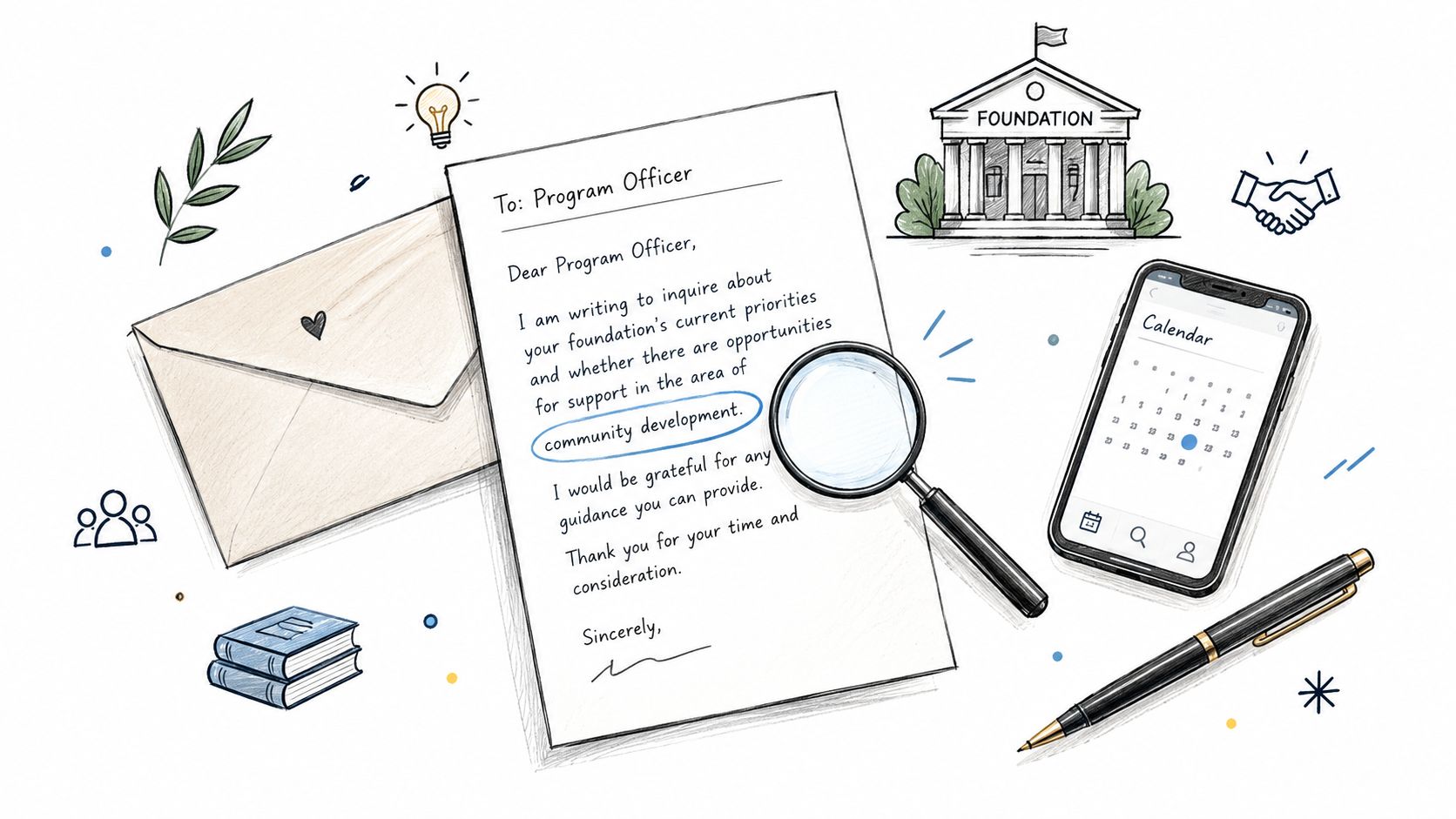
A general inquiry is appropriate when you've identified a potentially relevant foundation but still need to clarify whether your organization belongs in the funder's process. It isn't a disguised full proposal. The strongest version gives the program officer enough context to answer a focused question without asking them to review an unsolicited application.
Start with your organization, location, population served, and the program or issue you're considering. Then name the foundation priority that appears relevant and ask whether your proposed work fits the funder's current interests and eligibility rules. If the organization is a health nonprofit, for example, distinguish between direct services, research, systems work, and advocacy. Those categories may carry different eligibility implications.
Grantlas can help you locate a relevant program area, review a foundation's giving history, and identify trustees or staff who may be connected to the work. Use that research as preparation, not as proof that the foundation has approved your concept. A local community development organization might write to confirm geographic eligibility. An early-stage social enterprise might ask whether the foundation supports for-profit or hybrid entities before investing in a longer application.
A useful structure
Keep the message to one page, even if the funder hasn't published a formal limit. Include:
- Purpose: State why you're contacting the officer.
- Organizational context: Give a concise description of your work and community.
- Potential fit: Refer to a specific program interest or relevant giving pattern.
- Clarifying questions: Ask only what the officer can reasonably answer.
- Next step: Request confirmation about eligibility, process, or whether a conversation would be useful.
A short statement of need can help if it explains the proposed work without becoming a full narrative. Grantlas's guidance on a grant statement of need can help you frame that context, but the letter should still sound specific to the foundation.
Send the inquiry several weeks before a published deadline when possible. If there's no response, one courteous follow-up is enough. Don't send repeated messages or attach a complete proposal the officer didn't request.
2. Letter of Inquiry for Foundation Grants
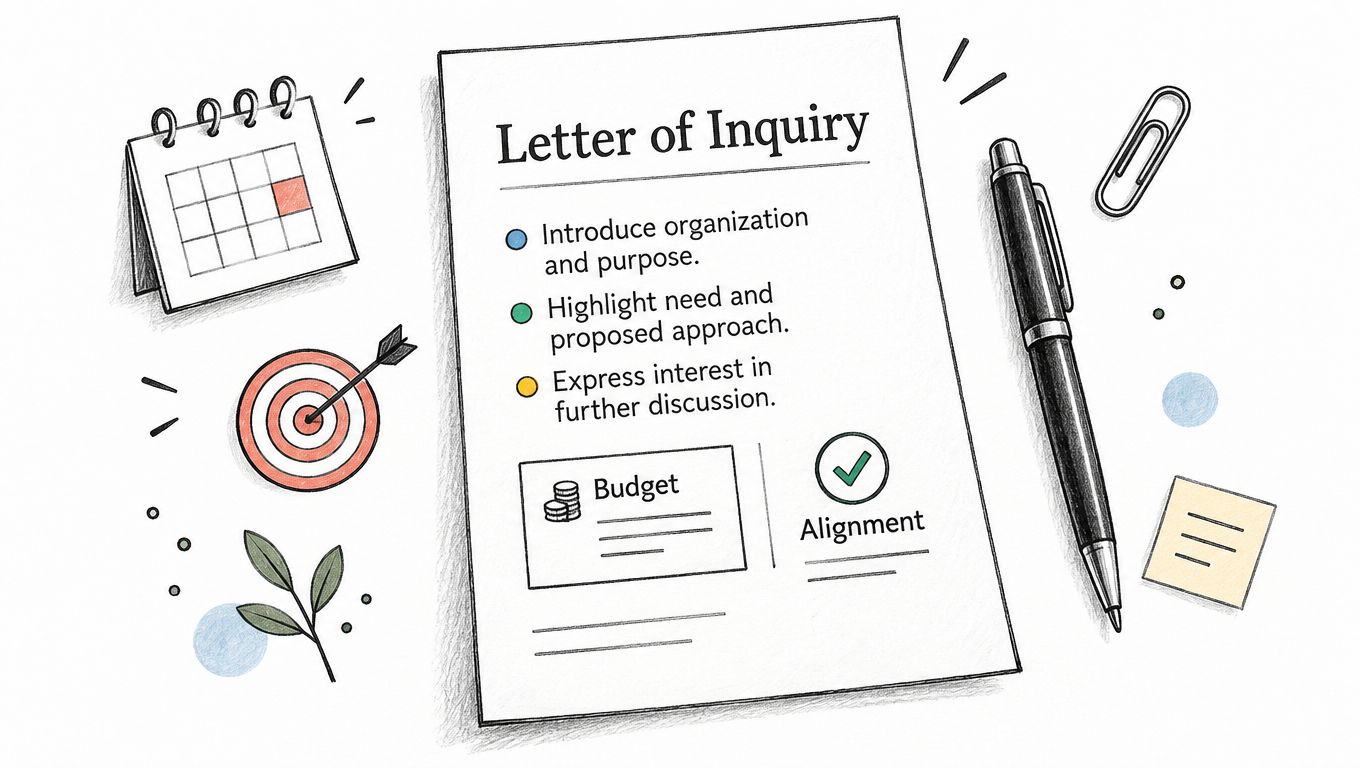
A foundation LOI succeeds or fails at the screening stage. Treat it as a concise case for fit, readiness, and support rather than a generic introduction. Candid describes an LOI as a brief executive summary and recommends covering the organization, requested amount, project, history, need, method, other funding, and closing summary. Its LOI content guidance provides the full framework.
The required format depends on the funder. Some foundations use an online form, while others specify a page limit, typeface, margins, or submission route. Northwestern's letter of inquiry guide presents a concise pre-proposal focused on need, activities, outcomes, and a budget summary. Follow the sponsor's instructions before adapting any sample.
Make the screening case specific
Open with the decision the reviewer must make: whether the proposed work belongs in the foundation's pipeline. Then connect four pieces without turning the LOI into a full proposal:
- Need: Identify the affected population, location, and practical consequence.
- Fit: Explain why this foundation's stated interests or giving history align with the work.
- Feasibility: Show the activities, responsible team, and way you will assess progress.
- Ask: Name the requested support and the work it would cover.
Grantlas can help compare a foundation's giving history with your initial assumptions, but research should lead to direct funder communication, not replace it. A food-security nonprofit, for example, should explain how its target population and delivery model relate to the foundation's priorities. Repeating the phrase “food insecurity” from a website or 990-PF does not establish fit.
Use a budget summary unless the instructions request more detail. State the total project cost, the amount requested, other committed or prospective funding, and the activities covered. An itemized budget can distract from the screening decision when the sponsor has not asked for one. For the distinction between an LOI and related preliminary documents, consult this guide to a letter of intent for a grant.
3. Exploratory Letter to Federal Grant Program Officers
A federal inquiry should reduce application risk before your team invests significant staff time. Confirm technical eligibility, timing, cost-share, registration, or program design requirements with the published program contact, rather than sending a general request to an agency's executive office.
Open with the agency, opportunity title, applicant type, and one decision you need clarified. For example, a community health center could ask whether its service model fits an opportunity for underserved populations. A workforce nonprofit might ask how matching requirements apply, whether particular partners qualify, or whether prior federal experience is expected. A research institution could ask whether its discipline falls within a specific NSF or NIH program.
The quality of the answer depends on the facts you provide. State your legal and organizational type, describe the proposed activity in plain language, identify collaborators and their roles, and explain any relevant budget constraint. Reference the opportunity's deadline and ask whether your preparation schedule is realistic. A focused question gives the program officer something concrete to assess. “Would we be eligible?” rarely does.
Grantlas can help identify opportunities and monitor changes, but verify each notice through Grants.gov and the relevant agency website before acting on it. Federal instructions and contact details can change. Treat verbal guidance as useful discussion, then confirm your understanding in writing rather than presenting it as a binding interpretation.
A short example:
“Our community health center proposes mobile preventive-care services for underserved rural residents. We are a nonprofit applicant with a prospective county partner. Does this program permit that partnership structure, and would the required cost share apply to mobile-service expenses?”
If the officer responds by phone, email a brief recap and ask whether it accurately reflects the guidance. Save the exchange in your grants file. The exploratory letter has done its job when it narrows a specific uncertainty and helps your team decide whether the opportunity merits a full application.
4. Networking Letter to Foundation Trustees and Board Members
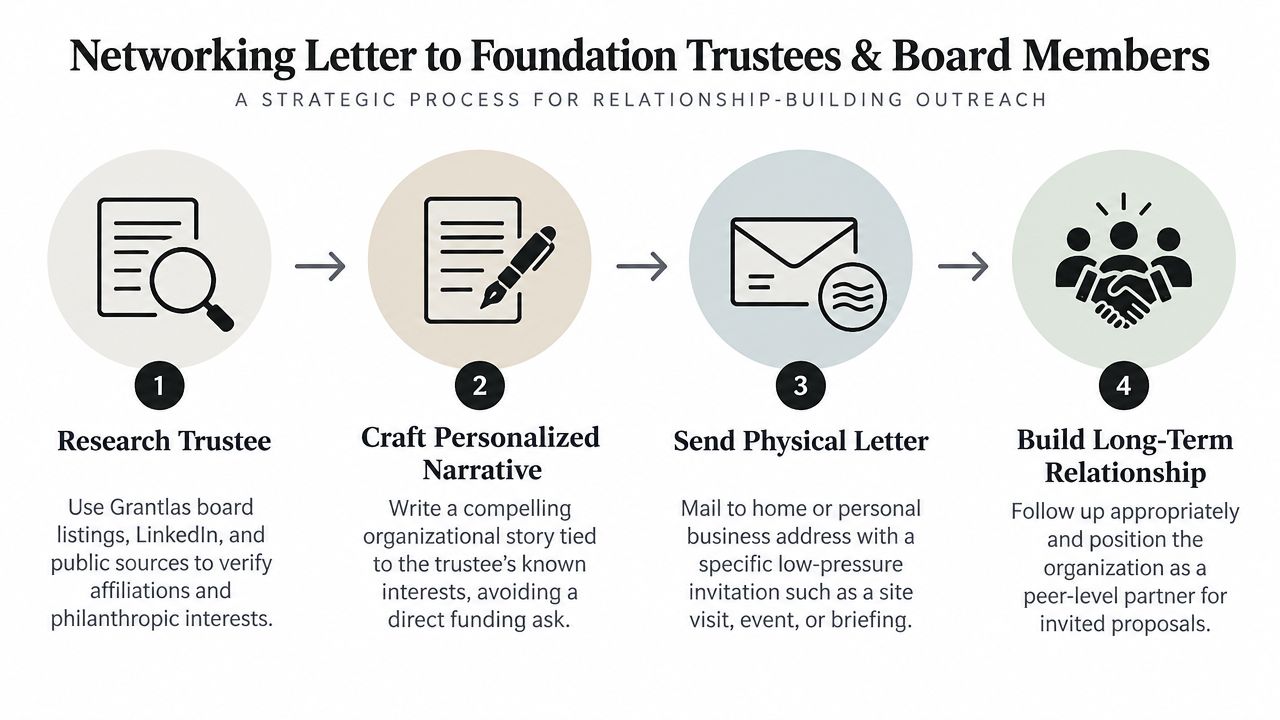
A trustee letter should open a relationship, not function as an unofficial grant application. Use it when your organization's work connects naturally with a trustee's community, profession, or civic interests, and when a short conversation or program invitation could build useful familiarity.
Lead with the reason for contacting that person. A youth development nonprofit might invite a trustee who serves on a local school board to a program showcase. An environmental organization could offer a field visit to a trustee with conservation experience. A healthcare nonprofit might request a brief informational meeting with a trustee who understands the sector. Each approach gives the trustee a clear way to engage without asking them to assess a proposal or promise support.
Grantlas's board and trustee listings can help locate possible contacts, but confirm current affiliations through the foundation's website and professional sources. Research the trustee's actual role, public interests, and connection to the community. A stale listing or weak connection can damage credibility. Never imply personal familiarity that does not exist.
Make the invitation specific and low pressure
A strong letter usually includes four elements:
- A genuine connection: Explain why the trustee's role or community involvement makes the invitation relevant.
- A concise organizational introduction: State what your nonprofit does and whom it serves.
- A concrete invitation: Offer a program visit, briefing, public event, or other defined opportunity.
- A respectful boundary: Clarify that you are seeking perspective or awareness, not asking the trustee to bypass the foundation's process.
Keep detailed eligibility questions and application materials for the appropriate foundation staff. Trustees may offer useful context or redirect you, but they may not handle program review. Avoid asking for advocacy before the trustee understands the work. The trade-off is intentional: a lighter message creates less immediate pressure, while giving the relationship room to develop.
Choose the timing carefully. Outreach during an active funding deadline can appear transactional. Contacting a trustee earlier allows time for a meaningful exchange and gives that person an opportunity to direct you to the right staff contact.
5. Letter of Inquiry for Government and Institutional Grants
Government and institutional LOIs succeed when reviewers can match your concept to the sponsor's decision rules quickly. Start with the controlling opportunity announcement, request for proposals, program notice, or institutional guidance. Extract its eligibility terms, required activities, performance expectations, partnership rules, and cost-share requirements before drafting.
Use the sponsor's language accurately, then translate it into a project-specific inquiry. A workforce organization might address eligible participants, employer partners, performance measures, and required match. A public health agency could connect activities to vulnerable populations and service outcomes. A university research center may need to ask whether its institutional structure and investigators fit an NIH or NSF mechanism. Each case calls for a different question, because the decision stage and funding model determine what the program contact can usefully answer.
A short scenario can clarify the format:
Our organization is considering this opportunity to expand workforce services for [eligible population]. We would partner with [employers or public agencies] and track [relevant outcomes]. Before developing a full application, could you confirm whether this applicant and partnership structure fit the program's eligibility requirements, and whether the proposed activities align with the notice?
Follow the sponsor's evaluation sequence when it helps the reader. A numbered format may cover applicant and partners, problem and target population, proposed activities, relevant capacity and past performance, expected outcomes, budget and cost-share question, and the specific clarification requested. Use only the headings that support the inquiry. A rigid checklist can make a preliminary letter read like an incomplete application.
Grantlas's federal opportunity scanning can help teams check whether an opportunity is active and identify recent changes. It does not replace confirmation from the program contact or review by compliance staff. Past performance should show readiness through comparable work, setting, population, and substantiated results. “We have extensive experience” does not provide that evidence.
Keep the document readable with short paragraphs, descriptive headings, and direct questions. Formality should signal care, not turn the LOI into a contract.
For teams coordinating technical requirements, this short video offers another perspective on organizing an inquiry before submission.
6. Follow-Up Letter After a Foundation Meeting or Site Visit
A follow-up letter should preserve the value of a real conversation. Its purpose is to confirm understanding, acknowledge the discussion, and complete agreed actions while details remain fresh. Treating it like a new proposal can create confusion, especially if the funder has not invited a broader request.
Anchor the message in what happened. If a program officer asked how your service model reaches rural participants, answer that question directly. If a trustee focused on youth outcomes during a site visit, include the information you promised. After a federal technical assistance workshop, state the eligibility issue you are clarifying and identify the next action.
Keep the letter to one page when possible. Thank the recipient, identify the most useful point from the conversation, confirm commitments, and attach only requested or promised materials. If you offered an organizational chart, send it. If the funder agreed to review a concept note, state when you will deliver it. Assigning an owner to each action keeps a positive meeting from ending in vague goodwill.
Practical rule: A thank-you letter should not conceal a full proposal.
Accuracy matters more than sending the note within minutes. Review your notes first, then distinguish a question, an expression of interest, and a confirmed invitation. “You asked us to clarify how referrals are handled, so we've attached the requested process summary” demonstrates careful listening. Generic praise does not.
The letter also creates a useful record for the next decision. Save it and any response in the prospect file, then capture:
- People involved: Record names, roles, and organizations.
- Topics discussed: Note questions, concerns, and areas of interest.
- Materials promised: Track what was sent and the delivery date.
- Next decision: State whether the next step is another conversation, an LOI, a full proposal, or no action.
- Timing: Set a reminder based on the funder's stated process.
Grantlas can organize a prospect pipeline and reminders, but it cannot infer the relationship details behind a public record. Record the funder's wording, level of interest, unresolved questions, and any condition attached to the next step. Direct communication remains the authority for interpreting the meeting.
7. Letter of Inquiry for Matching and Challenge Grants
A matching or challenge-grant LOI should test two forms of fit: whether the funder uses this funding model and whether your organization can meet its conditions. Treat the letter as a readiness check, not a shortened version of a standard project proposal.
Open with the project, requested amount, match structure, and current status of the qualifying funds. Use precise labels. Signed commitments, documented pledges, pending requests, and general donor interest carry different levels of certainty. “Several donors are interested” gives a funder no reliable basis for judging whether the match can be completed.
The strongest example depends on the audience and decision stage. An education nonprofit seeking a capital campaign match could cite board-approved pledges and clarify which gifts are unrestricted or eligible. A community center pursuing public matching funds might identify local government commitments and the records available to verify them. A health nonprofit seeking a challenge grant should explain which fundraising activity the grant would encourage, who will solicit gifts, and how qualifying contributions will be tracked.
Build the LOI around five decisions:
- Eligible match: State which sources qualify, what restrictions apply, and what documentation exists.
- Current commitment: Separate received funds, signed pledges, pending requests, and prospects.
- Certification timing: Ask whether the funder permits extensions, staged verification, or a phased campaign.
- Internal ownership: Identify the staff member, board committee, or campaign team responsible for fundraising.
- Shortfall response: Explain how the organization would adjust the project or cover the gap if the match is incomplete.
Research the funder's giving history before contacting its program staff. Ordinary project grants do not establish that the funder accepts matching or challenge structures. Use Grantlas to identify relevant giving patterns and prospect notes, then confirm the rules directly with the funder before making public commitments to donors.
Connect the budget to activities and timing. A grant proposal budget template can organize the underlying costs, while the LOI should include only the detail requested. Do not present a soft conversation as a pledge. State what is secured, what remains uncertain, and how the organization will manage the deadline.
8. Inquiry Letter for Funder Guidelines and Application Materials
Sometimes the right inquiry is administrative. You've found a promising opportunity, but the current guidelines, application form, deadline, or contact protocol isn't clear. In that situation, don't write a persuasive mini-proposal. Ask for the specific materials needed to make an informed go or no-go decision.
Use email when the funder provides a grants address or application contact. Identify your organization, state how you found the opportunity, and request the current version of the relevant documents. If you found a foundation prospect in Grantlas, mention the program or giving pattern you reviewed. If you're contacting a federal agency, identify the opportunity title and ask for the current applicant instructions or technical assistance resources.
A practical request might ask:
- Current guidelines: Confirm that the version you have is still active.
- Deadline and cycle: Ask whether the date applies to a preliminary inquiry, full application, or invitation-only stage.
- Application materials: Request forms, narrative prompts, budget instructions, and submission details.
- Eligibility clarification: Ask about organization type, geography, project type, or partnership requirements.
- Applicant support: Ask whether webinars, office hours, or technical assistance are available.
Make the request easy to process
Put the essential question in the subject line, such as “Request for current application guidelines, community health program.” Keep the body concise and avoid sending attachments unless requested. If the funder's website is hard to use, explain exactly which document appears outdated or missing.
A slow response doesn't necessarily indicate disinterest. Grant offices may receive a high volume of administrative questions, so allow reasonable time before following up. Send one short reminder that repeats the request and includes your original message. Once you receive the documents, compare every requirement with your organization's eligibility, capacity, and timeline before drafting.
8-Point Comparison of Letters of Inquiry
| Item | Implementation complexity | Resource requirements | Expected outcomes | Ideal use cases | Key advantages |
|---|---|---|---|---|---|
| General Inquiry Letter to Foundation Program Officers | Low–moderate (identify program officer) | Small: brief research and one-page letter | Clarify fit and eligibility before applying | Early-stage prospect validation | Builds relationships; documents contact |
| Letter of Inquiry (LOI) for Foundation Grants | Moderate (concise proposal drafting) | Moderate: project summary, budget estimate | Quick funder screening; possible invite to full proposal | Preliminary screening for multiple prospects | Reduces proposal workload; concise assessment |
| Exploratory Letter to Federal Grant Program Officers | Moderate–high (technical questions) | Moderate: program citations, eligibility details | Clarify federal eligibility and requirements | Federal opportunity readiness and compliance checks | Access to agency TA; early eligibility guidance |
| Networking/Relationship-Building Letter to Trustees and Board Members | High (deep personalization) | High: trustee research, tailored narrative | Long-term relationship building; potential advocacy | Cultivating multi-year funder relationships | Direct access to decision-makers; increases credibility |
| Letter of Inquiry for Government and Institutional Grants | High (compliance-heavy, formal) | High: legal IDs, budgets, performance metrics | Demonstrates compliance readiness; frames full proposal | Institutional, federal, or large-scale grant pursuits | Meets technical requirements; signals capacity |
| Follow-Up Letter After Foundation Meeting or Site Visit | Low (timely, specific) | Low: meeting notes, promised attachments | Documents commitments; reinforces rapport | Post-meeting/site-visit follow-up | Reinforces professionalism; clarifies next steps |
| Letter of Inquiry for Matching/Challenge Grants | Moderate–high (coordination with donors) | High: documented pledges, fundraising plan | Unlocks matching funds; accelerates fundraising | Capital campaigns; challenge grant applications | Leverages funder capital; increases total funding |
| Inquiry Letter for Funder Guidelines and Application Materials | Low (administrative request) | Minimal: contact details and concise request | Receive current guidelines and submission forms | Confirming application requirements and timelines | Quick access to accurate submission materials |
Turn the Best Example Into a Fundable Next Step
Choose the format by identifying the decision you need from the funder. If you need fit clarification, use a general inquiry. If the sponsor has invited or required preliminary screening, write a formal LOI. If the questions involve federal eligibility, match, cost share, or technical requirements, use an exploratory or compliance-focused format. If the immediate objective is trust, use a relationship-building letter. After a meeting, send a focused follow-up. When the obstacle is missing documentation, send an administrative request rather than a persuasive narrative.
Then verify the operating details before drafting. Check the organization's eligibility, geography, program area, deadline, page or word limit, required fields, budget instructions, and approved contact route. Candid's guidance describes the LOI as a short executive-summary document, while university and foundation guidance makes clear that the required format can vary. A template is useful only after you've confirmed which version of the process you're entering.
Adapt structure, not just names. A weak letter copies language from a previous application and changes the funder's name. A stronger letter uses funder-specific evidence, explains the relevant connection, and removes sections the sponsor didn't request. If the foundation wants a one-page inquiry, don't force in a complete evaluation plan. If a federal opportunity asks for technical alignment, don't send a warm relationship note that avoids the actual requirements.
Keep a record of what happens next. Save the inquiry, response, guidance received, promised materials, and follow-up date in a consistent pipeline. A response can change your status from “possible prospect” to “qualified opportunity,” “not eligible,” “wait for next cycle,” or “needs relationship development.” That history prevents your team from repeating questions and helps future writers understand why a prospect was prioritized or paused.
Grantlas can support this process by helping you shortlist private foundations and federal opportunities, review fit reasoning and giving history, monitor open opportunities, and organize follow-up. Its flags can surface apparent mismatches early, but they're starting points for verification, not permission to skip the funder's published guidance or direct communication. The final inquiry must reflect your organization's real capacity, current project, and actual relationship with the funder.
Before sending, read the letter as the recipient would. Can the program officer tell what you want, why you contacted this funder, what you're asking them to confirm, and what you'll do next? If not, cut background, sharpen the question, and remove unsupported claims. The most effective letter of inquiry examples aren't scripts to copy. They're models for matching the message to the funding moment.
Grantlas helps nonprofit teams find private foundations and open federal grant opportunities, compare fit reasoning and giving history, identify mismatches, and organize qualified prospects for follow-up. Use Grantlas to research the right funder before you write, then turn that research into a focused inquiry that reflects your organization's real circumstances.