Grant for Community Center: How to Apply in 2026
Oct 29, 2026 · 13 min read
The most popular advice on a grant for community center is to collect a long list and start writing. That advice burns months. The usable award is the one your organization can match, document, and administer, not the largest program name on a spreadsheet.
A strong building idea dies on a match letter that is really a promise to fundraise later, or on an eligibility flag nobody checked until the narrative was finished. Reviewers do not grade the warmth of the mission first. They grade applicant type, population, income benefit, site control, and whether the doors can stay open after the ribbon cutting.
I would ignore any roundup of "top grants" until you can name one primary route and one backup, and until the local cash sits in an account or in an executed award letter. The paperwork only matters after those two facts are true.
Table of Contents
- Federal and Local Routes for a Community Center
- Match Cash and Readiness Before You Apply
- How to Shortlist Funders and Tailor the Ask
- How to Assemble the Application Step by Step
- Tips for Capacity Follow-Up and Reporting
- Choose the First Grant Worth Writing
Federal and Local Routes for a Community Center
A community center rarely fits one national grant competition. Funding usually comes through one of four routes: a rural federal facility program, a local Community Development Block Grant allocation, private philanthropy, or congressionally directed project funding. Each has a different applicant, purpose, and timeline.
| Route | Who applies | Best use | Scale to plan around | Match reality |
|---|---|---|---|---|
| USDA Community Facilities direct loan and grant | Public body, community-based nonprofit, or federally recognized Tribe in an eligible rural area | Build, buy, or improve an essential community facility | 855 projects and about $1.014 billion nominal in FY2022–FY2024 | Local share plus proof that commercial credit cannot carry the project |
| CDBG public facilities | City, county, or state; nonprofits usually as partners to that government | Community centers and similar public facilities tied to a consolidated plan and low- and moderate-income benefit | National CDBG obligations of $8,747,716,880 in FY2022–FY2025; New York public-facility requests up to $1 million | A local match with a required cash slice is common in state programs |
| Private foundations | 501(c)(3) nonprofits, sometimes with a public partner, often by invitation or prior relationship | Capital campaigns, programs, or multi-year operating support | Award size is funder-specific, and repeat relationships absorb a large share of dollars | A statutory match is rare, but restricted purpose and invitation-only rules are common |
| Congressionally directed community project funding | Eligible entity working through a member office, on the appropriations calendar | A named facility project in a district | About $1.036 billion of Community Facilities project funding and directed spending across FY2015–FY2024, in 2024 dollars | Not an open rolling competition; timing follows the federal budget cycle |
The rural federal channel
The U.S. Department of Agriculture Community Facilities program supports rural essential facilities. From FY2015 through FY2024, Congress appropriated approximately $2.197 billion in inflation-adjusted 2024 dollars for Community Facilities programs, according to a Congressional Research Service report. About $509 million went to competitive applications, and about $1.036 billion went to Community Project Funding and Congressionally Directed Spending. From FY2022 through FY2024, 855 projects received grants through the direct loan and grant program, totaling about $1.014 billion in nominal dollars.
Those totals do not guarantee the size of a future appropriation. Congress provided $428 million in FY2023 and $523 million in FY2024. A city nonprofit outside an eligible rural area should look elsewhere. For a public body, community-based nonprofit, or Tribe in a small town, Community Facilities may be the primary route. This guide to how to get a federal grant explains how to assess a federal notice and its application requirements.
The city and county path
CDBG is administered through states, cities, and counties, not as a nationwide nonprofit contest. CDBG recorded $8,747,716,880 in total obligated funds in fiscal years 2022 through 2025. Community centers can qualify as public facilities, as shown in the Urban Institute's CDBG spending feature. A nonprofit usually needs an eligible government to apply, and the project must fit the local consolidated plan.
State ceilings give a more practical sense of scale. New York CDBG public-facility applications may request up to $1 million for projects such as senior centers, community centers, childcare facilities, and public-safety facilities. The key question is whether your city or county will include the center in its public-facility plans.
Private foundations follow different rules. Some fund buildings, others fund programs, and many restrict applications to invited organizations or established relationships. Congressionally directed spending follows the appropriations calendar: applicants work through a member office rather than a rolling portal.
Practical rule: Choose one primary route and one backup before building the project budget. A rural nonprofit with a public partner might pursue Community Facilities first and seek a foundation operating grant as a backup. A city-based project should start with the CDBG administrator.
Public facility awards may also require competitive bids, vendor compliance, and a clear record of purchasing decisions. Waymap's public sector tendering overview covers tendering in the public sector. Check the grant's procurement terms and the relevant public agency's rules before choosing vendors or committing funds.
Match Cash and Readiness Before You Apply
The largest grant is often the wrong target. A town hall renovation with a sketch and a $900,000 request still stalls if the notice requires committed local money at submission and the board has only a gala goal and a verbal nod from the mayor. Until the match is documented, the application is not ready.
Kansas's CDBG small-grant program requires a 10% local match, including at least 10% of the match in local cash. Large grants require a 20% match, with the same local-cash condition, under the Kansas Department of Commerce small-grants program. The program also requires at least 51% of beneficiaries to meet low- to moderate-income criteria. A popular building proposal still needs records that establish who will use it and where the committed cash will come from.
Rural facility programs set applicant contributions according to population and income. Check the specific funding notice for the required local share; do not assume a fixed percentage. A smaller operating grant may be the more usable award if the organization cannot raise and document the match for a capital project.
What you can attach as match
| Match source | Usually counts | Proof to attach | Watch-out |
|---|---|---|---|
| Local cash on hand | Yes, and some CDBG programs require a cash share of the match | Board resolution plus bank statement or restricted-fund ledger | A budget line for future fundraising is not cash |
| Awarded public or foundation grant | Yes, if the award is executed and the funder allows it as match | Award letter and written permission to use the funds as match | Pending applications do not count |
| City, county, or tribal funds | Yes, when the public partner controls them | Interlocal, subrecipient, or contribution agreement | A verbal pledge from a department head is not a commitment |
| Donated labor, land, or materials | Only if the funding notice allows in-kind contributions | Valuation method, donor letters, and, for land, a deed or option | In-kind contributions cannot satisfy a required cash percentage |
| Uncollected pledges | Rarely, and only if legally binding | Signed pledge agreements with payment dates | A campaign goal or letter of interest is not match |
Five questions settle the argument in the conference room.
Is the cash already ours? A board resolution and a bank statement or restricted-fund ledger answer that. A spreadsheet row labeled “to be raised” does not.
Does another grant count? Only after it is awarded and the funder permits its use as match. A pending application is not committed money.
Will the city or Tribe contribute? Get an interlocal, subrecipient, or contribution agreement. A department head's encouragement is not a commitment.
Can donated labor fill the gap? Only when the notice allows in-kind contributions, and never for a required cash share. Use a valuation method the notice accepts and keep the donor letters.
Is a pledge firm money? A signed pledge with payment dates might qualify. A campaign thermometer does not.
The file that exists before a narrative
Before drafting the needs statement, assemble the readiness folder: Census population for the service area, an income calculation supporting the beneficiary test, site control, environmental status, recent financial statements, a capital budget separate from the operating budget, and a short explanation of why commercial credit cannot carry the whole project.
No committed match and no site control means the application is not ready. Drafting early does not create eligibility; it creates work the organization may have to discard.
How to Shortlist Funders and Tailor the Ask
Selection is a portfolio, not a single heroic proposal. Historical Foundation Center data cited by Candid found that only 35% of surveyed grantmakers funded at least half of the requests they received. That figure covers 878 grantmakers and older data, so treat it as a benchmark, not your odds. Among funders receiving more than 1,000 proposals, just 11% funded at least half. Volume is a weak strategy when most desks already say no to most of what arrives.
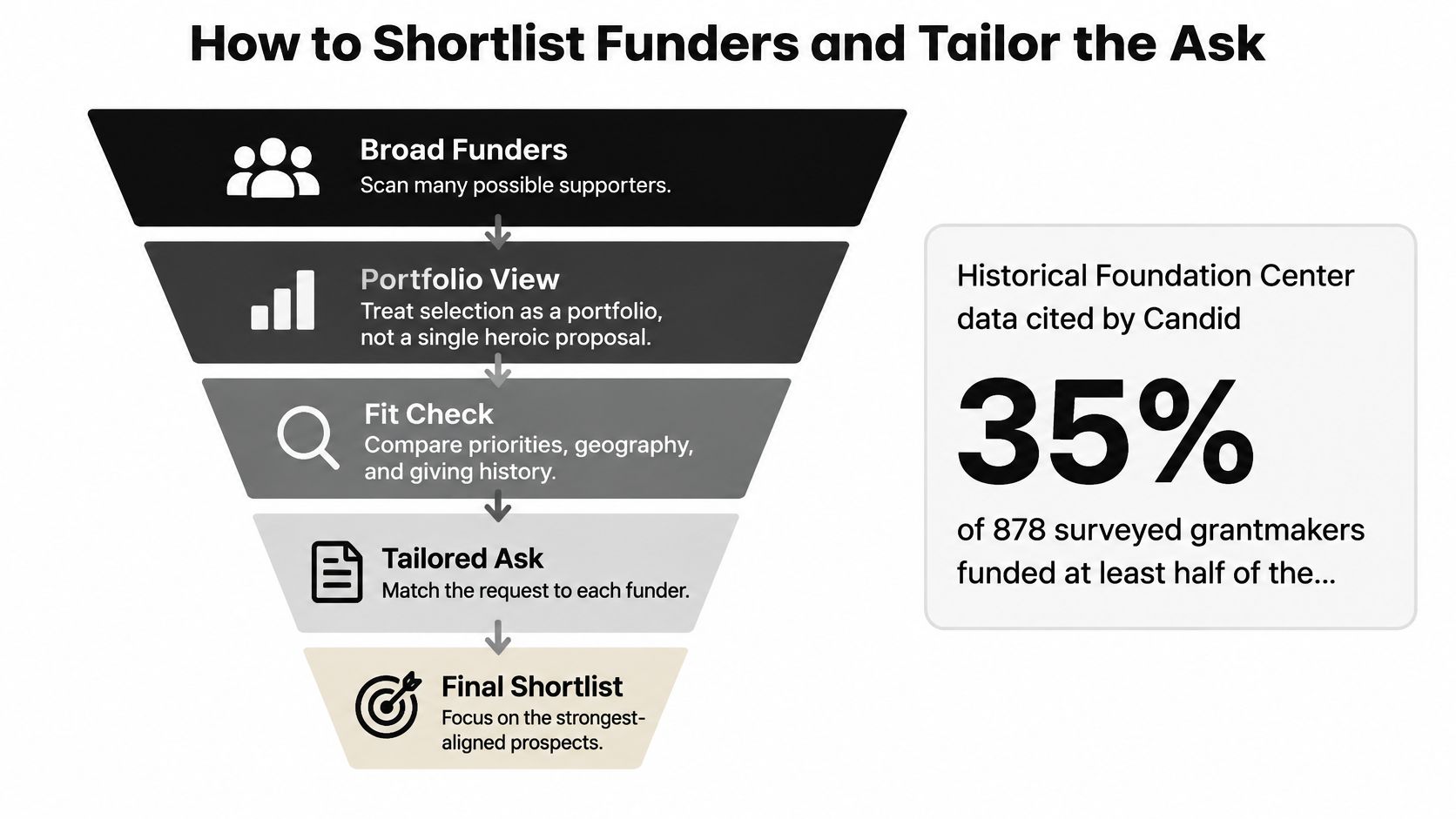
Candid also reports that approximately 60% of private-foundation funding, on average, comes from funders that have previously supported the recipient. Renewals and warm capital conversations belong at the top of the list. A cold open competition is the leftover, not the lead.
Sort, score, then cut
Put every prospect in one of three piles before you score anything.
Eligibility-qualified. The notice already fits your state, your applicant type, and a community facility or the program inside it.
Relationship-dependent. A program officer, a trustee, or a prior grant is the only realistic way in. Invitation-only with no relationship goes in a drawer.
Open competition. Anyone who meets the rules may apply, and the deadline is public.
Score what survives on geography, applicant type, population served, capital-versus-program fit, award size against your budget gap, and deadline. Drop a hard mismatch before anyone opens a narrative document. Wrong state, individuals-only, a $5,000 award against a $1.2 million building, or a foundation that funds arts exhibitions and not buildings: all of those are cuts, not "maybe if we explain our story."
Say a youth center in rural Ohio finds a coastal family foundation that loves "community spaces" and gives $250,000 capital grants. The 990-PF gifts are all in three coastal counties, and the guidelines say invitation-only. That prospect is a mismatch. Reading it twice will not move the county line.
For the survivors, rewrite the outputs to that funder's priorities. A capital funder gets construction milestones, a certificate of occupancy date, and partner dollars already signed. A program funder gets unduplicated participants, cost per participant, and utilization by week. Do not send both audiences the same paragraph with the dollar amount swapped.
Track four dates on every live prospect: submission, expected decision, first report, and whether a win can renew. A grant you cannot report on is not a win for a two-person shop. If you want a wider map of nonprofit funding types before you score, grants for nonprofits is a useful orientation, then come back and cut your own list to what you can match.
A fit-scored index can do the first pass from a website URL or EIN, pair a score with a short reason, and flag invitation-only rules, geography, grant size, and ineligible applicants. That is faster than reading Form 990-PF filings one by one, and it still leaves the final cut to you. The published funding rates stay a benchmark. They are not a promise that your fifth generic proposal will land.
How to Assemble the Application Step by Step
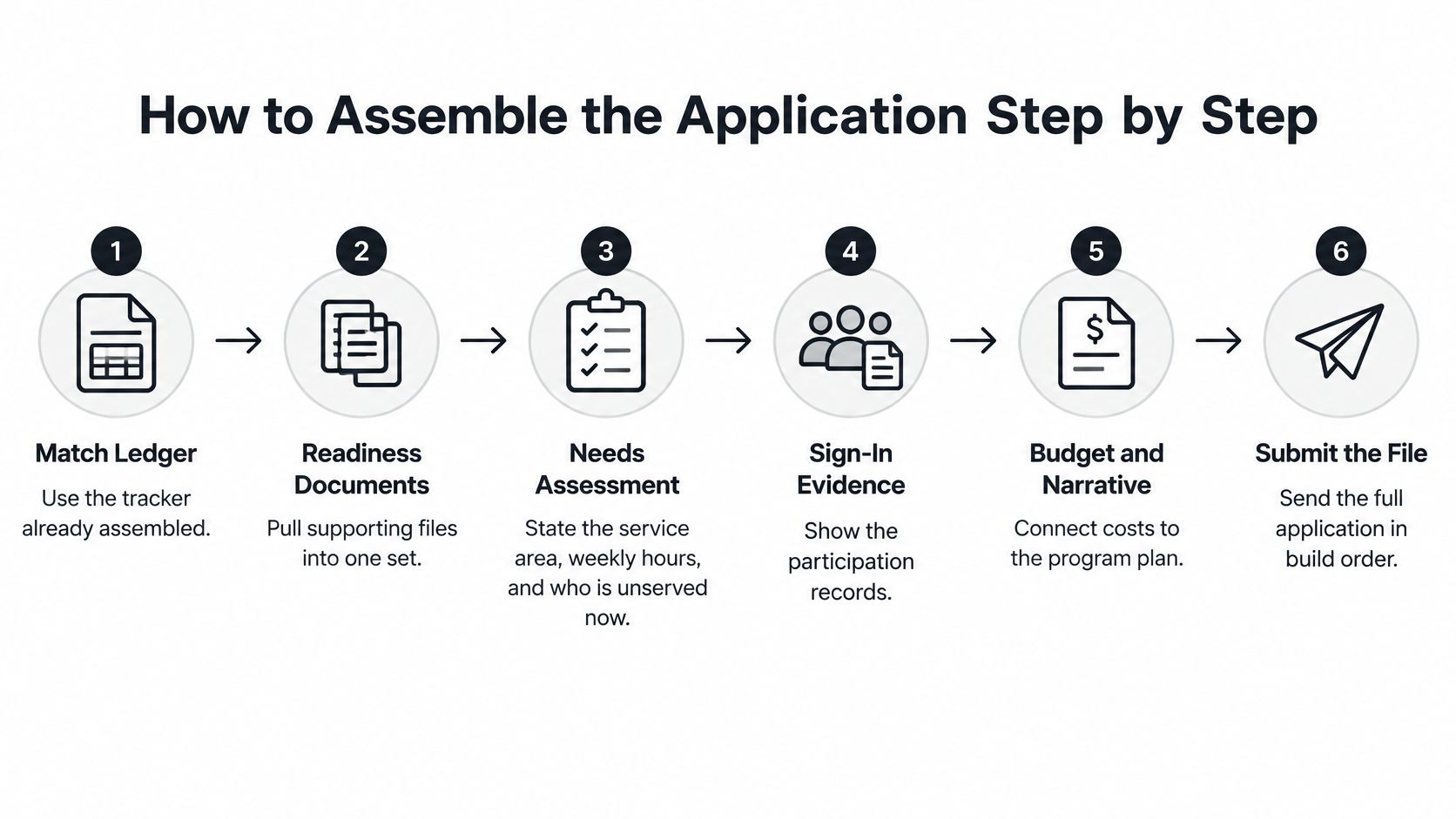
Build the file in order, from the match ledger and readiness documents you already have. Do not start with adjectives.
The USDA Community Facilities Direct Loan and Grant program is a useful screen even when you are writing a different notice. Confirm the applicant is a public body, a community-based nonprofit, or a federally recognized Tribe. Confirm the facility is an essential public service, not a private or commercial use. Validate a rural location of no more than 20,000 residents when that route is the one you chose. USDA Community Facilities grants can cover up to 75% of eligible project costs in communities of 5,000 or fewer with sufficiently low median household income, declining to 35% or 15% under less favorable population and income conditions. The program also looks at repayment capacity when a loan is in the mix, legal authority, and long-term maintenance.
Eight products, in build order
1. Needs assessment. Write the service area, the weekly hours, and who is unserved now. Use sign-in counts, partner referrals, or a short survey. A slogan is not a need.
2. Two budgets. Separate capital (construction or renovation and soft costs) from a year-one operating budget for staff, utilities, insurance, maintenance, and programming. Mark which award pays which lines. A facility grant often pays none of the operating lines. That split is where many pretty applications fail.
3. Beneficiary sheet. For a CDBG path, document the low- and moderate-income share. For a program funder, add unduplicated participants, cost per participant, and partner commitments you can count. One sheet, not three versions of the same boast.
4. Legal applicant. Name who signs. On the rural facility route that is the public body, community-based nonprofit, or Tribe. On CDBG it is usually the city or county, with the nonprofit as subrecipient. If your board cannot be the applicant, stop calling the file "our grant."
5. Site and environment. Attach site control and environmental-review status. Approval cannot outrun that review. An option, a deed, or a public-owner letter belongs here, not a paragraph that says you have a preferred corner lot.
6. Support and authority. Add letters or survey results that show demand, plus a board authorization to submit. Substantial community support is a file, not a feeling.
7. Credit and stewardship note. State why commercial credit cannot carry the whole project, and name who maintains the building after opening. Reviewers fund a facility they believe will still be open, insured, and cleaned in year three.
8. Checklist map. Map every attachment to the notice checklist and leave a week for signatures. Missing initials are a common reason a complete idea arrives incomplete.
A small-town senior and youth center that owns its lot, has a city partner, and already holds its local cash share is ready to draft. A group with a preferred site, no option, and no operating budget stops, even if the story is better.
The readiness folder behind those eight products is specific: Census population, service-area income calculations, board authorization, audited or reviewed financial statements, a capital budget, a debt-capacity note, site control, environmental documentation, and the letters or survey results. Treat the grant as a construction subsidy alone and you will miss the test the program runs.
Tips for Capacity Follow-Up and Reporting
Applying to more community-center grants is a weak default. The 2025 Nonprofit Finance Fund survey found that 44% of organizations identified the application process as too onerous, 40% said they were too small, 40% cited compliance burden, and 41% were unaware of relevant grants or contracts. On the funder side, 58.1% of surveyed funders expected applications to increase and 55% expected requested funding to rise, while only 33.3% prioritized reducing grantee burden. More submissions, against rising demand, with almost no relief on burden, is how a two-person shop gets worse at the work it already has.
A go or no-go you can run on one page
Estimate staff hours to write and hours to report for the full term. Confirm whether the award is capital, operating, or a narrow project. Recheck match and eligibility one more time. Then compare the reporting load with the dollars.
A $40,000 restricted program grant that needs quarterly participant audits can cost more staff time than it returns. Say your development lead and one program coordinator already share grant duty. Four audits a year, each pulling sign-in sheets, income documentation, and a narrative, can erase the margin that grant was supposed to create. I would rather take a smaller unrestricted or multi-year operating grant that pays salaries, utilities, insurance, and maintenance after a capital award has paid for the walls.
Construction money and center funding are different products. The building grant does not keep the lights on. If the only award in sight is a one-time capital check and you have no operating path, you are raising a building you may have to close.
A light cadence after you are actually ready
Contact the program officer or the municipal CDBG administrator only after the readiness file exists. Ask one eligibility question, and log the answer with the date and the person's name. Do not send a draft "for thoughts" when you still lack site control.
After submission, send a short thank-you, make one status check near the published decision window, and send a stewardship note to prior funders. A string of nudges reads as capacity trouble, which is the opposite of what you want a program officer to remember.
Keep deadlines and report dates in one calendar, not in separate inboxes. The same discipline shows up in tracking design requests and project KPIs: one owner, one date, one definition of done. Grant reporting is that habit applied to participants and dollars. If you need a simple structure for what to measure after an award, evaluating and monitoring is worth reading before you promise a metric you cannot collect.
Choose the First Grant Worth Writing
The biggest grant is not always the usable one. Choose the first application your organization can match, document, and administer.
A rural nonprofit with site control and a confirmed local cash share may be ready to apply for a federal community-facilities grant. Keep a private operating prospect in view as well. Capital funds can pay for the building, while a separate operating award can help cover staff, utilities, insurance, and programming after it opens. Set up separate application calendars so the operating ask does not wait until opening day.
For a city or county project, start with the CDBG administrator and the public-facility priorities in the consolidated plan. In New York, the program notice sets the current request ceiling, so check it before sizing the ask. The nonprofit is usually the partner rather than the applicant. Meet with the public partner before polishing a foundation letter that may not fit the project.
An organization with foundation history can start with a renewal or a capital conversation with a prior funder. A funder that has already paid your invoices may be a better first prospect than an unfamiliar name. Match the ask to the relationship and to the costs the grant can cover.
Skip a prestigious program if your organization cannot meet its eligibility rules, provide the committed match, or manage the reporting. A restricted grant can consume more staff time than a smaller operating award. Choose the application your team can complete accurately and administer after the award.
This month, and only this month
Finish the match ledger. Count only money in the bank or covered by an executed award. Leave unconfirmed funds off the form.
Book the public-partner meeting. Share the site status and beneficiary sheet with city, county, or Tribal staff before asking them to be the applicant.
Build a shortlist of five qualified prospects with deadlines. Grantlas can generate a scored shortlist of private foundations and open federal grants from a website URL or EIN, with a short reason and flags for geography, grant size, and applicant type. Use those details to narrow the list, then check each prospect against your documents and capacity.
Write one focused narrative for the best-fit prospect. The first grant for community center worth writing is the one your team can support with credible documents, a workable match, and a realistic reporting plan.
Grantlas builds a scored shortlist of private foundations and open federal grants from your website or EIN, with a short reason on each score and flags for geography, grant size, and applicant type. Visit Grantlas to build your organization profile before drafting the next narrative.