Foundation Grant Database Comparison for 2026
Oct 30, 2026 · 12 min read

Choose the foundation grant database with the most funders sounds like sensible advice. It isn't enough. If a search ranks a wealthy national foundation above a smaller funder that supports your county, accepts new applicants, and makes awards your organization can realistically use, a longer results list can make prospecting worse.
A useful comparison starts with what a small nonprofit can verify: the filing year, the applicant's eligibility, the explanation behind a match, and the subscription terms. Treat an impressive funder count as a coverage claim, not evidence that the database will help you decide where to send your next proposal.
Table of Contents
- Foundation Grant Databases Compared at a Glance
- Foundation Coverage Versus Federal Grants
- How Fresh Foundation Filing Data Is
- Search Filters and Fit Scoring That Matter
- What Each Pricing Tier Buys
- Workflows Grant Teams Actually Run
- Choose a Database With This Checklist
Foundation Grant Databases Compared at a Glance
Foundation grant databases side by side
| Option | Coverage | Data and freshness | Search and fit | Entry price |
|---|---|---|---|---|
| Publisher's platform | Private foundations and open federal opportunities nationwide | Public filings; filing year displayed; nightly opportunity scans and monthly rescoring described | Organization profiles; sector, geography, and grant-size filters; plain-English explanations and eligibility flags | Not independently verified |
| Instrumentl Discover | Plan-specific coverage not verified | Filing-year display and update cadence not verified | Discover-specific filters and eligibility explanations not verified | Not independently verified |
| GrantFrog Professional | Plan-specific coverage not verified | Source coverage and update cadence not verified | Professional-specific matching and eligibility tools not verified | Not independently verified |
| IRS SOI foundation datasets | Domestic private foundations and certain charitable trusts; not a federal opportunity index | Annual returns compiled into statistical datasets; interpret totals alongside reporting period and accounting method | Statistical analysis rather than organization-profile matching or application alerts | Public data access; analyst time required |
Not verified doesn't mean unavailable. It means the evidence needed to make that buying claim isn't established. Don't turn an empty competitor field into a disadvantage, and don't treat a product description as an independently tested result.
Read for decisions, not feature counts
Coverage tells you whether an option deserves a trial. Freshness tells you which period its evidence describes. Search and fit tools should tell you what to do with a result, rather than merely return a name containing your program's keywords.
The financial context makes those distinctions important. In the Nonprofit Finance Fund survey, 81% of surveyed nonprofits received private-foundation funding in 2024, while 75% said raising unrestricted dollars was challenging. Receiving foundation support and finding funding that meets operating needs are different problems.
A database can therefore identify relevant funders without identifying usable opportunities. A foundation might support your issue but restrict awards to existing partners. Another might support your location but offer project funding when your immediate need is unrestricted support.
A useful prospect isn't simply a foundation that could afford your request. It's a funder whose application rules and giving behavior make the request worth pursuing.
Keep the comparison honest
Use the table to retain plausible options, then test them against the same program description. Include the service area, applicant type, intended use of funds, and an achievable request.
Ask each vendor to demonstrate a plausible match and a rejected match. The rejection is particularly revealing: a product that explains why you shouldn't apply may protect more staff time than one that keeps adding names.
Don't declare a winner from unresolved fields. Request the relevant plan documentation, inspect the live product, and distinguish vendor-described capability from capability you've tested.
Foundation Coverage Versus Federal Grants
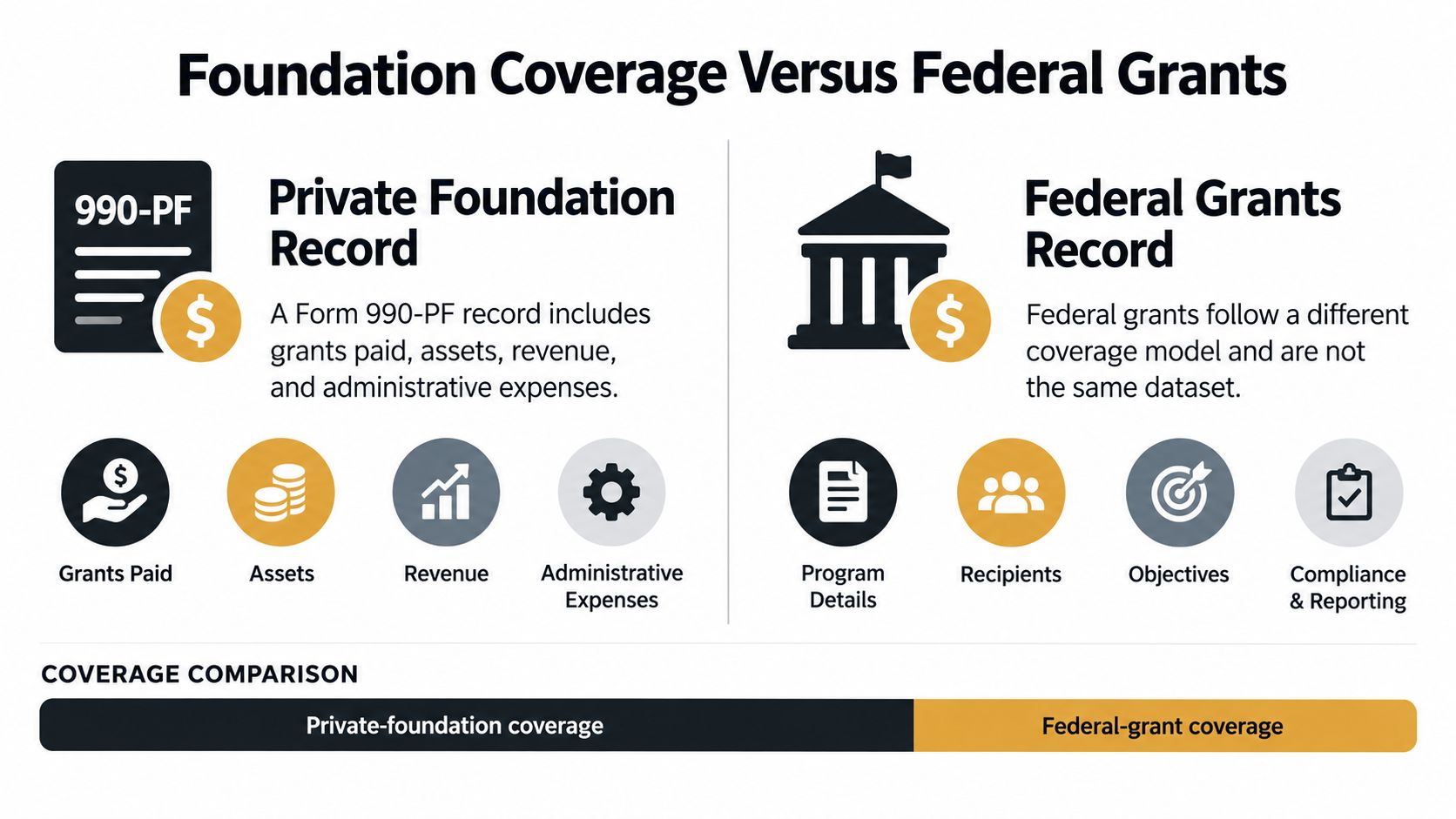
A private-foundation record and a federal opportunity announcement answer different questions. The foundation record helps you investigate past giving and financial capacity. The announcement tells you whether a specific program currently invites an application from an eligible organization.
This distinction should shape your shortlist before you compare search interfaces.
The coverage split is easier to evaluate when you separate the underlying records.
Match coverage to the applicant
Say a neighborhood food pantry wants support for local distribution and storage. Its researcher should investigate nearby funders, county restrictions, and whether the proposed expense fits the funder's application guidelines. A national opportunity list adds little if the organization can't separate local prospects from geographically ineligible results.
A university research office has a different problem. An administrator may need to compare private support for exploratory work with federal programs that have formal applicant requirements and submission deadlines. Combined discovery can be useful, provided staff can distinguish a historical foundation grant from an open announcement.
A consultant serving a clinic and an arts organization needs a reusable geographic search process. The relevant question isn't whether the database contains funders everywhere. It's whether the consultant can isolate each client's service area without importing another client's eligibility assumptions.
- For a local nonprofit: Test county-level restrictions, not just the presence of a state filter.
- For an academic applicant: Inspect the opportunity's applicant category and application instructions.
- For a multi-client practice: Check whether saved profiles preserve separate missions, locations, and funding needs.
Keep the record types separate
A combined index is useful only when users can filter foundation giving and federal announcements apart.
An award listed in a foundation's giving history isn't necessarily an opportunity you can apply for. Likewise, an open federal announcement doesn't establish that your organization has the administrative capacity to pursue it.
For teams considering that second category, this guide to federal grants for nonprofits can help frame the application decision. Review eligibility and obligations before allowing a deadline to enter the proposal calendar.
Choose combined coverage when your team already pursues both funding channels or has a clear reason to expand. Choose foundation-focused research when that matches your pipeline. A public filing dataset can be sufficient when you need historical financial analysis rather than active-opportunity discovery.
Unused coverage isn't added value. It becomes useful only when your team can act on the records it contains.
How Fresh Foundation Filing Data Is
Find the filing year before interpreting a foundation's grant totals. A recently refreshed interface can still display an older return. Without the underlying reporting period, you can't tell whether a grant history describes the foundation's recent behavior or a much earlier portfolio.
The IRS Statistics of Income foundation statistics provide an important historical illustration: in tax year 2017, foundations with at least $100 million in assets represented 1% of filed returns but held 65% of total assets. Those figures describe that tax year, not the current distribution of foundation assets.
The practical lesson is about interpretation. Asset scale can dominate a search result without telling you whether the funder is accessible to your organization.
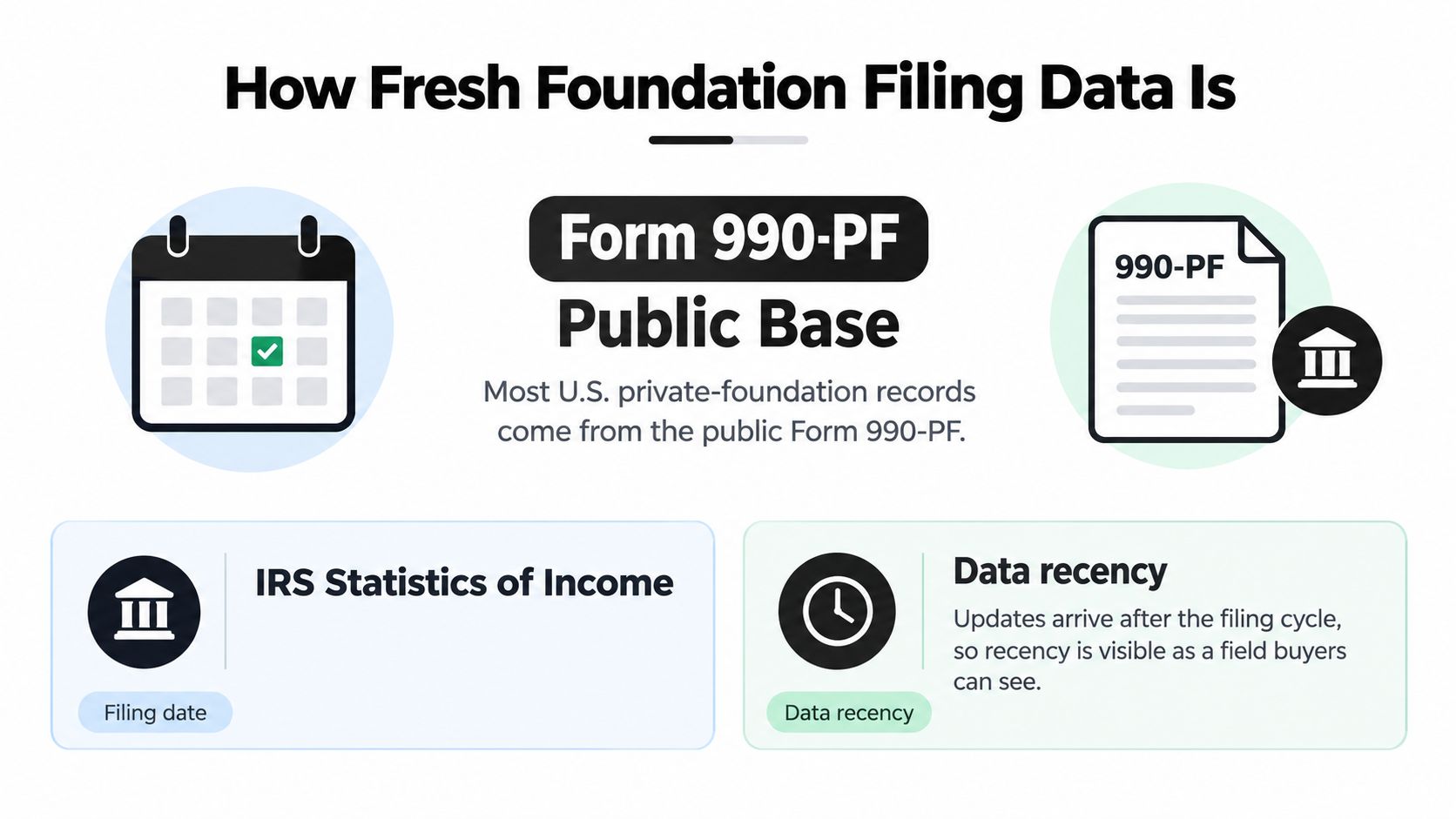
This visual separates the public-record foundation from the recency check a buyer should make.
Separate the update clocks
Form 990-PF supplies standardized financial information, including grants paid, revenue, administrative expenses, assets, and tax-related fields. The IRS compiles returns into datasets covering operating foundations, nonoperating foundations, and certain nonexempt charitable trusts.
A database can process that information on a different schedule from its opportunity index. Its matching system may operate on another schedule again.
| Clock | What it establishes | What it doesn't establish |
|---|---|---|
| Filing period | When the reported financial activity occurred | Whether applications are currently welcome |
| Opportunity refresh | When an announcement was checked or collected | Whether the historical financial record changed |
| Profile rescore | When a matching process reran | Whether new underlying evidence became available |
Ask a vendor to display these distinctions rather than collapse them into a general freshness label. A new score based on unchanged evidence is a new calculation, not a new foundation filing.
Interpret the totals before setting an ask
Cash-basis and accrual-basis reporting can affect how contributions, gifts, and grants paid appear across reporting periods. When a total changes, inspect the accounting basis and underlying grants before concluding that the foundation expanded or reduced its support.
Also distinguish a broad financial total from the award range relevant to your organization. A foundation's portfolio may contain different grant purposes and recipient types. A portfolio-wide median can be a poor guide if your program belongs to a narrower category.
Practical rule: If the product hides the filing year, don't use its median grant size to set your ask.
Use historical giving to formulate questions. Confirm current application policy separately, and record where each answer came from so another staff member can reproduce your judgment.
Search Filters and Fit Scoring That Matter
Say a database finds a grant to an organization called Community Arts Center. Your peer organization has that name, but so does an unrelated group elsewhere. If the system assigns the award to the wrong recipient, it can make a funder look locally relevant when the underlying grant offers no such evidence.
That's a data-quality problem, not merely a search inconvenience. The federal filing documentation describes an important limitation: private foundations generally aren't required to report grantee EINs on Form 990-PF Part XIV, while public foundations report grantee names and EINs on Form 990 Schedule I.
Start with filters that eliminate wasted work
A grant writer needs to narrow a search by sector, geography, and realistic award size. Plain-English search is useful when a program spans categories, such as food access combined with transportation assistance, but it shouldn't override eligibility restrictions.
A fit explanation should identify evidence rather than repeat your mission statement. Look for distinctions like these:
- Substantive alignment: The foundation has supported the relevant activity, not just organizations using a similar word.
- Geographic compatibility: The applicant's service area meets published rules, with historical giving used as supporting context.
- Application access: The funder accepts unsolicited requests, requires an introduction, or has an unresolved policy.
- Request compatibility: The proposed use and scale of funding fit the relevant giving history.
Keep unknown separate from eligible. A missing restriction isn't permission to apply.
Audit the match beneath the score
A sound recipient-matching process should preserve the original filing text and evaluate identifiers such as name, city, state, address, website domain, and EIN when available. It should also retain unresolved cases rather than force every grant into a single nonprofit profile.
For peer prospecting, ask the vendor to expose the recipient behind the recommendation. Check whether its location and identity match your known peer. If they don't, don't rely on the inferred sector, typical award, or repeat-recipient pattern.
Ask how the vendor measures false matches and missed matches, and whether unresolved grant dollars remain visible. A confident interface shouldn't conceal an uncertain association.
Test the explanation with a peer you know. A useful answer names genuine shared characteristics and shows supporting records. A weak answer supplies a familiar keyword and asks you to trust the score.
What Each Pricing Tier Buys
A price comparison should distinguish a published quote from a verified subscription commitment. Without current pricing-page evidence, exact fees, billing dates, and savings claims shouldn't determine the recommendation.
The purchasing question is broader than the entry fee: Which plan covers the people and organizations that must use it, and what work remains outside the subscription?
| Plan | Monthly price | Users | Organizations |
|---|---|---|---|
| Publisher's Solo plan | Confirm current quote | Confirm single-user entitlement | Confirm single-organization entitlement |
| Publisher's Pro plan | Confirm current quote | Confirm team cap | Confirm client-profile cap |
| Instrumentl Discover | Not independently verified | ||
| GrantFrog Professional | Not independently verified |
Blank competitor limits are deliberate. Don't infer seat counts from another tier or from an older review.
Price the actual working arrangement
An executive director researching for a single nonprofit should ask whether another staff member needs independent access. Sharing credentials isn't a substitute for confirming the plan's user permissions.
A consultant should examine organization limits separately from seats. A plan can accommodate the consulting team but still constrain the number of client profiles it can maintain.
Request written confirmation of:
- Billing terms: Monthly or annual commitment, renewal conditions, cancellation process, and applicable charges.
- Usage limits: Search credits, profile limits, exports, and any restrictions on repeated searches.
- Included functions: Which alerts, saved searches, collaboration tools, and matching features belong to the quoted tier.
- Trial conditions: Whether payment details are required and what happens when trial access ends.
Separate discovery costs from adjacent tools
Don't pay for a discovery subscription because a future integration sounds convenient. Treat pipeline tracking, chat integrations, APIs, and webhooks as unavailable until the vendor demonstrates that they're included in the plan you're buying.
If you're also reviewing shared AI subscriptions, keep that budget separate. The resource to compare family AI plan costs can support that adjacent review, but it doesn't establish grant-database functionality or nonprofit team permissions.
Annual billing makes sense only after the workflow passes a real test. Compare the written annual quote with the monthly commitment, then consider whether the discount justifies losing flexibility.
Buy the smallest plan that supports the actual working arrangement, not the largest plan you might eventually need.
Workflows Grant Teams Actually Run
A development associate opens a program description and needs a defensible outreach list, not another spreadsheet of foundation names. The useful output is a set of prospects with evidence, unresolved questions, and a next action.
Funding pressure makes disciplined triage important. In 2025, 87% of 227 foundation leaders surveyed said they had seen increased demand for funding since January, according to the Center for Effective Philanthropy finding reported by The Chronicle of Philanthropy.
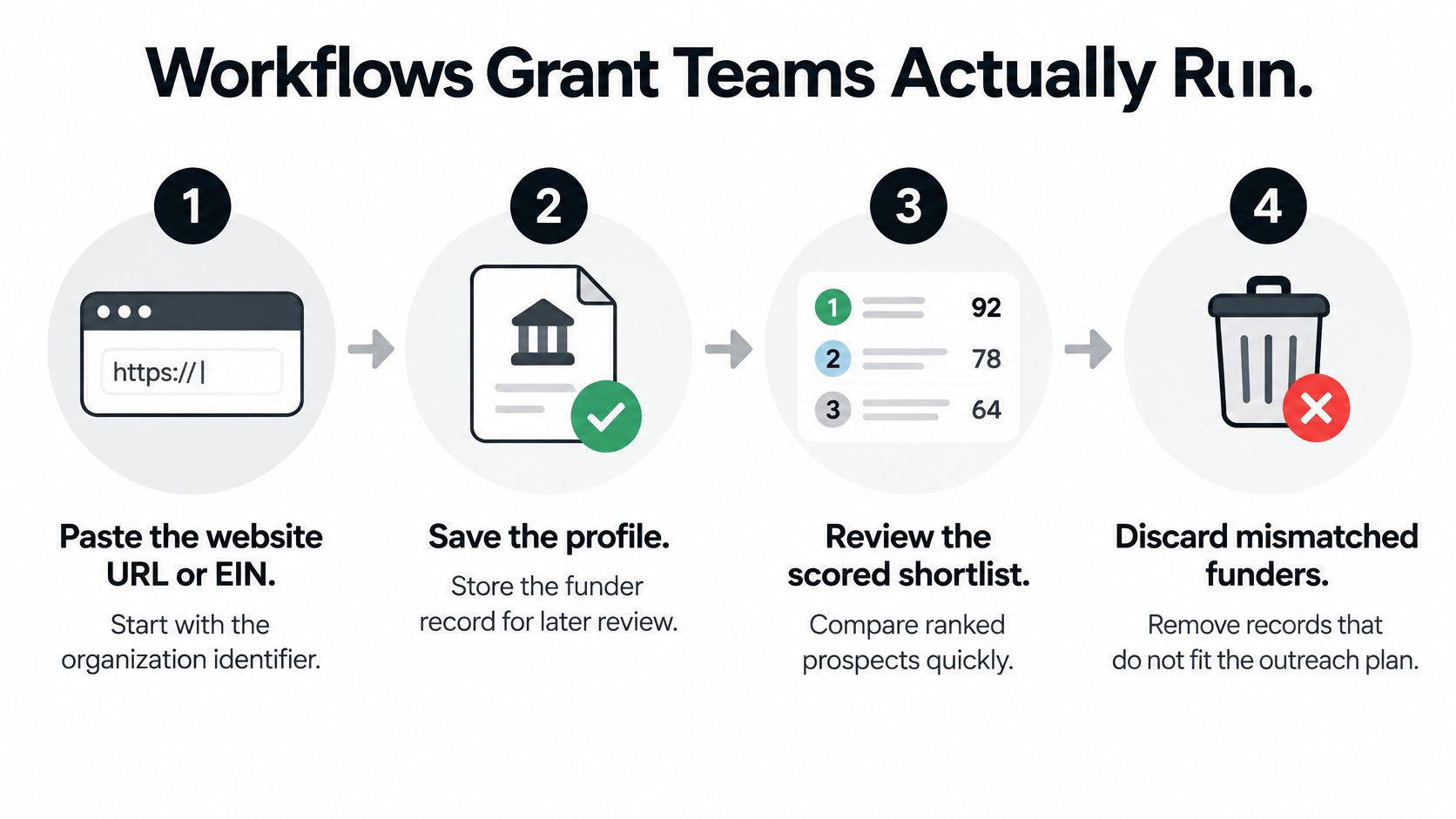
The discovery workflow should end with decisions rather than saved records.
From program description to outreach
For the development associate, start with an organization profile built from its website or EIN, then correct the imported details. Review the shortlist against the actual program, remove clear mismatches, and assign each remaining prospect an outreach task.
Board and trustee names can inform relationship research, but a name alone doesn't establish a connection. Record whether someone on your board can make an appropriate introduction rather than assuming familiarity.
An executive director needs a lighter routine. Review a digest, resolve eligibility questions, and approve only requests that fit staff capacity and the program budget. Deadline reminders should support that decision, not pressure the organization into pursuing every approaching date.
- Consultant output: Maintain distinct client searches and document why a peer-based recommendation belongs to the correct client.
- University output: Route eligible federal announcements and private-funder prospects to the appropriate internal owner, with different application requirements preserved.
This video provides an additional reference point for evaluating a discovery routine.
Make the handoff explicit
Discovery ends when someone knows what to do next. Use an existing spreadsheet or demonstrated tracking tool to record the owner, next action, eligibility evidence, and application status.
This guide to grant tracking software can help distinguish research needs from proposal-management needs. Don't assume a discovery subscription includes a complete application-management system.
If your team wants to connect approved prospects with other systems, review workflow automation tools compared after defining the handoff. Automating unreviewed matches only moves uncertain information faster.
During a trial, time the whole task: saving a search, reviewing an alert, rejecting an ineligible prospect, and assigning a useful next action. Logging in quickly isn't the same as finishing research efficiently.
Choose a Database With This Checklist
The subscription decision should rest on an observable change in proposal selection. A database earns its place when your team can identify a relevant prospect, explain the decision, and avoid an application it shouldn't pursue.
Use a real program rather than a generic mission statement. For a foundation-focused test, start with the application considerations in this guide to private foundation grants for nonprofits, then bring a specific funding need into the trial.
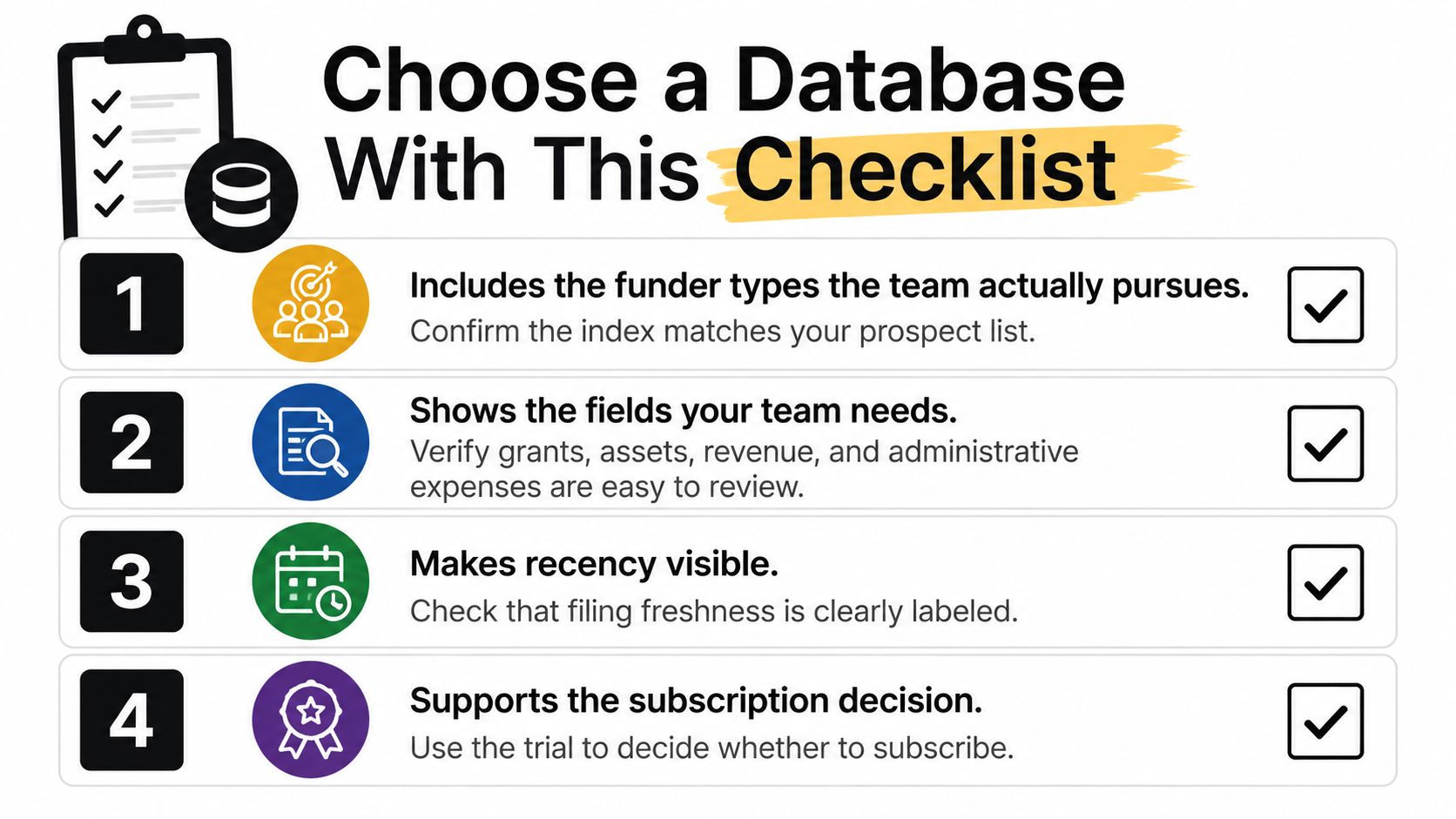
Keep a written pass-fail record while you evaluate the product.
Require evidence before subscribing
- Coverage passes when you can retrieve the funder types and service areas your team pursues. A broad marketing description alone doesn't pass.
- Record quality passes when you can inspect the underlying period, grant evidence, and unresolved fields without guessing.
- Eligibility passes when an explanation distinguishes documented restrictions from inferred preferences and missing information.
- Peer matching passes when a known recipient survives an identity check and the recommendation remains credible.
- Workflow passes when a researcher can turn a result into an assigned action without losing the supporting evidence.
- Commercial terms pass when the written quote covers your users, client profiles, billing commitment, and required functions.
Choose the appropriate level of assistance
A public IRS dataset is a reasonable choice for someone who needs historical totals and can perform the analysis. It isn't a substitute for an application-policy check, and the absence of a subscription fee doesn't remove the staff work.
A paid discovery product is worth considering when your team needs organization-specific prioritization and can verify that the explanations improve decisions. Compare Instrumentl Discover and GrantFrog Professional through the same practical test rather than assuming that an unknown field favors either option.
Don't subscribe because the first results screen looks busy. Keep a short decision log showing which prospect you advanced, which you rejected, and what evidence changed your judgment.
The strongest buying signal is a better proposal choice, not a longer shortlist. Build a profile from your website or EIN, examine the first flagged mismatches, and subscribe only if the test changes who deserves your team's attention this month.
Grantlas offers private-foundation and open federal-opportunity discovery with organization profiles, scored matches, and plain-English eligibility explanations. Build a profile and inspect the initial matches before entering a payment method, then judge whether the shortlist gives your team a clearer, defensible proposal decision.