10 Capacity Building Grants for Nonprofits in 2026
Oct 25, 2026 · 15 min read

Your donor database can't produce a reliable mailing list, your board wants a strategic plan, and your staff already has more work than it can finish. You search for capacity building grants for nonprofits and find promising descriptions, but the practical questions remain unanswered. Can your organization apply? Will the grant cover a consultant, staff training, or the operating costs you actually need?
The biggest distinction isn't between generous and modest funders. It's between support you can use and support that creates another obligation your team can't absorb. A planning grant won't solve an immediate cash shortage, and a technology award may leave you responsible for migration, training, and ongoing subscriptions.
The options below put geography, organizational budget, allowable expenses, cost sharing, and timing ahead of broad promises about organizational effectiveness. Grantlas is a research tool rather than a grantmaker; the remaining entries are funding programs with different restrictions.
Treat every deadline as a date to verify, not proof that applications are open today. The supplied program information includes dated application windows, closed-cycle references, and rolling processes. Where a date has passed when you're reading, check the next cycle rather than preparing an application against an old listing.
Table of Contents
- 1. Grantlas
- 2. SVP NYC Capacity-Building Grants
- 3. TD Charitable Foundation Capacity Building Fund
- 4. Washington State Department of Commerce Capital Project Capacity-Building Grants
- 5. Michigan Health Endowment Fund Capacity Building
- 6. Initiative Foundation Nonprofit Capacity-Building Grants
- 7. Foundation for Community Health Capacity Building Grant Program
- 8. RRF Foundation for Aging Organizational Capacity Building
- 9. Vermont Community Foundation Nonprofit Capacity Building
- 10. Dyson Foundation Capacity Building Grant
- How the nine capacity building grants compare on size, eligibility, and timing
- Turning a Shortlist Into Applications You Can Actually Submit
1. Grantlas
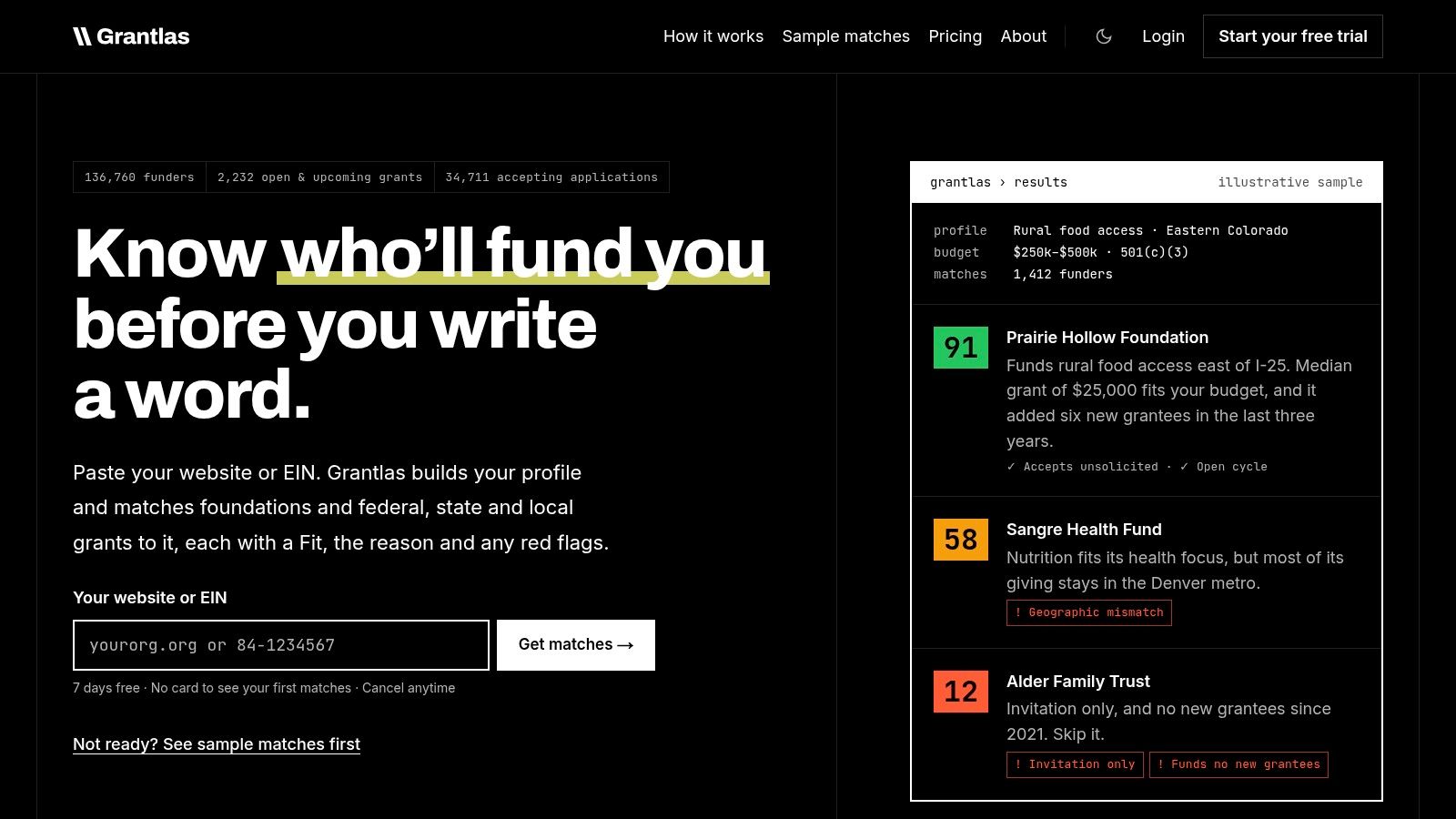
Grantlas helps build a prospect list; it doesn't award capacity-building funding. That distinction matters if your team needs money immediately rather than another research subscription.
You create an organizational profile using a website address, EIN, and supporting details. Grantlas ranks prospective foundations and opportunities with a Fit score, plain-English reasoning, and eligibility warnings, including geographic mismatch, invitation-only funding, and unsuitable applicant or budget ranges.
Where it helps a small team
- Eligibility screening: Use the flags to remove obvious mismatches before drafting a project narrative.
- Research context: Review giving histories, peer organizations, and trustee information rather than relying only on a funder's stated interests.
- Focused discovery: Search for organizational effectiveness, governance, fundraising infrastructure, and staff development, not just the phrase capacity building.
- Follow-through: Use saved searches and deadline reminders to revisit promising opportunities without restarting the research.
The practical advantage is prioritization. A funder with relevant past awards may deserve investigation even when its program title doesn't mention capacity building.
The trade-off is that a match isn't an eligibility determination. Public filings can describe earlier priorities, and opportunity coverage shouldn't be mistaken for a complete inventory of every local grant. Read the underlying application guidance before assigning proposal work.
For capacity projects, add your actual need to the profile: consultant support, implementation help, training, or flexible operating funds. Then inspect whether the funder supports that expense, accepts new applicants, and serves your community.
Practical rule: Use a research score to decide what to investigate next, not whether to submit an application.
Grantlas is most useful when your team needs a repeatable screening process. It's less useful if you already have a short, verified list and your main constraint is writing or implementing the project.
2. SVP NYC Capacity-Building Grants
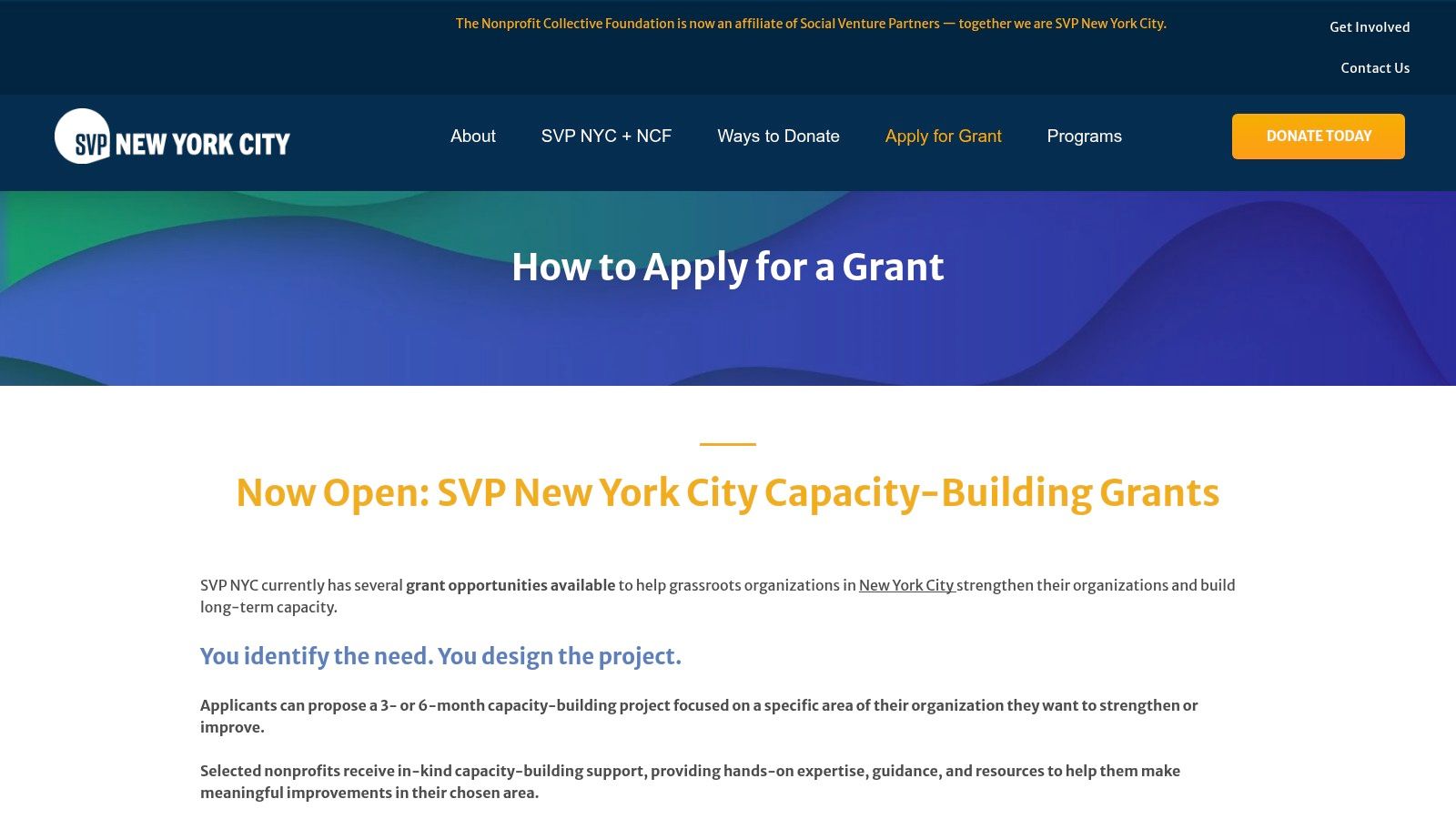
Choose SVP NYC when hands-on assistance matters as much as cash. The engagement model makes this different from a grant that only reimburses consultant invoices.
The supplied listing for SVP NYC's capacity-building grants describes three- or six-month engagements, most including $10,000 in unrestricted support, for qualifying public charities or public entities serving U.S. communities with revenue of $1 million or less, and lists an October 16, 2026 deadline.
Check fit before designing the engagement
The published eligibility isn't confined to organizations in New York. Still, applicants should confirm their legal status, service geography, and revenue eligibility directly rather than infer eligibility from the program's name.
The strongest request identifies an organizational problem that outside expertise can realistically help resolve. For example, propose a fundraising planning process with clear staff responsibilities rather than a broad request to improve sustainability.
- Useful feature: Expert assistance accompanies flexible funding, helping connect recommendations to organizational needs.
- Application friction: Applicants must register with The Nonprofit Cooperative.
- Timing caution: If the listed deadline has passed, ask about the next round instead of treating the application page as an open invitation.
The main trade-off is staff participation. An engagement requires someone inside the organization to provide information, make decisions, and carry recommendations forward. Don't pursue advisory support without identifying that internal owner.
3. TD Charitable Foundation Capacity Building Fund
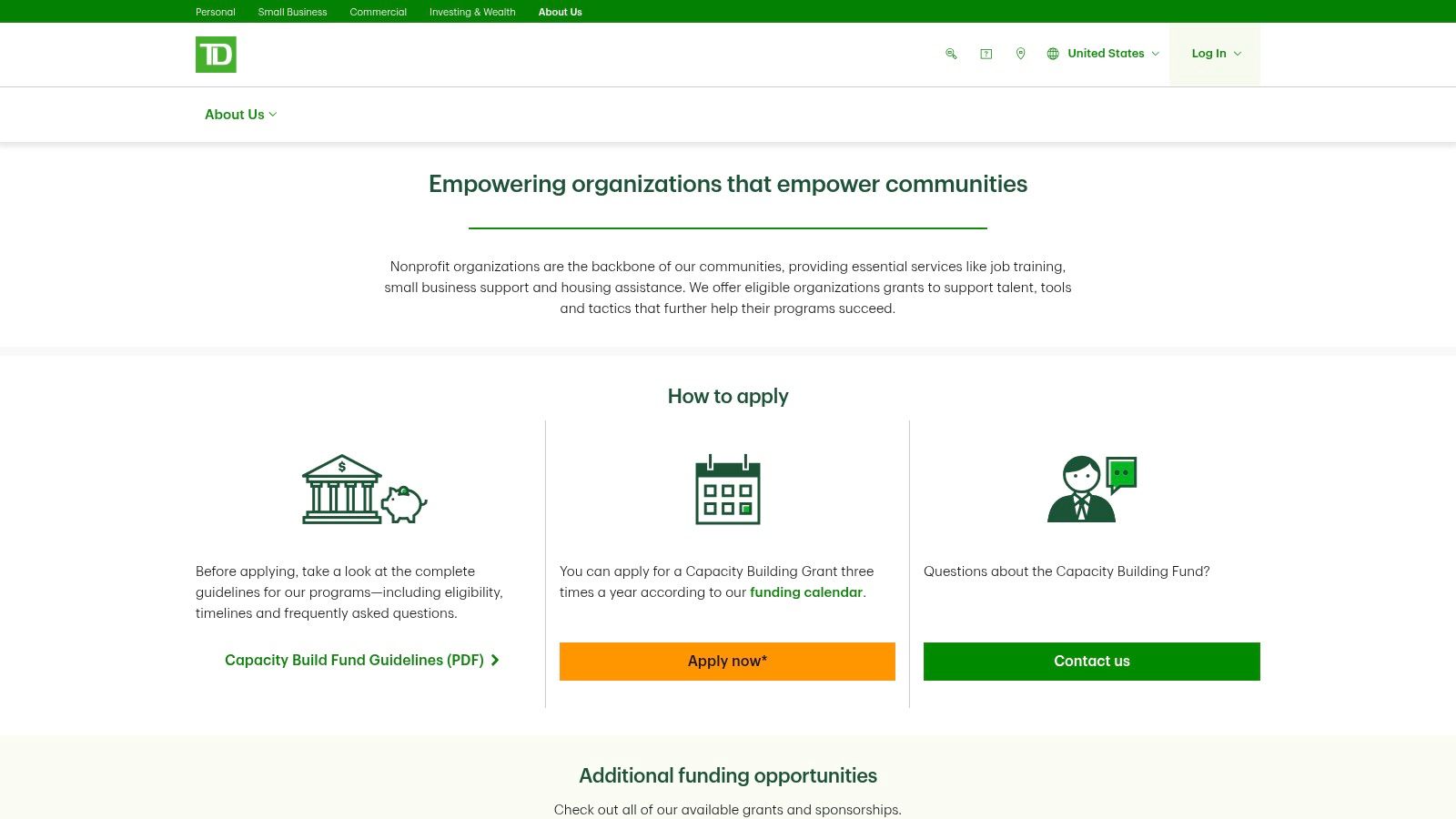
A team planning a substantial organizational improvement should first check where it operates, what the fund can support, and whether the listed application round is open. TD's Capacity Building Fund may fit requests that combine investments in talent, tools, training, or organizational strategy.
The TD nonprofit funding information lists awards of $25,000–$150,000, eligibility within TD's regional footprint, and a November 13, 2026 deadline for the identified round. Confirm that your organization and service area meet the current geographic requirements before preparing a proposal.
Match the request to the work
The award range alone does not establish fit. Define the organizational need and the work the funding would pay for, then check the fund's current guidance for eligible expenses. For a technology request, specify who will choose the system, prepare data, train staff, and maintain the workflow. Those responsibilities affect both the budget and whether the proposed change can be put into practice.
- Who should investigate: Organizations within TD's regional footprint seeking support for a defined capacity-building project.
- Main constraint: Regional eligibility and a specific application round. The listed deadline is November 13, 2026, so verify the round's status before scheduling application work.
- Budget check: Confirm whether staff time, subscriptions, consultant fees, and implementation costs qualify under current guidance.
The practical trade-off is scope: a larger award can support a substantial project, but a broad operations request may be harder to assess than a clear plan with costs tied to specific work. Build the budget from the project's needs, then confirm the fund's requirements.
4. Washington State Department of Commerce Capital Project Capacity-Building Grants
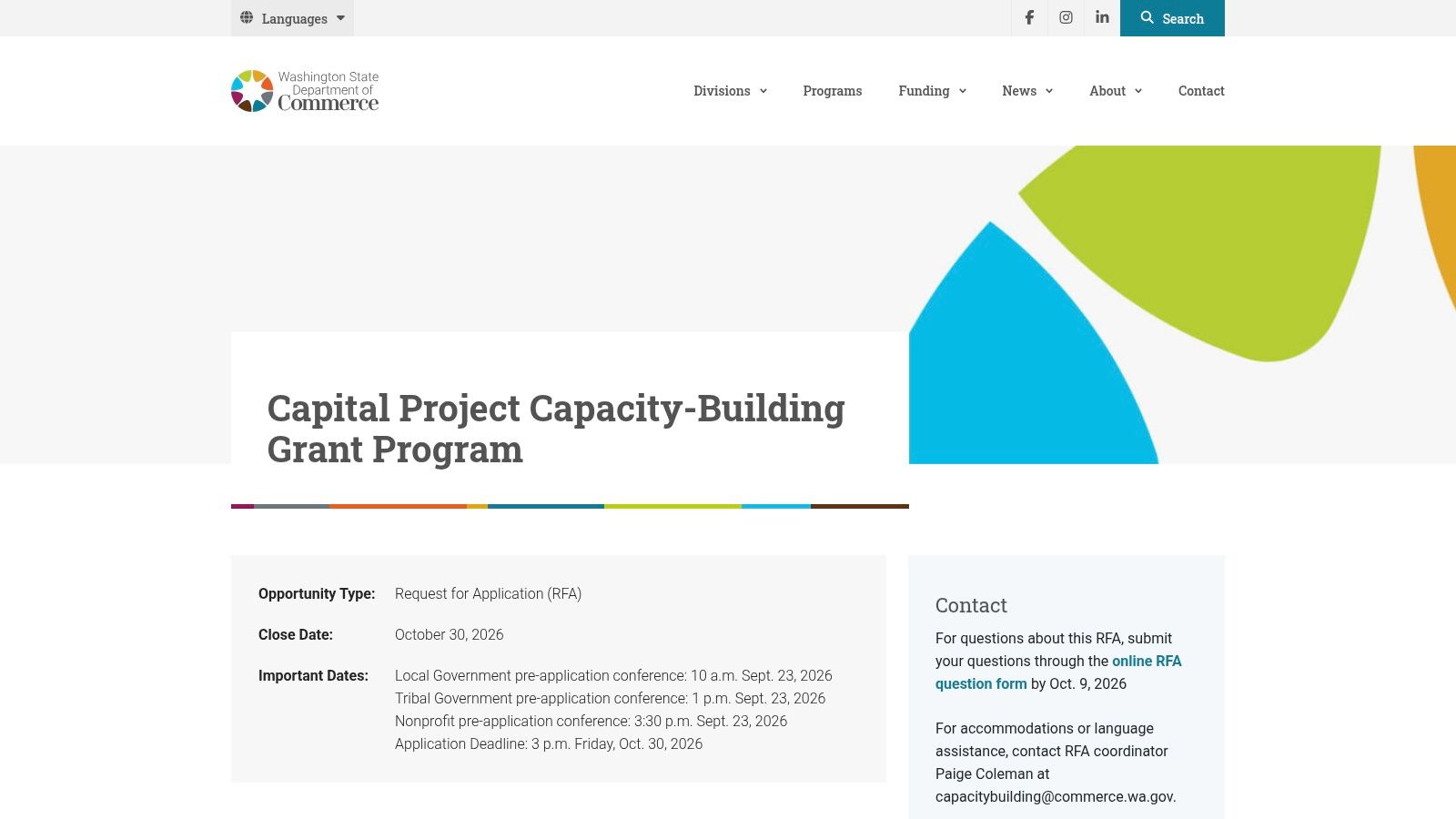
A nonprofit preparing a community-serving facility or infrastructure project may find this grant relevant. The program funds capital-project readiness, not general organizational development such as board training or a donor database.
The Washington Commerce program listing describes awards of up to $50,000 for eligible federally designated nonprofits registered in Washington. It supports early-stage readiness, technical assistance, and predevelopment for projects benefiting overburdened communities, with priorities including housing, energy, and infrastructure.
Check eligibility before building a budget. Confirm the applicant track, eligible predevelopment costs, required documentation, and any cost-share provisions in the current instructions. The listed deadline is October 30, 2026, at 3 p.m. Pacific Time; verify that the application window is still open before committing staff time or paying for estimates.
Separate readiness from construction
Start with the obstacle holding the project back. Then specify the preparatory work, the deliverable it will produce, and how the organization will use it. That clarity helps reviewers distinguish project preparation from construction or broad internal planning.
- Who should investigate: Eligible Washington nonprofits preparing qualifying capital projects.
- Who should look elsewhere: Organizations seeking unrestricted operating support or internal planning unrelated to a capital project.
- What to confirm: Whether the proposed expenses fit the program's current rules and whether the organization meets the applicant requirements.
Understanding how capital-project preparation differs from other types of grants can prevent a common application problem: presenting a worthwhile community project without showing that the requested costs belong in this funding category. Check the current deadline and submission time before starting an application.
5. Michigan Health Endowment Fund Capacity Building
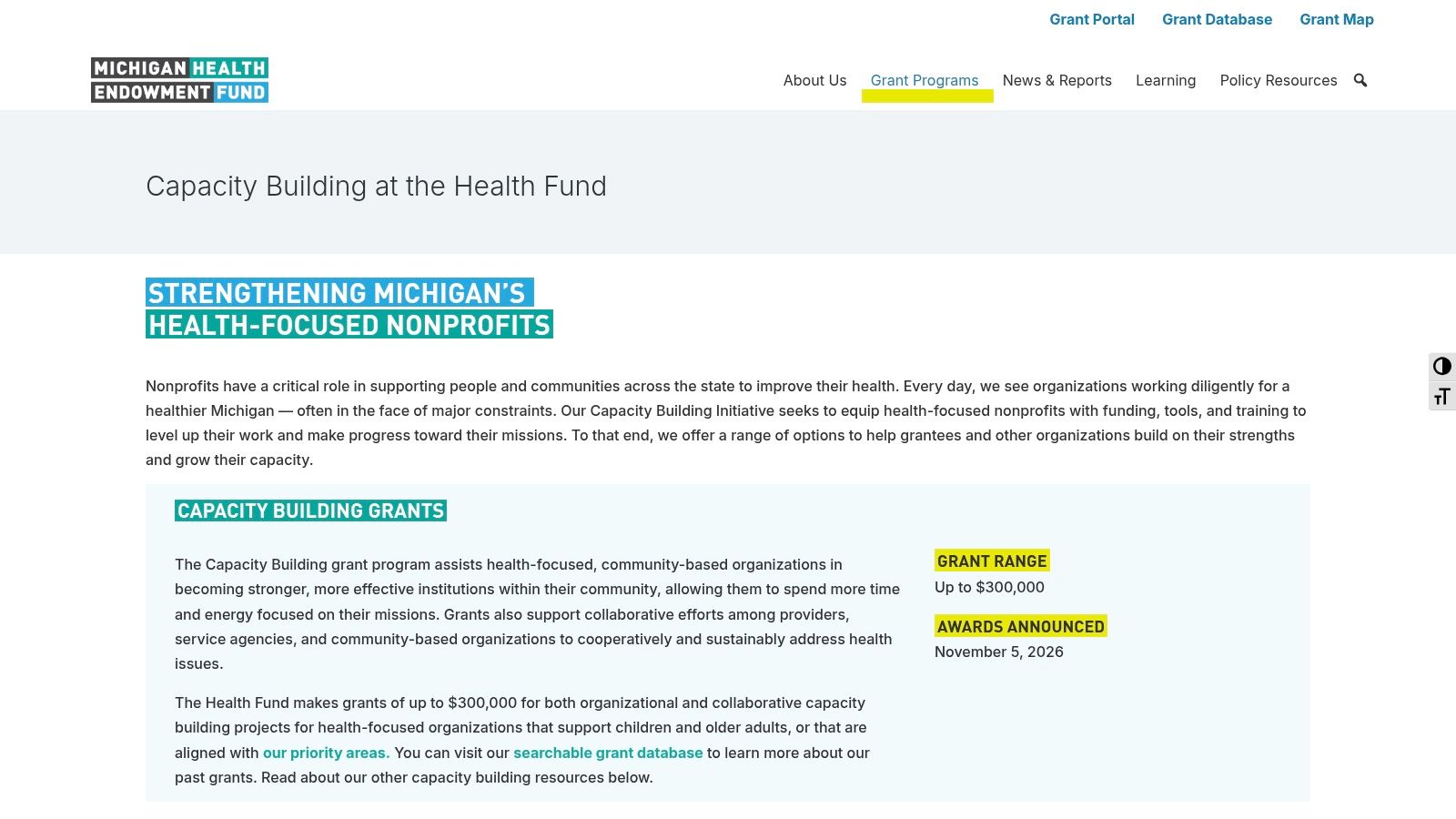
For a Michigan health organization, the key question is how stronger internal capacity will improve health-related work. A useful project might strengthen an individual organization or help partners coordinate more effectively.
The supplied Michigan Health Endowment Fund capacity-building listing identifies a maximum award of $300,000, with organizational and collaborative capacity work aligned to the fund's health priorities.
Don't interpret that ceiling as a typical award or a recommended request. The appropriate budget depends on scope, eligibility, and the work your organization can implement.
Make collaboration operational
A shared project needs more than partner endorsements. Explain who will manage the work, who owns shared systems, and how participating organizations will make decisions.
The supplied program information identifies past project areas including data systems, succession planning, shared services, and organizational change. Those are useful scope references, not guarantees that a similar proposal will qualify.
A collaborative capacity project needs a decision-making agreement, not just a list of participating organizations.
The geographic and mission filters are decisive. Organizations outside Michigan or without alignment to the fund's health priorities should avoid spending time on a speculative application.
Check the current program page for cycle dates and detailed eligibility. Before requesting technology or shared services, also establish how partners will cover maintenance and administration after the grant ends. A funded launch without a workable operating arrangement leaves the underlying capacity problem unresolved.
6. Initiative Foundation Nonprofit Capacity-Building Grants
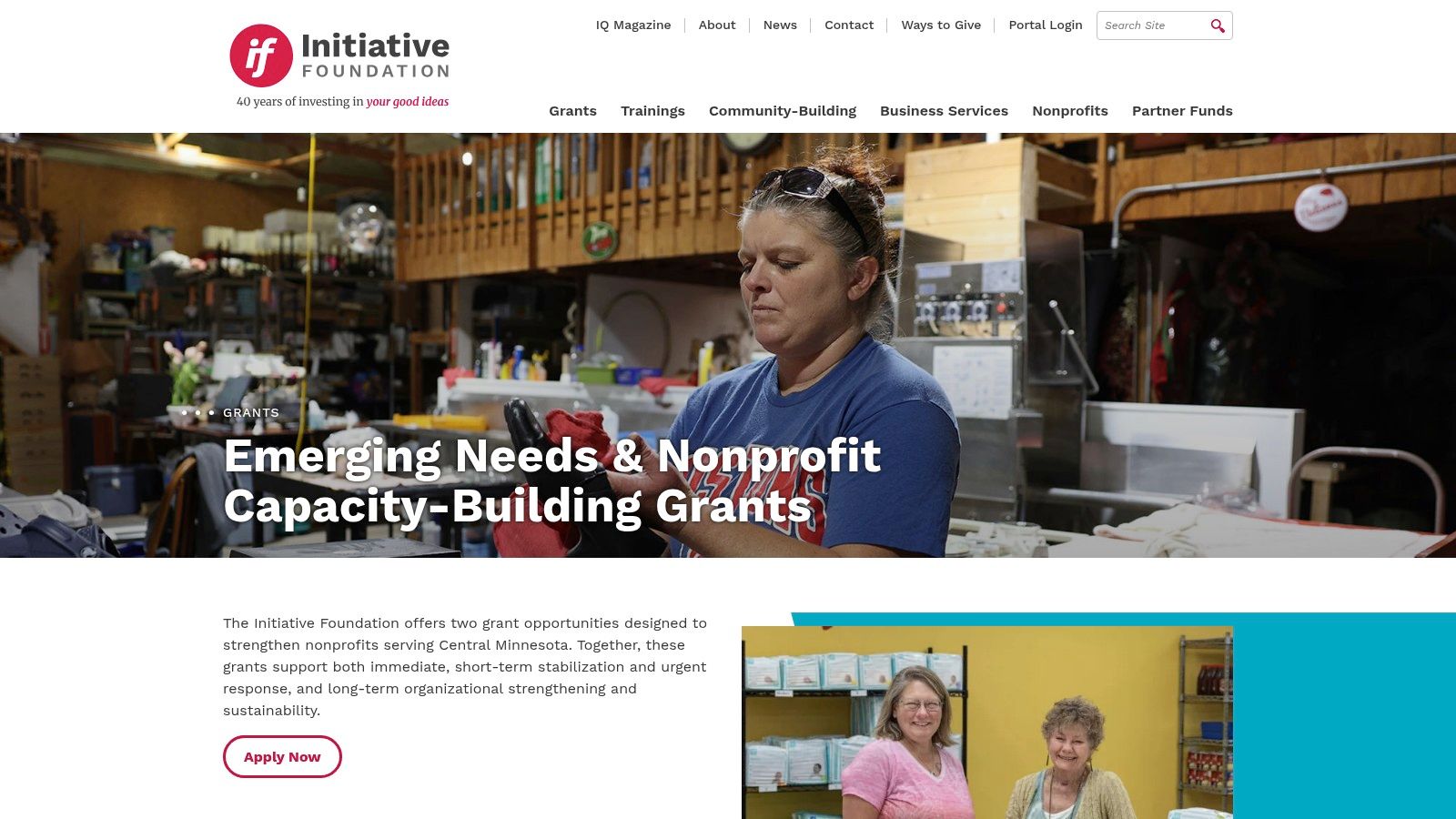
A small Central Minnesota nonprofit with a defined operational gap may find a better fit here than one proposing an organization-wide overhaul. Start by checking geography, eligible costs, and whether the application window is open.
The Initiative Foundation nonprofit grants listing describes awards of up to $10,000 for qualifying 501(c)(3) nonprofits serving Central Minnesota, an application window of October 5–November 6, 2026, and a limit of one grant per calendar year per organization. The listed window is in the future, so confirm current dates before treating the opportunity as open.
Potential project areas include strategic planning, fundraising capacity, technology, staffing, and operational stability. The capacity-building track is separate from short-term emergency support, so organizations needing cash for immediate bills should not assume this grant addresses that need.
Choose a result staff can maintain
A succession plan or fund-development plan needs a staff owner and a clear implementation process. Without both, the deliverable may become a document the organization cannot put into practice.
- Strong project boundary: Define a specific operational weakness and the work needed to address it.
- Funding fit: Connect requested costs to a practical capacity improvement, such as planning, technology, or staff training.
- Important restriction: Check how an earlier award affects eligibility before preparing another request.
Use the period before the application window to clarify scope and gather cost estimates. If the listed round has closed, check the foundation's grants page for the next published cycle. You can also ask whether pre-application conversations are available, rather than assuming staff support is part of the process.
7. Foundation for Community Health Capacity Building Grant Program
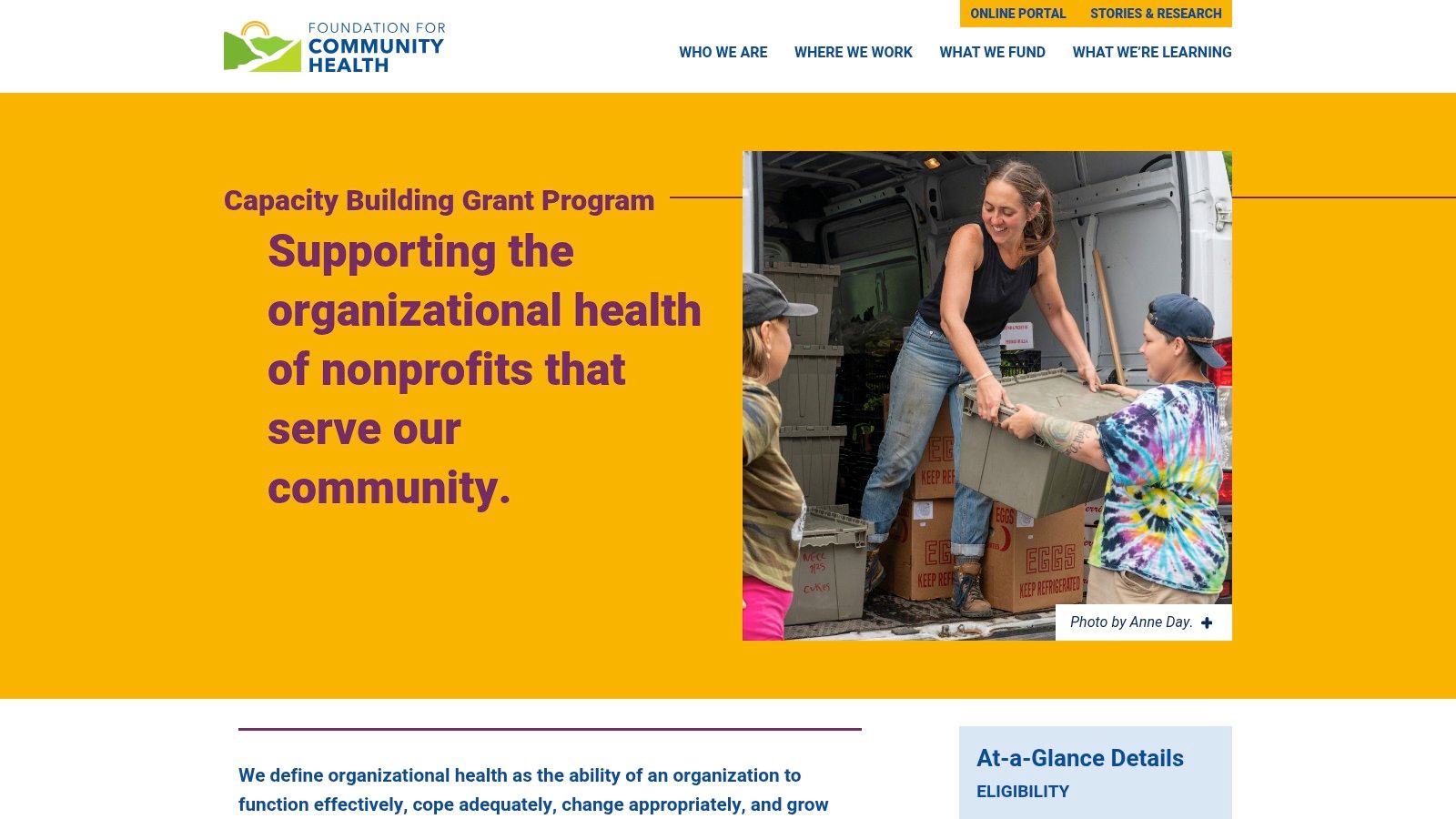
Flexible support can be more useful than a narrowly prescribed consultancy. Foundation for Community Health is worth examining when organizational needs overlap across governance, staffing, strategy, and infrastructure.
The supplied Foundation for Community Health program information describes up to $30,000 in unrestricted support, priority for organizations with annual budgets at or below $500,000, and an April 30, 2026 full-application deadline.
Eligibility depends on serving the foundation's catchment area and aligning with health and community well-being. Small size alone doesn't establish fit.
Use the preliminary conversation
The process includes an eligibility screen and a pre-application meeting. Applicants may seek support before they have a fully developed plan, making that conversation useful for testing whether the underlying need belongs in the program.
- What works: Explain the organizational constraint candidly, including uncertainty about the best intervention.
- What doesn't: Treat unrestricted support as permission to submit an unfocused request.
- Timing issue: If the listed full-application deadline has passed, ask about the next process and its preliminary steps.
The trade-off is advance coordination. A conversational process can help establish fit, but your team must allow time for it before the full application.
For a small organization, that can be worthwhile. A clear discussion of staffing pressure, financial administration, or governance may produce a more appropriate request than committing prematurely to a consultant-led plan.
8. RRF Foundation for Aging Organizational Capacity Building
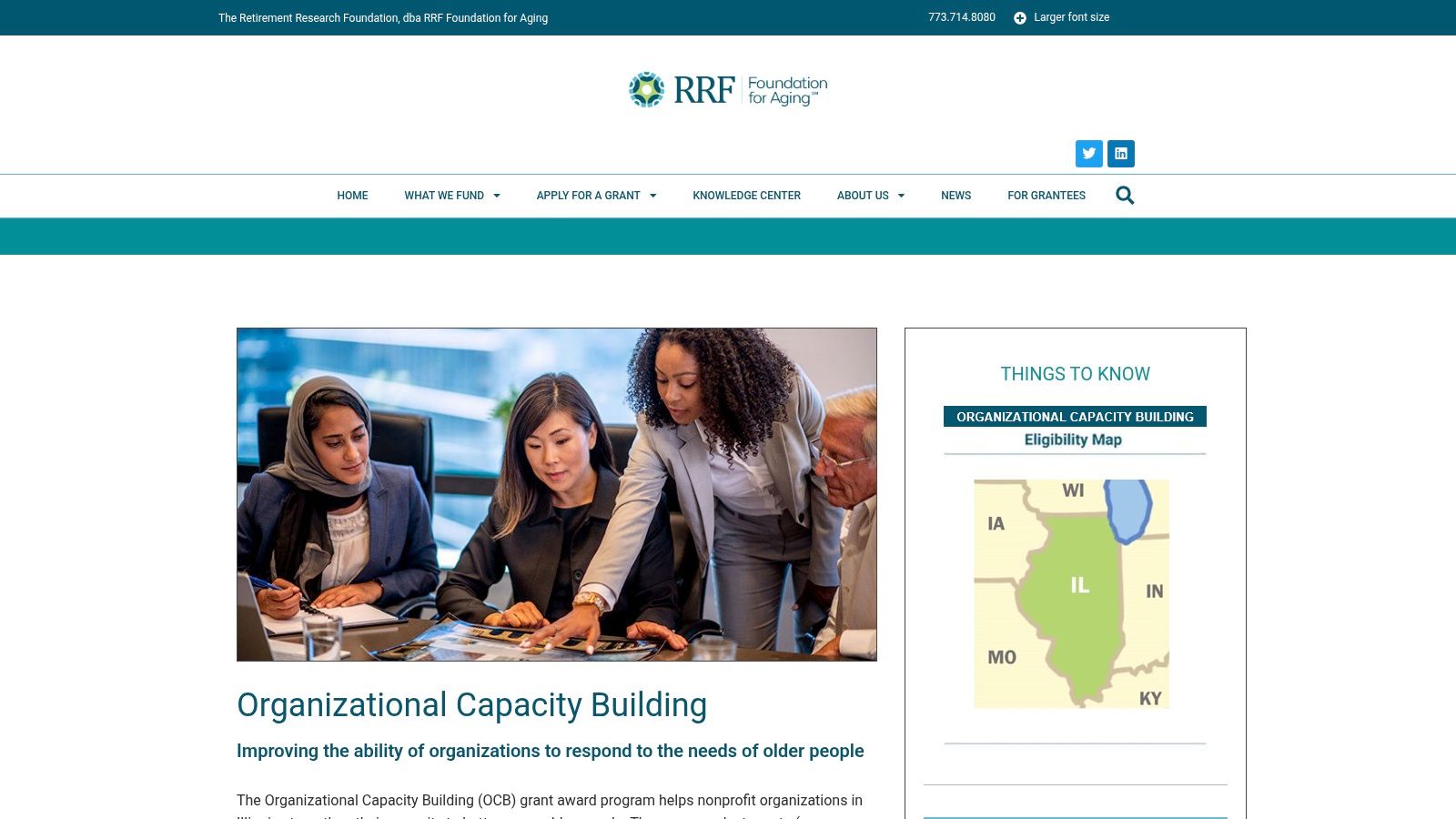
For an Illinois nonprofit serving older people, RRF's organizational capacity-building support may fit a defined internal improvement, rather than routine service delivery. Start by checking geography and project scope; a strong organizational need does not replace the location requirement.
The RRF organizational capacity-building listing describes rolling applications and awards of up to $15,000. Projects are generally completed within six months. The listing also identifies September 2026 as the point when its initial project-outline process becomes effective. Because that date affects how applicants begin, confirm RRF's current application procedure before submitting; rolling intake alone does not establish which process applies now.
Keep the request organizational
Eligible areas include board development, fundraising, human resources, information technology, financial management, and planning. Link the proposed work to how it will strengthen your organization's ability to serve older people, and identify who will manage the project.
Routine service costs belong in a different funding conversation. For payroll or ongoing delivery expenses, compare the need with operating grants for nonprofits, rather than presenting recurring costs as a capacity project.
A useful project outline names the problem, the assistance required, the staff member responsible, and the intended organizational result. It should also show that the work can fit the expected project period.
The focused scope helps teams define a manageable intervention, but it may not cover a complex system replacement or extended restructuring. Check provider availability before setting a schedule, especially when the project depends on outside expertise.
9. Vermont Community Foundation Nonprofit Capacity Building
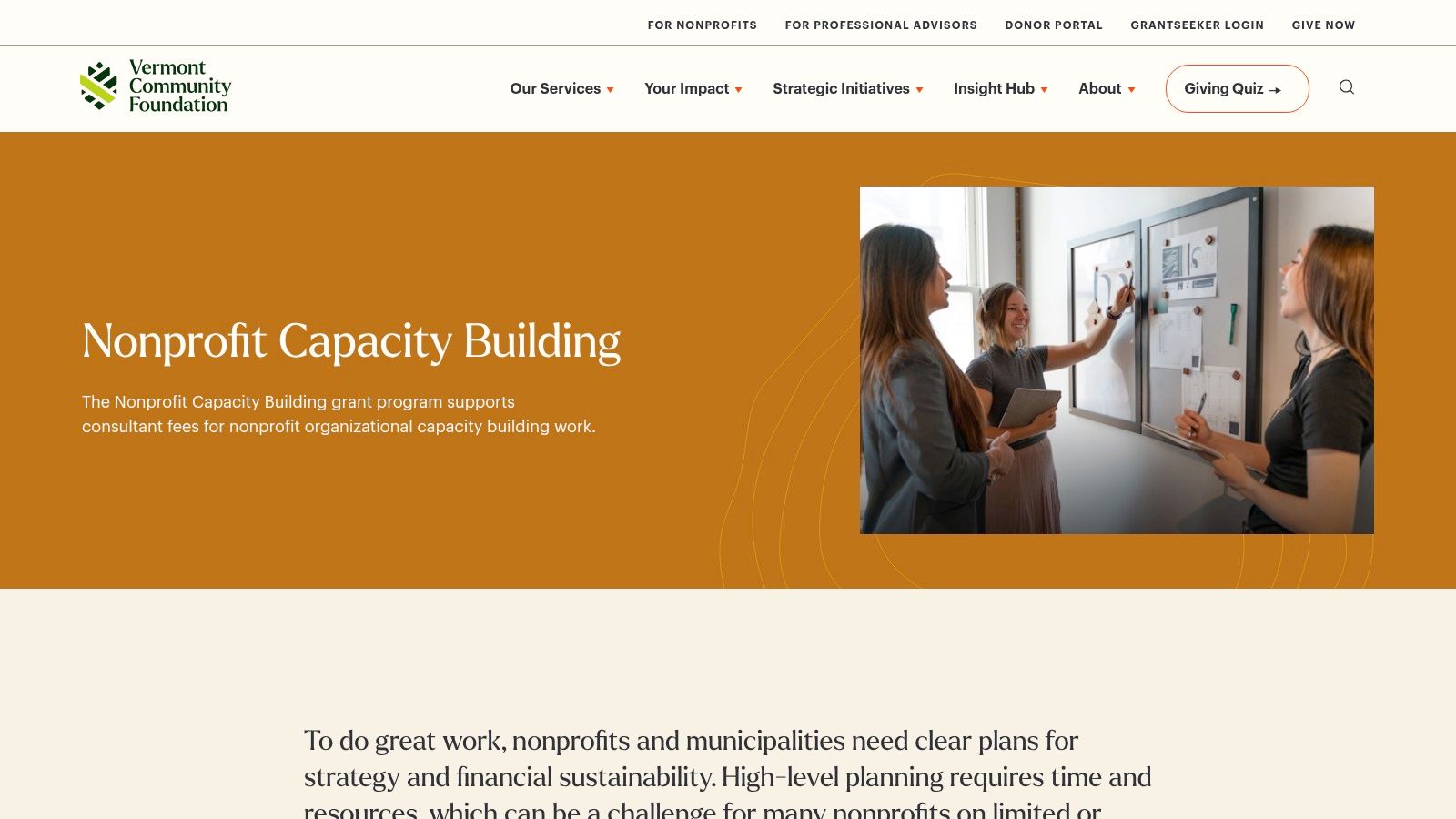
A Vermont nonprofit with a defined planning question may find a fit here, provided it can cover the work that follows the consultant's recommendations. This grant primarily supports planning, not implementation, technology purchases, or staff training.
The Vermont Community Foundation program listing describes typical awards of up to $5,000. Applicants must have budgets under $1 million, with priority for budgets below $250,000, and primarily serve Vermonters. Supported consultant work includes strategic planning, financial sustainability, revenue diversification, and fundraising or development planning.
Check fit, cost, and timing
- Who can apply: Vermont-focused nonprofits within the listed budget limits. Smaller budgets receive priority.
- What funds can cover: Consultant fees for planning. General operations, implementation, and staff training are outside the stated focus.
- Is the cycle open? Confirm the current application window and remaining funds directly with the foundation. Availability may be limited later in a cycle, so don't assume applications remain possible throughout the year.
The award may cover only part of the project. Before applying, identify who will carry out the consultant's recommendations and what resources will support that work. A fundraising plan, for example, has limited value if no staff member has time to put it into practice.
If flexible support is the actual need, compare unrestricted grants for nonprofits rather than stretching a planning request beyond the program's scope. A rolling process within an annual cycle does not guarantee funds will remain available.
10. Dyson Foundation Capacity Building Grant
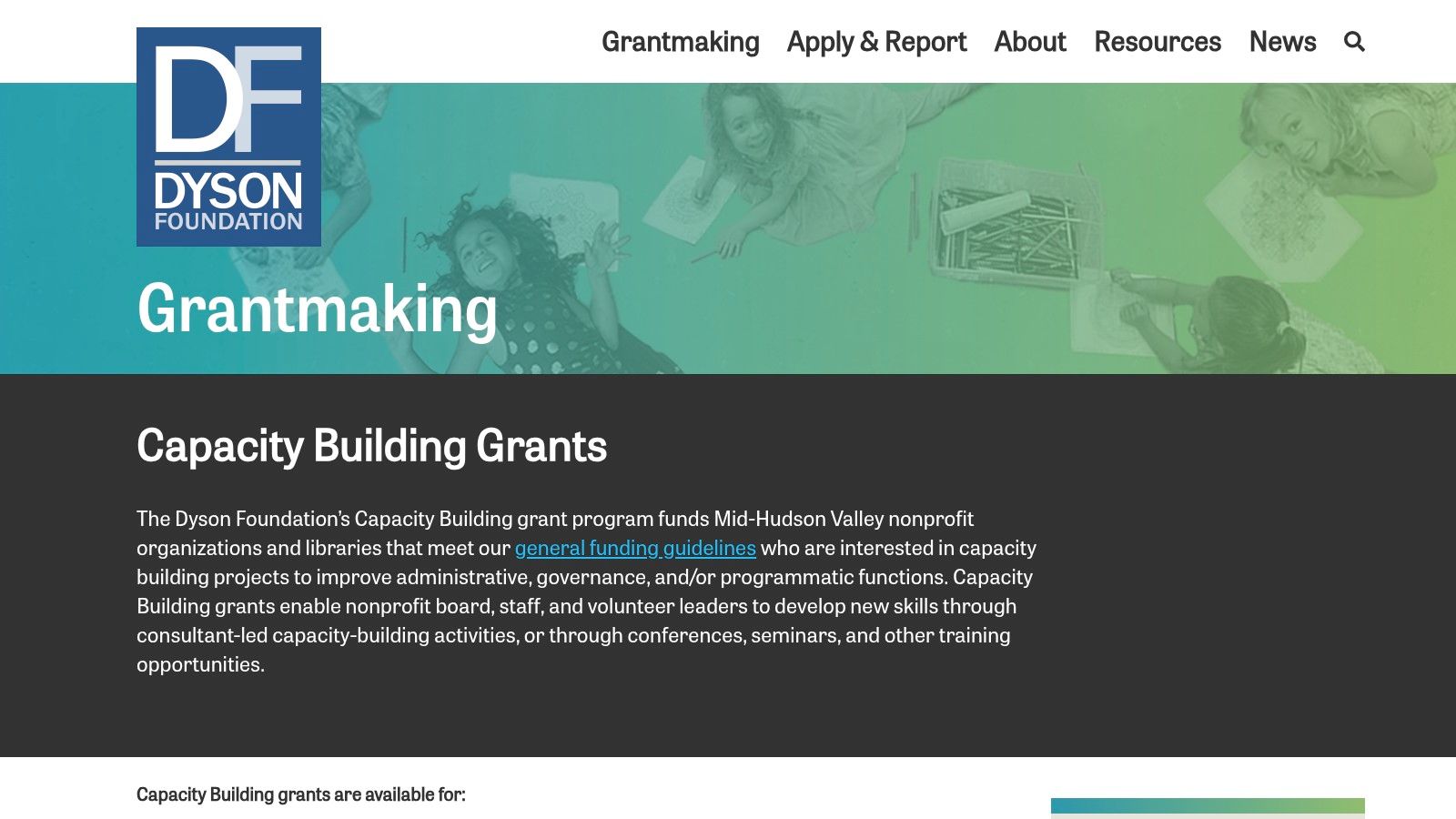
Dyson's match requirement should shape the project budget before you contact a consultant. Eligible nonprofits and libraries in New York's Mid-Hudson Valley can investigate support for consultancy or training connected to organizational capacity.
The supplied Dyson Foundation capacity-building guidance describes funding for up to 80% of eligible costs, capped at $15,000, with a 20% organizational match and a possible subsequent implementation grant of up to $3,000.
The possible follow-up support is useful, but it isn't an automatic part of the initial award. Don't make the project's success depend on receiving it.
Confirm exclusions before contracting
The program supports organizational functions including governance, administration, and programmatic capacity. However, the supplied guidance excludes projects already underway and certain services, including grant writing and web design.
Before signing: Confirm eligibility, allowable services, the match, and the permitted project start date.
A worthwhile consultancy can still be the wrong request for this fund. Review the provider's scope line by line rather than assuming every service in a capacity-building package qualifies.
Applicants can discuss eligibility with the program officer before applying. Use that conversation to confirm geographic fit, current submission arrangements, and whether the proposed work belongs within the program.
The main advantage is a defined contribution toward professional assistance. The main constraint is your organization's ability to fund its share and implement the results without assuming further support.
How the nine capacity building grants compare on size, eligibility, and timing
These nine funding programs differ on three practical filters: who qualifies, which costs the award can cover, and whether the listed deadline is still open. Check current cycle details with each funder before building an application schedule.
| Program | Award size | Eligible applicants | Listed deadline or timing | Best fit |
|---|---|---|---|---|
| SVP NYC Capacity-Building Grants | Most awards include $10,000 in unrestricted support | Qualifying public charities or public entities with revenue up to $1 million | October 16, 2026; verify current cycle | Expert-led support for a specific organizational need |
| TD Charitable Foundation Capacity Building Fund | $25,000–$150,000 | Nonprofits within TD's service footprint | November 13, 2026 | Larger-scale organizational capacity-building |
| Washington State Department of Commerce, Capital Project Capacity-Building Grants | Up to $50,000 | Eligible federally designated nonprofits registered in Washington | October 30, 2026, 3 p.m. PT | Early-stage readiness for community-serving capital projects |
| Michigan Health Endowment Fund, Capacity Building | Up to $300,000 | Michigan organizations aligned with health-related priorities | Deadline not listed | Health-focused organizational or collaborative capacity-building |
| Initiative Foundation, Nonprofit Capacity-Building Grants | Up to $10,000 | 501(c)(3) nonprofits serving Central Minnesota | November 6, 2026 | Long-term organizational strengthening and sustainability |
| Foundation for Community Health, Capacity Building Grant Program | Up to $30,000 | Nonprofits serving the foundation's catchment area | April 30, 2026; verify current cycle | Flexible support for organizational improvement |
| RRF Foundation for Aging, Organizational Capacity Building | Up to $15,000 | Illinois nonprofits serving older people | Rolling; confirm applications are open | Capacity improvements that strengthen services for older adults |
| Vermont Community Foundation, Nonprofit Capacity Building | Typically up to $5,000 | Nonprofits located in or serving Vermont, with budgets under $1 million | November 1, 2026 | Consultant-led planning for sustainability and fundraising |
| Dyson Foundation, Capacity Building Grant | Up to $15,000; 20% match required | Eligible nonprofits and libraries in New York's Mid-Hudson Valley | Deadline not listed | Consultancy or training to strengthen organizational capacity |
A listed date is a planning reference, not confirmation that applications remain open. The SVP NYC and Foundation for Community Health dates require particular attention: check with each funder for the current cycle rather than treating either date as an available deadline. For programs without a listed date, ask about timing and submission status before committing staff time.
Award size alone won't determine fit. Compare each program's applicant restrictions with your organization's geography and budget, then confirm whether the award supports the specific work you need, such as expert assistance, planning, or organizational improvement. Also account for conditions such as Dyson's required match when deciding whether the funding is workable.
Turning a Shortlist Into Applications You Can Actually Submit
Start with your organization's facts: service geography, annual budget, legal status, and the expense you need funded. Separate consultant assistance from software, training, implementation, and general operations. Those distinctions will eliminate unsuitable programs faster than comparing mission statements.
Confirm every deadline on the funder's website before planning around it. For a dated cycle that has closed, record the next anticipated announcement rather than keeping the opportunity in your active application queue. For rolling programs, confirm that applications and funds are still available.
Match the request to your financial position
Capacity building isn't always about growth. Distinguish resilience capacity, such as stronger financial controls, from growth capacity, such as expanded fundraising infrastructure, and crisis liquidity, such as money needed to maintain essential operations.
The 2025 nonprofit sector survey reported that 52% of organizations had three months or less of cash on hand. If your organization lacks financial runway, restricted planning support may be less useful than flexible funding that lets staff remain in place and implement improvements.
Don't conceal an operating need inside a technology proposal. Explain what your organization needs, then find a funding mechanism that permits it.
Define the result before writing the narrative
Choose a specific capability and identify how staff will know it has improved. For a data project, that might mean more complete records, easier reporting, or consistent use of the system. For financial administration, it might mean clearer forecasts or a more reliable closing process.
A capacity-building study summarized by North Carolina State University found no evidence that financial-capacity grants produced greater long-term financial gains than other capacity support. That supports looking beyond fundraising assistance when a governance, management, or systems problem is the more immediate obstacle.
- Rank by fit: Prioritize allowable expenses, eligibility, and realistic project timing over the largest advertised award.
- Count the full cost: Include matching funds, staff participation, maintenance, and implementation.
- Track the next action: Record required documents, preliminary conversations, deadlines, and responsibility for each task.
A workable shortlist contains opportunities your team can submit and projects it can deliver. Before drafting, confirm the funder's current rules, obtain a realistic scope, and assign an internal project owner. Then invest proposal time where the funding restrictions and your actual organizational needs align.
Grantlas builds a scored shortlist of prospective funders and grant opportunities, with plain-English fit explanations and eligibility flags. Visit Grantlas to create your organization's profile and investigate capacity-building prospects before committing staff time to a proposal.