10 Grant Tracking Software Options for Nonprofits
Oct 7, 2026 · 16 min read

A nonprofit discovers a promising foundation on Monday, copies its details into a spreadsheet, adds the application deadline to a personal calendar, and starts drafting in a shared document. After submission, the award information moves to finance, reporting obligations land in another worksheet, and nobody is completely sure which version contains the latest status. The problem isn't a lack of effort. It's that the grant workflow has been split across tools that don't share context.
Grant tracking software varies widely in what it tracks. Some platforms focus on funder discovery and prospect qualification, others manage applications, deadlines, tasks, and documents, while broader grants-management systems control awards, budgets, compliance, reporting, and closeout. A discovery database can be excellent at finding prospects but weak after submission. An enterprise platform may govern post-award work well but be too complex for a small development team that mainly needs a reliable pipeline.
The comparison below evaluates each option by workflow coverage, organizational fit, implementation effort, collaboration, integrations, pricing visibility, and limitations. The right choice depends on where the operational bottleneck sits today, whether that's finding suitable funders, coordinating applications, managing active awards, or connecting the full grant lifecycle.
Table of Contents
- 1. Grantlas helps you find the funder and decide if you're a fit
- 2. Instrumentl connects prospecting with application and award tracking
- 3. Fluxx Grantseeker is designed around awards you receive
- 4. AmpliFund controls complex post-award work
- 5. Euna Grants supports public-sector scale and shared workflows
- 6. GrantVantage is strongest for Microsoft-centered governance
- 7. Candid Premium prioritizes funder research
- 8. GrantForward serves research institutions and campus teams
- 9. Pivot-RP combines global research discovery with institutional coordination
- 10. GrantWatch offers simple discovery and pipeline tracking
- Top 10 Grant Tracking Software Comparison
- Match the platform to the work you need done
1. Grantlas helps you find the funder and decide if you're a fit
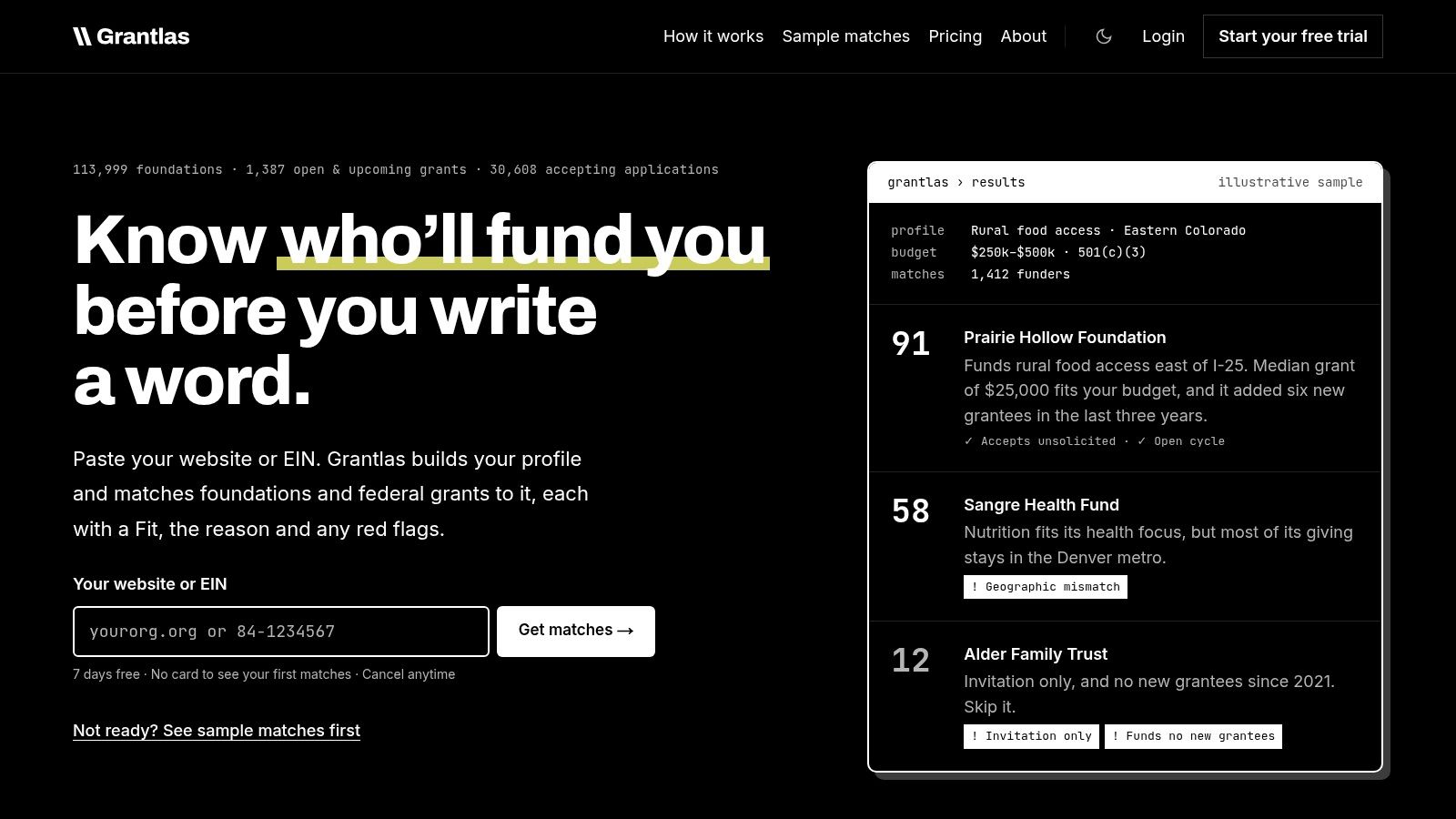
Grantlas is built for the earliest and often most expensive-to-ignore part of the workflow, deciding which opportunities deserve attention. Its index combines private foundations and open federal grants across all 50 states and DC, then lets a nonprofit create a profile from its website URL or EIN without an onboarding call. Natural-language searches are unlimited, so a development associate can describe a program in ordinary language rather than build every query from rigid filters. You can explore Grantlas to see how the discovery workflow is structured.
The important distinction is that Grantlas doesn't stop at a bare relevance score. Each match includes concise, plain-English reasoning and flags for issues such as geography, budget range, invitation-only status, or applicant ineligibility. That makes the score more useful operationally. A prospect with a high thematic match but an incompatible applicant type should leave the active pipeline before someone spends hours preparing a proposal.
Grantlas also adds context for outreach and prioritization, including giving history, peer-funded prospects, and board or trustee listings. Results are rescored monthly as new data arrives, while opportunities are scanned nightly. Saved searches, weekly digests, deadline reminders, calendar sync, and a simple pipeline connect research to submission and award tracking.
Best fit and trade-offs
Grantlas is a strong fit for small and midsized U.S. nonprofits, grant consultants, development associates, and multi-client fundraising teams that need better prospect qualification before they invest in application work. Published pricing is straightforward, with Solo at $99 per month or $999 per year, and Pro at $199 per month or $1,999 per year. The trial lets users build a profile and view matches before entering payment details.
The trade-off is scope. Grantlas is U.S.-only, and advanced integrations such as a REST API, webhooks, and ChatGPT or Claude connections are roadmap items rather than fully available capabilities. It isn't designed to replace a finance system or a deep post-award compliance platform.
Practical rule: Use Grantlas when the question is, “Should we pursue this funder?” Choose a broader grants-management system when the harder question is, “How do we administer this award across development, programs, and finance?”
2. Instrumentl connects prospecting with application and award tracking
Instrumentl is one of the more complete options for nonprofits that don't want discovery in one system and grant administration in another. Its central tracker holds deadlines, tasks, files, and calendar connections, while existing trackers can be imported. Saved searches support ongoing prospect research, and AI features assist with proposal drafting, review, and application guidance.
The platform's main advantage is continuity. A prospect can move from discovery into a pre-award workflow without being re-entered manually, then continue into post-award work. Budget spend-down, expense imports, and payment tracking extend the system beyond a simple application calendar. CRM connections, including Salesforce, RE NXT, and Virtuous, make it more suitable for teams that already treat their CRM as part of fundraising operations. More context on the discovery side is available in this guide to the best grant search tools.
Instrumentl's breadth also creates its central trade-off. A nonprofit that only needs a deadline list may find the platform heavier than necessary, while a team that wants prospecting, proposal coordination, and spend tracking can avoid maintaining several disconnected tools. Pricing is published through the Instrumentl pricing page, but the platform generally makes more sense when the organization will use its broader workflow rather than only its research features.
Workflow fit
Instrumentl suits nonprofits with an active pipeline, multiple contributors, and enough post-award activity to justify structured financial tracking. It reduces handoffs between prospect research and application management, but implementation still requires agreement on statuses, ownership, data imports, and the point at which a prospect becomes an active application.
3. Fluxx Grantseeker is designed around awards you receive
Fluxx Grantseeker approaches grant tracking from the recipient side, with the strongest emphasis on award obligations, payments, deliverables, and reporting. It gives nonprofits a workspace for monitoring what has been awarded rather than primarily helping them discover what to pursue. That distinction matters for organizations whose main risk is a missed report or unclear payment status, not an empty prospect list.
The system can schedule reports, track deliverables, and consolidate obligations that might otherwise live in spreadsheets, email threads, and shared folders. Its relationship to the broader Fluxx ecosystem may also help when a funder uses Fluxx, because the recipient's process sits within an environment familiar to many grantmaking organizations. Configuration and migration support are vendor-guided, which can reduce the burden on a small internal technology team, although it also means the buyer should clarify implementation responsibilities early. Product details are available on the Fluxx Grantseeker site.
Fluxx Grantseeker is not the natural first choice for a nonprofit whose central challenge is identifying new private foundations or open federal opportunities. Discovery and pre-award work are not its defining strengths. Its value becomes clearer after an award exists and the organization needs one accountable record for payment status, reporting dates, and deliverables.
Cost and organizational fit
Pricing is quote-based, and the vendor indicates that Grantseeker starts around $6,000 per year. That places the entry point at the higher end for small nonprofits, especially those managing a modest award portfolio. Organizations should compare the cost against the staff time and compliance exposure created by spreadsheet-based administration, not against the number of discovery searches they need.
4. AmpliFund controls complex post-award work
AmpliFund is oriented toward organizations managing awards with significant compliance, financial, and governance requirements. Its recipient functionality includes calendars, tasks, reporting periods, and expense tracking, while roles and permissions support controlled participation across departments. Integrations with ERP and finance systems are especially relevant when grant data must feed structured post-award reporting rather than remain in a development database.
This is a post-award management platform, not a funder-discovery product. The system's value appears after an organization has secured funding and must reconcile budgets, monitor expenses, coordinate reporting periods, and preserve an auditable record. A nonprofit applying for occasional private foundation grants may not need that depth. A recipient handling complex federal awards may need more than a tracker that only displays deadlines. The broader distinction is explained in this overview of grant management software.
Implementation is part of the purchase
AmpliFund typically sits in an enterprise purchasing category, with substantial license and setup requirements. Anecdotal reports place some annual costs in the mid-five-figure range, but buyers should treat any quote as organization-specific rather than assume a standard price. The more important question is whether the organization can supply the implementation ownership needed to map permissions, financial categories, reporting periods, and integrations.
The platform fits organizations where compliance, reconciliation, and governance outweigh speed of deployment. Its controls can be excessive for a small team that only needs opportunity tracking, but insufficient implementation planning can make even a well-matched system feel burdensome.
5. Euna Grants supports public-sector scale and shared workflows
Euna Grants, formerly eCivis, is built for government-scale grant processes involving applicants, award recipients, agencies, and subrecipients. Its workflow spans application intake, awards, post-award compliance, and closeout, giving public-sector teams a shared workspace rather than separate systems for each stage. Multi-party collaboration is central to the product's fit.
For a nonprofit, the relevant question isn't just whether Euna Grants can track an application. It's whether the organization participates in a government workflow where the platform is already required or recommended by an agency. In that situation, familiarity with the system can reduce friction between the agency and the subrecipient. The platform's audit and closeout orientation is also more important than discovery features when the grant has formal compliance obligations.
Where it can be too much
Euna Grants is designed around public-sector procurement, so pricing isn't publicly presented as a simple nonprofit subscription. That can make the buying process slower and less predictable for a small organization. A community nonprofit seeking private foundation prospects may pay for capabilities it won't use, while a state or county program managing multiple parties may find the scale appropriate.
Euna's relationship to AmpliFund technology also makes it relevant for buyers comparing public-sector and recipient-oriented systems. The decision should focus on who owns the workflow, which parties need access, and whether the organization must preserve formal application, award, compliance, and closeout records in one governed environment.
6. GrantVantage is strongest for Microsoft-centered governance
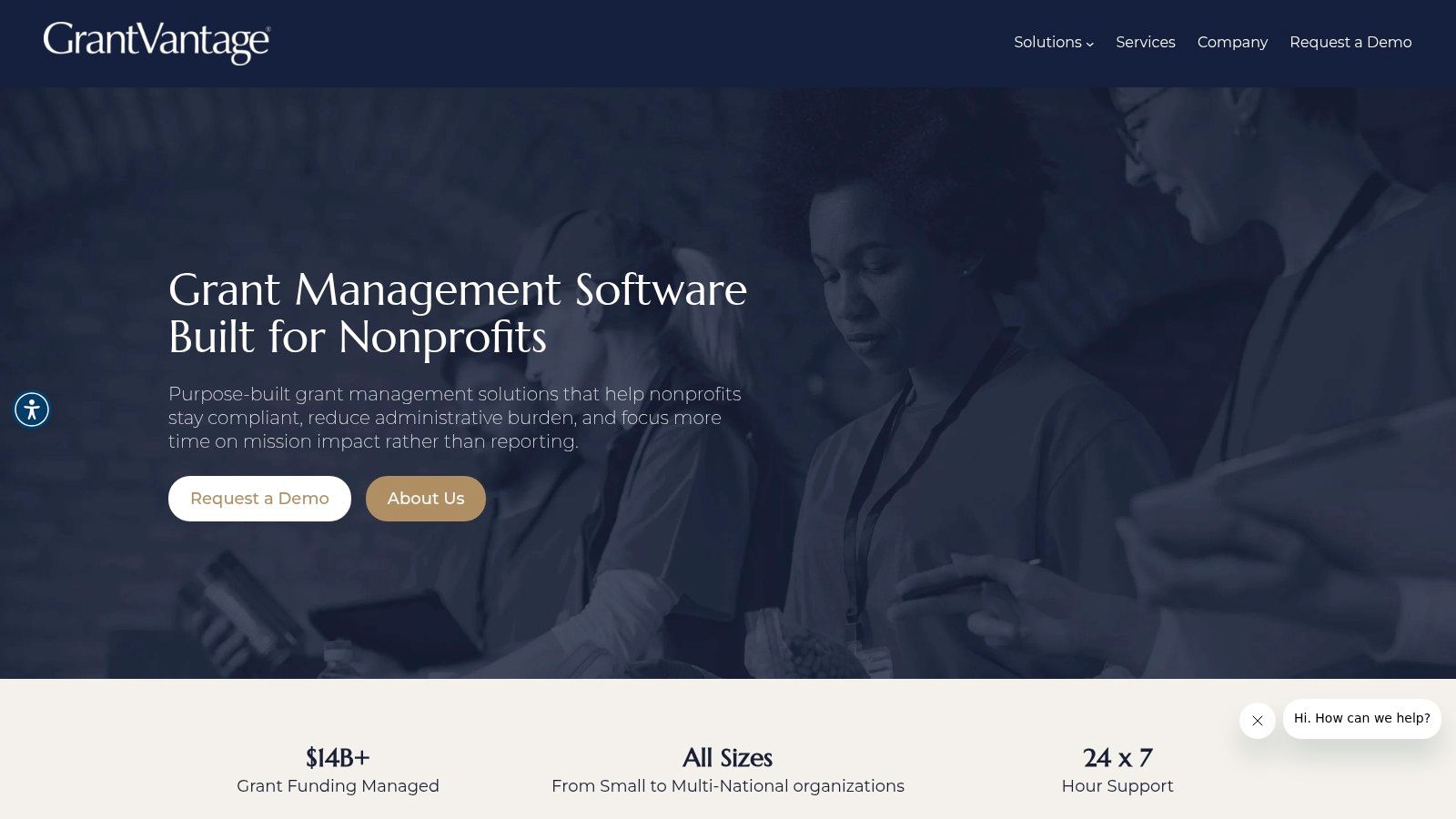
GrantVantage is a Microsoft-cloud-based grants management system for nonprofits and public entities. Its emphasis is not prospect discovery. Instead, it focuses on financial oversight, secure document management, subrecipient and contract workflows, reporting, and compliance. Alignment with Microsoft 365 and Entra ID makes identity, access, and governance part of the platform decision.
That ecosystem fit can be a practical advantage. An organization already standardized on Microsoft tools may prefer a grants system that works with existing identity and governance practices rather than introduce a separate technology environment. Subrecipient and contract management also make GrantVantage more relevant to organizations distributing funds or coordinating formal partner relationships than to a small nonprofit building a private-foundation pipeline. The product is described on the GrantVantage nonprofit platform page.
The integration question
Pricing isn't published, and procurement is typically sales-led. Buyers should ask for a concrete implementation plan covering Microsoft 365 configuration, Entra ID roles, document permissions, financial workflows, and data migration. The platform may require organizational alignment with the Microsoft ecosystem to deliver its best value.
GrantVantage is a good candidate when governance and controlled collaboration are more important than rapid self-service setup. It is less compelling if the team mainly needs an affordable database of prospective funders, saved searches, and deadline reminders.
7. Candid Premium prioritizes funder research
Candid Premium is primarily a discovery and funder-intelligence platform. Its unified data combines Foundation Directory and GuideStar information, with funder histories, nonprofit records, staff contacts, saved searches, alerts, dashboards, and AI-assisted recommendations. For development teams, the value lies in researching who funds similar work, understanding a funder's history, and preparing an initial approach.
The product can support planning through saved cohorts and personalized dashboards, but its tracking capabilities are lighter than those of a full grants-management system. It won't be the obvious system of record for complex reporting calendars, award budgets, expense reconciliation, or closeout. The Candid pricing information should be reviewed carefully because access levels differ, and some users may qualify for library or partner access.
Candid is particularly useful when the team needs deep U.S.-centric funder context and has another system for application and award administration. Its broad familiarity can also make it easier to introduce across a development team, though familiar data isn't the same as a complete workflow.
A discovery-first trade-off
A nonprofit choosing Candid Premium should decide whether it wants research depth or lifecycle control. If the current problem is identifying funders and drafting letters of inquiry, Candid's discovery orientation is logical. If the current problem is coordinating program staff, finance, documents, and reporting obligations after an award, the team will need another platform or a more advanced system. This comparison of the best grant databases for nonprofits provides additional context for that distinction.
8. GrantForward serves research institutions and campus teams
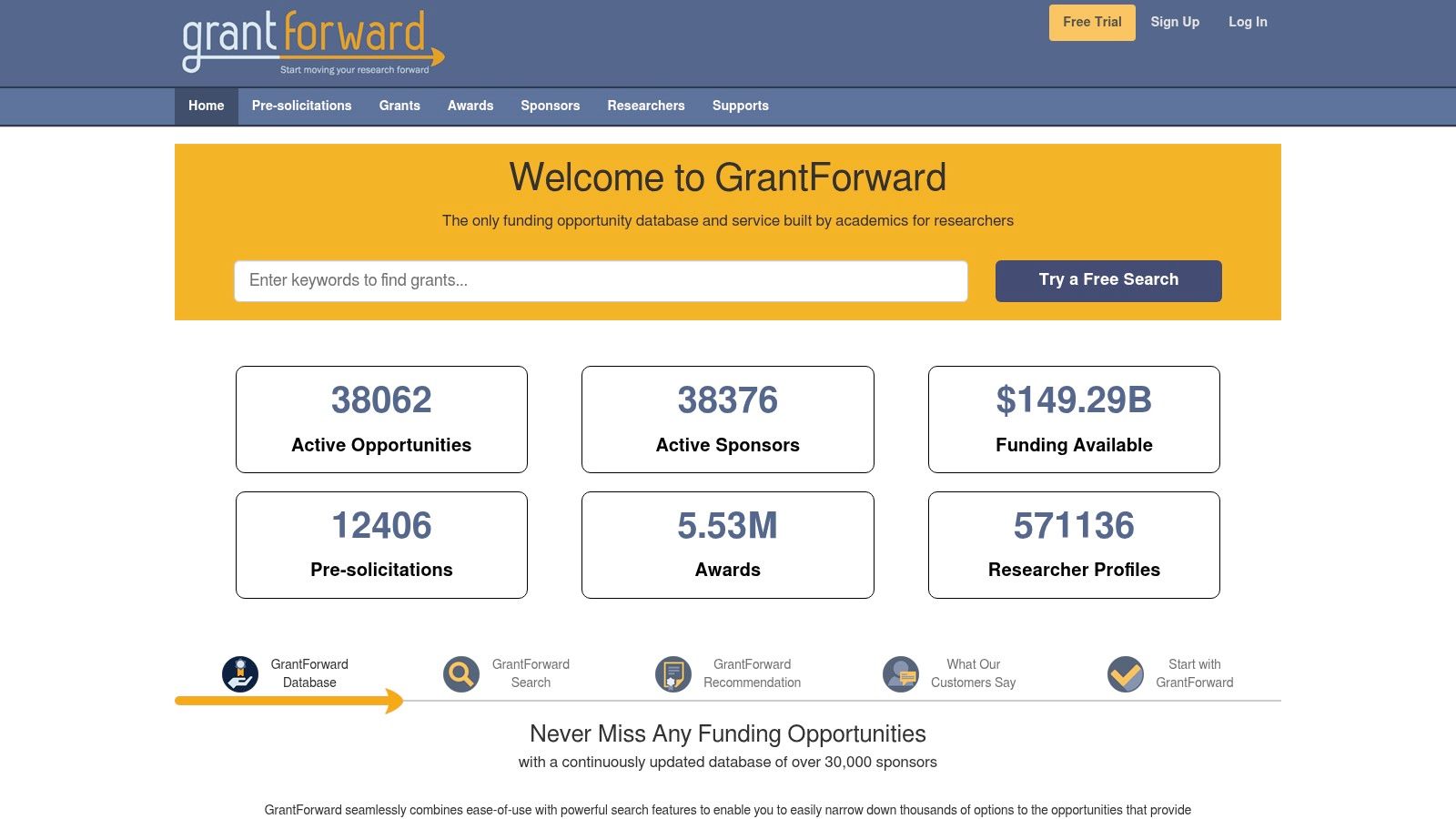
GrantForward is an institutional discovery and alerting platform designed for universities and research organizations. Its search filters can narrow opportunities by sponsor, deadline, amount, sponsor type, and grant type. Researchers can save searches and receive alerts, while research offices can disseminate opportunities across campus, manage lists, export records, and use embeddable search widgets. The GrantForward platform is therefore more than an individual researcher's bookmark list.
Its strongest workflow runs from funding discovery to campus communication and pre-award pipeline management. A research administrator can distribute an opportunity to the right investigators, maintain institutional lists, and move selected records into a separate tracker or CRM. That makes it well suited to organizations where many researchers need access to a centrally managed funding environment.
Not a post-award system
GrantForward's light tracking and favorites are useful before submission, but the platform isn't positioned as a complete recipient-side system for awards, spend-down, compliance, or closeout. Institutions should plan the handoff from discovery to their research administration, finance, or grants-management system.
Pricing is institution-sized and not published, so smaller nonprofits should confirm both fit and budget before committing. For a university research office, the administrative dissemination tools may justify the procurement. For a small community organization, they may add complexity without solving the primary need.
9. Pivot-RP combines global research discovery with institutional coordination
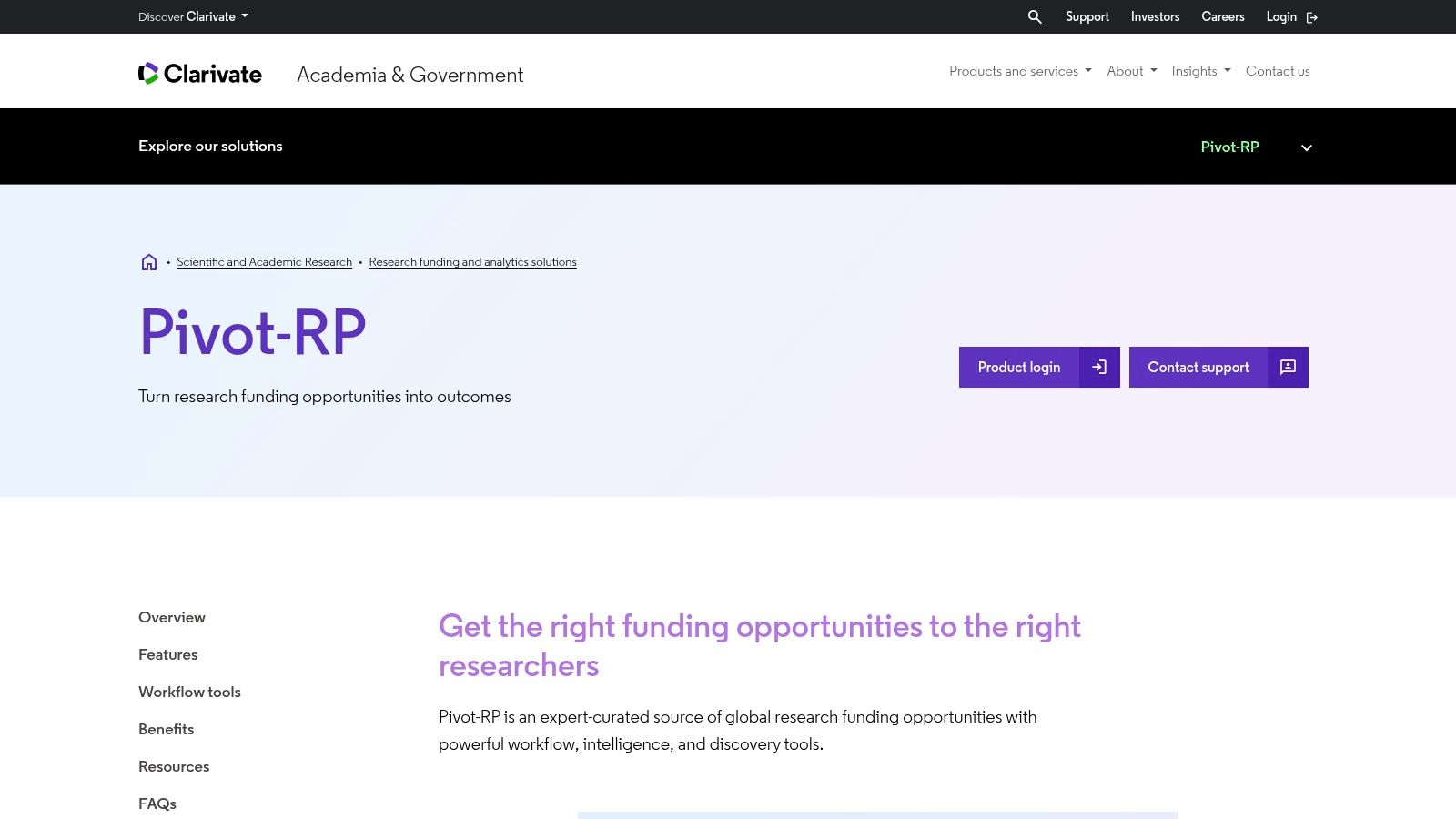
Pivot-RP from Clarivate is a discovery-first platform for universities, academic medical centers, and research institutions that need broad funding coverage. Its Funding Advisor, semantic search, researcher profiles, and AI-driven matching connect opportunities to institutional expertise. Saved searches, alerts, collaboration tools, and editorial curation support a research office that has to help many investigators find relevant programs.
The product's institutional strength is the profile layer. Rather than relying only on a keyword search, a research administrator can connect a researcher's expertise with opportunities and then support collaboration across the campus. Global coverage and editorial curation also make Pivot-RP more appropriate for institutions pursuing international or cross-border research funding than for nonprofits focused only on domestic foundation prospects. Details are available from Clarivate's Pivot-RP funding page.
Decide where tracking ends
Pivot-RP can support alerts, saved searches, and pre-award coordination, but post-award tracking is limited compared with recipient-oriented grants-management systems. A university should identify the point at which a qualified opportunity moves into its proposal, award, and finance systems. Without that handoff, strong discovery data can still become another isolated record.
Clarivate uses enterprise licensing and directs buyers to contact sales for pricing. That model suits institutions with centralized research administration and a defined owner for implementation. It may be excessive for an independent nonprofit that needs a straightforward prospect pipeline and deadline reminders.
10. GrantWatch offers simple discovery and pipeline tracking
GrantWatch targets organizations that want opportunity listings and basic pipeline management without adopting an enterprise grants-management environment. Its listings are human-verified, and the platform includes a pipeline, calendar, dashboards, collaboration, reporting tools, and deadline management. Subscription lengths and library or multi-user access options give budget-conscious teams several ways to approach access. See the available plans on the GrantWatch subscription page.
The platform's appeal is its simplicity. A small nonprofit can use one service to find opportunities, place prospects into a pipeline, and monitor key dates. That can be enough when the organization doesn't need finance integrations, complex permissions, subrecipient workflows, or detailed post-award controls.
Know what basic tracking won't cover
GrantWatch has lighter database breadth and tooling than premium discovery platforms or enterprise grants-management systems. Its basic lifecycle features may not provide the structured award, budget, compliance, and closeout controls required by organizations with complex grants.
That makes it a reasonable option for a team moving away from scattered spreadsheets but not yet ready for a large implementation. Buyers should test how the system handles the actual transition from prospect to application and whether awarded grants can retain reporting requirements, documents, owners, and historical status in a way the whole team can use.
Top 10 Grant Tracking Software Comparison
| Product (Recommendation) | Core focus / Coverage | Key features & UX | Target audience | Price / Value | Unique selling point |
|---|---|---|---|---|---|
| Grantlas, Find the funder. Then find out if you're a fit. | Nationwide discovery of private foundations + federal grants (US 50 states + DC) | Instant profile from URL/EIN, unlimited natural‑language search, fit score with two‑sentence reasoning, flags, monthly rescoring, saved searches/digests, pipeline basics | U.S. nonprofits & consultants needing fast, prioritized prospecting | Solo $99/mo ($999/yr); Pro $199/mo ($1,999/yr) | Combined private+federal index + human‑readable fit reasoning; unlimited searches; no sales call trial |
| Instrumentl | End‑to‑end discovery + pre/post‑award tracking | Central tracker (deadlines/tasks/files), integrated discovery, AI proposal helpers, CRM integrations, spend tracking | Nonprofits that want research and full lifecycle tracking in one tool | Higher‑priced tiers (noted competitive example: ~$349/mo for some plans) | Unified discovery → post‑award workflow with spend reconciliation |
| Fluxx Grantseeker | Recipient‑side post‑award/award tracking | Award/obligation tracking, deliverables, payment status, report scheduling; part of Fluxx funder ecosystem | Grant recipients working with foundations (esp. those using Fluxx) | Quote‑based; starts ~ $6,000/yr (vendor indicated) | Tight integration with Fluxx funder ecosystem; strong post‑award controls |
| AmpliFund (Recipients) | Enterprise recipient GMS for compliance | Deep post‑award controls, ERP/finance integrations, reporting periods, roles/permissions | Organizations with complex federal awards and compliance needs | Enterprise licensing and implementation (mid‑five‑figure anecdotes) | Robust compliance, reconciliation, and finance system integrations |
| Euna Grants (formerly eCivis) | Government/public‑sector full lifecycle grants | Multi‑party application/award workspace, audit/closeout controls, agency‑scale workflows | State/county agencies and large public‑sector grantees/subrecipients | Procurement/quote‑oriented; pricing not public | Built for government scale and multi‑party collaboration; strong audit features |
| GrantVantage | Microsoft‑aligned grants management | Financial oversight, subrecipient/contract workflows, secure docs, M365/Entra ID alignment | Organizations standardized on Microsoft 365 needing governance | Sales‑led pricing; not public | Deep M365/Entra integration and subrecipient management focus |
| Candid Premium | Funder discovery (Foundation Directory replacement) | Unified funder + nonprofit data, AI assistant, dashboards, saved cohorts/alerts | Nonprofits focused on prospect research and planning | Tiered paid plans; free library access and discounts available | Extensive U.S. funder data and broad community adoption |
| GrantForward | Research/institutional discovery & alerts | Filter‑rich discovery, saved searches/alerts, admin dissemination tools, exports | Universities, research offices, campus administrators | Institution pricing (quote‑based) | Designed for academic workflows and campus‑wide dissemination |
| Pivot‑RP (Clarivate) | Global research funding discovery | AI/semantic matching, researcher profiles, alerts, editorial curation | Research institutions and academic medical centers | Enterprise licensing via Clarivate (contact sales) | Global coverage with semantic AI matching to researcher profiles |
| GrantWatch | Affordable directory + basic pipeline | Human‑verified listings, pipeline/calendar, dashboards, deadline management | Small nonprofits and budget‑conscious teams | Low‑cost subscription plans; multiple lengths/options | Budget‑friendly discovery + basic tracking in one simple product |
Match the platform to the work you need done
The most useful distinction among these tools is not the size of their feature lists. It's where they create a reliable handoff. Discovery-first platforms help a team identify and prioritize funders. Application trackers coordinate deadlines, tasks, documents, and approvals. Post-award systems organize reporting, payments, budgets, compliance, and closeout. Full-lifecycle platforms try to connect those stages, but they usually require more configuration, governance, and implementation effort.
Start with the bottleneck your team can describe in operational terms. If staff spend too much time searching for funders, checking eligibility, comparing giving histories, or deciding which prospects deserve proposal effort, choose a discovery-first product such as Grantlas, Candid Premium, GrantWatch, GrantForward, or Pivot-RP, depending on the organization's geography and research context. Grantlas is especially relevant when a U.S. nonprofit wants private foundations and federal opportunities in one search workflow, with fit reasoning and explicit mismatch flags rather than an unexplained score.
Choose a broader platform when the organization needs application tasks, shared documents, deadline ownership, collaboration, and post-award visibility in one place. Instrumentl is the clearest fit among this list for a nonprofit that wants discovery connected to applications and spend tracking. Fluxx Grantseeker is more appropriate when received awards, payments, deliverables, and reports are the center of the problem.
Enterprise and public-sector systems deserve a different buying standard. AmpliFund, Euna Grants, GrantVantage, and similar platforms make more sense when permissions, finance integration, subrecipient management, auditability, reconciliation, and compliance drive the purchase. Their implementation effort and sales-led pricing aren't incidental drawbacks. They are part of the control environment these systems are designed to provide.
Before selecting a platform, map the current workflow from opportunity discovery through closeout. Record where the funder, application, award, budget, reporting calendar, and final documents live today. Then define the system of record, the required integrations, and the person responsible for each transition. A tool can't resolve ownership that the organization hasn't established.
Run one real grant cycle during evaluation, not a fictional demonstration. Test a genuine opportunity, a real application deadline, an award with reporting requirements, a finance handoff, and a document that another team member must find. Confirm how the platform handles imports, migration, permissions, exports, support, and pricing changes. If a vendor describes API access, webhooks, AI integrations, or other roadmap commitments, separate what is available now from what is planned.
The market context supports taking this workflow question seriously. A 2023 analysis of federal grants management found more than 150 grants-management IT solutions across 51 awarding agencies and over 1,500 grant programs, with limited interoperability and uneven technology maturity. The issue is not just that teams need a better calendar. They need a dependable way to preserve context as a prospect becomes an application, an application becomes an award, and an award becomes a set of financial and reporting obligations.
Grant tracking software reduces friction only when the surrounding process is clear. Set deadline conventions, establish reporting calendars, decide which fields are mandatory, and assign data-entry responsibility alongside the software rollout. Otherwise, the organization may replace multiple spreadsheets with a more advanced system that still depends on one person remembering what everyone else forgot.
Grantlas helps U.S. nonprofits discover private foundations and open federal grants, qualify prospects with fit scores and plain-English reasoning, and keep promising opportunities moving through a practical pipeline with reminders and saved searches. Visit Grantlas to build your organization profile, review matched funders, and see whether a discovery-first workflow fits the way your team manages grants.