10 Grant Management Software Platforms Compared
Oct 3, 2026 · 16 min read

The most popular advice about grant management software starts in the wrong place. Feature lists make discovery tools, nonprofit trackers, and grantmaker systems look like competing products, even though they support different sides of the funding relationship. A nonprofit seeking grants needs funder discovery, fit screening, deadlines, proposal coordination, and a pipeline. A foundation or public agency needs application intake, reviewer workflows, award decisions, disbursements, compliance, and outcome reporting.
That distinction matters because the market is no longer a niche administrative category. One industry estimate values grant management software at USD 2.56 billion in 2025 and projects USD 4.23 billion by 2030, with cloud deployments accounting for 61.57% of the market in 2024. Mordor Intelligence also identifies software platforms as the largest product segment and North America as the largest regional market in its analysis.
This comparison evaluates each platform by workflow fit, discovery depth, tracking, reporting, implementation effort, pricing transparency, and organization size. Grantlas is assessed mainly as a grant discovery and prospect-prioritization platform. Instrumentl, GrantHub, and Fluxx Grantseeker serve grantseekers more broadly, while the remaining products are primarily grantmaker-side systems. If you're comparing operational workflows more generally, the distinction resembles the one explored in this Jira versus Asana workflow features comparison, where the right choice depends on how work moves, not just how many features appear on a product page.
Table of Contents
- 1. Grantlas
- 2. Instrumentl
- 3. Foundant GrantHub and GrantHub Pro
- 4. Fluxx Grantseeker
- 5. Submittable
- 6. Blackbaud Grantmaking
- 7. SmartSimple Cloud for Grants Management
- 8. Salesforce Nonprofit Cloud for Grantmaking
- 9. Bonterra CyberGrants
- 10. SurveyMonkey Apply
- Top 10 Grant Management Software Comparison
- Choose the Platform That Matches Your Side of the Grant
1. Grantlas
Grantlas is built around the question that most grant tracking systems answer too late: which funders are worth pursuing in the first place? A nonprofit can enter its website or EIN, confirm an automatically drafted profile, and receive a ranked shortlist of private foundations and open federal grants. Each result includes a concise fit explanation and flags for problems such as invitation-only funding, geographic mismatch, grant-size mismatch, or an ineligible applicant.
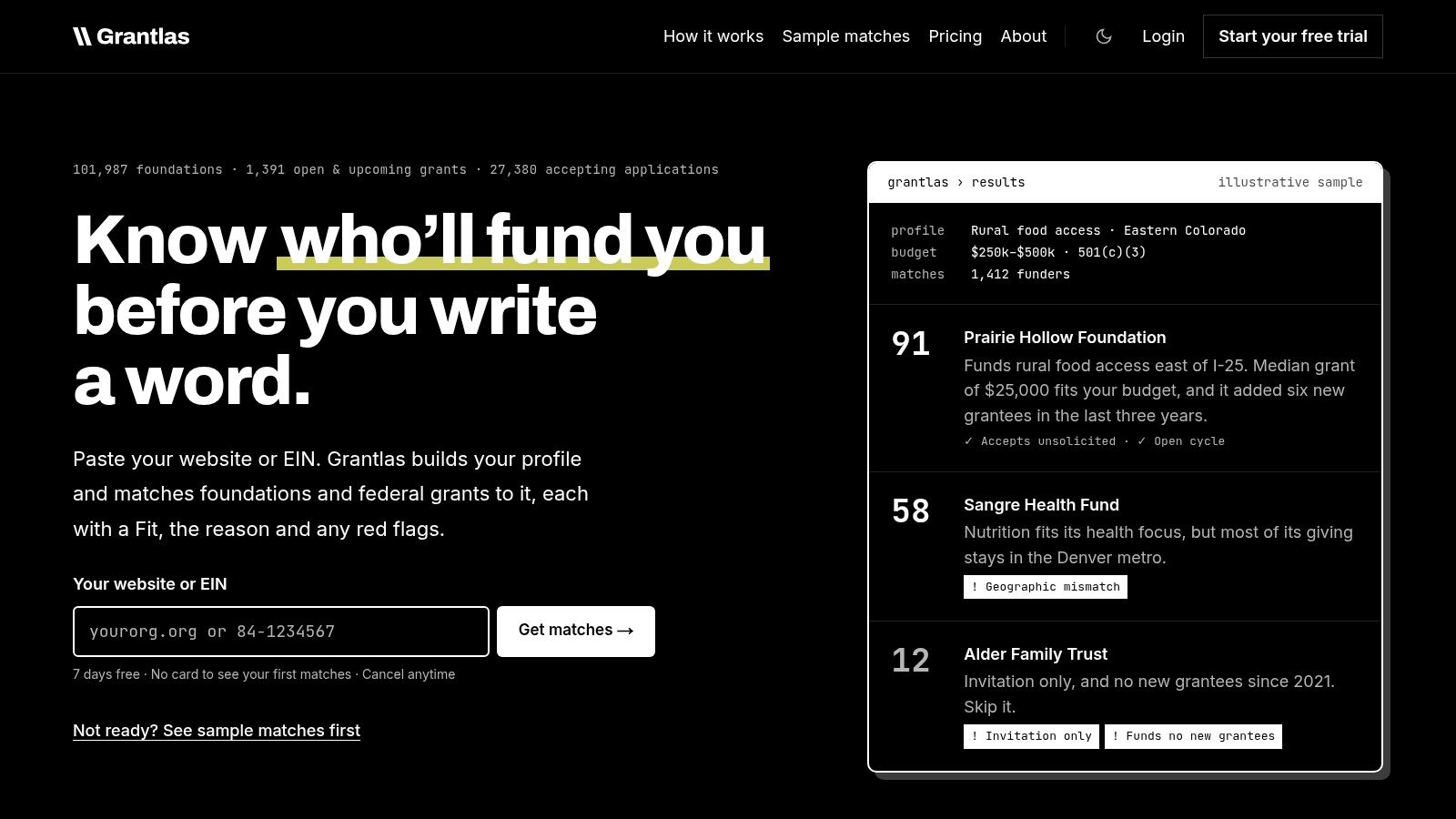
Best for prospect qualification
Grantlas combines private foundation records from IRS Form 990-PF filings with opportunities from Grants.gov. Its index covers 101,987 foundations, 1,391 open or upcoming grants, and approximately 27,380 opportunities currently accepting applications, according to the product information provided by Grantlas. Opportunities are scanned nightly, while saved profiles are rescored monthly to reflect changes in giving history and grant activity.
That makes the platform more than a directory. Funder records can show typical grant size, giving cadence, whether a foundation funds new grantees, board or trustee information, and peer organizations supported by the funder. These details help a development director decide whether to research, cultivate, or deprioritize a prospect.
Workflow and tradeoffs
Unlimited searches, natural-language search, saved searches, weekly digests, calendar-connected deadline reminders, and a Tracker pipeline cover the path from research to award. A team can start without an onboarding call, and the trial flow doesn't require a payment card. Solo costs $99 per month or $999 per year, while Pro costs $199 per month or $1,999 per year, with Pro supporting multiple users and organizations. Those prices are listed in the supplied product information.
Grantlas is less suitable as a complete post-award financial system. Its coverage centers on IRS 990-PF foundations and Grants.gov, so corporate giving, some state and local programs, and funders outside those sources may require additional research. ChatGPT integration requires a paid ChatGPT plan, and advanced multi-client capabilities, including the REST API, are associated with Pro.
Practical rule: Use Grantlas to decide where effort belongs before using a broader system to manage the application and award.
2. Instrumentl
Instrumentl is one of the stronger choices for grantseekers who want to connect discovery, application work, and post-award coordination in one workspace. It doesn't stop at showing opportunities. Its workflow includes curated matching, an AI prospecting assistant, pipeline management, tasks, calendar synchronization, proposal collaboration, and post-award budget tracking.
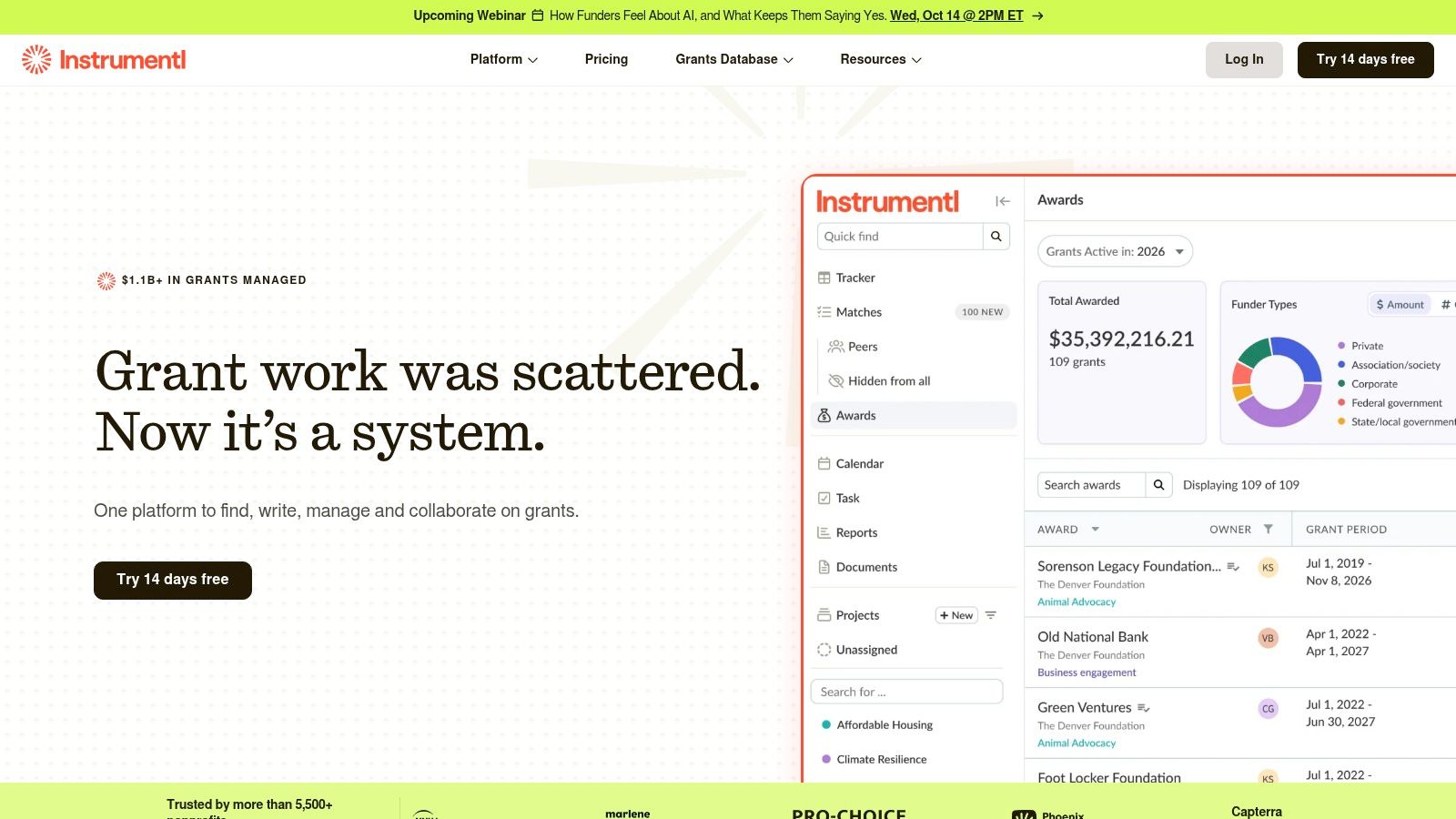
Best for a full grantseeker lifecycle
The platform's Apply tools support proposal collaboration and AI-assisted drafting, while Spenddown connects awarded grants to planned expenses, budgets, and accounting workflows. That combination is useful for development teams that don't want one tool for prospecting, another for proposals, and a third for post-award tracking.
Instrumentl also supports CRM and other integrations, and its product materials identify SOC 2 Type II controls. Its strongest fit is a nonprofit, university, consultant, or multi-program team that already has enough grant activity to need shared ownership and post-award visibility, but doesn't want to implement an enterprise grantmaker platform.
What to verify before buying
The tradeoff is cost and plan depth. Instrumentl is more capable than a basic deadline tracker, so its entry price is higher than lightweight tools. In-app application forms are limited to higher plans, which means a buyer should confirm whether the lowest tier covers the intended proposal workflow.
Pricing is posted and the platform offers a free trial, which makes initial evaluation easier than with quote-only systems. Still, teams should test a real prospecting workflow, import existing grant records, and check how much of the reporting process can be handled without exporting data.
For a broader view of how discovery, tracking, and fundraising tools fit together, see this guide to nonprofit fundraising software. Instrumentl is a credible choice when a grantseeker wants one environment from opportunity research through award management, but it isn't a foundation-side intake and review platform.
3. Foundant GrantHub and GrantHub Pro
Foundant GrantHub takes a deliberately narrower approach. It focuses on the grantseeker's pre-award workflow, with a pipeline for funders and opportunities, tasks, documents, custom fields, deadline reminders, and calendar integration. GrantHub Pro extends that foundation with post-award revenue and expense tracking, budgets, reporting, and dashboards.
A practical fit for smaller teams
GrantHub's appeal is its limited scope. A small development team doesn't have to configure a complex grantmaker system just to centralize deadlines and proposal files. The interface is designed around nonprofit grantseekers, and the product highlights support and training rather than assuming a dedicated systems administrator.
Funder research comes through Candid, with access to nonprofit profiles and 990 information. GrantStation is available as an optional research connection. That approach can work well for teams that need a structured tracker and are comfortable supplementing discovery through third-party databases.
Where the Pro tier changes the calculation
GrantHub Pro is more relevant when the same team needs to monitor budgets and reporting after an award. The implementation fee attached to Pro matters because the subscription price alone won't represent the total cost of adoption. Buyers should ask what data migration includes, whether historical awards are imported, and which dashboards require configuration.
The platform isn't designed to replace a funder-side grants management system. It won't be the natural choice for a foundation managing applicant intake, committee review, or disbursement governance. For nonprofits that mainly need a low-learning-curve tracker with optional research depth, however, GrantHub is easier to justify than an enterprise platform.
4. Fluxx Grantseeker
Fluxx Grantseeker is a pipeline and coordination product for nonprofits that want a path from straightforward grant tracking toward more advanced program reporting. Its Classic tiers are positioned for self-service use, while Pro packaging is intended for organizations with more complex needs inside the broader Fluxx ecosystem.
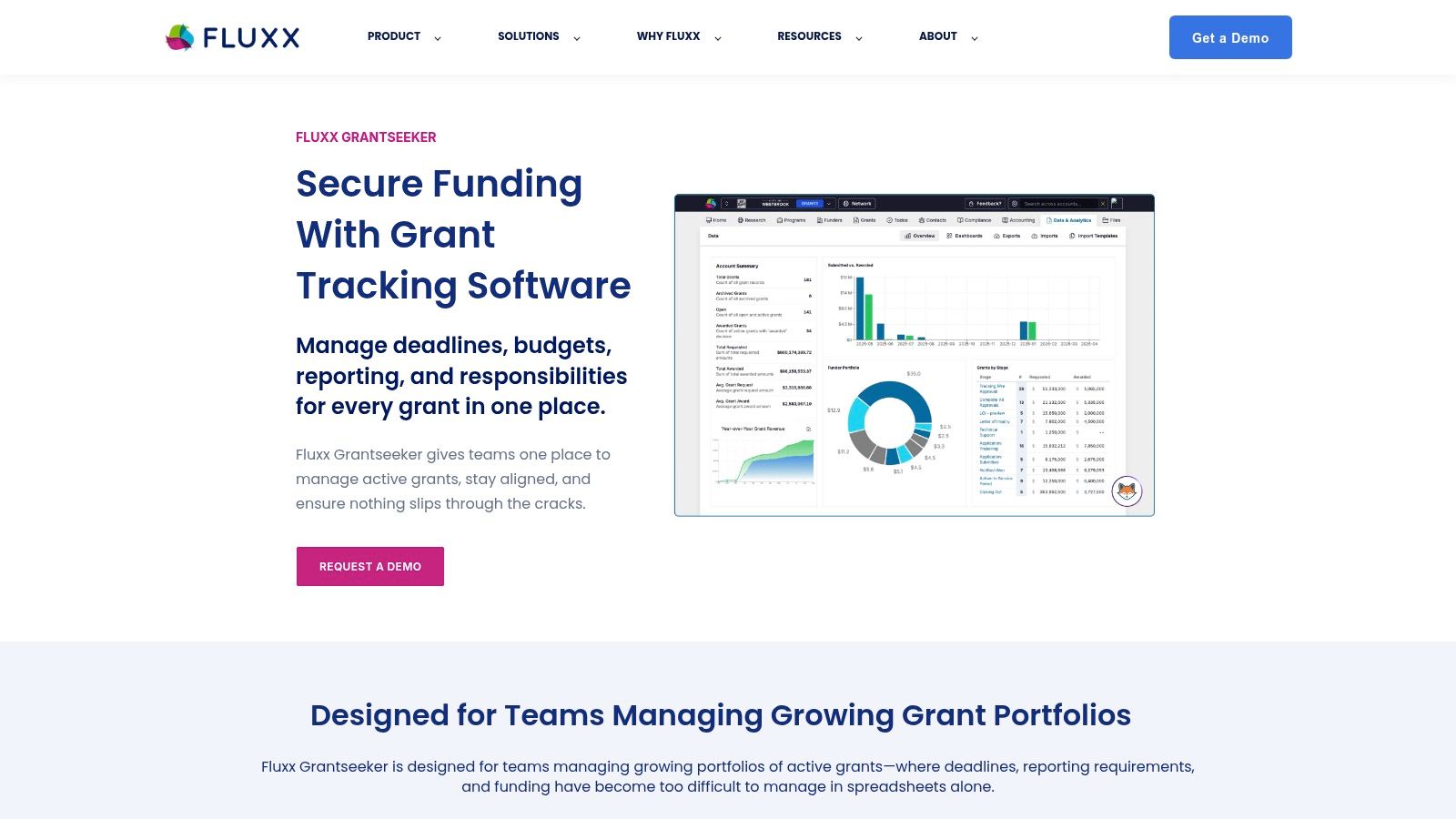
A central portfolio holds deadlines, tasks, reporting dates, and grant details. Higher-tier functionality includes program budgets and data visualizations, while Google Drive integration and advanced Excel exports support teams that still rely on familiar document and spreadsheet workflows. Prospecting is available as an add-on in Classic, with more capabilities in Pro.
Best when complexity is increasing
Fluxx is attractive to a nonprofit that expects its grants function to grow more complex. A team may begin with tracking and later need more structured budgeting, reporting, or data visualization without immediately replacing the platform.
The product's relationship to Fluxx's funder-side systems is also relevant. Organizations that work with institutional partners or manage funding programs themselves may value that ecosystem connection. It doesn't mean the products are interchangeable, however. A nonprofit buying Grantseeker is still purchasing a grantseeker workflow, not a complete grantmaking administration suite.
Implementation and packaging concerns
The Classic and Pro packages can be difficult to compare because their capabilities and commercial models differ. Buyers should request a plan-specific demonstration instead of relying on the Fluxx brand name. Historic portal connections to funders were discontinued in 2023, so teams should verify which integrations are currently supported before designing a process around them.
Fluxx Grantseeker fits organizations with a genuine need to scale coordination. It may be more platform than a small nonprofit needs if the immediate problem is finding suitable funders and setting deadline reminders.
5. Submittable
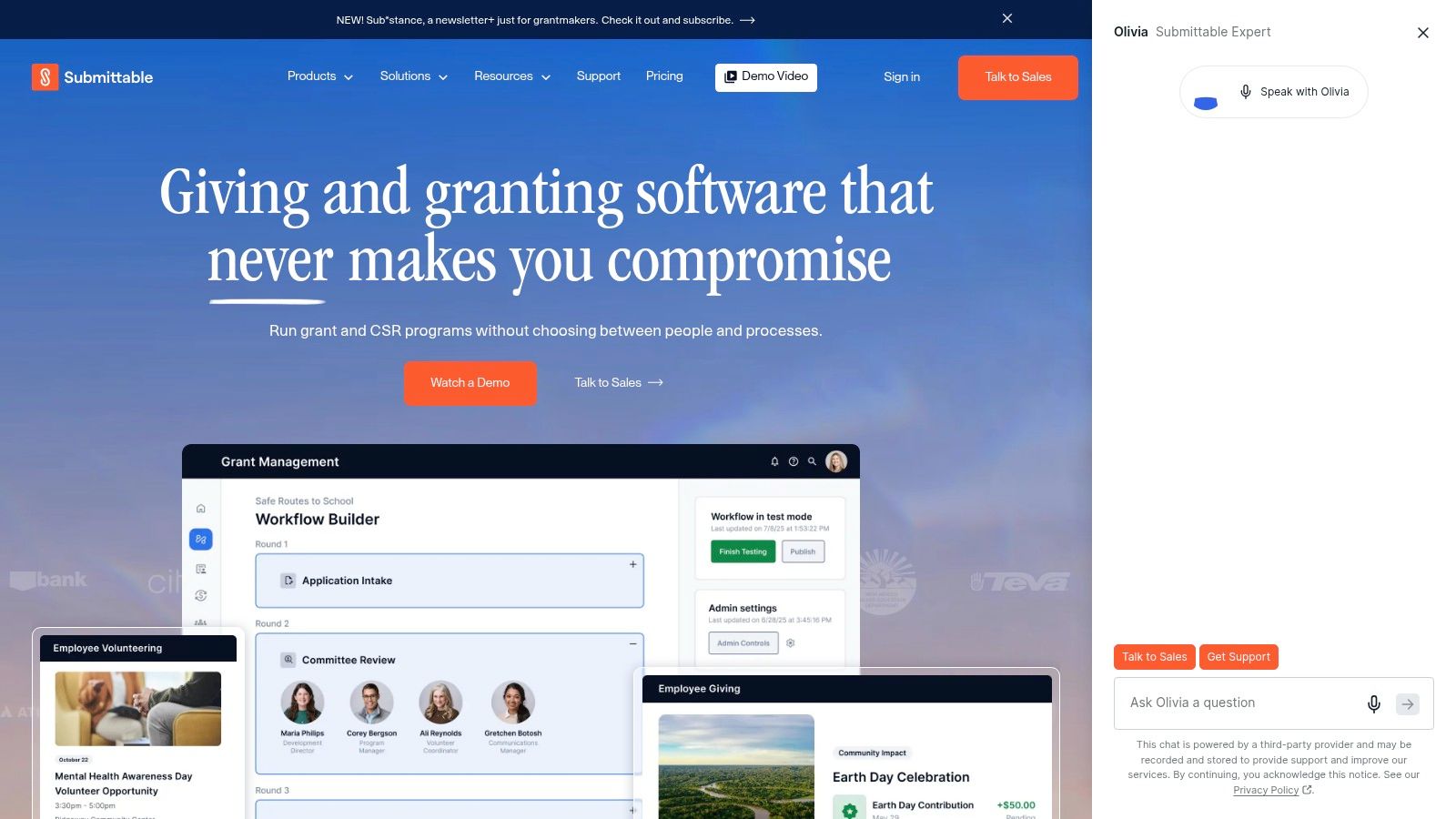
Submittable serves the opposite side of the workflow from Grantlas. It is primarily a grantmaker-side platform for organizations that run grant programs and need to collect applications, assign reviewers, communicate with applicants, distribute funds, and report on results.
Strong for intake and review
The no-code or low-code application builder supports custom forms and applicant portals. Review teams can use assignments, scoring, and workflow automation to move submissions through evaluation. Funds tracking, impact reporting, and export functions support the administrative work that follows a decision.
That makes Submittable a strong candidate for foundations, corporations, public agencies, and nonprofits operating open calls. It can improve applicant experience while giving internal teams a consistent process for reviewing and communicating decisions.
Not a discovery product
A grantseeking nonprofit won't use Submittable to search across available funding or rank private foundations by fit. It may encounter Submittable as an applicant when a funder uses the platform, but that isn't the same as using it to manage the nonprofit's own prospect pipeline.
Pricing is quote-based, which limits early budget comparison. Small programs should ask whether the proposed package includes the application builder, reviewer workflows, reporting, and support required for the first live cycle. A modern interface doesn't remove the need to define governance, approval rules, and data ownership before implementation.
Submittable is therefore a good grantmaker-side choice for configurable application and review operations, but it shouldn't be shortlisted as a replacement for discovery software.
6. Blackbaud Grantmaking
Blackbaud Grantmaking is an enterprise cloud system for foundations and corporate grantmakers that need controlled workflows across intake, review, decisions, disbursement, communication, and reporting. Its value is greatest when grantmaking is part of a wider nonprofit technology environment rather than an isolated administrative process.
Configurable workflows, dashboards, document management, permissions, security controls, and audit trails support programs with multiple stakeholders and formal oversight. Integrations across the Blackbaud product suite and partner tools can reduce duplication when an organization already relies on Blackbaud for fundraising or finance.
Fit depends on governance needs
Blackbaud's depth is a benefit for a foundation with complex approval structures, but it can become unnecessary overhead for a small program. A team that only needs to collect applications and send decisions may not use enough of the platform to justify its configuration and service requirements.
Pricing is quote-based, and the total cost can include implementation and services. Buyers should separate the cost of the software from the work required to configure workflows, migrate historical records, train program staff, and connect finance systems.
Blackbaud Grantmaking doesn't help a nonprofit discover funders. It manages the funder's side of the relationship. That distinction is more important than the product's long feature list, especially for organizations comparing it with GrantHub or Instrumentl.
7. SmartSimple Cloud for Grants Management
SmartSimple Cloud for Grants Management is aimed at foundations, governments, and research funders with complex or regulated programs. It combines applications, reviews, payments, outcomes, reporting, and document controls in a configurable environment with role-based access.
A platform for complex program design
SmartSimple's strength is flexibility. Different programs can use different forms, review stages, permissions, payment rules, and reporting requirements. Certain government use cases can ingest data from Grants.gov, while analytics and document controls support centralized oversight.
That flexibility is useful when a funder needs more than a standard application-to-award workflow. Research funding, public programs, and multi-program governance often create exceptions that lighter products struggle to represent.
Implementation reality: Configuration flexibility only creates value when the organization can define its processes, maintain them, and train the people who use them.
Pricing isn't posted, so prospective buyers should expect a sales-led evaluation and ask for a complete estimate covering implementation, subscription, migration, integrations, and ongoing administration. The practical question isn't whether SmartSimple can model a process. It is whether the buyer has enough internal capacity to maintain that model.
Teams comparing operational depth should also review evaluating and monitoring grants. SmartSimple is a funder-side platform, not a tool for a nonprofit deciding which prospects to research first.
8. Salesforce Nonprofit Cloud for Grantmaking
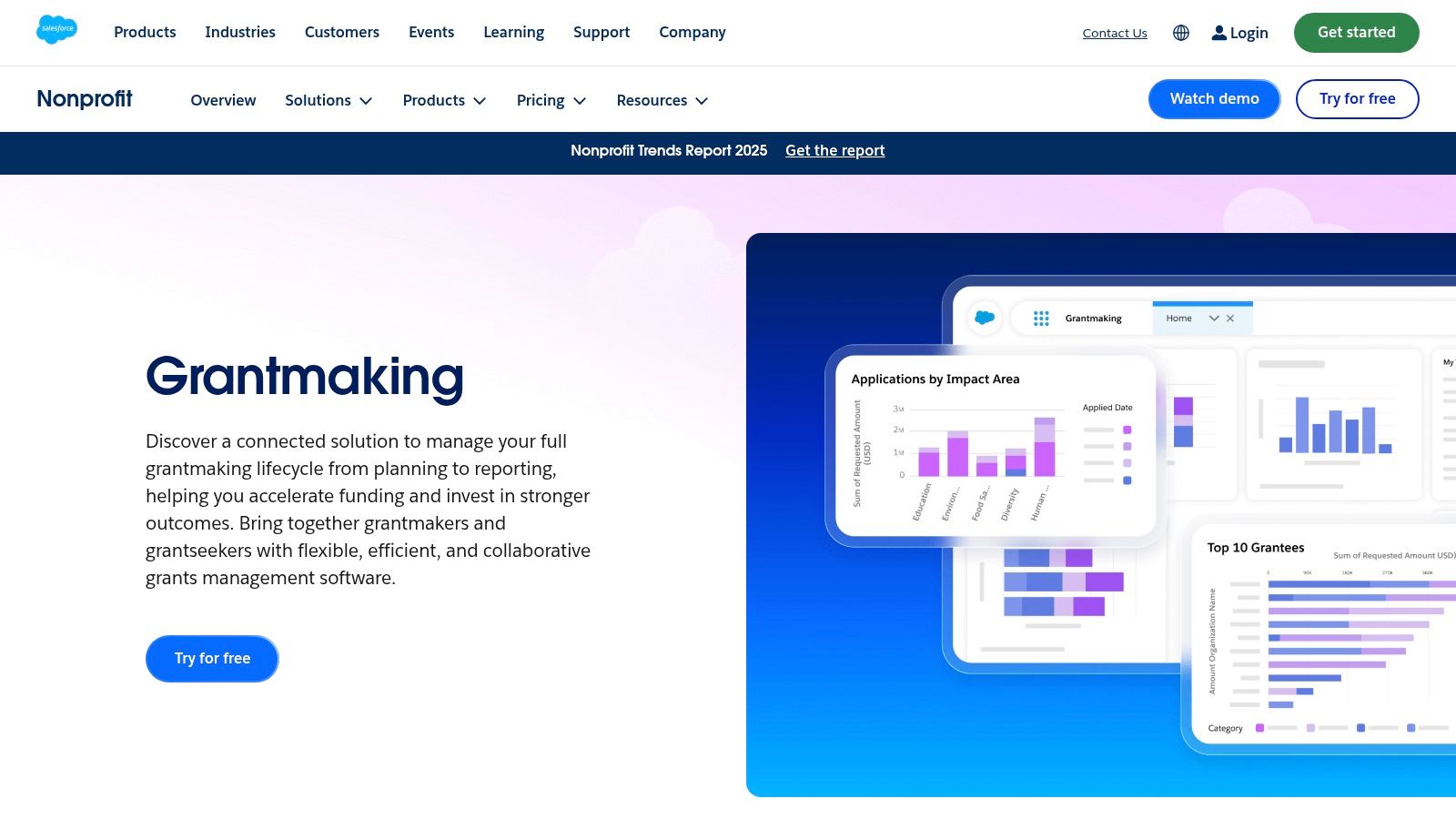
Salesforce Nonprofit Cloud for Grantmaking is best understood as a grantmaking solution inside a broader CRM platform. It combines a grantmaking data model, application and form tools, grantee portal experiences through Experience Cloud, automation, outcome management, and reporting.
The ecosystem is the product
Organizations already using Salesforce may benefit from connecting grant records with constituents, programs, and other relationship data. The AppExchange ecosystem and partner network create broad integration and customization options. Security, auditability, and enterprise controls also support larger organizations with formal governance requirements.
The same extensibility creates the main limitation. Licensing, Experience Cloud, configuration, and implementation services can produce a much larger total cost than the initial product description suggests. An organization without Salesforce administration skills may need a partner to build and maintain the environment.
Salesforce is a poor fit for a small nonprofit whose primary problem is funder discovery or deadline tracking. It becomes more compelling when a foundation wants grantmaking data to participate in a larger CRM architecture and has the budget and internal support to operate that architecture.
The evaluation should therefore include a real process map. Ask the implementation partner to show applicant intake, reviewer collaboration, award approval, reporting, and data handoff to finance, not just a polished CRM dashboard.
9. Bonterra CyberGrants
Bonterra CyberGrants is designed for corporate and institutional grantmakers managing grants alongside employee giving, volunteering, and broader corporate social responsibility programs. It is an enterprise platform for organizations with large, multi-program governance requirements rather than a nonprofit grantseeker tracker.
The product combines configurable grant workflows with budgeting, communications, distribution tracking, and impact reporting. Its appeal is the ability to view grants and other CSR activities in a unified operating environment while maintaining enterprise security and compliance controls.
Best for corporate philanthropy
A corporate foundation may need to coordinate legal, finance, CSR, employee engagement, and program teams. CyberGrants is built for that kind of cross-functional environment. It can be excessive for a small foundation that only needs an application form, reviewer assignments, and a report export.
Pricing is quote-only and positioned at the enterprise end of the market. A buyer should request a total-cost view that includes implementation, data migration, integration, user administration, and any required services. The platform's breadth is valuable only when the organization will use the related CSR capabilities.
CyberGrants also doesn't replace a discovery platform for nonprofits. A nonprofit applying to a corporate funder may interact with the system, but it won't use CyberGrants to search for suitable private foundations or prioritize outreach.
10. SurveyMonkey Apply
SurveyMonkey Apply is an application and review management system for foundations, institutions, public agencies, and other organizations running grants, scholarships, awards, or similar programs. Its workflow begins with intake and extends through review, decisions, notifications, and post-award requirements.
Strong process control for reviewers
The visual workflow designer supports staged processes, while reviewer assignment, scoring, conflict management, notifications, and exports help administrators coordinate complex evaluation cycles. Status dashboards give program managers visibility into applications moving through the pipeline.
That makes SurveyMonkey Apply useful when a funder needs a mature reviewer experience and repeatable process controls. It can accommodate more than a simple form-and-spreadsheet setup, particularly when several stages or reviewer groups are involved.
Quote-based evaluation
Pricing isn't publicly posted, so buyers need a scoped demonstration and a written proposal. Ask whether the package covers applicant support, reviewer permissions, post-award reporting, exports, integrations, and configuration assistance.
SurveyMonkey Apply is focused on grantmaker processes, not grant discovery. A nonprofit development team shouldn't choose it to replace a funder database or prospecting workflow. For organizations awarding grants, scholarships, or awards, it deserves consideration alongside Submittable and SmartSimple.
Teams seeking the opposite side of the process can start with this guide on how to find grants for nonprofits, then evaluate whether they need discovery software, a grantseeker tracker, or both.
Top 10 Grant Management Software Comparison
| Product | Primary focus | Core features / strengths | Target audience | Pricing / Value |
|---|---|---|---|---|
| Grantlas (recommended) | Discovery & prospecting for grantseekers | Profile from URL/EIN; scored matches with two‑sentence “Fit”; nationwide private + federal index; unlimited searches; monthly re‑scoring; giving history & board listings | Grant writers, small–mid nonprofits, consultants, university research admins | Solo $99/mo or $999/yr; Pro $199/mo or $1,999/yr (up to 3 users, 10 orgs); 7‑day free trial (no card) |
| Instrumentl | Full‑cycle grants (discovery → tracking → post‑award) | Curated matches + AI prospecting; pipeline & tasks; proposal drafting; post‑award spend tracking; CRM integrations | Nonprofits, consultants, universities, multi‑program teams | Posted pricing; typically higher entry (e.g., Discover tier cited ~$349/mo); 14‑day trial |
| Foundant GrantHub / GrantHub Pro | Pre‑award tracker with optional research | Pipeline, tasks, doc storage, deadline reminders; Candid/GrantStation research add‑ons; Pro adds post‑award budgeting | Small nonprofits, grant consultants, simple program teams | Clear posted tiers; affordable starter; Pro may require implementation fee |
| Fluxx Grantseeker | Scalable grants pipeline & team coordination | Central portfolio, deadlines, tasks; program budgeting (Premium); prospecting add‑on | Small teams to growing nonprofits needing scale | Self‑service Classic tiers; free 14‑day trial; pricing/packaging varies by tier |
| Submittable | Application intake & review for funders | No/low‑code form builder; reviewer portals, scoring, workflow automation; funds tracking & reporting | Foundations, public agencies, corporate grantmakers (funder‑side) | Quote‑based pricing; can be premium for small programs |
| Blackbaud Grantmaking | Enterprise grants management for funders | Configurable intake/review/workflows; dashboards, analytics; Blackbaud ecosystem integrations | Foundations and corporate grantmakers with enterprise needs | Quote‑based; enterprise TCO can be high |
| SmartSimple Cloud for Grants Management | Highly configurable GMS for complex programs | Role‑based access, complex workflows, Grants.gov ingestion (where eligible), strong reporting | Foundations, governments, research funders with complex governance | Pricing not posted; implementation + subscription fees expected |
| Salesforce Nonprofit Cloud for Grantmaking | Salesforce‑native grantmaking & CRM | Managed package, grantee portals, automation, AppExchange integrations | Orgs with Salesforce expertise or partners; enterprise nonprofits | Licensing + Experience Cloud + implementation costs; can be expensive |
| Bonterra CyberGrants | Enterprise CSR & grants platform for corporates | End‑to‑end lifecycle, budgeting, unified CSR reporting, enterprise security | Large enterprises, corporate grantmakers, complex CSR programs | Quote‑only pricing; premium enterprise TCO |
| SurveyMonkey Apply | Application & review management for funders | Visual workflow designer; reviewer assignment & scoring; automations and exports | Foundations, agencies, scholarship/award programs (funder‑side) | Quote‑based pricing; widely deployed for review workflows |
Choose the Platform That Matches Your Side of the Grant
There isn't one universal best platform because there isn't one universal grant workflow. A nonprofit looking for funding and a foundation distributing funding may use the same vocabulary, but they need different systems, permissions, data, and reporting logic.
For small and midsize nonprofits, grant consultants, development directors, and university research administrators, Grantlas is the clearest choice when the immediate bottleneck is prospect discovery and qualification. It creates a profile from a website or EIN, ranks private foundations and open federal grants, explains the match in plain English, and flags obvious reasons to deprioritize a prospect. That is a different job from managing a submitted application or reconciling an awarded grant.
Choose Instrumentl when you want discovery, proposal collaboration, pipeline work, and post-award spend tracking in one grantseeker workspace. Choose GrantHub Pro when you prefer a simpler nonprofit tracker with optional research and stronger budgeting and reporting after an award. Choose Fluxx Grantseeker when your organization needs a path toward more advanced coordination and reporting, and can tolerate more complicated packaging.
The funder-side shortlist is separate. Submittable suits foundations, corporations, public agencies, and nonprofits running open calls that need configurable forms and reviewer workflows. Blackbaud Grantmaking is more appropriate for established foundations that value enterprise controls and the Blackbaud ecosystem. SmartSimple fits complex or regulated programs where role-based access and workflow configuration justify heavier implementation.
Salesforce Nonprofit Cloud for Grantmaking makes the most sense when Salesforce already anchors the organization's CRM and a partner or internal administrator can support customization. Bonterra CyberGrants is aimed at corporate and institutional grantmakers combining grants with CSR, employee giving, or volunteering. SurveyMonkey Apply is a strong candidate for structured application and review processes across grants, scholarships, and awards.
The market's adoption gap reinforces the need for an honest workflow assessment. A roundup citing NTEN benchmarks reports that 64% of organizations with budgets between $500,000 and $10 million still rely primarily on spreadsheets for grant tracking. That analysis suggests many organizations don't need the most powerful platform first. They need a system that staff will maintain and that removes missed deadlines, scattered documents, and unclear ownership.
Use this evaluation sequence:
- Map the current workflow: Document discovery, qualification, applications, awards, reports, payments, and approvals.
- Separate discovery from administration: Decide whether you need funder intelligence, grantseeker tracking, grantmaker intake, or several connected tools.
- Test real records: Import active prospects and confirm that deadlines, tasks, documents, status changes, and reporting dates work as expected.
- Calculate implementation effort: Include migration, integrations, configuration, training, internal administration, and ongoing data cleanup.
- Challenge pricing assumptions: Verify which features require a higher plan, a paid add-on, professional services, or extra users.
- Check reporting depth: Confirm that the platform can produce the reports required by funders, boards, finance teams, auditors, or regulators.
Buyer priorities also point toward workflow utility rather than database size alone. Capterra summaries report that reviewers consider customizable forms critical at 70%, grant application management at 69%, and customizable questions at 63%. The available category summary supports a practical conclusion: teams value software that matches their intake, review, and reporting process without forcing unnecessary configuration.
Start with the part of the grant lifecycle where your team loses the most time. If that is finding suitable funders, rank discovery and fit explanations first. If it is managing applications, prioritize forms, review, and communications. If it is post-award accountability, examine budgets, reports, disbursements, integrations, and audit trails before comparing brand names.
Grantlas helps nonprofit teams find private foundations and open federal grants, score prospects for fit, and understand why an opportunity belongs on the shortlist. Visit Grantlas to build a profile from your website or EIN and start replacing spreadsheet-led prospecting with clearer priorities.
