10 Types of Grants Nonprofits Should Know in 2026
Sep 29, 2026 · 15 min read
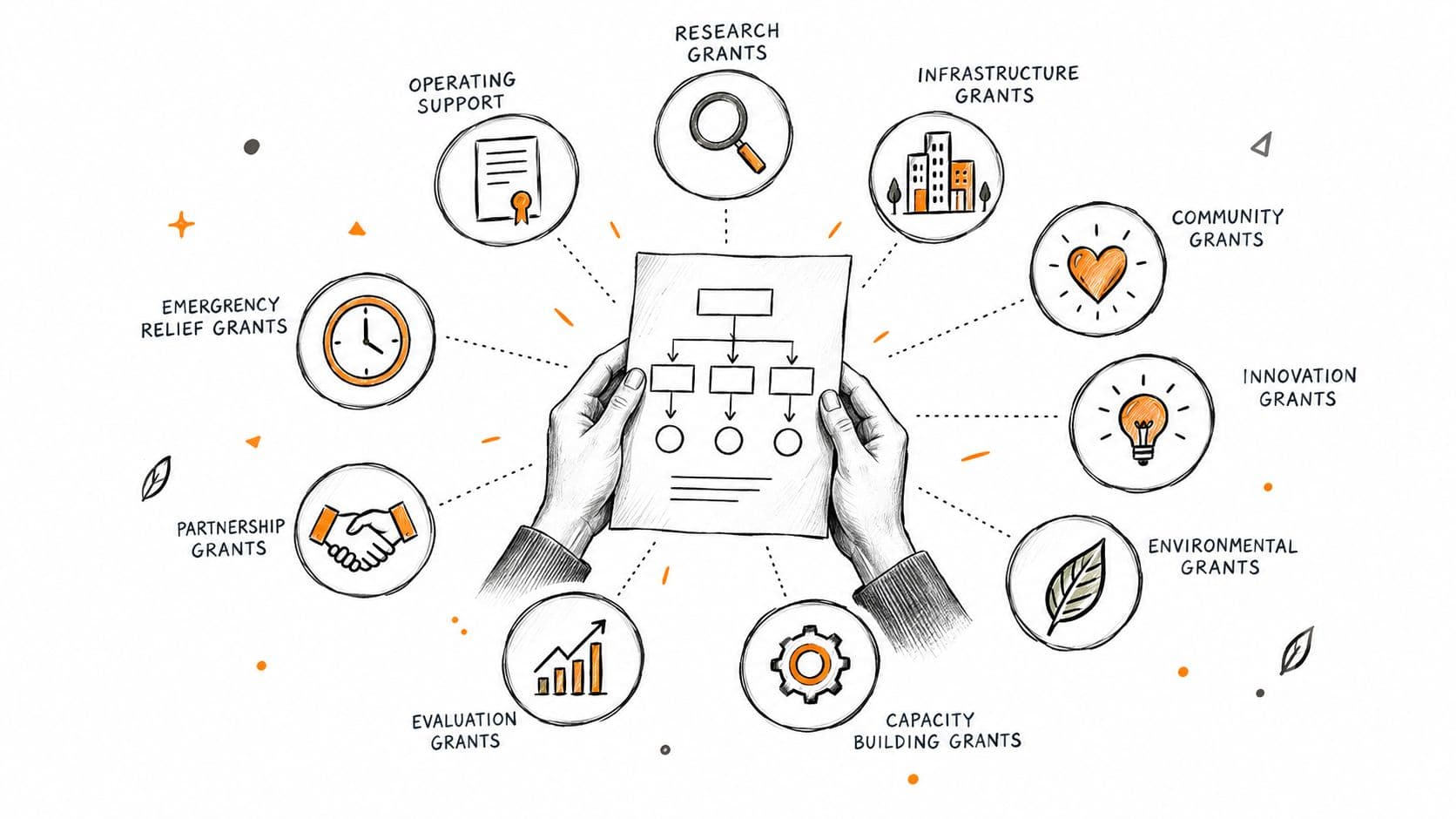
A neighborhood nonprofit may need flexible cash to keep staff employed, launch a youth program, fund research, respond to a storm, or deliver services under a public contract. Those needs can all involve outside funding, but they don't point to the same kind of grant. Applying for a tightly restricted project award when the core issue is a budget shortfall creates avoidable work. Pursuing a government contract as if it were a grant creates a different set of compliance and delivery obligations.
The useful question isn't only, “What types of grants exist?” It's, “What kind of funding matches our purpose, eligibility, evidence, timing, and capacity?” This guide separates ten practical categories by what they fund, who typically provides them, how eligibility works, what an award may require, and how to prospect efficiently. The distinction matters in a crowded field. As of FY2025, the United States had at least 1,183 funded federal grant programs, according to the 2024 State of Grantseeking report.
Grantlas can help create a scored shortlist across private foundations and open federal opportunities, with reasons and eligibility flags. Category knowledge still matters, because you need a clear funding need before any search tool can identify a realistic match.
Table of Contents
- 1. Foundation Grants
- 2. Federal Grants
- 3. Corporate Grants and Sponsorships
- 4. Government Contracts and Procurements
- 5. Program-Specific Grants
- 6. Operating Support and General Operating Grants
- 7. Capacity-Building and Technical Assistance Grants
- 8. Matching and Challenge Grants
- 9. Research and Innovation Grants
- 10. Emergency, Disaster, and Relief Grants
- Top 10 Grant Types Comparison
- Turn Grant Categories Into a Focused Prospect List
1. Foundation Grants
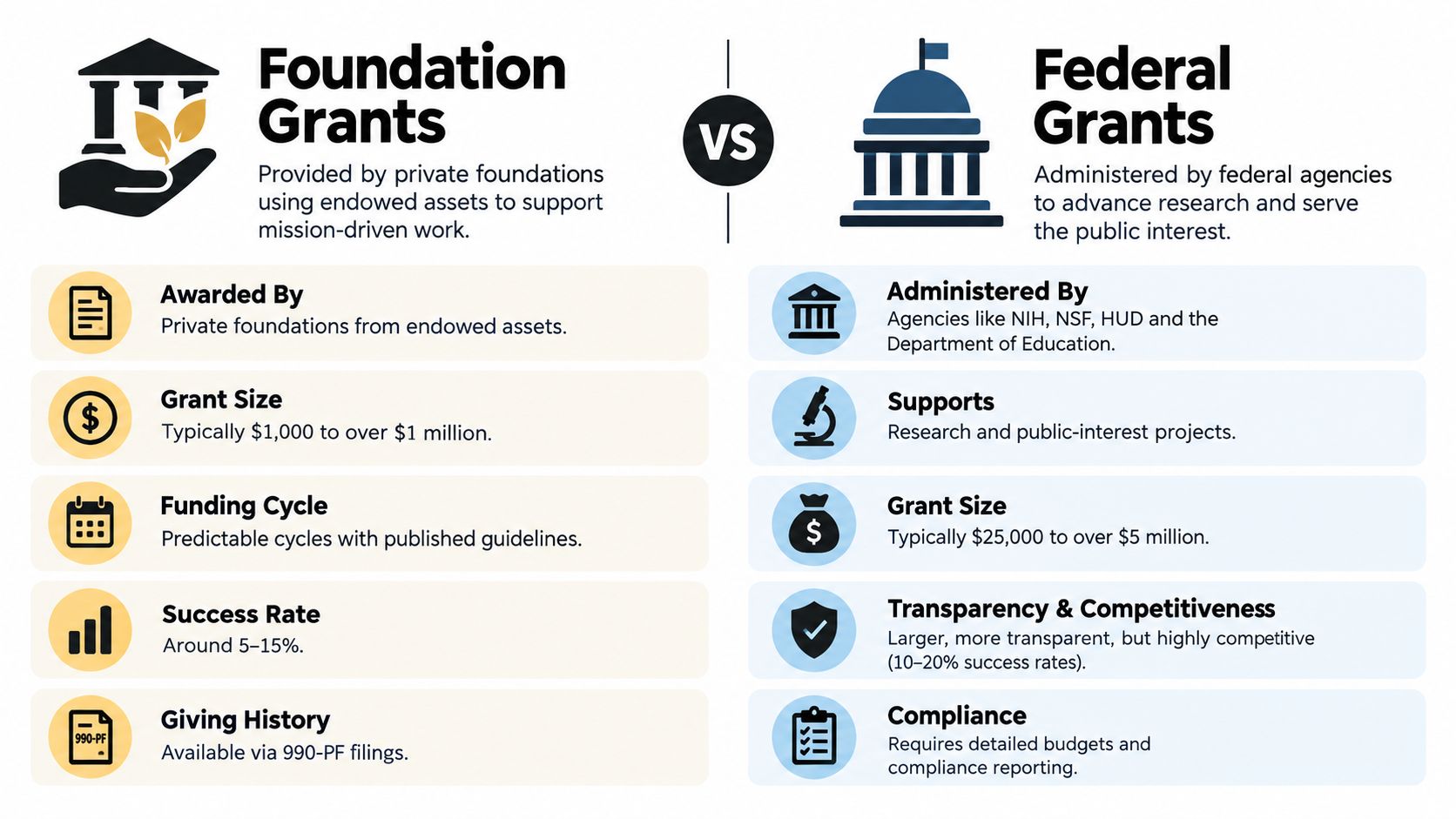
Private foundations fund charitable work from assets or endowments established by individuals, families, corporations, or other institutions. Their priorities can range from local food access to global health, climate action, racial justice, arts, education, or civic participation. A community foundation may focus on one region, while a large national foundation may support work across several states or countries.
Foundation grants often reward strong alignment with the funder's stated mission. A neighborhood organization serving one county may fit a local community foundation better than a national funder whose eligibility rules exclude its geography. A nonprofit working on environmental activism might research Patagonia's giving priorities, while an organization focused on global health may examine Gates Foundation programs. Those names are starting points, not proof of eligibility or an open application window.
Practical rule: Treat a foundation's recent giving history as evidence of behavior, not just its published mission statement.
Review the funder's application process, geographic rules, new-grantee policy, and typical award structure before drafting. IRS Form 990-PF filings can reveal prior recipients, subject areas, trustees, and grant patterns. Grantlas can help you compare different types of grants while filtering prospects by geography, sector, and fit signals.
A practical prospecting routine is simple:
- Check geographic fit: Remove funders that don't support your service area.
- Review giving history: Look for repeated support for organizations like yours.
- Assess award flexibility: Determine whether the funder supports projects, operations, or both.
- Track timing: Save searches and reminders for invitation or deadline-based processes.
Foundation grants are often relationship-driven. Board members, trustees, donors, and peer organizations can provide useful context, but a warm introduction won't replace eligibility.
2. Federal Grants
Federal grants distribute public funds through agencies such as the National Institutes of Health, National Science Foundation, Department of Housing and Urban Development, Department of Energy, and Department of Education. They can support research, housing, education, health, rural development, workforce programs, and community services. Some opportunities are formula-based, while others are discretionary and competitive.
Federal grantmaking has several structural categories. The Congressional Research Service describes broad grant types as categorical grants, block grants, and general revenue sharing. Categorical grants themselves include project categorical, formula categorical, formula-project categorical, and open-end reimbursement grants. Applicants don't need to memorize every label, but they do need to understand whether an opportunity is open to proposals or distributed through a formula.
Federal applications usually demand detailed responses, budgets, work plans, evaluation methods, registrations, and compliance documentation. A nonprofit that has a strong program but limited grants administration may need more preparation before pursuing a large federal opportunity. GrantStation's 2024 report also shows why applicants distinguish government funding from non-government funding. Among organizations that received federal funding in 2023, 64% said their largest federal award was a grant, while 12% identified a contract and 15% another form such as a cooperative agreement or reimbursement.
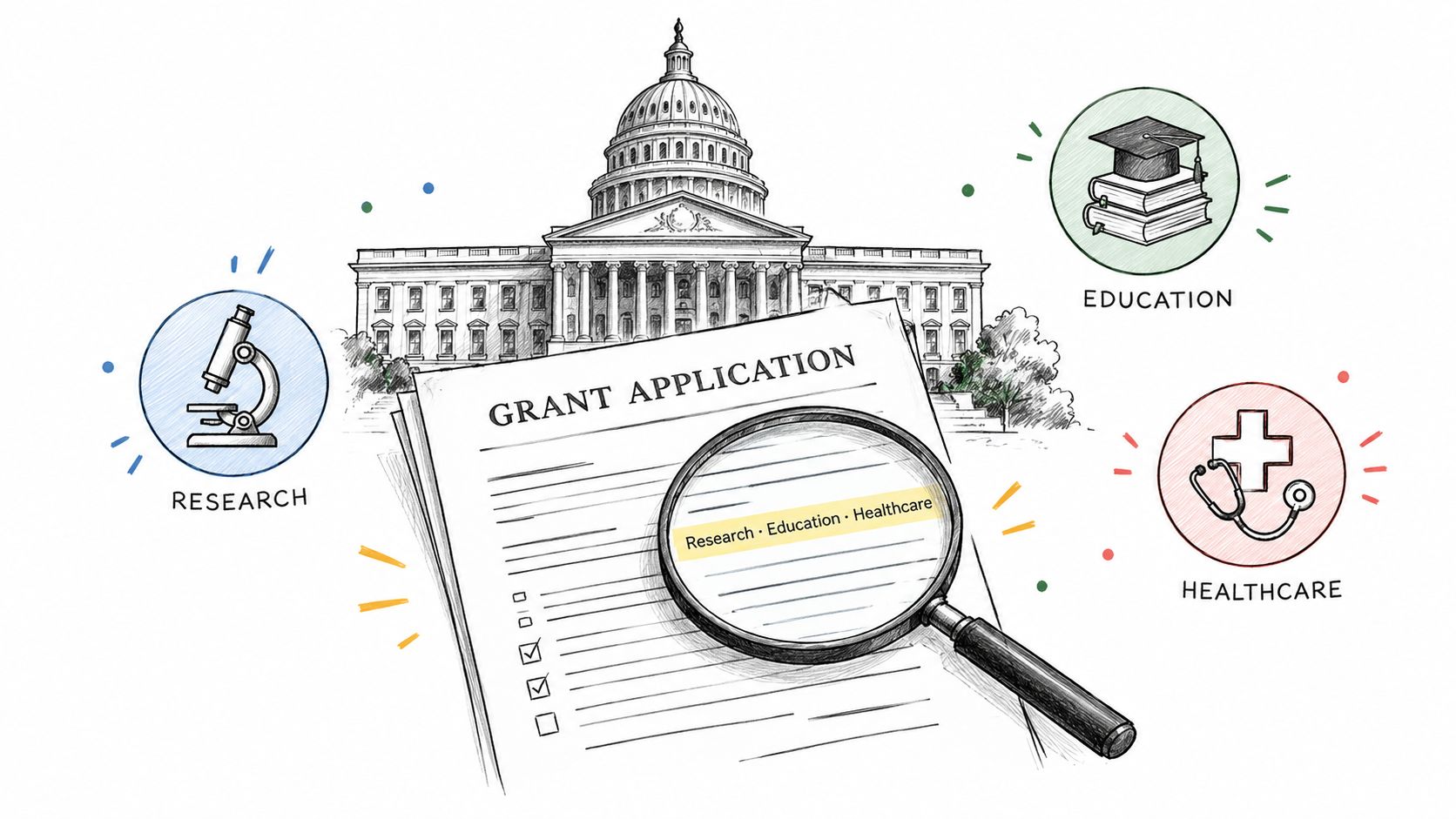
Start with the notice of funding opportunity. Confirm eligible applicants, required registrations, matching conditions, allowable costs, reporting expectations, and submission system. Use grants for nonprofits to support discovery, but rely on the official opportunity notice for final requirements.
3. Corporate Grants and Sponsorships
Corporate funding comes from businesses, corporate foundations, employee-giving programs, or marketing and community-investment budgets. It may support a defined program, a local event, a capital purchase, employee volunteering, or a community partnership. Unlike many foundation grants, corporate support can include visibility expectations, employee engagement, public recognition, or alignment with the company's customers and brand.
A technology company may be interested in digital skills or nonprofit technology. A retailer may prioritize neighborhoods where it has stores. An outdoor brand may support conservation. Salesforce.org, Google.org, Patagonia, Microsoft, and Target are recognizable examples of companies with public social-impact or community programs, but their priorities and application routes vary over time.
The fit question is two-sided. Your nonprofit should serve a community or address an issue the company truly cares about, while the proposed partnership should offer a credible community-impact story. A youth coding program might approach a technology employer with a clear explanation of participants, learning outcomes, volunteer roles, and local relevance. It shouldn't just ask for money because the company is nearby.
Separate grants from sponsorships
A grant generally supports charitable activity under a funder's program priorities. A sponsorship may involve promotional benefits, event visibility, naming rights, or audience access. The accounting, deliverables, and relationship expectations can differ, so read the agreement carefully.
Research corporate social responsibility pages, annual reports, local giving programs, and employee volunteer networks. Review corporate foundation filings where available, then ask existing board members, donors, volunteers, and business partners for introductions. Your proposal should connect the company's interests to a specific community benefit without overstating what the partnership can deliver.
4. Government Contracts and Procurements
A government contract pays a nonprofit to deliver a defined service, manage a program, or provide goods. That makes it related to grants, but not interchangeable with them. A grant usually supports an approved public-purpose activity, while a procurement process asks an organization to meet specifications set by a government buyer.
A homeless-services nonprofit might bid on a local housing-services contract. A workforce organization could respond to a Department of Labor procurement. A community health provider might pursue a state Medicaid agreement, while a youth organization could compete for a local after-school services contract. In each case, the funding is tied to delivery, performance, documentation, and contract terms.
The first evaluation question is operational, not ideological: can your organization deliver the required service at the required scale and under the required controls? Examine insurance, staffing, cash flow, accounting systems, data security, subcontracting rules, procurement standards, and reporting capacity. A strong mission fit doesn't compensate for an inability to meet contractual obligations.
Federal organizations generally use SAM.gov for registrations and contracting information, while states and municipalities maintain their own procurement portals. Monitor notices in the communities you serve and learn how agencies describe upcoming needs. A nonprofit may also partner with a larger prime contractor when it has strong community access but lacks the administrative infrastructure to lead.
Don't label every public opportunity a grant. The distinction affects pricing, risk, cash management, and the evidence you must provide.
5. Program-Specific Grants
Program-specific grants fund a defined issue, population, intervention, or service model. Common areas include STEM education, youth mental health, climate action, housing, health equity, arts, and criminal justice reform. Foundations and government agencies use these awards when they want money tied to a particular public outcome rather than the organization's entire budget.
A youth nonprofit might seek support for a mental health initiative rather than describe its whole mission. An arts organization could pursue funding for a cultural program with defined participants and activities. A criminal justice reform organization may need to show that its proposed work fits the funder's theory of change and evidence expectations.
The strongest application connects four elements:
- Specific need: What problem affects the intended population?
- Defined activity: What will the nonprofit deliver?
- Credible evidence: Why should the approach work in this setting?
- Measurable result: What will the funder learn or see?
Program fit isn't the same as keyword fit. A funder that mentions “education” may support research, teacher training, policy advocacy, or direct services, and those models aren't interchangeable. Read past awards, program guidelines, geographic restrictions, and application calendars. Peer organizations can show how a funder interprets its priorities in practice.
Use plain-English searches such as “youth mental health support in our county” rather than relying only on formal program names. Then compare the opportunity against your actual design. If the funder wants an evidence-based intervention and your organization is still testing a concept, a research or innovation grant may be more appropriate.
6. Operating Support and General Operating Grants
Operating support funds the organization rather than a single project. It can help pay for staff, rent, technology, insurance, finance, communications, and other core functions that allow programs to continue. For a nonprofit facing a gap between restricted awards and real operating costs, unrestricted or general support can be more useful than another project grant.
GrantStation's 2024 findings show how important this distinction is. Among respondents discussing non-government awards, general support was the largest award type for 33%, followed by project or program support at 32%. The same report lists capacity-building at 9% and building and infrastructure funds at 6%. These figures come from the State of Grantseeking 2024 findings, and they illustrate why an organization's funding mix matters.
A general operating request should explain the mission, organizational strength, community need, and overall results. Don't disguise a core budget request as a project if the funder explicitly invites unrestricted support. Conversely, don't assume every foundation can make flexible awards. Many funders have policies that restrict operating support or favor program-specific proposals.
Match the ask to organizational readiness
A newer nonprofit may need capacity-building support before it can manage a broad operating award. An established community organization with reliable programs, clear governance, and strong financial controls may be a better candidate for multi-year general support. Review the funder's philosophy, past recipients, grant agreements, and reporting requirements.
Use search filters that identify funders supporting organizations rather than only programs. Family foundations and community foundations can be useful prospects, but their policies vary. The proposal should show what flexible funding makes possible, not merely list expenses.
7. Capacity-Building and Technical Assistance Grants
Capacity-building grants strengthen the systems behind a nonprofit's mission. They may support strategic planning, board development, financial management, leadership transitions, technology, fundraising infrastructure, evaluation, or staff training. Technical assistance can be delivered through coaching, consultants, peer learning, workshops, or direct support from an intermediary.
Consider a nonprofit with excellent community programs but weak financial reporting. Its best funding request may be for accounting systems and staff training, not another service expansion. An organization preparing for executive transition may seek governance and succession support. A growing group with outdated technology could request help selecting and implementing a donor-management or case-management system.
Start with an honest internal diagnosis. Ask where the current weakness limits program quality, compliance, revenue, or leadership capacity. Then write the request around the gap and its consequences. “We need a strategic plan” is less persuasive than explaining how unclear roles delay decisions, complicate fundraising, or prevent the organization from managing growth.
Look for funders and intermediaries that explicitly support organizational development. Community foundations, nonprofit support organizations, technology programs, and financial-health intermediaries may offer both money and expertise. The assistance itself can be as important as the cash, especially when the grant includes a skilled consultant or sustained coaching.
Capacity-building works best when the organization can name the capability it needs, the change it expects, and the way that change will improve mission delivery.
Confirm whether the award permits consultant fees, software, staff time, or indirect costs. A capacity-building application should also explain how the organization will maintain the new system after the grant period ends.
8. Matching and Challenge Grants
Matching and challenge grants ask a nonprofit to raise additional funds under conditions set by the funder. The funder may match eligible donations, release money after a fundraising goal is reached, or support a campaign that demonstrates broad community participation. This structure can be useful for capital campaigns, local giving drives, and donor reactivation.
The category carries a built-in risk. A nonprofit that lacks a reliable donor base, board participation, or campaign plan may win the challenge but fail to receive the funds. Before applying, examine past fundraising performance, donor communications, major-gift prospects, volunteer capacity, and the time available to meet the challenge.
A community foundation might offer a local matching opportunity. A corporation may match employee gifts or fundraising efforts. A foundation could use a challenge grant to encourage participation in a building campaign. These arrangements differ, so check what counts as eligible money, whether prior commitments qualify, how gifts are documented, and when the match is paid.
Build the campaign before pursuing the award
Create a prospect list of likely donors and define the message before submitting a challenge request. The grant should accelerate a credible campaign, not substitute for one. Give donors a concrete reason to act, such as expanding a service, opening a facility, or reaching an underserved group.
Your letter of inquiry can test whether the funder supports this structure before you invest in a full proposal. Review letter of inquiry examples for ways to state the need, campaign plan, match conditions, and likely community response clearly.
Set an internal target that reflects actual fundraising capacity. A challenge deadline can create urgency, but it won't fix an unrealistic goal or an unclear donor proposition.
9. Research and Innovation Grants
Research and innovation grants support new knowledge, pilot programs, evaluation, prototypes, and approaches that haven't yet become standard practice. They can suit nonprofits testing a new service model, building evidence, studying a community problem, or partnering with an academic institution. Funders may expect a clear research question, methodology, evaluation plan, dissemination strategy, and qualified project team.
A public-health nonprofit could pilot a new outreach model and measure participation and outcomes. An education organization might work with a university to evaluate a learning intervention. A justice-reform group could study whether a proposed service improves outcomes for a defined population. In each example, the application must explain not only what the organization will do, but what it will learn.
Research awards usually require more than an appealing idea. Reviewers may examine the design, baseline information, analytic approach, ethics, data management, staffing, and feasibility. If your organization lacks research expertise, a university, evaluation firm, or subject-matter partner can add credibility. The partnership should define responsibilities, ownership of data, publication rights, and communication with participants.
A pilot request should also address what happens after the grant. Will the findings inform program design, public policy, replication, or a larger funding request? Innovation without a learning plan can sound like ordinary program expansion with unfamiliar language.

Search federal agencies and private funders that explicitly support evidence-building or innovation. Read prior awards carefully. Some programs favor academic applicants, while others welcome community-based organizations with lived experience and implementation access.
10. Emergency, Disaster, and Relief Grants
Emergency and relief grants provide funding when communities face disasters, public-health crises, displacement, sudden unemployment, food insecurity, or urgent housing needs. They can support immediate response, recovery, or resilience. Local community foundations often play an important role because they understand the affected area and can move resources through established nonprofit relationships.
A food bank responding to a sudden disruption may need flexible support for distribution and transportation. A housing nonprofit may seek emergency assistance for displaced residents. After a hurricane, flood, wildfire, or other disaster, a community organization may shift staff and services quickly while documenting changing needs.
The application process can be faster than a standard program cycle, but speed doesn't eliminate accountability. Keep organizational records current, maintain a concise description of emergency services, document affected populations, and prepare a basic budget that can be updated quickly. Funders may ask how the response meets immediate needs and how the organization will prevent duplication with other providers.
Response principle: Maintain a ready-to-send organizational profile before the emergency occurs. Preparation is part of emergency grant strategy.
Build relationships with local foundations, disaster-response coalitions, government agencies, and major service partners. Sign up for alerts from funders and emergency-grant platforms. After the response, record outputs, community feedback, unmet needs, and recovery lessons. That evidence can support later resilience or operating requests.
Track both dedicated emergency programs and regular opportunities that allow rapid-response work. A relief grant may be short-term, so plan early for the transition from immediate aid to recovery and ongoing services.
Top 10 Grant Types Comparison
| Type | Implementation complexity | Resource requirements | Expected outcomes | Ideal use cases | Key advantages |
|---|---|---|---|---|---|
| Foundation Grants | Moderate, formal proposals, multi-month review | Moderate, proposal research and relationship-building | Variable, small to large awards; medium-term support | Mission-aligned programs, capital projects, general support | Predictable cycles, giving history, relationship opportunities |
| Federal Grants | High, detailed applications, strict compliance | High, audits, accounting, evaluation, admin capacity | Large awards; recurring cycles; high credibility | Large-scale research, public programs, infrastructure | Substantial funding, transparency, prestige |
| Corporate Grants & Sponsorships | Low–Moderate, CSR alignment, branding expectations | Moderate, partnership management, marketing commitments, in-kind coordination | Medium funding plus visibility and in-kind support | Community programs, events, brand-aligned initiatives | Faster decisions, in-kind resources, employee engagement |
| Government Contracts & Procurements | Very high, competitive bids, specific deliverables | Very high, operational capacity, insurance, cashflow to bridge payments | Predictable, often multi-year revenue tied to service delivery | Delivering government services (case mgmt, training, health) | Larger predictable revenue, clear deliverables, potential renewals |
| Program-Specific Grants | Moderate–High, alignment with models and outcomes | Moderate, program staff and evaluation resources | Targeted program funding with defined outcomes (2–5 years) | Issue-focused program expansion, pilots, evidence-based work | Strong mission-fit, technical support, measurable outcomes |
| Operating / General Support Grants | Moderate, relationship-driven, competitive | Moderate, proven track record and financials | Flexible funding for core costs; stability, often multi-year | Core operations, infrastructure, organizational scaling | Flexibility, reduced admin burden, long-term stability |
| Capacity-Building & Technical Assistance Grants | Low–Moderate, applications plus TA commitments | Moderate, staff time for training, consultants, tech upgrades | Improved systems and sustainability; readiness for larger grants | Governance, finance, tech, strategic planning, staff development | Embedded TA, builds long-term capacity, increases effectiveness |
| Matching & Challenge Grants | Moderate, campaign planning and targets | High, fundraising capacity, donor mobilization and tracking | Leveraged funds; increased overall fundraising if match met | Capital campaigns, fundraising drives, donor engagement events | Multiplies donations, motivates donors, generates publicity |
| Research & Innovation Grants | High, rigorous design, evaluation, and reporting | High, research partners, data collection, analysis resources | Evidence generation, thought leadership, possible large awards | Pilot studies, academic partnerships, new model testing | High credibility, publishable results, attracts further funding |
| Emergency, Disaster & Relief Grants | Low–Moderate, expedited processes, rapid turnarounds | Low–Moderate, readiness for quick deployment and reporting | Rapid, flexible funding for immediate relief; short-term support | Disaster response, public-health crises, urgent community needs | Speed, flexibility, focus on immediate impact |
Turn Grant Categories Into a Focused Prospect List
The best grant search starts with a funding need stated in operational language. “We need unrestricted cash to retain staff” points toward operating support. “We need to test a new intervention” points toward research and innovation. “We need equipment for a facility” may indicate capital or infrastructure funding, even if the organization initially searches for general grants. “We want to deliver services under an agency's specifications” is more likely a procurement question than a grant question.
Once the need is clear, choose the most relevant categories. Don't search every category with equal effort. A small community nonprofit might prioritize local foundation, operating-support, program-specific, and capacity-building prospects. A university-affiliated research organization may add federal and innovation searches. A service provider with strong compliance systems may evaluate government contracts separately from grant opportunities.
Eligibility comes before proposal writing. Confirm applicant status, geography, population served, organizational age or experience requirements, fiscal sponsorship rules, partnership requirements, and restrictions on funding use. Grant type alone doesn't determine fit. The same program label can conceal different rules for location, budget, legal status, or invitation status.
Compare the opportunity with your capacity
Review the funder's giving history, typical grant size, award cadence, openness to new grantees, and reporting requirements. GrantStation's survey found a substantial difference between non-government and government award levels. The 2023 report summary identified a median largest award of $40,000 from non-government funders, $218,000 from government funders, and $423,435 for the largest federal award median. Those figures don't predict your award, but they show why government applications can require a different level of preparation and infrastructure.
Federal grant work can also be materially heavier. A grant statistics summary from Instrumentl reports that foundation applications take 15 to 20 hours, while federal applications take more than 100 hours, and cites average grant-seeking success rates of around 10%. Use those figures as planning context, not as a guarantee. The right prospect is one where the expected strategic value justifies the work.
Create separate searches for:
- Operating support: Funders that support organizational mission and core costs.
- Program funding: Opportunities aligned with a defined service or population.
- Capacity building: Grants for systems, governance, technology, finance, or leadership.
- Research and innovation: Funders seeking pilots, evaluation, or evidence.
- Urgent opportunities: Emergency, disaster, recovery, and rapid-response support.
Saved searches, weekly digests, monthly rescoring, and deadline reminders can keep the pipeline current. Grantlas uses an organization profile to generate a scored shortlist of private foundations and open federal opportunities, with plain-English reasoning, giving history, peer prospecting, and flags for issues such as geography or applicant eligibility. Its index covers private foundations and federal opportunities across the United States, while opportunities are scanned nightly and saved profiles are rescored monthly.
Prioritize fit and readiness, not the prestige of the funder or the size of the possible award. A smaller, flexible opportunity that matches your geography and current capacity may be more valuable than a large federal program that requires infrastructure you don't yet have. Review the evidence, confirm the rules, and then draft the proposal that your organization can deliver well.
Grantlas helps nonprofits identify prospective private foundations and open federal grant opportunities, score fit against an organization profile, and explain why a prospect may or may not match. Create focused searches for operating support, program funding, capacity building, research, or emergency opportunities, then visit Grantlas to build and manage a more practical funding shortlist.