Nonprofit Funding Sources: A Practical Guide for 2026
Oct 13, 2026 · 12 min read
Friday's federal proposal is half-written. Two foundation letters of inquiry are waiting for a second review. A board member has offered an introduction to a company executive, while the program director is asking why fee-based services keep losing priority. The development team is busy, but nobody can say which opportunities deserve the next hour.
That situation is common because nonprofits often manage funding sources as separate task lists. Grants sit in one spreadsheet, donors in another, sponsorships live in board email threads, and earned revenue gets discussed only when cash is tight. A stronger approach treats revenue as a portfolio, with each source judged by fit, eligibility, flexibility, time to award, renewal prospects, and concentration risk.
Table of Contents
- Why Nonprofit Funding Sources Deserve a Strategy
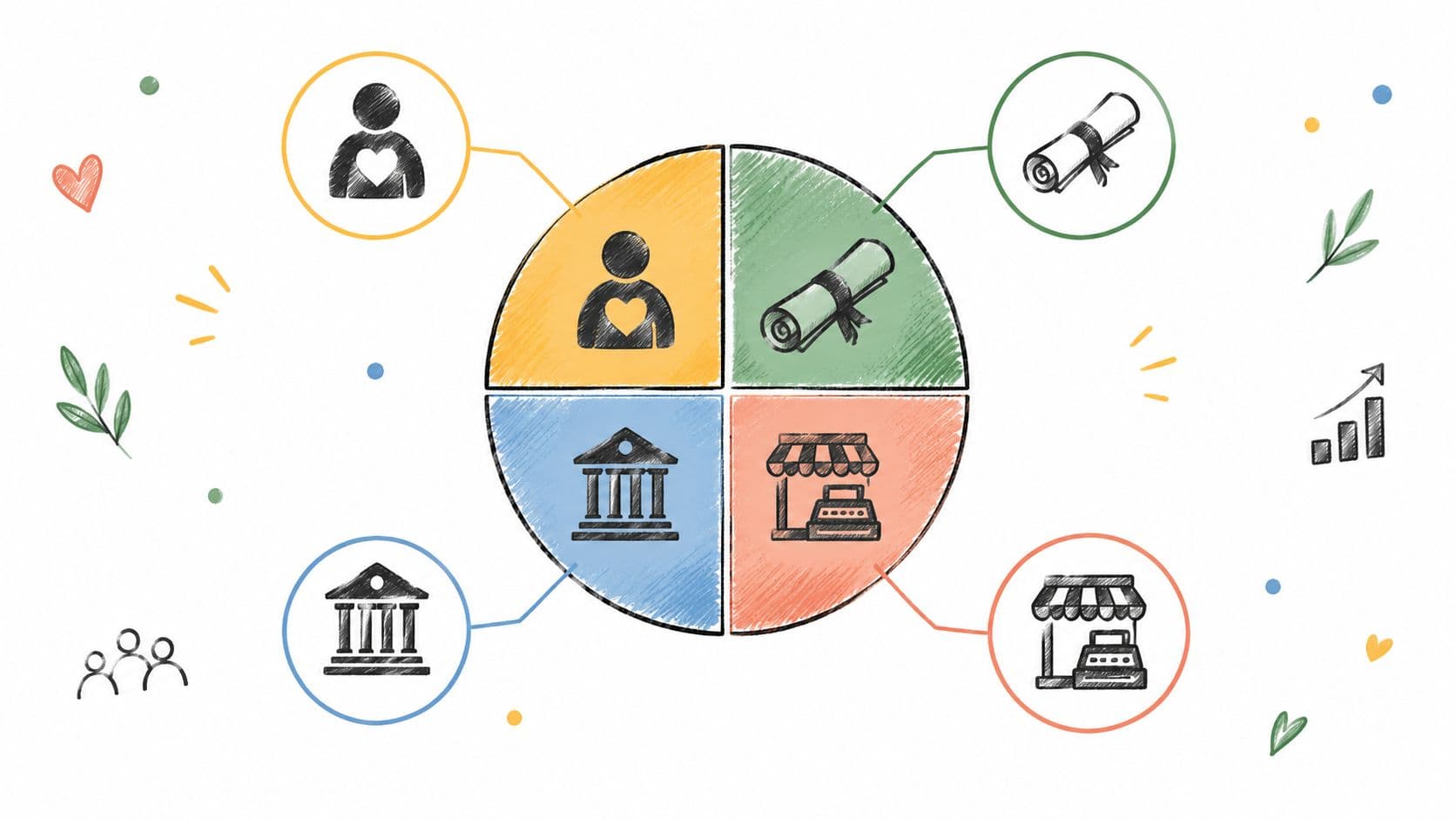
- The Four Core Categories Every Nonprofit Should Know
- How Foundation and Federal Grant Data Actually Works
- Comparing Individual Giving, Corporate Support, and Government Funds
- Why Unrestricted Dollars and Concentration Risk Matter More Than Fit
- How to Prospect, Qualify, and Prioritize Funders
- Building a Diversified Funding Mix That Actually Holds
- Frequently Asked Questions About Nonprofit Funding Sources
Why Nonprofit Funding Sources Deserve a Strategy
The problem isn't a lack of possible funders. It's the assumption that every dollar serves the same purpose.
A federal award may finance a defined service while bringing reporting obligations and reimbursement delays. A foundation grant may support a pilot but restrict spending to approved activities. An individual donor may offer less money per gift but more discretion. Earned revenue can be dependable when the service is strong, yet it can also pull staff toward customers who can pay instead of people the mission prioritizes.
A list of opportunities doesn't solve those differences. A strategy does.
Treat revenue as a portfolio
Start with four categories:
- Private giving, including individuals, families, bequests, and corporate philanthropy.
- Institutional grants, particularly private foundations and community funders.
- Government funds, including grants, contracts, and subawards.
- Earned income, such as program fees, tuition, admissions, memberships, and services.
These categories have different operating requirements. Private giving depends on relationships and stewardship. Foundation funding depends on mission alignment, eligibility, timing, and often an invitation or letter of inquiry. Government funding requires close attention to program rules, procurement, compliance, and reporting. Earned income requires a viable service model and disciplined cost accounting.
Practical rule: Never ask only, “Can we win this money?” Ask, “What will this money require, and what part of our financial model will it strengthen?”
The distinction matters because a nonprofit can grow its grant pipeline while becoming less financially stable. Restricted awards may expand program activity without paying for supervision, finance, technology, fundraising, or reserves. A sponsor may bring visibility but require event benefits that consume staff time. A fee-based program may generate cash while reducing access for the people the organization exists to serve.
The rest of the strategy should therefore compare sources by purpose, not popularity. The right mix gives your team enough flexible capital to operate, enough restricted support to deliver programs, and enough recurring or earned revenue to reduce dependence on any single decision maker.
| Category | Typical providers | Typical check size | Flexibility |
|---|---|---|---|
| Private giving | Individuals, families, bequests, corporations | Highly varied | Often highest for individual gifts |
| Institutional grants | Private and community foundations | Highly varied | Usually restricted or purpose-specific |
| Government funds | Federal, state, and local agencies | Highly varied | Tied closely to scope, eligibility, and compliance |
| Earned income | Participants, customers, members, purchasers | Based on service demand | Depends on pricing and program design |
The Four Core Categories Every Nonprofit Should Know
A small nonprofit should assign every revenue stream a job before pursuing it. Evaluate each source by fit, eligibility, flexibility, and concentration risk, not by the size of the opportunity.
Private giving covers donations from individuals and families, charitable bequests, and corporate philanthropy. In the United States, individuals supplied $392.45 billion, approximately 66% of total charitable giving, in 2024. Foundations supplied $109.81 billion, or 19%, bequests supplied $45.84 billion, or 8%, and corporations supplied $44.40 billion, or 7%, according to Giving USA's 2024 charitable giving figures. Individual fundraising therefore belongs in the core revenue plan, even when grants receive most of the development team's attention.
Institutional grants come from private, family, community, and corporate foundations, along with other grantmaking institutions. They may support programs, capacity work, research, capital needs, or general operations. The award's restrictions matter more than the label “grant.” A funder with a clear renewal pattern or flexible support can be a better prospect than one offering a stronger subject-area match but only short-term project awards.
Government funds include grants and contracts from federal, state, county, and municipal agencies. Grants usually support an approved purpose. Contracts pay for defined services or deliverables. Both can finance meaningful work, but neither functions like unrestricted cash. Compliance, invoicing, performance measures, procurement rules, and political changes can raise the actual cost of accepting an award.
Earned income includes program-service revenue, fees, tuition, admissions, memberships, consulting, and other payments tied to services or assets. The IRS reported that public charities generated approximately $2.4 trillion in revenue and held $3.2 trillion in assets in the relevant filing year. About 71% of revenue, or approximately $1.7 trillion, came from program services, while contributions, gifts, and grants represented $551 billion, as summarized in IRS Publication 5331.
That evidence changes the first question. Instead of automatically seeking another grant, assess whether the organization needs a stronger pricing model, a service contract, recurring individual gifts, or a better renewal process.
For a closer examination of the private-grant category, see this guide to private foundation grants for nonprofits. Funding sources describe where money comes from; a funding strategy decides what each dollar is allowed to do.
How Foundation and Federal Grant Data Actually Works
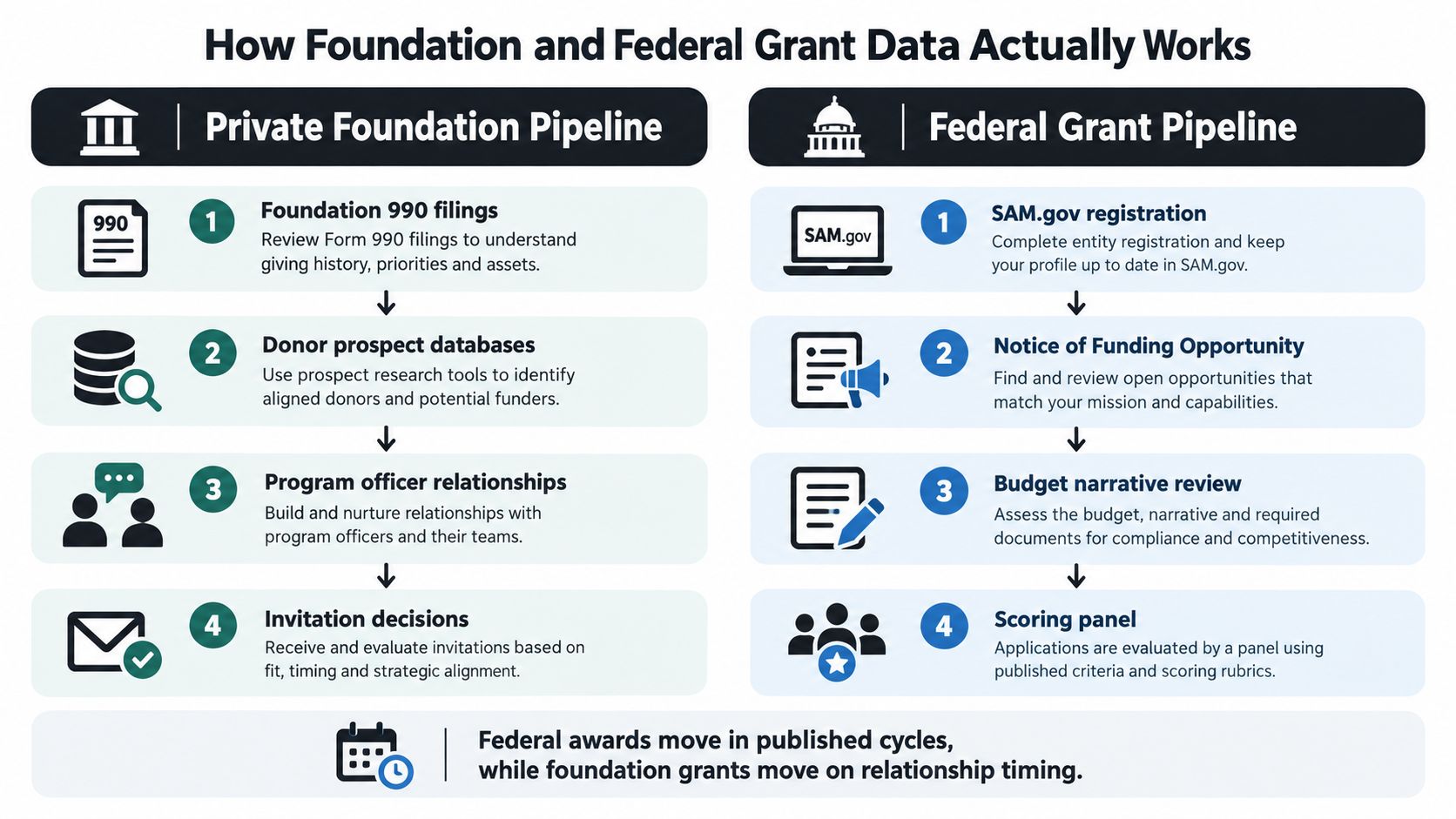
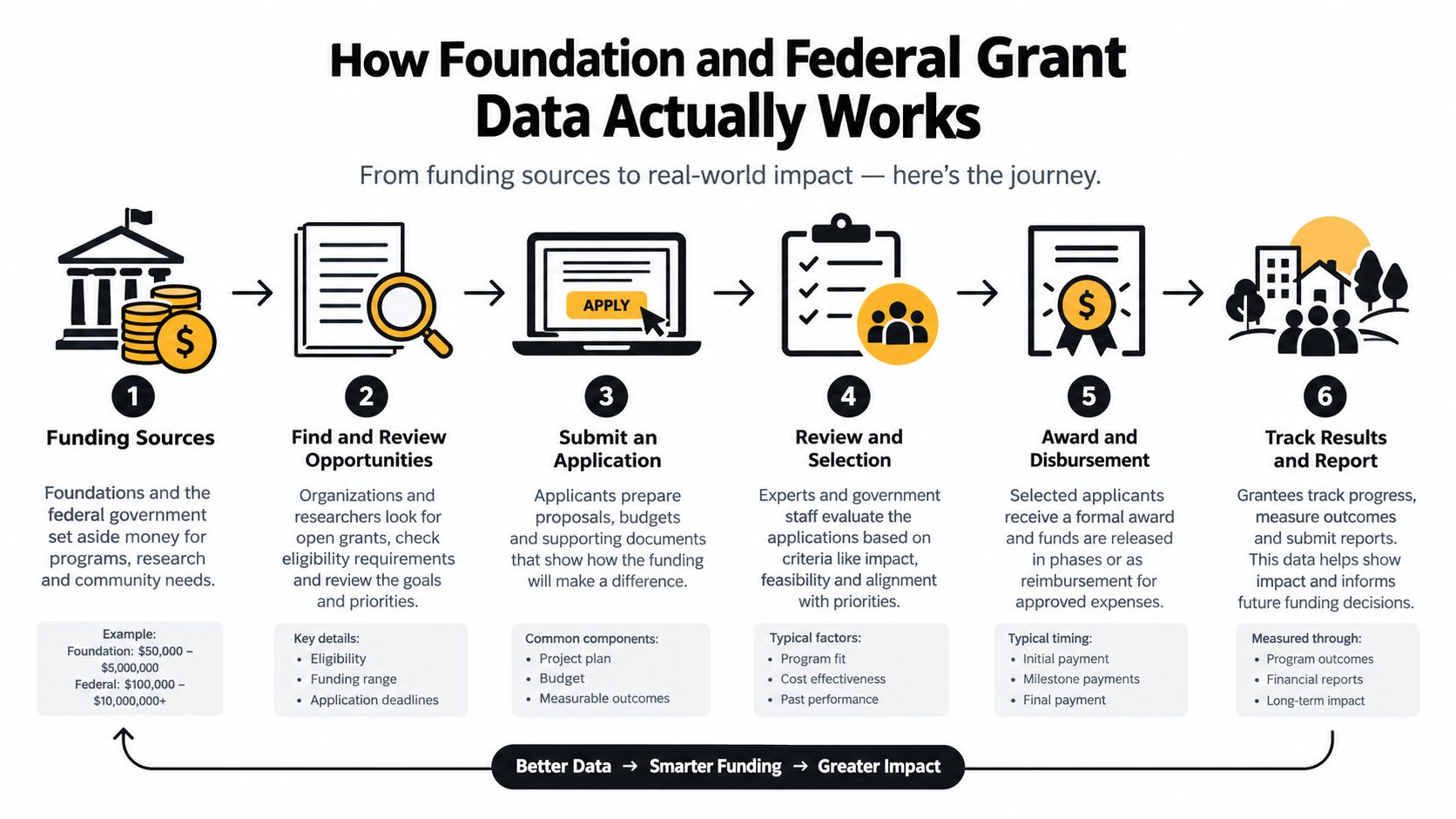
Grant prospecting is not a clean search-and-apply exercise. Private foundation records and federal award records are created for different purposes, updated on different schedules, and interpreted at different levels.
Private foundation records are historical evidence
Candid processes approximately 3 million annual grant transactions representing more than $180 billion, using IRS Forms 990 and 990-PF alongside direct funder reports, websites, news, and other public sources, as described in Candid's grants data fact sheet. A Form 990-PF can provide a useful picture of a foundation's past giving, including recipients, issue areas, geography, and award amounts.
It doesn't prove that the foundation is accepting applications today.
Filing-derived data can reach aggregators six months to two years after the return is filed, and U.S. grant data for a given year is generally considered complete about two years after year-end, according to Candid. That lag makes the filing year essential. A prospect record without a visible source date encourages false confidence.
A responsible foundation prospecting record should include:
- Award fiscal year: When the foundation made the grant.
- Source type: Funder announcement, direct grant list, filing, or another public record.
- Source freshness: How recently the underlying evidence was updated.
- Award structure: Program, general operating, capital, capacity building, or another purpose.
- Relationship signal: New grantee, repeat grantee, invitation-only, or unclear.
Use recent direct announcements and funder-provided grant lists more heavily than old filing records. Historical giving can estimate typical award size and renewal behavior, but it shouldn't be presented as an open opportunity.
Federal records show more than direct awards
USAspending.gov separates federal prime awards from first-tier subawards, with geographic breakdowns that can include state, county, city, congressional district, and ZIP code. Agencies report prime awards, while prime recipients such as governments, universities, nonprofits, and businesses generally report first-tier subawards.
That distinction can reveal partnership routes. A nonprofit may not appear as a federal prime recipient but may have received money as a subrecipient under a municipality, university, or larger nonprofit. Search results that include only prime awards can therefore understate relevant federal activity.
Federal research should distinguish:
- Agency and assistance listing or program
- Prime recipient and subrecipient
- Award amount and obligation date
- Applicant type and geographic level
- Direct eligibility and partnership eligibility
Don't add prime and subaward amounts together. The same federal dollars can appear at both levels, creating double counting. Historical awards can show which agencies fund comparable work, but current eligibility still requires checking the active notice of funding opportunity. The Congressional Research Service overview of USAspending.gov explains why award-level distinctions matter.
For current opportunity research, pair historical evidence with live announcements and use federal grant opportunities as a separate research task from private-foundation discovery.
Comparing Individual Giving, Corporate Support, and Government Funds
These three channels can all produce charitable revenue, but they demand different strategies. Comparing them by award size alone leads small teams into bad decisions.
Individual giving usually offers the strongest flexibility and the clearest path to renewal. The trade-off is that each gift requires a relationship, a case for support, a usable donation experience, and consistent stewardship. Monthly giving and donor upgrades can create dependable revenue, but they don't appear automatically after a campaign.
Corporate support moves faster when a clear business connection exists. A company may sponsor an event, underwrite a visible initiative, provide employee engagement, or contribute in-kind support. The organization often has to provide recognition, reporting, activation, or access to an audience. A sponsorship that looks attractive on paper can become expensive if staff spend weeks delivering benefits that don't advance the mission.
Government funding can provide substantial support for defined services, especially when the nonprofit already has the systems to manage procurement, compliance, reimbursement, and reporting. The downside is a longer planning cycle and greater exposure to administrative or political changes. A two-person development team should not pursue a large government opportunity merely because the headline award is larger than a corporate contribution.
| Channel | Flexibility | Typical award | Time to award | Renewal risk |
|---|---|---|---|---|
| Individual giving | High, especially for unrestricted gifts | Small to large across a broad donor base | Often faster for appeals, slower for major gifts | Relationship-dependent |
| Corporate support | Medium to low, depending on sponsorship terms | Small to large, often tied to visibility or a project | Often faster than government cycles | Business priorities can change |
| Government funds | Low to medium, tied to scope and rules | Small to large, including contracts and grants | Usually longer and more administratively demanding | Budget, policy, and performance-dependent |
Choose by capacity, not prestige
A $25,000 corporate sponsorship can be more useful than a $100,000 federal contract for a two-person team if the sponsorship covers the actual delivery burden and arrives in time to meet payroll. The federal award may still be worthwhile, but only after the organization prices in application labor, compliance systems, reporting, cash-flow needs, and the risk of restricted spending.
Individual giving deserves a dedicated operating rhythm. Build a donor calendar, write appeals around specific outcomes, invite recurring support, and assign stewardship before the campaign closes. For corporate prospects, define the exchange clearly. For government prospects, confirm eligibility and administrative capacity before investing in a narrative.
The next outreach hour should go to the channel with the strongest combination of fit, usable flexibility, realistic timing, and manageable workload, not the most impressive award announcement.
Why Unrestricted Dollars and Concentration Risk Matter More Than Fit
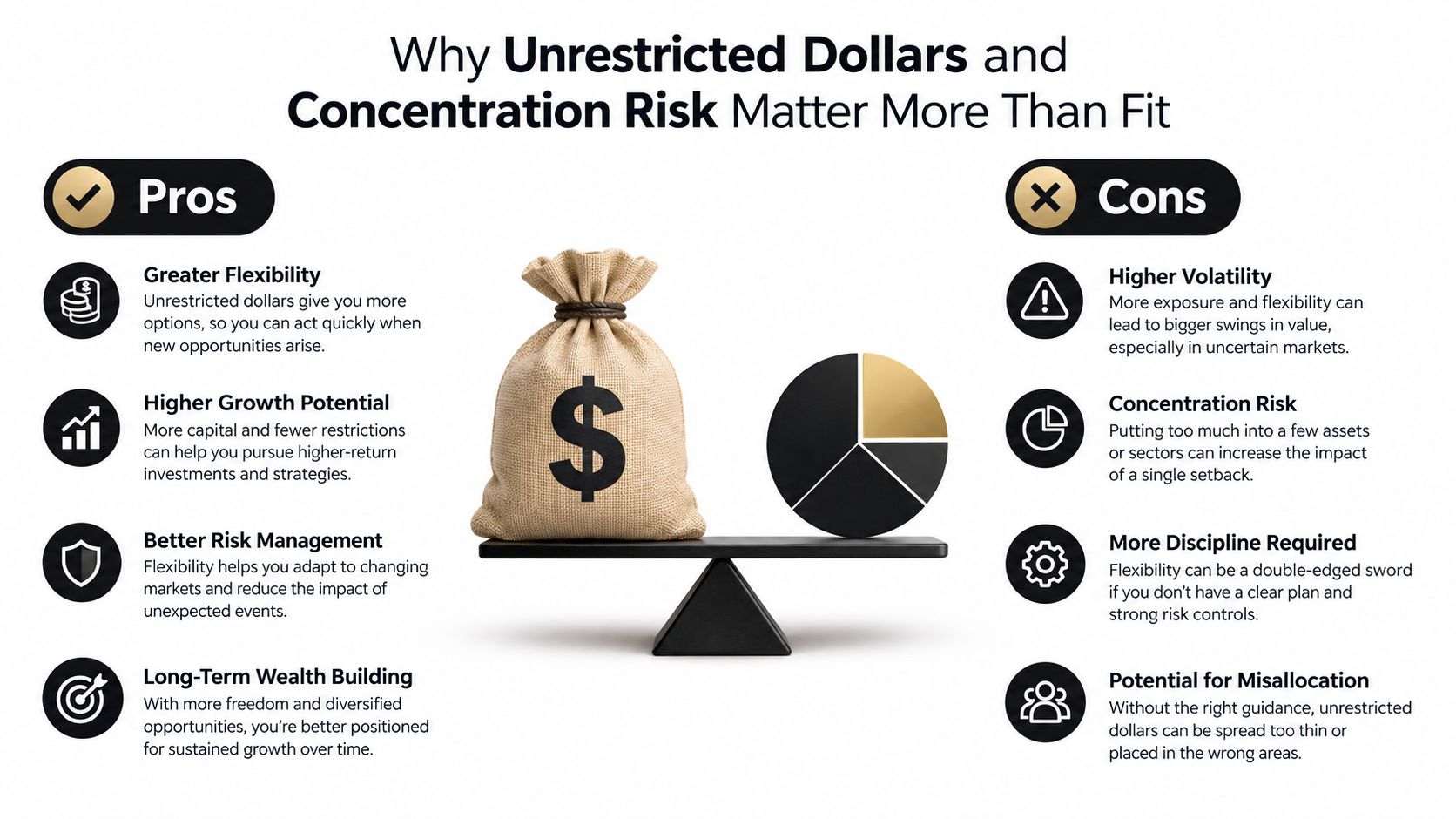
A funder can match your mission perfectly and still create financial strain. A restricted award may expand programming while leaving no money for staff management, technology, finance, administration, or urgent operating needs. Evaluate each opportunity by fit, eligibility, flexibility, timing, and concentration risk, not mission alignment alone.
The NFF 2025 survey report found that 64% of nonprofits received less than half of their 2024 grants and donations as unrestricted. 75% said raising unrestricted dollars was challenging, and 46% called it a major challenge. Those figures point to a structural weakness: restricted growth can increase service activity without strengthening the systems that make delivery possible.
Some foundation practices are becoming more flexible. 42% of surveyed foundations reported providing more unrestricted grants than before 2025, while another 17% were considering doing so, according to the same report. Treat that shift as an opportunity, not an assumption. Ask directly about general operating support, capacity-building funds, multi-year awards, and reasonable reporting requirements.
Score flexibility explicitly
Add these questions to every prospect review:
- Purpose: Can the funder support general operations, capacity building, or multiple years?
- Renewal: Do comparable organizations receive repeat awards?
- Burden: How much reporting, recognition, evaluation, and coordination will the award require?
- Cash flow: Will payment arrive before the organization must spend the money?
- Concentration: Would this award make one funder, agency, or contract responsible for too much revenue?
Government revenue deserves a separate stress test. The Urban Institute found that about one-third of community-serving U.S. nonprofits experienced government-funding losses or disruptions in early 2025. Affected service organizations received 42% of total revenue from government sources, according to its analysis of nonprofit funding disruption. The analysis also states that total government funding for nonprofits is roughly three times total foundation funding.
Model the consequences of delayed reimbursement, a reduced contract, or changed eligibility. Apply the same test to a major foundation, corporate sponsor, or annual event. Record the revenue share, payment schedule, renewal conditions, and replacement options before treating the opportunity as dependable.
Financial discipline: A funder isn't a strong prospect if winning its award would make losing its renewal an organizational emergency.
Build a pipeline for flexibility, not award volume alone. Track renewal probability, unrestricted potential, administrative burden, and the share of total revenue each prospect could represent before submitting.
How to Prospect, Qualify, and Prioritize Funders
A small team needs a repeatable qualification process, not an enormous list of plausible names.
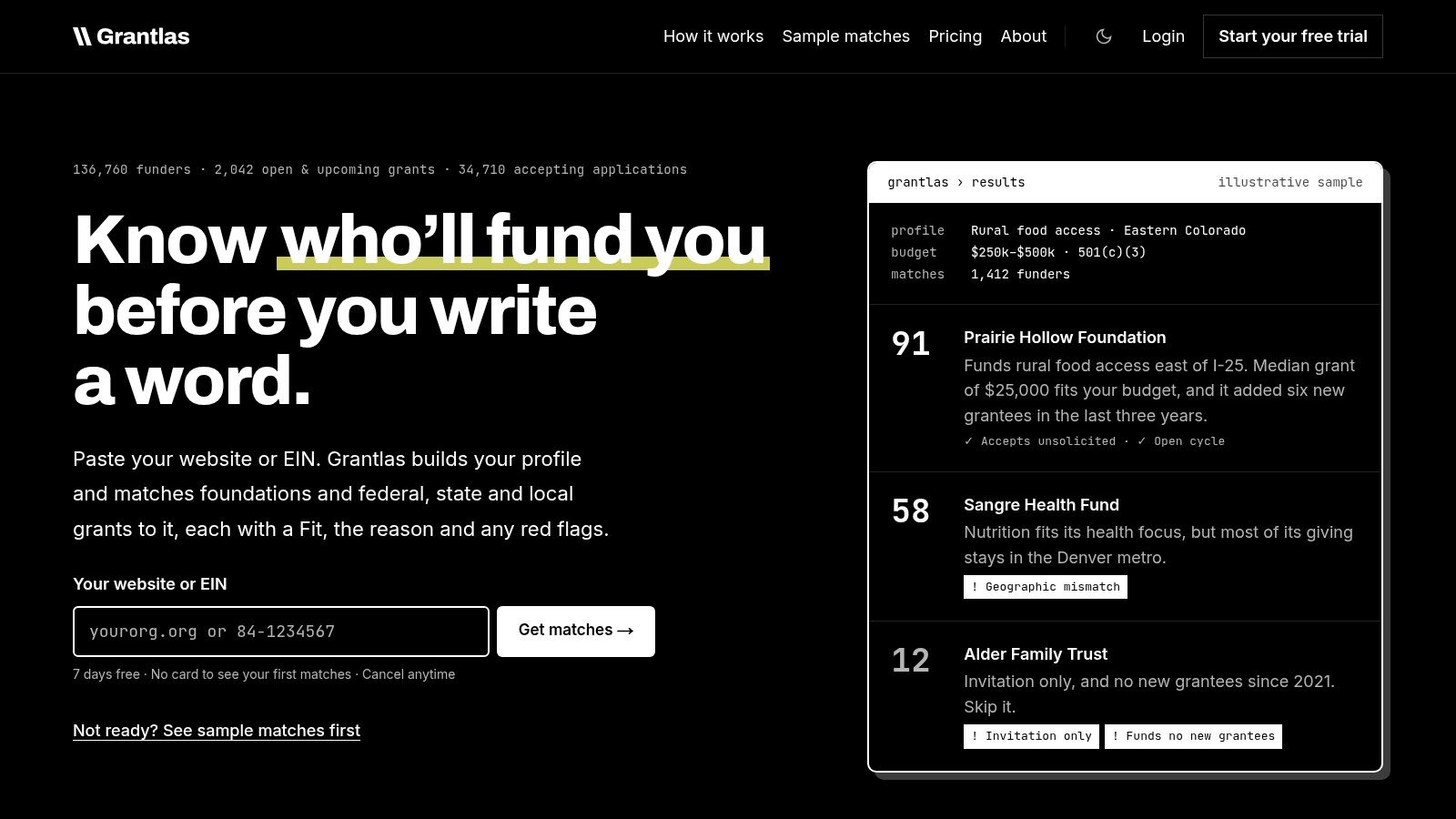
Start by building an accurate organization profile from your website, EIN, geography, legal status, budget context, programs, and populations served. Then define hard filters before reading opportunities. Geography, applicant type, budget range, invitation status, and program eligibility should remove prospects early, not after a proposal is drafted.
Next, create a shortlist with a reason attached to every name. A good lead should answer four questions:
- Why us? The organization resembles funded peers or matches the funder's stated interests.
- Why now? The application window, relationship timing, or renewal cycle is actionable.
- What evidence? Recent grants, direct announcements, or clear program information support the match.
- What could disqualify us? Geography, invitation rules, budget mismatch, or applicant restrictions are visible.
Giving history should then determine priority. Check typical award size, cadence, repeat-grantee behavior, new-grantee activity, and whether awards support operating needs or narrowly defined projects. Board and trustee relationships can help open a conversation, but they don't replace eligibility.
For individual and corporate outreach, use professional networks to identify relevant decision makers and timing signals. A practical guide to spotting intent signals on LinkedIn can help your team distinguish a cold name from a prospect showing an active organizational need or transition.
Use a weekly review to sort prospects into apply, cultivate, monitor, or remove. A platform such as Grantlas can generate a scored shortlist from an organization profile, explain the score in plain English, flag eligibility issues, show giving history, and rescore saved prospects as data changes. It should support judgment, not replace a conversation with a program officer or a careful reading of the current guidelines.
The same principle applies to donor research. Keep donor research tools in the broader development stack, alongside a customer relationship management system, proposal calendar, and stewardship records.
Building a Diversified Funding Mix That Actually Holds
A diversified mix should reflect the organization's operating model, not a fashionable percentage target. A community-services nonprofit may need a strong government and earned-revenue base, then use individual giving and foundations to fund access, innovation, and flexibility. An early-stage research nonprofit may prioritize foundation support and individual major gifts until it can qualify for larger government awards. A small arts organization may combine ticket or membership income, individual donors, corporate sponsorships, and project grants.
Use those profiles as starting points, not formulas.
For a two- or three-person team, the first ninety days should follow a practical sequence:
- Days 1 to 30: Build the organization profile, define hard eligibility filters, classify current revenue, and identify concentration risks.
- Days 31 to 60: Qualify a small shortlist, schedule funder and donor outreach, and prepare a stewardship calendar for current individual supporters.
- Days 61 to 90: Submit only the strongest applications, test one flexible-giving appeal, and review whether each prospect justifies its staff time.
Separate revenue targets from pipeline targets. A foundation prospect is not revenue until the award is made and the payment terms are understood. A government contract is not reliable cash until reimbursement timing works. A donor campaign isn't complete when gifts arrive, because renewal begins with the next communication.
Review the portfolio monthly. Re-score fit, deadline, award purpose, renewal evidence, and concentration risk. Preserve room for unrestricted support even when restricted opportunities look easier to explain to the board. Flexible dollars pay for the infrastructure that lets every other funding source function.
Frequently Asked Questions About Nonprofit Funding Sources
How much unrestricted funding should a small nonprofit expect?
There is no universal target. Build unrestricted support deliberately through individual donors, operating grants, and carefully chosen corporate or community relationships. Treat flexible dollars as the budget that covers administration, staffing, and other costs restricted awards often exclude.
What happens when government funding is disrupted?
Model the risk before a disruption occurs. Government funding is roughly three times total foundation funding in the United States, according to the cited analysis. Organizations dependent on public awards should test delayed payments, reduced awards, and replacement revenue. Concentration risk matters more than a funder's apparent fit when one delayed contract threatens payroll.
When is earned income better than another foundation application?
Choose earned income when demand is clear, the price is defensible, and delivery will not reduce access. Program-service revenue represented about 71% of public charity revenue in the relevant filing year, as reported in Publication 5331. Assess margin, capacity, and mission fit before adding a fee-based service.
How should a prospecting tool fit into development work?
Use it to discover prospects, screen eligibility, track deadlines, research peers, and review the portfolio. Staff must still confirm guidelines, build relationships, write proposals, and steward donors.
Grantlas helps nonprofits review foundation and federal opportunities, assess fit, flag eligibility mismatches, and monitor funder history. Visit Grantlas to organize a qualified pipeline.