Grants for Ministries: A Practical Funding Guide
Sep 27, 2026 · 14 min read

A pastor opens a laptop before breakfast and finds seventeen tabs competing for attention. One shows a federal grant portal, another lists religious foundations, three contain outdated “grants for ministries” articles, and the inbox is full of announcements that may or may not fit the food pantry, mentoring program, or church renovation project on the annual plan. By lunch, the ministry has found plenty of possibilities and made no decision.
That's the funding problem. Most small ministries don't need a longer list of grants. They need a disciplined way to decide which opportunities deserve scarce staff time, which activities can legally receive funding, and which applications have a credible chance of success. This guide treats grant research as triage, not treasure hunting.
Table of Contents
- Which Grants for Ministries Are Worth Your Staff Hours
- Where Ministry Funding Actually Comes From
- Who Qualifies and Who Gets Filtered Out Early
- Faith-Based Funding Rules You Cannot Ignore
- Why Most Ministry Grant Lists Miss the Point
- Choosing the Right Funding Path for Your Ministry
- A Practical Search Strategy That Saves Staff Time
- Your First Week of Ministry Grant Research
Which Grants for Ministries Are Worth Your Staff Hours
A small ministry cannot chase every promising lead. The director is already carrying programs, volunteers, donors, board requests, compliance, and pastoral work. A proposal that takes several days to prepare has a real cost, even if no one invoices those hours.
The question that matters is simple. Which grants justify the staff hours you will spend writing the application and reporting after the award?
Answer that first, and the search gets sharper. A serious opportunity needs four things at once. The award has to justify the effort. The funder has to support the actual activity. The ministry has to meet the eligibility rules on paper and in practice. The team has to have the time and capacity to deliver the project without weakening other commitments.
Build a short list, not a fantasy pipeline
Rate each prospect against four filters:
- Award fit: Does the likely award meaningfully support the project, or does it barely cover the application burden?
- Program fit: Does the funder support the service itself, rather than the ministry's broader identity?
- Eligibility fit: Can the organization document applicant status, geography, budget rules, registration, and reporting requirements?
- Execution fit: Can the team submit a credible application and manage the award after approval?
That discipline matters because a small ministry usually has room for only a limited number of serious proposals in a year. Accept that limit. It forces better choices and keeps staff from chasing every announcement that mentions faith.
Four carefully selected applications can beat fifteen speculative ones. The smaller list protects capacity and usually produces stronger narratives, cleaner budgets, and more reliable follow-through.
Advisor's rule: Treat every application as an investment. If the expected award does not justify the work, walk away.
This approach also forces a harder but better question. Before you start writing, price the proposal in staff hours and compare that cost to the likely award. If the numbers do not make sense, the opportunity is not a fit, no matter how appealing the title sounds.
The sections that follow separate funder types, flag early eligibility traps, define the boundary between public funding and religious activity, and show you how to build a short list before writing a single narrative.
Where Ministry Funding Actually Comes From
The simplest way to understand ministry funding is to ask two questions: Who supplied the money, and what rules came with it? The source determines what the funder considers eligible, how much freedom the ministry has, and what evidence it must provide after an award.
Use this four-part model rather than treating every opportunity as interchangeable. A ministry may fit more than one category, but it shouldn't use the same pitch, budget, or compliance assumptions for all of them.
Government grants
Federal and state programs fund defined public purposes, such as social services, community facilities, food access, or safety. Federal opportunities are published through Grants.gov, the federal government's central entry point for discretionary grants and cooperative agreements, while HHS award information is also organized through TAGGS. Government money usually brings the heaviest administrative requirements, and the program must stand on its own as an eligible public benefit.
State and local pass-through funding can be more accessible, especially when a ministry already has relationships with public agencies. The trade-off is that the ministry may need to follow both the original grant rules and the subrecipient's additional procedures.
Private foundations
Private foundations may be secular, family-led, corporate, or explicitly faith-friendly. Their interests often center on a population, place, or issue rather than an organization's religious identity. Foundations can offer more flexibility than federal programs, but they still expect a clear project, credible leadership, sound finances, and evidence that the proposed work matches their giving history.
Faith-specific funders
Denominations, religious foundations, and ministry networks are natural prospects for church planting, leadership development, discipleship, theological education, and other explicitly religious work. These funders may understand a ministry's language and context better than a secular foundation. Their pools can be narrower, though, and awards may be tightly limited to members, affiliated congregations, or specific regions.
A useful overview of the broader funding picture appears in this guide to different types of grants, but the operational lesson is more important than the category names: match the project to the funder's rules before matching the organization to the funder.
Congregational and member-supported revenue
Congregational giving, individual donors, special offerings, campaigns, and local partnerships often provide the most practical support for general operations or explicitly religious activity. These sources usually allow the ministry to explain its full mission without separating secular and devotional components.
They're also valuable as evidence of community trust. A ministry with local financial participation can present a stronger sustainability story to outside funders, especially when a grant requires matching support or continuation beyond the award period.
Who Qualifies and Who Gets Filtered Out Early
Eligibility decisions happen before reviewers admire your mission. A ministry can have an excellent program and still be excluded because it lacks a registration, falls outside a geographic boundary, exceeds a budget cap, or requests money for an activity the funder won't support.
Federal and state readiness
Federal applications often require a recognized nonprofit structure, a 501(c)(3) status, a Unique Entity ID, and active registration in SAM.gov. Some opportunities also expect financial statements, audit materials, indirect-cost information, or evidence of prior program management. A ministry that hasn't maintained these records won't become competitive by writing a more emotional proposal.
The federal system is structured around searchable award and opportunity data, including HHS's TAGGS database and the government-wide Grants.gov portal. That structure makes research easier than manually reviewing scattered agency notices, but it also makes administrative gaps easier to identify and harder to excuse.
State programs may add requirements involving local incorporation, service geography, licensing, county partnerships, or state-specific reporting. Read the applicant section first. Don't spend an afternoon studying program priorities before confirming that your organization type is allowed to apply.
Foundation screening
Private foundations set their own gates. Some fund only public charities with particular tax classifications. Others accept applications through a fiscal sponsor, restrict awards to a defined region, avoid newer organizations, or set budget and program limits that exclude a ministry.
Read the guidelines in this order:
- Applicant type: Confirm that churches, religious organizations, public charities, or fiscally sponsored projects are eligible.
- Geography: Check whether the rule applies to headquarters, service location, beneficiary residence, or all three.
- Program purpose: Identify the exact activities the funder supports and excludes.
- Award and budget fit: Compare the request range with the ministry's budget and the funder's stated preferences.
- Submission route: Determine whether the funder accepts unsolicited proposals, letters of inquiry, or invitations only.
A five-minute disqualifier test
Before researching a funder's history, answer these questions in the opportunity document:
- Is the ministry an eligible applicant?
- Is the service area included?
- Is the proposed activity allowable?
- Does the requested amount fit the funder's range?
- Can the ministry meet the reporting and match requirements?
If any answer is clearly no, stop. A polite inquiry won't repair a mandatory eligibility failure.
| Funder Tier | Common Eligibility Filters | Typical Disqualifier for Ministries |
|---|---|---|
| Federal and state government | Applicant registration, nonprofit status, geography, program purpose, financial controls, reporting capacity | No active registration, unsupported religious activity, or inability to document public-service delivery |
| Private foundations | Public charity status, fiscal sponsorship rules, service area, issue focus, budget range, submission process | Geographic mismatch, invitation-only process, or request outside the foundation's giving pattern |
| Faith-specific funders | Denominational affiliation, doctrinal or mission alignment, membership, leadership criteria, defined ministry purpose | Strong social program but no required affiliation, or a project outside the funder's religious mandate |
| Congregational and member-supported sources | Community relationship, donor trust, local leadership, campaign credibility | Weak local base or a request that lacks a clear, immediate ministry outcome |
Eligibility is a research task, not a persuasive-writing task. Find the disqualifier before the proposal consumes your week.
Faith-Based Funding Rules You Cannot Ignore
Faith-based organizations can compete for many public grants, but federal eligibility doesn't mean every ministry activity is fundable. Federal guidance distinguishes between a ministry acting as a service provider and a ministry using public money for worship, religious instruction, or proselytization. The U.S. Department of Justice guidance for faith-based organizations explains the basic boundary and should be read alongside each specific funding notice.
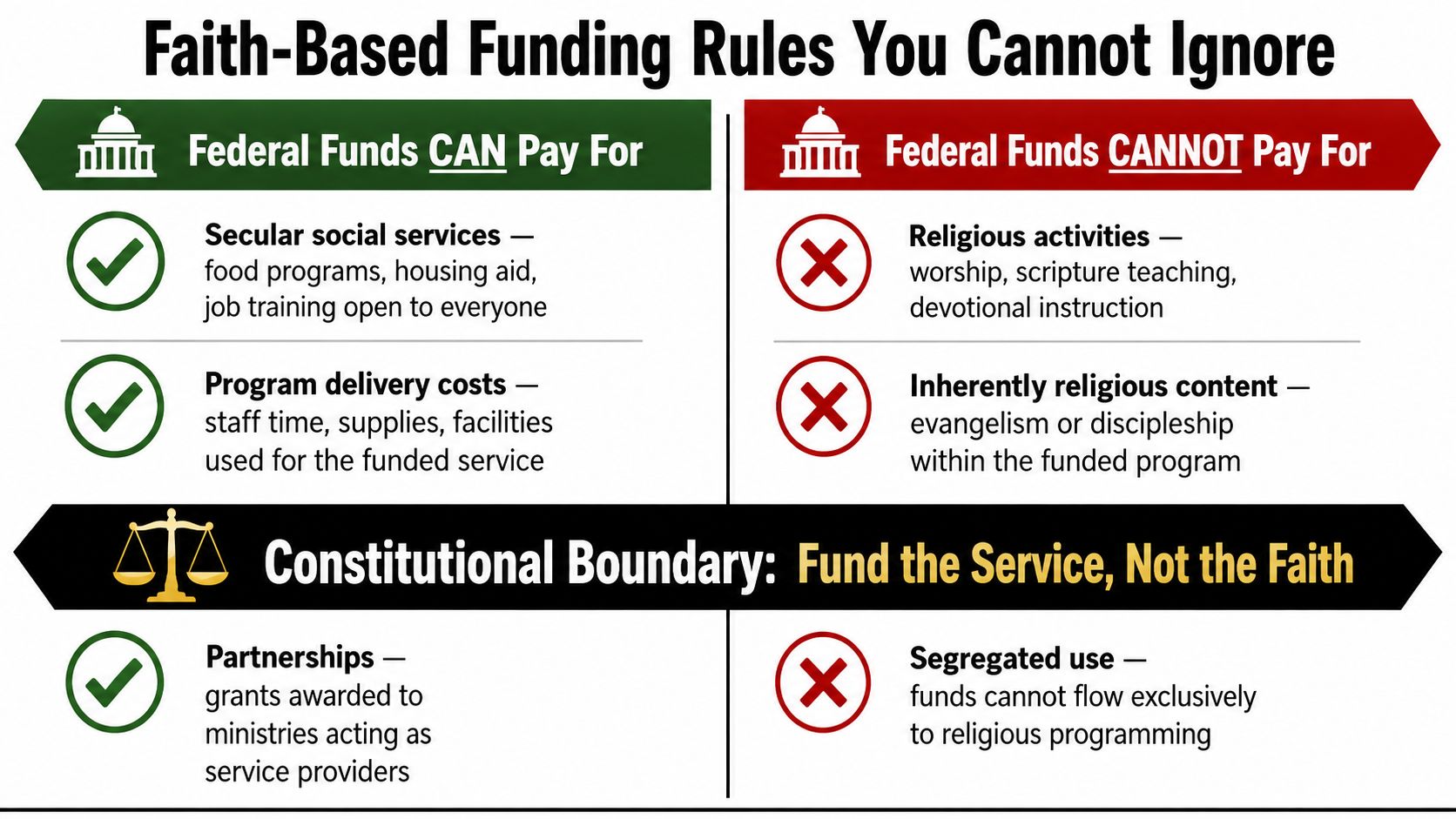
A food pantry can be operated by a church. A housing program can be delivered by a religious nonprofit. A job-training project can be managed by ministry staff. The public award must pay for the eligible service, not for worship, scripture teaching, devotional instruction, evangelism, or discipleship inside the funded activity.
Design the program before writing the budget
Separate the funded service from religious components in the program design. Depending on the award terms, that may require distinct time periods, locations, staffing allocations, registration choices, and financial records. A participant must be able to receive the public service without being required to join worship or accept religious teaching.
Practical controls include:
- Separate cost centers: Track public grant expenses apart from donations and unrestricted ministry funds.
- Time and space records: Document when staff and facilities serve the funded program and when they support religious activity.
- Voluntary participation: Make religious activities optional and separate from access to the public benefit.
- Staff allocation: Record the portion of employee time charged to the grant and retain supporting documentation.
- Written procedures: Train staff and volunteers before launch, not after an auditor asks questions.
Volunteer-heavy programs also need risk controls. For ministries placing people around children, vulnerable adults, or private homes, volunteer background checks for nonprofits can help the organization document a responsible screening process, although the grant notice may impose its own requirements.
Private foundations generally have more latitude than federal agencies, but their rules still vary. Some will support a faith-rooted organization's community work while excluding evangelism, denominational promotion, or direct religious programming. Never assume that a foundation's religious identity makes every ministry expense acceptable.
The best compliance question is simple: Could an auditor trace every funded dollar to an eligible service without relying on the ministry's religious purpose as justification? If the answer is no, redesign the project before submitting.
For an organizational tax-status primer, review 501(c)(3) versus 501(c)(6). Tax status doesn't solve program compliance, but misunderstanding it can end the application before program review begins.
Why Most Ministry Grant Lists Miss the Point
A long list creates the appearance of progress. It does not tell a ministry which opportunity deserves a proposal, whether the award is large enough to justify the work, or when the deadline will require staff attention.
Current faith-based grant listings illustrate the problem. One database reports 509 open opportunities, with a median listed award of $10K, a middle range from $3K to $40K, and 359 opportunities without a published deadline. Among opportunities with dated deadlines, 53% fall in January through March. These figures appear in Grantable's faith-based grants database. The practical message is clear: the opportunity pool is broad, awards are often modest, deadlines are uneven, and early-year workload can become crowded.
Government and private funding also differ in timing and scale. Large public awards can justify substantial preparation, while a small local or faith-specific award may be valuable because it funds one concrete deliverable. Neither is automatically better. The right choice depends on the cost of pursuing it.
Use a capacity-weighted score
Create a simple score for every prospect:
| Funder Type | Typical Award Range | Application Effort | Fit Probability |
|---|---|---|---|
| Government grants | Can range from modest program support to substantial awards | High, with registration and compliance work | Strong only when the program, applicant, and reporting systems align |
| Private foundations | Often modest and project-specific, with some larger exceptions | Moderate to high, depending on inquiry and proposal requirements | High when geography, issue, giving history, and program design match |
| Faith-specific funders | Often narrow and purpose-driven, with size varying by program | Low to moderate when the ministry meets affiliation rules | High for tightly aligned religious or ministry projects |
| Congregational and member-supported giving | Flexible and determined by local relationships | Variable, usually centered on trust and communication | High when the ministry has an active local base |
Add four fields to your spreadsheet: award value, fit score, estimated application hours, and deadline distance. Then ask whether the expected return is defensible. A project requiring extensive narrative development for a small, weakly aligned award should usually lose to a simpler opportunity that directly funds the ministry's strongest program.
A shortlist is not a record of everything you found. It's a record of what you're willing to pursue.
The early-year deadline concentration matters because staff capacity is finite. If several good opportunities arrive together, the ministry should rank them before assigning writers. Submit the strongest application first, and decline the prospect that would force rushed work on a better-fit proposal.
Choosing the Right Funding Path for Your Ministry
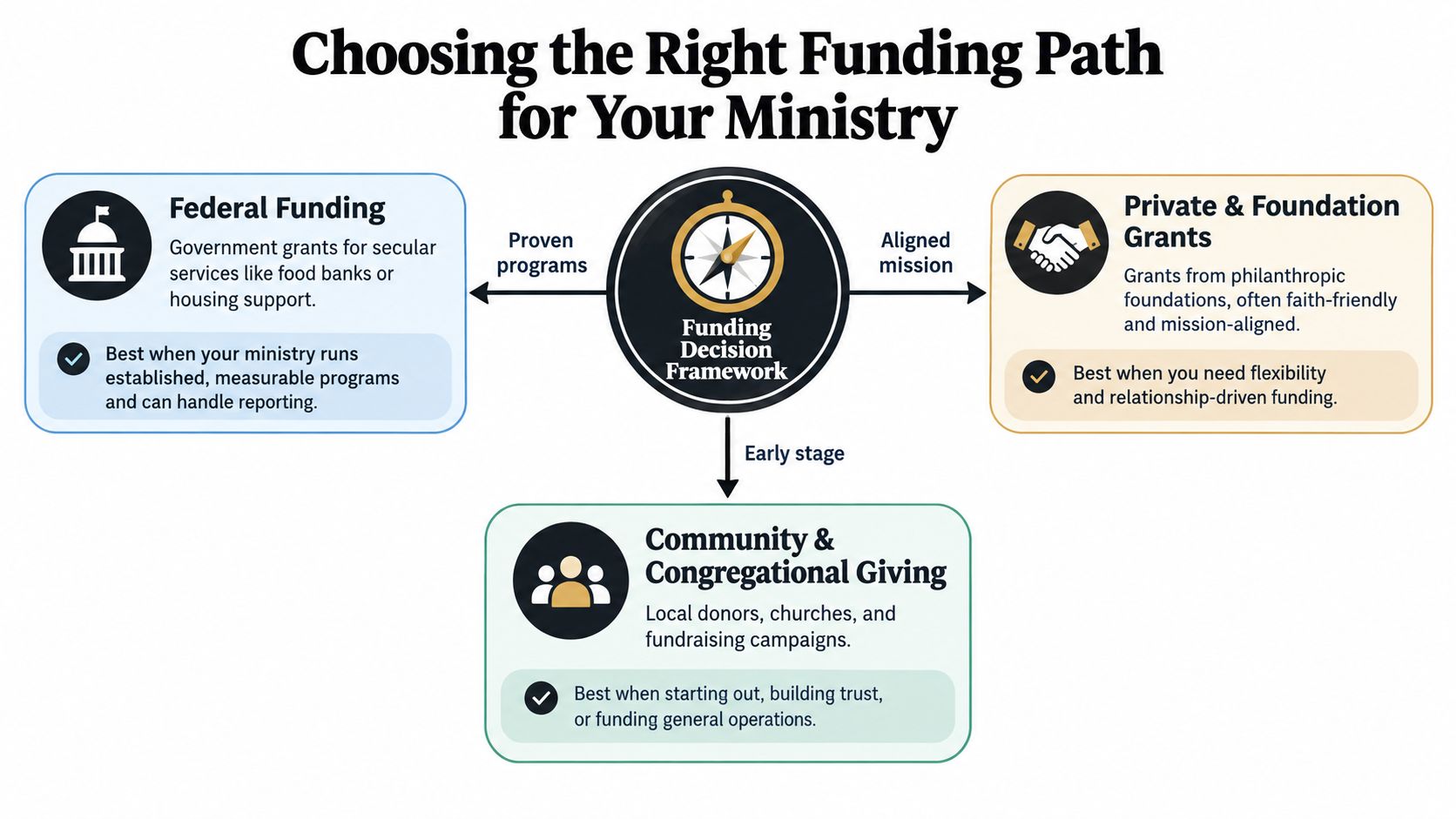
Three paths deserve most ministries' attention: federal funding, private foundations, and faith-specific or community support. Choose based on the activity, the records already in place, and the organization's ability to manage the award after it arrives.
Federal funding
Choose this route when the ministry runs an established secular service with measurable outputs, sound financial controls, and staff who can handle registration, procurement, reporting, and monitoring. It's a poor first target for a ministry seeking unrestricted operating money or direct support for worship and religious instruction.
The upside is access to substantial public programs and formal award systems. The cost is administrative intensity, strict allowability rules, and a longer path from research to implementation.
Private foundations
Private foundations suit ministries with a defined community problem, a compelling local story, and enough evidence to explain who benefits and what changes. Relationship-building matters. A foundation may want a short inquiry before a full proposal, and its giving history can reveal whether it supports new applicants or mainly renews established relationships.
This path often offers more room to explain a ministry's approach, but it still demands a clean budget and specific outcomes. Flexibility doesn't mean informality.
Faith-specific and community support
Faith-specific funders make sense for church planting, leadership development, discipleship, theological education, and ministry formation. Congregational giving and local campaigns are often better for general operations, urgent needs, and projects that combine secular and religious activity.
A public fundraising campaign can also support a defined initiative. If you're considering a rewards or community campaign model, review guidance on using Kickstarter for charity projects before committing to the platform and its requirements.
Use three questions to choose:
- What activity needs funding? Public service, religious programming, general operations, or a mixed initiative?
- What documentation is ready? Registration, financial statements, outcomes, budgets, policies, and governance records?
- What capacity exists? Who will write, approve, administer, report, and maintain the funder relationship?
The best path minimizes friction without weakening fit. A ministry with a mature food program and strong compliance systems can pursue government funding. A ministry with excellent local outcomes but limited federal readiness may start with foundations. A church launching a new discipleship initiative should usually begin with aligned congregational or faith-specific support.
This short video provides another way to think about matching funding channels to project needs:
A Practical Search Strategy That Saves Staff Time
Searching only for “grants for ministries” is too narrow. Secular funders often describe the need they support, not the religious identity of the applicant. Search for the service first, then add funding language.
Start with combinations such as:
- “food insecurity” + grant
- “reentry services” + request for proposals
- “supportive housing” + RFP
- “job training” + community grant
- “youth mentoring” + funding opportunity
Then add geography and population terms. A county, ZIP code, state, age group, veteran status, or neighborhood qualifier can reveal place-based programs that a broad ministry search misses.
Read the funder behind the opportunity
Once you identify a possible funder, inspect its giving history and public filings. IRS Form 990 Part XV can show application procedures, geographic focus, and the types of organizations the foundation has supported. Search award descriptions for the ministry's service terms, not just its denomination or religious language.
Board and trustee information can reveal relationships and local affinity, but don't treat a shared connection as a substitute for program fit. Use it to plan respectful outreach, not to bypass the eligibility rules.
| Keyword Layer | Example Phrases | Typical Funder Type | Fit Signal to Capture |
|---|---|---|---|
| Service problem | Food insecurity, reentry, housing stability | Government and private foundations | The funder names the same public need |
| Intervention | Pantry expansion, case management, job training | Foundations and local agencies | The proposed activity matches an eligible method |
| Population | Families, returning citizens, youth, older adults | Place-based and issue funders | Beneficiaries match the stated priority |
| Geography | County, city, ZIP code, rural region | Local foundations and pass-through programs | Service location satisfies the boundary |
| Funding language | Grant, RFP, request for proposals, letter of inquiry | All funder types | The opportunity has a clear submission route |
Your output should be a qualified prospect list, not a browser history. Capture the funder, opportunity, service match, geography, award fit, deadline, application route, and likely disqualifier. Tools such as Grantlas's religion-focused funder directory can support this kind of prospecting, but every match still needs manual confirmation against the current funder rules.
Your First Week of Ministry Grant Research
Grant research becomes manageable when you serialize it. Don't attempt to identify, qualify, write, and submit proposals in one heroic sprint. Give each task a defined output, then carry the strongest information forward.
Day one, establish readiness
Confirm the organization's tax status and collect the records a funder will ask for. Verify the ministry's nonprofit information through a recognized nonprofit directory, organize the EIN-related records you already have, and identify gaps in registrations, financial statements, insurance, policies, or board documentation.
Write down the programs the ministry delivers. Avoid broad labels such as “community transformation.” Name the service, the beneficiary, the location, the staff or volunteers involved, and the expense that needs support.
Day two, prepare reusable evidence
Collect program metrics from the records the ministry already maintains. Organize participant counts, service units, referral sources, completion information, testimonials, and outcome evidence without overstating what the data proves.
Draft a short organizational overview, a program description, a needs statement, an outcomes paragraph, and a basic budget narrative. These pieces should be modular. A reusable draft saves time, but it must be edited for every funder.
Days three and four, build and cut
Use service, geography, population, and funding-language searches to create a long list. Record each prospect in a spreadsheet, then remove opportunities with an obvious applicant, location, program, or award-size mismatch.
Score the survivors for fit, deadline, effort, and documentation readiness. Keep only the prospects the team can realistically pursue. A shorter list creates room for thoughtful questions, better budgets, and timely approvals.
Day five, start relationships
Select the strongest prospects and determine whether they accept a letter of inquiry, introductory email, or full proposal. Send focused inquiries that describe the project, beneficiaries, location, requested support, and reason for alignment.
At the same time, create a one-page project overview that a pastor, board member, or program director can review quickly. Ask for feedback before the narrative becomes elaborate. Internal clarity usually improves the external application.
The first week should produce decisions, not just research.
By the end of the week, you should know which activities belong in public funding conversations, which require faith-specific support, which prospects are worth approaching, and what records must be repaired before application season. That's a useful grant system, even before the first award arrives.
Grantlas helps ministries identify prospective private foundations and open federal opportunities, score funder fit, flag eligibility and geography mismatches, review giving history, and organize deadline research in one workflow. Visit Grantlas to build a focused funding shortlist instead of spending another week sorting through disconnected grant lists.