Federal Grant Opportunities: How to Find and Win Them
Oct 6, 2026 · 11 min read

You've found a federal notice that looks perfect. The mission aligns, the service area fits, and the award could materially strengthen your program. Then someone checks the organization's registration, discovers that the federal profile is inactive or controlled by the wrong contact, and the proposal stops before reviewers ever see it.
That failure is avoidable. Federal grant opportunities aren't just items in a search result. They're strategic commitments that carry eligibility gates, administrative workload, reporting obligations, timing risk, and uncertain continuation. The organizations that win consistently don't chase every plausible notice. They build a disciplined process for finding realistic opportunities, testing readiness, and rejecting attractive awards their teams can't deliver.
Table of Contents
- Why Federal Grant Opportunities Deserve a Real Strategy
- What Federal Grant Opportunities Actually Are
- Eligibility and Registration Requirements You Must Clear First
- Where to Find Federal Grant Opportunities
- How to Prioritize Opportunities Beyond a Simple Fit Score
- A Practical Walkthrough of Federal Discovery in One Week
- Putting It All Together with a Sustainable Federal Funding Plan
Why Federal Grant Opportunities Deserve a Real Strategy
A development director sits down to work on federal funding and opens a familiar mess: Grants.gov searches, agency forecast pages, saved browser tabs, old spreadsheets, and notices that no longer match the organization's programs. The problem isn't a lack of information. It's the absence of a filter strong enough to separate a genuine prospect from an expensive distraction.
Reactive searching creates a predictable trap. Staff read the title, recognize a connection to their mission, and start discussing a proposal before checking whether the organization can submit, perform, report, and sustain the work. By the time the team discovers a registration problem or an impossible match requirement, valuable writing time has already disappeared.
Practical rule: Treat every federal opportunity as a business decision before treating it as a writing assignment.
A workable strategy has three parts:
- Disciplined discovery: Find notices through Grants.gov, agency program pages, and historical award data rather than relying on one keyword search.
- Honest readiness assessment: Check entity status, applicant authority, staffing, financial controls, reporting capacity, and cash-flow exposure.
- Ruthless prioritization: Choose pursuits based on capacity-adjusted fit, not award size, prestige, or how closely the title resembles your mission.
That last point matters most for small nonprofits. The 2025 Nonprofit Finance Fund survey results show that respondents identified burdensome applications, excessive compliance work, and organizational size as major barriers. The same survey also shows that discovery itself remains a problem. Finding opportunities and executing them are connected tasks.
Your team needs a repeatable answer to a harder question than “Are we eligible?” Ask, “Can we absorb this award without weakening the programs we already operate?” That question turns federal grant research from an endless search exercise into an operating discipline.
What Federal Grant Opportunities Actually Are
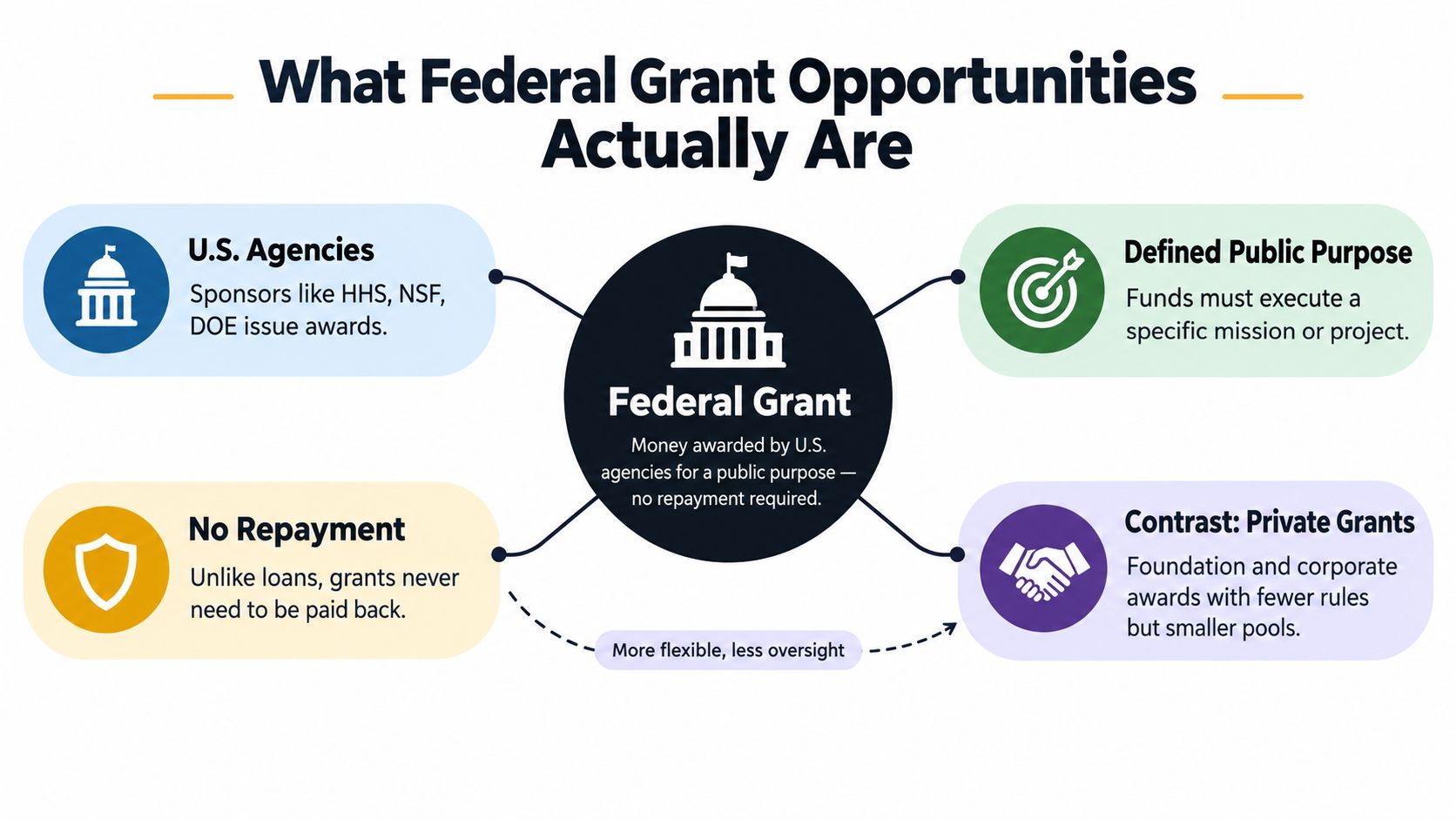
Federal grants are funds awarded by a U.S. government agency to support a defined public purpose. The recipient doesn't repay the award like a loan, but the organization must use the money according to the notice, approved budget, award terms, and applicable compliance requirements.
Private foundation grants often allow more conversational relationship-building and may give applicants greater flexibility in shaping a request. Federal awards usually demand more formal documentation, stronger controls, and closer adherence to published requirements. A foundation may respond to a concise concept note. A federal agency generally expects the applicant to follow a prescribed application process and demonstrate that its proposed work satisfies a specific public purpose.
Think of federal funding as three streams flowing from one river:
- Discretionary awards are competitive. An agency defines its priorities, eligible applicants submit proposals, and reviewers or agency officials select recipients.
- Formula awards distribute funds according to statutory or administrative formulas. The organization's access may depend on government designation, geography, population, or another qualifying condition.
- Pass-through funding moves from a federal agency to a state, tribe, city, county, or another intermediary, which then makes awards to local organizations.
These streams can look similar in a search result but behave very differently. A discretionary notice may require a detailed proposal and competitive narrative. A formula program may depend more heavily on the organization's relationship with a state or local administering body. A pass-through award may involve a separate application, contract, timeline, and reporting system.
Before assigning a writer, identify the funding stream. It affects who makes the decision, where the application goes, what match or reporting rules apply, and when cash may arrive. Confusing a federal award with a pass-through opportunity is a common way to misjudge both competition and administrative effort.
Eligibility and Registration Requirements You Must Clear First
Federal eligibility starts with organizational identity, not narrative quality. An applicant can have an excellent program design and still fail to submit because the federal government can't validate the entity, confirm its authority, or connect the application to an authorized representative.
Clear these gates in order:
Establish the organization's federal identity
Obtain a Unique Entity ID, or UEI, and make sure the legal name, address, and organizational details are consistent across records. Treat the UEI as a core control point. A mismatch can create confusion during validation and force staff to resolve administrative issues under deadline pressure.
Maintain an active SAM.gov record
The organization needs an active registration in SAM.gov. Don't treat registration as a one-time setup task. The record must remain current throughout the federal award process, so build status checks into the grant calendar rather than waiting until a notice opens.
Review the information that affects entity validation, organizational control, applicant type, and payment administration. Assign responsibility to a named staff member, and give that person enough time to resolve discrepancies before proposal work begins.
Configure the Grants.gov applicant profile
The organization also needs the appropriate Grants.gov applicant profile and user permissions. Grants.gov links organizational authority to the SAM.gov Electronic Business Point of Contact. If the wrong person controls the organization's authorization or a staff member lacks the required role, the application can become impossible to submit even when the proposal itself is responsive.
Confirm the agency workflow
Some federal programs use an agency-specific workflow in addition to the central application process. Confirm the exact submission path in the notice and identify every account, certification, attachment, and authorization required for that program. Don't assume that a working Grants.gov login proves readiness for every agency or award type.
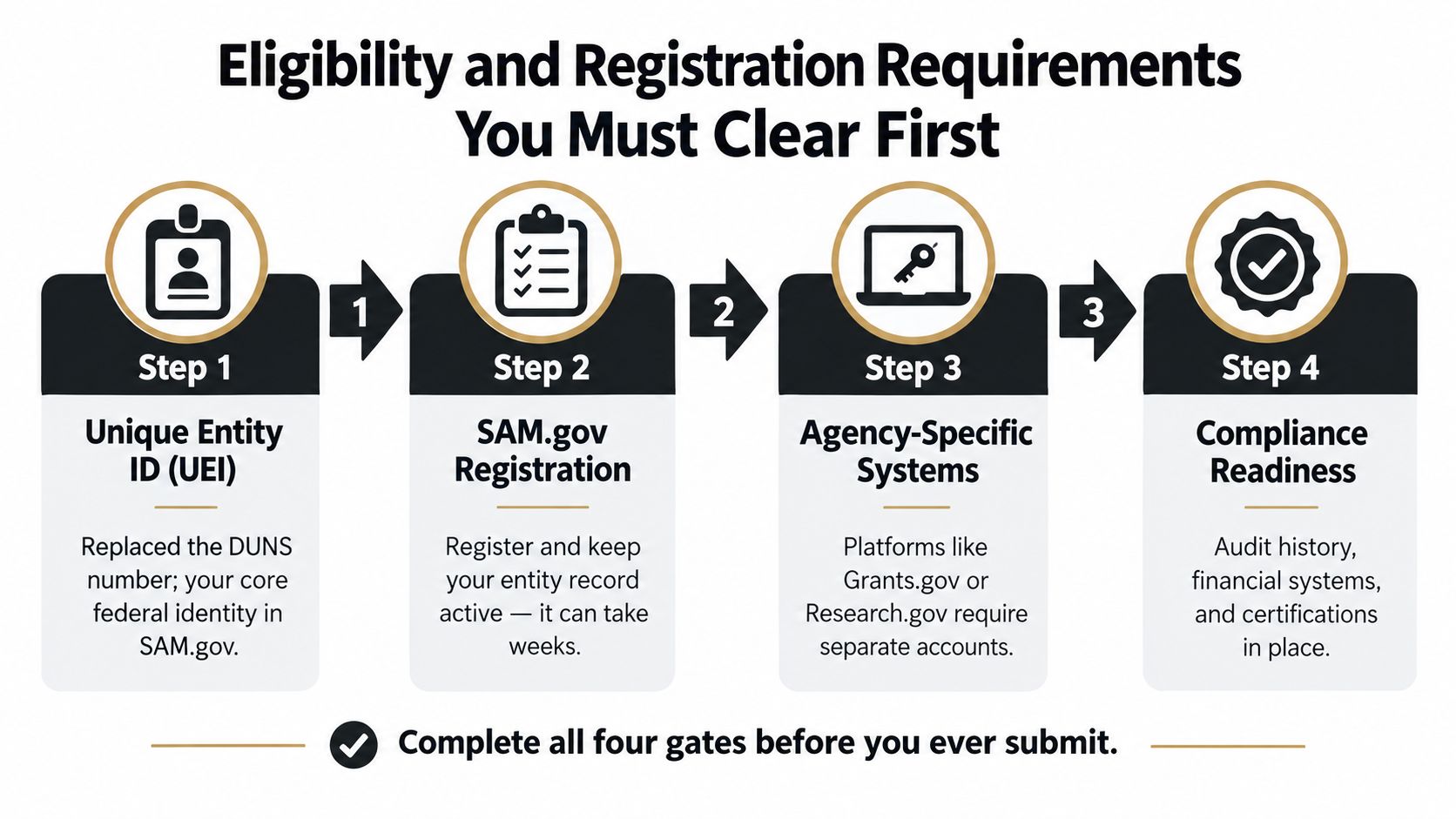
Check these items before finalizing the proposal, not on submission day. Grants.gov's applicant registration guidance makes the practical sequence clear: entity identity, active registration, applicant profile, and authorized submission must line up. Registration problems are hard submission constraints. Reviewers can't score a proposal that never enters the system.
Where to Find Federal Grant Opportunities
No single portal gives a complete view of federal grant prospects. Build a discovery stack, with each source answering a different question.
| Portal | Best For | Bookmark If You… |
|---|---|---|
| Grants.gov | Open notices, forecasts, and application instructions | Need to monitor active federal competitions |
| SAM.gov | Entity registration and federal procurement information | Need to verify organizational readiness or explore contracts |
| USAspending.gov | Historical awards, recipients, agencies, locations, and award identifiers | Want evidence about who has actually received federal funds |
| Agency program pages | Program forecasts, policy priorities, and office-specific guidance | Need context that a central listing may not provide |
| Assistance Listings | Authoritative program descriptions and federal assistance details | Need to test whether a program's purpose matches your work |
| State or local pass-through portals | Opportunities administered below the federal agency level | Expect funds to flow through a state, tribe, city, or county |
Start with Grants.gov for newly posted opportunities and forecasts, but don't stop at the notice title. Search by mission language, population served, geography, and applicant type. Save searches that reflect the organization's actual programs, then review them regularly because terminology changes between agencies and notices.
Use agency program-office pages to identify priorities before a notice opens. A forecast can reveal that an apparently relevant program is moving in a different direction, requires a particular partnership, or will be administered through another entity. That information can save weeks of unnecessary proposal preparation.
Assistance Listings help clarify program intent and structure. They're especially useful when a notice uses broad language that could describe several activities. Read the program description, eligibility language, and delivery model together.
Historical intelligence comes from USAspending.gov's documented API endpoints, which support award and recipient analysis by agency, fiscal year, geography, and award identifier. That evidence won't predict a future award, but it can show whether comparable organizations or nearby jurisdictions have received similar funding.
Use this guide to grant search tools only as part of the stack, not as a replacement for reading the official notice. The search tool can help reduce noise and organize prospects, while the federal agency remains the authority on current eligibility and submission rules.
How to Prioritize Opportunities Beyond a Simple Fit Score
The biggest award is often the least useful award. Large federal grant opportunities can demand substantial match funding, complex procurement, intensive reporting, specialized staff, and cash flow that a small nonprofit can't safely provide.
Run every prospect through four filters before calling it a priority.
Indirect cost coverage
Read the indirect cost language carefully. An award that appears generous can leave the organization subsidizing administration if the permitted recovery doesn't align with its real operating needs. Ask whether the budget covers finance, supervision, evaluation, technology, compliance, and grant administration, not just direct program activities.
Match realism
A required match is a financing commitment. Separate cash, in-kind contributions, pledged support, and allowable volunteer time, then confirm which forms the notice accepts. If the organization can't document the match throughout the award, the opportunity isn't viable.
Reporting and compliance load
Count the reporting products, performance measures, data systems, site visits, financial certifications, and partner-monitoring duties. An award that requires frequent reporting may consume more staff capacity than its program team expects.
Awardee continuity
Review historical recipients and the program office's funding pattern. Repeated awards to comparable organizations can signal operational realism, while concentration among a different recipient class should lower the priority. Treat missing subaward information cautiously. GAO's discussion of federal subaward reporting and USAspending identifies limitations in completeness and oversight, so an absent historical record isn't proof that an agency never funds your organization type.
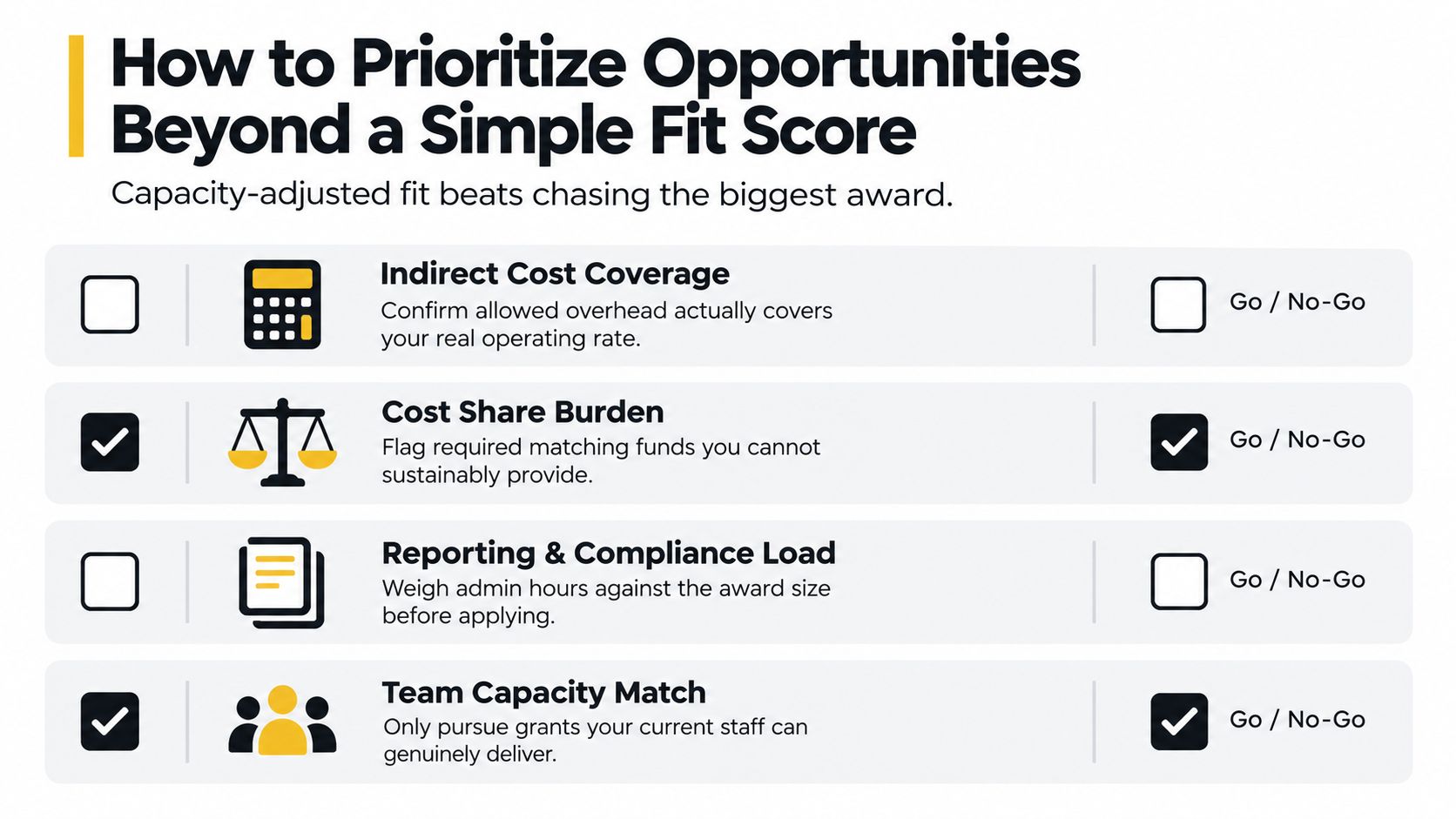
Build a scorecard with explicit categories for mission alignment, geography, applicant eligibility, administrative intensity, match capacity, staffing, and funding stability. Use a clear internal cutoff and make exceptions require executive approval. If a prospect fails a gating requirement, don't let a high fit score rescue it.
Prestige belongs in the notes column, not the decision column.
Also examine volatility. A funding pathway may depend on annual appropriations, a temporary initiative, changing agency priorities, or a pass-through decision outside your control. Recent sector evidence shows why timing deserves its own review: the cited funder survey analysis reports rising application expectations alongside a decline in direct federal grant funding for the specified charity category after excluding one-time funding. Don't build recurring services around a revenue source you can't explain beyond the current notice.
A Practical Walkthrough of Federal Discovery in One Week
Consider a small youth workforce nonprofit with a lean development function. Its director doesn't begin by reading every open notice. She creates a controlled process that forces each prospect through a different evidence check.
Monday is for rebuilding the search. She reviews the organization's actual activities, populations, and service areas, then creates keyword groups around those terms. She separates workforce training from youth development, digital skills, employer partnerships, and economic mobility instead of putting every phrase into one broad search. She records the relevant applicant types and agencies so the search produces a usable working list.
Tuesday is for program intent. Each result is compared with the applicable Assistance Listing and the full notice. She checks whether the program funds direct services, planning, research, technical assistance, capital, or a pass-through activity. Several results look relevant by title but fail because the organization's role or proposed activity doesn't match the program design.
Wednesday is for historical evidence. She reviews recipient records and award details for the strongest prospects through USAspending.gov. She looks for comparable recipients, relevant geographies, agency concentration, award type, and fiscal-year context. She doesn't treat a missing record as a rejection, especially where subaward reporting may be incomplete.
Thursday is deliberately lighter. She subscribes to updates from the agency offices most relevant to the organization and blocks time to review new notices. She also checks whether the strongest opportunities depend on a state or local intermediary, because that changes the relationship strategy.
Friday is the cutting day
The director scores the remaining prospects against the organization's mission, eligibility, geography, match capacity, staff time, reporting burden, and funding durability. She chooses a small number for concept development and archives the rest with a reason for rejection.
That archive matters. “Not now” is useful only when the team records why. A notice may return in a revised form, become suitable after a partnership changes, or remain permanently wrong for the organization. A disciplined archive prevents the same dead end from consuming staff time every cycle.
Putting It All Together with a Sustainable Federal Funding Plan
A sustainable federal funding plan depends on repeatable decisions, not deadline sprints. Assign clear ownership for four operating habits: weekly notice review, a maintained saved-search library, a triage scorecard, and a recurring pipeline review. The aim is to keep poor-fit opportunities from consuming the same staff time every cycle.
Keep source material in a shared drive where the team can inspect it: full notices, amendments, application instructions, eligibility matrices, budgets, prior submissions, and agency guidance. Store the operational record in the CRM, including opportunity stage, owner, next action, decision date, submission deadline, partner status, and rejection reason. A deadline buried in a PDF is a preventable failure.
Schedule writing, internal review, budget approval, and final submission as separate calendar events. Leave working time for authorization, registration, attachment, and platform problems. A proposal that is finished but not successfully submitted has no value.
Use this weekly checklist:
- Confirm readiness: Review the UEI, SAM.gov status, Grants.gov authority, and agency-specific requirements.
- Review new notices: Scan the Grants.gov digest and relevant agency updates.
- Score prospects: Evaluate three opportunities against mission fit, staff capacity, match, reporting burden, and funding volatility.
- Draft one concept memo: State the problem, eligible activity, target population, budget logic, partners, and delivery capacity.
- Update the pipeline: Record the next action, owner, deadline, and reason for every decision.
For proposal quality, follow a structured guide to writing a grant that ties the narrative to the notice, evidence, outcomes, budget, and implementation plan. Do not start with a generic organizational story and force it into a federal template. Start with the agency's problem definition, then show exactly how your organization will deliver the permitted work.
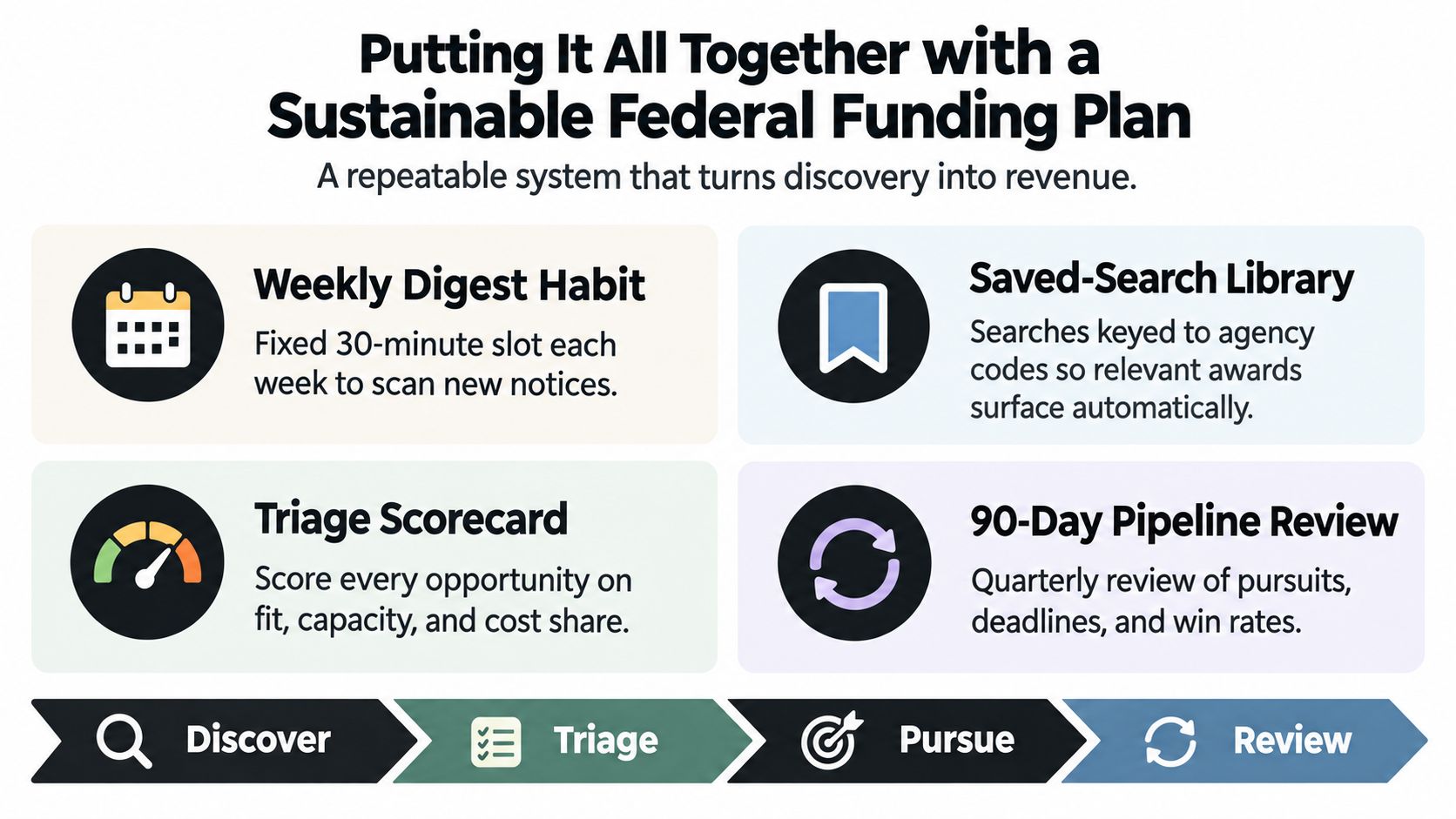
A credible pipeline mixes near-term applications, developing relationships, and monitored opportunities that are not ready yet. Include private and pass-through funding so one federal program's timing or policy changes cannot destabilize the plan. Use USAspending evidence to test whether comparable organizations have received similar awards, then adjust the opportunity's fit for your actual staff, match capacity, reporting load, and delivery record.
If your team spends too much time sorting possibilities before official review, Grantlas can help build scored shortlists with plain-English reasoning and eligibility or geography flags. Treat that output as triage, not approval. Validate every serious pursuit against the agency's current notice and registration requirements.
Visit Grantlas to turn your organization profile into a working shortlist of federal and private funding prospects. Use the results to test capacity, verify official requirements, and build a pipeline your team can realistically manage.