Best Grant Database for Nonprofits: 10 Top Picks
Oct 4, 2026 · 15 min read
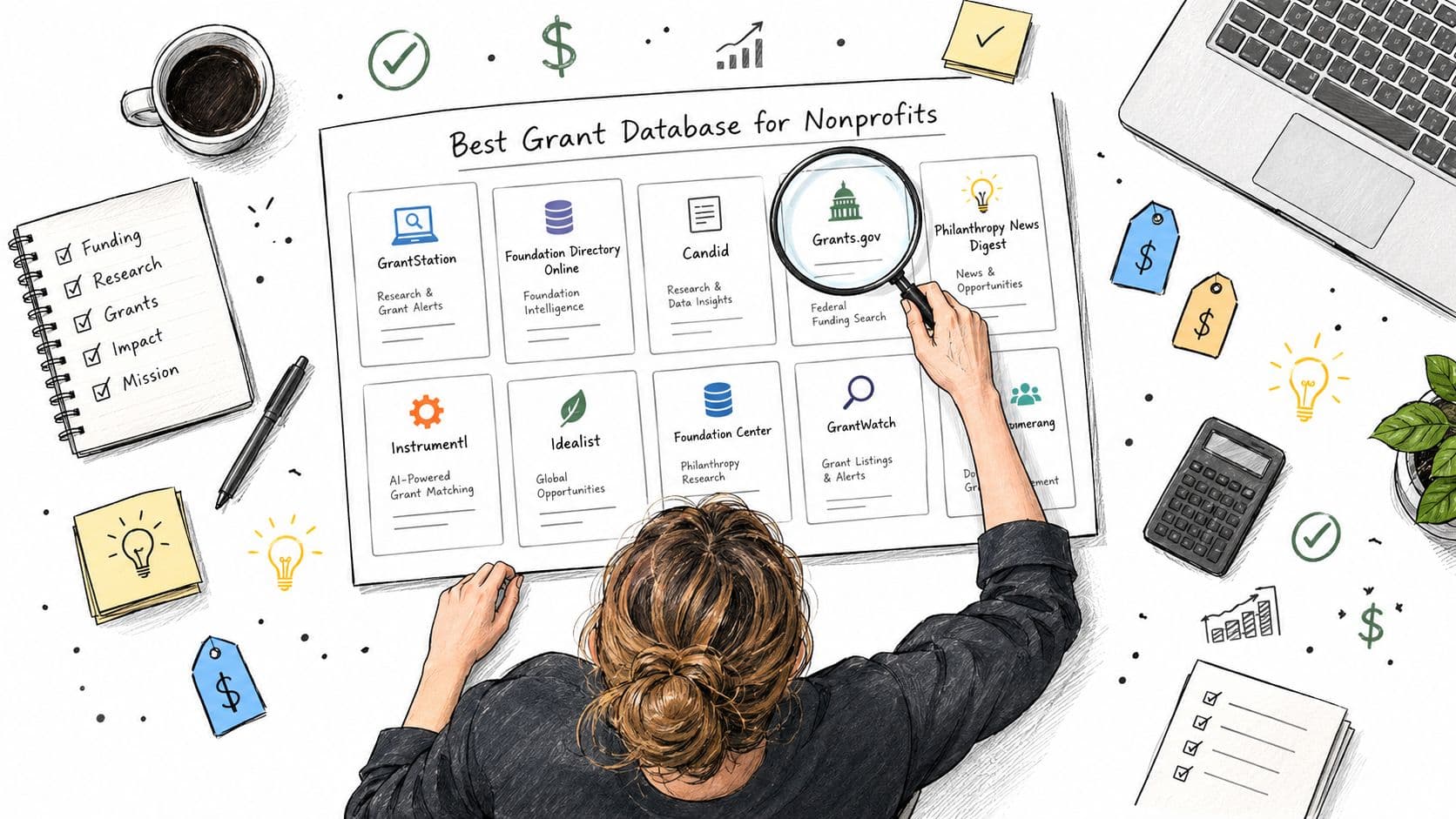
The popular advice about the best grant database for nonprofits usually starts with the wrong question: which platform has the most listings? A large catalog can still leave a small nonprofit sorting through opportunities it can't apply for, outdated deadlines, unsuitable geographies, or funders that don't support organizations like theirs.
The better question is which funding workflow you're trying to improve. Foundation prospecting depends on historical giving and Form 990 intelligence. Federal research depends on authoritative open notices. Broad directories help teams scan across sources, while research-oriented platforms prioritize sponsors, pre-solicitations, and institutional collaboration. Workflow tools add saved searches, reminders, application tracking, and team ownership.
This comparison ranks ten options by coverage, data freshness, fit signals, collaboration, price transparency, and implementation effort. It separates foundation intelligence from federal opportunity search instead of pretending that every database solves the same problem. It also distinguishes tools that help a small team build a shortlist from platforms designed for research offices with established grant operations.
Table of Contents
- 1. Grantlas
- 2. Instrumentl
- 3. Candid Search
- 4. Grants.gov
- 5. GrantWatch
- 6. GrantStation
- 7. FoundationSearch
- 8. GrantForward
- 9. OpenGrants
- 10. Pivot-RP
- Top 10 Grant Databases Comparison
- Choose the Database That Matches Your Next Funding Move
1. Grantlas
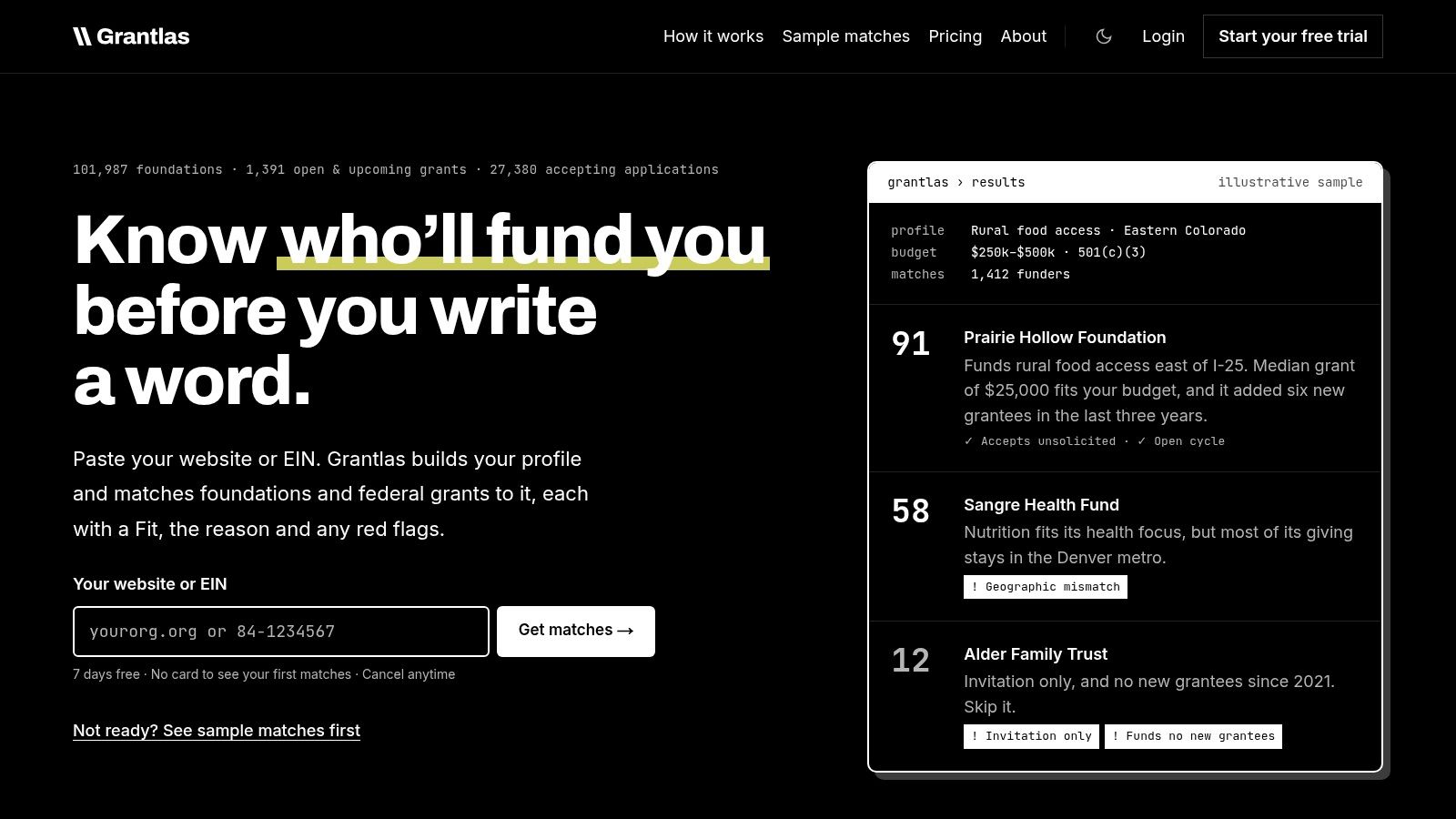
Grantlas is the strongest choice when a U.S.-based nonprofit wants to identify plausible funders before investing in proposal writing. Instead of presenting only a keyword list, the platform lets a team create an organization profile from its website or EIN, then returns a ranked shortlist of private foundations and open federal opportunities from Grants.gov.
Each result includes a concise fit explanation and flags for issues such as invitation-only status, geography mismatch, grant-size or budget mismatch, and applicant ineligibility. That design addresses the practical bottleneck identified in recent grant database comparisons: nonprofits usually need fewer false positives, not just more search results. Research on nonprofit RFP databases also emphasizes the value of eligibility, geography, program area, and prior recipient patterns when building a prospect list.
Why it ranks first
Grantlas combines foundation research and federal opportunity discovery in one self-serve workflow. Its product information describes a national index of private foundations, open federal grants, nightly opportunity scans, and monthly rescoring against saved nonprofit profiles. It also provides giving history, typical grant-size context, funder cadence, peer prospecting, board and trustee listings, saved searches, digests, reminders, and a simple pipeline.
The practical advantage is prioritization. A development associate can move from “this funder might be relevant” to “this funder appears relevant for these stated reasons” without manually reading every record first. Human verification still matters, especially for invitation-only funders and changing eligibility rules.
Grantlas publishes accessible pricing, with Solo at $99 per month or $999 per year and Pro at $199 per month or $1,999 per year, according to its product information. It also offers a seven-day trial without requiring a payment card. The main limitation is scope: the platform focuses on U.S. private foundations and federal opportunities, so it isn't a complete source for international funding, every corporate program, or every donor-advised fund.
Practical rule: Use the fit score to decide what deserves attention, then verify the funder's official guidelines before making contact or submitting an application.
2. Instrumentl
Instrumentl is the better fit for a nonprofit that wants prospect discovery and grant workflow in the same system. Its model combines private-foundation research based on Form 990 insights with active opportunities from foundation, corporate, and government sources. That makes it more than a directory, but also more operationally demanding than a simple search tool.
The platform supports funder matches, saved searches, centralized documents, tasks, team collaboration, and application workflow. Its AI-assisted features can help with prospecting and drafting, although teams should treat generated application content as a starting point that requires program and compliance review.
Best for established development operations
Instrumentl's strongest differentiator is continuity. A team can research a prospect, save it, assign work, organize supporting documents, and keep the opportunity connected to its broader grant pipeline. That structure matters because the 2023 State of Grantseeking survey found that grant activity is widespread, with 91% of respondents submitting at least one application and 92% applying to private foundations. The same source reports a median largest individual award of $74,500 and median total grant funding of $150,000, figures that help explain why serious teams may value workflow discipline.
The tradeoff is cost and complexity. Instrumentl is generally a mid-to-upper-tier purchase among nonprofit tools, and its government application assistance doesn't cover state and federal forms in the same way as a full submission system. Smaller organizations may use only a fraction of its workflow capacity.
For teams comparing discovery and operations, the distinction is useful. Grantlas emphasizes fast fit screening and accessible self-serve research, while Instrumentl is stronger when several people need to manage prospects, drafts, deadlines, and documents together. See this guide to grant management software for the workflow distinction.
Instrumentl is a serious option for a funded development team, but its value depends on whether staff will consistently maintain the pipeline.
3. Candid Search
Candid Search is the foundation-research choice for organizations that need depth more than speed. It brings together foundation and nonprofit information associated with Candid, including access to Form 990 records, staff contacts, and enriched funder profiles.
Its value comes from historical context. A nonprofit can investigate who a foundation has supported, where it gives, what issues appear in its filings, and which staff or trustees may matter for relationship development. Candid's Foundation Directory is described by Candid's Foundation Directory information as containing more than 16 million grants awarded since 2003, searchable by subject, population served, and geography. The same reference notes that Foundation Directory Online includes over 100,000 foundations, corporate giving programs, and grantmaking public charities in the United States.
Research depth has a cost
Candid Search is particularly useful for a prospect researcher, development director, or consultant who needs to understand a foundation's giving pattern rather than merely find an open RFP. It can also be more accessible than expected when a nonprofit uses a participating library or community foundation location for on-site access.
The limitation is that a deep archive doesn't automatically produce a ready-to-submit opportunity. Many private foundations don't publish open application windows, and an apparently suitable giving history doesn't guarantee that a new organization can approach the funder. Teams still need to verify current priorities, application procedures, and relationship expectations.
Recent product and interface changes may also require a period of relearning for users who worked in the legacy Foundation Directory Online environment. Candid Search is best when historical foundation intelligence is central to the funding strategy, not when a small team needs the fastest possible shortlist.
Explore Candid Search when the quality of your prospect research matters more than having every task in one lightweight interface.
4. Grants.gov
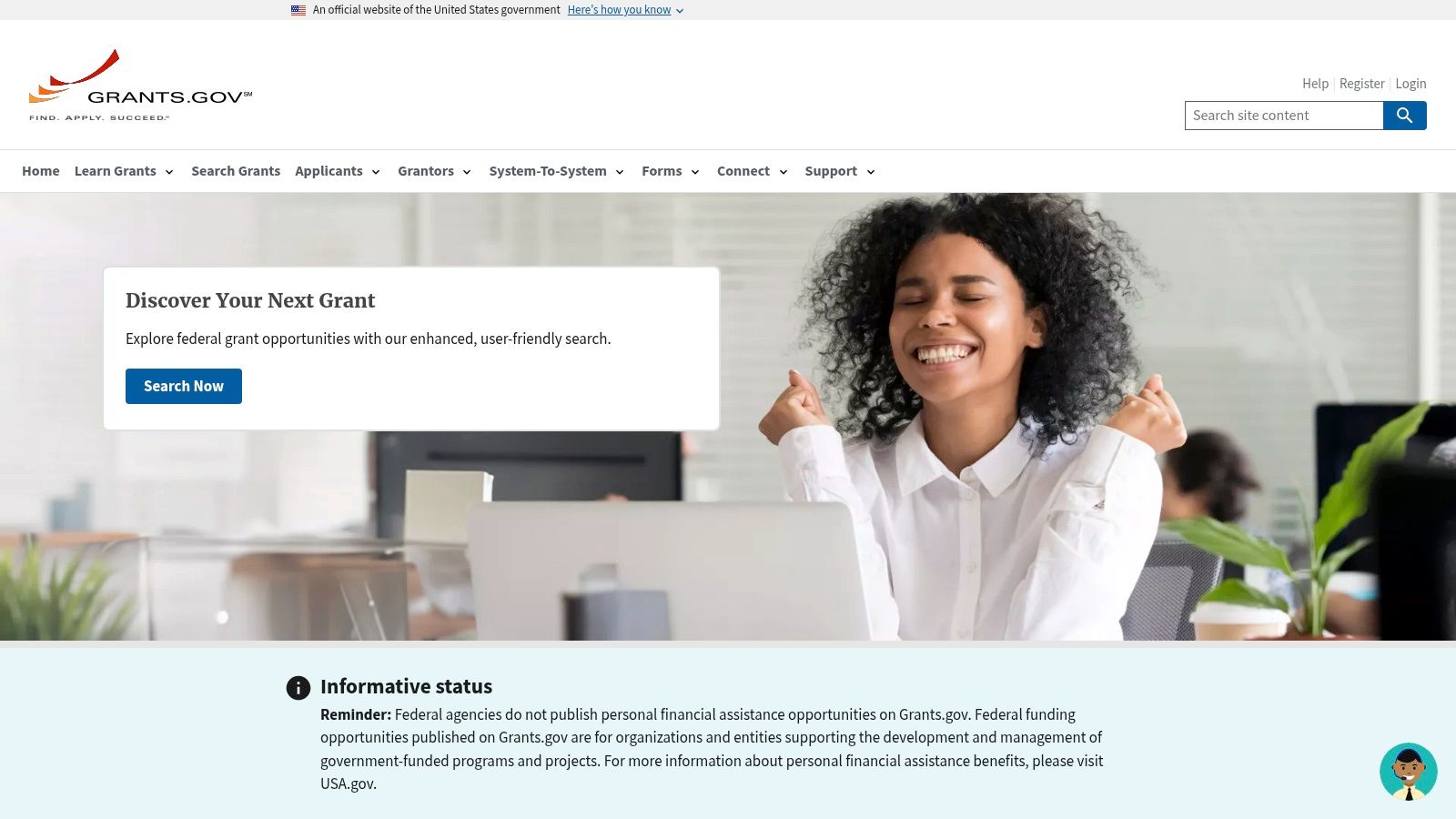
Grants.gov is the authoritative starting point for U.S. federal opportunities. It provides a single search environment across federal agencies' grants and cooperative agreements, along with notifications, Workspace tools for multi-user applications, and educational material for applicants.
It should not be judged by the same standard as a foundation prospecting tool. Federal opportunities are published as open notices and historical awards, while foundation intelligence is commonly reconstructed from IRS filings and voluntary disclosures. The IRS explanation of private foundation statistics explains that private foundation statistics are compiled from Form 990-PF and that nonoperating foundations generally provide charitable support through grants and other financial means. That difference makes source selection more important than feature count.
Use it for federal work, not universal prospecting
Grants.gov is free and authoritative, but federal applicants need internal preparation. Registration through UEI and SAM.gov is part of the setup, and applications often require coordinated budgets, attachments, certifications, and compliance review. The portal doesn't replace state pass-through research, foundation prospecting, or relationship work with private funders.
Its search filters can narrow results, but users need to understand federal agency language and eligibility categories. A plain-language query may surface technically related programs that aren't practical for a community nonprofit. That isn't a data failure. It reflects the difference between keyword retrieval and organization-specific fit screening.
A nonprofit considering federal funding should begin with Grants.gov, then use a separate tool for foundation history and private-funder relationship research. The guide to finding grants for nonprofits can help teams combine those approaches without treating one portal as a complete funding strategy.
5. GrantWatch
GrantWatch is a broad listings directory for organizations that want to scan private, corporate, local, state, and some federal opportunities in one place. Its all-state coverage and category filters make it approachable for a small nonprofit that hasn't yet developed a narrow prospecting system.
The platform adds alerts, dashboard and pipeline functions, weekly email updates, and GrantWatch Intelligence summaries. Higher plans include AI writing tools. Those features help a team move beyond a static list, but the platform's core value remains breadth and fast scanning.
A practical low-cost scanning option
GrantWatch is most useful when a nonprofit already knows how to evaluate opportunities and needs a steady stream of potential RFPs. It can surface possibilities across geography and program categories without requiring the team to assemble separate searches for every funder type.
Its main limitation is fit depth. Compared with a profile-based matching platform or a research database built around historical giving, GrantWatch behaves more like a listings directory. A listing doesn't prove that the organization is eligible, that the deadline is current, or that the funder has supported comparable nonprofits. Multi-user access also requires custom licensing, which can complicate budgeting for consultants or distributed development teams.
That makes GrantWatch a reasonable choice for broad discovery, but not a substitute for checking the original RFP. A small team should open the funder's official page, confirm eligibility and deadline details, and record the opportunity in its own pipeline before drafting.
See GrantWatch if affordable, wide-angle scanning matters more than deep funder analytics.
6. GrantStation
GrantStation combines curated opportunity listings with educational resources, tutorials, newsletters, and funding trend content. Its nonprofit orientation makes it approachable for smaller organizations and consultants that want a familiar research environment without buying a highly specialized institutional platform.
The database includes private, corporate, and government opportunities. Partner access through organizations such as TechSoup and nonprofit associations can materially affect the effective price, so buyers should check available discounts before comparing direct membership costs.
Useful for teams that still research manually
GrantStation's strength is the combination of listings and learning support. A newer grant writer can use the educational material to improve search habits, understand funder language, and build a repeatable research process. A consultant can also use it as a practical starting point across several client missions.
The platform is less compelling for teams seeking advanced analytics, automated fit scoring, or a fully integrated grant lifecycle. Its interface and reporting depth are lighter than those of enterprise-oriented systems, and direct pricing may be less transparent than partner-discounted access.
GrantStation makes sense when the team wants curated breadth and guidance, but is comfortable validating prospects and managing much of the application process elsewhere. That can be a strength for organizations that don't want a complex implementation.
Visit GrantStation to evaluate the current membership terms and available nonprofit partner discounts before committing.
7. FoundationSearch
FoundationSearch by Metasoft is designed for research-heavy private-foundation prospecting. Its emphasis is historical grant data, proposal and letter-of-inquiry examples, deadline tracking, visual analytics, and detailed outreach intelligence.
This is not the natural first purchase for a small nonprofit that needs a few current RFPs. It is better suited to an organization, consultant, or development office that treats foundation research as a specialized function and wants to examine patterns across many prospective funders.
Depth for private-foundation strategy
The platform can help researchers move beyond a foundation's stated mission. Historical awards may show whether a funder supports a particular program type, geography, recipient profile, or scale of work. Searchable proposal samples can also give experienced grant professionals context for how successful applicants have framed their work, although no sample should be copied without adapting it to the organization's own evidence and voice.
FoundationSearch is focused on foundations rather than serving as a complete federal or state RFP index. Pricing is quote-based and typically requires a larger commitment than mass-market tools, so the business case depends on how frequently the team conducts foundation prospecting and how many people will use the research.
Teams should also remember that historical giving is evidence of fit, not a promise of future funding. A foundation may change priorities, pause applications, or fund only through invitations.
FoundationSearch is the specialist choice for organizations that need granular foundation intelligence and have the staff capacity to interpret it. Teams seeking broader nonprofit prospecting can also review this resource on grants for nonprofits.
8. GrantForward
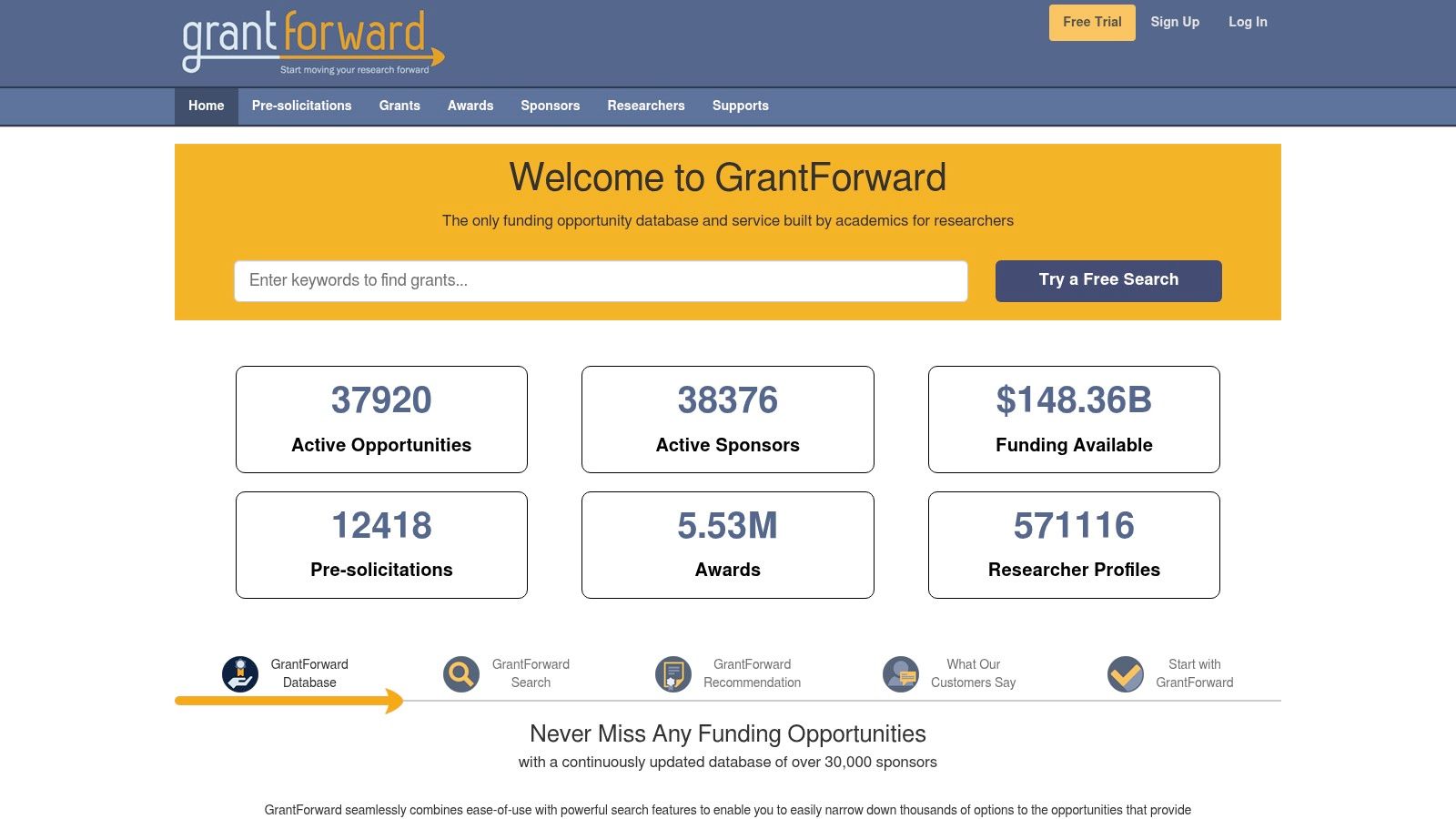
GrantForward is built around broad sponsor discovery, personalized recommendations, alerts, profiles, and institutional administration. It indexes federal, corporate, private foundation, and international sponsors, with support for pre-solicitations and early notices.
That orientation makes it a strong candidate for universities, research-focused nonprofits, and organizations with multiple departments or principal investigators. Administrators can organize groups, distribute newsletters, and manage delivery of relevant opportunities rather than asking each researcher to search independently.
Broad sponsor coverage can create friction
GrantForward's breadth is valuable when an organization pursues research funding across public, private, and global sources. Early notices can also give research teams time to develop partnerships and shape a response before a final solicitation appears.
The limitation is fit for independent community nonprofits. Its taxonomy and interface lean toward academic and research users, and pricing isn't publicly presented as a simple small-team subscription. That creates implementation and procurement work before a buyer can determine whether the platform fits its grant process.
A nonprofit housed within a university or research institution should first ask whether an institutional subscription already exists. An independent organization with a small development team may find the platform more powerful than necessary, especially if its priority is foundation relationship research or current local RFPs.
GrantForward deserves consideration when research administration and sponsor breadth are central requirements, not merely because its catalog is large.
9. OpenGrants
OpenGrants is a practical entry point for nonprofits prioritizing public funding over a historical private-foundation archive. It offers a free search tier, paid collaboration features, daily refreshes, nonprofit discounts, and an integrated marketplace of grant strategists. API and integration options may also help organizations connect opportunity data with existing systems.
Its strongest fit is a small team testing whether structured grant research will improve its process before committing to a larger platform. The decision case is accessibility and current public opportunities, not the deepest sponsor history or the most advanced workflow. Teams focused mainly on private foundations should rank it below databases with stronger foundation profiles and giving records.
A low-commitment entry point
A small group can use OpenGrants to share research, while the strategist network provides access to outside grant-writing support. That combination suits nonprofits with viable opportunities but limited staff capacity for every application. It does not replace eligibility review, proposal planning, or relationship building with funders.
The tradeoff is lighter data and workflow depth than enterprise tools, along with plan details that may vary. Before choosing it, buyers should confirm what the free tier includes, how many users can collaborate, and whether coverage matches their geography and program priorities. Public-funding breadth may matter more than feature volume for a small organization, while research-oriented teams may need stronger profiling, archival data, and workflow controls.
The vendor's 2026 grant-management software comparison offers additional product context, but it should not be treated as independent evidence that software alone improves fundraising results. Review discipline still determines whether alerts and shared research lead to better submissions.
Try OpenGrants when low-barrier public-funding discovery and optional outside support outweigh the need for a deep private-foundation database.
10. Pivot-RP
Pivot-RP by Clarivate is the enterprise-oriented choice for complex, research-centric teams. It provides customized funding recommendations, saved searches, alerts, profiling, collaboration, exports, documentation, and training resources.
The platform is designed for environments where multiple researchers, departments, or programs need coordinated opportunity discovery. Its workflow features are more relevant to teams managing institutional research priorities than to a small nonprofit executive director searching for local operating support.
Powerful, but often unnecessary for small nonprofits
Pivot-RP's value comes from maturity and integration. A research administrator can help investigators maintain profiles, distribute relevant opportunities, and coordinate funding intelligence across a large organization. Teams that already have institutional access through a university or affiliate should investigate that route before considering an independent purchase.
The limitations are equally clear. Pricing is quote-based and oriented toward institutional buyers. The interface, terminology, and implementation effort may overwhelm a small nonprofit whose funding strategy centers on private foundations, community funders, or a limited number of federal programs.
A research-heavy nonprofit should assess whether its staff will use profiling, alerts, collaboration, and export functions consistently. If not, a simpler database with stronger fit screening may produce more practical value.
Pivot-RP is best reserved for organizations with complex research portfolios, institutional support, and a clear need for coordinated sponsor intelligence.
Top 10 Grant Databases Comparison
| Product | Coverage & data | Core features / workflow | Fit & priorititization | Target audience & price |
|---|---|---|---|---|
| Grantlas (Recommended) | Nationwide private foundations + open federal grants; nightly scans; monthly rescoring (101k+ foundations) | Self-serve profile from URL/EIN; unlimited searches; filters, AI search; giving history, peer prospecting, board listings, saved searches & reminders | Two-sentence Fit + plain-English reasoning and automatic red flags (geography, invite-only, budget) | Small nonprofits, consultants, dev teams, Solo $99/mo ($999/yr); Pro $199/mo ($1,999/yr) |
| Instrumentl | Private foundations + active RFPs (foundations, corporations, government) | Discovery + lightweight grants CRM; 990 analytics; AI-assisted drafting; centralized tasks & docs | Strong matching and integrated workflow; good 990-derived signals | Nonprofits wanting discovery + tracking in one tool, mid/upper-tier pricing |
| Candid Search | Deep U.S. foundation database with 990s and staff contacts | Unified search across funders/grants/nonprofits; enriched funder profiles; unlimited 990 downloads (paid) | Data-rich profiles and contact depth for manual prioritization | Organizations needing comprehensive foundation intel; library/partner access can reduce cost |
| Grants.gov | Official federal grants portal across agencies; authoritative listings | Single federal search; Workspace for multi-user applications; notifications & learning center | No commercial fit scoring; federal-focused eligibility checks & deadlines | Nonprofits pursuing federal funding, free to use (requires UEI/SAM registration) |
| GrantWatch | Listings across private, corporate, local/state and some federal opportunities | Location/category filters; weekly alerts; pipeline dashboard; AI tools on higher plans | Listings-led; lighter vetting and no advanced fit scoring | Small nonprofits needing low-cost, quick scanning, low entry price, flexible plans |
| GrantStation | Curated U.S. opportunities + educational content and tutorials | Curated listings, newsletters, tutorials; partner/TechSoup discounts | Manual curation supports prioritization; lighter analytics | Small shops and consultants; low effective price via partners |
| FoundationSearch (Metasoft) | 200k+ U.S. foundations with extensive historical grant data | Deep grant histories; searchable proposal samples; advanced prospecting analytics | High-resolution historical fit analysis for foundations | Teams prioritizing private-foundation strategy, quote-based, premium pricing |
| GrantForward | Broad index: federal, corporate, private, international sponsors; pre-solicitations | Profile-based recommendations; group/admin tools; early notices; institutional trial | Personalized alerts and recommendations geared to institutions | Research orgs and institutions, pricing quoted for institutions |
| OpenGrants | Public funding focus with daily refreshes; free tier available | Free search; paid collaboration tools; marketplace/strategist network; API options | Basic discovery with alerts; lighter curation than enterprise tools | Small orgs validating opportunities, free tier + nonprofit discounts |
| Pivot‑RP (Clarivate) | Global, research-focused funding index for universities and research orgs | AI funding advisor; saved searches, alerts, exports; robust workflow integrations | Tailored, enterprise-grade recommendations and alerts | Universities & research-heavy nonprofits, enterprise/quote pricing |
Choose the Database That Matches Your Next Funding Move
The best grant database for nonprofits isn't the one with the longest feature list. It's the one that matches the next funding move your team can realistically execute.
Choose Grantlas when a small or midsize U.S. nonprofit wants scored matches across private foundations and federal opportunities, plain-English fit reasoning, explicit red flags, and a self-serve workflow. Its combination of foundation history, federal discovery, reminders, peer prospecting, and accessible published pricing is especially useful when one development person handles research, outreach, and pipeline maintenance.
Choose Instrumentl when prospecting needs to connect directly to a shared grant workflow. It makes more sense for organizations with dedicated development staff who will use centralized documents, tasks, collaboration, and application tracking. The cost is harder to justify if the team only needs occasional searches.
Choose Candid Search or FoundationSearch when deep private-foundation research is the core requirement. Candid is the broader established research backbone, with library and community access routes that may improve accessibility. FoundationSearch is more specialized for teams that need granular grant histories, proposal examples, and advanced foundation prospecting.
Use Grants.gov for authoritative federal listings. It should remain part of any federal funding process, even when another platform helps with discovery or prioritization. Federal registration, eligibility, documentation, and compliance still require direct review of the official opportunity notice.
Consider GrantWatch or GrantStation for lower-cost broad scanning. GrantWatch is oriented toward a wide mix of current listings, while GrantStation pairs curated opportunities with educational support and partner discounts. Neither removes the need to confirm the original funder guidelines.
Reserve GrantForward and Pivot-RP for research-oriented or institutionally supported teams. Their sponsor breadth, alerts, profiling, and administrative features are valuable in complex environments, but they may create unnecessary cost and implementation work for a small independent nonprofit.
Before buying, test five things:
- Coverage: Does the database include the funder types and geographies your strategy targets?
- Freshness: How often are opportunities updated, and does the record show enough source context to verify it?
- Fit signals: Can the tool surface applicant type, geography, program area, grant size, and prior giving patterns?
- Workflow: Can your team save prospects, assign work, set reminders, and preserve institutional knowledge?
- Verification: Does the process make it easy to confirm eligibility and deadline details on the original funder's site?
Software can reduce research waste, but it can't replace eligibility review or relationship building. The most useful database helps your team decide where to focus. Your staff still need to read the guidelines, contact funders appropriately, build a credible case, and submit an application that reflects the organization's actual work.
Grantlas brings private-foundation research and open federal opportunities into one self-serve platform, then ranks prospects with plain-English fit reasoning, eligibility flags, giving history, reminders, and a simple pipeline. If your nonprofit wants to spend less time sorting weak leads and more time pursuing realistic funders, visit Grantlas and test your organization profile before choosing a larger grant database commitment.