501c3 vs 501c6: A Practical Comparison Guide
Sep 23, 2026 · 11 min read
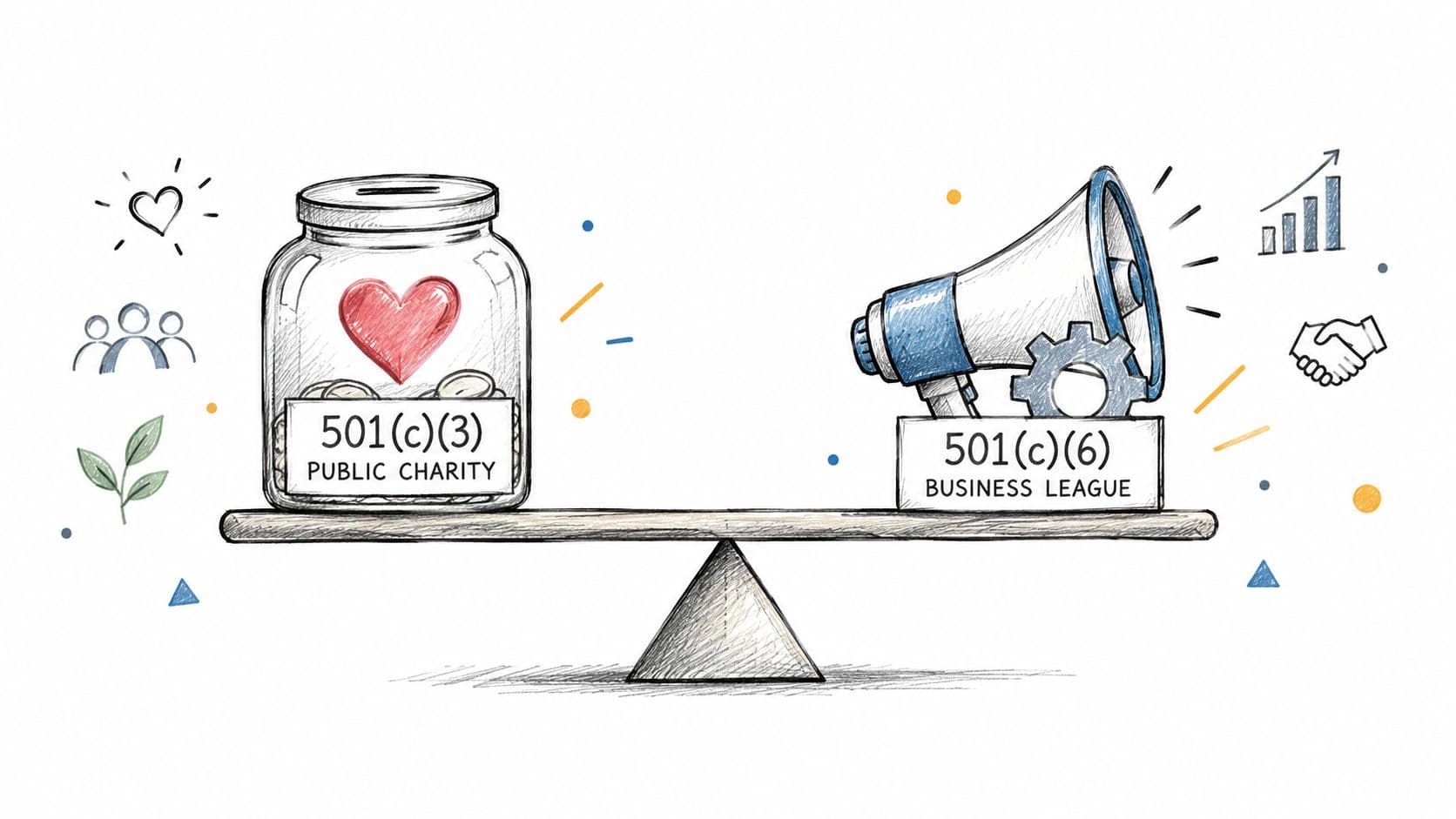
You're at the incorporation stage, and the wrong filing choice can trap your organization for years. If your board wants charitable donations, foundation grants, and government awards, you're looking at a 501(c)(3). If your real engine is member dues, industry advocacy, and legislative influence, you're looking at a 501(c)(6). Treat this as a financing decision and a lobbying decision, not a branding decision.
| Metric | 501(c)(3) Public Charity | 501(c)(6) Business League |
|---|---|---|
| Core purpose | Public benefit, charitable or similar exempt purposes | Common business interest, industry or member benefit |
| Donor deductibility | Contributions are generally charitable gifts | Dues and payments are generally not charitable deductions |
| Grant readiness | Strong fit for foundation and government grants | Much weaker fit for most grant programs |
| Lobbying posture | Tight limits, higher compliance risk | Broader advocacy room, better for member-driven lobbying |
| Best use case | Clinics, schools, food programs, public education | Chambers, trade groups, professional associations |
Table of Contents
- Why the 501c3 vs 501c6 Question Matters
- How Many Organizations Actually Hold Each Status
- Legal Purpose, Tax Treatment, and Deductibility Compared
- Lobbying, Political Activity, and Compliance Pressure
- Grant Eligibility and the Funding Pool Each Status Reaches
- Real-World Scenarios That Map to Each Designation
- Which Structure Fits Your Mission and Next Steps
Why the 501c3 vs 501c6 Question Matters
A founder usually feels this split before the IRS paperwork is filed. Your mission may sound public-minded, but your board may also want to shape standards, press for policy changes, or defend an industry interest. That is the core decision, and it is why 501(c)(3) vs 501(c)(6) is a formation choice, not a branding choice.
Public-benefit fundraising and member-driven advocacy are different machines
A 501(c)(3) is built for public benefit. The IRS classifies it around religious, charitable, scientific, educational, literary, and similar purposes, and donor contributions are generally treated as tax-deductible charitable gifts IRS classification guidance, donor deductibility overview. That profile fits grant-funded organizations because foundations and public funders recognize it immediately.
A 501(c)(6) serves a common business interest. Chambers of commerce, boards of trade, and business leagues fit that model. Its financial base is usually member dues and sponsorships, and its strength is organized advocacy for members, not charitable fundraising IRS classification guidance.
Grant-dependent founders should answer one question first. If your first-year plan depends on foundation grants, public grants, and individual gifts, a 501(c)(3) is the better fit. If your first-year plan depends on dues-paying members who expect policy representation and industry defense, a 501(c)(6) fits the work better.
A workforce coalition makes the trade-off plain. If the board wants apprenticeship funding and broad donor support, form as a 501(c)(3). If the board wants to coordinate employers, press regulators, and fund the effort through membership, choose the 501(c)(6) route. A mismatch here causes real problems later, because the funding pool, the compliance burden, and the message to supporters all change with the designation lobbying and financing comparison.
Grant-funded nonprofits should treat this as a gating decision. Pick the structure that matches who will pay, who will benefit, and who you plan to influence.
How Many Organizations Actually Hold Each Status
The scale difference is not trivia. It shows which structure has the deeper infrastructure, the broadest funder familiarity, and the larger peer bench.
The IRS population gap is huge
IRS exempt-organization data shows 1,640,646 active 501(c)(3) organizations, or 83.8% of 1,956,822 active tax-exempt organizations in the dataset downloaded September 8, 2026. In the same analysis, 501(c)(6) organizations numbered 57,720, or 2.9% of the total.
That gap explains why grant systems are built around the public-benefit model. Foundation portals like Fluxx and government systems like Grants.gov default to 501(c)(3) eligibility checkboxes because that is where most applicants sit. A 501(c)(3) is the standard grant-facing structure. A 501(c)(6) is a narrower fit.
Visibility changes how funders evaluate you
If you form a 501(c)(3), you enter a crowded but familiar market. Funders know how to read the mission, the IRS status, and the charitable purpose. Intake is usually smoother, but competition is intense.
If you form a 501(c)(6), you may face less saturation in advocacy circles, but you also step into a thinner grant ecosystem. Most grantmakers are not searching for business leagues first. They screen for charitable fit, public benefit, and deductible giving, which is why most grant language assumes a 501(c)(3).
Read the scale gap as a strategy signal, not a vanity metric. More **501(c)(3)**s means more grant pathways, more template language, and more funder familiarity. Fewer **501(c)(6)**s means more specialization and less room for grant-led growth.
A status that funders see every day is easier to finance. A status that members understand is easier to advocate through.
Legal Purpose, Tax Treatment, and Deductibility Compared
A founder choosing between these two structures should separate three questions: what the organization exists to do, how the IRS treats it, and what donors or members can deduct. Confusing those questions leads to the wrong filing.
Purpose drives the filing
A 501(c)(3) must be organized and operated for exempt public-benefit purposes such as charitable, educational, religious, scientific, or literary work. A 501(c)(6) serves a different function, promoting a common business interest and improving conditions for members.
Write your bylaws to match that reality. If the board is focused on clinics, scholarships, public education, or humanitarian service, the organizing documents should say so clearly and consistently. If the board is focused on standards, market conditions, member competitiveness, or legislative representation, the language should point to a 501(c)(6).
Tax exemption is not the deciding factor
Both structures can be exempt from federal income tax at the entity level under IRS exempt-organization classification. That similarity often misleads founders into treating them as interchangeable. They are not, because donor treatment and grant access follow the purpose.
Donations to a 501(c)(3) are generally treated as charitable contributions and can be tax-deductible for donors. Contributions to a 501(c)(6) are generally not deductible as charitable gifts, though dues or other payments may be deductible as ordinary and necessary business expenses in some cases.
| Criterion | 501(c)(3) Public Charity | 501(c)(6) Business League |
|---|---|---|
| Legal purpose | Public-benefit charitable, educational, religious, scientific, literary, and similar purposes | Common business interest, trade, professional, or industry benefit |
| Entity tax treatment | Exempt from federal income tax under the exemption regime | Exempt from federal income tax under the exemption regime |
| Donor treatment | Contributions are generally charitable deductions | Payments are generally not charitable deductions |
| Best funding logic | Gifts, foundation grants, public grants | Dues, sponsorships, commercially oriented revenue |
Draft the purpose clause with filing consequences in mind
The IRS reads your organizing language as evidence of what you intend to do, not as marketing copy. Use bylaws and articles that match your revenue model.
- For a 501(c)(3), the purpose clause should point to public benefit, and the dissolution clause should keep assets dedicated to exempt purposes.
- For a 501(c)(6), the purpose clause should describe the shared business or professional interest the group will advance.
- In both cases, the documents should avoid mixed messaging. A charity that reads like a trade association creates problems at the application stage and later with funders.
For grant-funded founders, the practical rule is simple. Choose 501(c)(3) if you need access to charitable gifts and grant capital. Choose 501(c)(6) if the organization exists to serve members first and the money will come from dues, sponsorships, or business-linked support.
Lobbying, Political Activity, and Compliance Pressure
Founders often want the public-benefit money of a charity and the advocacy freedom of a trade group. The IRS does not let you combine those goals casually. If your mission depends on policy pressure, file the right entity before you start spending money.
Lobbying tolerance is radically different
A 501(c)(3) faces tight lobbying limits and can lose exempt status if lobbying becomes a substantial part of its activity advocacy comparison. A 501(c)(6) has much broader room to lobby as long as the activity stays tied to the organization's purpose.
Neither structure should engage in partisan campaign activity. That line matters from day one. If the board wants to support candidates or make electioneering part of the mission, the entity choice is already wrong for a charity.
The compliance burden is part of the business model
A 501(c)(3) that wants predictable lobbying compliance should elect 501(h) and track lobbying on Form 990 Schedule C using the expenditure test. Do not rely on vague judgment calls. Set separate general-ledger codes for direct lobbying, grassroots lobbying, and non-lobbying advocacy, then reconcile those accounts every month. That gives you a defensible record if the IRS asks how you spent charitable funds.
A 501(c)(6) has more flexibility, but it still needs disciplined records. Member communications, advocacy spending, and dues usage all need clean documentation. If the organization crosses into election-related activity or misstates how dues are used, the compliance problem shows up quickly.
For readers who also want the donor-side view of political giving, this guide for civic-minded donors is useful background.
What founders should assume in practice
If your work is regular meetings with legislators, issue advocacy, and member mobilization, a 501(c)(6) is the cleaner fit. If your policy work is limited and your real engine is grants and charitable gifts, a 501(c)(3) can still work, but only if lobbying stays tightly controlled and documented.
The mistake is choosing a charity and hoping the advocacy problem sorts itself out later. It will not. If politics is central, file for the structure that can carry it.
Grant Eligibility and the Funding Pool Each Status Reaches
If your organization depends on grants, this is the decision that should drive the filing. Grant eligibility is not a side benefit. It is often the difference between a viable launch and a stalled idea.
501(c)(3) opens the mainstream grant pipeline
A 501(c)(3) is the structure private foundations expect, donor-advised funds are built to support, and government grant systems recognize most easily. The charitable purpose matches the way funders justify their distributions. It also helps that donations are treated as charitable gifts, which supports donor deductibility.
The mechanics matter too. Grantmakers usually ask for organizational status, a public-benefit purpose, and standard compliance documents. A 501(c)(3) usually satisfies those checks without explanation. If your development team wants fewer eligibility questions and fewer wasted applications, this is the cleaner structure.
501(c)(6) can receive funding, but the lane is narrower
A 501(c)(6) can still collect dues, sponsorships, conference revenue, and member support. It can also receive some grants where the funder explicitly allows it. But it usually sits outside the default charitable grant pipeline, and it is not the structure most private foundations or public funders assume.
That changes the fundraising story. A 501(c)(3) can speak to foundations, donors, and agencies in the language they already use. A 501(c)(6) usually has to rely on a membership-driven or business-services narrative. For founders who want to compare grant categories and funding sources, the internal different types of grant guide is a useful reference point.
DAFs, disclosures, and fiscal sponsorship
Donor-advised funds and foundation workflows are built around charitable giving logic, which is why the 501(c)(3) designation fits them naturally. A 501(c)(6) may still operate through a charitable sponsor or a fiscally sponsored project, but that is a bridge, not a substitute for the right entity.
If you need to launch before exemption is fully in place, fiscal sponsorship can keep the work moving while you sort out the longer-term structure. Do not treat it as a permanent fix for a mission that is mainly public-benefit and grant-funded.
| Funding Source | 501(c)(3) Eligible | 501(c)(6) Eligible |
|---|---|---|
| Private foundation grants | Yes, typically | Usually no |
| Government grants | Yes, commonly | Usually not the default fit |
| Donor-advised fund support | Yes, commonly | Usually not the default fit |
| Individual charitable donations | Yes | Not as charitable deductions |
| Membership dues | Sometimes | Yes, core funding source |
| Sponsorships and conference revenue | Yes, if structured properly | Yes, core funding source |
Real-World Scenarios That Map to Each Designation
Choose the structure by asking one question first, is the mission built around public benefit fundraising or member-driven advocacy?
Community health nonprofit
A group running free clinics, health screenings, or public education programs should file as a 501(c)(3). The funding model is charitable, and the organization will likely depend on foundation grants, government awards, and individual donations. For readers comparing grant categories, the community and public benefit funding page is the right place to start.
The board's work should center on program design, donor development, grant reporting, and compliance. If policy work exists, keep it subordinate to the charitable mission. Anything else creates friction with the structure.
Regional chamber of commerce
A chamber that pools member dues to lobby on zoning, permitting, and local business conditions belongs in 501(c)(6). Its purpose is collective business improvement, not charity. The money comes from members, not philanthropic donors.
That structure lets the board focus on member services, advocacy, and convening without pretending to be a public charity. It fits the work cleanly.
Hybrid industry association
A clean-energy consortium or professional association often wants both policy influence and educational programming. That creates the hard case. If advocacy is central, the core entity should usually be 501(c)(6), with a separate 501(c)(3) affiliate handling education, research, or other public-benefit programming.
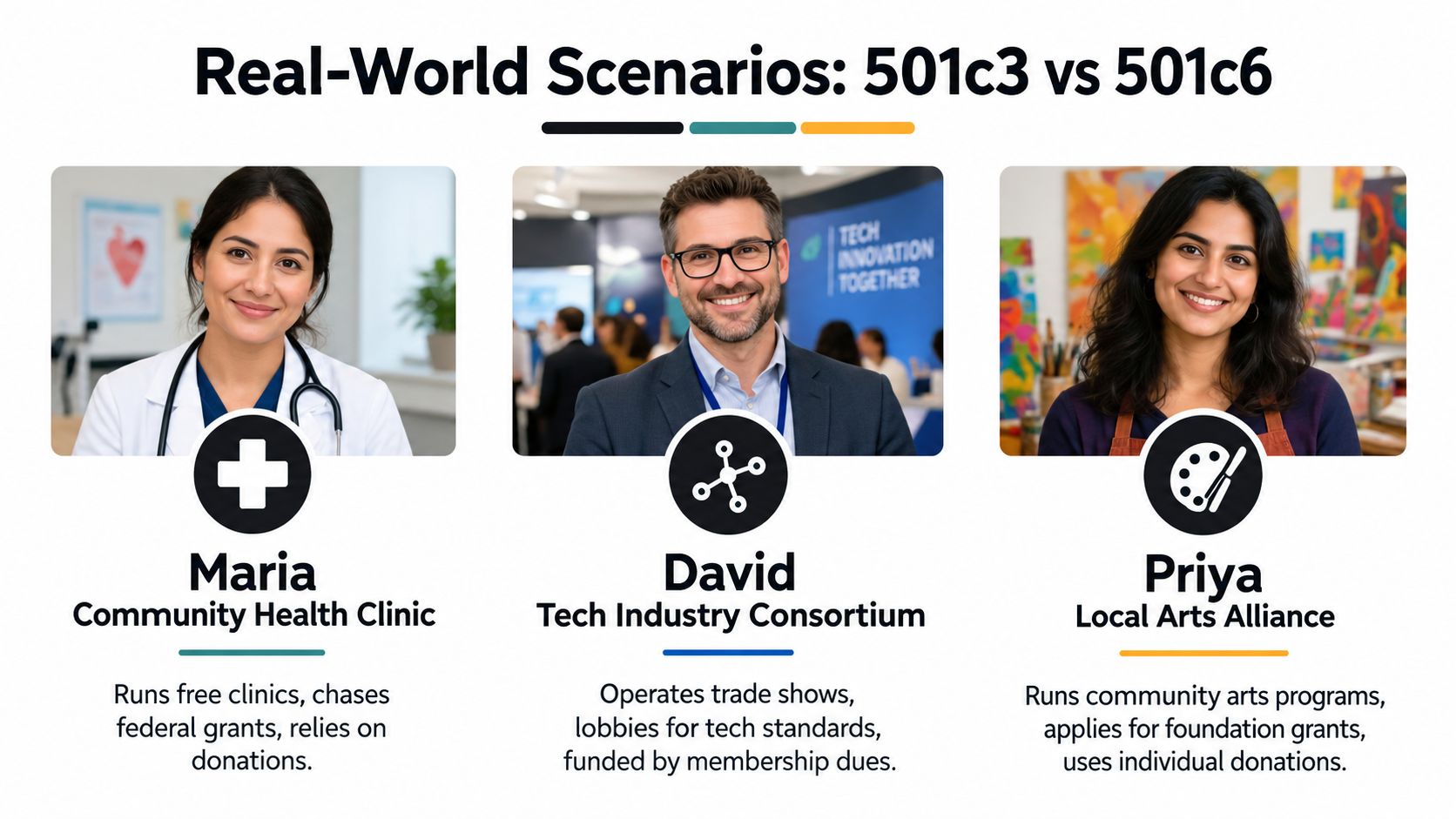
Use the chart above to keep the decision grounded. If the work is built for grants, gifts, and public trust, the 501(c)(3) route fits. If the work is built for dues, industry coordination, and policy pressure, 501(c)(6) is the better fit.
Which Structure Fits Your Mission and Next Steps
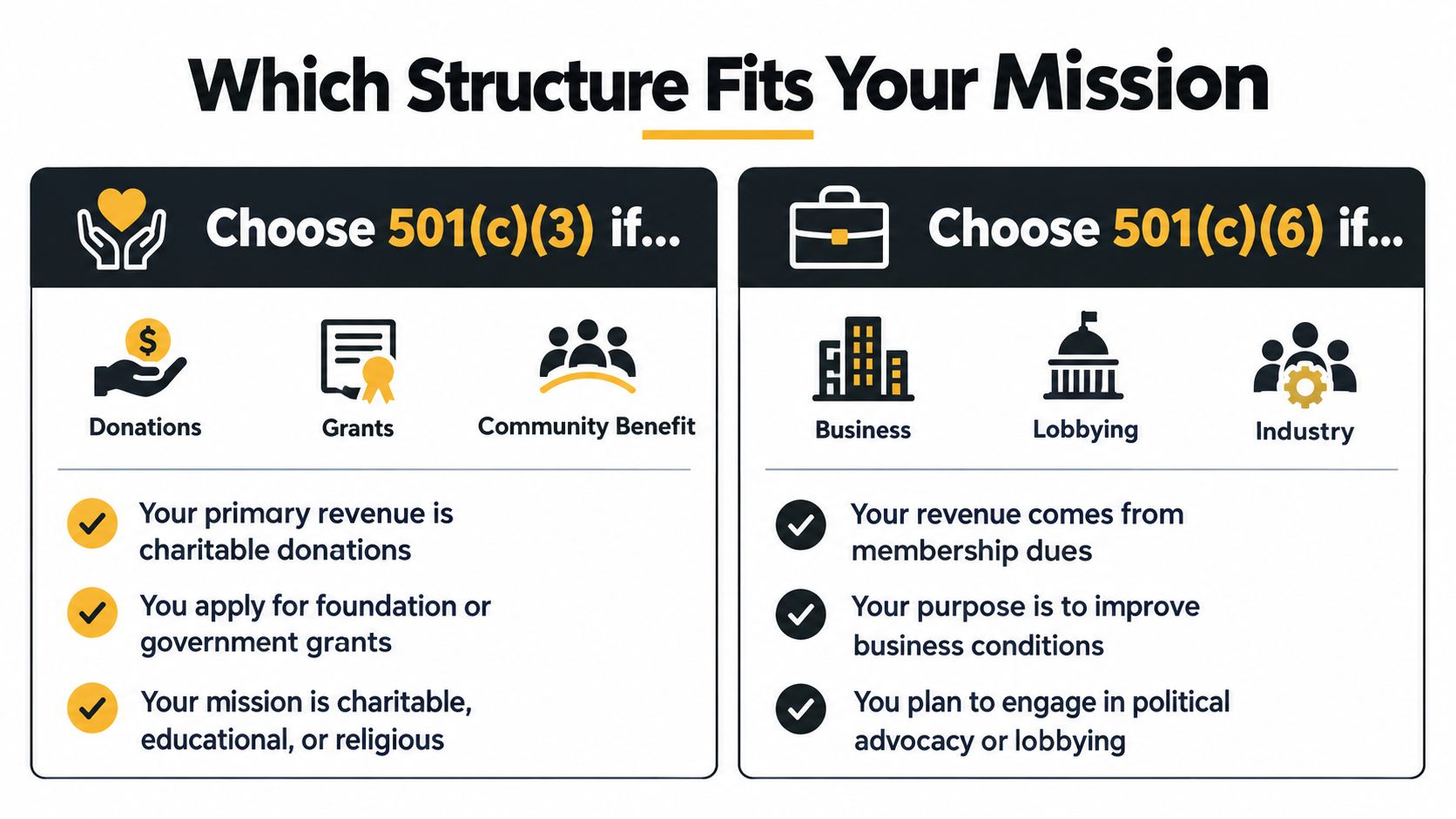
Choose the structure by asking one blunt question. Is your organization built to raise charitable dollars for public benefit, or is it built to advance a membership base, profession, or industry through advocacy and dues? If the first answer is yes, file as a 501(c)(3). If the second answer is yes, file as a 501(c)(6).
Match the structure to your actual revenue model
If your plan depends on gifts, foundation grants, grant reimbursements, and public trust, a 501(c)(3) is the right fit. If your plan depends on member dues, conferences, standards work, and policy pressure, a 501(c)(6) fits better.
Do not force a grant-funded mission into a trade-association frame. The funding market will expose that mismatch fast, and the IRS will not treat mission language as a substitute for actual operations. If you are leaning toward 501(c)(3), review grants for nonprofits before you file so you can map the funding pipeline against the structure you choose.
A dual-entity setup can work. Put advocacy in a 501(c)(6) and keep education or public-benefit programming in a separate 501(c)(3) affiliate. That separation keeps the missions clean and gives each entity a funding path that fits how it operates.
Do not treat conversion as an easy fix
Changing status later is possible, but it is a messy correction, not a clean shortcut. You may need revised governing documents, a new EIN, and a fresh exemption filing or reclassification path. That takes time, and it usually takes more than founders expect.
Your next moves should be procedural
- Confirm the state filing first. The nonprofit corporation language should match the federal purpose you want.
- Align the bylaws with the purpose clause. Internal inconsistency invites problems.
- Map three years of activity. You need a credible story for Form 1023 or Form 1024.
- Budget for legal prep. If you hire counsel, pre-filing work usually falls in a modest range, but the exact cost depends on how simple or complex the structure is.
- Choose the funding path now. Grants and donations point to 501(c)(3). Dues and advocacy point to 501(c)(6).
If you are choosing between grant-funded charity work and member-driven advocacy, Grantlas helps you pressure-test your funding strategy before you file. Visit Grantlas to see whether your organization fits the grant market and where it should apply.