Letter of Intent for a Grant How to Write and Win
Sep 21, 2026 · 16 min read

Your team finally finds a promising grant. The program looks aligned, the timeline seems workable, and you can already picture the full proposal taking shape. Then you reach one line in the guidelines: submit a letter of intent first.
That's the moment many first-time nonprofit writers stall. Is this just a short intro note? A mini proposal? A formality? If you get it wrong, will you lose the chance to apply?
Those questions make sense, because a letter of intent for a grant sits in an awkward middle space. It's short, but it matters. It's preliminary, but it often decides whether reviewers want to see more. And before you write a single sentence, there's an even more important question many guides skip: does this funder want an LOI at all?
Table of Contents
- Introduction Why a Short Letter Can Decide Your Grant Future
- What a Grant Letter of Intent Really Is and How It Works
- When Funders Require a Letter of Intent and When They Do Not
- Key Parts of a Strong Grant Letter of Intent
- 1. A direct opening that orients the reviewer
- 2. A need statement tied to a specific group and place
- 3. A short project description with only the highest-value details
- 4. Clear fit with the funder's current priorities
- 5. Feasibility, outcomes, and the level of budget detail requested
- 6. Format and compliance signals
- What to Include Now Versus Save for the Full Proposal
- Sample Language and Reusable Template You Can Adapt
- Next Steps After You Submit Your Letter of Intent
Introduction Why a Short Letter Can Decide Your Grant Future
A first-time grant writer opens a promising opportunity and starts planning the full proposal. Program goals match. The budget seems possible. The team is ready to gather data and draft narratives. Then the guidelines add one condition: send a letter of intent first.
That small step can decide whether the larger application ever gets read.
For funders, an LOI often works as an early screening tool. It helps staff sort strong-fit ideas from weak-fit ones before they spend time on full proposals. In a short space, they are asking practical questions: Does this project match our priorities? Is the request sized realistically? Does this organization appear prepared to carry out the work?
A short document can carry a lot of weight. That is what catches newer nonprofit teams off guard.
The confusion usually starts before the writing does. Some funders still require an LOI. Some have replaced it with an online eligibility quiz, a concept form, or a short pre-application. Some accept full proposals directly and do not want a preliminary letter at all. If you skip that rule check and draft the wrong document, you can waste hours polishing material the funder never asked to see.
The next decision is just as important. What belongs in an LOI, and what should wait?
A good LOI works like a front porch, not the whole house. It should let a reviewer see the shape of the project, who it serves, why your organization fits, and whether the request deserves a closer look. It does not need every room furnished. Long methodological detail, full partner descriptions, dense evaluation plans, and line-by-line budget defense usually belong in the full proposal unless the guidelines ask for them now.
That is where many nonprofit writers lose ground. Some stay so general that the project sounds thin. Others pour in every fact they have, hoping detail will prove seriousness. Both approaches miss the funder's decision point. At the LOI stage, the reviewer is often deciding whether to invite the longer conversation, not whether to approve the entire grant on the spot.
A better approach is simpler. First, confirm whether the funder wants an LOI, a different pre-application step, or no preliminary submission at all. Then shape the letter for that screening purpose and save the heavier evidence for later, unless the guidelines clearly request it now.
That choice, made before you draft the first paragraph, can save time and improve your odds.
What a Grant Letter of Intent Really Is and How It Works
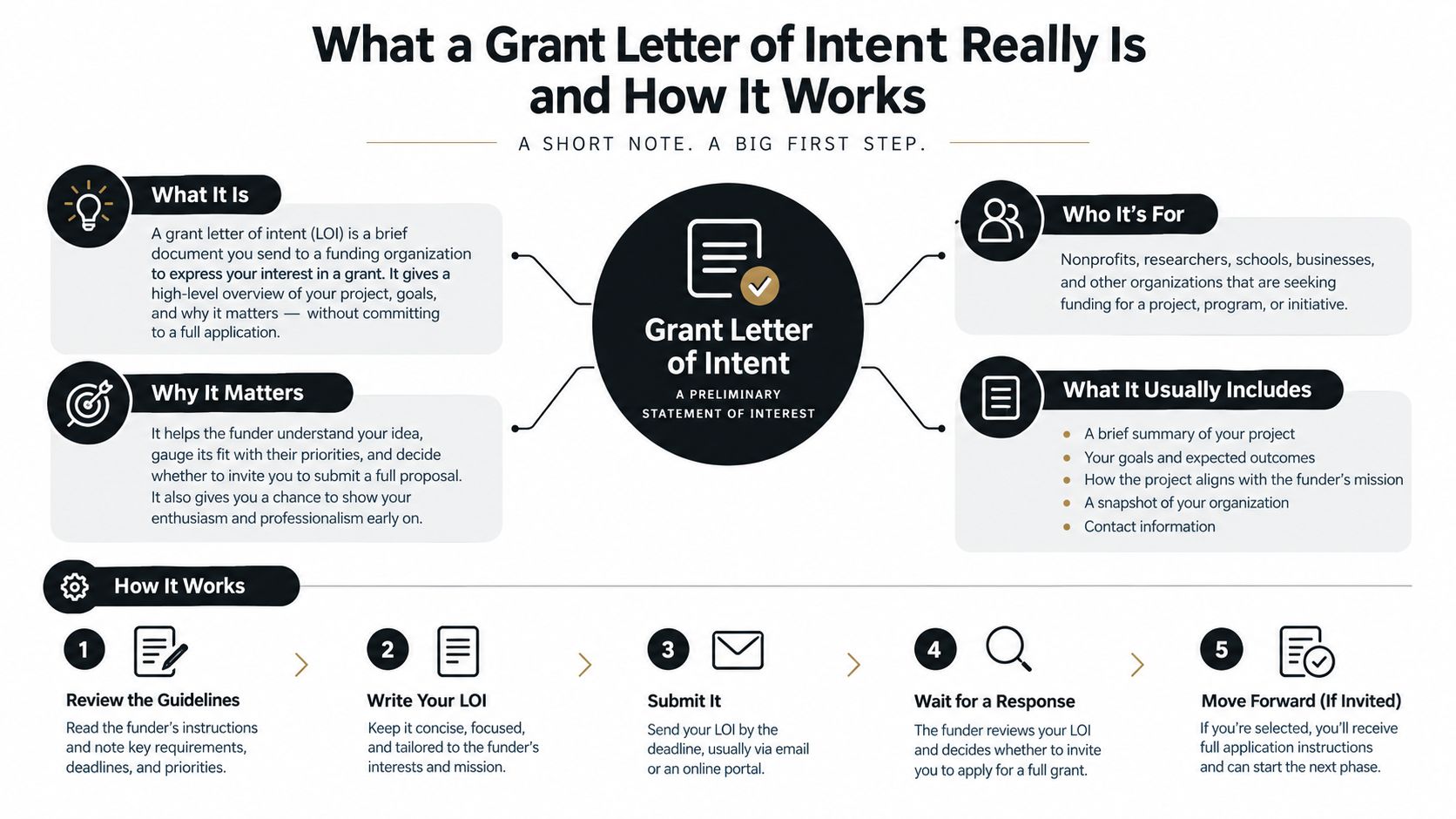
The easiest way to understand a letter of intent for a grant is this: it's a movie trailer, not the full film.
A trailer gives the audience the premise, the tone, and enough evidence that the story is worth their time. It doesn't reveal every scene. A grant LOI works the same way. It introduces the problem, names your proposed response, signals why your organization is a believable fit, and gives reviewers enough confidence to decide whether they want the full narrative.
It's not the same as an inquiry email
Writers often mix up four different documents:
| Document | Main purpose | Typical tone |
|---|---|---|
| Letter of intent | Screen for fit before a full proposal | Formal and concise |
| Letter of inquiry | Introduce a funding idea, often in foundation settings | Brief and persuasive |
| Cover letter | Accompany a full application package | Supportive and administrative |
| Full proposal | Make the full case for funding | Detailed and evidence-driven |
If you want to see how an LOI differs from a foundation-first inquiry, this guide to a letter of inquiry for a grant is useful as a comparison point.
Why funders use it
Funders don't request LOIs just to create extra work. They use them because review capacity is limited and not every applicant is a strong match. A short pre-proposal helps staff decide which ideas fit the guidelines closely enough to move forward.
That function is especially clear in federal settings. USDA National Institute of Food and Agriculture guidance shows how formal this stage can be. Its LOI instructions state that the letter is limited to 3 pages for CAP grants and 2 pages for all other grant types, that LOIs are encouraged for all grant types except Conference Grant applications, that only PDF submissions are accepted, and that submitting more than one LOI to a program is discouraged, according to GrantBoost's summary of the USDA NIFA LOI instructions. That's not a courtesy note. That's a controlled intake process.
What reviewers are usually deciding
At the LOI stage, reviewers often focus on a smaller set of questions than many applicants expect:
- Is there clear alignment? Does the project fit the funding opportunity?
- Is the scope believable? Does the plan sound appropriately sized and manageable?
- Does the applicant seem credible? Can this organization reasonably carry out the work?
- Should we invite more detail? Is a full proposal worth the time to review?
Practical rule: If a sentence doesn't help a reviewer answer one of those questions, it probably doesn't belong in the LOI.
That's why effective LOIs feel calm and selective. They don't try to win the whole grant in one shot. They make a disciplined first case.
When Funders Require a Letter of Intent and When They Do Not
You find a promising grant on Monday. By Tuesday, your team is drafting project language. By Friday, someone notices a line buried in the guidelines: full proposals are by invitation only, and the invitation depends on a short pre-application you already missed.
That happens more often than new applicants expect. The first decision is not how to write the LOI. The first decision is whether this funder wants one at all, and if so, whether it is a screening tool, a courtesy notice, or a required first step.
The three patterns you will see most often
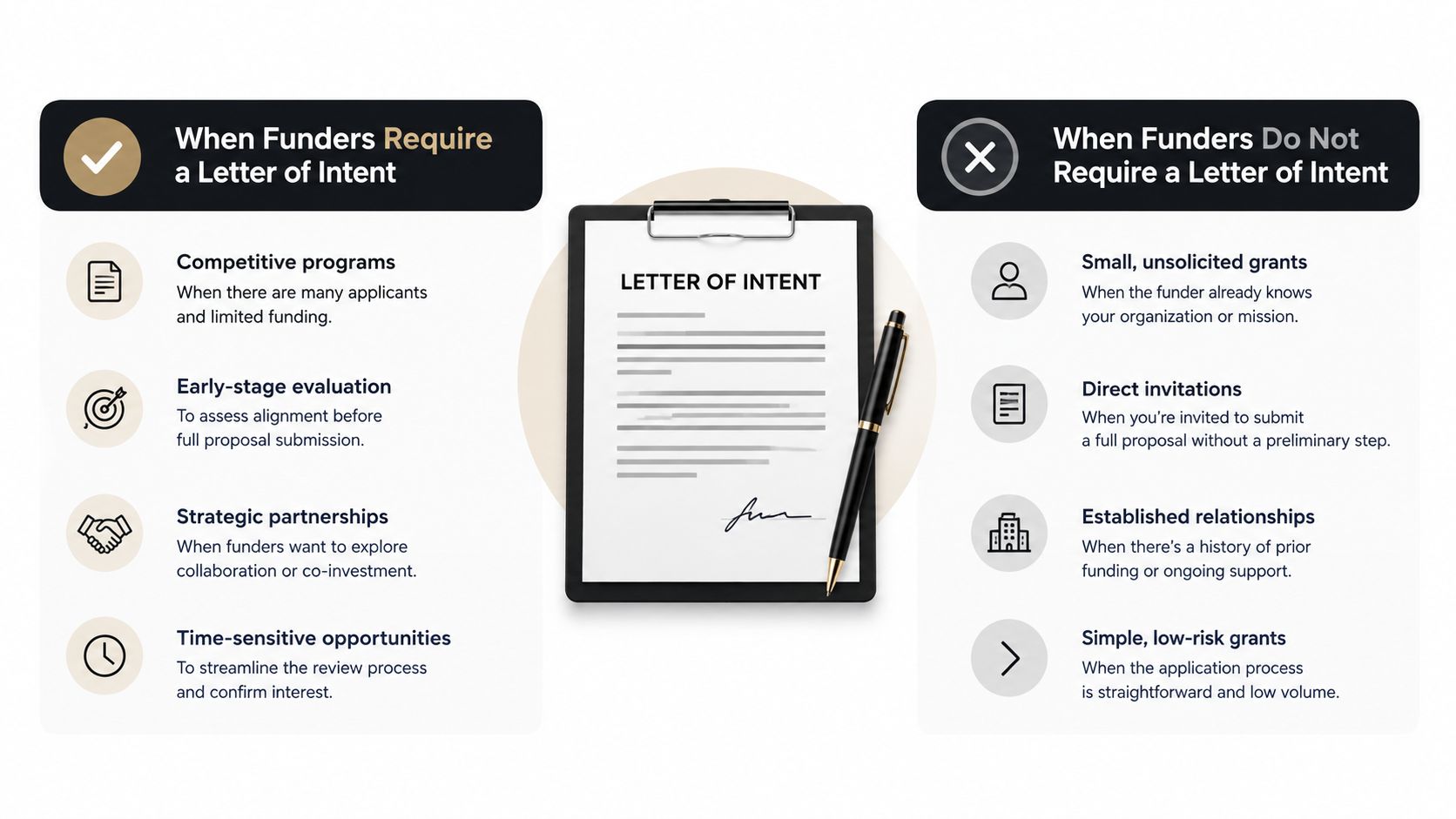
Funders usually handle early-stage submissions in one of three ways.
Mandatory LOI
The letter is part of eligibility. Miss it, and you are out of the process.Optional or encouraged LOI
The funder uses it to estimate interest, answer questions, or advise applicants, but a full proposal may still be allowed without it.No LOI at all
The program goes straight to a full application, or it uses a different first-stage document such as a concept paper or pre-application.
A helpful comparison is airport security. Some programs wave everyone toward the main line. Some send you through a short checkpoint first. Some use a different gate entirely. If you walk into the wrong line, strong project ideas still get turned away.
This video gives a quick overview of how grant gatekeeping can work in practice.
Why this question matters more now
Funder rules have become less predictable across agencies and programs. As summarized in this review of LOI rule changes, some federal programs that once accepted letters of intent no longer do, while others still require them and tie them to a strict early deadline.
That shift creates a common mistake. Nonprofit teams read one guide about LOIs, then assume the same process applies everywhere. It does not. The live funding notice controls the process, even when an agency used a different approach last year.
A second source of confusion is that funders do not always call this step an LOI. You may see pre-application, concept note, statement of interest, project summary, or request to apply. Different label, same practical question: do you need to submit something short before the full proposal?
How to tell, fast
Start with the application sequence, not the narrative requirements. Scan the notice, portal, or guidelines for these signals:
- A separate due date before the full proposal
- Language such as “required,” “invited,” “pre-application,” or “selected applicants only”
- Portal tasks that open in stages
- Instructions that full applications are accepted only after review of an earlier submission
- A contact note encouraging potential applicants to notify program staff in advance
Read those clues together, not one by one. A short form with its own deadline and its own portal tab is usually a formal gate. A brief note requested for planning purposes is usually less consequential, though you should still treat it carefully.
What to do if the instructions are unclear
Use a simple check:
- If the guidelines say required, treat the LOI as an eligibility item.
- If the guidelines say encouraged or optional, decide whether submitting one improves your position or helps you get feedback.
- If the guidelines say nothing, search for alternate terms and review the portal before assuming no LOI exists.
- If the notice and portal seem to conflict, ask the program contact in writing.
That last point matters. Some funders have updated one part of their process but not another. The PDF may say one thing. The portal may suggest another. Current program instructions win.
A careful pause here saves hours later. It also helps you make the next smart choice: what belongs in this short first submission, and what should wait for the full proposal.
Key Parts of a Strong Grant Letter of Intent
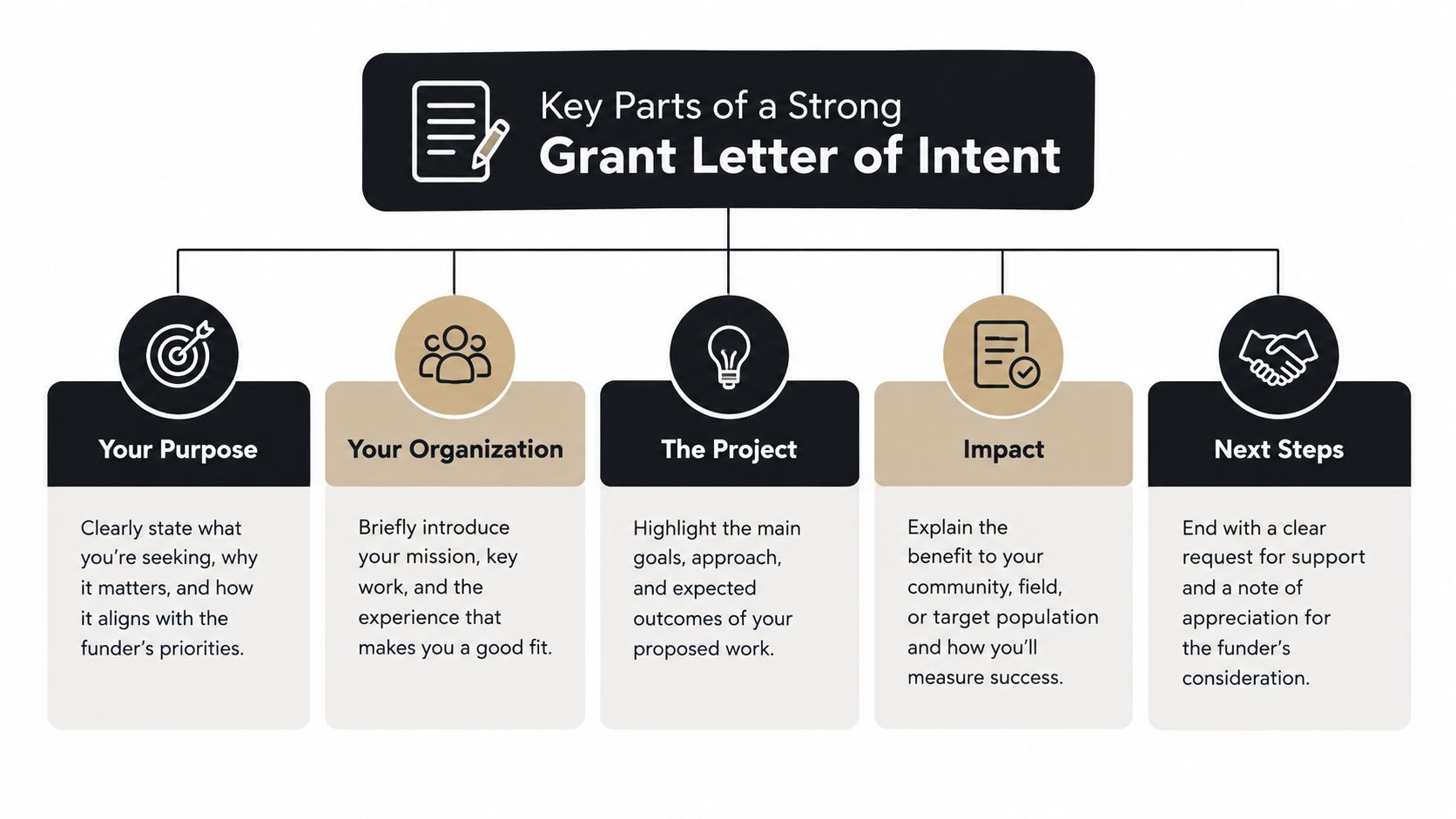
A strong LOI works like a screened porch. It lets the funder see the shape of the house without walking through every room. Your job is to give a clear view of the project, show that it fits the program, and stop before you drift into full proposal detail.
1. A direct opening that orients the reviewer
Open fast. In the first few lines, name your organization, the funding opportunity, the amount if requested, and the project you want funded.
A reviewer should not have to hunt for the point. If your first paragraph is clear, the rest of the letter is easier to trust.
For example, a sentence like this does real work: “Bright Path Youth Services seeks support through the Healthy Communities Fund for a school-based mental health initiative serving middle school students in Jackson County.”
Then add one or two lines that explain why your organization is a believable lead for this work. Keep the focus narrow. The reviewer needs relevant credibility, not your full history.
2. A need statement tied to a specific group and place
First-time writers often go too wide. They start describing a national problem when the funder needs a local, workable case for support.
Anchor the need in your community, your population, and the barrier you plan to address. Then connect it to the project right away. If the problem and the response sit too far apart on the page, the LOI starts to feel abstract.
A simple sequence helps:
- The problem
- Who is affected
- What gets in the way now
- What your project will do
If you want a model for that middle section, these statement of need examples for grants show how to stay specific without overexplaining.
3. A short project description with only the highest-value details
At the LOI stage, reviewers usually want the frame, not the blueprint.
Describe the core activities, who will receive them, and the basic timeline or scope if the guidelines ask for it. A few concrete details help the reviewer picture the work. Too many details can create a different problem. They signal that you may not understand what belongs in an LOI versus a full application.
A useful test is simple. If a detail helps the funder decide whether to invite a proposal, keep it. If it mainly helps them manage an award after approval, save it for later.
4. Clear fit with the funder's current priorities
Fit deserves its own paragraph because LOI rules have shifted at many foundations and grantmakers. Some now use the short first-stage submission to screen for alignment before they ask for budgets, attachments, or long narratives. That means a well-written LOI is not just a summary. It is an early yes-or-no test.
Show the match in plain language. Name the priority, population, or strategy your project supports. Then explain the connection in one or two sentences.
Avoid pasting the funder's language back at them. Reviewers can tell when wording has been copied from the guidelines. Use their terms accurately, but explain the fit in your own voice.
5. Feasibility, outcomes, and the level of budget detail requested
The reviewer is asking two questions. Can this organization carry out the project, and is the request sized realistically?
Answer both without turning the LOI into an operations memo. Mention the staff capacity, partner role, or prior experience that makes the project doable. Add a brief outcome statement so the reader knows what change you expect.
If the funder asks for budget information, keep it at the level requested. Many LOI processes ask for an estimate rather than a full line-item budget, and some do not require a complete personnel list at this stage. As noted earlier, that is a reminder to stay focused on scope, fit, and readiness.
A strong LOI gives the reviewer enough detail to make an invitation decision, not enough detail to run the entire project on paper.
6. Format and compliance signals
Content matters. So does obedience to the instructions.
Page limits, file type, naming rules, form fields, and character counts are part of the review experience. A clean LOI tells the funder your team can follow directions and respect the process. A crowded, over-limit, loosely formatted letter suggests the opposite.
Before you submit, check one last thing many writers miss. Make sure every section earns its place. If a paragraph does not help the funder decide whether to invite a full proposal, cut it.
What to Include Now Versus Save for the Full Proposal
You open the funder portal and see “Letter of Intent.” Then you freeze. Should you squeeze in every detail now, just in case they never ask for more, or keep it short and risk sounding thin?
A good LOI solves that tension by doing one job well. It helps the funder decide whether your project deserves a full review. That means your letter should read like an informed preview, not a packed storage closet.
Use the LOI as a screening tool, not a mini proposal
Many first-time applicants assume more detail shows seriousness. In an LOI, extra detail often creates a different signal. It suggests the team may not understand this stage of the process.
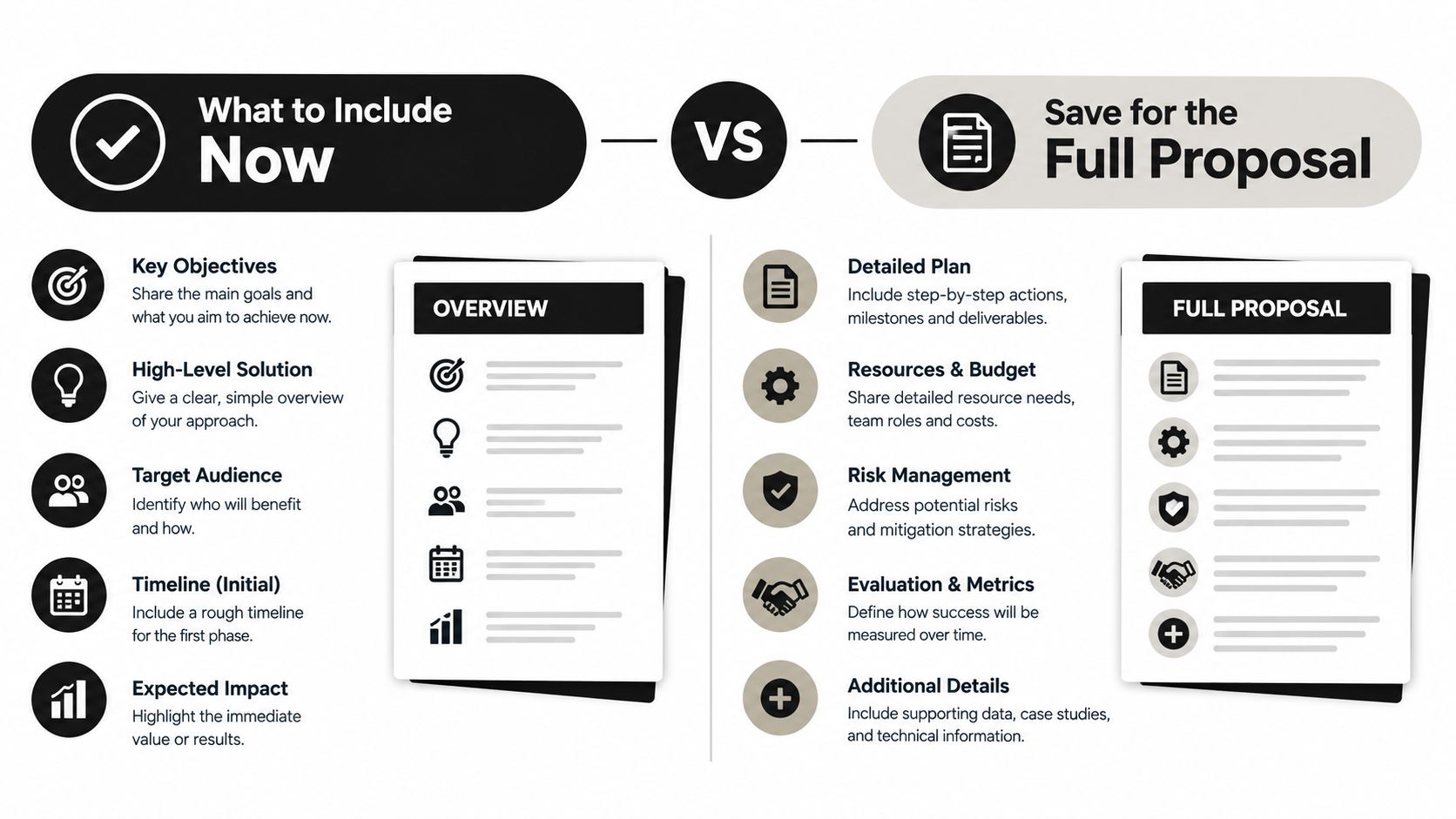
A simple rule helps. Include enough for a reviewer to judge fit, need, and basic feasibility. Save the proof layers, attachments, and operating detail for later unless the funder specifically asks for them now.
That distinction matters even more because some funders have changed their intake process. A growing number now use online forms, short concept fields, or invitation-only proposals instead of a traditional letter. So before drafting, confirm what this “LOI” is in this competition. It may be a letter, a portal form, or a short narrative with strict word limits. The writing choice changes with the format.
A simple comparison that prevents overwriting
| Belongs in the LOI | Save for the full proposal |
|---|---|
| Short project summary | Full work plan |
| Brief need statement | Expanded evidence and context |
| Basic organizational fit | Detailed history and attachments |
| Budget estimate | Line-item budget and narrative |
| High-level staffing mention | Full personnel list and bios |
| Short note on outcomes | Full evaluation framework |
This is not about being vague. It is about sequence. The reviewer needs the front door first, not every room in the building.
What belongs in now
Put in the information that answers the invitation question: Should this applicant be asked to submit more?
That usually includes:
- The project in plain language, including who you will serve and what you plan to do
- The reason this matters now, stated briefly and specifically
- Why your organization fits this grant, based on mission, experience, population served, or setting
- A realistic request amount or budget estimate, if the funder asks for one
- A short feasibility signal, such as current staff, an existing site, or an active partner
- A simple outcome statement, so the reviewer can picture the result
Current LOI rules often support this lighter level of detail. Some funders ask for only estimated costs at this stage. Some do not want a full staffing roster yet. As noted earlier, that is your cue to show readiness without dropping the entire proposal into the letter.
What usually belongs later
Save the material that proves, documents, or breaks down the project in full unless the instructions request it now.
That often includes:
- Step-by-step methods
- Full evaluation plans
- Detailed partner roles and MOUs
- Complete staff bios
- Line-item budget notes
- Long support letters and attachments
Support letters are a good example. A reviewer rarely needs several pages of endorsements to decide whether to invite a proposal. Those documents usually carry more weight later, once your core idea has cleared the first screen. If you want to prepare ahead, this sample letter of support for a grant shows the kind of material you can develop for the full proposal stage.
A quick filter for hard choices
If you are unsure whether a paragraph belongs in the LOI, ask one question: does this help the funder decide on an invitation now?
If yes, keep it.
If not, move it to your proposal draft file.
Another useful test is to label each paragraph by function. It should be doing at least one of these jobs:
- showing need
- showing fit
- showing feasibility
- showing readiness for next-step review
Paragraphs that do none of those jobs are usually the ones that make an LOI feel crowded. Cutting them does not weaken the letter. It improves the signal.
Sample Language and Reusable Template You Can Adapt
Starting from a blank page is hard. Starting from a calm pattern is easier.
Below are sample passages you can adapt. They aren't magic phrases, and they shouldn't be copied word for word. Their value is in the structure. Each one stays short, specific, and centered on what a reviewer needs to know at the LOI stage.
Sample opening paragraph
“Our organization, Riverbend Youth Center, respectfully submits this letter of intent for the Community Learning Fund. We seek support for an expansion of our after-school literacy and family engagement program serving middle school students in our service area. This proposed project aligns with the fund's focus on educational access and community-based support for young people.”
Why this works:
- It names the applicant.
- It names the funding opportunity.
- It states the request plainly.
- It signals fit early.
Sample need and project summary
“Many students we serve face barriers that affect consistent academic support outside school hours, including limited access to tutoring and caregiver support during the school week. To respond, we propose a school-year program that combines small-group literacy instruction, family workshops, and coordinated case management referrals. Our team already operates youth programming in this setting, which gives us the staff relationships and delivery structure to launch the project efficiently.”
This kind of paragraph stays at the right altitude. It doesn't wander into a full curriculum description or staffing chart.
A useful LOI sentence names both the problem and the response in the same breath.
Sample budget and closing language
“We anticipate submitting a full proposal requesting support within the funder's typical range and would be prepared to provide a detailed budget, implementation plan, and partnership documentation if invited. Thank you for considering this project summary. We would welcome the opportunity to submit a full application and provide any additional information helpful to your review.”
That closing works because it's courteous and forward-moving. It doesn't pressure the funder. It makes the next step easy.
Reusable template
You can build a first draft from this fill-in structure:
Opening
“[Organization name] submits this letter of intent for [program name]. We seek support for [short project description].”Need
“The project addresses [problem] affecting [population] in [service area].”Response
“We propose to [core activities] in order to [intended change].”Why your organization
“Our organization is positioned to do this work because [relevant experience, relationships, or capacity].”Funder fit
“This request aligns with [specific priority or guideline language in natural wording].”Budget and close
“We estimate a request of [budget estimate if appropriate] and would welcome the opportunity to submit a full proposal.”
If you want help organizing draft language around timing and submissions, these free templates for proposal deadlines can be useful for keeping your LOI and follow-up materials moving on schedule.
For federal contexts, keep the tone a bit more procedural. For private foundations, you can usually sound slightly warmer. In both cases, clarity beats flourish.
Next Steps After You Submit Your Letter of Intent
Submitting the LOI isn't the end of the task. It starts a new phase.
A funder will usually do one of three things. They may invite a full proposal, ask a follow-up question, or decline to move forward. Each response gives you information. An invitation confirms fit. A question signals interest but also shows where your summary left uncertainty. A decline may reflect competition, timing, or mismatch, not necessarily poor writing.
What to do right after submission
Create a simple tracking record with:
- Funder name
- Program name
- LOI submission date
- Expected response window if stated
- Who submitted it
- Any follow-up tasks or internal reminders
Then save the exact version you sent. If you're invited to apply, you'll want to reuse language carefully and expand it, not rewrite from memory.
How to respond to each outcome
If you're invited, review the LOI before drafting the full proposal so your larger narrative stays consistent. If the funder asks a clarifying question, answer directly and briefly. If you receive a no, archive the draft and note whether the project might fit another funder with only light adaptation.
Treat each LOI as reusable groundwork, not a one-time writing exercise.
Before you hit submit, do one final check on page limit, file type, submission method, and any required naming or portal instructions. Those details seem small until they keep a strong idea from reaching review.
Grant writing gets easier when you can quickly tell which funders want an LOI, which opportunities fit your organization, and which deadlines matter first. Grantlas helps nonprofits find private and federal grant opportunities, flag likely mismatches early, and keep a cleaner pipeline from prospect research to submission. If you're tired of guessing where to spend proposal time, it's worth a look.