10 Different Types of Grant Explained for Nonprofits
Sep 22, 2026 · 18 min read
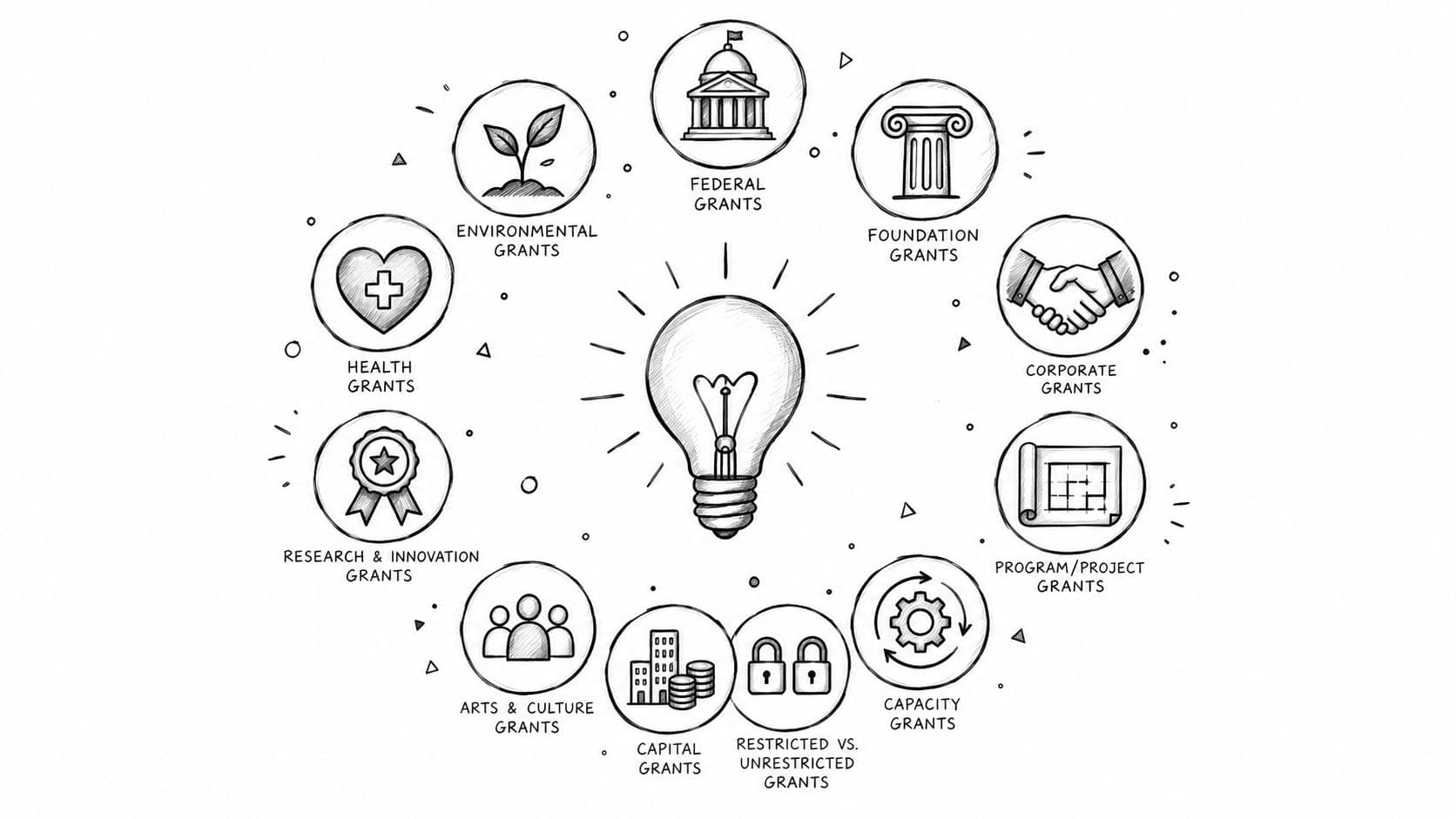
“Apply for as many grants as possible” is popular advice, but it's usually a poor strategy. The phrase grant type can describe who provides the money, such as a federal agency, foundation, corporation, or local government, or what the money may fund, such as a project, operating costs, research, emergency response, or a capital campaign.
This distinction matters. A federal grant may be project-specific and highly structured, while a foundation grant may support general operations. A corporate award may include sponsorship expectations, while a capacity-building grant may pay for a financial system rather than direct services. This guide explains 10 different types of grant across both dimensions so your team can compare the funder, purpose, eligibility, preparation, restrictions, and reporting burden before investing in an application.
Government funding is a central nonprofit revenue channel. In 2023, two out of three U.S. nonprofits received at least one government grant or contract, and the average nonprofit generated about one-quarter of its revenue from government sources, according to the Urban Institute's national findings on government grants and contracts. Private foundations and other funders create a different research problem, so use giving history, eligibility flags, and realistic fit rather than broad outreach. Teams that need help with outreach can also review these fundraising resources for cold email.
Table of Contents
- 1. Federal Grants
- 2. Foundation Grants
- 3. Corporate Grants and Sponsorships
- 4. Government Program Grants
- 5. Project-Specific Grants
- 6. Operating Support and General Operating Grants
- 7. Research and Development Grants
- 8. Capacity Building and Organizational Development Grants
- 9. Emergency and Disaster Relief Grants
- 10. Endowment and Capital Campaign Grants
- 10 Grant Types Compared
- Match the Grant to the Need Before You Apply
1. Federal Grants
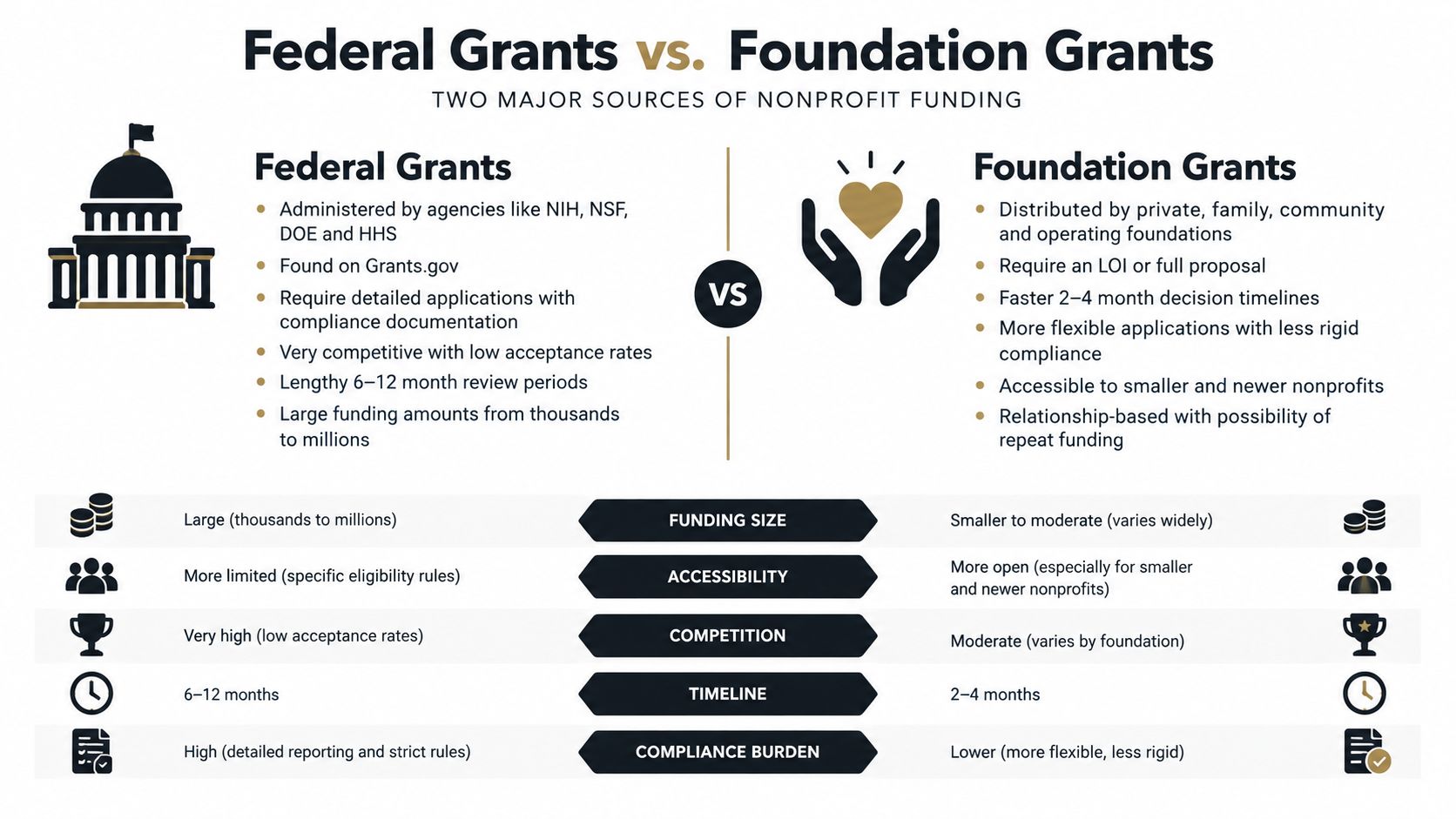
Federal grants are public funds distributed by U.S. government agencies for activities that serve a public purpose. They may support health, education, research, transportation, income security, community development, or social services. The Congressional Research Service explains that these awards generally use one of two routes: formula grants, allocated according to a set method, or discretionary competitive grants, awarded through a proposal competition.
The funding source is only half the classification. Purpose also shapes the application. A Department of Justice opportunity for victim services may require a community organization to present a defined project, while a university hospital seeking National Institutes of Health research funding must document a research plan and institutional capacity. Both are federal prospects, but their eligible activities, evidence, budgets, and review criteria differ.
Practical rule: Check federal eligibility and registration before writing. They determine whether the opportunity is realistic.
What federal applicants should prepare
Start by confirming the applicant type, geographic rules, allowable costs, matching requirements, reporting schedule, and submission system. Keep federal registration details, financial records, and other organizational documents current. Read the complete notice of funding opportunity, because it sets the project boundaries and evaluation criteria.
A competitive application should connect five parts:
- Public need: Define the problem with credible local or sector evidence.
- Program design: Specify who will act, what they will do, when activities will occur, and whom they will serve.
- Outcomes: Identify expected changes and explain how staff will measure them.
- Budget: Link every expense to an eligible activity and a workable implementation plan.
- Compliance capacity: Demonstrate that the organization can manage procurement, records, subawards, monitoring, and required reports.
A small nonprofit may have a strong service idea but lack the staff or systems required for a federally funded project. Use Grantlas to find opportunities that match your organization's profile, then confirm each condition in the official notice. A promising purpose does not overcome an ineligible applicant type or an unsupported budget.
2. Foundation Grants
A foundation grant can fund a project, but it can also support the organization doing the work. That range makes foundation funding different from a federal, project-specific opportunity. The provider is a philanthropic organization, such as a private, family, community, or endowed foundation. Its governing documents, trustees, giving history, and geographic or thematic priorities shape what it will consider.
The field is broad. The 2025 UKGrantmaking analysis reported that general foundations in the United Kingdom spent £2,823.7 million on grantmaking in 2023–24, compared with £2,329.0 million the previous year, a 6% increase. It also distinguishes community foundations from government or lottery-endowed foundations. Those categories can differ in application route, decision process, and willingness to fund new organizations.
Match the purpose to the funder
Begin with the foundation's mission, location, program interests, past recipients, and usual award purpose. IRS Form 990-PF filings can show recipients and giving patterns. A keyword match is only a starting point. A foundation that supports education might fund one age group, county, intervention, or institution type.
A youth mentoring nonprofit, for example, should explain how its work fits the foundation's stated priorities, rather than submit the same case for support to every funder. Its preparation may include:
- A case for support: Link the organization's work to the foundation's priorities.
- An organizational profile: Summarize its history, governance, community role, and financial position.
- A funder-specific budget: Show the requested costs separately from the full project or operating budget.
- A relationship plan: Identify trustees, staff, or community contacts who can clarify fit.
- An access check: Confirm whether unsolicited proposals are accepted or applications are invitation-only.
The word “foundation” does not tell you whether funding is restricted. Some awards pay for a defined program, while others cover general operations, research, technology, or organizational development. Read the restrictions before designing the request, especially as a new grantee.
Grantlas can help identify foundation prospects, explain fit in plain English, display giving history, and show trustee or board information for thoughtful outreach.

3. Corporate Grants and Sponsorships
Corporate funding sits at the intersection of two questions: who provides it and what it pays for. A business, corporate foundation, employee-giving program, or corporate social responsibility team may offer cash for a project, equipment, professional services, event support, employee volunteering, or a cause-related marketing partnership. The purpose can be restricted to a defined initiative or tied to broader community support.
A youth employment nonprofit might seek equipment and mentors from a technology company, workforce training support from a bank, or community-program funding from a retailer with a local presence. These prospects differ because each company has its own operating footprint, employee interests, public commitments, and approval process. A strong match connects the nonprofit's needs with the company's stated interests, rather than treating every corporate contact as the same type of funder.
The relationship may also include duties beyond accepting a charitable contribution. A company could ask for recognition, employee participation, impact updates, event involvement, or permission to describe the partnership publicly. Clarify those terms before accepting support, especially when publicity could affect beneficiary privacy or the nonprofit's independence.
Review the channel that fits the opportunity:
- Corporate foundations: Check the formal mission, application process, past recipients, and geographic focus.
- Direct corporate giving: Look for community investment or social impact programs managed within the company.
- Employee programs: Check for matching gifts, volunteer grants, workplace campaigns, and team-led fundraising.
The proposal should explain two things clearly: the community problem the funding will address and the practical role the company can play. A sponsor may receive appropriate recognition, but promotional value should not replace a defined charitable purpose.
Prepare a short partnership brief covering the request, beneficiaries, timeline, budget, recognition terms, staff contact, and measurable outputs. Grantlas can help locate corporate foundation opportunities and review past giving, allowing your team to focus on companies with a genuine connection to its mission.

4. Government Program Grants
Government program grants come from state, county, city, and other local public agencies. Their funding priorities may include public health, education, employment, neighborhood revitalization, recreation, housing, and social services. The source is governmental, while the purpose is usually a public service tied to a defined community and jurisdiction.
For example, a county health department might support disease prevention services. A state education agency could fund dropout prevention, while a city department might hire a nonprofit to run activities at a community center. These opportunities differ from federal grants mainly in administrative distance and local fit. The agency is closer to the residents, needs, and public systems involved.
A nonprofit can deliver an excellent program and still be ineligible if it serves the wrong county, falls outside the required service area, or lacks the required public-sector partnership. Read those conditions before contacting program staff or preparing a budget.
Start with the agency's rules
Local context shapes both eligibility and administration. Review the public grant portal, city or county announcements, program guidelines, and application calendar. Government deadlines may follow public budget cycles rather than your fundraising schedule.
Before applying, prepare:
- A local-need record: Organize service records, community input, referral data, and local planning documents.
- A program contact plan: Ask agency staff about objectives, eligible costs, reporting, and partnership expectations.
- A cash-flow plan: Confirm when reimbursement occurs and whether your nonprofit can cover expenses before payment.
- A compliance workflow: Assign responsibility for invoicing, data collection, procurement, monitoring, and required reports.
The last point can determine whether the opportunity is practical. A grant may match your mission but strain staff capacity if the reporting and reimbursement process exceeds what your team can manage.
Government program funding often suits nonprofits already providing services that public agencies need. Grantlas can help search state and local opportunities across all 50 states and DC, using geographic filters to narrow the field before staff spend time on detailed eligibility review.
5. Project-Specific Grants
Project-specific grants pay for a defined initiative with a clear scope, start point, end point, activities, outcomes, and budget. This purpose category can appear across federal, foundation, corporate, and local government funding. The source tells you who controls the money. The project restriction tells you what the award can pay for.
Consider an adult literacy nonprofit proposing a new instructional program. Its application should describe the participants, curriculum, staff roles, recruitment approach, delivery schedule, expected outcomes, evaluation method, and plan for continuing or adapting the work after the award ends. A request for general organizational expenses would answer a different question and may not be allowable under the opportunity.
Build the project before you build the proposal
Define the project internally first. Staff should agree on the problem, activities, responsibilities, timeline, costs, risks, and evidence of progress. Then match those elements to funders that support the same population, geography, and intervention.
A project budget may include direct personnel, supplies, outreach, evaluation, technology, travel, and an appropriate share of indirect costs if permitted. Don't promise an ambitious service model without confirming that the team can recruit participants, manage partners, collect data, and report results.
Your narrative should also address sustainability. That doesn't require claiming that the project will become permanently self-funding. It can explain how the organization will use lessons, partnerships, evidence, infrastructure, or future funding to preserve valuable work.
For structure and language ideas, review these sample nonprofit grant proposals, then adapt the approach to the specific funder rather than copying a generic format.
A focused prospect list is more useful than a large one. Use Grantlas fit scoring to compare funders by project alignment, eligibility, geography, likely award purpose, and giving history. Include the video below as a training resource for staff who need a visual introduction to grant proposal development.
6. Operating Support and General Operating Grants
Operating support grants provide funding for an organization's core work rather than a single restricted project. Depending on the award terms, the money may help cover salaries, rent, utilities, administration, communications, insurance, technology, or other expenses that allow programs to function. The funder invests in the organization's ability to deliver its mission over time.
This flexibility makes general operating support valuable, but it also changes the application. The proposal must explain why the organization deserves investment as a whole, not why one activity deserves a budget.
What funders need to trust
A nonprofit seeking operating support should present a coherent organizational narrative. Explain the community need, the organization's role, its programs, evidence of effectiveness, leadership, governance, financial controls, and near-term priorities. A funder may also want to understand revenue concentration, reserves, staffing, and major operational risks.
Private philanthropy is shifting toward more flexible funding, but access remains uneven. The 2025 report on private philanthropy found that private foundations gave about 38% of grants for general operating support in 2025, after remaining near 20% for roughly two decades. The same source reports that 77% of grantmakers provide capacity-building support, while only 28% offer multiyear general operating support. The gap shows why unrestricted funding exists but shouldn't be assumed.
Prepare to answer:
- What will flexible dollars support? Tie the request to staffing, continuity, responsiveness, or strategic priorities.
- How does the organization manage money? Provide clear financial statements, controls, governance information, and an understandable budget.
- What evidence supports the work? Use service outcomes, community feedback, partnerships, and stories without overstating causation.
- Why this funder? Point to actual giving history and a demonstrated interest in organizations like yours.
A carefully targeted request will outperform a generic appeal for unrestricted funds. Grantlas can help identify foundations with a history of operating support and compare their giving patterns before you draft an organization-wide case.
For proposal structure, consult this sample grant proposal for a nonprofit organization, then rewrite every section around your organization's own priorities and evidence.
7. Research and Development Grants
Research and development grants pay for learning as well as action. They can support investigation, intervention design, pilot implementation, data collection, evaluation, refinement, and knowledge sharing. Funding may come from a federal agency, foundation, university, research center, or corporate program, so classify the opportunity by both funding source and funding purpose. A federal, project-specific grant may require formal methodology and reporting, while a foundation-funded innovation grant may allow a nonprofit more flexibility.
The applicant could be a nonprofit, university, research center, social enterprise, or partnership. A workforce nonprofit might test a coaching model for job seekers. A public health organization could evaluate a community intervention, while a STEM education nonprofit develops a new learning approach. Each must explain the question behind the work and what decision the results will inform.
Design for learning, including uncertain results
R&D proposals become more credible when they acknowledge uncertainty. Reviewers need clear assumptions, possible risks, decision points, and responses to different findings. A hypothesis that fails can still produce useful knowledge when the question is precise and the results are reported accurately.
Before applying, prepare:
- A research question: Define the problem or uncertainty the project will examine.
- A theory of change: Show why the proposed intervention could produce the intended result.
- A measurement plan: Identify indicators, collection methods, comparison points, and limitations.
- Qualified partners: Include academic advisors, evaluators, practitioners, or community researchers when their expertise improves the design.
- A dissemination plan: State how findings will reach practitioners, participants, policymakers, or peer organizations.
Budget for implementation and learning together. Evaluation affects staffing, consent, data systems, participant burden, analysis, and reporting. It should shape the project from the start, rather than appear as a final paragraph.
Use an evaluation and monitoring framework to assign responsibilities and define evidence before submission. Also estimate the bookkeeping workload if the grant includes partners, restricted cost categories, or detailed reporting. Guidance on when to outsource nonprofit bookkeeping can help an organization assess whether internal staff can manage that work.
Grantlas can help locate federal and foundation funders that support research, innovation, and evidence-building. Check each official guideline to confirm that your methodology, partnership model, and applicant structure qualify.
8. Capacity Building and Organizational Development Grants
A capacity-building grant pays for the nonprofit's ability to do its work, rather than for a single service or research project. The funder may be a foundation, government agency, or corporation, while the purpose can include strategic planning, board development, staff training, financial controls, fundraising systems, communications, technology, human resources, data infrastructure, or governance. Classifying the opportunity by both source and purpose prevents confusion. A federal capacity grant may support a defined systems project, while a foundation grant may offer broader organizational support.
Consider a community nonprofit replacing disconnected spreadsheets with a donor management system. Another organization may need a board retreat, a financial controls review, a staff recruitment process, or a strategic communications plan. Each request should connect the internal improvement to program delivery. Weak systems can delay services, complicate grant administration, and limit the organization's response to community needs.
Show the operational problem clearly
Funders need more than a general request for improvement. “We need better technology” leaves the problem undefined. “Our current system prevents program and development staff from sharing reliable participant and donor information” identifies the constraint and its effect.
Build the proposal around the decisions the funder must make:
- The current constraint: Explain what fails, who is affected, and how the problem appears in daily work.
- The planned improvement: Identify the system, training, consultant, process, or governance activity.
- The implementation owner: Name the staff member, board group, or external partner responsible.
- The adoption plan: Describe how users will learn the change and keep using it.
- The sustainability plan: Account for recurring costs, maintenance, updates, and future ownership.
A new system is only useful if people can maintain it. Include staff time, training, data migration, accessibility, security, and ongoing administration when those costs apply.
Grantlas can help identify funders with giving histories that include organizational development and capacity support. Compare each opportunity's funding source, geographic focus, applicant requirements, and purpose with your organization's actual need before preparing an application.
9. Emergency and Disaster Relief Grants
Emergency and disaster relief grants are defined by purpose, not by who provides them. Government agencies, foundations, corporations, and international donors may all fund responses to natural disasters, public health crises, displacement, economic disruption, or other urgent community needs. A federal opportunity can therefore be emergency-focused and restricted to a defined response, while a foundation may offer quicker, more flexible support for similar costs.
The clearest application starts with the immediate need. A food access organization serving displaced families might request supplies, transportation, temporary staff, or expanded distribution. A shelter provider may need to add service capacity quickly. A community health organization could redirect staff and equipment toward an urgent public health response. In each case, connect the requested costs to verified needs, the people affected, and a response plan the organization can carry out.
Readiness often determines whether a nonprofit can apply in time. Keep registrations, financial records, leadership contacts, vendor information, insurance details, and a short response profile current. Build relationships with emergency management agencies, local authorities, foundation networks, and nonprofit associations before a crisis occurs.
Prepare a compact response file with:
- A current capability statement: Summarize the people, geography, services, partnerships, and resources the organization can deploy.
- A flexible response budget: Identify likely costs and the approval process for urgent spending.
- A beneficiary protection plan: Cover safety, privacy, accessibility, language access, and referral pathways.
- A documentation process: Record services, purchases, participants, partners, and changing needs as they occur.
- A recovery pathway: Show how immediate relief connects with longer-term stabilization.
Emergency grants may use shorter applications or allow broader spending, yet accountability remains. Record decisions during the response, so reports and later recovery requests rely on evidence rather than memory.

Monitor government announcements, foundation alerts, and local emergency channels. Grantlas can help organizations monitor new opportunities and identify emergency-related prospects as announcements appear. Confirm the current deadline, eligible costs, and response requirements with the issuing funder.
10. Endowment and Capital Campaign Grants
Endowment and capital campaign grants support assets that serve a nonprofit over time, rather than routine program delivery. The funding source may be a foundation, government agency, corporation, or individual donor, while the purpose determines how the money can be used. An endowment contribution is invested, with future earnings supporting the organization under the fund's terms. A capital grant may cover construction, renovation, equipment, accessibility improvements, vehicles, or technology infrastructure.
Consider a nonprofit planning a community facility. Its application should connect the building to specific services, users, and community needs. It also needs architectural and construction plans, site control, financing assumptions, and a maintenance model. An organization requesting endowment support prepares a different case: it explains the fund's financial purpose, governance, investment oversight, and place in the nonprofit's broader revenue strategy.
The purchase is only part of the case. A building request should show who will use the space, what activities it will make possible, and how the organization will pay for operations, insurance, maintenance, upgrades, staffing, and eventual replacement. An endowment request should explain how the fund strengthens long-term financial stability and what restrictions will guide its use.
Before approaching funders, assemble:
- A campaign plan: Set the goal, phases, leadership roles, prospective funders, and gift strategy.
- A funding mix: Map foundation, government, corporate, individual, financing, and matching sources.
- A readiness assessment: Check governance, financial controls, project management, and legal requirements.
- An asset plan: Cost maintenance, insurance, upgrades, staffing, and replacement.
- A mission connection: Show how the investment improves access, quality, continuity, or reach.
A grant award can create obligations beyond the initial project. Confirm that the organization can operate and maintain what it builds or buys. Grantlas can help identify funders with a history of supporting capital campaigns and endowment-building, while your team confirms current priorities and invitation requirements.
10 Grant Types Compared
| Grant Type | Implementation complexity | Resource requirements | Expected outcomes | Ideal use cases | Key advantages |
|---|---|---|---|---|---|
| Federal Grants | High, detailed compliance, long review cycles | Significant institutional capacity, dedicated grant staff, SAM/DUNS, time | Large-scale, measurable programs or research with strict reporting | Established nonprofits, research institutions, large multi-year projects | Large award sizes, credibility, predictable cycles, agency support |
| Foundation Grants | Medium, LOI/proposal, relationship-driven | Moderate research, tailored proposals, relationship-building time | Program or capacity support, often flexible and multi-year | Nonprofits aligned to funder priorities, community organizations | Faster decisions, flexibility, feedback, repeat funding potential |
| Corporate Grants & Sponsorships | Low–Medium, varied processes, brand/visibility requirements | Partnership/marketing assets, ability to deliver visibility, relationship management | Program funding, in-kind support, marketing collaborations | Organizations with community presence or brand alignment | Quick decisions, in-kind resources, public visibility, employee engagement |
| Government Program Grants (state/local) | Medium–High, bureaucratic, eligibility rules, fiscal timelines | Knowledge of local processes, possible matching funds, reporting capacity | Locally targeted services, policy-driven program delivery | Local nonprofits addressing community or mandated needs | Local alignment, regular cycles, technical assistance, policy support |
| Project-Specific Grants | Medium, requires clear scope, milestones, evaluation plans | Project management, detailed budgets, evaluation resources | Time-limited deliverables, measurable impact for specific initiatives | Pilots, new programs, discrete service expansions | Focused funding, easier impact measurement, funder willingness for innovation |
| Operating Support (General Operating) | High, hard to secure, requires strong track record | Strong financial management, governance, long-term funder relationships | Unrestricted funds for core operations and sustainability | Established nonprofits with proven outcomes and stewardship | Flexibility, stability, enables capacity building and long-term planning |
| Research & Development Grants | High, rigorous evaluation, academic standards | Research capacity, evaluation expertise, academic or institutional partners | New evidence, pilot models, potential for scalable solutions | Organizations pursuing innovation, evidence-building, academic partnerships | Funds for innovation, credibility, potential to attract follow-on funding |
| Capacity Building & Org Development Grants | Medium, requires internal coordination and buy-in | Staff time, consultants, change management, technical assistance | Stronger governance, systems, staff capacity, improved effectiveness | Nonprofits seeking operational improvements or scaling readiness | Strengthens long-term effectiveness, supports future growth and funding |
| Emergency & Disaster Relief Grants | Low–Medium, expedited processes, rapid timelines | Rapid-response capacity, flexible spending, quick reporting | Immediate relief, emergency services, short-term recovery support | Community responders, disaster-prone area nonprofits | Fast access, flexible use, accessible to newer organizations during crises |
| Endowment & Capital Campaign Grants | High, complex planning, matching, governance needs | Major fundraising capacity, campaign management, asset stewardship | Long-term financial stability or new infrastructure/assets | Established organizations pursuing capital projects or sustainability | Builds endowment/assets, attracts matching funds, supports long-term viability |
Match the Grant to the Need Before You Apply
The best grant strategy starts with the funding need, not the grant database. Identify whether your organization needs support for a defined project, core operations, capacity, emergency response, research, or a capital investment. Then evaluate the source. Federal and local government grants may align with public service delivery but bring formal eligibility and compliance requirements. Foundations may offer program, operating, research, or capacity support based on mission and giving history. Corporations may combine funding with sponsorship, employee engagement, or in-kind support.
A simple decision sequence can prevent wasted applications:
- Define the purpose: Decide what the money must accomplish and what expenses it should cover.
- Choose the source: Identify the funder category most likely to support that purpose.
- Check eligibility: Review nonprofit status, applicant type, geography, population served, partnerships, and invitation requirements.
- Test budget fit: Compare the request with the funder's typical giving pattern and determine whether restricted costs are allowable.
- Assess capacity: Confirm that staff can complete the application, manage the award, track expenses, deliver services, and submit reports.
- Review timing: Match the deadline, decision period, award start date, and cash-flow needs to your operating calendar.
- Estimate reporting burden: Account for financial reports, performance measures, audits, site visits, data privacy, and partner monitoring.
The distinction between public and private grant size can be substantial. A 2024 grantseeker survey from GrantStation found that the median largest award from non-government funders was $42,500, while the median largest award from federal government funders was $615,000. The same survey reported that 91% of respondents applied for grants in the prior year, with median total grant funding of $170,000. Those figures don't make federal grants automatically better. They show why funder type, award scale, competition, compliance, and organizational readiness must be considered together.
Private philanthropy also varies internally. A 2024 private-philanthropy report found that 1,136 foundations made 37,143 grants totaling $983.5 million, with an average of 32 grants and $26,479 per grant per foundation. Because that source URL has already been used for the survey findings, don't treat the figures as a separate citation in your prospecting process. Instead, use the broader lesson: private funders differ in cadence, award size, and openness to new applicants.
Create a prospect pipeline with fields for source, purpose, eligibility, geography, expected award, deadline, relationship status, restrictions, and reporting demands. Validate each prospect against its current website, application instructions, and giving history. Prioritize clear fits, including realistic local and regional opportunities, rather than applying broadly to every grant that mentions your issue area.
Grantlas can support that process by combining private foundation and open federal opportunities in one index. Its profile-based matching creates fit scores with plain-English reasoning and flags common mismatches, including invitation-only status, geography, applicant type, budget range, and grant size. Teams can use saved searches, weekly digests, deadline reminders, giving history, peer prospecting, board and trustee information, and recurring rescoring to keep a pipeline current as new data arrives.
The platform doesn't replace funder due diligence or proposal judgment. It can reduce the time spent sorting prospects so grant writers and development directors can focus on eligibility validation, relationship building, program design, budgets, and reporting readiness. The right grant is the one whose source, purpose, restrictions, timing, and organizational capacity point in the same direction.
Use Grantlas to compare private foundation and federal prospects by mission, geography, eligibility, grant purpose, and likely fit. Build your nonprofit profile, review plain-English match reasoning and mismatch flags, then save promising searches for digests and deadline reminders.